
What This Corner Adds
Sections 1 to 10 built this chapter properly. , , with the tension in newtons, the Laplace correction, superposition, reflection, standing waves, normal modes of strings and pipes, beats and the Doppler effect are all in place, and for the Board paper that build is complete.
What this corner adds is not a new kind of wave. It is three extra questions asked about the same wave.
Key Point — the three questions behind every advanced wave problem.
- Is this a wave at all, and how fast does it go? Answered by the wave equation, .
- How much energy is it carrying, and where does that energy go? Answered by on a string, by in a medium, and by the reflection and transmission coefficients at a boundary.
- What does the geometry allow? Answered by boundary conditions — a clamp is a node, a free end is an antinode, and everything else is fitting quarter wavelengths into a length.
Almost every problem below is one of those three wearing a costume. The Doppler effect and the overtone naming sit outside the rationalised syllabus body text, and JEE Main and JEE Advanced set them every year, so both are used freely here and pushed further than Sections 6 to 9 took them.
Notation for This Section
| Symbol | Meaning | Unit |
|---|---|---|
| amplitude of a travelling wave | m | |
| wavelength | m | |
| angular wave number, | rad/m | |
| frequency (Greek nu, never the italic vee of speed) | Hz | |
| angular frequency, | rad/s | |
| wave speed | m/s | |
| particle speed, | m/s | |
| linear mass density of a string | kg/m | |
| tension in a string | N | |
| power carried past a point | W | |
| intensity, power per unit area | W/m | |
| , | amplitude reflection and transmission coefficients | dimensionless |
| , | power reflection and transmission coefficients | dimensionless |
| Young's modulus of a rod | Pa | |
| end correction of a pipe | m | |
| Mach number, | dimensionless | |
| Mach half-angle, or the angle a velocity makes with the line of sight | degrees |
Three symbol collisions run through this whole chapter and each of them costs marks every year.
- is the tension, in newtons, inside , and the time period, in seconds, everywhere else. Both appear in the same problems here. Where the power coefficient is meant, it is written .
- is the angular wave number, , in rad/m. It is never a spring constant in this chapter.
- is the wave speed and is the particle speed. They are different quantities with different values. The maximum particle speed is ; it has nothing whatever to do with .
Constants and standard values
Unless a problem states otherwise:
| Quantity | Value |
|---|---|
| Speed of sound in air | 340 m/s |
| for air | 1.4 |
| Density of air at STP | 1.29 kg/m |
| Young's modulus of the steel rod used below | Pa |
| Density of that rod | kg/m, giving a longitudinal speed of 5000 m/s |
| End correction of a pipe of internal radius |
The twelve skills this section teaches
| # | Skill | Why it earns marks |
|---|---|---|
| 1 | Testing a given against the wave equation | One differentiation decides a whole question |
| 2 | Reading the speed and direction off any valid wave function | is whatever makes the two sides agree |
| 3 | and where the energy sits on the string | The energy is largest where the displacement is zero |
| 4 | and the spreading laws | for a point source, for a line |
| 5 | Amplitude and power coefficients at a junction | is the check that never fails |
| 6 | Partial standing waves, with a non-zero minimum | Gives the reflection coefficient from two ruler readings |
| 7 | Rods clamped at the middle or a quarter along | The clamp is a node, the free ends are antinodes |
| 8 | Two-segment sonometers and strings joined end to end | Same tension, one frequency, two harmonic numbers |
| 9 | Pipes with a movable piston and a proper end correction | Successive resonances are always apart |
| 10 | Beats between a fundamental and an overtone | Naming the two frequencies is most of the problem |
| 11 | Non-collinear Doppler, reflectors, wind, echoes | Only the component along the line of sight counts |
| 12 | The Mach angle and the geometry of a sonic boom | , and the boom arrives late |
[Exam Tip] Four questions, asked before any algebra, choose the method for almost every problem below. Is the quantity in front of me a wave speed or a particle speed? Is the in this line a tension in newtons or a period in seconds? Which points of this system are forced to be nodes, and which are forced to be antinodes? Am I being asked about a harmonic or about an overtone? Answer those four and most of these problems are three lines long.
The Wave Equation, and Whether a Function Is a Wave at All
Everything so far started by assuming a sinusoidal wave and checking that it behaved. Turn that round. Suppose someone hands you a function and asks whether a string could ever look like that. There is a test, and it comes straight out of Newton's second law applied to a bit of string.
Deriving it from one element of string
Take a string of linear mass density under a tension (in newtons), displaced only slightly, so every slope is small. Look at the short piece between and . The tension pulls on each end along the local tangent. Because the slopes are small, the horizontal components cancel and only the transverse components matter, and the transverse component at any point is times the slope there:
The piece has mass and transverse acceleration , so Newton's second law reads
Cancel , divide by , and recognise from :
Key Point — the wave equation. The curvature of the string at a point, times , is the acceleration of the string at that point. A displacement that satisfies this can propagate; one that does not, cannot. The same equation, with read as a pressure or an electric field and as the appropriate speed, governs sound in a gas and light in vacuum.
Two features are worth noticing before going on. The equation contains second derivatives in both variables, so it is unchanged when — a wave run backwards is still a legal wave. And it is linear: if and each satisfy it, so does . That linearity is the principle of superposition, now derived rather than assumed.
Its general solution, and the direction rule
Let for any twice-differentiable , and write . By the chain rule,
so automatically. The same works for . In fact every solution is of the form
which says something worth saying out loud: every solution of the wave equation is one shape travelling towards plus another shape travelling towards . A standing wave is not an exception to that; it is the special case where the two shapes are identical sinusoids.
The three-part test
Key Point — can this function be a travelling wave? Check three things, in this order.
- Is it a function of or alone, for some constant ? If the combination and appear in cannot be squeezed into a single bracket , it is not a travelling wave.
- Does it satisfy the wave equation? Differentiate twice in , twice in , and see whether one is times the other for all and all — not just at a lucky point.
- Is it finite, single-valued and defined everywhere? A function that blows up at some , or that is undefined for part of the string, describes no physical displacement.
A function can pass test 2 and fail test 1: that is a standing wave, a perfectly good solution that does not travel.
Reading the speed off is then automatic. Write the argument in the form ; the bracket is , so
and the sign between the two terms gives the direction: minus means towards , plus means towards , exactly as for .
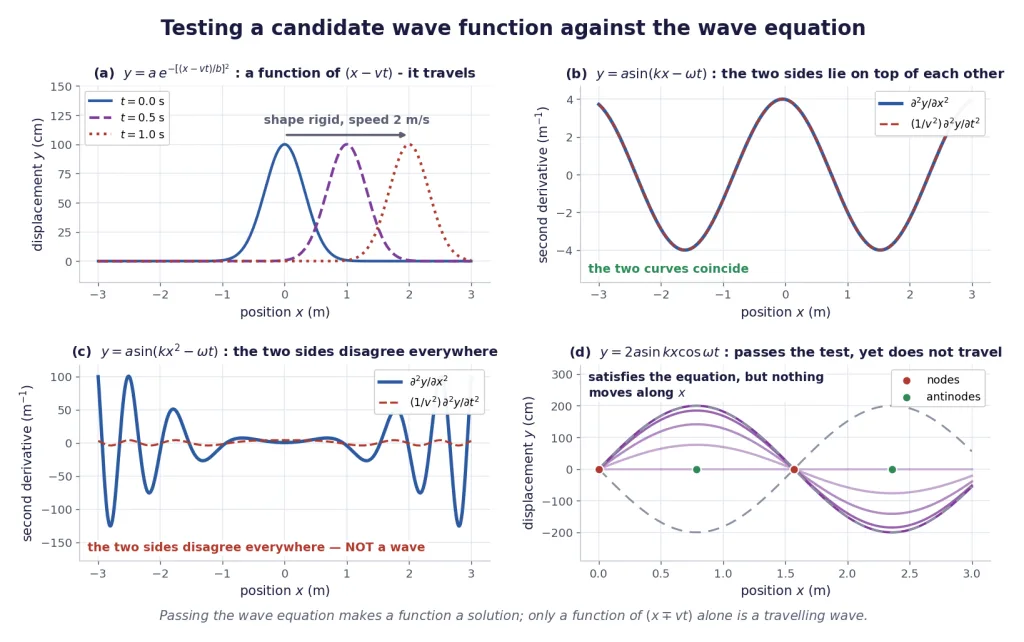
Panel (a) is a Gaussian bump written as a function of ; it keeps its shape exactly and slides at 2 m/s. Panel (b) is the familiar harmonic wave, and the two sides of the equation are plotted separately, and the curves lie exactly on top of each other. Panel (c) is , which looks harmless and is not a wave at all: the two sides disagree by as much as the peaks themselves, at every point. Panel (d) is the standing wave, which passes the equation but has nothing travelling anywhere.
A worked table of candidates
Each of these is a function of in metres and in seconds, giving in metres.
| Function | Verdict | Speed and direction |
|---|---|---|
| travelling wave | m/s towards | |
| travelling wave | m/s towards | |
| travelling wave | 2 m/s towards | |
| not a wave | the bracket cannot be closed | |
| solution, but standing | nothing travels | |
| not a wave | fails the equation everywhere | |
| not a wave | undefined wherever |
The fourth row is the one worth staring at. It is nearly the third row, and students transform it into and stop, feeling they have found a wave. They have not: a product of two brackets is not a function of either one alone, and putting the thing through the wave equation shows the mismatch at once.
Particle velocity from the slope
One consequence of is used constantly and is almost never written down in full. Differentiate with respect to and with respect to and compare:
Key Point — particle velocity and slope. The transverse velocity of a particle is minus the wave speed times the slope of the string at that particle. So on a snapshot graph, a point on a steep downhill (going right) is moving up, and a point at a crest or a trough, where the slope is zero, is momentarily at rest. This one line answers most "which way is this particle moving" questions in a second, and it holds for with the sign reversed.
For a harmonic wave it gives , since the largest slope is and . Take in SI units: the wave speed is 5 m/s while the largest particle speed is m/s, thirteen times smaller. They are not the same number and they are not even the same kind of quantity.
Energy, Power and Intensity
A wave carries energy without carrying matter. This block puts a number on that.
Where the energy sits on a string
Take on a string of density under tension (newtons). A short piece of length has
Its potential energy is the work done stretching it against the tension, which for small slopes comes to
and since and , that is exactly the same expression. So the energy per unit length is
Key Point — the surprise in the energy distribution. On a travelling wave the kinetic and potential energies of any element are equal at every instant, and both are largest where , that is where the displacement is zero. A particle at the crest of a travelling wave has no energy — neither kinetic (it is momentarily at rest) nor potential (the string there is unstretched, the slope being zero).
That is the opposite of a single oscillator, where the extreme position is where all the potential energy is. A travelling wave is not a row of independent oscillators; it is a row of oscillators being stretched by their neighbours.
Averaging over a cycle gives , so the average energy per unit length is . That whole store of energy moves along at the wave speed , so the power crossing any point is the energy per unit length times :
Key Point — power carried by a wave on a string. with in kg/m, in rad/s, in m and in m/s, giving watts. The instantaneous power is , so it oscillates between zero and , never becoming negative — the energy always flows one way.
Using , the same thing reads , which is the form to use when the tension is given and is not.
The scalings are what get tested: , , . Double the frequency at fixed amplitude and the power is four times as large; double the amplitude and halve the frequency and the power is exactly unchanged.
Intensity, and why
For a wave spreading through a three-dimensional medium the useful quantity is the power per unit area crossing a surface held perpendicular to the flow. That is the intensity:
Repeat the string calculation for a column of medium of density and cross-section — the mass per unit length is , so and dividing by :
Key Point — intensity of a mechanical wave. so that, for one medium at one frequency, , and for one medium at one amplitude, . Together: Loudness follows intensity, which is why the beat argument of Section 8 needed the square of the amplitude, and why doubling the amplitude of a note makes it four times as intense.
Spreading: the two laws, and the amplitudes that follow
Energy is conserved as a wave spreads, so if nothing absorbs it, the same power crosses every closed surface drawn round the source. The geometry of that surface decides everything.
| Source | Surface at distance | Intensity | Amplitude |
|---|---|---|---|
| Point source, power | sphere, area | ||
| Line source, power per length | cylinder, area | ||
| Plane wave | constant area | constant | constant |
Because , the amplitude always falls as the square root of the intensity law. Get that step wrong and every number after it is wrong.
Key Point — the ratio form, which is how these are actually asked. For a point source, and for a line source, A point source's amplitude is halved by doubling the distance; a line source's amplitude is halved by quadrupling it. A long straight road or a railway line behaves as a line source, which is exactly why moving twice as far from a motorway helps so much less than you expect.
[Exam Tip] Every one of these results assumes a medium that absorbs nothing and a source that radiates equally in all directions. Real air absorbs, and real sources are directional; a question that mentions absorption wants you to say so, not to apply anyway.
Junctions, Energy Accounting and Partial Standing Waves
Section 5 found what a wave does at the joint between two strings. This block turns those amplitudes into an energy account, and then answers the question the whole set-up raises: what does a string look like when only some of the wave comes back?
The coefficients, and then the energy
Two strings under the same tension (newtons), joined at , with linear densities and and speeds and . Matching the displacement and the slope at the joint gives the amplitude coefficients
Now the energy. The power a wave carries is , and is the same on both sides of the joint because the frequency does not change. So
and since for both strings, the awkward prefactor collapses to :
Key Point — the power coefficients at a junction. The last equality is not an extra assumption; multiply out and . is the check to run on every junction problem, and it is what rescues the alarming case where the transmitted amplitude is bigger than the incident one: a light string needs a bigger amplitude to carry the same power, and the account still balances exactly.
Two limits are worth carrying. As we get , , , : a rigid wall, total inverted reflection, nothing through. As we get , , , and still : a free end, total erect reflection, a doubled amplitude carrying no power at all because there is no medium to carry it in.
Partial standing waves
Send a wave in and get part of it back and the string carries two waves of unequal amplitude running opposite ways. Write them with the incident wave going towards :
Expand both and collect:
Two terms with the same frequency and a quarter-cycle phase difference; their resultant amplitude at a point is the Pythagorean sum:
Key Point — the partial standing wave. The maxima are still apart, the minima are still apart, and a maximum and its neighbouring minimum are still apart. What has changed is that the minima are no longer zero. They are not nodes; nothing on the string is ever at rest. The old standing wave is the special case , where collapses to zero and genuine nodes appear.
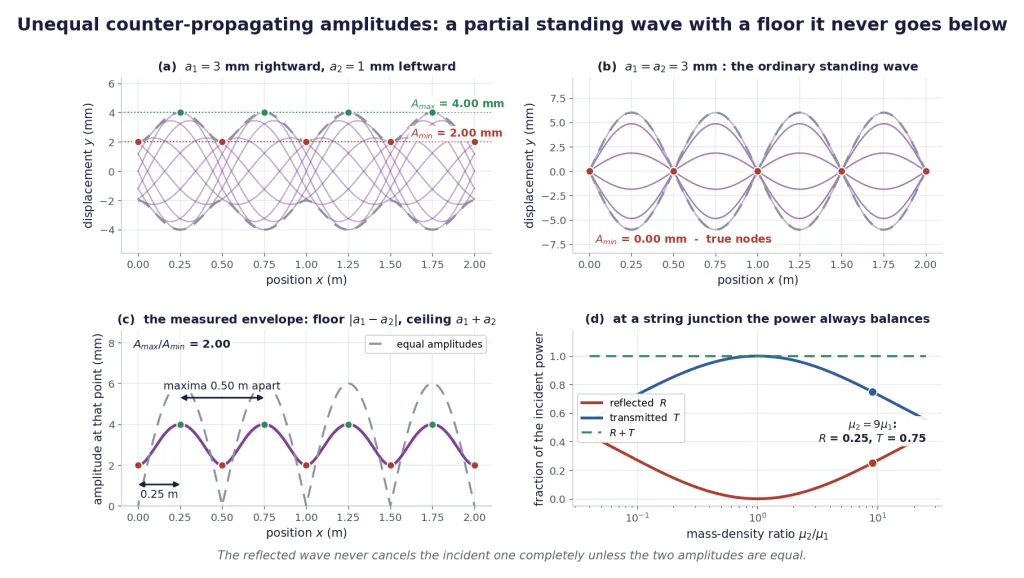
Panel (a) is the real sum of a 3 mm rightward wave and a 1 mm leftward one, drawn at ten instants through a cycle. The envelope never gets above 4 mm and never gets below 2 mm — the two numbers and , measured off the sum rather than quoted. Panel (b) is the same picture with equal amplitudes, where the envelope touches zero. Panel (c) plots the envelope alone with the spacings marked, and panel (d) shows the power always dividing into two fractions that add to one.
Turning two ruler readings into a reflection coefficient
This is what the whole construction is for. Define the standing-wave ratio
and invert it:
Key Point — reading the reflection off the pattern. Measure the largest and smallest amplitudes anywhere along the string and you have the reflection coefficient of the far end without going near it. A perfectly matched end gives and no reflection; a perfect reflector gives .
The power that actually goes on
Where does the energy go in a partial standing wave? The rightward wave carries and the leftward one carries back, so the net power flowing along the string is their difference:
Set and it is exactly zero, which is the energy statement of what a standing wave is: a pure standing wave transports no energy at all. Set and it is the full travelling-wave power. Everything in between is a partial standing wave delivering the fraction of what was sent in — which is , as it must be.
[Exam Tip] If a question gives you the maximum and minimum amplitudes along a string, do not hunt for the individual waves first. Go straight to and , and every other quantity follows in one line.
Clamped Rods, Divided Sonometers and Pipes with a Piston
Three set-ups, one idea: write down which points must be nodes and which must be antinodes, then fit quarter wavelengths between them. Nothing else is needed.
Longitudinal waves in a rod
Strike the end of a metal rod and a longitudinal wave runs along it at
with the Young's modulus in pascals and the density. For steel with Pa and kg/m that is 5000 m/s, about fifteen times the speed of sound in air.
The boundary conditions are the ones you already know, in longitudinal dress:
Key Point — the two rules for a rod.
- A clamped point cannot move, so it is a displacement node.
- A free end has nothing to push against, so it is a displacement antinode.
A node and its neighbouring antinode are apart, and that single fact generates every mode.
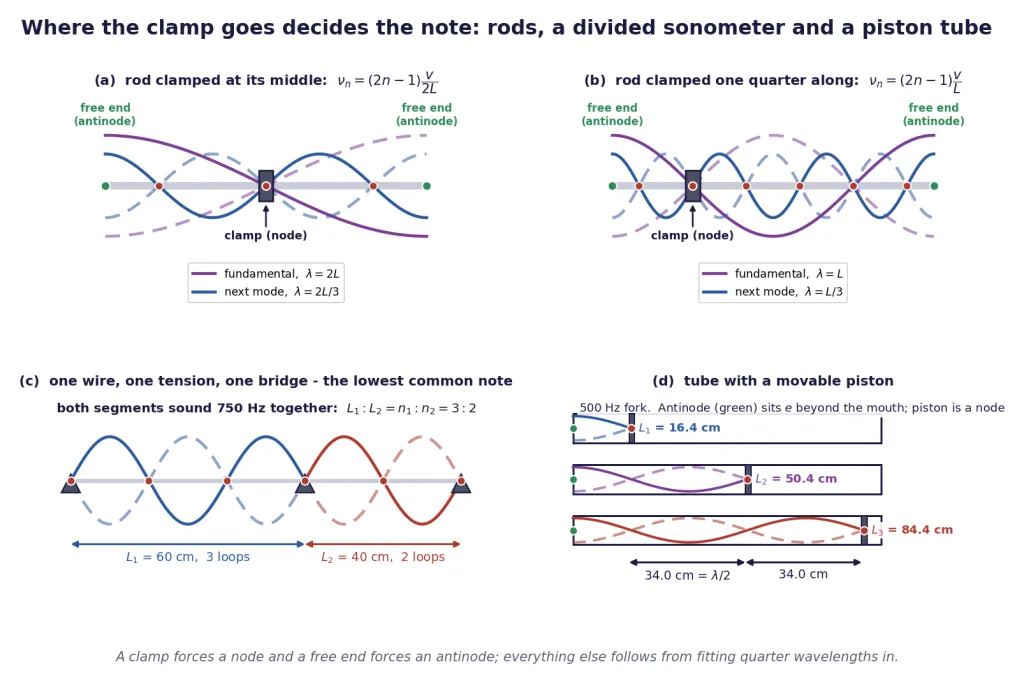
Clamped at the middle. Antinodes at both ends, a node at the centre. Measuring from one end, the displacement pattern is , and requiring a node at gives , so and
The other end then looks after itself. The fundamental fits exactly half a wavelength into the rod, and the series is — odd harmonics only, so the rod clamped at its middle is a closed pipe in disguise, doubled.
Clamped one quarter along. Now the node sits at , which needs , so and
The fundamental now fits a whole wavelength in, so it is twice the mid-clamped fundamental, and the far end at comes out an antinode automatically. The mode has a second node, at , that nobody put there.
| Rod of length , speed | Fundamental | Series |
|---|---|---|
| clamped at the middle | ||
| clamped at one end | ||
| clamped one quarter along | ||
| clamped at both ends | all harmonics |
The general rule behind the table: with the clamp at a distance from one end, both and must be odd multiples of , because each runs from a node to an antinode. That is possible only for particular ratios , which is why examiners stick to the middle, the quarter and the end.
The two-segment sonometer
Put a bridge under a stretched wire and you have two vibrating segments, of lengths and , sharing one tension and one — so one wave speed with in newtons. The bridge is a support, so it is a node for both.
Each segment has its own ladder of frequencies, and . The interesting question is when they can sound together, and it has a tidy answer:
Key Point — the two segments resonate together when The lengths are in the ratio of the harmonic numbers, and the number of loops on each segment is that harmonic number. The lowest common frequency is the lowest common multiple of the two fundamentals.
For a wire with g/m under a tension of 90 N, m/s. A bridge placed 60 cm along a 1.0 m wire gives fundamentals of 250 Hz and 375 Hz, and the lowest frequency both segments accept is 750 Hz — the third harmonic of the longer piece and the second of the shorter, three loops beside two, exactly as demands.
Strings joined end to end work the same way with one extra wrinkle: the two pieces have different and therefore different speeds, but the same tension and the same frequency. If the joint is a node, each piece separately satisfies with its own and , and the whole system rings at the common .
A pipe with a movable piston
A tube open at one end with a sliding piston at the other is a closed pipe of adjustable length. Hold a fork of fixed frequency at the mouth and slide the piston: the sound swells at a series of positions.
The mouth is an antinode — but it sits a little outside the tube, by the end correction , with the internal radius. So resonance at the th position means
Key Point — the two results that come out of a piston tube. Subtract consecutive resonance conditions and the unknown vanishes: and combining the first two gives the end correction itself: Successive resonances are always half a wavelength apart, whatever the end correction is. Using only the first resonance forces , which silently assumes and always comes out a few per cent low.
Panel (d) of the figure shows a 500 Hz fork resonating at 16.4 cm, 50.4 cm and 84.4 cm. The gaps are 34.0 cm each, so m and m/s; and cm, which for means an internal radius of 1.0 cm.
[Exam Tip] A closed pipe of any kind — piston tube, resonance tube, stopped organ pipe, rod clamped at one end — supports only odd harmonics, so its first overtone is its third harmonic. Before writing anything, decide whether the system has a node at one end and an antinode at the other (odd only) or the same kind of point at both ends (all harmonics).
Doppler When Nothing Is in a Straight Line
Section 9 fixed the sign convention and it does not change here:
with the positive direction taken from the source towards the observer, and , the signed velocity components along that line. Everything in this block is that formula with a harder geometry attached.
Only the component along the line of sight counts
The derivation used the closing speed along the line joining the two bodies. Nothing in it required the bodies to be moving along that line. So when a source moves at speed in some other direction:
Key Point — the projection rule. where and are the angles each velocity makes with the instantaneous line joining source to observer, measured on the positive axis running from the source towards the observer. The component perpendicular to that line does nothing at all: it changes neither the wavelength being laid down along the line nor the rate at which crests are met.
Three consequences follow immediately, and all three are asked.
At the closest approach the shift is exactly zero. When the source is at the foot of the perpendicular from the observer, its velocity is at right angles to the line of sight, , and . The pitch does not "drop as it goes past" in one step; it slides continuously from high to low and passes through the true frequency at that one instant.
The angles change as the motion proceeds, so is a function of time, not a constant. Far away on the approach side and you get the full head-on shift; far away on the far side and you get the full receding shift.
The angle is the one at the moment of emission, not of reception. The sound you hear now left the source when it was somewhere else. In an exam this only matters when the question says so; but if you are asked "when the car is at the point of closest approach, what does the listener hear?", the honest answer is: at that instant the listener is still receiving sound emitted earlier, from further back, and so still hears a raised pitch. The unshifted note arrives a little later.
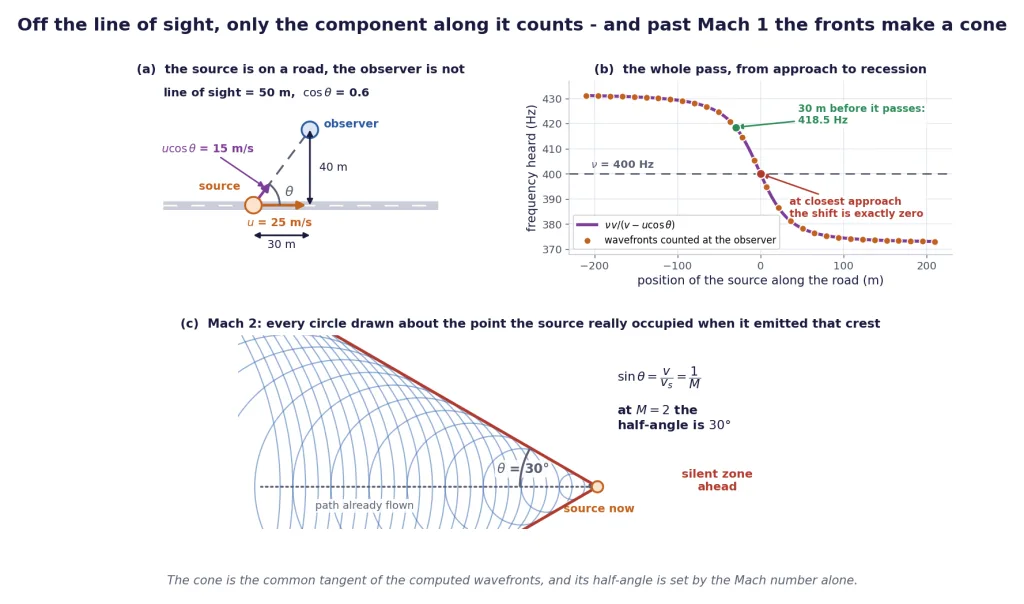
Panel (b) is the whole pass for a 400 Hz horn on a car doing 25 m/s, with a listener 40 m from the road. The smooth curve is the projected formula; the dots come from a completely separate construction that emits crests and times their arrivals. They agree everywhere, and the curve passes cleanly through 400 Hz at the closest approach.
Two bodies, both off the line
Nothing new. Draw the line joining them, project both velocities onto it, sign them on that one axis, substitute. The one thing to watch is that both projections must be taken on the same axis, positive from source to observer. Two cars on perpendicular roads approaching a crossing have and that are generally different numbers, and each is computed from its own geometry.
A reflector that is itself moving
Section 9's rule stands: apply the shift twice, first with the reflector as an observer, then with the reflector as a source re-emitting exactly what it received. Draw a fresh axis for the second step, because the sound is now travelling the other way.
For the common case — a stationary source and observer at the same place, and a reflector approaching them head-on at speed — the two steps collapse:
Key Point — echo off a moving reflector. The factor of 2 in the approximation is the signature of the double shift, and it is what a speed gun measures. Beating the echo against the original note gives beats per second, which is how a small speed becomes a countable number.
A moving medium
A wind carries the whole medium with it. Take the component of the wind velocity along the same positive axis and replace by everywhere:
For an echo this must be done twice, with the sign of reversed on the return leg, because the axis has turned round. A tailwind on the way out is a headwind on the way back, and the two effects very nearly cancel — which is why radar and sonar speed measurements are so insensitive to wind.
The Mach angle
Push past and the wavefront picture of Section 9 takes over from the formula. Here is the number that goes with the picture.
In a time the source travels . A crest emitted at the start of that interval has spread to a radius . The cone that touches all such circles has the source at its apex, and in the right-angled triangle formed by the flight path, the radius of that circle and the tangent line,
Key Point — the Mach cone. where is the half-angle of the cone, measured from the flight path, and is the Mach number. The cancels, so the angle is constant and the cone is genuinely a cone. Faster source, narrower cone: at the half-angle is (a flat front travelling with the source), at it is , and at it is about .
The geometry that follows is the examinable part. An aircraft flying level at height passes directly overhead; the cone trails behind it, so the boom reaches the ground observer only when the aircraft has gone a further horizontal distance
which takes a time after the overhead moment. At and km that is m and s.
There is a check worth running on any such answer. The boom is the first sound the observer hears from the aircraft at all — earlier than the sound emitted at the overhead moment, which would take s to come straight down. That is the whole reason the sky is silent until the crack arrives.
[Exam Tip] Two traps live in this one topic. A supersonic source has no frequency in front of it, because no sound gets there — if a question asks for one, say so. And "the boom happens when the aircraft breaks the sound barrier" is false: the cone trails the aircraft for as long as it stays supersonic, sweeping the ground like the wake of a boat.
Beats Between a Fundamental and an Overtone, and the Five Traps
Beats when the two notes come from different ladders
Section 8 settled the physics of beats: two nearby frequencies at one place give a loudness that rises and falls times a second. What is added here is that the two frequencies are rarely handed to you. One of them is a particular rung on one system's ladder and the other is a rung on a different system's, and naming the two rungs correctly is most of the problem.
The mapping is the one from Sections 6 and 7, and it is worth having in front of you every time:
| System | Harmonics present | 1st overtone | 2nd overtone | th overtone |
|---|---|---|---|---|
| string fixed at both ends | all, | 2nd harmonic | 3rd harmonic | th harmonic |
| pipe open at both ends | all, | 2nd harmonic | 3rd harmonic | th harmonic |
| pipe closed at one end | odd only, | 3rd harmonic | 5th harmonic | th harmonic |
| rod clamped at its middle | odd only | 3rd harmonic | 5th harmonic | th harmonic |
Key Point — the routine that never fails. Write down, in words, exactly which frequency each source is producing. Convert every overtone name into a mode number first. Then compute both frequencies in hertz, and only then subtract. The beat frequency is the difference of the two numbers that are actually sounding, and nothing else.
A worked naming. A pipe closed at one end, 25.0 cm long, in air at 340 m/s, has Hz. Its first overtone is its third harmonic, 1020 Hz — not 680 Hz, which is not a mode of this pipe at all. A sonometer wire 50.0 cm long in its second overtone is in its third harmonic, with in newtons. Set those two against each other and you have a beat problem whose entire difficulty was in the previous two sentences.
The loading ambiguity, in its harder form
Six beats per second between a pipe at 1020 Hz and a wire tells you the wire is at 1014 Hz or 1026 Hz, and both give a legitimate tension. To decide, change something on purpose and listen:
| Change made | If the wire was flat (1014 Hz) | If the wire was sharp (1026 Hz) |
|---|---|---|
| tension raised slightly | wire rises towards 1020, beats slow | wire rises away from 1020, beats quicken |
| vibrating length shortened | frequency rises, beats slow | beats quicken |
| wire loaded with a heavier wire of the same length | frequency falls, beats quicken | beats slow |
The reasoning is always the same: work out which way your change pushes the wire's frequency, then ask whether that moves it towards the fixed frequency or away from it.
The five traps, and how each one is spotted
1. Using the period where the tension belongs. In and the letter is a tension in newtons. In it is a period in seconds. A problem that gives you both — "a wire under 90 N carries a wave of period 4.0 ms" — is testing exactly this. Spot it by checking units: a tension divided by kg/m gives m/s, and a period does not. Write the unit beside every you substitute and the trap cannot close.
2. Forgetting that a closed pipe has no even harmonics. The examiner's favourite wrong option is the fundamental doubled. In a closed pipe the first overtone is the fundamental tripled. The quick test: divide the frequency by the fundamental. An odd whole number means the mode exists; an even one means it does not exist at all. Rods clamped at the middle and at one end obey the same rule, and so does a piston tube.
3. Halving the beat frequency. The equation has sitting in it, and that number is not the answer. It is the frequency of the envelope. The ear hears loudness, loudness goes as the square of the amplitude, and squaring turns into a maximum as surely as — so there are two loudness peaks per envelope cycle and .
4. Taking the wave speed for the particle speed. is how fast the pattern moves; is how fast a bit of the medium moves. They differ by a factor of , which for any real wave is a small number. A question asking for "the maximum speed of a particle of the string" wants ; one asking "how long does the disturbance take to reach the far end" wants . And connects them whenever a snapshot graph is involved.
5. Reversing the Doppler signs. Draw the axis from the source towards the observer and mark it on the page before substituting. Then an observer moving towards the source has , because approaching the source means travelling in the negative direction on that axis. Say out loud, before computing, whether the answer must be higher or lower than , and check the number against that. Mixing the single-axis form with the "each speed positive when it points at the other body" form is what makes an approaching observer come out lower.
Key Point — the last line of every answer. Write the unit and name the quantity. is in Hz, in rad/s, in rad/m, and both in m/s but meaning different things, in newtons when it is a tension and seconds when it is a period, in watts, in W/m, and , , , , and are pure numbers. If the unit does not match what was asked for, the algebra was beside the point.
Solved Examples, Part 1: Wave Functions, Energy and Junctions
Conventions used throughout: SI units unless a question says otherwise. The speed of sound in air is 340 m/s. In the symbol is a tension in newtons; where a time period is meant it is named as one. A wave written with travels towards and one written with travels towards . Every Doppler solution names its positive direction — from the source towards the observer — before substituting, and predicts in words whether the answer should rise or fall.
Example 1: Four functions, one test
Each of the following gives in metres for in metres and in seconds. Decide which can represent a travelling wave, and for those that can, find the speed and the direction of travel.
(a) (b) (c) (d)
Solution:
Step 1 — the test to apply. A travelling wave must be a function of or alone, must satisfy , and must be finite and defined for every and .
Step 2 — (a). Factor the bracket: . That is a function of , so it is a travelling wave with
The minus sign puts it travelling towards . Checking the equation: and , and indeed .
Step 3 — (b). Here , a function of . So it is a travelling wave of speed m/s, and the plus sign puts it travelling towards . It is a Gaussian pulse, not a harmonic wave, and that is fine: the wave equation never asked for a sinusoid.
Step 4 — (c). Try to close the bracket. is not , which would be — the cross term is missing and cannot be conjured up. To be sure, differentiate. With ,
For these to be in a fixed ratio for all and we would need and in that same ratio everywhere, which happens only on the two lines . Not a wave.
Step 5 — (d). This one satisfies the wave equation. and , exactly as in (a), so it is a solution with m/s in the formula. But it is not a function of alone — it is a product of a function of and a function of — so nothing travels. It is a standing wave, the sum of a 5 m/s wave going each way, and the points never move.
Final Answer: (a) travelling, 5 m/s towards . (b) travelling, 4 m/s towards . (c) not a wave at all. (d) a valid solution but a standing wave, with no travel.
Takeaway: Satisfying the wave equation and being a travelling wave are two different tests, and (d) is the reason both are needed. Close the bracket first; if it will not close, differentiate and watch the two sides refuse to agree.
Example 2: The power in a string, and what changes it
A string of linear mass density 10 g/m is stretched to a tension of 100 N, and a harmonic wave of amplitude 4.0 mm and frequency 100 Hz travels along it.
(a) Find the wave speed, the wavelength and the angular wave number. (b) Find the average power the wave carries, and the largest instantaneous power. (c) Find the maximum particle speed, and compare it with the wave speed. (d) The amplitude is now doubled and the frequency halved. What happens to the power?
Solution:
Step 1 — (a) the speed, from the tension in newtons.
Check the identity: m/s, agreeing with .
Step 2 — (b) the power.
The instantaneous power carries a factor , so it runs between zero and twice the average:
Step 3 — (c) particle speed against wave speed.
against a wave speed of 100 m/s. The wave outruns the fastest bit of string by a factor of forty. They are different quantities and the ratio is , as it must be.
Step 4 — (d) the scaling. , so
The power is unchanged, at 3.16 W. The two changes cancel exactly.
Final Answer: (a) 100 m/s, 1.00 m, 6.28 rad/m. (b) 3.16 W average, 6.32 W peak. (c) 2.51 m/s against 100 m/s. (d) unchanged.
Takeaway: is the whole of part (d), and it is the same proportionality as . Notice also that gravity, the string's length and the shape of the source never entered: only , the tension, and .
Example 3: A point source and a line source
(a) A small loudspeaker radiates 40 W of sound uniformly in all directions in a medium that absorbs nothing. Find the intensity at 10 m and at 20 m, and the ratio of the amplitudes at those two distances. (b) At 5.0 m from the same speaker the displacement amplitude is 6.0 micrometres. What is it at 10 m? (c) A long straight motorway behaves as a line source. The intensity 4.0 m from it is W/m. Find the intensity and the relative amplitude at 16 m.
Solution:
Step 1 — (a) a point source spreads over a sphere.
The ratio is exactly 4, as demands for a doubling of distance.
Step 2 — amplitudes follow the square root. Since ,
Step 3 — (b) apply directly. Doubling the distance from 5.0 m to 10 m halves the amplitude:
Step 4 — (c) a line source spreads over a cylinder, whose area grows as , not :
The intensity has dropped by a factor of 4 over a factor of 4 in distance, where a point source would have dropped by 16. The amplitude ratio is , so the amplitude has merely halved over a fourfold increase in distance.
Final Answer: (a) W/m and W/m, amplitudes in the ratio 2 to 1. (b) 3.0 micrometres. (c) W/m, amplitude halved.
Takeaway: Decide the shape of the spreading surface first, and the exponent follows: sphere gives , cylinder gives , plane gives no fall at all. Then take the square root for the amplitude, every time.
Example 4: A junction, and the energy account across it
Two long strings, one with g/m and the other with g/m, are knotted together and stretched to a common tension of 100 N. A wave of frequency 50 Hz and amplitude 4.0 mm travels along the light string towards the joint and carries 2.0 W.
(a) Find the two wave speeds and the two wavelengths. (b) Find the reflected and transmitted amplitudes, and say which pulse is inverted. (c) Find the fractions of the power reflected and transmitted, and check they add to one. (d) Find the reflected and transmitted powers in watts.
Solution:
Step 1 — (a) speeds from the same tension.
The frequency is carried across the joint unchanged, so the wavelengths differ in the same ratio as the speeds:
Step 2 — (b) the amplitude coefficients.
The negative means the reflected pulse is inverted — the second string is heavier and slower, so it behaves like a partial wall. The transmitted pulse is never inverted.
Step 3 — (c) the power fractions.
Step 4 — a direct check on , without the formula. Compare on the two sides, with common:
The heavier string carries three quarters of the power on half the amplitude, because is three times .
Step 5 — (d) the watts.
Final Answer: (a) 100 m/s and 33.3 m/s; 2.00 m and 0.667 m. (b) both 2.0 mm, with the reflected pulse inverted. (c) , , summing to 1. (d) 0.50 W back and 1.50 W on.
Takeaway: Amplitudes divide by and ; powers divide by and , and those two must add to exactly one. If they do not, the arithmetic is wrong — there is nowhere else for the energy to go.
Solved Examples, Part 2: Partial Standing Waves, Rods and Pipes
Example 5: A minimum that is not a node
A string of linear mass density 20 g/m carries two waves,
with in metres and in seconds.
(a) Find the wavelength, frequency and wave speed. (b) Find the largest and smallest amplitudes anywhere on the string, and the distance between successive minima. (c) Find the standing-wave ratio, the reflection coefficient of whatever produced , and the fraction of the incident power reflected. (d) Find the net power flowing along the string.
Solution:
Step 1 — (a) read the constants off. From : rad/m and rad/s, so
Check: m/s, agreeing.
Step 2 — (b) the envelope. The two waves run opposite ways with unequal amplitudes, so
The minima are not nodes: every point of the string is moving all the time, the quietest points merely swinging through 2.0 mm. Successive minima are m apart, and the nearest maximum to any minimum is m away.
Step 3 — (c) invert the ratio.
So 36% of the incident power came back and 64% went on. That agrees with the amplitudes directly: .
Step 4 — (d) the net power is the difference of the two flows.
That is 50.5 mW travelling towards , being 64% of the 78.9 mW the incident wave brought in.
Final Answer: (a) 1.00 m, 20.0 Hz, 20.0 m/s. (b) 8.0 mm and 2.0 mm, minima 0.500 m apart. (c) , , 36% of the power reflected. (d) 50.5 mW.
Takeaway: Two ruler readings taken anywhere along the string — the largest swing and the smallest — give the reflection coefficient of a boundary you never have to touch. And a non-zero minimum is the signature of partial reflection; a genuine zero means the reflection was total.
Example 6: The same rod, clamped in two different places
A steel rod 1.0 m long has Pa and kg/m. It is set into longitudinal vibration.
(a) Find the speed of longitudinal waves in it. (b) It is clamped at its midpoint. Find the fundamental frequency and the frequency of the first overtone, and say where the nodes are in each. (c) It is now clamped at a point 25 cm from one end. Find the new fundamental. (d) Could this rod, clamped at its midpoint, be made to sound 5000 Hz?
Solution:
Step 1 — (a) the longitudinal speed.
Step 2 — (b) fit the boundary conditions. The clamp is a displacement node; both free ends are displacement antinodes. A node with an antinode on each side, symmetric about the centre, needs the rod to hold half a wavelength in its lowest mode:
The only node is at the centre, 50 cm from either end.
The general condition is , so and the series runs 2500, 7500, 12500 Hz — odd multiples only. The first overtone is therefore the third harmonic:
with m, and nodes at , and — that is at 16.7 cm, 50 cm and 83.3 cm. The clamp is still one of them, as it has to be.
Step 3 — (c) move the clamp to the quarter point. Now a node sits at with antinodes at and . From the free end to the node is , which must be an odd number of quarter wavelengths; the lowest choice is , giving m. Check the far end: from the node at to the end at is , three quarter wavelengths, which lands on an antinode. Both conditions hold, so
exactly twice the mid-clamped fundamental, with a second node appearing at 75 cm.
Step 4 — (d) test 5000 Hz against the mid-clamped ladder.
an even number, so it is not a mode of the mid-clamped rod at all. Clamped at the midpoint, the rod simply will not sound 5000 Hz. Clamped at the quarter point it sounds it as its fundamental — the same rod, the same material, a different clamp.
Final Answer: (a) 5000 m/s. (b) 2500 Hz, first overtone 7500 Hz; nodes at the centre, and at 16.7, 50 and 83.3 cm respectively. (c) 5000 Hz. (d) No — 5000 Hz is the second harmonic, and a mid-clamped rod has no even harmonics.
Takeaway: A clamped rod is a closed-pipe problem in a different material. Mark the node and the antinodes on a sketch, count quarter wavelengths between them, and every mode falls out. The clamp does not merely shift the frequencies — it decides which frequencies exist.
Example 7: One wire, one tension, two segments
A sonometer wire of length 1.00 m has g/m and is stretched by a tension of 90 N. A bridge is placed 60 cm from one end, dividing the wire into segments of 60 cm and 40 cm.
(a) Find the wave speed and the fundamental frequency of each segment. (b) Find the lowest frequency at which both segments resonate together, and the number of loops on each. (c) Where must a second bridge be placed so that the wire is divided into three segments whose fundamentals are in the ratio 1 : 2 : 3?
Solution:
Step 1 — (a) one speed for the whole wire, because the tension in newtons and are the same everywhere:
Step 2 — (b) find the lowest common frequency. Segment A can sound 250, 500, 750, 1000, … Hz; segment B can sound 375, 750, 1125, … Hz. The lowest frequency on both lists is
which is the third harmonic of A () and the second of B (). So A carries 3 loops and B carries 2.
Step 3 — check against the length rule.
The lengths are in the ratio of the harmonic numbers, exactly as the common-frequency condition requires.
Step 4 — (c) three segments with fundamentals 1 : 2 : 3. Since a fundamental goes as , the lengths must go as , that is as . With a total of 1.00 m and parts:
so the bridges go at 54.5 cm and at cm from the same end. Their fundamentals are
which is 1 : 2 : 3.
Final Answer: (a) 300 m/s; 250 Hz and 375 Hz. (b) 750 Hz, with 3 loops on the 60 cm segment and 2 on the 40 cm one. (c) Bridges at 54.5 cm and 81.8 cm, giving 275, 550 and 825 Hz.
Takeaway: With one tension and one wire there is one speed, so every segment's frequency is decided by its length alone. "Resonate together" always means , and "fundamentals in a given ratio" always means lengths in the inverse ratio.
Example 8: The piston tube, with the end correction taken seriously
A tuning fork of 500 Hz is held at the open mouth of a tube whose other end is closed by a movable piston. As the piston is drawn out, the sound is loud when the air column is 16.4 cm, 50.4 cm and 84.4 cm long.
(a) Find the wavelength and the speed of sound in the tube. (b) Find the end correction, and hence the internal radius of the tube. (c) What value would you have got for the speed by using the first resonance alone, and by how much would it be wrong? (d) Predict the next resonance position.
Solution:
Step 1 — (a) successive resonances differ by half a wavelength. Whatever the end correction is, it cancels in the difference:
The next gap confirms it: cm as well.
Step 2 — (b) extract the end correction. The two lowest resonances mean
Multiply the first by 3 and subtract the second:
Check it: cm, and cm. Then from ,
so the tube is 2.0 cm across inside.
Step 3 — (c) the careless answer. Using only the first resonance forces , that is :
It is always too low, because ignoring makes the quarter wavelength look shorter than it is. This is exactly why the experiment insists on a second resonance.
Step 4 — (d) the next one. Resonances are apart:
and it corresponds to cm , the seventh harmonic — the fourth mode of a closed pipe, since only odd harmonics exist.
Final Answer: (a) 0.680 m and 340 m/s. (b) cm, internal radius 1.0 cm. (c) 328 m/s, low by 3.5%. (d) 118.4 cm.
Takeaway: The difference of two resonance lengths is the only measurement in this experiment that does not need . Take it first, get , and only then go back for as a bonus. And note the harmonic numbers: 1st, 3rd, 5th, 7th — a piston tube is a closed pipe and skips every even one.
Solved Examples, Part 3: Beats with Overtones, and Doppler off the Line
Example 9: A pipe's overtone against a wire's overtone
A pipe closed at one end is 25.0 cm long, in air at 340 m/s. A sonometer wire 50.0 cm long has g/m. When the pipe sounds its first overtone and the wire its second overtone, 6 beats per second are heard.
(a) Find the frequency of the pipe's first overtone. (b) Find the two possible tensions in the wire, in newtons. (c) The tension is raised slightly and the beats are found to quicken. Which tension was it?
Solution:
Step 1 — (a) name the pipe's mode before computing anything.
A closed pipe has only odd harmonics, so its modes are 340, 1020, 1700, … Hz. The first overtone is the third harmonic:
Not 680 Hz. There is no 680 Hz mode in this pipe.
Step 2 — name the wire's mode. A wire fixed at both ends has all harmonics, so its second overtone is its third harmonic:
with the tension in newtons.
Step 3 — (b) 6 beats per second means a gap of 6 Hz either way. The wire is at 1014 Hz or at 1026 Hz. Rearranging,
For 1014 Hz: , so N.
For 1026 Hz: , so N.
Step 4 — (c) resolve the ambiguity. Raising the tension raises the wire's frequency, since .
- If the wire were at 1014 Hz, raising it moves it towards 1020 Hz and the beats would slow.
- If the wire were at 1026 Hz, raising it moves it away from 1020 Hz and the beats would quicken.
The beats quickened, so the wire was the sharp one and the tension was 117.0 N.
Final Answer: (a) 1020 Hz. (b) 114.2 N or 117.0 N. (c) 117.0 N.
Takeaway: Two overtone names, two different rules — the pipe's first overtone is its third harmonic, the wire's second overtone is its third harmonic, and the two "thirds" mean different multiples of different fundamentals. Convert every name to a mode number in writing before touching the algebra.
Example 10: A horn on a road, and a listener who is not on it
A car sounds a 400 Hz horn while driving at a steady 25 m/s along a straight road. A listener stands 40 m from the road.
(a) What frequency reaches the listener from the moment when the car is 30 m short of the nearest point? (b) What frequency comes from the moment of closest approach? (c) What frequency comes from the moment when the car is 30 m past that point? (d) What are the extreme frequencies heard, far before and far after?
Solution:
Step 1 — the positive direction, and the prediction. Take the positive direction from the source (the car) towards the observer, along the instantaneous line of sight. The listener is at rest throughout, so . Only the component of the car's velocity along that line counts:
While the car is still approaching, that component points towards the listener, so and the pitch must come out above 400 Hz. After the car has passed, the component points away, so the pitch must come out below 400 Hz.
Step 2 — (a) the geometry, 30 m short. The line of sight is the hypotenuse of a triangle with legs 30 m and 40 m, so it is 50 m long and
Higher, as predicted.
Step 3 — (b) at closest approach. The car is at the foot of the perpendicular, so its velocity is at right angles to the line of sight:
Exactly the emitted frequency. The car is moving as fast as ever, and at right angles to you its motion does nothing to the pitch.
Step 4 — (c) 30 m past. Same triangle, but the component now points away, so m/s:
Lower, as predicted.
Step 5 — (d) the extremes. Very far away on either side the line of sight is almost along the road, so and the full head-on shifts apply:
Final Answer: (a) 418.5 Hz. (b) 400 Hz. (c) 383.1 Hz. (d) Between 431.7 Hz and 372.6 Hz.
Takeaway: Resolve the velocity along the line joining the two bodies and use the ordinary formula on that component. The perpendicular part is invisible to the Doppler effect, which is why the pitch slides smoothly through the true frequency instead of stepping down.
Example 11: An echo off a moving car, and then a wind
A stationary siren sounds 500 Hz. A car drives straight at it at 2.0 m/s, and the sound reflected from the car comes back to the siren, where it is heard alongside the direct note.
(a) Find the frequency the car receives. (b) Find the frequency of the echo returning to the siren. (c) Find the number of beats heard per second, and compare with the approximation . (d) Repeat (b) and (c) with a 10 m/s wind blowing from the siren towards the car.
Solution:
Step 1 — (a) the car as an observer. Axis: positive from the source (siren) towards the observer (car). The siren is at rest, so ; the car is moving towards the siren, that is in the negative direction on this axis, so m/s. The gap is closing, so the car must receive more than 500 Hz.
Step 2 — (b) the car as a source. It re-emits 502.94 Hz. Draw a fresh axis, now positive from the car towards the siren. The car is moving towards the siren, so along this new axis m/s, and the siren is at rest, . Closing again, so the frequency must rise again.
The closed form checks it in one line:
Step 3 — (c) the beats. Two nearby frequencies at the same place:
so a little under six loudness maxima a second — comfortably countable, which is the point of the method. The standard approximation gives
within 1% of the exact value, and the factor of 2 in it is the fingerprint of the shift having been applied twice.
Step 4 — (d) with a wind. A wind changes the effective speed of sound along whichever axis you are using, by its component along that axis.
Outward leg, axis from siren to car: the wind blows that way, so and the effective speed is 350 m/s.
Return leg, axis from car to siren: the same wind now points backwards along this axis, so and the effective speed is 330 m/s.
Essentially unchanged — 5.923 Hz against 5.917 Hz. The wind helps one leg and hinders the other by almost exactly the same fraction.
Final Answer: (a) 502.94 Hz. (b) 505.92 Hz. (c) 5.92 beats per second, against 5.88 from the approximation. (d) 505.92 Hz and 5.92 beats per second — the wind makes almost no difference.
Takeaway: A reflector is an observer and then a source, and each role gets its own axis. When there is a wind, the sign of its component flips between the two legs, which is why speed guns are so untroubled by weather.
Example 12: The boom that arrives after the aircraft
An aircraft flies level at a steady Mach 2 at a height of 3.0 km. Take the speed of sound as 340 m/s.
(a) Find its speed and the half-angle of its Mach cone. (b) An observer on the ground is directly beneath the aircraft at one instant. How far past that point has the aircraft flown when the observer hears the boom, and how long after the fly-past is that? (c) How far is the aircraft from the observer at the moment the boom is heard? (d) Show that the boom arrives before the sound the aircraft emitted while directly overhead.
Solution:
Step 1 — (a) the Mach number does both jobs.
Step 2 — (b) where the cone meets the ground. The cone trails back from the aircraft at to the flight path. It reaches the observer when the aircraft has gone a horizontal distance such that the observer lies on the cone:
That is about 5.2 km beyond the overhead point, and it takes
Step 3 — (c) the distance to the aircraft then.
exactly twice the height — which is , as the geometry demands.
Step 4 — (d) compare with the straight-down sound. The crest emitted at the overhead instant travels straight down at 340 m/s and takes
That is later than the 7.64 s at which the boom arrives. So the first sound the observer receives from this aircraft is the boom itself, generated well before the fly-past and delivered by the cone. Everything the aircraft emitted earlier is folded into that single front, which is exactly why it is heard as one crack rather than a rising note.
Final Answer: (a) 680 m/s, half-angle . (b) 5196 m beyond, 7.64 s later. (c) 6000 m. (d) 7.64 s against 8.82 s, so the boom is first.
Takeaway: gives the cone; after that it is a right-angled triangle. And the counter-intuitive part is worth remembering as a sentence: silence, then the aircraft overhead, then the bang — because the aircraft is outrunning everything it has ever emitted.