
What Happens When the Medium Runs Out
Every wave so far has had room to keep going. The string was long, the air was open, and the wave sailed off towards without ever meeting anything. Real media are not like that. A guitar string is 65 cm long and then it stops. The air in an organ pipe is trapped between two ends. A shout in a valley meets a cliff.
So the question this section answers is simple to ask: what does a wave do when it reaches the edge of the medium it is travelling in?
The answer is that it comes back. The wave is reflected. And the whole of the rest of the chapter — standing waves, the notes a guitar plays, the notes a flute plays, the pitch of a bottle you blow across — depends on one detail of how it comes back: whether it flips over on the way.
Two kinds of end
There are two idealised boundaries, and every real one sits somewhere between them.
Key Point:
- A rigid (or fixed) boundary is one that cannot move: a string knotted to a wall, an air column shut off by a solid plug.
- A free boundary is one that offers no transverse resistance at all: a string ending in a light ring that slides on a smooth rod, an air column opening into the wide atmosphere.
The rigid end: the wall pushes back
Take a long string with its far end tied tightly to a heavy clamp, and send a single upward pulse — a crest — down it. Watch what the clamp has to do.
Step 1 — the string pulls on the clamp. When the leading edge of the crest arrives, the last bit of string is tilted. The tension in it is directed along the string, so it has a component at right angles to the string's rest line — and for an arriving crest, that transverse component pulls the clamp upwards.
Step 2 — Newton's third law answers. The clamp is a body like any other. If the string pulls up on the clamp with a force , the clamp pulls down on the string with a force of the same size . That is not a special rule for waves; it is the third law, applied at the point where the two touch.
Step 3 — the clamp wins. The clamp is immovable, so it does not budge and it does not absorb the pulse by moving out of the way. What it does instead is push down on the end of the string, hard, for exactly as long as the crest is arriving. That downward push on the string is a disturbance in its own right — and being downward, it is a trough. It travels away from the clamp, back along the string.
So the crest goes in and a trough comes out.
Key Point — reflection at a rigid boundary:
The reflected pulse is inverted: a crest returns as a trough, and a trough as a crest. In terms of a harmonic wave, the reflected wave suffers a phase change of (that is, 180°).
The boundary point itself has zero displacement at every instant — it is a node.
The node is not an extra fact bolted on. It is the same fact stated the other way round. The clamp holds the end still, so the incident wave and the reflected wave must always cancel exactly there. The only way an arriving crest can be cancelled is by a departing trough. Inversion is what "the end cannot move" looks like from the string's point of view.
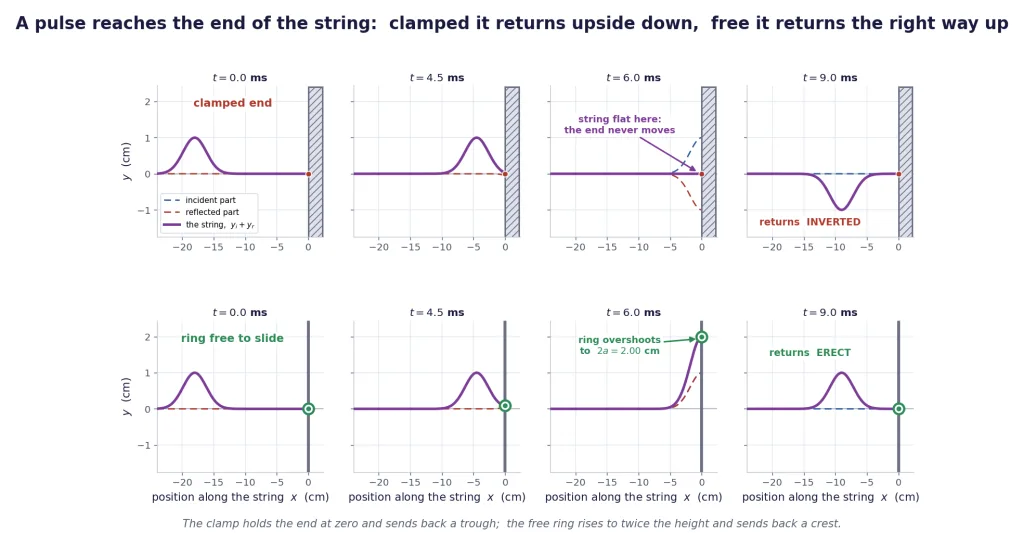
Follow the top row of the figure. The purple curve is the actual string; the two dashed curves are the incident and reflected parts that add up to it. At ms the crest is fully at the wall and the two parts cancel completely, so the string is momentarily flat. A moment later the trough emerges, and by ms it is running back down the string with exactly the height and shape the crest had.
Where the energy is at the flat instant
That flat frame looks alarming until you remember the same argument from the previous section. The displacement is zero everywhere near the wall; the transverse velocity is not. Every element there is moving, and a moment later the whole pulse reappears. Nothing was lost.
Nothing is lost to the clamp either, and there is a neat reason. Work is force times displacement in the direction of the force. The clamp exerts a large force on the string, but the point where it acts never moves, so the clamp does no work on the string. An ideal rigid support cannot absorb energy from a wave. The reflected pulse carries the whole of the incident energy.
[Board Important] A one-mark version of this appears constantly: "A wave is reflected from a rigid boundary. What is the phase change?" The answer is radians, or 180° — and if the question asks for the path-difference equivalent, that is .
Notation for this section
Two symbols in this section do double duty elsewhere, so fix them now.
| Symbol | Meaning here | Unit |
|---|---|---|
| angular wave number, | rad/m | |
| tension in the string, in | N | |
| linear mass density | kg/m | |
| amplitude of the incident wave | m |
is never a spring constant in this chapter, and where a time period is needed it is written out as such. The wave speed is the speed at which the disturbance travels; the speed of a particle of the medium is a different quantity altogether.
The Free End: Nothing Pushes Back
Now change one thing. Instead of knotting the string to a wall, thread its end through a light ring that can slide up and down a smooth vertical rod. The string is still held taut along its length, but the end is now free to move sideways as much as it likes.
Send the same crest down.
Step 1 — what force can act on the end? The transverse direction — the direction in which the wave displaces the string — runs along the rod. A smooth rod can push the ring only at right angles to itself; along its own length it could act only through friction, and there is none. The ring is also light enough for its weight and inertia to be ignored. So nothing at all can supply a transverse force to the end of the string.
Step 2 — so the string's own transverse force there must vanish. A massless ring with a finite acceleration needs zero net force. The transverse pull of the string on the ring is times the string's slope at that point, so the slope at a free end has to be zero: the string always meets a free end horizontally.
Step 3 — the end overshoots. As the crest arrives, the element just behind the ring is higher than the ring, so it drags the ring upwards. In the clamped case that motion was forbidden. Here nothing forbids it, so the ring keeps rising even after the middle of the pulse has arrived, and it climbs to a height of — twice the amplitude of the incident pulse.
Step 4 — and then the string pulls it back. Stretched taut and bent upwards, the string now pulls the ring back down. In doing so it launches a disturbance back along the string — and it is an upward one, because it came from a raised ring falling. A crest goes in and a crest comes out.
Key Point — reflection at a free boundary:
The reflected pulse is erect: a crest returns as a crest. There is no phase change — the phase change is .
The boundary point moves with the largest amplitude anywhere, — it is an antinode.
Look at the bottom row of the figure in the previous block: at ms the ring is at exactly cm when each pulse alone is cm high, and by ms an upright pulse is on its way back.
The two ends, side by side
| Rigid (fixed) end | Free end | |
|---|---|---|
| Physical picture | string knotted to a wall | light ring on a smooth rod |
| What is fixed there | the displacement is zero | the slope is zero |
| Reflected pulse | inverted | erect |
| Phase change | (180°) | |
| Equivalent path difference | ||
| The boundary point is a | node | antinode |
| Displacement of the boundary | always | swings between and |
| Energy absorbed by the boundary | none (it does not move) | none (no force acts on it) |
Notice the pleasing symmetry in the middle rows. At a rigid end the displacement is pinned; at a free end the slope is pinned. One condition each, and each one fixes the reflection completely.
The same two ends for sound
Sound in a pipe is a longitudinal wave, so "displacement" means the back-and-forth motion of the air layers along the pipe rather than a sideways wiggle. The two boundary rules carry over without change.
Key Point — the boundary rules for a pipe:
- A closed end is a rigid boundary. The air there cannot move through the solid stopper, so a closed end is a displacement node, and sound reflects from it with a phase change of .
- An open end is a free boundary. The air there can swing in and out freely, so an open end is a displacement antinode, and sound reflects from it with no phase change.
Those two lines are all Section 7 needs to build every organ-pipe result, so learn them in that form.
Why an open end reflects at all
The closed end is easy to accept — there is a solid wall. The open end takes some getting used to, because there is nothing there. Yet the sound in a flute or an organ pipe genuinely does bounce back at the open end; if it did not, no pipe would ever sound a note.
Reflection does not need an obstacle. It needs an abrupt change in what the wave is travelling through. Inside the pipe the air is confined, so a push at one place has nowhere to go but along the tube. At the mouth, that same push suddenly finds the whole open atmosphere to spread into. The conditions the wave has been obeying change over a distance far shorter than a wavelength, and a wave meeting that kind of sudden change always sends part of itself back. An open doorway or an open window is the same kind of boundary: an opening reflects sound, with no inversion, exactly as a wall reflects it with inversion.
[NEET Important] Two statements that are asked in almost these words: a closed end of a pipe is a displacement node and a pressure antinode; an open end is a displacement antinode and a pressure node. The displacement half is what this section establishes. The pressure half is its exact complement — where the air barely moves, it is squeezed hardest — and it is developed with the air columns themselves.
[JEE Tip] When a question says "free end" or "open end", the useful thing to write down first is not the phase change but the boundary condition: displacement zero at a rigid end, slope zero at a free end. Everything else follows from it, and you cannot misremember a condition you have derived.
The Same Two Rules, Written as Equations
Pictures of pulses are convincing but they will not get you through a numerical. Here are the two results as equations, derived rather than announced.
Setting the stage
Let the string lie along the -axis, occupying , with the boundary at . A harmonic wave travels along it towards the boundary, that is towards :
Recall the direction rule: a minus sign between and means travel towards ; a plus sign means travel towards . The reflected wave has to run back towards , so whatever else is true of it, it must be of the form
for some fixed phase . The amplitude is still because an ideal boundary absorbs nothing. The only thing left to find is , and the boundary condition finds it.
Case 1: the clamped end
The clamp holds still, so the total displacement there must vanish at every instant:
which is satisfied for every only if . So
Key Point — reflection from a rigid (clamped) end at : The reflection carries a phase change of , and at at every instant: the boundary is a node.
Case 2: the free end
At a free end it is the slope that vanishes, since there is no transverse force:
Differentiating each wave with respect to ,
which holds for every only if . Then gives
Key Point — reflection from a free end at : The reflection carries no phase change. At the sum is , an oscillation of amplitude : the boundary is an antinode.
Reading the signs correctly
At first glance those two boxes look upside down. The clamped end is the one that inverts the pulse, and yet its equation has a plus sign in front. That is worth a moment, because getting it wrong ruins every standing-wave problem that follows.
Two separate things happen when a wave reflects, and they have to be counted separately.
1. The direction reverses. In the formula, that means replacing by .
2. The wave may or may not flip over. That is the phase change, and it is the physics.
Apply only the first to the incident wave and you get
using . That is the reflection with no flip — the free end. Now add a phase change of on top of it:
which is the clamped end. Reversing the direction has already supplied one sign change of its own, and the phase change then supplies a second, so the two cancel. The sign in front of the reflected wave is not, on its own, the inversion.
Key Point — the test that never fails: do not try to read the physics off the sign. Substitute and look at the sum. If vanishes there for all , the end is a node and the boundary is rigid. If it swings to , the end is an antinode and the boundary is free.
One collision to be aware of: an incident wave written as describes the same wave with the opposite overall sign, and every sign in the pair above flips with it. Fix the form of the incident wave first, then impose the boundary condition, and the pair comes out consistent every time.
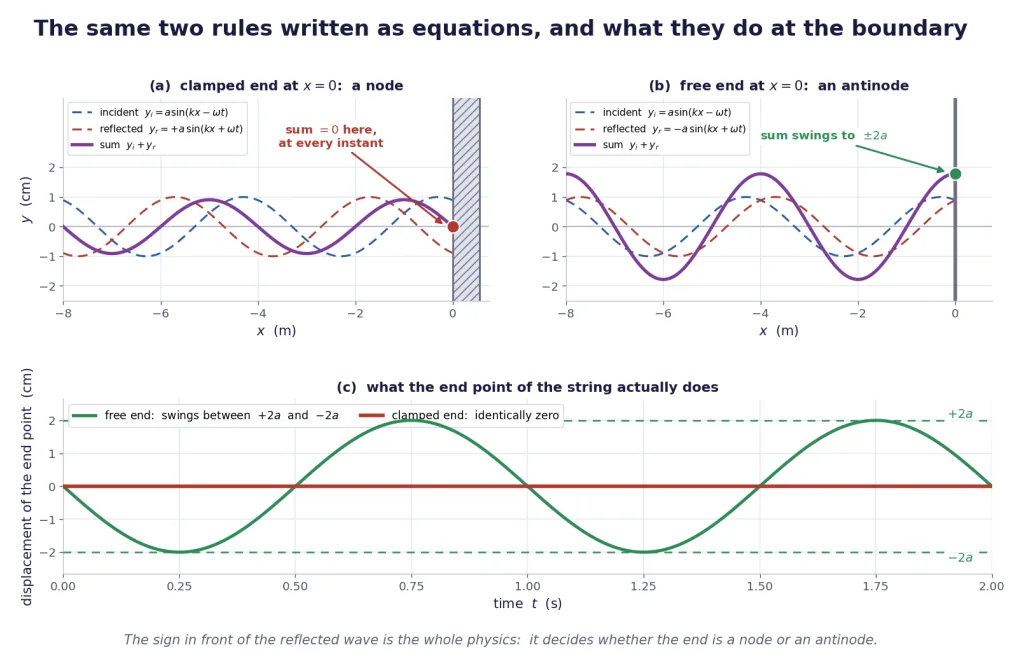
Panels (a) and (b) are snapshots at one instant, and panel (c) is the one that settles the argument: it plots the displacement of the end point itself against time. For the clamp it is a flat line at zero, for ever. For the ring it is a full oscillation between and .
What this sets up
Both boxes describe a medium that is now carrying two waves at once — the one you sent in and the one coming back — travelling in opposite directions with the same amplitude and frequency. The previous section gives the rule for what happens next: add them.
Do that sum and something remarkable falls out. The result is not a travelling wave at all; it is a pattern that stands still in space and merely breathes in place, with some points of the string permanently motionless. That is the standing wave, and it is the whole of the next section.
[Board Important] For a derivation question, the marks are in this order: state the boundary condition in words, write the incident and reflected waves with an unknown phase , impose the condition at , solve for , and state the conclusion (node or antinode). Quoting the boxed result without the boundary condition loses most of the marks.
When the Boundary Is Neither: Partial Reflection
A wall and a frictionless ring are the two extremes. Most boundaries in the real world are neither: they are the place where one medium ends and a different one begins. Sound in air meeting a brick wall, light meeting glass, and — the case to think with — a thin string knotted to a thick one.
At a boundary like that, the wave does not simply come back. Part of it is reflected and part of it goes on into the second medium, and the two shares depend on how different the media are.
The two conditions at the joint
Take two strings under the same tension (in newtons), joined at . String 1 occupies and has linear mass density , string 2 occupies and has . Their wave speeds are
Two physical facts pin the answer down.
- The string does not break at the joint, so the displacement must be the same on both sides of it: at .
- The knot has negligible mass, so the transverse forces on it must balance. The transverse force is times the slope, and is the same on both sides, so the slope must also match at the joint.
Impose those two, and the incident, reflected and transmitted amplitudes come out fixed.
Key Point — amplitudes at a junction: A negative value of means the reflected pulse is inverted. The transmitted ratio is always positive, so the transmitted pulse is never inverted.
Which case inverts
Everything hinges on the sign of , and that is easy to keep straight if you think about which string is heavier.
Light string into a heavy string (, so ). Then , so is negative: the reflection is inverted. And that is exactly what you should expect, because a very heavy second string is hard to move and behaves like a wall. In the limit we get , so and : total inverted reflection, nothing transmitted. The rigid-boundary result, recovered.
Heavy string into a light string (, so ). Then is positive: the reflection is erect, like a free end. In the limit we get , so and : total erect reflection, and a transmitted amplitude of . The free-boundary result, recovered — including the doubling at the end.
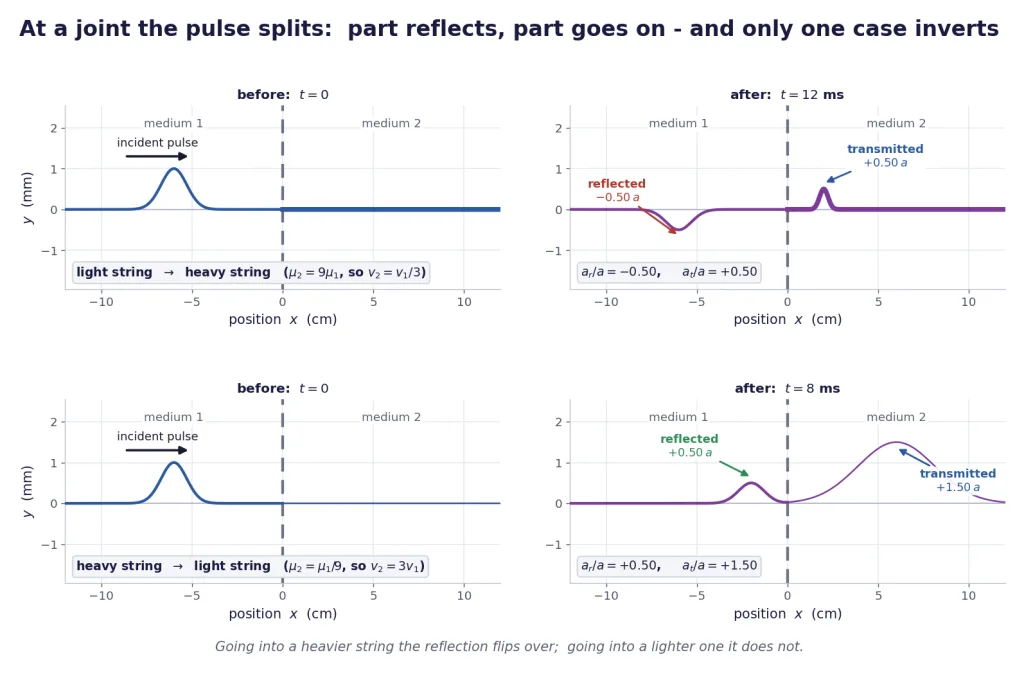
Both rows of the figure use a nine-to-one mass-density ratio, so the speeds differ by a factor of three and the amplitude ratios come out at exactly one half. Going into the heavier string the reflection is a trough; coming out of it, going into the lighter string, the reflection is a crest — and the transmitted pulse is taller than the one that arrived, at .
That taller transmitted pulse is not a violation
A pulse of amplitude producing one of amplitude looks like energy from nowhere. It is not. The power a wave carries on a string depends on the string as well as on the amplitude: for the same frequency it goes as . The light string has a much smaller , so it needs a bigger amplitude to carry the same power. Do the bookkeeping and it balances exactly — the fraction of the incident power that is reflected is
and the rest goes on into the second medium.
What changes across the joint, and what does not
| Quantity | Across the junction |
|---|---|
| Frequency | unchanged — the joint is driven by the arriving wave, so it wiggles at the arriving wave's rate |
| Wave speed | changes; it is set by the new medium's and |
| Wavelength | changes in the same proportion as |
| Amplitude | changes, by the ratios boxed above |
| Phase on reflection | if the second medium is slower, if it is faster |
[JEE Tip] The frequency row is the one that is tested. Whenever a wave crosses into a new medium — string to string, air to water, air to glass — the frequency is carried over unchanged and the wavelength does the adjusting. A question that offers "the frequency halves" as an option is offering a trap.
Back to the echo
Now the everyday case makes sense. Sound in air meeting a brick wall is going from a medium in which it travels at 340 m/s into one in which it travels at several thousand metres per second, and the densities differ by a factor of a couple of thousand. The mismatch is enormous, so almost none of the sound gets into the wall and almost all of it comes straight back. That is why a wall behaves, to a very good approximation, as a rigid boundary — and why rooms echo.
Echo, and Why 17 Metres
An echo is reflected sound heard as a separate sound, distinct from the original. Shout at a cliff face and the shout comes back a moment later, recognisably itself.
Everything about the echo follows from one number about your ears rather than about sound.
Key Point — persistence of hearing: the sensation of a sound lasts in the ear for about 0.1 s after the sound itself has stopped. Two sounds arriving less than 0.1 s apart are heard as one prolonged sound; more than 0.1 s apart, as two.
The minimum distance
Stand a distance from a wall and clap. The sound travels to the wall and back, so it covers , and it does so at the speed of sound :
For the returning clap to be heard as a separate clap, must be at least 0.1 s. With m/s,
Key Point: A distinct echo needs the reflecting surface to be at least about 17 m away, when the speed of sound is 340 m/s. Closer than that, the reflection merges into the original sound.
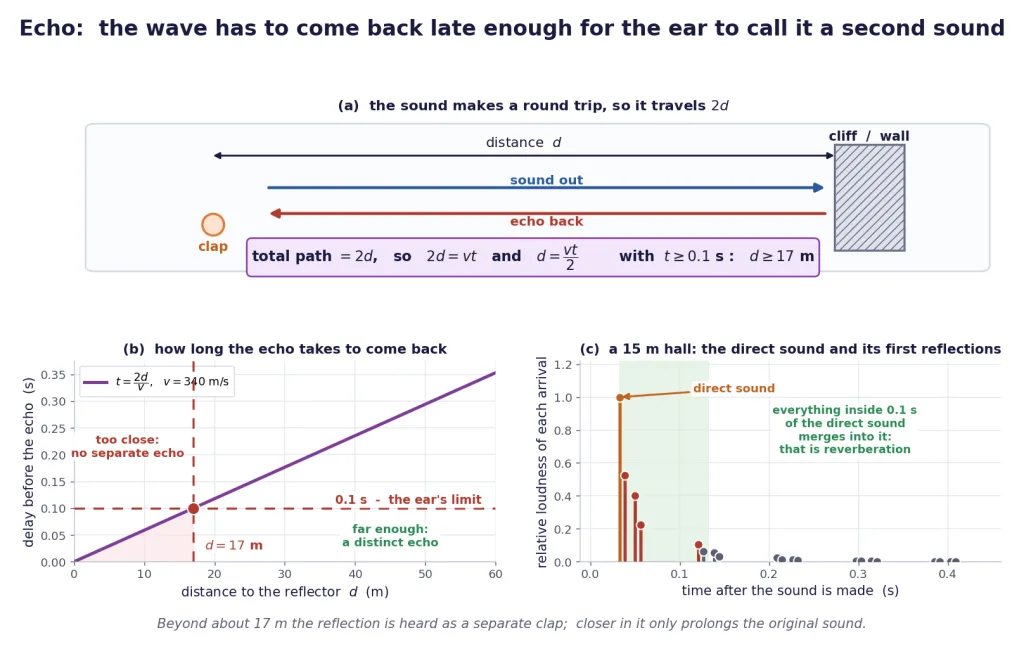
The 17 m is not a constant of nature — it is , and changes with temperature. On a cold morning sound is slower and the minimum distance is a little less; on a hot afternoon it is a little more. Quote 17 m only when you are using 340 m/s, and recompute it whenever the question hands you a different speed.
[Board Important] This derivation, in these four lines, is a standard two-mark question: write , put s, put m/s, get 17 m. State the persistence of hearing explicitly — a mark usually sits on it.
What else an echo needs
Distance is necessary but not sufficient.
- The reflector must be large compared with the wavelength. A wave slips around an obstacle much smaller than its own wavelength instead of bouncing off it. Middle-C in air has a wavelength of about 1.3 m, so a lamp post reflects almost nothing of it while a cliff reflects nearly all.
- The reflector must be hard and smooth. Soft, porous surfaces — curtains, carpet, a hedge, a crowd of people — absorb sound instead of returning it.
- The reflected sound must still be loud enough to notice when it gets back.
Echoes put to work
The relation is the whole of echo-ranging, and it is used far more often than the word "echo" suggests.
| Application | How it uses |
|---|---|
| SONAR | a ship sends an ultrasonic pulse down and times the return, giving the depth of the sea or the range of a submarine |
| Echolocation by bats and dolphins | short ultrasonic clicks and the delay of their echoes map obstacles and prey in the dark |
| Ultrasonography | pulses reflect from the boundaries between tissues of different density, and the delays are assembled into an image |
| Ultrasonic flaw detection | an echo from inside a metal casting reveals a crack that is invisible from outside |
Ultrasound is used in all of these for one reason: high frequency means short wavelength, and only a wave whose wavelength is small compared with the target will reflect from it cleanly rather than spreading around it. A bat calling at 50 kHz is working with a wavelength of under 7 mm, which is why it can locate a moth.
Reverberation: the echo that never separates
Now take the same reflections and move the walls closer than 17 m — an ordinary hall, a classroom, a bathroom.
Every reflection still comes back, but each one arrives less than 0.1 s after the direct sound, so none of them is heard separately. Instead they pile onto the original sound and stretch it out. Then those reflections reflect again, and again, each round trip a little weaker as the surfaces absorb a share. The result is a sound that keeps going for a while after the source has stopped.
Key Point: Reverberation is the persistence of sound in an enclosed space caused by repeated reflections from its walls, floor and ceiling. It differs from an echo only in timing: the reflections arrive too soon (within about 0.1 s) to be heard as separate sounds, so they merge into the original.
Panel (c) of the figure makes the distinction visible. In a 15 m hall, the direct sound and the first several reflections all land within a tenth of a second of one another. Not one of them is an echo; together they are reverberation.
The time a hall takes for its sound to die away — conventionally, to fall to a millionth of its original intensity — is its reverberation time. Too short and the room sounds flat and lifeless; too long and each syllable is still ringing when the next arrives, so speech turns to mush. Halls are tuned by choosing what the surfaces are made of: heavy curtains, perforated boards, carpets and upholstered seats absorb sound and shorten the reverberation, while bare plaster and glass lengthen it. An audience is itself a good absorber, which is why an empty hall sounds so different from a full one.
[NEET Important] The one-line discriminator, and it is asked in exactly this form: an echo is a reflection heard as a separate sound (reflector more than about 17 m away); reverberation is the merging of many reflections into a prolonged sound (reflector nearer than that). Both are the same physics — reflection at a boundary — separated only by 0.1 s.
[JEE Tip] Reflection also carries a phase change into interference problems, and that is where it is really tested — but which quantity picks up the decides the answer. At a rigid boundary the displacement reverses, so a displacement-reflected wave carries an extra , worth of path difference; the pressure does not reverse, because a rigid wall is a displacement node and a pressure antinode. A microphone and your ear both read pressure, so when a direct sound meets a wall-reflected sound the familiar conditions survive: loudest when the extra path is , quietest when it is . Ask two things before applying any path-difference condition — is a reflection involved, and which quantity is being detected?
Solved Examples
Conventions used throughout: SI units unless a question states otherwise. The standard form of a progressive wave is , so a minus sign between and means travel towards . In every reflection problem the boundary is placed at with the medium occupying . The speed of sound in air is taken as 340 m/s unless a question gives a temperature or another value, and the ear's persistence of hearing as 0.1 s. In the symbol is the tension in newtons, not a time period.
Example 1: Writing down the reflected wave at a clamped end
A wave , in metres and seconds, travels along a string whose end at is clamped to a rigid wall. Find (a) the wavelength, frequency and wave speed, (b) the equation of the reflected wave, and (c) the displacement of the clamped point at s.
Solution:
Step 1 — read the constants off the bracket. Comparing with ,
(a)
As a check, m/s, as it must be.
Step 2 — apply the rigid-end result. The reflected wave runs towards with the same amplitude, and the clamped end forces at :
(b)
Step 3 — check the boundary. Put in both:
(c)
which is zero at s and at every other instant. The clamped point never moves.
Final Answer: (a) m, Hz, m/s; (b) ; (c) zero, at all times.
Takeaway: Copy and straight across and flip the sign between them. The reflection changes the direction of travel and the phase; it never changes the wavelength, the frequency or the speed, because those belong to the medium and the source.
Example 2: The same wave at a free end
The same wave now travels along a string whose end at carries a light ring free to slide on a smooth rod. Find (a) the reflected wave, (b) the motion of the ring, and (c) the largest displacement the ring reaches.
Solution:
Step 1 — the free-end result. The slope, not the displacement, is pinned at zero, which gives a reflected wave with no phase change:
(a)
Step 2 — add the two at .
(b)
The ring performs simple harmonic motion of angular frequency 600 rad/s — the same frequency as the wave.
(c) Its amplitude is m, that is 4.0 cm, which is .
Final Answer: (a) ; (b) the ring oscillates as m; (c) 4.0 cm, twice the incident amplitude.
Takeaway: A free end is an antinode, and its amplitude is , not . The incident and reflected waves arrive there in step, so they reinforce completely — which is the exact mirror image of the clamped end, where they cancel completely.
Example 3: The shortest distance that gives an echo
A boy stands in front of a large wall and claps. Taking the speed of sound in air as 340 m/s and the persistence of hearing as 0.1 s, find the least distance from the wall at which he can hear a distinct echo. What would that distance be on a day when the speed of sound is 350 m/s?
Solution:
Step 1 — the sound makes a round trip. If the wall is a distance away, the sound travels before it gets back:
Step 2 — put in the smallest usable delay. For the reflection to be heard as a separate sound, must be at least 0.1 s:
Step 3 — repeat with the faster sound.
Final Answer: 17 m at 340 m/s; 17.5 m at 350 m/s.
Takeaway: The 17 m is , not a universal constant. Sound speeds up as the air warms, so the minimum echo distance creeps up with it. Recompute rather than reciting whenever a different speed is given.
Example 4: Finding the distance to a cliff
A man standing in a valley shouts and hears the echo from a cliff 3.2 s later. Taking the speed of sound as 340 m/s, how far away is the cliff?
Solution:
Step 1 — the round trip again.
Step 2 — sanity check. 3.2 s is comfortably more than 0.1 s, so a distinct echo is indeed what he would hear, and 544 m is far more than the 17 m minimum.
Final Answer: The cliff is 544 m away.
Takeaway: Halve, do not double. The single commonest error in every echo question is using and getting 1088 m. Draw the out-and-back path before you substitute; the factor of 2 lives there.
Example 5: Two cliffs, and how many echoes
A man stands on a straight path between two parallel cliffs, 60 m from one and 180 m from the other. He fires a starting pistol. Taking the speed of sound as 340 m/s, find (a) the times at which he hears the first two echoes, (b) whether he hears them as separate sounds, and (c) the time of the echo that has bounced off both cliffs in turn.
Solution:
Step 1 — each cliff acts on its own.
(a) The first echo arrives after 0.353 s and the second after 1.059 s.
Step 2 — test the separations. The first echo comes 0.353 s after the shot, which is more than 0.1 s, so it is distinct from the shot. The gap between the two echoes is
(b) which is also more than 0.1 s, so the two echoes are heard as separate sounds. He hears three bangs in all.
Step 3 — the double reflection. Sound that goes to the near cliff, back past him to the far cliff, and back again covers
(c)
Final Answer: (a) 0.353 s and 1.059 s; (b) yes — every gap exceeds 0.1 s, so he hears three separate bangs; (c) 1.412 s.
Takeaway: Two facing walls give an endless train of echoes, not two. Each round trip between them adds a further arrival, steadily weaker. That is exactly the picture that turns into reverberation once the walls are brought close together.
Example 6: Sounding the depth of the sea
A ship's sonar sends a pulse vertically downwards and receives its echo 1.6 s later. The speed of sound in sea water is 1450 m/s. Find the depth of the sea at that point. Why is an ultrasonic pulse used rather than an audible one?
Solution:
Step 1 — the round trip.
Step 2 — the choice of frequency. Ultrasound has a very short wavelength. At 50 kHz in sea water, m, about 3 cm. A wave only reflects cleanly from an object that is large compared with its wavelength, so a short-wavelength pulse can be sent out as a narrow, well-aimed beam and can return a sharp echo from a small target. Audible sound, with wavelengths of metres, would spread out in all directions and give no useful bearing.
Final Answer: The depth is 1160 m.
Takeaway: Every echo-ranging device is with a different . Change the medium and only changes: 340 m/s in air, about 1450 m/s in sea water, several thousand in metals.
Example 7: A pulse crossing into a heavier string
A string of linear mass density kg/m is joined to a second string of kg/m, and the joined string is stretched with a tension of 40 N. A wave of frequency 100 Hz and amplitude 4.0 mm travels along the first string towards the joint. Find (a) the wave speed in each string, (b) the wavelength in each, (c) the amplitude of the reflected and transmitted waves, and (d) whether the reflected wave is inverted.
Solution:
Step 1 — the two wave speeds. Here N is the tension.
(a) So m/s and m/s, in the ratio — as expected, since the mass densities are in the ratio and .
Step 2 — the wavelengths. The frequency is the same in both strings.
(b) The wavelength in the heavy string is one third of that in the light one.
Step 3 — the amplitude ratios.
(c)
(d) The ratio is negative, so the reflected wave is inverted — a crest comes back as a trough. The transmitted wave is erect.
Final Answer: (a) 63.2 m/s and 21.1 m/s; (b) 0.632 m and 0.211 m; (c) both 2.0 mm; (d) yes, the reflected wave is inverted.
Takeaway: Going into a slower (heavier) medium inverts the reflection. The heavy string resists being moved, so as far as the light string is concerned it is behaving like a partial wall — and a wall inverts.
Example 8: The same joint, taken the other way
Now the same wave of amplitude 4.0 mm and frequency 100 Hz starts in the heavy string ( kg/m) and travels towards the light one ( kg/m), the tension still 40 N. Find the reflected and transmitted amplitudes, state whether the reflection is inverted, and show that energy is still conserved.
Solution:
Step 1 — the speeds swap over.
Step 2 — the amplitude ratios.
The transmitted pulse is taller than the one that arrived.
Step 3 — check the energy. The fraction of the incident power that is reflected is
so 75% must be transmitted. Check that directly. Power on a string goes as at a fixed frequency, so
and exactly.
Final Answer: reflected 2.0 mm and erect; transmitted 6.0 mm; 25% of the power reflected and 75% transmitted, so energy is conserved.
Takeaway: A transmitted amplitude bigger than the incident one is normal, not an error. A light string carries far less power for a given amplitude, so it needs a bigger swing to take the same energy per second. Check the power, never the amplitude, when you suspect energy has gone missing.
Example 9: A reflection that leaves the microphone at a maximum
A small loudspeaker sounding a steady 500 Hz note faces a flat wall 3.4 m away. A microphone is placed on the line between them, exactly midway. Taking the speed of sound as 340 m/s, decide whether the direct sound and the wall-reflected sound reinforce or cancel at the microphone.
Solution:
Step 1 — the wavelength.
Step 2 — the two paths. The microphone is 1.7 m from the speaker and 1.7 m from the wall.
Step 3 — convert to phase, and ask what the microphone actually measures. The path difference alone gives
A microphone responds to pressure, not to displacement, and a rigid wall is a displacement node but a pressure antinode — so the reflection flips the sign of the displacement but not of the pressure, and adds no extra phase to the quantity being measured (Section 7 develops this duality for air columns).
an even multiple of .
Step 4 — read the answer. An even multiple of is the condition for constructive interference, so the two pressure waves reinforce at the microphone. The reinforcement is not quite perfect, because the reflected sound has travelled three times as far and so arrives a little weaker.
Final Answer: They reinforce — the microphone sits at a maximum, the loudest point on the line, matching the path difference of a whole five wavelengths.
Takeaway: Ask what the detector measures before you add a reflection's phase. A pulse on a string flips on bouncing off a rigid support, and so does the air's displacement at a hard wall — but the pressure does not, and pressure is what a microphone and your ear register. For sound reflected from a hard surface the familiar rules survive unchanged: gives a loudness maximum and a minimum.
Example 10: A hall that reverberates instead of echoing
A hall is 15 m long. A speaker stands at one end wall and a listener 3.0 m in front of her. Taking the speed of sound as 340 m/s, find (a) the time the direct sound takes to reach the listener, (b) the time taken by the sound that reflects from the far wall, and (c) whether the listener hears an echo.
Solution:
Step 1 — the direct sound.
Step 2 — the reflected sound. It travels the full 15 m to the far wall, then back to the listener, who is m from that wall:
Step 3 — compare the arrivals.
(c) That is less than 0.1 s, so the ear cannot separate the two. The listener hears no echo. What she hears instead is the speaker's voice slightly prolonged — and with the side walls, ceiling and floor all contributing further reflections a few hundredths of a second apart, that prolongation is reverberation.
Final Answer: (a) 0.0088 s; (b) 0.0794 s; (c) no echo — the gap of 0.0706 s is under the 0.1 s limit, so the reflection merges into the direct sound as reverberation.
Takeaway: Echo and reverberation are the same physics separated by one number. Ask only whether the reflection lands more or less than 0.1 s after the direct sound; everything else about the two phenomena is identical.
Example 11: Measuring the speed of sound with a pair of hands
A student stands 68 m from a large wall and claps at a steady rate. She adjusts the rate until each clap's echo returns at the exact instant she makes the next clap, and then counts 30 claps in 12.0 s. Find the speed of sound.
Solution:
Step 1 — the interval between claps. Thirty claps at a steady rate in 12.0 s means
between one clap and the next.
Step 2 — that interval is one round trip. The echo of a clap arrives just as the next clap is made, so the sound has covered in exactly that time:
Step 3 — check the setup is workable. The delay is 0.400 s, well above 0.1 s, so each echo really is a distinct sound and the student can judge the coincidence by ear.
Final Answer: The speed of sound is 340 m/s.
Takeaway: Matching an echo to a rhythm beats trying to time a single one. Timing one echo by hand is hopeless at these delays; matching a repeated clap to its own echo turns the measurement into counting, and averaging over 30 claps kills most of the error.
Example 12: How a bat sees in the dark
A bat emits a short ultrasonic pulse at 50 kHz and receives its echo from a moth 20 ms later. Take the speed of sound in air as 340 m/s. Find (a) the distance to the moth, (b) the wavelength of the pulse, and (c) explain why the bat's pulse has to be much shorter than 20 ms.
Solution:
Step 1 — the range. With ms s,
(a)
Step 2 — the wavelength.
(b)
A moth is a few centimetres across, comfortably larger than 6.8 mm, so it reflects the pulse instead of letting it spread around. An audible call at 500 Hz would have a wavelength of 0.68 m and would sail straight past the moth without a useful echo.
Step 3 — why the pulse must be brief.
(c) If the bat were still calling when the echo came back, the loud outgoing call would swamp the faint returning one, and the bat could not tell where the echo began. The pulse must therefore end well before the echo arrives, that is in far less than 20 ms — real bats use pulses of only a few milliseconds, and shorten them further as they close on the target.
Final Answer: (a) 3.4 m; (b) 6.8 mm; (c) so that the outgoing call has finished before the echo returns, leaving the echo clearly detectable.
Takeaway: High frequency buys resolution. Short wavelengths reflect from small objects and can be aimed as a narrow beam — the same reason ultrasound, not audible sound, is used in sonar, flaw detection and medical imaging.