
How to Use These Cards
This is the last section of the chapter, and the last section of the year. It has one job: to be read the night before the paper, and again in the queue outside the hall.
Nothing new is taught here. Every card below compresses something an earlier section built properly, in the same notation and with the same numbers. So if a line here surprises you, that is not a line to memorise — it is a signal to go back and reread the section that owns it.
Five cards, four figures, the master table of strings and pipes, the Doppler sign chart, the mistake checklist, a 60-second list and a fast self-test. Photograph the master table and the mistake checklist.
The Doppler effect, and the naming of overtones, sit outside the body text of the rationalised syllabus, and Boards, JEE and NEET ask about them every single year — so both are on these cards in full.
Notation for This Chapter
Three symbols decide more marks here than everything else on this page put together.
Key Point — is the ANGULAR WAVE NUMBER. It counts radians of phase per metre travelled. In this chapter is never a spring constant and never carries newtons per metre. A question that hands you has handed you the wavelength, , and nothing else.
Key Point — does two jobs, and the unit settles which.
In the symbol is the tension, in newtons. Everywhere else is the time period, in seconds; and inside it is the absolute temperature, in kelvin. One problem happily carries two of them: a wire under a tension of 90 N vibrating with a period of 4 ms. Read the unit, never the letter.Key Point — is the WAVE speed; the particle speed is .
They are different quantities with different values. The wave speed is and belongs to the medium; the largest particle speed is and belongs to how hard the source was shaken. Never write or say a bare "the speed" in this chapter — write wave speed or particle speed every time.
| Symbol | Meaning | Unit |
|---|---|---|
| , or | displacement of a particle from its rest position | m |
| amplitude, the largest displacement of any particle | m | |
| wavelength, the least distance between points in the same phase | m | |
| angular wave number, | rad/m | |
| time period of the oscillation | s | |
| frequency, (Greek nu, never the italic vee of speed) | Hz | |
| angular frequency, | rad/s | |
| phase constant; the phase is the whole bracket | rad | |
| wave speed | m/s | |
| tension in a stretched string, in | N | |
| linear mass density of a string, | kg/m | |
| mass density of a medium | kg/m³ | |
| , | bulk modulus, Young's modulus | Pa |
| ratio of the specific heats of a gas | none | |
| pressure of the gas | Pa | |
| molar mass of the gas | kg/mol | |
| absolute temperature of the gas | K | |
| mode number, | none | |
| end correction at an open end of a pipe | m | |
| frequency the observer receives in a Doppler problem | Hz | |
| , | signed velocities of source and observer along one chosen line | m/s |
Three habits protect all of it. Write the unit beside every you use. Say "wave speed" or "particle speed", never just "speed". Check whether a belongs in the formula before you write one.
The constants sheet
| Quantity | Value |
|---|---|
| speed of sound in air, used unless a problem states otherwise | 340 m/s |
| speed of sound in dry air at 0°C | 331 m/s |
| speed of sound in air at 20°C | 343 m/s |
| rise near room temperature | about 0.6 m/s per °C |
| ratio of specific heats for air, | 1.4, so |
| density of air at STP, | 1.29 kg/m³ |
| atmospheric pressure, | Pa |
| gas constant, | 8.314 J per mole per kelvin |
| audible range for a healthy human ear | 20 Hz to 20 kHz |
| audible wavelengths in air, at 340 m/s | 17 m down to 1.7 cm |
| persistence of hearing, which sets the echo limit | about 0.1 s, so about 17 m |
| , | , |
Take the speed of sound as 340 m/s everywhere unless a temperature or another value is given, and say so in your answer.
Card 1 — The Wave, Written Down
Key Point — the displacement relation for a progressive wave: is the displacement, at time , of the particle whose rest position is . The whole bracket is the phase; alone is the phase constant, the value of the phase at and .
Key Point — the direction rule: Opposite signs on and means the wave goes towards ; the same sign means it goes towards . That one sentence survives every disguise, because it does not care what sits in front of the bracket. So , and all travel towards .
The four constants
Key Point: is phase per metre and is phase per second: the same idea applied to the wave's two variables. Move one wavelength and the phase changes by ; wait one period and it changes by .
Written the other way round, an equation hands you everything: from you read cm, rad/m so m, rad/s so Hz and s, and the wave runs towards at m/s.
The two graphs, and the trap between them
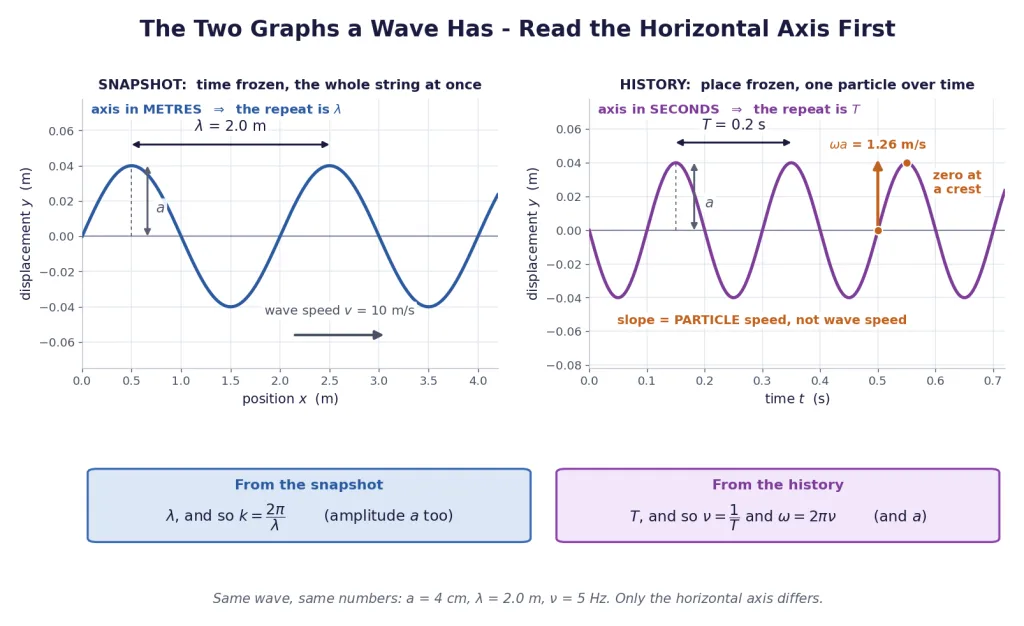
Key Point — read the horizontal axis first:
Snapshot History what is held fixed the time the position plotted against position (m) time (s) shows the whole medium at one instant one particle over an interval the repeat along the axis is the wavelength the period gives you , and so , and so and the slope means the shape of the medium the particle velocity Calling the repeat of a history graph "the wavelength" is the standard error. A wavelength is measured in metres; if the axis is in seconds, what you are looking at is a period.
Particle velocity
The particle is fastest as it crosses and momentarily at rest at a crest or a trough, where it has stopped to turn round. For the wave above, m/s, while the wave speed is 10 m/s. The two numbers have nothing to do with each other.
Phase difference
Key Point: In words: the phase difference is times the fraction of a wavelength (or of a period) that separates them. Run them backwards when you are given the phase: .
| Path difference | Phase difference | In degrees | The two particles are |
|---|---|---|---|
| 0° | in phase | ||
| 90° | a quarter cycle apart | ||
| 180° | exactly out of phase | ||
| 360° | in phase again | ||
| in phase | |||
| exactly out of phase |
[Board Important] Transverse means the particles move across the direction of travel — crests and troughs. Longitudinal means they move along it — compressions and rarefactions. A gas has no shear strength, so sound in air is necessarily longitudinal; a solid carries both.
Card 2 — Every Speed Formula in the Chapter
Key Point — the wave-speed identity, true for every wave here: In one period the pattern advances by exactly one wavelength. Divide the distance by the time and you have the speed. The s cancel between and , which is why the same comes out of both forms.
Key Point — who fixes what:
The medium fixes the speed . The source fixes the frequency . The wavelength is then whatever those two force it to be, . Wavelength is never chosen; it is always a consequence.
| Quantity | Crossing into a new medium | Why |
|---|---|---|
| frequency | unchanged | the boundary particles are driven by the arriving wave |
| speed | changes | it is a property of the medium |
| wavelength | changes in the same ratio as | because with fixed |
On a stretched string
Key Point: with the tension in newtons and the linear mass density in kg/m. Nothing else appears — not the amplitude, not the frequency, not the wavelength, not the length of the string.
For a wire of circular cross-section, . And because the speed goes as the square root of the tension, you must quadruple the tension to double the speed. A tension of 90 N on a string of kg/m gives m/s.
In a bulk medium
Key Point: In a thin rod the sides bulge freely, so the material is under a simple stretch and Young's modulus replaces the bulk modulus .
Solids are enormously stiffer than gases while being only a few thousand times denser, so the ratio is far larger: sound runs at roughly 5900 m/s in steel, 1500 m/s in water and 340 m/s in air.
In a gas — Newton, and the correction that fixed him
Key Point: The whole correction is a single factor of . Newton assumed the compressions stayed at the same temperature; in fact they happen far too fast for heat to escape, so they are adiabatic. For air and , which lifts Newton's 280 m/s to 331 m/s — the measured value.
Key Point — the working form, and the three dependences:
- Pressure does not matter. Squeeze a gas at constant temperature and and rise together, so is unchanged.
- , with absolute: . Convert to kelvin first, always.
- at a fixed temperature, which is why sound is far faster in helium and hydrogen than in air.
Humid air is slightly less dense than dry air, so sound travels a little faster in it.
[JEE Tip] Every "how does the speed change?" question is one of these three lines. Pressure alone: no change. Temperature: square root, in kelvin. Different gas: inverse square root of the molar mass, with adjusted if the gas is not diatomic.
[NEET Important] From 0°C to 20°C the speed rises from 331 m/s to m/s — about 0.6 m/s for each degree, which is the number worth carrying.
Card 3 — Superposition, Reflection and the Standing Wave
Key Point — the principle of superposition:
Where waves overlap, the displacement of any particle at any instant is the algebraic sum of what each wave would have produced on its own: Each wave then travels on as though the others had never been there.
Two waves of the same amplitude, differing in phase by
Key Point: The resultant is still a wave of the same frequency, wavelength and direction. Only the amplitude and the phase constant are new.
| Character | Phase difference | Path difference | Amplitude | Intensity |
|---|---|---|---|---|
| Fully constructive | ||||
| Halfway | ||||
| Fully destructive |
For unequal amplitudes, so the resultant always lies between and , and complete silence needs equal amplitudes. Interference redistributes energy; it never creates or destroys it, and the average intensity over the whole pattern is still . A steady pattern needs coherent sources: the same frequency and a phase difference that does not drift.
Reflection, with the signs that actually work
Key Point — boundary at , incident wave : Reversing the direction of travel already supplies one sign change, which is why the phase change of a rigid end lands on a plus. Never read the physics off the sign: substitute and look at the sum. Zero for all means a node and a rigid end; a swing to means an antinode and a free end. And a reflected wave still written with is travelling the wrong way.
| Rigid (fixed) end | Free end | |
|---|---|---|
| Physical picture | string knotted to a wall; closed end of a pipe | ring on a smooth rod; open end of a pipe |
| What is fixed there | the displacement is zero | the slope is zero |
| Reflected pulse | inverted | erect |
| Phase change | , that is 180° | |
| Equivalent path difference | ||
| The boundary point is a | node | antinode |
At a junction between two strings under the same tension, and ; the transmitted pulse is never inverted, and the frequency never changes.
The standing wave
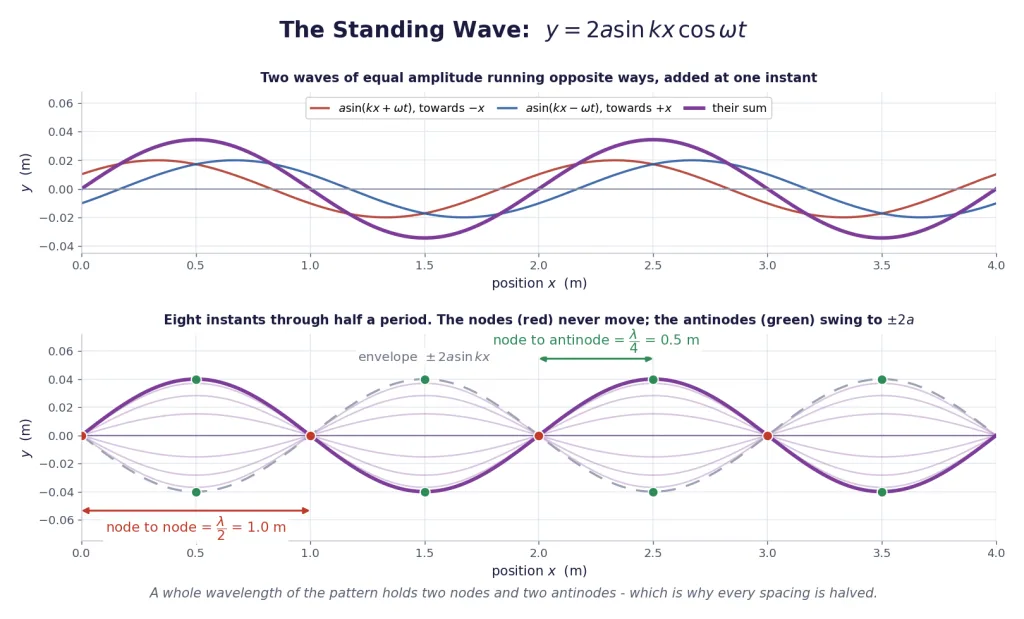
Key Point: and now sit in separate factors, so the pattern goes nowhere: each point simply oscillates with its own fixed amplitude . That separation is the test — is a standing wave, is a travelling one.
Key Point — the three spacings, and they are the most-asked fact in the topic: Nodes sit at and antinodes at . Every spacing is half what you would guess, because one full wavelength of the pattern holds two nodes and two antinodes. Each loop is half a wavelength long, so (distance between adjacent nodes).
| Feature | Progressive wave | Standing wave |
|---|---|---|
| Equation | ||
| The waveform | travels at | stays put; grows and shrinks in place |
| Amplitude | the same everywhere | , depends on position |
| Points at rest | none | the nodes, apart |
| Phase between particles | , any value at all | within a loop, across a node — nothing else |
| Energy | transported along the medium | stored between nodes, none transported |
[JEE Tip] In a standing wave every particle of one loop passes through zero at the same instant, twice per period. In a progressive wave they cross at different instants. That single fact settles most "which graph is which" questions.
Card 4 — Strings, Open Pipes and Closed Pipes
Everything in this card comes from fitting a sine curve between two boundary conditions. There is nothing else to remember.
Key Point — the two rules for a pipe:
- A closed end is rigid, so it is a displacement node.
- An open end is free, so it is a displacement antinode.
A string fixed at both ends is a node at each end, which is the same problem as the open pipe with the pattern shifted by a quarter wavelength.
The master table
| String fixed at both ends | Pipe OPEN at both ends | Pipe CLOSED at one end | |
|---|---|---|---|
| Ends are | node, node | antinode, antinode | node, antinode |
| Fits into | whole number of | whole number of | odd number of |
| Wavelengths | |||
| Frequencies | |||
| Fundamental | |||
| Harmonics present | all: 1, 2, 3, 4, 5, … | all: 1, 2, 3, 4, 5, … | odd only: 1, 3, 5, 7, … |
| 1st overtone | 2nd harmonic, | 2nd harmonic, | 3rd harmonic, |
| 2nd overtone | 3rd harmonic, | 3rd harmonic, | 5th harmonic, |
| th overtone | th harmonic | th harmonic | th harmonic |
| Gap between successive modes | |||
| For = 34 cm and = 340 m/s | — | 500, 1000, 1500, 2000 Hz | 250, 750, 1250, 1750 Hz |
Here is the tension in newtons and the mass per unit length in kg/m; inside a pipe is the speed of sound in the air, not a wave speed on a string.
Harmonics against overtones
Key Point — the two countings:
- Harmonics are counted from the fundamental, and the fundamental is the first harmonic. The th harmonic has frequency .
- Overtones are counted from the first tone above the fundamental. The fundamental is not an overtone at all.
For a string or an open pipe the th harmonic is the th overtone. For a closed pipe only odd harmonics exist, so the first overtone is the THIRD harmonic — never the second.
| Mode | String / open pipe | Closed pipe |
|---|---|---|
| fundamental | 1st harmonic, | 1st harmonic, |
| 1st overtone | 2nd harmonic, | 3rd harmonic, |
| 2nd overtone | 3rd harmonic, | 5th harmonic, |
| 3rd overtone | 4th harmonic, | 7th harmonic, |
A closed pipe of the same length sounds an octave lower than an open one, since ; and because it is missing every even harmonic, its tone is hollow next to the open pipe's. Pitch is set by the fundamental, timbre by the mix of harmonics above it.
The laws of the vibrating string
Halve the length and the pitch rises an octave — that is the guitarist's left hand. Quadruple the tension to double the frequency — that is the tuning peg, and the square root is what students forget. A fatter or denser string sounds lower, which is why the bass strings are the thick ones. All three laws are checked on a sonometer.
Pressure, and the resonance tube
Key Point: A displacement node is a pressure antinode, and a displacement antinode is a pressure node. The two patterns are shifted by . So the closed end of a pipe, where the air cannot move, is exactly where the pressure swings hardest; the open end is pinned at atmospheric pressure.
In the resonance tube the first two resonances of the closed column give
Taking the difference of the two lengths is the whole point: the unknown end correction cancels out. Separately, for a tube of internal radius , so the effective length is for a closed pipe and for an open one — two corrections, one at each mouth.
[NEET Important] Sound travels faster in warmer air, so every pipe frequency rises as the room warms; the length of the pipe has not changed at all. A string's frequency, by contrast, depends on tension and length, not on the temperature of the air around it.
Card 5 — Beats and the Doppler Effect
Beats
Key Point — the beat equation: The fast factor is the pitch you hear, at the average frequency . The slow bracket is a changing amplitude, too slow to be a pitch, and it is heard as the loudness rising and falling.
Key Point — the beat frequency, and the factor of two: The envelope repeats at , but loudness goes as the square of the amplitude, and squaring makes the two halves of an envelope cycle sound identical. So a loud moment arrives twice per envelope cycle, and the beat frequency is the full difference — not half of it.
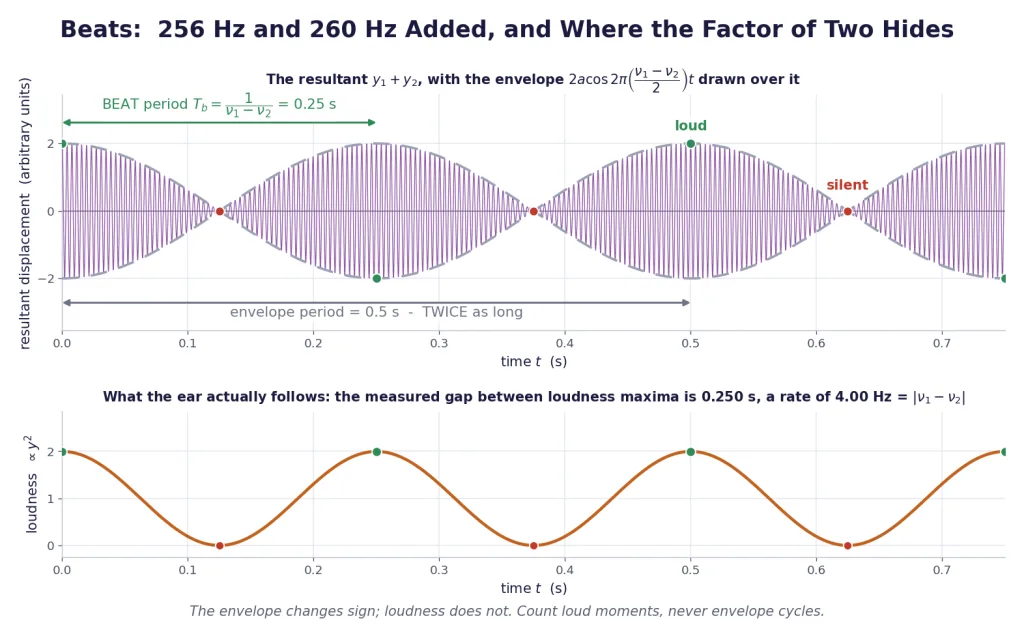
For 256 Hz against 260 Hz: the pitch heard is 258 Hz, the envelope repeats at 2 Hz, the beat frequency is 4 Hz and the beat period is 0.25 s.
| What you measure on a beat graph | What it gives |
|---|---|
| time between consecutive waists (silences) | , so |
| time between consecutive loud moments | again |
| the full period of the envelope curve | — halve the frequency you get from this |
| fast cycles per second inside a bulge | |
| greatest and least heights | and |
Beats can only be counted while the difference is below about 10 Hz; past roughly 20 Hz the throbbing disappears and two separate pitches are heard. And given and one known fork, the unknown is — two candidates. Resolve it by changing something on purpose: wax on a prong or slackening a string lowers that source; filing a prong, tightening or shortening a string raises it. If the beat rate falls, you moved the unknown towards the reference.
The Doppler effect
Key Point: When source and observer move relative to one another, the frequency received, , differs from the frequency emitted, . Closing the gap raises the pitch; opening it lowers the pitch. The speed of sound belongs to the medium and is not altered by anybody's motion.
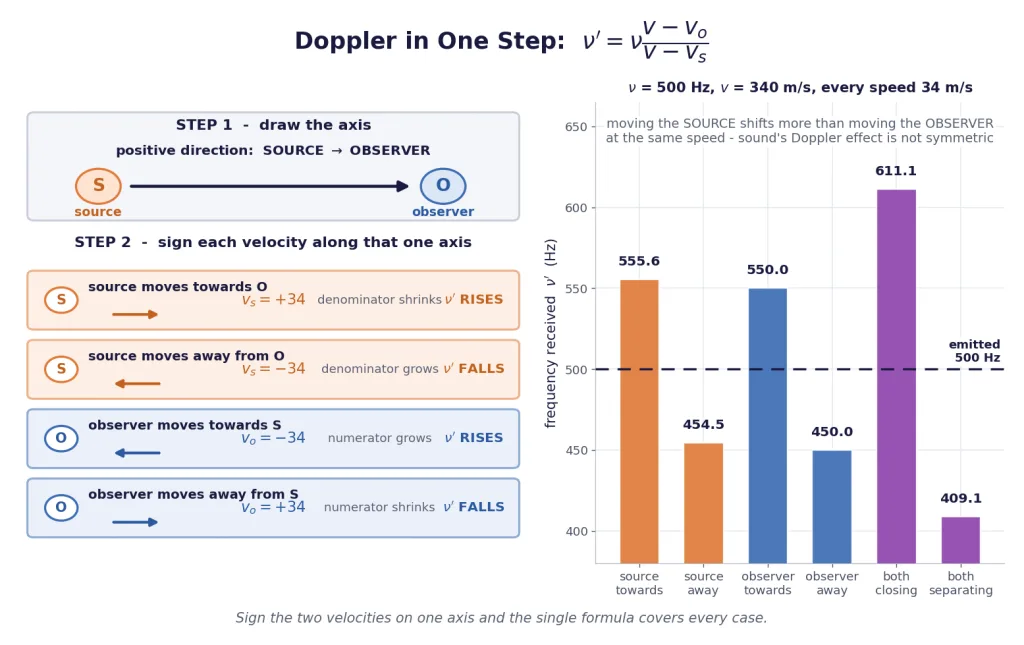
Key Point — one axis, one formula:
Draw the line joining them and take the direction from the SOURCE towards the OBSERVER as positive. Then and are signed velocity components along that one line, and covers all four cases with nothing else to decide. Read it as: the numerator is how fast the sound closes on the observer, and the denominator is what set the wavelength in the first place.
Mind the numerator sign. On a single signed axis it is , not . An observer moving towards the source is travelling in the negative direction on the source-to-observer axis, so and correctly grows. The familiar belongs to a different convention, in which each speed is counted positive when it points towards the other body. Both are right; mixing them makes an approaching observer come out lower.
| Form | What means | What means |
|---|---|---|
| signed along the axis from source to observer | signed along that same axis | |
| positive when the observer moves towards the source | positive when the source moves towards the observer |
With Hz, m/s and every speed 34 m/s, the single-axis formula gives:
| Case | |||
|---|---|---|---|
| source approaching | 555.6 Hz | ||
| source receding | 454.5 Hz | ||
| observer approaching | 550.0 Hz | ||
| observer receding | 450.0 Hz | ||
| both closing | 611.1 Hz | ||
| both separating | 409.1 Hz |
Notice that 555.6 Hz and 550.0 Hz are not the same: for sound the effect is not symmetric between source motion and observer motion, because the medium is a real stage that one of them is moving through. Light has no medium, so its Doppler shift depends only on the relative velocity and is symmetric.
- Wind. Take the wind's component along the same positive axis and use in place of everywhere: .
- A reflector shifts twice. The surface is first an observer, then a source re-emitting exactly what it received, from wherever it now is. Draw a fresh axis for the second step. A car sounding a 400 Hz horn while driving at 20 m/s at a wall: the wall hears Hz, and the driver hears the echo at Hz. For source and observer riding together at towards a still reflector this collapses to , and Hz confirms it.
- Beyond the speed of sound the wavefronts pile up on a trailing Mach cone, and the pressure jump across it is heard as a sonic boom when the cone sweeps past. The Mach number is , and the boom is produced continuously all the way along the flight, not once at the moment of "breaking the sound barrier".
[JEE Tip] Before substituting anything, say in words whether the pitch should come out higher or lower. Then compute. If the arithmetic disagrees with the sentence, the sign is wrong, not the physics.
The Mistakes That Cost the Most Marks
Ordered by how often they turn up in answer scripts. The first five are worth more than the rest of the list put together.
1. Taking the wave speed for the particle speed. The wave speed is and belongs to the medium; it is the same everywhere and at every instant. The particle speed is , it changes through every cycle, and its largest value is . For m, Hz and cm these are 10 m/s and 1.26 m/s. Write "wave speed" or "particle speed" every single time and this cannot happen.
2. Letting a closed pipe have even harmonics. A closed pipe supports only. Its first overtone is the third harmonic, at . There is no second harmonic to be the first overtone. The gap between successive modes is , not .
3. Halving the beat frequency. , full stop. The envelope repeats at half that rate, and measuring from one bulge to the next bulge of the same sign gives you the envelope, not the beat. Loudness goes as the square of the amplitude, so a loud moment happens twice per envelope cycle.
4. Confusing tension with time period. Both are . In it is the tension, in newtons. In it is the period, in seconds. In it is the absolute temperature, in kelvin. The unit settles it every time.
5. Reversing the Doppler signs. Draw the axis from the source towards the observer, sign both velocities along that one line, and use . An observer moving towards the source has negative. Never mix this with the other convention's inside one solution, and always say aloud whether the pitch should rise or fall before you substitute.
6. Guessing the direction of travel from the sign in front of the bracket. Compare the signs on and on only. Opposite signs means ; the same sign means . So goes towards , exactly like .
7. Calling the repeat of a history graph a wavelength. A wavelength is in metres, measured off a snapshot. If the horizontal axis is in seconds, the repeat is a period.
8. Getting the node and antinode spacings wrong. Node to node and antinode to antinode are both ; node to the neighbouring antinode is . Each loop is half a wavelength, so (distance between adjacent nodes) — never one loop equals one wavelength.
9. Reading the reflection sign off the page instead of testing it. For at , a rigid end gives and a free end . Substitute and check the boundary condition; the plus sign on the rigid case is not a misprint, because reversing the direction of travel has already supplied one sign change.
10. Doubling the tension to double the frequency. , so doubling the frequency needs four times the tension. The same square root sits in the wave speed on a string.
11. Putting the pressure into the speed of sound. does not mean the speed rises with pressure: at constant temperature and rise together. Only the temperature and the gas itself can change it.
12. Leaving a temperature in degrees Celsius. needs in kelvin. Add 273 first. The same slip ruins every ratio.
13. Applying the Doppler formula once to a reflector. The reflecting surface is an observer and then a source. Two applications, with a fresh axis for the second.
14. Expecting complete silence from unequal amplitudes. The minimum is , which is zero only when .
15. Forgetting that the frequency survives a change of medium. Crossing a boundary changes and together; is fixed by the source and does not change. That includes light entering glass and sound entering water.
Key Point: Three that cost single marks each — quoting in hertz, quoting in newtons per metre, and forgetting the end correction when a question gives you the radius of a resonance tube.
The 60-Second Revision
You are in the queue outside the hall. This is the irreducible minimum.
The wave. ; opposite signs on and means it goes towards . in rad/m, in rad/s, in Hz.
Speeds. . Largest particle speed — a different quantity. Snapshot gives ; history gives .
Phase. .
Media. String (tension in N). Bulk , rod . Gas : no pressure dependence, in kelvin, . Laplace over Newton is one factor of for air. Take 340 m/s.
Superposition. ; constructive at , destructive at ; unequal amplitudes give .
Reflection. Rigid end: inverted, phase change , node, . Free end: erect, no phase change, antinode, .
Standing wave. ; nodes at , antinodes at ; node to node , node to antinode ; no energy transported.
Modes. String and open pipe: , all harmonics, th harmonic = th overtone. Closed pipe: , odd only, first overtone = third harmonic, fundamental an octave below the open pipe of the same length. String laws: , , . Resonance tube: , . Displacement node = pressure antinode.
Beats. , pitch , envelope repeats at half the beat rate. Two candidates for an unknown fork; load or file it to decide.
Doppler. Axis from source to observer is positive; ; wind adds to ; a reflector shifts twice; sound's effect is not symmetric.
Habits. Name the speed. Write the unit on every . Convert temperatures to kelvin. Say whether the answer should be higher or lower before you compute it.
The Fast Self-Test
Cover the answers. Fifteen questions, five minutes. Anything you miss tells you which card to reopen tonight.
- What are the units of and of , and what is each of them made from?
- Which way does travel, and by what rule?
- Write the wave-speed identity in its three forms.
- What is the largest particle speed, and how does it differ from the wave speed?
- A wave crosses into a slower medium. Which of , and change?
- Write the speed of a transverse wave on a string, naming the unit of each symbol.
- What exactly did Laplace correct, and by what factor?
- State the three things the speed of sound in a gas does and does not depend on.
- Write the resultant amplitude of two equal waves differing in phase by , and give the path differences for constructive and destructive interference.
- Write the reflected wave at a rigid end and at a free end, for at .
- Write the standing wave, and give the node-to-node and node-to-antinode spacings.
- Give the harmonic series of a string, an open pipe and a closed pipe, and name the first overtone of each.
- Two forks give 5 beats per second. What is the beat frequency, and what are the two candidate frequencies if one fork is 512 Hz?
- Write the signed Doppler formula and state the positive direction.
- A car drives at towards a wall sounding its horn. What does the driver hear in the echo?
Answers. 1. is in rad/m and equals ; is in rad/s and equals . 2. Towards — the signs on and are opposite. 3. . 4. , reached as the particle crosses its mean position; the wave speed is , is set by the medium and is the same at every point and instant. 5. is unchanged; and both fall, in the same ratio. 6. with the tension in newtons and the linear mass density in kg/m. 7. Newton took the compressions to be isothermal; they are adiabatic, so becomes and the speed is multiplied by for air. 8. It does not depend on pressure; it goes as with in kelvin; it goes as . 9. ; constructive at , destructive at . 10. Rigid: , giving a node. Free: , giving an antinode of amplitude . 11. ; node to node , node to the antinode beside it . 12. String and open pipe: every harmonic , first overtone the second harmonic. Closed pipe: odd harmonics only, first overtone the third harmonic. 13. The beat frequency is 5 Hz; the other fork is 517 Hz or 507 Hz. 14. , with the positive direction taken from the source towards the observer. 15. — the shift applied twice, once with the wall as observer and once with the wall as source.
That is Chapter 14, and that is Class 11 Physics. You started the year with a metre rule and a stopwatch, and you finish it able to say why a closed pipe sounds an octave low, why an ambulance drops its pitch as it passes, and why a tuner listens for silence rather than for a note.
Every idea in Class 12 is built on this year — fields on force, circuits on energy, optics and alternating current directly on waves. Nothing you learned here gets left behind. Go and get the marks.