
Same Chapter, Half the Clock
Sections 1 to 10 took waves apart slowly and worked a long list of problems through them. If you did that work, you already know more than this section will ever ask of you.
So why a separate corner? Because the skill being tested here is different. This paper does not want a derivation. It wants a sentence you can quote, a formula you can recognise, one substitution you can do without a calculator, and a proportionality you can read off in five seconds.
Physics is 45 questions, and inside a 180-minute paper shared with Chemistry and Biology those 45 deserve about 45 minutes. One minute each. Waves reliably supplies two to four of them — usually one on standing waves or pipes, one on beats or the Doppler effect, and one pure recall item — and every one has to be finished in well under a minute, correctly, so the time is banked for the questions that genuinely need it.
One syllabus note. The Doppler effect and the naming of overtones both sit outside the body text of the rationalised syllabus, yet NEET has asked about them year after year, so both are drilled in full below.
The five types, and what each should cost you
| Type | What it looks like | Your budget | The right instinct |
|---|---|---|---|
| 1. Direct recall | "Sound cannot travel through vacuum because…" "State the principle of superposition." "Why does a closed pipe have only odd harmonics?" | 15-20 s | You either know the sentence or you do not. Never derive a definition. |
| 2. One-step plug-in | , , , , | 25-35 s | Name the card, substitute once. |
| 3. Proportionality | "The tension is quadrupled." "The length is halved." "The temperature rises from 27°C to 127°C." | 15-25 s | Cancel everything common. Never substitute numbers. |
| 4. Graph reading | A snapshot, a history graph, a beat waveform, a standing-wave pattern | 20-30 s | Read the axis label first — metres or seconds decides everything. |
| 5. Assertion-Reason / Column matching | Two special formats, both drilled below | 35-45 s | Judge each statement alone, then judge the link. |
[Important] A diagnostic worth internalising: if a waves question needs a fifth line of working, you have misread it. You are given a length and a speed and asked for a fundamental, or two frequencies and asked for a beat rate. If your page is filling up, stop and reread the stem.
Three symbol collisions that decide more marks than any concept
Not one of these is a concept. All three are bookkeeping, and all three are printed on the option list as the wrong answer.
Key Point — collision 1: has two jobs.
In the symbol is the tension in the string, measured in newtons. Everywhere else in this chapter is the time period, in seconds, with . Both can turn up in the same problem — a string under 400 N tension carrying a wave of period 0.01 s. Write the unit next to every you use, N or s, and the collision cannot bite you.Key Point — collision 2: is the angular wave number. It counts how many radians of phase you advance per metre travelled. In this chapter is never a spring constant and has nothing to do with newtons per metre.
Key Point — collision 3: wave speed is not particle speed.
is the speed at which the pattern moves through the medium, and it is fixed by the medium alone. The particle speed is , and its largest value over a cycle is which depends on the amplitude — something never does. They are different quantities with different values and usually different units of magnitude. Naming a bare "speed" in your head is how this one goes wrong; say wave speed or particle speed every single time.
Here is what ignoring collision 3 costs. For in SI units, the wave speed is m/s while the maximum particle speed is m/s. Two different numbers, and both are on the option list.
Constants for this section
| Quantity | Value |
|---|---|
| speed of sound in air | 340 m/s, unless a problem states otherwise |
| ratio of specific heats for air, | |
| density of air at STP, | 1.29 kg/m³ |
| atmospheric pressure, | Pa |
| , and | |
| human audible range | 20 Hz to 20000 Hz |
Working values for this section. A question that supplies its own number always wins. Where a temperature is given, absolute temperature in kelvin is used, so 27°C means 300 K.
What This Corner Drills
- The sentences that come back almost verbatim.
- Every formula in the chapter as a recognition table, with a hook for each.
- Strings, open pipes and closed pipes drilled as one lookup table.
- The proportionality grid, which is the highest-yield page here, and graph reading.
- The four Doppler cases reduced to one signed formula and a twenty-second routine.
- The biology-adjacent physics this paper reaches for every year, the two special formats, and the habits that finish a question in under 45 seconds.
The / arithmetic
Four marks right, minus one wrong, zero for a blank. On a doubtful item the real question is not "can I get this?" but "can I get this in 40 seconds?" A blind guess among four is worth , essentially nothing. Eliminate two options first and a guess between the survivors is worth marks on average. Eliminate, then commit.
The Sentences That Come Back Almost Verbatim
Read this block as flashcards, not as prose. Every item here has appeared as a complete question by itself.
Transverse against longitudinal
Key Point — the definition, in the form that earns the mark:
- In a transverse wave the particles of the medium oscillate at right angles to the direction the wave travels. Example: a wave on a stretched string. Also light, and the S-waves of an earthquake.
- In a longitudinal wave the particles oscillate along the direction the wave travels, producing alternate compressions and rarefactions. Example: sound in air. Also the P-waves of an earthquake.
One example of each is all a stem ever wants: string for transverse, sound in air for longitudinal.
[Important] Two follow-ups arrive with it. Sound in a gas or a liquid must be longitudinal, because a fluid has no rigidity — it cannot resist a shearing, sideways push, so a transverse mechanical wave has nothing to travel on. In a solid, which does resist shear, sound can be either. And a wave on the surface of water is neither purely transverse nor purely longitudinal: the water particles go round small circles, combining both.
Why sound cannot travel through vacuum
Key Point: Sound is a mechanical wave. It travels by one layer of the medium pushing on the next, compressing it, and so passing the disturbance along. A vacuum has no particles to push, so there is nothing to hand the disturbance on and no sound can propagate. Light and radio are electromagnetic waves, need no medium, and cross a vacuum perfectly well — which is why astronauts working side by side in space have to talk by radio.
The classic demonstration: an electric bell ringing inside a sealed jar. As the air is pumped out the sound fades away to nothing, while the bell can still be seen hammering.
The principle of superposition
Key Point: When two or more waves travel through the same region of a medium at the same time, the resultant displacement of any particle at any instant is the vector sum of the displacements that each wave would have produced at that particle on its own: Each wave passes through the other unchanged — it emerges with its own amplitude, wavelength, frequency and direction intact, as though the other had never been there.
Three consequences, and each has been a question. Superposition is what makes interference possible, what makes a standing wave out of a wave and its reflection, and what makes beats out of two nearly equal frequencies. And there is a moment during the collision of a crest and an equal trough when the medium is completely flat — the energy is then entirely kinetic, not destroyed.
Why a rigid boundary reflects with a phase change of
Key Point: A rigid boundary cannot move. So the total displacement there must be zero at every instant, which forces the reflected wave to cancel the incident one at that point at all times — and the only wave that cancels an arriving crest is a departing trough. The reflected wave is therefore inverted, which for a harmonic wave is a phase change of (that is, 180°), and the boundary is a node.
The mechanism in one line: the string pulls up on the clamp, so by Newton's third law the clamp pulls down on the string, and that downward push is the trough that travels back.
At a free boundary nothing pushes back, the end is free to overshoot to , the reflected wave is not inverted — no phase change — and the boundary is an antinode.
[Exam Tip] The equations shipped with these two are worth having straight. With the boundary at and an incident , a rigid end gives and a free end gives . The signs look inverted because reversing the direction of travel supplies one sign change of its own. Never read the physics off the sign — substitute and see whether the sum vanishes (node, rigid) or swings to (antinode, free).
How a standing wave differs from a progressive one
Key Point — the two, side by side:
Progressive wave Standing wave Equation The pattern travels through the medium stays where it is Amplitude the same, , for every particle varies with position, Nodes none fixed points that never move Energy carried steadily along not transported; it sloshes inside each loop Phase changes continuously from point to point every particle in a loop is in phase; adjacent loops are exactly out of phase All particles reach zero together no yes, twice every period The structural giveaway is in the equation: in a standing wave and sit in separate factors, so no combination survives to travel.
Why a closed pipe has only odd harmonics
Key Point: A pipe closed at one end has a displacement node at the closed end and a displacement antinode at the open end. A node and its nearest antinode are apart, so the pipe must hold an odd number of quarter wavelengths: The frequencies are — the odd harmonics only.
Why the even ones are impossible, in one sentence: an even number of quarter wavelengths always puts the same kind of point at both ends — node and node, or antinode and antinode — but a closed pipe needs two different kinds. Try to run the second harmonic and you end up demanding a node at the open end, which the open end cannot supply.
What beats are, and why the beat frequency is the difference
Key Point: Beats are the periodic rise and fall in the loudness of the sound heard when two notes of nearly equal frequency are sounded together. The rate at which the loudness peaks is the beat frequency:
The factor of two that everybody loses: the sum of the two waves is an oscillation at the average frequency inside an envelope , and that envelope has frequency — half the answer. But your ear hears loudness, and loudness goes as the square of the amplitude, so it cannot tell a bulge of the envelope from the trough-shaped bulge that follows it. The loudness peaks twice in every envelope cycle, and the count comes back to . The answer is the difference, never half of it.
Two more facts from the same box. Beats are only heard while the two frequencies are close, within about 10 Hz, because the ear cannot resolve faster fluctuations and the two notes are then heard as separate pitches instead. And the beat frequency gives the size of the difference but not its sign — 256 Hz against 260 Hz and 256 Hz against 252 Hz both give 4 beats per second.
What the Doppler effect is, with one application
Key Point: The Doppler effect is the apparent change in the frequency received by an observer when there is relative motion between the source of the waves and the observer. Closing the gap raises the pitch; opening it lowers the pitch. The source never changes what it emits.
The two mechanisms are different physical events. A moving source genuinely rewrites the wavelength in the medium — the crests are laid down closer together ahead of it and further apart behind. A moving observer leaves the wave completely alone and merely meets the crests at a different rate. Because of that, the Doppler effect for sound is not symmetric: moving the source at 34 m/s and moving the observer at 34 m/s give different answers. For light it is symmetric, because light has no medium and only relative velocity can matter.
One application, and one line is enough: the speed gun — a beam is bounced off a moving vehicle and returns shifted twice over, and the shift is read as a speed. Equally acceptable: medical Doppler ultrasound for blood flow, bat echolocation, sonar, or the red shift of receding galaxies.
The always-true / never-true table
Speed comes from knowing which sentences are safe.
| Statement | Verdict |
|---|---|
| A wave transports energy without transporting matter | Always |
| Sound can travel through a vacuum | Never — no particles to push |
| Sound in air is longitudinal | Always |
| A wave on a stretched string is transverse | Always |
| The wave speed and the maximum particle speed are the same quantity | Never — against |
| The wave speed depends on the amplitude | Never |
| The frequency changes when a wave passes into a new medium | Never — the source fixes |
| The wavelength changes when the wave speed changes | Always, since |
| The speed of sound in a gas depends on the pressure at fixed temperature | Never — and rise together |
| The speed of sound in a gas rises with absolute temperature | Always, as |
| A rigid boundary reflects with a phase change of | Always |
| A free boundary reflects with a phase change of | Never — no phase change there |
| Every particle of a standing wave has the same amplitude | Never — it is |
| A standing wave carries energy along the medium | Never |
| Node to nearest antinode is | Always |
| A closed pipe can sound its second harmonic | Never — odd harmonics only |
| The first overtone of an open pipe is its second harmonic | Always |
| The first overtone of a closed pipe is its second harmonic | Never — it is the third |
| A displacement node is a pressure antinode | Always |
| The beat frequency is half the difference of the two frequencies | Never — it is the full difference |
| Beats are heard for any frequency difference whatever | Never — only for a small difference |
| The Doppler effect for sound is symmetric in source and observer motion | Never — the medium breaks the tie |
| A wind alters the pitch heard by a stationary observer from a stationary source | Never — it cancels top and bottom |
[Important] Five wrong answers come back more often than any others in this chapter: the particle speed offered as the wave speed, an even harmonic in a closed pipe, the beat frequency halved, the period substituted where the tension belongs, and the Doppler signs reversed. Each turns up somewhere almost every year, and each is worth four marks in fifteen seconds.
The Recognition Table, With a Hook for Each
Sections 1 to 10 derived all of these. Your job here is different: see the situation, name the formula, substitute. No derivation, ever.
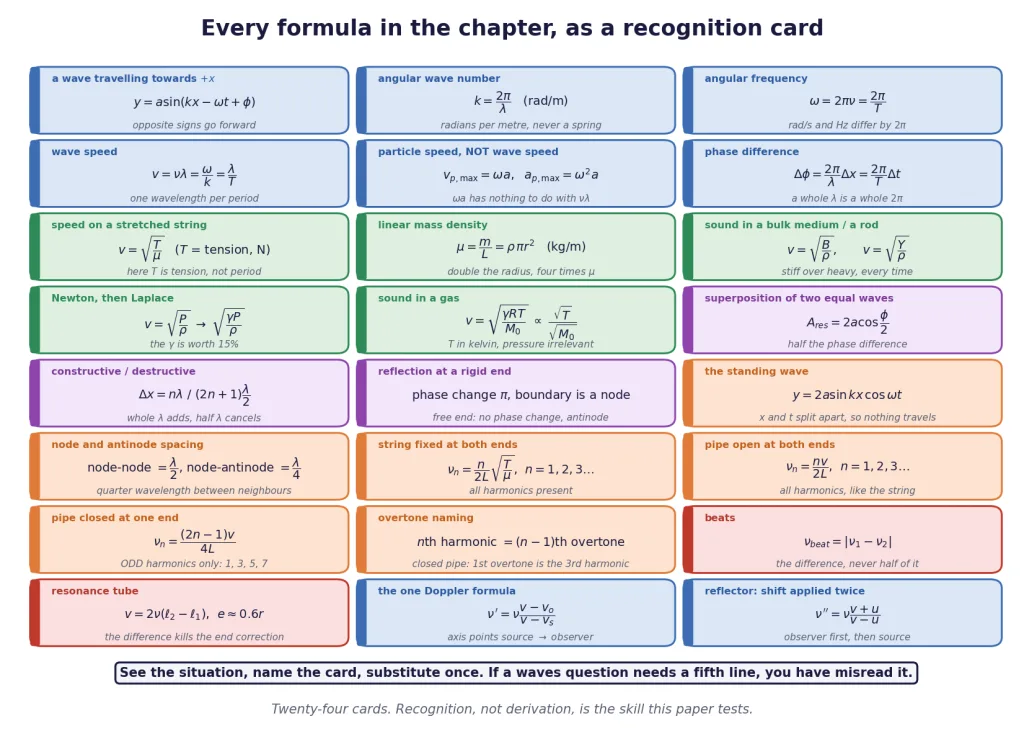
The twenty-four you must know cold
| # | Situation | Formula | Memory hook |
|---|---|---|---|
| 1 | a wave travelling towards | opposite signs go forward; same signs go back | |
| 2 | angular wave number | , in rad/m | radians per metre — never a spring constant |
| 3 | angular frequency | rad/s and Hz differ by | |
| 4 | wave speed | one wavelength advanced per period | |
| 5 | particle speed, not wave speed | , | the only place the amplitude appears |
| 6 | phase difference | a whole is a whole | |
| 7 | transverse wave on a string | , in newtons | here is tension, not period |
| 8 | linear mass density | , in kg/m | double the radius, four times |
| 9 | sound in a fluid, and in a rod | , | stiffness over inertia, every time |
| 10 | Newton, then Laplace | the is worth about 15% | |
| 11 | sound in a gas, worked form | in kelvin, | |
| 12 | two equal waves superposed | half the phase difference in the cosine | |
| 13 | interference conditions | adds; cancels | whole wavelength adds, half cancels |
| 14 | unequal amplitudes | the parallelogram law wearing a hat | |
| 15 | reflection at a rigid end | phase change ; boundary is a node | free end: no phase change, antinode |
| 16 | the standing wave | and split apart, so nothing travels | |
| 17 | node and antinode spacing | node-node ; node-antinode | a quarter wavelength between neighbours |
| 18 | string fixed at both ends | all harmonics, | |
| 19 | pipe open at both ends | all harmonics, exactly like the string | |
| 20 | pipe closed at one end | odd harmonics only: 1, 3, 5, 7 | |
| 21 | overtone naming | the th harmonic is the th overtone | but a closed pipe skips the even ones |
| 22 | resonance tube | , | the difference kills the end correction |
| 23 | beats | the difference, never half of it | |
| 24 | the Doppler shift | axis points from source to observer |
And one more, which finishes the chapter:
| # | Situation | Formula | Memory hook |
|---|---|---|---|
| 25 | reflector, or a moving vehicle heard through its own echo | the shift is applied twice |
The four traps hiding inside that table
Trap 1 — the tension symbol. Card 7 uses for tension in newtons; cards 3 and 4 use for the period in seconds. A stem that gives you "a string of length 1 m, mass 10 g, under a tension of 40 N, carrying a wave of period 0.02 s" has handed you both, on purpose. Write the units down and the ambiguity disappears.
Trap 2 — the wave speed does not care about the source. Cards 4, 7, 9 and 11 all say the same thing: belongs to the medium. Changing the frequency of the source changes and leaves alone. Changing the medium changes and and leaves alone. Frequency is the one thing that survives a change of medium, because it is set by the source and nothing else.
Trap 3 — a closed pipe is not just "half an open pipe". Its fundamental is indeed half that of an open pipe of the same length, against . But its spacing between successive modes is , which is twice its own fundamental. So an open pipe's modes go 500, 1000, 1500, 2000 Hz and a closed pipe of equal length goes 250, 750, 1250, 1750 Hz. Both spacings are 500 Hz; only one series starts there.
Trap 4 — the amplitude never appears in a speed, a frequency or a wavelength. It appears in exactly two places you need here: the particle speed , and the loudness of a sound, which goes as and is what makes the beat frequency come out as the full difference. If an option makes the wave speed or the fundamental depend on how hard the string was plucked, it is wrong before you read the rest of it.
[Exam Tip] Three unit checks are free marks. is in kilograms per metre, so a string quoted as "2 g per metre" is kg/m and not . is in rad/m and in rad/s, so a wave written as has and directly — no needed unless the stem writes the in. And a frequency in the audible range is hundreds or thousands of hertz; if your answer is 3 Hz or 3 MHz for an organ pipe, something inverted.
One Lookup: String, Open Pipe, Closed Pipe
This is the single highest-yield page in the chapter. Three systems, one table, and almost every standing-wave question on this paper is a lookup in it.
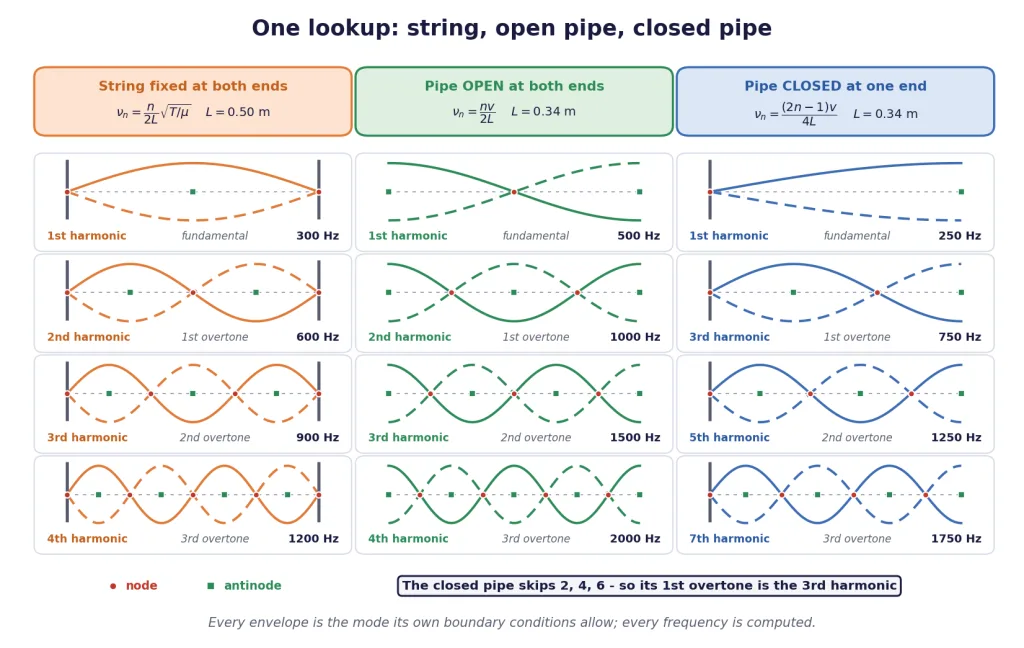
The master table
Take a string of length 0.50 m carrying waves at 300 m/s, and two pipes of length 0.34 m with the speed of sound 340 m/s, so that the three fundamentals are 300 Hz, 500 Hz and 250 Hz.
| String fixed at both ends | Pipe OPEN at both ends | Pipe CLOSED at one end | |
|---|---|---|---|
| Ends are | node, node | antinode, antinode | node, antinode |
| What fits in | whole half wavelengths | whole half wavelengths | an odd number of quarter wavelengths |
| Fundamental | |||
| Harmonics present | all: 1, 2, 3, 4, … | all: 1, 2, 3, 4, … | odd only: 1, 3, 5, 7, … |
| 1st overtone | 2nd harmonic, | 2nd harmonic, | 3rd harmonic, |
| 2nd overtone | 3rd harmonic, | 3rd harmonic, | 5th harmonic, |
| 3rd overtone | 4th harmonic, | 4th harmonic, | 7th harmonic, |
| Spacing of successive modes | |||
| The worked numbers | 300, 600, 900, 1200 Hz | 500, 1000, 1500, 2000 Hz | 250, 750, 1250, 1750 Hz |
Key Point — the mapping that questions are built on:
Harmonics are counted from the fundamental, which is the first harmonic. Overtones are counted from the first tone above the fundamental, so the fundamental is not an overtone at all. For a closed pipe the first overtone is the third harmonic, the second overtone is the fifth, the third overtone is the seventh.
Using it without slipping
The whole method is three steps, and step 1 is where the marks are.
- Turn the name into a mode number. "Third overtone" of an open pipe means the 4th harmonic. "Third overtone" of a closed pipe means the 7th harmonic. Write the harmonic number down before you touch a calculator.
- Do the physics with that number. , always — for a closed pipe as much as for an open one, provided the harmonic number you use is odd.
- Check it against the series. A closed-pipe answer that is an even multiple of is wrong by construction.
[Important] "Second harmonic" and "second overtone" are different modes in every one of the three systems. For a string or an open pipe they are and ; for a closed pipe the second harmonic does not exist and the second overtone is . Reading the wrong one of those two words is the commonest single slip in this chapter.
The three laws of the vibrating string, as ratios
Everything a sonometer question can ask sits in one line, , read three ways.
| Law | Statement | The exponent to use |
|---|---|---|
| Law of length | at fixed tension and , | halve , double |
| Law of tension | at fixed and , | quadruple , double |
| Law of mass | at fixed and , | quadruple , halve |
And the one that catches people: for a wire of the same material, , so doubling the radius quadruples and halves the frequency. The radius enters as a square before the square root gets at it, so the two effects cancel to a plain inverse first power — .
Two more air-column facts that get asked on their own
Key Point — displacement nodes are pressure antinodes. Where the air is not moving at all, layers arrive from both sides and the pressure swings hardest; where the air is swinging most freely, the pressure barely changes. So a displacement node is a pressure antinode, and a displacement antinode is a pressure node. At the closed end of a pipe: displacement node, pressure antinode. At the open end: displacement antinode, pressure node, because the open end is held at atmospheric pressure.
Key Point — the end correction. The displacement antinode sits a little outside the open end, by for a tube of radius , so the effective length of a closed pipe is . In a resonance tube you never have to measure at all: take the first two resonating lengths and and subtract, because the correction is the same in both and cancels:
The Proportionality Grid, and Reading the Graphs
Change one thing, read the exponent off
Most waves questions on this paper do not ask for a number at all. They ask what happens to the speed when the tension is quadrupled, to the fundamental when the length is halved, to the speed of sound when the air warms up. Substituting numbers into those is a waste of forty seconds.
Key Point — the four master lines, from which every entry follows: In the first line is the tension in newtons; in the second is the absolute temperature in kelvin. Everything that follows is those four lines with one quantity moved.
| Change made | Which line it touches | Factor on the answer |
|---|---|---|
| tension on a string | , and | |
| tension on a string | ||
| tension halved | ||
| quadrupled, same tension | ||
| wire radius doubled, same material and tension | , | |
| length of the string or pipe halved | ||
| length | ||
| air warmed from 27°C to 127°C | , that is | |
| air warmed from 0°C to 273°C | ||
| gas changed from oxygen to hydrogen at the same temperature | , | |
| pressure doubled at constant temperature | and rise together | unchanged |
| open pipe replaced by a closed pipe of the same length | ||
| amplitude of the wave doubled | no speed or frequency contains | , , unchanged; |
| frequency of the source doubled, same medium | fixed, so | , unchanged |
Three cells worth memorising as sentences.
To double the speed on a string you must quadruple the tension. Speeds live under square roots. Confusing with is the commonest arithmetic slip in this chapter, and the wrong one is always printed.
Temperature must be in kelvin, and only then square-rooted. From 27°C to 127°C the temperature does not go up by a factor of about 4.7; it goes from 300 K to 400 K, a factor of , and the speed rises by — about 15%. A useful working rule near room temperature: the speed of sound in air rises by roughly 0.6 m/s for every degree celsius.
Pressure does nothing. Squeeze a gas at constant temperature and both and double, so is untouched. "The speed of sound doubles when the pressure doubles" appears on option lists every year and is always wrong.
[Exam Tip] Do these as ratios, never as substitutions: No constants, no calculator, no risk of a unit slip. If you find yourself typing into a proportionality question, you have chosen the ninety-second route to a ten-second answer.
Reading the graphs
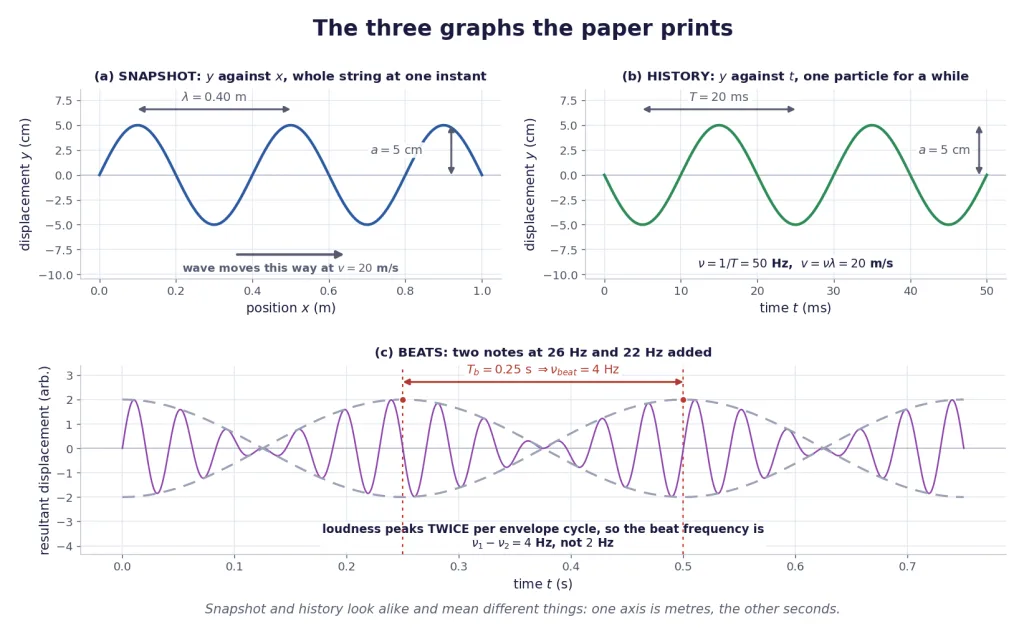
Three pictures cover almost every graph question this chapter can produce, and the first two are the ones that catch people, because they look identical.
1. The snapshot: against . A photograph of the whole medium at one instant. The horizontal axis is in metres. What you read off it is the wavelength — crest to crest — and the amplitude. You cannot read the period or the frequency from it at all.
2. The history: against . The record of one particle over a stretch of time. The horizontal axis is in seconds. What you read off it is the period — and hence — and the amplitude. You cannot read the wavelength from it.
Key Point — the habit that settles it in one second: read the axis label before you read the curve. Metres means snapshot means ; seconds means history means . Give a student both graphs and they have the whole wave, because . Give them one and half the questions are unanswerable.
In the figure the snapshot gives m and cm; the history gives ms, so Hz. Together, m/s. And the maximum particle speed is a different number entirely: m/s.
3. The beat waveform. A fast oscillation at the average frequency, inside a slowly varying envelope. The measurement that goes wrong: the beat period is the interval between successive loudness maxima, which is half the period of the envelope curve. In the figure the loudness peaks are 0.25 s apart, so Hz — which is exactly 26 Hz minus 22 Hz, and not 2 Hz.
| What you are shown | What to say |
|---|---|
| a sinusoid whose horizontal axis is in metres | a snapshot; read and |
| a sinusoid whose horizontal axis is in seconds | a history; read , then |
| a wave pattern with fixed points that never move | a standing wave; node-node is |
| loops of unequal amplitude along one string | a standing wave; count loops for the harmonic number |
| a fast oscillation inside a slow envelope | beats; the beat period is between loudness peaks |
| two pulses meeting and the medium momentarily flat | destructive superposition; energy is all kinetic |
| a graph of frequency against time stepping down as a vehicle passes | the Doppler effect |
[Important] Two habits make graph questions fast. Read the axis unit first, every time. And count the loops in a standing-wave picture: loops on a string or in an open pipe means the th harmonic; in a closed pipe count the quarter wavelengths instead, because the picture there is half a loop plus whole loops.
The Four Doppler Cases as One Routine
Four cases, four sign patterns, and an exam hall is exactly the wrong place to be remembering which is which. They are all the same statement, and this is how to write it once.
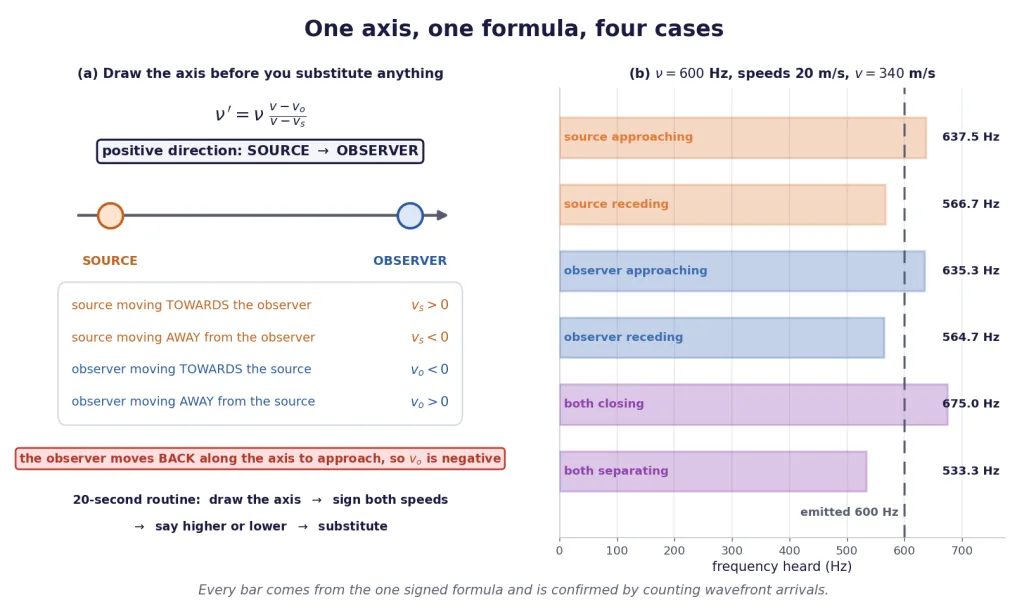
Key Point — the sign convention, and it is the whole method:
Draw the straight line joining the source to the observer, and take the direction from the SOURCE towards the OBSERVER as positive. Then and are the signed velocities of the source and the observer along that one line, and covers every case. Here is the speed of sound in the medium — not relative to anybody — and is the frequency received.
Read it once so it stops being arbitrary. The denominator is what set the wavelength: the source lays down as it moves. The numerator is how fast the sound closes on the observer: . Divide the second by the first and you have the arrival rate.
The twenty-second routine
Key Point — four steps, in this order, every time:
- Draw the axis and put the arrowhead on it, pointing from the source towards the observer.
- Sign both velocities on that axis. A body moving along the arrow is positive; against it, negative.
- Say out loud whether the answer should be higher or lower. Closing the gap means higher; opening it means lower. This is your check, and it takes two seconds.
- Substitute, then look at your answer and see whether it went the way you predicted. If it did not, you have a sign wrong — not a concept wrong.
Step 3 is not optional decoration. It is the only thing standing between you and a reversed answer, and reversed answers are always on the option list.
The four cases, with the sign that catches people
Take Hz, the speed of sound 340 m/s, and a speed of 20 m/s throughout.
| Case | Substituting | Predicted | |||
|---|---|---|---|---|---|
| source approaching, observer at rest | 637.5 Hz | higher | |||
| source receding, observer at rest | 566.7 Hz | lower | |||
| observer approaching, source at rest | 635.3 Hz | higher | |||
| observer receding, source at rest | 564.7 Hz | lower | |||
| both closing on each other | 675.0 Hz | higher still | |||
| both separating | 533.3 Hz | lower still | |||
| both moving the same way at the same speed | 600.0 Hz | unchanged |
[Important] Look hard at row three. The observer is approaching the source, and is negative. That is not a trick: the axis points away from the source, so moving towards the source means moving in the negative direction. Say it out loud each time — approaching the source means a negative , because the axis points away from the source — and the one sign everybody reverses stops being a problem.
Three facts that come with it
The effect is not symmetric. Compare rows one and three: the same 20 m/s of approach gives 637.5 Hz when the source moves and 635.3 Hz when the observer moves. Sound has a medium, and moving through it is a genuinely different physical event from staying still in it while the source moves. For light, which has no medium, the shift is symmetric and only the relative velocity matters.
A reflector is shifted twice. A wall, a car, a red blood cell — anything that bounces the sound back is first an observer receiving a shifted frequency, and then a source re-emitting exactly what it received. Apply the formula twice, drawing a fresh axis for the return leg because the sound is now travelling the other way. For the common arrangement of a source and observer riding together at speed straight at a stationary reflector, the two steps collapse to
A wind changes nothing if nobody is moving. Add the wind's component along the axis to everywhere. With both source and observer at rest, cancels top and bottom and the pitch is unaltered. The wind does change the wavelength in the air and the arrival time, but not the frequency.
[Exam Tip] Three sanity checks that cost nothing. The shift is always small at ordinary speeds — a 20 m/s vehicle changes a 600 Hz horn by tens of hertz, not hundreds. An approaching source raises the pitch by more than an equal receding speed lowers it, because sits in the denominator; that is why the true frequency of a passing horn is the harmonic mean of the two heard frequencies, not the ordinary average. And if a stem gives a source speed at or above the speed of sound and asks what is heard in front, the answer is that nothing is heard in front — the source has outrun its own sound.
Waves Wearing a Lab Coat, and the Two Special Formats
Two thirds of this paper is about living things, and sound reaches further into biology than any other topic in mechanics. Hearing is a wave detector. Ultrasound imaging is a wave reflected. Blood-flow measurement is the Doppler effect used as an instrument. Expect at least one of your waves questions to arrive wearing biological clothes, and be pleased when it does, because the physics inside is always the easy kind.
The audible range, and what sits on either side of it
Key Point — the three bands, and the numbers are asked directly:
Band Frequency Who uses it infrasound below 20 Hz elephants, whales, earthquakes; felt rather than heard audible 20 Hz to 20000 Hz the healthy young human ear ultrasound above 20000 Hz bats, dolphins, medical scanners, sonar, cleaning baths The upper limit falls with age — an adult may hear only to 15000 Hz — and prolonged loud noise damages the high-frequency end first.
The wavelengths that go with those limits are worth carrying, because they explain everything else. At 340 m/s, a 20 Hz note has m, and a 20000 Hz note has m, which is 1.7 cm. The audible range spans a factor of a thousand in wavelength, from the length of a room to the width of a finger.
Why medical ultrasound uses megahertz
Key Point: A wave cannot resolve detail much finer than its own wavelength, so a shorter wavelength means a sharper image. In soft tissue the speed of sound is about 1540 m/s, so a 2 MHz probe works at which is 0.77 mm — fine enough to see a structure a millimetre across. Audible sound at 2000 Hz is a thousand times lower in frequency, so in that same tissue it stretches to a thousand times that wavelength, m, which is 77 cm and would show nothing at all. Ultrasound is used because it is short, not because it is inaudible.
Three more facts that get asked with it. Ultrasound is non-ionising, which is why it is safe for imaging a foetus while X-rays are not. It works by echo: a pulse goes in, reflects from each boundary between tissues of different density, and the time delay gives the depth, exactly as sonar does under water. And it is directional — a short wavelength can be sent as a narrow beam, whereas a low-frequency wave spreads out in all directions, which is why you can locate a source of high notes but not of a low rumble.
Doppler blood-flow measurement
Key Point: Red blood cells moving through a vessel act as moving reflectors. The probe is a stationary source, the cells receive a shifted frequency as moving observers, and re-emit it as moving sources — the shift is applied twice. For a cell moving at speed towards the probe, with far smaller than the speed of sound in tissue, the returned frequency is raised by Blood at 0.30 m/s scattering 2 MHz in tissue at 1540 m/s returns a shift of about 780 Hz — four parts in ten thousand, small but easy to measure against the transmitted signal.
Colour Doppler paints flow towards the probe in one colour and flow away in another, taken straight from the sign of the shift. It is used to find blocked arteries, leaking heart valves and a foetal heartbeat. And the same physics with the same double shift is what a bat uses: 45 kHz emitted while flying at 6 m/s at a wall comes back at about 46.6 kHz, a rise of some 1600 Hz that the bat reads as a closing speed.
The rest of the list, one line each
| Observation | The physics |
|---|---|
| Astronauts outside a spacecraft must use radio | sound is mechanical and needs a medium; radio is electromagnetic |
| A doctor's stethoscope | sound guided along an air column instead of spreading out |
| A bat hunting in the dark, a dolphin in murky water | echolocation: ultrasound plus the time delay of the echo |
| A dog whistle nobody can hear | above 20000 Hz — ultrasound for us, audible for the dog |
| The pitch of a mosquito against that of a bumblebee | wingbeat frequency; the pitch you hear is |
| A man's voice is lower than a woman's | longer, more massive vocal folds, so a lower |
| Breathing helium makes a voice squeaky | , so every resonance of the vocal tract rises |
| A kidney stone broken up without surgery | focused high-intensity ultrasound |
| An ambulance siren dropping in pitch as it passes | the Doppler effect, source motion |
[Exam Tip] In every one of these the physics being tested is one of exactly four things: a conversion, the audible-range boundaries, the word "Doppler" with its shift applied once or twice, or the classification transverse / longitudinal / mechanical / electromagnetic. Decide which of the four it is before you read the options, and the biology stops mattering.
Assertion-Reason: the four codes
You are given an Assertion (A) and a Reason (R) and asked to choose:
| Code | Meaning |
|---|---|
| (a) | Both A and R are true, and R is the correct explanation of A |
| (b) | Both A and R are true, but R is not the correct explanation of A |
| (c) | A is true but R is false |
| (d) | A is false but R is true |
Read the option list before you start — the order of these four is not fixed between papers, and choosing "option (a)" from memory when the paper has shuffled them is a self-inflicted wound.
Key Point: Three separate judgements, in this order, and never let one influence the next:
- Cover R. Is A true, on its own?
- Cover A. Is R true, on its own?
- Only if both are true: does R actually explain A, or is it merely another true statement about the same topic?
Step 3 is where the marks are. Ask: if R were false, would A stop being true? If yes, R explains A. If A would survive without R, the answer is (b).
Column matching: anchor, do not solve
You are given four items in Column I, four in Column II, and four codes. Never work out all four pairings. Find the one or two that are unmistakable and use them to kill codes.
Key Point: Anchor on whatever is structurally unique in Column II — the only entry with a in it, the only one that is a difference of two frequencies, the only one carrying a , the only zero. Two anchors almost always leave exactly one surviving code.
[Exam Tip] In this chapter one anchor is nearly always free. Anything with in it is a closed pipe; anything with is a string; a difference of two frequencies is beats; a ratio with in both numerator and denominator is Doppler; can only be node-to-antinode. Find whichever of those appears and you have a pairing before you have finished reading the question.
The six habits that finish a waves question in under 45 seconds
1. Read the last line of the stem first. It tells you which card you need and, half the time, which trap is set. "Wave speed" and "maximum particle speed", "second harmonic" and "second overtone", "frequency" and "beat frequency" all change the answer without changing the topic.
2. Write the unit on every symbol you carry. in newtons or in seconds. in kg/m, so "2 g/m" is . in rad/m. That habit alone removes three of this chapter's five standard wrong answers, and it costs two seconds.
3. Ask whether the question is a ratio. If two situations are being compared, cancel everything common and read the exponent off the master line. No constants, no calculator. Nearly every proportionality in this chapter is a square root or a plain reciprocal.
4. For any pipe or string question, name the harmonic number before anything else. Convert "third overtone" into a harmonic number on the page — 4 for a string or open pipe, 7 for a closed pipe — and the rest is one multiplication.
5. For any Doppler question, draw the axis before you substitute, and predict the direction of the shift. Four seconds spent there is the difference between a reliable four marks and a coin toss.
6. Sanity-check the size before you look at the options. Sound in air is a few hundred metres per second; on a taut string, a few hundred too. An organ pipe sounds in the hundreds of hertz. A beat rate is a few per second. A Doppler shift at road speeds is tens of hertz. If your answer is a decade away from those, you have inverted a fraction or dropped a square root.
[Important] One last habit, and it is about the clock rather than the physics. If forty seconds have gone and you are still on line two, mark it and move. A waves question on this paper is worth exactly as much as the easier ones elsewhere in it, and four marks lost to the clock at the end of the paper cost the same as the four you were fighting for here.
Solved Examples
Eleven problems at exam level and exam pace. Give yourself 45 seconds on each before reading the solution. Throughout, the speed of sound in air is 340 m/s unless the problem says otherwise, , kg/m³ at STP and Pa. Temperatures inside a are always in kelvin. Every Doppler solution states its positive direction before substituting, and says whether the pitch should rise or fall before computing it.
Example 1: Eighteen statements, no arithmetic
Answer each in a single sentence, with no calculation.
(a) Distinguish transverse from longitudinal waves, with one example of each. (b) Why must sound in air be longitudinal? (c) Why can sound not travel through a vacuum? (d) State the principle of superposition. (e) Why does a rigid boundary reflect with a phase change of ? (f) What happens at a free boundary instead? (g) Give three differences between a standing wave and a progressive wave. (h) What is a node, and what is an antinode? (i) How far apart are two adjacent nodes, and a node and its nearest antinode? (j) Why does a closed pipe have only odd harmonics? (k) Which is the first overtone of a closed pipe? (l) What are beats, and what is the beat frequency? (m) Why is the beat frequency the difference and not half of it? (n) What is the Doppler effect, and give one application? (o) Is the Doppler effect for sound symmetric between source motion and observer motion? (p) Does the speed of sound in a gas depend on its pressure? (q) What is the audible range for a human? (r) Where is a displacement node in a pressure picture?
Solution:
(a) In a transverse wave the particles oscillate at right angles to the direction of travel — a wave on a stretched string. In a longitudinal wave they oscillate along it, making compressions and rarefactions — sound in air.
(b) Because a gas has no rigidity: it cannot resist a shearing, sideways push, so there is no restoring force for a transverse disturbance. Only a compression can travel.
(c) Sound is a mechanical wave, passed on by one layer of the medium pushing the next. A vacuum has no particles to push, so there is nothing to carry the disturbance.
(d) When two or more waves overlap, the resultant displacement of any particle is the vector sum of the displacements each wave would produce alone, and each wave then continues unchanged.
(e) Because the boundary cannot move, so the resultant displacement there must be zero at all times. Only a returning trough can cancel an arriving crest, so the reflected wave is inverted — a phase change of — and the boundary is a node.
(f) A free end offers no transverse resistance, so it overshoots to : the reflection is not inverted, there is no phase change, and the boundary is an antinode.
(g) The pattern does not travel; the amplitude varies with position as instead of being the same everywhere; and there are nodes that never move. (Also: no net energy is transported.)
(h) A node is a point of permanently zero displacement; an antinode is a point of maximum displacement, .
(i) Node to node is ; node to nearest antinode is .
(j) It has a displacement node at the closed end and an antinode at the open end, which are apart, so an odd number of quarter wavelengths must fit: . An even number would put the same kind of point at both ends, which this pipe cannot have.
(k) The third harmonic, at . The second harmonic does not exist.
(l) The periodic rise and fall of loudness when two notes of nearly equal frequency sound together, at a rate .
(m) Because the ear responds to loudness, which goes as the square of the amplitude, so it cannot tell a positive bulge of the envelope from the negative one that follows. Loudness peaks twice per envelope cycle, doubling the envelope's frequency back to the full difference.
(n) The apparent change in the frequency received when there is relative motion between source and observer, with the emitted frequency unchanged. Application: the speed gun, or Doppler ultrasound for blood flow.
(o) No. Sound has a medium, and moving through it is a different physical event from standing still in it. For light the shift is symmetric, because there is no medium.
(p) No. Compressing a gas at constant temperature raises and in the same proportion, so is unchanged.
(q) About 20 Hz to 20000 Hz.
(r) A displacement node is a pressure antinode — the pressure swings hardest exactly where the air does not move.
Takeaway: Eighteen questions, no arithmetic, and about four minutes of your life. Every one of them has been the whole of somebody's four marks.
Example 2: One wave written down, seven quantities read off
A transverse wave on a long string is described by , with and in metres and in seconds. Find (a) the amplitude, (b) the wavelength, (c) the frequency and the period, (d) the direction and speed of travel, (e) the maximum particle speed, (f) the maximum particle acceleration, and (g) the phase difference between two points 0.05 m apart.
Solution:
Compare with , term by term. That comparison is the whole question.
(a) m, that is 3 cm.
(b) rad/m, so
(c) rad/s, so Write the units. The answer "600 Hz" is the same number as with the wrong unit stuck on it, and it is always an option.
(d) The signs of and are opposite, so the wave travels towards , and Check it the other way: m/s. Same.
(e) This is the part that is answered wrongly most often: 18 m/s is not 30 m/s. The wave speed is a property of the string; the particle speed depends on how hard the string was shaken. Notice the ratio: , which is a neat check.
(f) m/s².
(g) Card 6, straight off: Reading it as saves computing at all.
Takeaway: Seven answers, seven single lines. The comparison hands you , and directly, and everything else is one step from those. The only place a mark is genuinely at risk is part (e).
Example 3: Three speeds, three formulas
(a) A wire of length 2.0 m and mass 5.0 g is stretched to a tension of 400 N. Find the speed of a transverse wave on it. (b) The speed of sound in air at 27°C is 340 m/s. Find it at 127°C. (c) Compute the speed of sound in air at STP from Newton's formula and from the Laplace-corrected formula, taking Pa, kg/m³ and , and say which one experiment supports.
Solution:
(a) First , in kilograms per metre: Here N is a tension. Grams left as grams give an answer times too small, and that wrong answer is printed.
(b) Absolute temperatures: 27°C is 300 K and 127°C is 400 K. Then , done as a ratio: A rise of about 15%. Using 27 and 127 directly instead of 300 and 400 gives a factor of , which is nonsense — sound does not more than double in speed on a warm day.
(c) Newton assumed the compressions were isothermal, giving : Laplace's correction is that the compressions are so rapid that no heat leaks out, so they are adiabatic and the bulk modulus is : The measured value at STP is about 331 m/s, so Laplace is right and Newton is low by about 15%. The whole discrepancy is the single factor .
Takeaway: Three formulas, three answers. The only judgement anywhere is remembering that is in kg/m, that temperature goes in as kelvin, and that the is what rescues Newton.
Solved Examples (continued)
Example 4: Seven proportionality questions in two minutes
For each change state the factor, with no calculator.
(a) The tension in a string is quadrupled. What happens to the wave speed? (b) And to the fundamental frequency? (c) A wire is replaced by one of the same material and tension but twice the radius. What happens to the fundamental? (d) A string's length is halved at fixed tension. What happens to the fundamental? (e) Air is warmed from 27°C to 127°C. What happens to the speed of sound? (f) The pressure of a gas is doubled at constant temperature. (g) An open pipe is replaced by a closed pipe of the same length.
Solution:
Everything comes off two lines, and neither needs a number substituted into it:
(a) , so . The speed doubles. To double a wave speed you must quadruple the tension, and "the speed quadruples" is always on the option list.
(b) with unchanged, so the fundamental follows the speed exactly: also .
(c) Same material, so : doubling makes four times larger. Then The fundamental halves. Notice how the squares and the square root combine: , a plain reciprocal, which is worth remembering as its own sentence.
(d) at fixed , so halving gives . The fundamental doubles. This is not a square root — the length enters the frequency directly, unlike the tension.
(e) In kelvin, 300 K to 400 K: About 15% faster.
(f) Unchanged. At constant temperature both and double, so is untouched. Pressure never appears in the answer on its own.
(g) , so — the closed pipe sounds one octave lower. But its successive modes are still apart, so its series is 1, 3, 5, 7 times its own new fundamental.
Takeaway: Seven answers, no arithmetic beyond one square root of . Cancel first, and only then look for a calculator — you will find you do not need one. Watch which quantities sit under the root (, , ) and which do not ().
Example 5: The lookup table, used six times
Take the speed of sound as 340 m/s. (a) A string 0.50 m long carries waves at 300 m/s. Find its fundamental and its third overtone. (b) A pipe 0.34 m long is open at both ends. Find its fundamental and its second overtone. (c) The same pipe is now closed at one end. Find its fundamental and its first overtone. (d) A closed pipe sounds 1750 Hz. Which harmonic and which overtone is that, if its fundamental is 250 Hz? (e) Can a closed pipe of fundamental 250 Hz sound 1000 Hz? (f) In a resonance tube with a fork of 512 Hz, the first two resonating lengths are 0.16 m and 0.50 m. Find the speed of sound and the end correction.
Solution:
(a) String, all harmonics present. Third overtone 4th harmonic Hz.
(b) Open pipe, all harmonics present. Second overtone 3rd harmonic Hz.
(c) Closed pipe, odd harmonics only. First overtone 3rd harmonic Hz. Not 500 Hz, which is what the open-pipe habit produces and which the closed pipe cannot sound at all.
(d) , so it is the seventh harmonic. Counting overtones on the odd ladder — 1st, 3rd, 5th, 7th are the fundamental and the first, second and third overtones — it is the third overtone.
(e) No. , an even multiple, and a closed pipe has no even harmonics. An open pipe with the same 250 Hz fundamental could sound it, as its 4th harmonic.
(f) Resonance tube. The first two resonances are a half wavelength apart, whatever the end correction is, so and the correction comes out of the two lengths together: that is 1 cm, consistent with a tube of radius about 1.7 cm.
Takeaway: Convert the overtone name into a harmonic number on the page before you compute anything — 4 for a string or open pipe, but 3, 5, 7 for a closed one. Then it is a single multiplication. Part (e) is the check that costs nothing: divide by the fundamental and see whether the answer is an allowed multiple.
Example 6: Four beat questions
(a) Two forks of 256 Hz and 260 Hz are sounded together. Find the beat frequency and the beat period. (b) A fork gives 5 beats per second with a standard 288 Hz fork. When a little wax is stuck to the unknown fork, the rate falls to 3 beats per second. What was the unknown frequency? (c) 24 beats are counted in 6 seconds. What is the beat frequency? (d) On a beat waveform the loudness maxima are 0.25 s apart. What is the frequency difference, and what would you get if you measured the envelope's own period instead?
Solution:
(a) Hz, so the beat period is second. The average frequency of the sound heard is Hz — that is the pitch; the 4 Hz is the throb.
(b) Five beats per second means the unknown is either Hz or Hz. Loading a fork with wax adds mass and always lowers its frequency.
- If it was 293 Hz, loading takes it down towards 288, so the gap shrinks — beats fall from 5 to 3. This matches.
- If it was 283 Hz, loading takes it further below 288, so the gap grows — beats would rise above 5. This does not match.
So the unknown fork was 293 Hz, and after loading it is at Hz.
(c) Hz. Counting over several seconds rather than one is exactly how it is done in a laboratory, because a single second is too short to count reliably.
(d) The loudness maxima are the beats, so Hz and the frequency difference is 4 Hz. If instead you measured from one envelope maximum to the next, you would get 0.50 s and report 2 Hz — exactly half the right answer. The envelope goes positive, negative, positive, but the ear hears a loud burst at both the positive and the negative bulge, so loudness peaks twice per envelope cycle.
Takeaway: The beat frequency is the difference, the pitch heard is the average, and the ambiguity in part (b) is resolved by knowing which way loading or filing moves a fork: wax lowers, filing raises. Part (d) is the factor of two that the whole derivation exists to establish.
Solved Examples (continued)
Example 7: The Doppler routine, run five times
Take the speed of sound as 340 m/s and an emitted frequency of 600 Hz. Find the frequency heard when (a) the source moves towards a stationary observer at 20 m/s; (b) the source moves away at 20 m/s; (c) the observer moves towards a stationary source at 20 m/s; (d) both move towards each other at 20 m/s each; (e) both travel the same way at 20 m/s, the source behind the observer.
Solution:
Draw the axis once: positive from the source towards the observer. Then every time, and the only work is signing two numbers.
(a) Source approaching. The gap is closing, so the pitch must rise. The source moves along the axis, so , and : Higher, as predicted.
(b) Source receding. Pitch must fall. Now :
(c) Observer approaching. Pitch must rise. The source is at rest, so . The observer moves towards the source, that is backwards along the axis, so : Higher, as predicted — and notice that it is not the same as part (a). The same 20 m/s of approach gives 637.5 Hz when the source moves and 635.3 Hz when the observer does. The Doppler effect for sound is not symmetric, because the air is a real stage that only one of them is moving through.
(d) Both closing. Pitch must rise more than either alone. and :
(e) Both moving the same way at the same speed. Both velocities point along the axis, so : No shift at all. The distance between them is not changing, so there is nothing to shift. This is not a special rule — it is the formula doing its job.
Takeaway: One axis, one formula, five answers. Say "higher" or "lower" before you substitute and a reversed sign announces itself immediately. And part (c) against part (a) is the asymmetry, worth a mark on its own.
Example 8: Two reflectors, and a shift applied twice
(a) A train sounds a 500 Hz horn while approaching a cliff at 30 m/s. What frequency does the driver hear in the echo? Speed of sound 340 m/s. (b) A Doppler ultrasound probe transmits 2.0 MHz into tissue where the speed of sound is 1540 m/s. Blood is flowing towards the probe at 0.30 m/s. Estimate the frequency shift in the returned signal.
Solution:
The reflector rule, once: a reflecting surface is first an observer, receiving whatever the formula gives for its own motion, and then a source, re-emitting exactly what it received. Apply the shift twice.
(a) Step 1, the cliff as observer. Axis from the train towards the cliff. The train moves along it, so ; the cliff is at rest, . Closing, so higher:
Step 2, the cliff as source. New axis, now from the cliff towards the driver. The cliff is at rest, . The driver is moving towards the cliff, so backwards along this new axis: . Closing again, so higher again:
Both legs raised the pitch, so the echo comes back at about 597 Hz against the 500 Hz sounded. The shortcut for this arrangement — source and observer riding together at towards a stationary reflector — gives the same thing in one line:
(b) Same structure, with the blood as the moving reflector and the probe stationary at both ends. Because is tiny compared with , the double shift collapses to about 780 Hz on 2 MHz — a fractional change of four parts in ten thousand, small but perfectly measurable against the transmitted signal. Flow towards the probe raises the frequency; flow away lowers it, and colour Doppler paints the two in different colours straight from that sign.
Takeaway: Reflector means twice, and the tell-tale of a correct double shift is that the moving speed appears once in the numerator and once in the denominator, . A single application gives about half the shift and is always offered.
Example 9: Reading three graphs
(a) A graph of against for a wave on a string shows crests 0.40 m apart and a maximum displacement of 5 cm. What can you read off it, and what can you not? (b) A graph of against for one particle of the same wave shows a full oscillation every 20 ms. Now what can you find? (c) For that wave, compare the wave speed with the maximum particle speed. (d) A beat waveform shows loudness maxima 0.25 s apart. What is the frequency difference? (e) A standing wave on a 1.2 m string shows three loops. What is the wavelength, and which harmonic is it?
Solution:
(a) The horizontal axis is in metres, so this is a snapshot — the whole string frozen at one instant. It gives m and cm. It gives you nothing about time: not the period, not the frequency, and therefore not the speed.
(b) The horizontal axis is in seconds, so this is a history — one particle followed through time. It gives ms, hence Now the two graphs together give the wave completely:
(c) Two different quantities: The wave crosses the string at 20 m/s; no particle of the string ever exceeds 15.7 m/s, and each of them only goes up and down. The two numbers have nothing to do with each other.
(d) The loudness maxima are the beats, so Hz, and the two frequencies differ by 4 Hz. Measuring from one envelope crest to the next would give 0.50 s and the wrong answer 2 Hz.
(e) Each loop is half a wavelength, so three loops mean : Three loops on a string fixed at both ends is the third harmonic, which is the second overtone.
Takeaway: Read the axis unit before the curve. Metres means snapshot means ; seconds means history means . Loops count harmonics; loudness peaks count beats. Every one of these is a five-second answer once you know which picture you are looking at.
Solved Examples (continued)
Example 10: Four assertion-reason items, judged three times each
For each pair choose: (a) both true and R explains A; (b) both true but R does not explain A; (c) A true, R false; (d) A false, R true.
(i) A: Sound cannot travel through a vacuum. R: Sound is a mechanical wave and needs a material medium to carry the disturbance.
(ii) A: A closed organ pipe cannot sound its second harmonic. R: A closed pipe has a displacement node at the closed end and an antinode at the open end.
(iii) A: A standing wave transports no net energy along the string. R: In a standing wave the amplitude varies with position as .
(iv) A: When two notes of 256 Hz and 260 Hz sound together the beat frequency is 2 Hz. R: The envelope of the resultant oscillates at half the difference of the two frequencies.
Solution:
(i) A alone: true. R alone: true. Does R explain A? Yes, exactly: a mechanical wave propagates by one layer pushing the next, and a vacuum has no layers. Answer (a).
(ii) A alone: true — a closed pipe has only the odd harmonics. R alone: true, and it is the standard description of the boundary conditions. Does R explain A? Yes. Node and antinode are apart, so the pipe must hold an odd number of quarter wavelengths; an even number would demand the same kind of point at both ends. The second harmonic is exactly the case that demands a node at the open end. Answer (a).
(iii) A alone: true. R alone: true. Does R explain A? No. R says only that different particles have different amplitudes, which is a statement about the shape of the pattern. The reason no energy flows is different: the standing wave is the sum of two waves of equal amplitude travelling in opposite directions, so the energy each carries is exactly cancelled by the other, and the nodes never move so no energy can cross them. Two true sentences about the same object with no explanatory link between them. Answer (b). This is the hardest of the four, and it is the pattern the format exists to test.
(iv) A alone: false — the beat frequency is the full difference, Hz. R alone: true: the envelope factor is , which does oscillate at 2 Hz. Answer (d). And notice the construction: the true statement about the envelope has been used to smuggle in a false statement about what is heard. The ear responds to loudness, which peaks twice per envelope cycle, doubling 2 Hz back to 4 Hz.
Takeaway: Cover R and judge A. Cover A and judge R. Only then ask whether R explains A rather than merely sitting beside it. Item (iv) shows why step one must come first: had you read R and agreed with it, you might have let a false assertion through.
Example 11: Two column-matching sets, anchored not solved
Set 1. Column I: (A) (B) (C) (D) . Column II: (i) beat frequency (ii) string fixed at both ends (iii) Doppler shift (iv) pipe closed at one end.
Set 2. Column I: (A) distance between two adjacent nodes (B) distance between a node and the nearest antinode (C) phase change on reflection at a rigid boundary (D) phase change on reflection at a free boundary. Column II: (i) (ii) (iii) zero (iv) .
Solution:
Set 1 — find the structurally unique entries first.
Anchor 1: exactly one formula in Column I contains a , and can only be a closed pipe. A-iv. Anchor 2: exactly one contains , and that can only be a string. B-ii. Two anchors, and the rest is forced: a plain difference of two frequencies is beats, C-i, and the ratio with above and below is Doppler, D-iii.
Final: A-iv, B-ii, C-i, D-iii. Total working: about ten seconds, and two of the four pairings were never thought about at all.
Set 2 — anchor on the odd one out.
Anchor 1: exactly one entry in Column II is zero, and exactly one situation in this chapter has no phase change: reflection at a free boundary. D-iii. Anchor 2: the two lengths are the easy pair, and they are the ones most often swapped. Node to node is a half wavelength; node to the nearest antinode is a quarter. So A-ii and B-iv. The survivor: a rigid boundary reflects with a phase change of , C-i.
Final: A-ii, B-iv, C-i, D-iii.
[Exam Tip] In both sets the anchors were found by looking for structural oddities — the only , the only , the only zero — never by working out a pairing. Once two pairings are fixed, a four-item code list almost always has a single survivor. Match two, eliminate, and move.
Takeaway: Column matching is an elimination exercise wearing the costume of a calculation. Find the entry that could only be one thing, and let it kill three of the four codes.