
Sound in a Pipe Is a Standing Wave Too
Blow across the mouth of an empty bottle and you get a note. Blow across the same bottle half full of water and you get a higher note. Nothing about the air changed — the speed of sound in it is exactly the same. What changed is the length of the air column, and with it the set of standing waves that the column can hold.
That is the whole of this section. A pipe of air is the same problem as a stretched string: send a wave in, let it reflect off the ends, superpose the wave with its reflection, and only certain frequencies survive. The physics is identical. The boundary conditions are not, and they are what change the answer.
What is doing the vibrating
Sound is a longitudinal wave, so the air does not move across the pipe — it moves back and forth along the pipe's axis. To keep that straight, write the displacement of an air element as , measured along the axis, where is the distance from one end of the pipe. Everything you learned about on a string carries over unchanged; only the direction of the wiggle is different.
When a wave travelling along the pipe meets an end and reflects, the wave and its reflection add to give
or the same thing with , depending on where the origin is placed. Either way, the -dependence and the -dependence have separated: the pattern stands still and only breathes in place, with displacement nodes where the amplitude is permanently zero and displacement antinodes where it is the full .
| Symbol | Meaning | Unit |
|---|---|---|
| displacement of an air element, along the pipe | m | |
| length of the air column | m | |
| wavelength | m | |
| angular wave number | rad/m | |
| frequency | Hz | |
| angular frequency | rad/s | |
| speed of sound in the air of the pipe | m/s | |
| end correction at an open end | m |
Here is the angular wave number and nothing else — it is not a spring constant in this chapter.
The two ends, and the two rules
Everything about pipes comes out of two facts you already have from the study of reflection.
A closed end is a displacement node. The end is sealed by a rigid wall. Air cannot pass through it and cannot pile up against it and move — the wall simply will not budge. So the air element sitting right at the closed end has zero displacement at all times. That is exactly the rigid-boundary condition: the reflection there comes back with a phase change of , and the boundary is forced to be a node.
An open end is a displacement antinode. At the open end the air column is in contact with the whole atmosphere. There is nothing to stop the air there from sloshing in and out, and the free atmosphere keeps the pressure at that point pinned at atmospheric — the pressure variation is zero there. An end that is free to move as much as it likes is the free-boundary case: the reflection returns with no phase change, and the boundary becomes an antinode.
Key Point — the only two rules you need for pipes:
- Closed end displacement NODE.
- Open end displacement ANTINODE.
Every wavelength, every frequency, every "which harmonics are present" question in this section is obtained by fitting a sine curve into the pipe so that these two conditions hold at the two ends. Nothing else is needed.
Two spacings do the fitting for you, and both were established for standing waves in general:
[Board Important] A very common slip is to say "the open end is a node because the air escapes there". It is the opposite. The open end is where the air is freest to move, so it is an antinode of displacement. The closed end is where the air cannot move at all, so it is the node.
One honest caution before the formulas. The displacement antinode at an open end does not sit exactly at the mouth of the pipe; it lies a small distance outside it, because the air just beyond the mouth is dragged along too. That distance is the end correction, and it is developed at the end of this section. Until then, take the antinode to be at the mouth — that is the idealisation every formula below is built on.
A Pipe Open at Both Ends
A flute, an organ flue pipe and a length of plastic tubing held open at both ends are all the same object: an air column with an antinode at each end.
Fitting the wave in
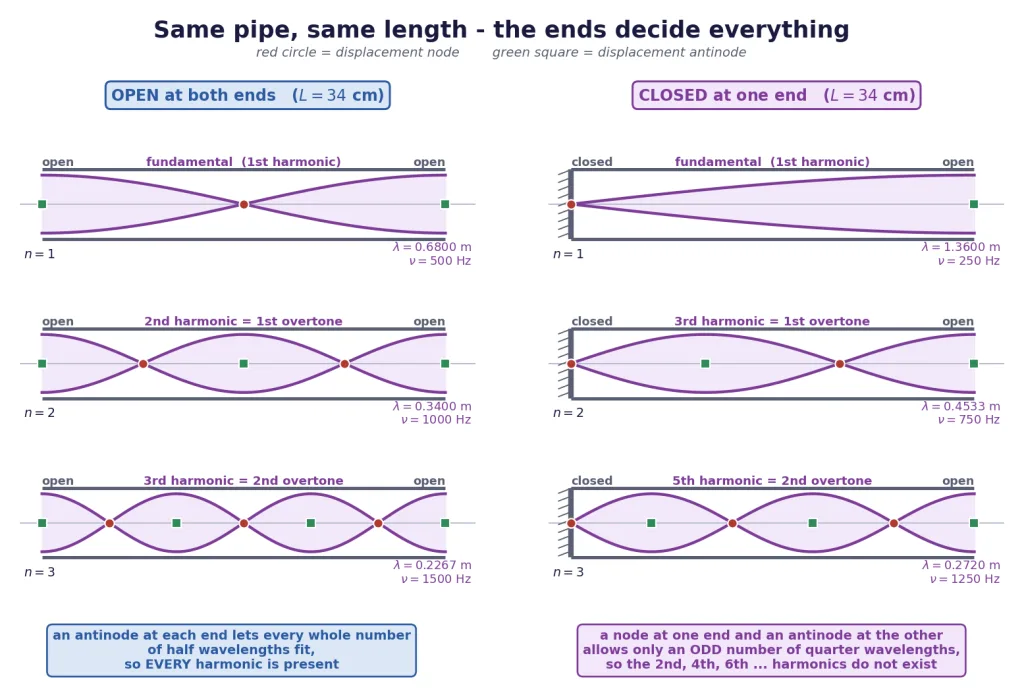
Start from the boundary conditions and count. There must be an antinode at and an antinode at . Neighbouring antinodes are apart, so the pipe must hold a whole number of half wavelengths:
Rearranging, and then converting to a frequency with :
Key Point — pipe open at both ends: The fundamental (first harmonic) is , and every integer multiple of it is a mode of the pipe.
Notice what this is: exactly the result for a string fixed at both ends, with replaced by the speed of sound in air. The string had a node at each end and the open pipe has an antinode at each end, and it makes no difference to the counting — either way you are fitting whole half-wavelengths between two identical ends.
The first four modes
Take a pipe of length 34 cm with the speed of sound 340 m/s, so that Hz.
| Name | Nodes inside | Antinodes | |||
|---|---|---|---|---|---|
| 1 | fundamental, 1st harmonic | 0.68 m | 500 Hz | 1 | 2 |
| 2 | 2nd harmonic, 1st overtone | 0.34 m | 1000 Hz | 2 | 3 |
| 3 | 3rd harmonic, 2nd overtone | 0.2267 m | 1500 Hz | 3 | 4 |
| 4 | 4th harmonic, 3rd overtone | 0.17 m | 2000 Hz | 4 | 5 |
Two patterns are worth locking in. The th mode has displacement nodes inside the pipe and antinodes counting the two ends. And the frequencies are — a plain arithmetic ladder, every rung present.
Harmonics and overtones are two different countings
Harmonics are counted from the fundamental: the fundamental is the first harmonic, twice it is the second harmonic, three times it is the third. Overtones are counted from the first tone above the fundamental: the lowest frequency above the fundamental is the first overtone, the next is the second overtone, and so on.
For an open pipe, where every harmonic exists, the two countings differ by exactly one:
so the first overtone of an open pipe is its second harmonic, at . That much is easy. It stops being easy at the closed pipe, taken up below, where the even harmonics are missing and the two countings no longer differ by one.
[JEE Tip] Two questions that sound the same are not. "The fundamental of an open pipe is 500 Hz. Find its first overtone" wants 1000 Hz. "Find its second harmonic" also wants 1000 Hz. But "find its second overtone" wants 1500 Hz, and "find its third harmonic" also wants 1500 Hz. Translate the words into a harmonic number before you multiply anything.
Two useful consequences
A shorter pipe sounds higher. Since , halving the length doubles the fundamental — one octave up. That is what a flute player does by opening a hole: the air column effectively ends at the first open hole, which shortens .
A warmer pipe sounds higher. The length has not changed, but has. The speed of sound in a gas goes as the square root of the absolute temperature, so with in kelvin. A wind instrument carried in from the cold plays flat until it warms up, which is why players blow warm air through it before a performance.
A Pipe Closed at One End
Now seal one end. A test tube, a bottle, a clarinet, an organ stopped pipe and the resonance tube in your laboratory are all this object: an air column with a node at one end and an antinode at the other.
Fitting the wave in
A node and its neighbouring antinode are apart. So the shortest column that works holds exactly one quarter wavelength. Add a further half wavelength — which is a node plus an antinode — and the ends still satisfy their conditions. Keep going, and the pipe holds an odd number of quarter wavelengths:
Key Point — pipe closed at one end: The fundamental is , and the modes are — only the odd harmonics exist.
Why the even harmonics simply are not there
This is not a rule to memorise; it is arithmetic. Suppose you tried to run the second harmonic, at , in a closed pipe. Its wavelength would be , so a quarter wavelength is and the pipe would have to hold two quarter wavelengths. But two quarter wavelengths take you from a node to an antinode and back to a node — you would end up with a node at the open end, and the open end must be an antinode. The mode is impossible. The same argument kills the 4th, the 6th and every other even multiple: an even number of quarter wavelengths always puts the same kind of point at both ends, and a closed pipe needs two different kinds.
The first four modes
The same 34 cm pipe, now with one end plugged, and the same 340 m/s:
| Harmonic | Overtone | |||
|---|---|---|---|---|
| 1 | 1st (fundamental) | — | 1.36 m | 250 Hz |
| 2 | 3rd | 1st overtone | 0.4533 m | 750 Hz |
| 3 | 5th | 2nd overtone | 0.272 m | 1250 Hz |
| 4 | 7th | 3rd overtone | 0.1943 m | 1750 Hz |
The trap, stated plainly
The overtone naming sits outside the rationalised syllabus body text, and Boards, JEE and NEET ask it every year, so it is set out here in full.
Key Point — the harmonic-to-overtone map:
System Harmonics present 1st overtone 2nd overtone th overtone string fixed at both ends all, 2nd harmonic 3rd harmonic th harmonic pipe open at both ends all, 2nd harmonic 3rd harmonic th harmonic pipe closed at one end odd only, 3rd harmonic 5th harmonic th harmonic For a closed pipe the th overtone has frequency . The first overtone is the third harmonic, at — never the second.
[NEET Important] "The first overtone of a pipe closed at one end" is the single most reliable trap in this chapter. The examiner's favourite wrong option is the one you get by doubling the fundamental. In a closed pipe you must triple it. If you remember one line from this section, remember that.
A quick check you can always run
Given any frequency and any closed pipe, divide by the fundamental. If the ratio is an odd whole number, that mode exists and the ratio is its harmonic number. If the ratio is even, or is not a whole number at all, the pipe will not resonate at that frequency. This one division answers most closed-pipe questions in a single line.
The Two Pipes Side by Side
Both results are now in hand. Put them next to each other, because almost every question in this section is really asking you to tell them apart.
| Pipe OPEN at both ends | Pipe CLOSED at one end | |
|---|---|---|
| Ends | antinode, antinode | node, antinode |
| Fits into | whole number of | odd number of |
| Wavelengths | ||
| Frequencies | ||
| Fundamental | ||
| Harmonics present | all: 1, 2, 3, 4, 5, … | odd only: 1, 3, 5, 7, … |
| 1st overtone | 2nd harmonic, | 3rd harmonic, |
| 2nd overtone | 3rd harmonic, | 5th harmonic, |
| Spacing of successive modes | , that is | , that is |
| For cm, m/s | 500, 1000, 1500, 2000 Hz | 250, 750, 1250, 1750 Hz |
Read the last two rows together and you have a fact worth its own line: successive resonances of either pipe are separated by . For an open pipe that gap equals the fundamental; for a closed pipe it is twice the fundamental. That is how you work backwards from two measured resonances to the pipe.
Why a closed pipe sounds an octave lower
Compare the fundamentals of two pipes of the same length:
Halving a frequency is exactly what "one octave down" means. The physical reason is the picture: the open pipe has to fit a whole half wavelength into , while the closed pipe only has to fit a quarter of one. A quarter wavelength inside the same length means the wavelength is twice as long, and twice the wavelength at the same speed is half the frequency.
Turn it round and you get the fact an instrument maker cares about: to sound a given note, a closed pipe need only be half as long as an open one. A clarinet and a flute are about the same length, yet the clarinet plays roughly an octave lower, and that is why.
Why a flute and a clarinet do not sound alike on the same note
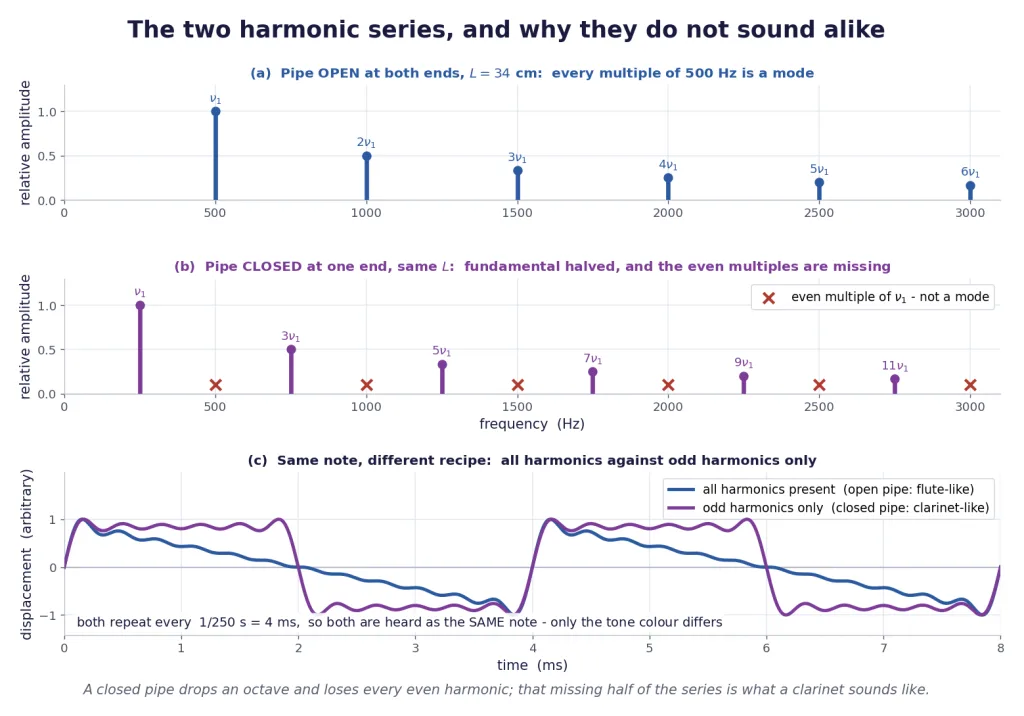
A real instrument almost never vibrates in one pure mode. Blow it and you excite the fundamental together with a mix of its higher modes, and it is the recipe of that mix — which harmonics are present and how strong each one is — that your ear reads as tone colour, or timbre.
Now the difference is obvious. A flute is an open pipe, so its sound contains the fundamental and every harmonic above it: . A clarinet behaves as a pipe closed at the reed end, so its sound contains only the odd ones: . Half of the series is simply missing. Both instruments repeat their waveform times a second, so both are heard as the same note — but the shapes of those waveforms are completely different, and that is the difference you hear.
Key Point: Pitch is set by the fundamental; timbre is set by the mix of harmonics built on it. Two instruments on the same note differ in timbre, not in pitch. A closed pipe is missing every even harmonic, which is why a clarinet's tone is described as hollow or woody next to a flute's.
[JEE Tip] The clarinet also explains a musician's complaint: because its second harmonic is missing, it "overblows" to a note a twelfth above the fundamental (a factor of 3) rather than an octave (a factor of 2), the way a flute does. If a question mentions overblowing, it is asking whether you know that the next available mode of a closed pipe is , not .
Displacement Nodes Are Pressure Antinodes
Everything so far has described the standing wave by the displacement of the air. But a sound wave can just as truthfully be described by the pressure variation it produces, and a microphone, an eardrum and most laboratory sensors respond to pressure, not to displacement. The two descriptions carry the same information — and their nodes sit in completely different places. Exam questions are built on precisely that.
The relation between the two
Take a thin slab of air between and . If both faces move by the same amount, the slab is carried along bodily and its volume is unchanged, so its pressure is unchanged. The slab is squeezed only when the two faces move by different amounts — that is, only where changes with position. Writing for the bulk modulus of air, the excess pressure is
The minus sign says the obvious thing: where the displacement increases with , the slab is being stretched, and its pressure drops below atmospheric.
The consequence, which is all you need
Apply that to the standing wave :
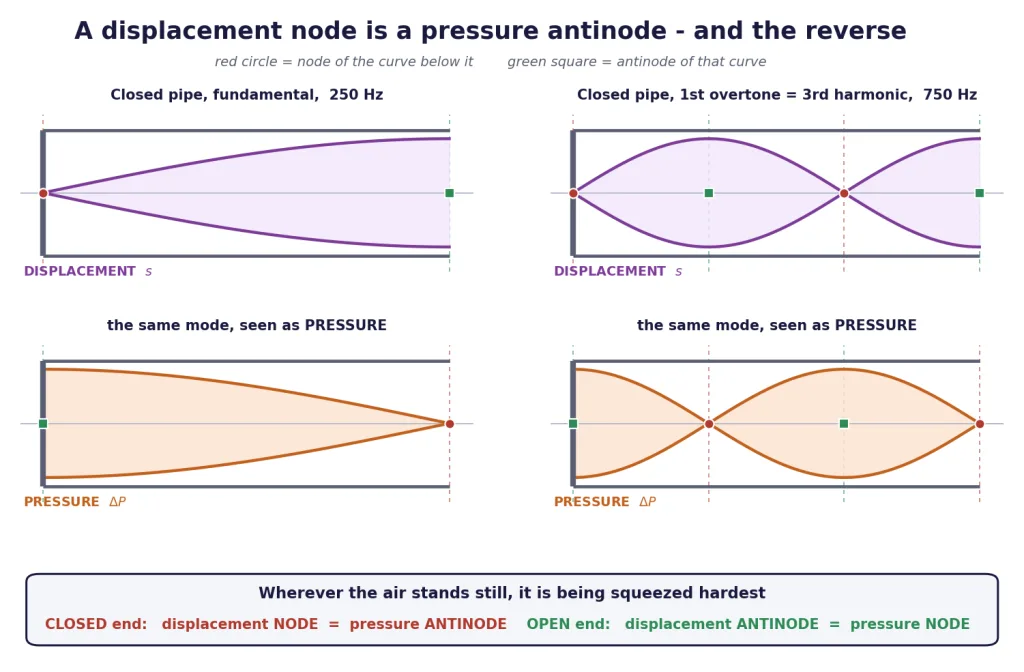
The displacement carries ; the pressure carries . One is zero exactly where the other is largest. So:
Key Point — the interchange:
- A displacement node is a pressure antinode.
- A displacement antinode is a pressure node.
- The two patterns are shifted by relative to each other.
Why it has to be that way
Look at a displacement node. The air element sitting there never moves. But the elements on its two sides are oscillating towards it and then away from it together — they are half a wavelength apart in the pattern and so move in opposite directions. Air piles up on it, then drains away from it. That point therefore suffers the largest compressions and the largest rarefactions of anywhere in the pipe: it is a pressure antinode.
Now look at a displacement antinode. There, a whole neighbourhood of air is swinging back and forth in step, all moving the same way at the same instant. Nothing is being squeezed against anything. The volume of each slab stays essentially constant, so the pressure barely changes: it is a pressure node.
The slogan is worth keeping: wherever the air stands still, it is being squeezed hardest.
At the two ends of a pipe
| End | Displacement | Pressure |
|---|---|---|
| closed | node (the air cannot move) | antinode — largest pressure swing |
| open | antinode (the air moves freely) | node — pressure pinned at atmospheric |
The open-end pressure node is the deeper of the two statements. The mouth of the pipe opens into the whole atmosphere, which is far too large a reservoir for the little column of air to push around. Its pressure is therefore held at atmospheric, and the pressure variation there is zero — which is the real reason the open end is a displacement antinode. The displacement rule is the consequence; the pressure rule is the cause.
[NEET Important] A question that asks "at which point in the pipe is the pressure variation maximum?" is asking you to find the displacement nodes and name one of them. In the fundamental of a closed pipe there is exactly one, and it is at the closed end. Put the microphone there.
[JEE Tip] In a Kundt's-tube demonstration, fine powder inside the tube collects into small heaps. The heaps sit at the displacement nodes, because that is where the air is not moving and cannot sweep the powder away — so measuring the spacing of the heaps gives directly, and hence the speed of sound.
The Resonance Tube, and the End Correction
The standard laboratory method for measuring the speed of sound in air uses a pipe closed at one end whose length you can change continuously. That is the resonance tube.
The apparatus and the procedure
A long glass tube stands vertically, connected at the bottom to a reservoir of water that can be raised or lowered. The water level is the closed end; the air column above it, of length , is the pipe; its mouth is the open end. A vibrating tuning fork of known frequency is held just above the mouth.
Lower the water slowly. At most positions you hear a faint, ordinary sound. At certain lengths the sound suddenly becomes loud — the air column has hit one of its natural frequencies and is resonating with the fork. Note the two lowest such lengths, and .
What each resonance means
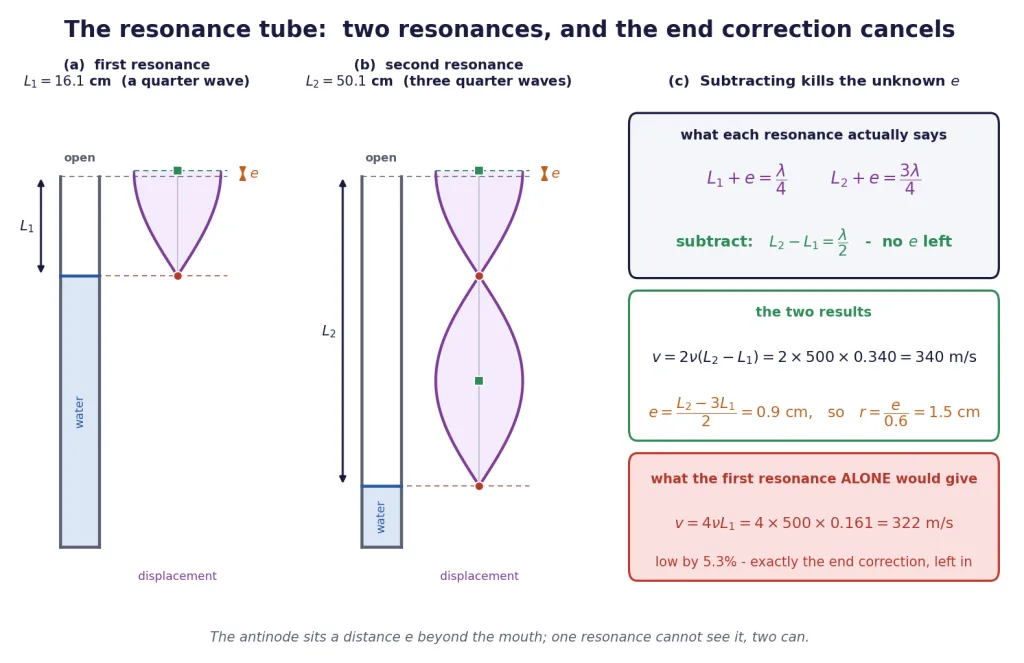
The air column is closed at one end and open at the other, so it resonates when it holds an odd number of quarter wavelengths. If the antinode sat exactly at the mouth, the first two resonances would be at and . It does not. The antinode lies a small distance beyond the mouth, because the air just outside the tube is dragged into the oscillation as well. That distance is the end correction. So what the resonances actually say is
Why the second resonance is the whole point
You do not know , and you cannot measure it directly. But look at those two equations: appears in both, with the same sign. Subtract them and it is gone.
That is why the experiment insists on finding a second resonance instead of stopping at the first. Using only the first would force you to write , which quietly assumes and always gives a value that is too low, by a few per cent.
And once you have both lengths you can extract as a bonus. Multiply the first equation by 3 and subtract the second:
Key Point — the end correction: A wider tube has a larger end correction. The effective length of the air column is the measured length plus one for each open end: An open pipe gets two end corrections, one at each mouth.
Getting the experiment right
- Keep the fork just above the mouth and vibrating in a horizontal plane, so it drives the air column and not the tube walls.
- Approach each resonance from both directions — lowering and then raising the water — and average the readings. The loudness peak is broad, and this removes most of the personal bias.
- Take the room temperature. The value of you measure belongs to that temperature, and quoting it against the standard value at needs with in kelvin.
- If the tube is not uniform in bore, changes down its length and the two-resonance method loses its advantage. Use a tube of constant internal diameter.
[Board Important] "Why is the second resonance position used?" is a standard two-marker, and the answer is one sentence: because subtracting the two resonance lengths eliminates the unknown end correction, leaving with nothing assumed. Write the two equations, subtract them, and the marks are yours.
Solved Examples
Conventions used throughout: SI units unless a question states otherwise. The speed of sound in air is taken as 340 m/s unless a problem gives a temperature or states another value. is the length of the air column and the end correction, with for a tube of internal radius . "Closed pipe" always means closed at one end and open at the other. Harmonics are numbered from the fundamental; overtones are numbered from the first mode above the fundamental. Where a temperature appears, it is converted to kelvin and is used.
Example 1: An open pipe, from the boundary conditions up
A pipe of length 34 cm is open at both ends. Find (a) the wavelength and frequency of its fundamental, (b) its first overtone, and (c) its second overtone. Take the speed of sound as 340 m/s.
Solution:
Step 1 — write down the boundary conditions. Both ends are open, so both are displacement antinodes. Neighbouring antinodes are apart, so the pipe holds a whole number of half wavelengths:
Step 2 — (a) the fundamental, .
Step 3 — (b) the first overtone. In an open pipe every harmonic exists, so the first mode above the fundamental is the second harmonic, :
Step 4 — (c) the second overtone is the third harmonic, :
Final Answer: m and Hz; first overtone Hz; second overtone Hz.
Takeaway: In an open pipe the modes are with nothing missing, so the th harmonic is the th overtone. Get first and everything else is a multiplication.
Example 2: The same pipe with one end plugged
The pipe of Example 1 is now closed at one end. Find its fundamental, its first overtone and its second overtone, and compare each with the open-pipe answer.
Solution:
Step 1 — the boundary conditions have changed. The closed end is a displacement node, the open end an antinode, and a node and its neighbouring antinode are apart. The pipe now holds an odd number of quarter wavelengths:
Step 2 — the fundamental, .
which is exactly half the open pipe's 500 Hz — one octave lower, from the same tube.
Step 3 — the first overtone. The next odd harmonic is the third, not the second:
Step 4 — the second overtone is the fifth harmonic:
Comparison. Open: 500, 1000, 1500 Hz. Closed: 250, 750, 1250 Hz. The closed pipe starts an octave lower and then climbs in steps of Hz, skipping every even multiple of 250 Hz.
Final Answer: Hz, Hz and Hz, against Hz, Hz and Hz for the same pipe open at both ends.
Takeaway: Closing one end halves the fundamental and deletes every even harmonic. The first overtone becomes the third harmonic — tripling the fundamental, never doubling it.
Example 3: Will it resonate?
A source of frequency 1500 Hz is held at the mouth of a 34 cm pipe. (a) If the pipe is open at both ends, which mode responds? (b) If one end is then closed, will the same source still produce resonance?
Solution:
Step 1 — (a) list the open pipe's modes. From Example 1, Hz. Divide the source frequency by the fundamental:
A whole number, so the source matches the third harmonic, which is the second overtone. It resonates.
Step 2 — (b) list the closed pipe's modes. From Example 2, Hz and the modes are Hz. Divide again:
A whole number — but an even one. The sixth harmonic is not a mode of a closed pipe, because an even number of quarter wavelengths would put a node at the open end. The frequency 1500 Hz falls in the gap between the modes at 1250 Hz and 1750 Hz.
Step 3 — answer the question. The pipe will not resonate with this source once one end is closed.
Final Answer: (a) the third harmonic, that is the second overtone; (b) no resonance — 1500 Hz would be the sixth harmonic, and a closed pipe has no even harmonics.
Takeaway: Divide the given frequency by the fundamental and look at the answer. A whole number means resonance for an open pipe; for a closed pipe it must be a whole odd number. Anything else, and the pipe stays quiet.
Example 4: Two pipes, one note
A pipe open at both ends is 85 cm long. (a) Find its fundamental. (b) How long must a pipe closed at one end be, to have the same fundamental?
Solution:
Step 1 — (a) the open pipe.
Step 2 — (b) set the closed pipe's fundamental equal to it.
Step 3 — read the ratio. cm is exactly half of cm, and that is general:
Final Answer: Hz; the closed pipe must be cm, half the length of the open one.
Takeaway: For the same pitch, a closed pipe is half as long as an open one. The two pipes still do not sound alike, because the open one carries all the harmonics and the closed one only the odd ones.
Example 5: Counting inside a higher mode
A pipe closed at one end is 25 cm long. Find (a) its fundamental, (b) the frequency and wavelength of its third overtone, and (c) the positions of all displacement nodes and antinodes in that mode, measured from the closed end.
Solution:
Step 1 — (a) the fundamental.
Step 2 — (b) translate "third overtone" into a harmonic number. For a closed pipe the th overtone is the th harmonic, so the third overtone is the seventh harmonic:
Step 3 — (c) place the nodes and antinodes. Measure from the closed end, which is itself a node. Nodes repeat every m:
Antinodes sit a quarter wavelength, m, from each node:
The last one lands exactly on m, the open end — which is the check that the mode is legal.
Final Answer: Hz; third overtone Hz with m; four nodes and four antinodes, the last antinode at the open end.
Takeaway: Convert overtone language into a harmonic number before touching the arithmetic, and finish by checking that the pattern really does end in an antinode at the open end. If it does not, the mode you have written down is impossible.
Example 6: The resonance tube measures the speed of sound
A resonance tube is sounded with a tuning fork of frequency 500 Hz. Resonance is first heard when the air column is 16.1 cm long, and again when it is 50.1 cm long. Find (a) the wavelength, (b) the speed of sound, (c) the end correction, (d) the internal radius of the tube, and (e) the value of that the first resonance alone would have given.
Solution:
Step 1 — write what each resonance says. The column is closed at the water surface and open at the top, so it resonates at odd quarter wavelengths, measured to the true antinode a distance above the mouth:
Step 2 — (a) subtract, and disappears.
Step 3 — (b) the speed of sound.
Step 4 — (c) now recover . Multiply the first equation by 3 and subtract the second:
Step 5 — (d) the radius, from .
so the tube's internal diameter is about 3.0 cm.
Step 6 — (e) what one resonance alone would have said. Assuming gives and
low by m/s, or — and the whole of that error is the end correction that was ignored.
Final Answer: m; m/s; cm; cm; the single-resonance estimate would have been m/s.
Takeaway: Two resonances beat one, because the difference is free of the end correction. Never compute the speed of sound from a single resonance length unless the question explicitly tells you to neglect .
Example 7: The same experiment, different fork
In a resonance tube experiment with a fork of frequency 425 Hz, the first two resonances occur at air-column lengths 18.8 cm and 58.8 cm. Find the speed of sound, the end correction, the internal diameter of the tube, and predict the length at which the third resonance will be heard.
Solution:
Step 1 — the speed of sound.
Step 2 — the end correction.
Step 3 — the tube.
This tube is wider than the one in Example 6, and its end correction is correspondingly larger — exactly what predicts.
Step 4 — the third resonance is the next odd quarter wavelength, :
Check the spacing: cm, the same that separated the first two. Successive resonances are always half a wavelength apart, however large is.
Final Answer: m/s; cm; internal diameter cm; the third resonance at cm.
Takeaway: Successive resonance lengths differ by , always. The end correction shifts every reading by the same amount, so it changes where the ladder starts but never the spacing of its rungs.
Example 8: Where is the pressure largest?
A pipe closed at one end is 34 cm long and is vibrating in its first overtone. Take the closed end as . Find (a) the frequency, (b) the positions of the displacement nodes and antinodes, and (c) the positions where a pressure sensor would read the largest and the smallest variation.
Solution:
Step 1 — (a) the first overtone of a closed pipe is its third harmonic.
Step 2 — (b) place the displacement pattern. The closed end is a node; nodes repeat every m:
Antinodes lie m from each node:
and the second of these is the open end, as it must be.
Step 3 — (c) swap the labels for pressure. A displacement node is a pressure antinode and a displacement antinode is a pressure node. So the pressure variation is
- largest at (the closed end) and at m;
- zero at m and at m (the open end).
A microphone placed against the closed end reads the maximum; one held at the mouth reads essentially nothing, because the atmosphere holds the pressure there at its ordinary value.
Final Answer: Hz; displacement nodes at and m, antinodes at m and m; pressure maxima at and m, pressure zeros at m and m.
Takeaway: Find the displacement pattern, then swap every label to get the pressure pattern. The two are offset by , and the closed end is always the point of largest pressure swing.
Example 9: Working backwards from two resonances
(a) A pipe closed at one end resonates at 425 Hz and again at 595 Hz, with no resonance in between. Find its fundamental and its length. (b) A pipe open at both ends resonates at 510 Hz and again at 680 Hz, with nothing in between. Find its fundamental and its length.
Solution:
Step 1 — (a) successive modes of a closed pipe. The modes are , so consecutive ones differ by :
Step 2 — check both are odd harmonics.
Both odd, and consecutive in the odd series. The data are consistent.
Step 3 — the length.
Step 4 — (b) successive modes of an open pipe differ by itself:
Check: and — consecutive harmonics, and one of them is even, which is fine for an open pipe.
Both pipes are a metre long, yet the closed one has half the fundamental of the open one.
Final Answer: (a) Hz, m; (b) Hz, m.
Takeaway: The gap between successive resonances is for both pipes — but it equals for an open pipe and for a closed one. Get the gap first, then decide which pipe you are holding.
Example 10: A flute and a clarinet on the same note
A flute behaves as a pipe open at both ends and a clarinet as a pipe closed at one end. Both are sounding the same note, of fundamental frequency 340 Hz. Find the length of each air column and list the first four resonant frequencies of each.
Solution:
Step 1 — the flute (open).
Its modes are every multiple of 340 Hz:
Step 2 — the clarinet (closed).
Its modes are the odd multiples only:
Step 3 — read the comparison. The clarinet's air column is half as long for the same pitch. Its first four modes climb far faster, because it skips 680 Hz, 1360 Hz and every other even multiple.
Step 4 — why they sound different. Both waveforms repeat 340 times a second, so the ear assigns both the same pitch. But the flute's tone is built from and the clarinet's from — half the ingredients are missing, and the resulting waveform is a different shape. That difference is the timbre.
Final Answer: flute m with modes Hz; clarinet m with modes Hz.
Takeaway: Same pitch, different recipe. Pitch comes from the fundamental alone; the character of the sound comes from which harmonics are stacked on it, and a closed pipe is missing every even one.
Example 11: A warmer room raises the note
The fundamental of a pipe open at both ends is 300 Hz when the room is at . The room is heated to . Find the new fundamental. The pipe's length is unchanged.
Solution:
Step 1 — decide what changes. The pipe's length is fixed, so is fixed. The only thing that can change the frequency is the speed of sound, and in a gas
Since with constant, the frequency scales the same way: .
Step 2 — convert both temperatures to kelvin. This is the step that decides the answer.
Step 3 — take the ratio.
Step 4 — sanity check. Hotter air carries sound faster, so the note must go up, and it does — by about 15 per cent, which is a very audible shift in pitch.
Final Answer: the fundamental rises from Hz to Hz.
Takeaway: A pipe's pitch follows in kelvin, because the length is fixed and only can move. Using Celsius in the ratio is the standard wrong answer: would give Hz, which is nonsense.
Example 12: Matching overtones
The first overtone of a pipe open at both ends has the same frequency as the first overtone of a pipe closed at one end. Find the ratio of their lengths, and check it with an open pipe 80 cm long.
Solution:
Step 1 — name the two overtones correctly. This is the whole question.
- Open pipe: first overtone = second harmonic .
- Closed pipe: first overtone = third harmonic .
Step 2 — set them equal.
Step 3 — check with numbers. Take m. Its first overtone is
The ratio predicts m, whose first overtone is
Final Answer: ; an cm open pipe matches a cm closed pipe, both at Hz.
Takeaway: Translate every "overtone" into a harmonic number in the first line of the solution. Reading the closed pipe's first overtone as instead of turns this ratio from into , and that single slip is the most common way to lose the mark.