
Send a Wave Down a String and Trap It
Everything is now in place. Two results are already in hand: overlapping waves simply add their displacements, and a wave meeting a rigid support comes back inverted. Put the two together on a string that is tied at one end, and something appears that neither result predicts on its own: a pattern that does not go anywhere.
Pluck a guitar string and look at it. The string is not carrying a wave from one end to the other. It is sitting there humming, bulging in the middle and pinned at the ends. That shape is what this section is about, and it has a name — a standing wave, or stationary wave.
The two waves we are adding
Reflection at a rigid end was settled in the previous section: the reflected wave returns inverted, with a phase change of , and the support itself is forced to be a point of permanent zero displacement.
For a string it is convenient to put the origin at the support, because that is exactly where the permanently still point has to sit. So fix the end at and send a wave in along the string towards it, that is, in the direction:
It reflects and runs back out towards :
These two really are exactly out of phase at the support, which is the whole content of the phase change. Check it: at ,
so at every instant. The tied end never moves. That is what "rigid" means, and the signs have delivered it automatically.
Doing the sum
By superposition the string's actual displacement is :
The identity to reach for is
with and . That gives the central result of the section.
Key Point — the standing wave: where is the amplitude of each of the two travelling waves, is the angular wave number in rad/m and is the angular frequency in rad/s.
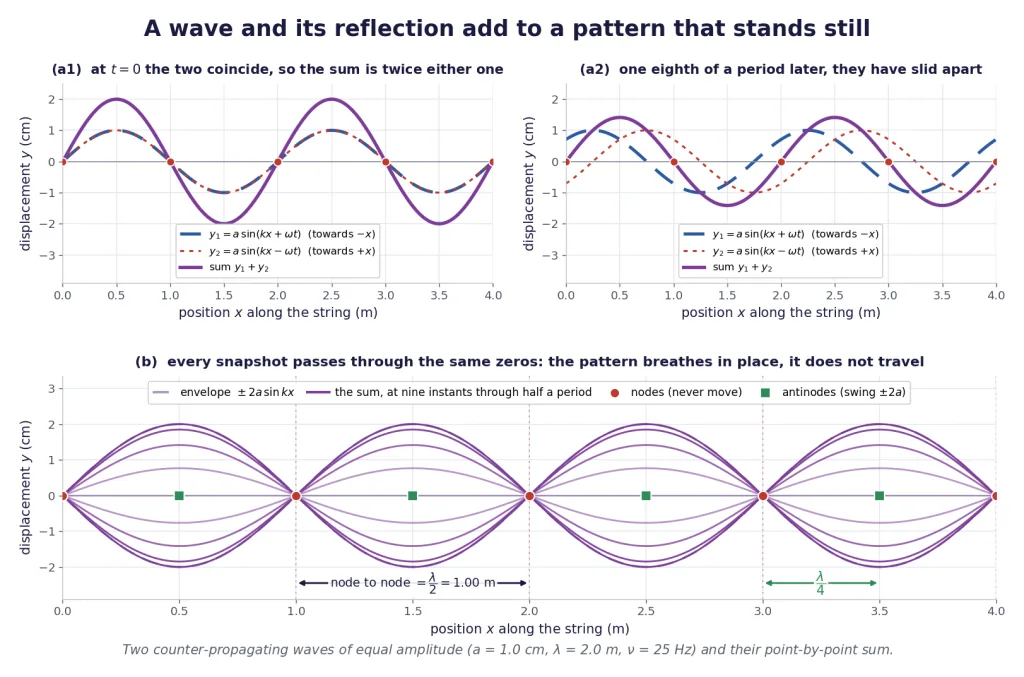
The purple curve in the figure is the literal point-by-point sum of the blue and the red one — nothing has been drawn by hand. In the top-left panel the two waves happen to sit on top of each other, so the sum is exactly twice either one. One eighth of a period later they have slid past each other and the sum has shrunk. Keep watching and the sum keeps changing height — but look at where it crosses zero. Those crossings never move.
Why this is not a travelling wave
Compare the two equations side by side, because the difference is one symbol deep and everything follows from it.
In the travelling wave, and are locked together inside one bracket. That is what makes the shape move: increase a little and you can restore the same value of by increasing a little, which is precisely the statement that the pattern has shifted along.
In the standing wave, and have separated into different factors. There is no way to trade a change in for a change in , because they no longer appear in the same bracket. The shape is stuck.
Key Point: Any function of the form , with position and time in separate factors, describes a standing wave. Any function in which and appear only in the combination describes a travelling wave. That single test settles almost every "is this a travelling or a stationary wave?" question you will be asked.
What each particle of the string is actually doing
Freeze your attention on one point of the string, at a fixed . Then is just a number, and the equation reads
which is simple harmonic motion of angular frequency . So:
- every particle of the string performs SHM;
- every particle does it at the same frequency ;
- but the amplitude, , is different at different places.
That last line is the whole novelty. In a travelling wave every particle swings through the same amplitude and they differ only in phase. In a standing wave every particle is in step, and they differ only in amplitude.
Notation for This Section
Two symbols do double duty across the syllabus, and both are worth pinning down before the algebra starts.
| Symbol | Meaning | Unit |
|---|---|---|
| amplitude of each travelling wave | m | |
| the largest amplitude anywhere on the string | m | |
| wavelength | m | |
| frequency | Hz | |
| angular wave number, | rad/m | |
| angular frequency, | rad/s | |
| mass per unit length of the string | kg/m | |
| length of the vibrating segment | m | |
| mode number, | none |
Key Point — the two meanings of .
In the symbol is the tension, measured in newtons. In the same symbol is the time period, measured in seconds. One problem can carry both: a wire under a tension of 90 N vibrating with a period of 4 milliseconds. The unit settles it every time — read the unit, not the letter.
And one more: here is the angular wave number in rad/m, . It is not a spring constant, and it is never measured in N/m.
Nodes and Antinodes
The amplitude of the point at is . That expression swings between and as you walk along the string, and the two extremes have names.
Nodes: the points that never move
A node is a point whose amplitude is zero. It is not "a point that happens to be at zero right now" — every point of the string passes through zero twice a cycle. A node is a point that is at zero permanently, at every instant, for as long as the wave lasts.
Set the amplitude to zero:
Put :
So the nodes sit at and consecutive ones are half a wavelength apart.
Antinodes: the points that move most
An antinode is a point of maximum amplitude, . That needs :
The antinodes sit at — again half a wavelength apart from each other, and each one exactly midway between two nodes.
Key Point — the three spacings, and they are the most-asked fact in the topic: Every one of these is half the spacing you might guess from "one wavelength", because a full wavelength of the pattern contains two nodes and two antinodes.
A worked layout
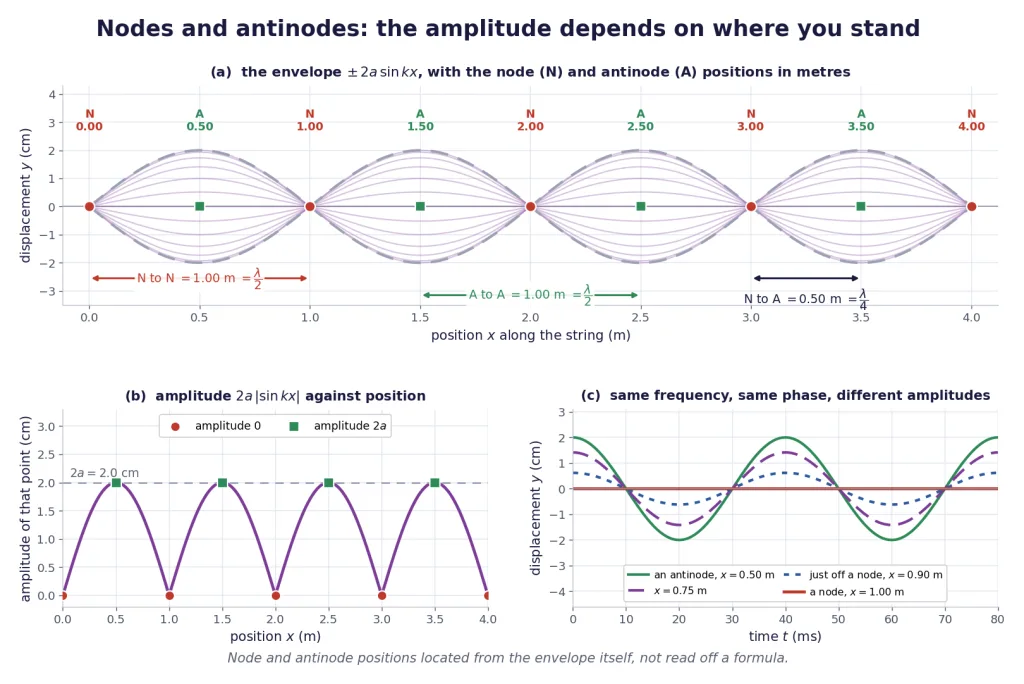
Take the wave in the figure: cm for each travelling wave, so cm, and m at Hz. Then rad/m, and the pattern along the first four metres of string is:
| (m) | amplitude (cm) | what it is | |
|---|---|---|---|
| 0.00 | 0 | 0.00 | node |
| 0.25 | 0.707 | 1.41 | ordinary point |
| 0.50 | 1 | 2.00 | antinode |
| 0.75 | 0.707 | 1.41 | ordinary point |
| 1.00 | 0 | 0.00 | node |
| 1.50 | 2.00 | antinode | |
| 2.00 | 0 | 0.00 | node |
| 2.50 | 1 | 2.00 | antinode |
Nodes at m — one metre apart, which is . Antinodes at m — also one metre apart, and each sits m from the node on either side, which is .
The trick that turns a measurement into a wavelength
You can almost never measure on a vibrating string directly, because the pattern does not look like one sine cycle — it looks like a row of identical bulges. What you can measure is the distance between two things that are easy to see: two neighbouring still points.
Key Point: Adjacent nodes are apart, so Each bulge, or loop, of a standing wave is half a wavelength long, not one wavelength.
[JEE Tip] The commonest single error in this topic is calling the distance between adjacent nodes instead of , which makes every speed and every frequency that follows wrong by a factor of 2. Count loops, not humps of a sine curve: one loop = half a wavelength.
The amplitude at a point in between
Nothing stops you asking for the amplitude at an ordinary point, and the formula gives it directly. For a string in a mode of wavelength , measuring from a node,
For instance with m and m, the point at m has
that is cm — most of the way to the full cm, because m is fairly close to the antinode at m.
[Board Important] "Distinguish between a node and an antinode" is a standard two-marker. The marks are for saying that a node has permanently zero amplitude while an antinode has the maximum amplitude , and for the spacings: consecutive nodes (or consecutive antinodes) are apart, and a node and its neighbouring antinode are apart.
Standing Waves Against Progressive Waves
A snapshot of a standing wave and a snapshot of a travelling wave can look identical — both are sine curves along the string. Everything that distinguishes them is in how they change from one snapshot to the next, and in what they do with energy. This comparison is worth learning as a block, because it is asked directly.
The comparison table
| Feature | Progressive (travelling) wave | Standing (stationary) wave |
|---|---|---|
| Equation | : and locked in one bracket | : and in separate factors |
| The waveform | travels forward at | stays put; the pattern only grows and shrinks in place |
| Amplitude | the same at every point of the medium | — depends on where the point sits |
| Points permanently at rest | none; every particle oscillates | the nodes, spaced apart |
| Phase | each particle lags the one before it; all phases occur | all particles in one loop are exactly in phase; neighbouring loops are exactly out of phase |
| When particles cross | at different instants | all together, twice every period |
| Energy | carried steadily along the medium | no net transport; energy sloshes between kinetic and potential inside each loop |
| Frequency | the same for every particle | the same for every particle |
| A snapshot | a sine curve that has slid along | a sine curve that has been scaled up or down about the axis |
Why a standing wave carries no energy
A standing wave carries no energy from place to place, and the reason is short: a node cannot transmit any. Power is delivered across a point of a string by the transverse force there acting through the transverse velocity there. At a node the displacement, and therefore the velocity, is zero for all time — so the power crossing a node is zero for all time.
The nodes are spaced apart along the whole string, so the string is divided into sealed compartments. Whatever energy is inside one loop stays inside that loop. Twice per cycle it is all kinetic, with the string flat and every particle moving fastest; a quarter period later it is all potential, with the string at maximum bulge and momentarily at rest everywhere.
That is exactly the bookkeeping of the two travelling waves that made the pattern: one carries energy to the right, the other carries an equal amount to the left, and the two flows cancel.
Key Point: A progressive wave transports energy through the medium. A standing wave stores it, trapped between consecutive nodes, and transports none. Both still transport zero matter.
The phase point, which decides several exam questions
Look again at . The time factor is the same for every point on the string. So the only thing that can vary from point to point is the sign and size of .
- Inside one loop, keeps the same sign, so every particle of that loop reaches its highest point at the same instant and its lowest at the same instant. They are in phase, phase difference .
- Cross a node into the next loop and flips sign. Those particles go down whenever the first loop goes up. They are exactly out of phase, phase difference .
Key Point: In a standing wave the phase difference between any two particles is either (same loop) or (loops separated by an odd number of nodes) — never anything in between. In a progressive wave the phase difference between two points a distance apart is , which can be anything at all.
[NEET Important] "Do all particles of a stationary wave vibrate with the same amplitude / frequency / phase?" — the answer is not the same for the three words. Same frequency: yes, every particle. Same phase: yes within a loop, and exactly opposite in the next loop, so never an odd in-between value. Same amplitude: no — that is the one thing that changes from point to point.
Reading a snapshot
Given a picture of a string at one instant, you cannot tell which kind of wave it is. Given two pictures a short time apart, you can, immediately:
- if the curve has slid sideways keeping its height, it is progressive;
- if the curve has shrunk or grown about the axis with its zeros pinned in the same places, it is standing.
The lower panel of the standing-wave figure earlier in this section carries nine such snapshots drawn on one pair of axes. Every one of them passes through the same set of zeros.
Normal Modes of a String Fixed at Both Ends
So far one end has been tied. A real musical string is tied at both ends, and that second condition is where all the interesting physics is, because it stops the string from vibrating at whatever frequency it pleases.
Two boundary conditions
Let the string run from to , clamped at both ends. Then
Take the standing wave . The condition at is already satisfied, because — that is why we put the origin at a support. The condition at demands
( is thrown out: it gives , which is a string lying still.) Substituting ,
Read that in words, because it is the whole idea
The string must hold a whole number of half wavelengths. No fraction of a loop is allowed, because a loop has to end on a node and both ends of the string are nodes. Rearranged:
Key Point — the allowed wavelengths and frequencies: Here is the speed of a transverse wave on the string, is the tension in newtons and the mass per unit length in kg/m. These allowed frequencies are the string's normal modes or natural frequencies.
This is a genuinely new kind of statement. A travelling wave will run along an unbounded string at any frequency you care to feed it. Clamp both ends and the string accepts only a discrete list. Drive it at anything else and it refuses to build up a pattern.
The modes, one by one
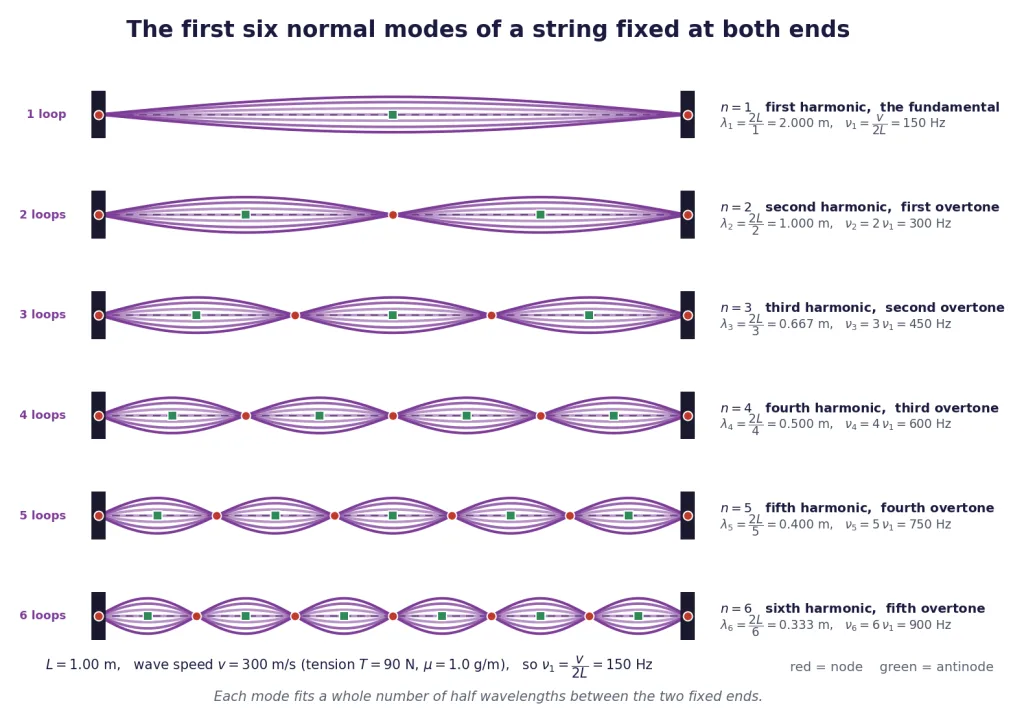
Take the string of the figure: m, tension N, g/m. Then
| Loops | (m) | (Hz) | Nodes | Antinodes | |
|---|---|---|---|---|---|
| 1 | 1 | 2.000 | 150 | 2 | 1 |
| 2 | 2 | 1.000 | 300 | 3 | 2 |
| 3 | 3 | 0.667 | 450 | 4 | 3 |
| 4 | 4 | 0.500 | 600 | 5 | 4 |
| 5 | 5 | 0.400 | 750 | 6 | 5 |
| 6 | 6 | 0.333 | 900 | 7 | 6 |
Three patterns are worth naming.
- Mode has loops, nodes (counting the two fixed ends) and antinodes. That is the fastest way to identify a mode from a picture: count the bulges.
- The wavelengths shrink, but not the speed. depends only on the tension and the string, so it is the same for every mode. The frequency rises purely because the wavelength falls.
- The frequencies are exact whole-number multiples of the lowest one.
Key Point — a string supports every harmonic. The allowed frequencies of a string fixed at both ends are all integer multiples of the fundamental, with none missing. (Air columns are not always so generous, and the next section takes them up.)
The fundamental
The lowest mode, , is the fundamental mode or first harmonic:
Its wavelength is — twice the length of the string, which surprises people. The string only holds half a wave: one loop, a node at each end and a single antinode in the middle.
This is the note you hear when a string is plucked, and it is the one you tune. On a guitar the top E string is about m of vibrating length and carries a wave at roughly m/s, giving
which is the E above middle C.
Why a plucked string sounds like a string and not like a tuning fork
A real string almost never vibrates in a single mode. Pluck it and you excite a superposition of many modes at once — strongly, plus , and so on with smaller amplitudes. Your ear reports the pitch of the fundamental, but the mix of harmonics is what makes a sitar and a violin sound different on the same note.
Where you pluck decides the mix. Pluck at the exact midpoint and you cannot excite the second harmonic at all, because the midpoint is a node of that mode and you have just pulled it a centimetre sideways. Pluck near the bridge and the high harmonics come up strongly, which is why the note sounds thin and bright.
[JEE Tip] A light touch at a point kills every mode that does not have a node there, and lets the rest through. Touch a string at its midpoint and only the modes with a node at survive — those are , the even harmonics. The fundamental is silenced and the pitch jumps an octave. That is the harmonic technique on a guitar.
Harmonics and Overtones — Two Names for the Same Ladder
You now have the ladder of frequencies . There are two systems for naming its rungs, they are off by one, and exam questions live in that gap.
The overtone naming sits outside the rationalised syllabus body text, and Boards, JEE and NEET ask it every year, so it is set out in full here.
The two systems
Key Point — the definitions:
- Harmonics are counted from the fundamental, which is itself counted. The th harmonic has frequency . So the fundamental is the first harmonic.
- Overtones are counted from the first tone above the fundamental. The fundamental is not an overtone at all; the next mode up is the first overtone, the one after that the second, and so on.
Everything follows from that one difference: harmonic numbering includes the fundamental, overtone numbering does not. So for a string, where every integer multiple exists, the overtone number is always one less than the harmonic number.
The mapping, printed in full
| Mode | Frequency | Harmonic name | Overtone name |
|---|---|---|---|
| 1 | first harmonic | the fundamental — not an overtone | |
| 2 | second harmonic | first overtone | |
| 3 | third harmonic | second overtone | |
| 4 | fourth harmonic | third overtone | |
| 5 | fifth harmonic | fourth overtone | |
| 6 | sixth harmonic | fifth overtone | |
| th harmonic | th overtone |
Key Point — for a string fixed at both ends: equivalently, the th overtone is the th harmonic, with frequency .
Using it without slipping
The safest routine has three steps, and it never fails.
- Convert the name into a mode number . "Third overtone" means . "Fifth harmonic" means .
- Do the physics with . , .
- Convert back if the answer is wanted as a name.
Two quick lookups on a string whose fundamental is Hz:
- "What is the frequency of the third overtone?" Third overtone Hz.
- "600 Hz is which overtone?" , so , the fifth harmonic, which is the fourth overtone.
- "Can this string sound 300 Hz?" , not a whole number, so no — 300 Hz is not a normal mode of this string at all.
That last check is worth keeping. To test whether a given frequency is a mode of a string, divide it by the fundamental. A whole number means yes; anything else means no.
[NEET Important] Read the question word by word. "Second harmonic" and "second overtone" are different modes — and . The single most common slip in this entire chapter is answering the harmonic question when the overtone was asked, or the reverse. Write down explicitly before you calculate anything.
[Board Important] A one-mark definition that comes up: an overtone is any natural frequency of the system higher than the fundamental; a harmonic is a frequency that is an integer multiple of the fundamental. For a string every overtone happens to be a harmonic — which is not true of every vibrating system, and is exactly why the two words exist.
Air columns run the same argument with different boundary conditions, and one of them breaks the neat rule. That comes next.
The Laws of the Vibrating String, and the Sonometer
Everything about the pitch of a stretched string is contained in one formula:
with the tension in newtons. Vary one quantity at a time and it splits into three statements, traditionally called the laws of the vibrating string.
The three laws
Key Point — law of length. At constant tension and constant mass per unit length, Halve the vibrating length and the pitch goes up an octave. This is what a guitarist's left hand is doing.
Key Point — law of tension. At constant length and constant mass per unit length, Tighten the string and the note rises — but only as the square root. To double the frequency you must quadruple the tension, not double it. This is the tuning peg.
Key Point — law of mass. At constant length and constant tension, A thicker or denser string sounds lower. This is why the bass strings on any instrument are the fat ones, and why they are often overwound with wire — the extra metal raises without making the string too stiff to bend.
Since , for a wire of radius and density we have , so . Two useful corollaries drop out:
[JEE Tip] Ratio questions are best done in one line by combining all three at once:
Never compute the two frequencies separately when the wire's material is not given — you cannot, and you do not need to.
The sonometer
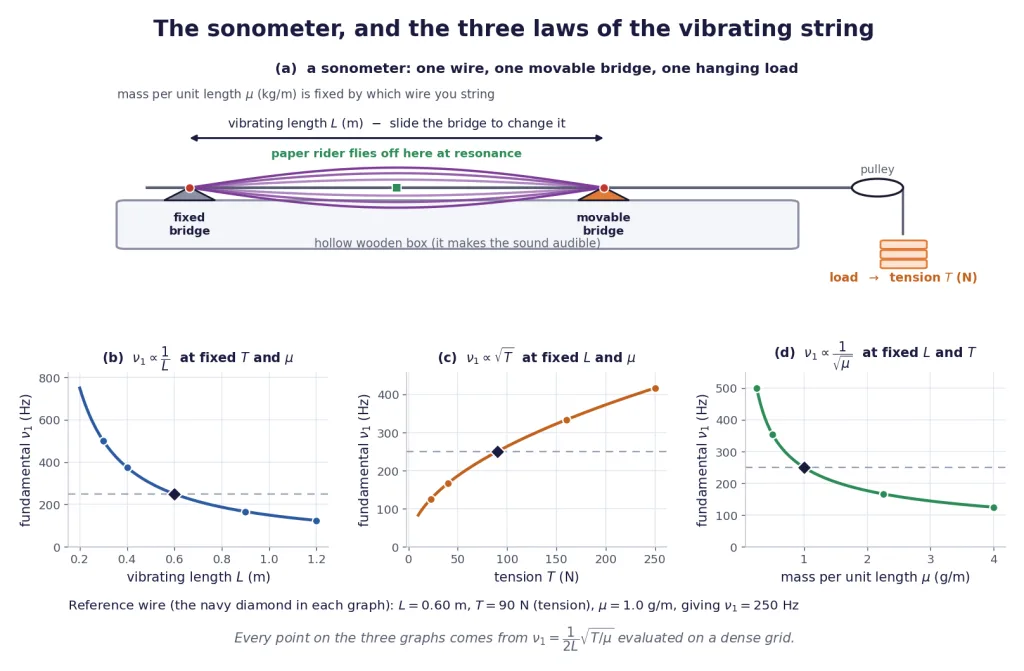
The sonometer is the laboratory instrument built to demonstrate exactly these three laws. It is a hollow wooden box with a thin metal wire stretched along its top. One end of the wire is fixed to a peg; the other passes over a frictionless pulley at the far end and carries a hanger of slotted weights, which sets the tension. Two bridges stand under the wire, and one of them slides, so the length of wire free to vibrate can be set to whatever you like.
Two details make the instrument work.
- The bridges are the fixed ends. The vibrating segment is the wire between them, so in every formula is the distance between the bridges, not the whole length of the wire.
- The hollow box matters. A bare wire moves too little air to be heard. The box is set into forced vibration by the wire and, having a large surface, pushes far more air — so the note becomes audible. It adds nothing to the frequency.
How each law is checked
The wire is set going by striking it, and a small paper rider is placed at its midpoint. A tuning fork of known frequency is sounded and the movable bridge is slid until the wire resonates with it; at resonance the wire's amplitude jumps and the rider is thrown off. That flying rider is the measurement.
| Law | Held constant | Varied | Measured | Result |
|---|---|---|---|---|
| length | , | fork frequency | resonating length | comes out constant |
| tension | , | load on the hanger | fork that resonates | comes out constant |
| mass | , | which wire is strung | fork that resonates | comes out constant |
The three graphs beside the instrument in the figure are against , against and against for one reference wire: m, tension N, g/m, which gives
The navy diamond marks that wire on all three curves. Slide along the first curve and the frequency falls as ; along the second it rises as ; along the third it falls as .
[Board Important] "State the laws of the vibrating string" is a three-marker: one mark per law, and each mark needs the proportionality and the phrase "other two held constant". Writing without saying that and are fixed does not earn the mark.
A caution about the tension
A hanging load of mass gives a tension in newtons — but only when the load hangs freely in air. If the weights are lowered into a liquid, the upthrust reduces the tension to , and the frequency falls by the factor . Questions that dip the load into water are testing whether you noticed.
Solved Examples
Conventions used throughout: SI units unless a problem states otherwise. A standing wave is written with measured from a node, so is the amplitude of each of the two travelling waves and the amplitude at an antinode. In the symbol is the tension in newtons; where a time period is meant it is written as such and quoted in seconds. is the angular wave number in rad/m and the angular frequency in rad/s. Take , and m/s² where a hanging load appears.
Example 1: Reading a standing wave off its equation
A string carries the standing wave
with and in metres and in seconds. Find (a) the amplitude of each of the two travelling waves that produced it, (b) the wavelength, frequency and speed of those waves, (c) the positions of all nodes and antinodes between and m, and (d) the amplitude of the particle at m.
Solution:
Match the standard form : So each travelling wave has amplitude
Wavelength, frequency, speed. Check with the other route: m/s. Agreed.
Nodes. needs , so : Five nodes, each m from the next — and m, as it must be.
Antinodes. Midway between consecutive nodes: Node to neighbouring antinode is m, which is . Correct.
Amplitude at m. That is cm, close to the full cm because m is not far from the antinode at m.
Final Answer: (a) cm each; (b) m, Hz, m/s; (c) nodes at m and antinodes at m; (d) cm.
Takeaway: Match the given equation to term by term and every quantity falls out. The coefficient of is , the coefficient of is , and the number in front is — not .
Example 2: Splitting a standing wave back into two travelling waves
A string of length m is clamped at both ends and vibrates as
(a) Write the two travelling waves whose superposition this is. (b) Which harmonic is the string sounding, and which overtone is that? (c) What is the fundamental frequency of this string?
Solution:
Undo the identity. Since , with and , Two waves of amplitude m each, one travelling towards and one towards .
Their common wavelength, frequency and speed.
Fit half wavelengths into the string. The clamped string must satisfy : A whole number, so this really is one of the string's modes: the fourth harmonic, which is the third overtone. The string is showing four loops.
The fundamental. Equivalently Hz.
Final Answer: (a) ; (b) fourth harmonic, third overtone; (c) Hz.
Takeaway: A standing wave splits back into two travelling waves of half the amplitude each, running opposite ways. To identify the mode, always divide by — never count humps by eye.
Example 3: From a fundamental to the tension
A wire of length m and mass g is stretched between two rigid supports and vibrates in its fundamental mode at Hz. Find (a) its mass per unit length, (b) the speed of transverse waves on it, (c) the tension in it, and (d) the wavelength and frequency of its third harmonic.
Solution:
Mass per unit length.
Wave speed, from the fundamental. In the fundamental the string holds one loop, so m, and
Tension. From , with in newtons,
Check it forwards.
Third harmonic. The speed is a property of the wire and the tension, so it does not change: Check: m/s, the same speed. Good.
Final Answer: (a) g/m; (b) m/s; (c) N; (d) m and Hz.
Takeaway: The fundamental gives you the speed in one step, because always. From the speed, the tension follows as in newtons — and the speed is then the same for every harmonic of that wire.
Example 4: The harmonic and overtone lookup
A string fixed at both ends has a fundamental frequency of Hz. (a) What is the frequency of its third overtone? (b) Hz is which harmonic and which overtone? (c) Can this string vibrate at Hz?
Solution:
Turn the name into a mode number first. Third overtone means .
Go the other way for 600 Hz. A whole number, so Hz is a genuine mode: the fifth harmonic. Its overtone number is , so it is the fourth overtone.
Test 300 Hz the same way. Not a whole number, so Hz is not a normal mode of this string. Driving the string at Hz will not build up a standing wave: it lies between the second harmonic at Hz and the third at Hz.
Final Answer: (a) Hz; (b) fifth harmonic, fourth overtone; (c) no — Hz is not an integer multiple of Hz.
Takeaway: Convert every name into the mode number before doing any arithmetic, and convert back at the end. Divide the given frequency by the fundamental: a whole number means it is a mode, anything else means it is not.
Example 5: Amplitude at a point on a real string
A string m long is fixed at both ends and made to vibrate in its third harmonic. The amplitude at an antinode is mm. Find (a) the wavelength, (b) the positions of all the nodes and antinodes, and (c) the amplitude of the particle at m from one end.
Solution:
Wavelength of the third harmonic. So rad/m.
Nodes. The third harmonic has three loops, so four nodes, spaced m apart:
Antinodes. Three of them, midway between consecutive nodes: Each is m from the nearest node, and m. Consistent.
Amplitude at m. Measuring from the node at , with mm,
Sanity check. The point m sits exactly halfway between the antinode at m and the node at m. Being halfway in position does not mean halfway in amplitude: the amplitude follows , and halfway corresponds to of the maximum. Indeed mm is of mm.
Final Answer: (a) m; (b) nodes at m and antinodes at m; (c) mm.
Takeaway: The amplitude varies as , not linearly. A point halfway between a node and an antinode has of the maximum amplitude, not .
Example 6: Retuning a sonometer wire
A sonometer wire of vibrating length m sounds a fundamental of Hz under a tension of N. (a) What tension would raise the fundamental to Hz, with the length unchanged? (b) What vibrating length would do it instead, with the original tension restored?
Solution:
Part (a) — use the law of tension. At fixed and , , so
Notice the size of the change. The frequency went up by only , and the tension had to go up by — because the square root flattens the response. Tightening a string is a blunt instrument.
Part (b) — use the law of length. At fixed and , is constant:
Check both. With fixed by the original data, m/s. Part (b) then gives Hz. Correct.
Final Answer: (a) N; (b) m, that is, move the bridge in by cm.
Takeaway: Frequency goes as but as . Length is the sensitive control and tension the coarse one, which is why you tune a guitar with the pegs and play it with your fingers.
Example 7: Comparing two wires in one line
Two wires A and B are made of the same material. Wire B is twice as long as A, has twice A's radius, and is under twice A's tension. Find the ratio of their fundamental frequencies.
Solution:
Write the general formula and see which quantities enter. Same material means the same , so and . Hence
Take the ratio, one factor at a time.
As a number. Wire A sounds nearly three times as high. Every one of the three changes worked in the same direction: B is longer, fatter and — only weakly — tighter.
Final Answer: , about .
Takeaway: When the material is not given, take the ratio, never the two frequencies. handles every comparison question in one line.
Example 8: A sonometer and two tuning forks
A sonometer wire under fixed tension resonates with a Hz tuning fork when the length between the bridges is cm. (a) What is the speed of transverse waves on the wire? (b) At what length will it resonate with a Hz fork? (c) Verify that is constant.
Solution:
Resonance means the fork's frequency is the wire's fundamental for that bridge separation, so m and
The speed does not change when you move the bridge — it is fixed by the tension and the wire, both untouched. So for the second fork,
Check the law of length. Identical, as requires.
Final Answer: (a) m/s; (b) cm; (c) Hz m in both cases.
Takeaway: Moving the bridge changes and therefore , but never the wave speed — that belongs to the tension and the wire. So is a constant for the whole experiment, and that is the law of length in one symbol.
Example 9: Particle speed is not wave speed
A standing wave on a long string is
Find (a) the speed of the two travelling waves that make it, (b) the velocity of the particle at m at s, and (c) the maximum speed of that particle. Comment on the comparison.
Solution:
Part (a) — the wave speed. Here rad/m and rad/s, so This is the speed at which each of the two component waves runs along the string. It says nothing about how fast any bit of string moves.
Part (b) — the particle velocity. Differentiate with respect to , holding fixed: At m, — that point is an antinode. At s, . So The minus sign says the particle is moving downwards at that instant.
Part (c) — the maximum particle speed. The largest value of is 1, so at that antinode (This point is already at its maximum at s.) A particle sitting at a general has a smaller maximum, , and a particle at a node has zero.
The comparison. The wave speed is m/s; the fastest any particle ever moves is m/s. They are different physical quantities with different formulas: depends on the wavelength, while depends on how hard the string was plucked. Pluck the string twice as hard and the particle speed doubles while the wave speed is unchanged.
Final Answer: (a) m/s; (b) m/s, that is, m/s downwards; (c) m/s.
Takeaway: Never write "the speed" without saying which one. Wave speed is and is set by the medium; maximum particle speed is and is set by how hard you excited it.
Example 10: Which frequencies will this string accept?
A string m long is fixed at both ends and transverse waves travel on it at m/s. (a) List its first four normal modes. (b) Which of Hz, Hz, Hz and Hz can set up a standing wave on it? (c) The string is bowed and then touched lightly at its exact midpoint. Which modes survive?
Solution:
Part (a) — the mode ladder.
Part (b) — divide each candidate by the fundamental.
| Frequency | Whole number? | Verdict | |
|---|---|---|---|
| 100 Hz | 1 | yes | fundamental — resonates |
| 250 Hz | 2.5 | no | does not resonate |
| 300 Hz | 3 | yes | third harmonic — resonates |
| 400 Hz | 4 | yes | fourth harmonic — resonates |
Only Hz is rejected. It falls between the second and third harmonics, and the string has nothing at that frequency to build on.
- Part (c) — the light touch. Touching a point forces it to be a node. A mode survives only if it already has a node at m. Mode has nodes at , so it has one at exactly when is even: The fundamental is killed, so the pitch you hear jumps from Hz to Hz — one octave up. This is how a guitarist plays a harmonic.
Final Answer: (a) Hz; (b) all except Hz; (c) only the even harmonics, Hz, so the pitch rises by an octave.
Takeaway: A clamped string accepts only whole-number multiples of its fundamental, and touching a point silences every mode that does not already have a node there.
Example 11: Weighing a wire by listening to it
A wire is stretched between two rigid supports m apart under a tension of N, and its fundamental frequency is Hz. Find the mass per unit length of the wire and the mass of the vibrating length.
Solution:
Speed from the fundamental. m, so
Mass per unit length from the speed. From with N,
Mass of the vibrating segment.
Check it back.
Final Answer: kg/m, and the vibrating length has a mass of g.
Takeaway: A frequency measurement is a mass measurement in disguise. , with the tension always in newtons.
Example 12: From the node spacing to everything else
On a vibrating string, adjacent nodes are found to be cm apart while the string vibrates at Hz. (a) Find the wavelength and the wave speed. (b) How far is a node from the antinode next to it? (c) The string is then driven so that adjacent nodes are cm apart, with the tension unchanged. What is the new frequency?
Solution:
Part (a) — the spacing is half a wavelength, not a whole one.
Part (b). which is, of course, exactly half of the cm node-to-node spacing.
Part (c) — the speed is unchanged, because the tension and the wire are unchanged. The new wavelength is The nodes crowded closer by a factor , and the frequency rose by the same factor: Hz.
Final Answer: (a) m and m/s; (b) cm; (c) Hz.
Takeaway: Adjacent nodes are apart and a node and its neighbouring antinode are apart. Doubling the given spacing is always the first line of a node-spacing question, and forgetting it halves every answer that follows.