
After Fertilisation — The First 6 Days
The zygote, formed in the ampulla, doesn't just sit there. It undergoes rapid mitotic divisions called cleavage as it travels down the fallopian tube toward the uterus, eventually arriving as a hollow ball of cells called a blastocyst ready for implantation.
Timeline (approximate)
| Day | Event |
|---|---|
| 0 | Fertilisation in ampulla |
| 1 | First cleavage → 2 cells |
| 2 | 4-cell stage |
| 3 | 8-cell stage; entering uterus |
| 4 | Morula (16-cell solid ball) |
| 5 | Blastocyst formation |
| 6-7 | Implantation in endometrium |
| 9-10 | Implantation complete |
Definition
Cleavage = a series of rapid mitotic divisions of the zygote that does NOT increase the embryo's size — instead it divides the existing cytoplasm into more, smaller cells.
Key feature of cleavage
- Cell divisions occur rapidly (every 12-24 hours).
- NO growth phase between divisions — cells get smaller with each division.
- The embryo's overall size remains roughly the same as the zygote.
- All divisions occur within the zona pellucida (which still surrounds the embryo).
[NEET Important] Cleavage = mitosis WITHOUT growth. Embryo size doesn't change.
Cleavage Stages — From Zygote to Blastocyst
\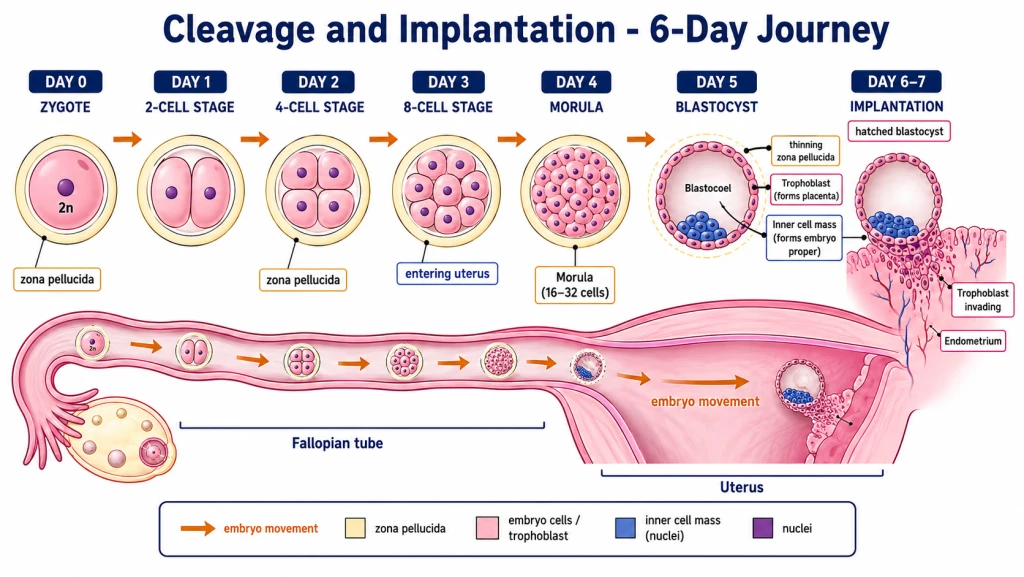
Stage 1: 2-cell stage (Day 1)
- Zygote divides into 2 daughter cells.
- Each cell is called a blastomere.
Stage 2: 4-cell stage (Day 2)
- Each blastomere divides → 4 cells.
Stage 3: 8-cell stage (Day 3)
- 8 cells, all roughly similar in size.
- Embryo enters uterus around this time.
Stage 4: Morula (Day 4) — the "mulberry"
- 8-16 cell stage.
- Solid ball of cells, no cavity yet.
- Cells are tightly packed.
- Resembles a mulberry (Latin: morum).
Stage 5: Blastocyst (Day 5)
This is a critical transition. The morula transforms into a blastocyst — a hollow ball with two distinct cell types:
Trophoblast (outer layer):
Forms the outer wall of the blastocyst.
Will become the placenta.
Initiates implantation.
Inner Cell Mass (ICM):
Cluster of cells at one end of the blastocyst (sometimes called the "embryoblast").
Will become the embryo proper (and parts of the umbilical cord).
Blastocoel: the fluid-filled cavity inside the blastocyst.
[NEET Important] Two key cell types of the blastocyst:
- Trophoblast → placenta
- Inner cell mass (ICM) → embryo proper
Why two cell types?
The trophoblast handles the "outside" job (interfacing with the mother, getting nutrients, forming the placenta). The ICM handles the "inside" job (becoming the actual baby). This early specialisation is essential for the embryo to interface with the maternal blood supply once implanted.
Implantation — Anchoring to the Mother
By day 6-7, the blastocyst has reached the uterus and is ready to attach to the endometrium. This process — called implantation — is the embryonic equivalent of "moving in with the parents."
What happens
- Zona pellucida thins and dissolves ("hatching" of blastocyst).
- The blastocyst attaches to the endometrium with its trophoblast side.
- Trophoblast cells invade the endometrial tissue.
- The blastocyst becomes completely embedded in the endometrium by ~day 9-10.
Where does implantation occur?
- Posterior wall of the uterus is the most common site (~80% of cases).
- The endometrium at this stage is in the secretory phase — thick, glandular, well-vascularised.
What happens after implantation?
- Trophoblast cells start producing hCG (human Chorionic Gonadotropin).
- hCG → maintains the corpus luteum → progesterone continues → endometrium maintained → no menstruation.
- The trophoblast develops into the chorion → forms the fetal portion of the placenta.
- The ICM begins differentiating into the embryo proper.
Pregnancy vs ectopic pregnancy
- Normal pregnancy: Implantation in uterus.
- Ectopic pregnancy: Embryo implants somewhere else (most commonly in the fallopian tube — "tubal pregnancy"). LIFE-THREATENING. Requires immediate medical intervention.
Pregnancy = "the woman is now pregnant"
- Fertilisation alone is NOT pregnancy.
- A woman is officially pregnant only after implantation is complete.
- This is why some early pregnancy losses (before implantation) are called "chemical pregnancies" (the embryo formed but never implanted).
[NEET Important] Memorise the timeline:
- Day 0: Fertilisation (in ampulla)
- Day 5: Blastocyst (in uterus)
- Day 6-7: Implantation begins
- Day 9-10: Fully implanted
Small Memory Capsule
Section 11 in 60 seconds.
Cleavage = rapid mitotic divisions of zygote
- Where: In fallopian tube (eventually moving to uterus)
- Pattern: Embryo divides without growing (cells get smaller)
- No growth phase between divisions
Sequence (memorise!)
Zygote → 2-cell → 4-cell → 8-cell → Morula → Blastocyst → Implantation
Timeline
| Day | Stage |
|---|---|
| 0 | Fertilisation (ampulla) |
| 1 | 2 cells |
| 4 | Morula (8-16 cell solid ball) |
| 5 | Blastocyst (in uterus) |
| 6-7 | Implantation begins |
| 9-10 | Fully implanted |
Blastocyst structure
| Component | Function |
|---|---|
| Trophoblast (outer) | Will form placenta |
| Inner Cell Mass (ICM) | Will form embryo proper |
| Blastocoel | Fluid-filled cavity |
| Zona pellucida | Outer shell — DISSOLVES before implantation |
Implantation
- Where: Posterior wall of uterus (most common)
- Process: Trophoblast invades endometrium
- Status: Pregnancy officially begins
- Hormone: Trophoblast secretes hCG → maintains corpus luteum
Hormonal consequences
- hCG (from blastocyst trophoblast) → maintains corpus luteum
- Corpus luteum → continues progesterone secretion
- Endometrium → maintained (no menstruation)
- Result: Pregnancy continues; cycle paused
Ectopic pregnancy
- Implantation outside uterus (often fallopian tube)
- Life-threatening
- ~1% of pregnancies
One-line takeaway
"Zygote undergoes cleavage (no growth) → 2-cell → 4-cell → 8-cell → morula (8-16) → blastocyst (with trophoblast outer + inner cell mass + blastocoel) → arrives in uterus by day 5 → implants by day 9-10; trophoblast secretes hCG to maintain corpus luteum and pregnancy. Trophoblast becomes placenta; ICM becomes embryo proper."
Solved Examples
Example 1: Define cleavage
What is cleavage? How does it differ from normal mitotic divisions?
Solution:
Cleavage = a series of rapid mitotic divisions of the zygote that does NOT increase the overall size of the embryo. Each division produces smaller and smaller blastomeres (cells).
Difference from normal mitosis:
| Normal mitosis | Cleavage |
|---|---|
| Includes G1, S, G2, M phases | Compressed cell cycle (mostly S + M) |
| Cell grows between divisions | NO growth between divisions |
| Daughter cells same size as parent | Daughter cells are HALF the size |
| Slow (hours-days per cycle) | Fast (12-24 hours per cycle) |
Why no growth? The zygote already has the cytoplasm needed for early development. It just needs to divide into more cells to begin tissue specialisation.
Answer: Cleavage = rapid mitotic divisions without cell growth; cells get smaller with each division.
Example 2: Sequence of cleavage
Arrange in correct order: morula, blastocyst, zygote, 2-cell, 8-cell, 4-cell.
Solution:
Correct chronological order:
Day-by-day timeline:
- Day 0: Zygote (1 cell)
- Day 1: 2-cell stage
- Day 2: 4-cell stage
- Day 3: 8-cell stage (entering uterus)
- Day 4: Morula (8-16 cell solid ball)
- Day 5: Blastocyst (with cavity + trophoblast + inner cell mass)
Answer: Memorise this 6-stage sequence.
Example 3: What is a blastocyst?
What is a blastocyst? Name its three structural features.
Solution:
A blastocyst is the embryonic stage that follows the morula (~day 5). It's a hollow ball of cells with three structural features:
- Trophoblast (outer layer) — forms the wall of the blastocyst; will become the placenta.
- Inner Cell Mass (ICM) — cluster of cells at one end inside the blastocyst; will become the embryo proper.
- Blastocoel — fluid-filled cavity inside the blastocyst.
The zona pellucida still surrounds the blastocyst at this stage, but is about to dissolve to allow implantation.
Answer: Blastocyst = hollow ball with trophoblast (outer) + ICM (inner) + blastocoel (cavity).
Example 4: Trophoblast vs ICM
What does the trophoblast become? What does the inner cell mass become?
Solution:
The blastocyst's two cell types have different fates:
Trophoblast (outer layer):
Forms the placenta (specifically, the chorion = fetal part of placenta).
Initiates implantation by invading the endometrium.
Secretes hCG (human Chorionic Gonadotropin) to maintain the corpus luteum.
Inner Cell Mass (ICM) (inner cluster):
Forms the embryo proper (the actual baby).
Also forms parts of the umbilical cord and embryonic membranes.
Memorable trick: "Trophoblast feeds; ICM is the baby."
Answer: Trophoblast → placenta; ICM → embryo proper.
Example 5: Implantation timing and site
When and where does implantation occur?
Solution:
When: Implantation begins around day 6-7 after fertilisation. Fully embedded by ~day 9-10.
Where: Most commonly in the posterior wall of the uterus (about 80% of cases). The blastocyst attaches and the trophoblast invades the endometrium.
Endometrial state at implantation:
- Secretory phase (luteal phase, ~day 21 of cycle)
- Thick (~5-7 mm)
- Vascular and glandular
- Optimal for receiving the embryo
Answer: Day 6-7 (begins) to 9-10 (complete); posterior uterine wall (most common).
Example 6: Why doesn't the blastocyst implant in fallopian tube?
Normally the embryo travels through the fallopian tube before reaching the uterus. Why doesn't implantation happen in the tube?
Solution:
Several reasons prevent normal implantation in the fallopian tube:
Zona pellucida is intact during tube transit. It must dissolve (hatch) before implantation can begin. The blastocyst doesn't hatch until reaching the uterus.
Tube wall is unsuitable — the fallopian tube has cilia that move the embryo along; not designed for embryo attachment.
Endometrium is in uterus — the secretory endometrium with its thick, vascular, glandular state is in the uterus only. Tubes have a different lining.
Hormonal signals direct movement — peristaltic contractions of fallopian tube and ciliary motion push the embryo toward the uterus.
When implantation DOES occur in the tube (called ectopic / tubal pregnancy), it's a life-threatening complication because the tube cannot expand to accommodate a growing fetus. Requires immediate medical intervention.
Answer: Zona pellucida intact during tube transit; tube wall not designed for implantation; endometrium only in uterus; hormonal cues drive embryo to uterus.