
The Menstrual Cycle — A 28-Day Hormonal Symphony
The menstrual cycle is the cyclical reproductive cycle in females, characterised by predictable changes in:
- Hormones (FSH, LH, oestrogen, progesterone)
- Ovary (follicular development → ovulation → corpus luteum)
- Uterus (endometrium thickening → shedding)
Key facts
- Cycle length: Typically 28 days (range: 21-35 days; varies between women).
- Onset: Begins at menarche (~11-14 years) and continues until menopause (~50 years).
- Function: Prepares the female body for potential pregnancy each month.
What's happening during the cycle?
The cycle has TWO simultaneous processes:
- Ovarian cycle: Follicular development, ovulation, corpus luteum formation/regression in the ovary.
- Uterine cycle: Endometrial thickening (preparing for implantation) → shedding (menstruation if no pregnancy).
Both are coordinated by hormones from hypothalamus, pituitary, ovary.
Four Phases of the Menstrual Cycle
The menstrual cycle is divided into four phases, each with characteristic events in both ovary and uterus:
\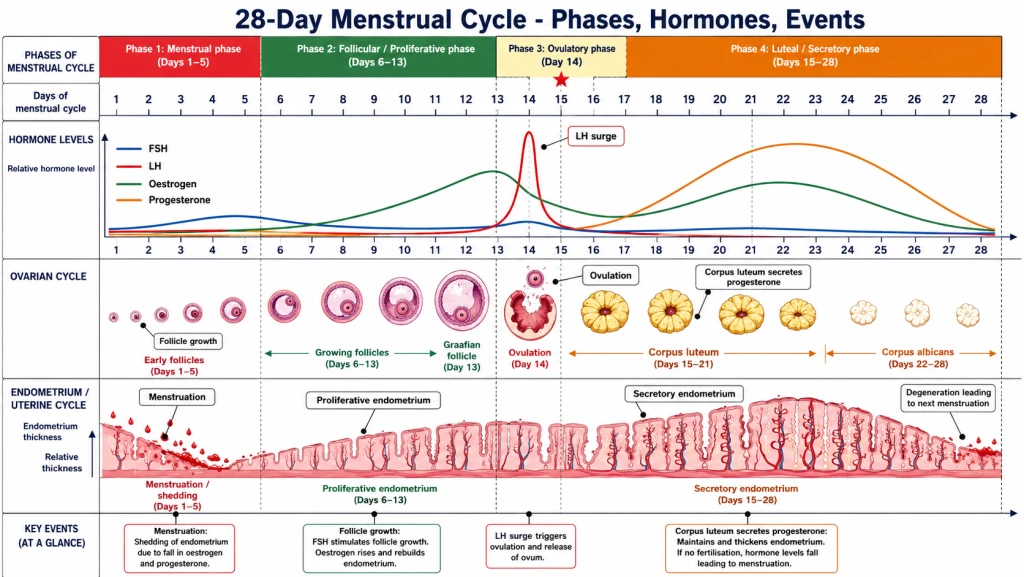
Phase 1: Menstrual Phase (Days 1-5)
- Trigger: Drop in oestrogen and progesterone (corpus luteum has degenerated from previous cycle).
- Events:
- Endometrium sheds — bleeding through vagina (~3-5 days, ~30-50 mL blood + tissue).
- In the ovary, new follicles are starting to develop (FSH-driven).
- Hormone levels: FSH starts rising; oestrogen and progesterone are LOW.
Phase 2: Follicular / Proliferative Phase (Days 6-13)
- Ovarian event: Follicles develop (primordial → primary → secondary → tertiary → Graafian).
- Uterine event: Endometrium thickens (proliferates) under oestrogen stimulation.
- Hormones:
- FSH rising → drives follicular development.
- Oestrogen rising sharply → drives endometrial thickening.
- LH still moderate.
Phase 3: Ovulatory Phase (~Day 14)
- LH SURGE — sudden massive spike in LH (driven by high oestrogen from mature Graafian follicle).
- Ovulation — LH surge triggers Graafian follicle to rupture → secondary oocyte released into fallopian tube.
- Single most important event of the cycle. Without ovulation, no egg → no fertilisation possible.
Phase 4: Luteal / Secretory Phase (Days 15-28)
- Ovarian event: Ruptured follicle becomes corpus luteum, secreting progesterone + some oestrogen.
- Uterine event: Endometrium becomes secretory — glands enlarge and secrete nutrients, preparing for potential implantation.
- Hormones:
- Progesterone dominates (peaks ~day 21).
- Oestrogen secondary.
- FSH and LH suppressed by progesterone (negative feedback).
What happens at the end of the cycle (~day 28)?
If pregnancy occurs: Implanted blastocyst secretes hCG → maintains corpus luteum → progesterone continues → endometrium retained → no menstruation.
If no pregnancy: Corpus luteum degenerates (becomes corpus albicans) → progesterone drops → endometrium can no longer be maintained → menstrual phase begins (back to phase 1).
Hormones of the Cycle
Four key hormones orchestrate the cycle:
1. FSH (Follicle-Stimulating Hormone)
- From: Anterior pituitary.
- Role: Drives follicular development (primordial → Graafian).
- Levels: Rises gradually through the follicular phase and, like LH, attains its peak in the middle of the cycle (~day 14) (NCERT); oestrogen exerts negative feedback in between.
2. LH (Luteinizing Hormone)
- From: Anterior pituitary.
- Role: LH surge triggers ovulation; supports corpus luteum formation.
- Levels: Low except for massive surge ~day 13-14 (the ovulation trigger), then moderate during luteal phase.
3. Oestrogen
- From: Developing follicles (mainly granulosa cells).
- Role: Endometrial proliferation; secondary sexual characteristics; positive feedback at high levels (triggering LH surge).
- Levels: Low at start, RISES sharply during follicular phase, peaks just before ovulation, second smaller peak in luteal phase.
4. Progesterone
- From: Corpus luteum (luteal phase).
- Role: Endometrium becomes secretory; maintains pregnancy if it occurs; negative feedback on FSH/LH.
- Levels: Very low until ovulation, RISES sharply post-ovulation, peaks ~day 21, then drops if no pregnancy.
How they interact (the symphony)
- Follicular phase: FSH ↑ → follicles grow → oestrogen ↑ → endometrium thickens.
- Mid-cycle: Oestrogen high → POSITIVE feedback → LH surge → ovulation.
- Luteal phase: Corpus luteum → progesterone + oestrogen → endometrium secretory; FSH/LH suppressed.
- End of cycle: No pregnancy → corpus luteum dies → hormones drop → menstruation → cycle repeats.
[NEET Important] The LH surge at day 14 is the most critical hormonal event — it triggers ovulation. Memorise.
Special Topics — Menarche, Menopause, Variations
Menarche
- The first menstruation of a woman's life.
- Typical age: 11-14 years.
- Indicates that:
- Hypothalamus is producing GnRH.
- Pituitary is releasing FSH/LH.
- Ovaries are producing oestrogen and progesterone.
- Endometrium is responsive.
- Marks the beginning of reproductive life.
Menopause
- The permanent end of menstrual cycles.
- Typical age: 45-55 years (avg ~50).
- Cause: Exhaustion of primary oocyte reserve.
- Symptoms: Hot flashes, mood changes, decreased libido, decreased bone density (due to oestrogen decline).
- Marks the end of reproductive life.
Cycle variation
- Cycle length can range 21-35 days; not all women have exactly 28-day cycles.
- Anovulation = cycle without ovulation; can be due to stress, weight changes, medical conditions.
- Amenorrhea = absence of menstruation; can be primary (never started) or secondary (started, then stopped).
- Pregnancy is the most common cause of secondary amenorrhea.
Why is the menstrual cycle 28 days?
Coincidentally about the same as a lunar cycle (~29.5 days), but evolutionary biologists don't think the moon directly affects it. The 28-day length seems to be a balance between:
- Time needed for follicular development (~14 days).
- Time the corpus luteum can sustain progesterone (~14 days).
Comparing reproductive cycles
| Cycle | Species | Cycle length | Ovulation cue |
|---|---|---|---|
| Menstrual cycle | Humans, Old World primates | 28 days | LH surge |
| Estrus cycle | Most other mammals (dogs, cats, cows, etc.) | Varies (4-21 days) | Estrus (heat); receptive only at ovulation |
Humans don't have a "heat" period — sexual receptivity is constant throughout the cycle.
[NEET Important] Menarche (first menstruation) and menopause (end of cycles) are NEET-favourite terms. Memorise typical ages (11-14 yr; 45-55 yr).
Small Memory Capsule
Section 9 in 60 seconds.
Menstrual cycle = cyclic reproductive cycle in females
- Length: 28 days (range 21-35)
- Onset: Menarche (~11-14)
- End: Menopause (~50)
- Function: Prepares uterus for potential pregnancy each month
4 Phases (memorise!)
| Phase | Days | Key events | Dominant hormone |
|---|---|---|---|
| 1. Menstrual | 1-5 | Endometrium shedding, bleeding | None (drop in O+P) |
| 2. Follicular / Proliferative | 6-13 | Follicles develop; endometrium thickens | Oestrogen rising (FSH-driven) |
| 3. Ovulatory | ~14 | LH surge → OVULATION | LH spike |
| 4. Luteal / Secretory | 15-28 | Corpus luteum; endometrium secretory | Progesterone (peaks day 21) |
Hormones — quick guide
| Hormone | Source | Peaks | Action |
|---|---|---|---|
| FSH | Pituitary | Mid-cycle peak (~day 14, with LH) | Drives follicular development |
| Oestrogen | Follicles | Just before ovulation | Endometrium thickens, +ve feedback for LH |
| LH | Pituitary | Day 14 (surge) | Triggers ovulation |
| Progesterone | Corpus luteum | Day 21 | Endometrium secretory; pregnancy maintenance |
LH surge — most critical event
The LH surge (~day 13-14) is the direct trigger for ovulation. It:
- Causes Graafian follicle to rupture
- Releases secondary oocyte
- Initiates corpus luteum formation
End of cycle outcomes
| If pregnancy | If no pregnancy |
|---|---|
| Implanted blastocyst → hCG → maintains corpus luteum → progesterone continues → endometrium retained | Corpus luteum dies → progesterone drops → endometrium shed → menstruation → cycle repeats |
Menarche vs Menopause
- Menarche = FIRST menstruation (~11-14 yr); start of reproductive life.
- Menopause = END of menstrual cycles (~50 yr); end of reproductive life.
One-line takeaway
"Menstrual cycle = 28-day rhythm coordinating ovary (follicles → ovulation → corpus luteum) and uterus (endometrium thickening → shedding) via FSH, LH, oestrogen, progesterone; LH surge on day 14 triggers ovulation; if no pregnancy, drops in progesterone trigger menstruation, restarting the cycle."
Solved Examples
Example 1: Define menstrual cycle
Define the menstrual cycle. State its typical duration and the hormones involved.
Solution:
The menstrual cycle is the cyclical reproductive cycle in females characterised by predictable changes in ovary, uterus, and hormone levels — preparing the body for potential pregnancy.
- Duration: Typically 28 days (range 21-35).
- Begins: At menarche (~11-14 years).
- Ends: At menopause (~50 years).
- Hormones involved: FSH, LH, oestrogen, progesterone.
- Phases: Menstrual, Follicular/Proliferative, Ovulatory, Luteal/Secretory.
Answer: Cyclic reproductive process; 28 days; involves FSH, LH, oestrogen, progesterone.
Example 2: Four phases
Name the four phases of the menstrual cycle, their typical day ranges, and key events.
Solution:
| Phase | Days | Key events |
|---|---|---|
| Menstrual | 1-5 | Endometrium sheds → bleeding (~30-50 mL); new follicles begin developing |
| Follicular / Proliferative | 6-13 | Follicles grow under FSH; oestrogen rises; endometrium thickens |
| Ovulatory | ~14 | LH surge triggers Graafian follicle to rupture → ovulation (release of secondary oocyte) |
| Luteal / Secretory | 15-28 | Corpus luteum secretes progesterone; endometrium becomes secretory; if no pregnancy → cycle ends with menstruation |
Answer: Memorise this 4-phase table — appears in NEET every other year.
Example 3: LH surge significance
What is the LH surge? What does it do? When does it occur?
Solution:
The LH surge is a sudden, massive spike in LH (Luteinizing Hormone) levels that occurs around day 13-14 of the menstrual cycle.
What it does:
- Triggers ovulation — causes the mature Graafian follicle to rupture and release the secondary oocyte into the fallopian tube.
- Initiates corpus luteum formation — the ruptured follicle transforms into the progesterone-secreting corpus luteum.
- Triggers Meiosis I completion in the primary oocyte → secondary oocyte (which then arrests in metaphase-II).
Cause: The high oestrogen from the mature Graafian follicle creates a positive feedback loop with the pituitary, triggering the LH surge.
Without LH surge: No ovulation → no fertilisation possible → cycle continues without pregnancy chance.
Answer: LH surge = day 13-14 spike in LH; triggers ovulation. The single most critical event of the cycle.
[NEET Important] A frequent NEET MCQ topic.
Example 4: Hormones in each phase
Which hormone is dominant in each of the four phases of the menstrual cycle?
Solution:
| Phase | Days | Dominant hormone(s) |
|---|---|---|
| Menstrual | 1-5 | None — drop in oestrogen and progesterone is what triggers menstruation. FSH starts rising. |
| Follicular / Proliferative | 6-13 | Oestrogen rising (with FSH driving follicle development). |
| Ovulatory | ~14 | LH surge (triggers ovulation); oestrogen still high. |
| Luteal / Secretory | 15-28 | Progesterone (peaks ~day 21); secondary oestrogen. |
Answer: Each phase has a characteristic dominant hormone. Master this table for NEET.
Example 5: Endometrium changes
Describe the changes in the endometrium during each phase of the menstrual cycle.
Solution:
| Phase | Endometrial state |
|---|---|
| Menstrual | Sheds (about 2/3 of the thickness) → bleeding through vagina. ~3-5 days. |
| Follicular / Proliferative | Regenerates and thickens (proliferates) under oestrogen. Glands grow. Reaches ~3 mm by day 14. |
| Ovulatory | Continues to thicken; in transition. |
| Luteal / Secretory | Becomes secretory under progesterone — glands enlarge and secrete nutrients (mucus, glycogen) to support potential implantation. Reaches ~5-7 mm. |
| End of cycle (if no pregnancy) | Progesterone drops → blood vessels constrict → endometrium dies → sheds in next menstrual phase. |
Answer: Sheds (menstrual) → thickens (follicular) → secretory (luteal) → sheds again (next cycle if no pregnancy).
[NEET Important] Standard NEET MCQ on endometrial changes.
Example 6: What happens if pregnancy occurs?
If pregnancy occurs at this cycle, what changes happen at the end of the cycle (instead of menstruation)?
Solution:
If pregnancy occurs, the following changes prevent menstruation:
- Implantation — fertilised egg (now blastocyst) implants in endometrium ~day 21-23.
- Trophoblast cells of the blastocyst start producing hCG (human Chorionic Gonadotropin).
- hCG maintains the corpus luteum — it does NOT degenerate as it normally would.
- Corpus luteum continues secreting progesterone for ~3 months.
- Endometrium is maintained (not shed) — so no menstruation.
- No new cycle starts — pregnancy continues for ~9 months.
- After ~3 months, the placenta takes over hormone production from the corpus luteum.
Result: No menstrual cycle for the duration of pregnancy + ~6-12 months postpartum (during breastfeeding).
Answer: hCG from blastocyst → maintains corpus luteum → progesterone continues → endometrium maintained → no menstruation. Cycle is "paused" for the duration of pregnancy.
[NEET Important] Common application question.