
Spermatogenesis — Sperm Production
Spermatogenesis is the process of forming sperms (spermatozoa) from spermatogonia (the diploid stem cells of the testis). It happens inside the seminiferous tubules and is continuous from puberty to old age.
Definition (NCERT-canonical)
"Spermatogenesis is the formation of sperms from the spermatogonia (immature germ cells) which are present on the inside wall of seminiferous tubules. The spermatogonia (sing. spermatogonium) multiply by mitotic division and increase in numbers."
The 4 phases
Spermatogenesis has four phases:
- Multiplication phase — spermatogonia divide mitotically (maintain stem cell pool).
- Growth phase — spermatogonia enlarge to form primary spermatocytes.
- Maturation phase — primary spermatocytes undergo meiosis to form spermatids.
- Spermiogenesis — spermatids transform into mature sperms (no further division).
Where it happens
- Location: Seminiferous tubules of testis.
- Cell types involved: Germ cells (developing) + Sertoli cells (supporting).
- Hormonal control: FSH (→ Sertoli), LH/ICSH (→ Leydig → testosterone).
- Duration of complete spermatogenesis: ~64-72 days from spermatogonium to mature sperm.
[NEET Important] Spermatogenesis happens IN seminiferous tubules; meiosis happens at the primary spermatocyte stage; produces 4 sperms per primary spermatocyte.
The 4 Phases in Detail
\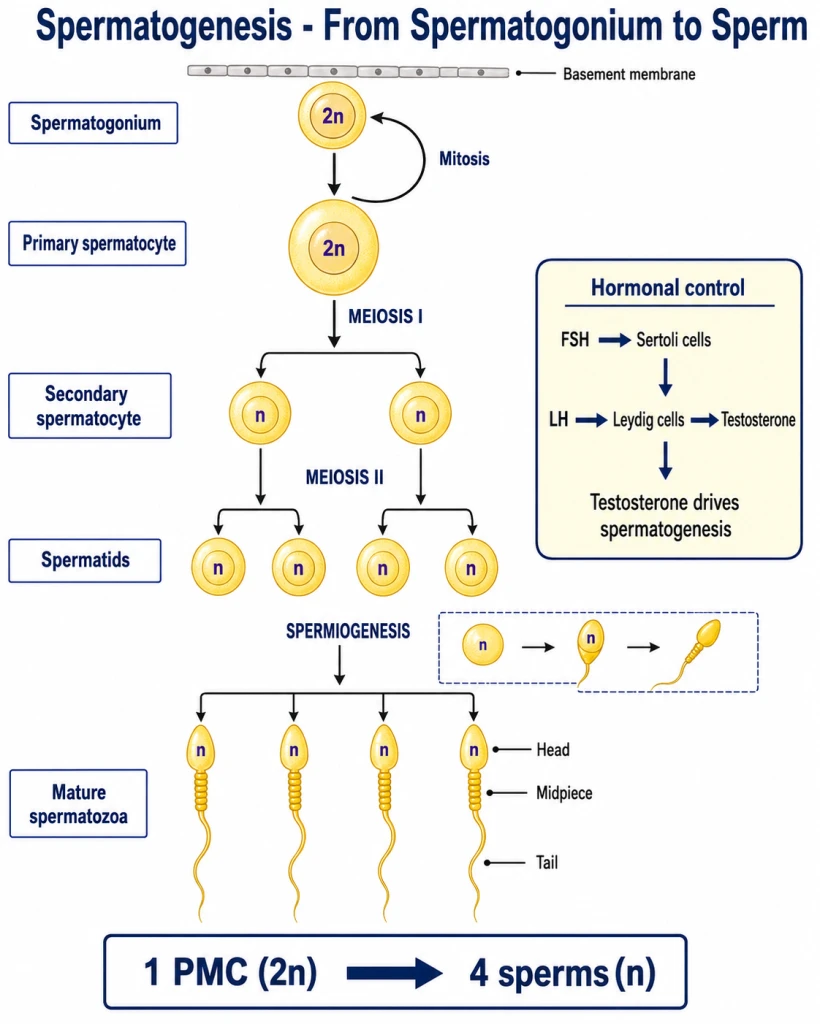
Phase 1: Multiplication (Mitosis)
- Spermatogonia () sit on the basement membrane of the seminiferous tubule.
- They divide mitotically to produce more spermatogonia.
- Some daughter cells maintain the stem cell pool (so spermatogenesis can continue indefinitely).
- Others commit to becoming gametes — they become primary spermatocytes.
Phase 2: Growth
- Primary spermatocytes () — bigger than spermatogonia, with more cytoplasm.
- They prepare for the next stage: meiosis.
Phase 3: Maturation (Meiosis)
This is the key phase that halves the chromosome number and produces haploid cells.
- Meiosis I — Primary spermatocyte () → 2 secondary spermatocytes ( each).
- Meiosis II — Each secondary spermatocyte () → 2 spermatids ( each).
- Result: 1 primary spermatocyte → 4 spermatids (all haploid).
Phase 4: Spermiogenesis
- Spermatids are round haploid cells with NO sperm-like features.
- Spermiogenesis = the morphological transformation of spermatids into mature sperms.
- Changes:
- Cytoplasm reduces dramatically.
- Acrosome forms (from Golgi apparatus) — covers sperm head.
- Nucleus condenses and elongates (becomes the head).
- Mitochondria spiral around the midpiece.
- Tail (flagellum) develops from the centriole.
- No cell division in this phase — just morphological reshaping.
Result
[NEET Important] The 1:4 ratio (1 PMC → 4 sperms) is fixed by meiosis. Memorise.
Hormonal Control of Spermatogenesis
Spermatogenesis is under tight hormonal control from the HPG axis:
The hormonal cascade
- Hypothalamus secretes GnRH (Gonadotropin-Releasing Hormone).
- Pituitary secretes FSH and LH (ICSH).
- FSH acts on Sertoli cells → spermatogenic support.
- LH (ICSH) acts on Leydig cells → testosterone production.
- Testosterone → drives spermatogenesis (acts on Sertoli cells which support germ cells).
- Inhibin (from Sertoli) and testosterone provide negative feedback to limit hormone production.
Specifically, what each hormone does for sperm production
| Hormone | Target | Effect |
|---|---|---|
| GnRH | Pituitary | Triggers FSH + LH release |
| FSH | Sertoli cells | Activates spermatogenesis support |
| LH (ICSH) | Leydig cells | Triggers testosterone synthesis |
| Testosterone | Sertoli cells, germ cells | Drives spermatogenic progression |
| Inhibin | Pituitary (negative feedback) | Inhibits FSH |
[NEET Important] Memorise: FSH→Sertoli, LH→Leydig (testosterone), testosterone→spermatogenesis, inhibin→inhibits FSH. Common NEET MCQ pattern.
Sperm Structure
The mature sperm (spermatozoon) is a highly specialised cell adapted for swimming and fertilisation. It has four parts (NCERT) — head, neck, middle piece and tail. The neck, between head and middle piece, contains the centrioles. Key parts:
\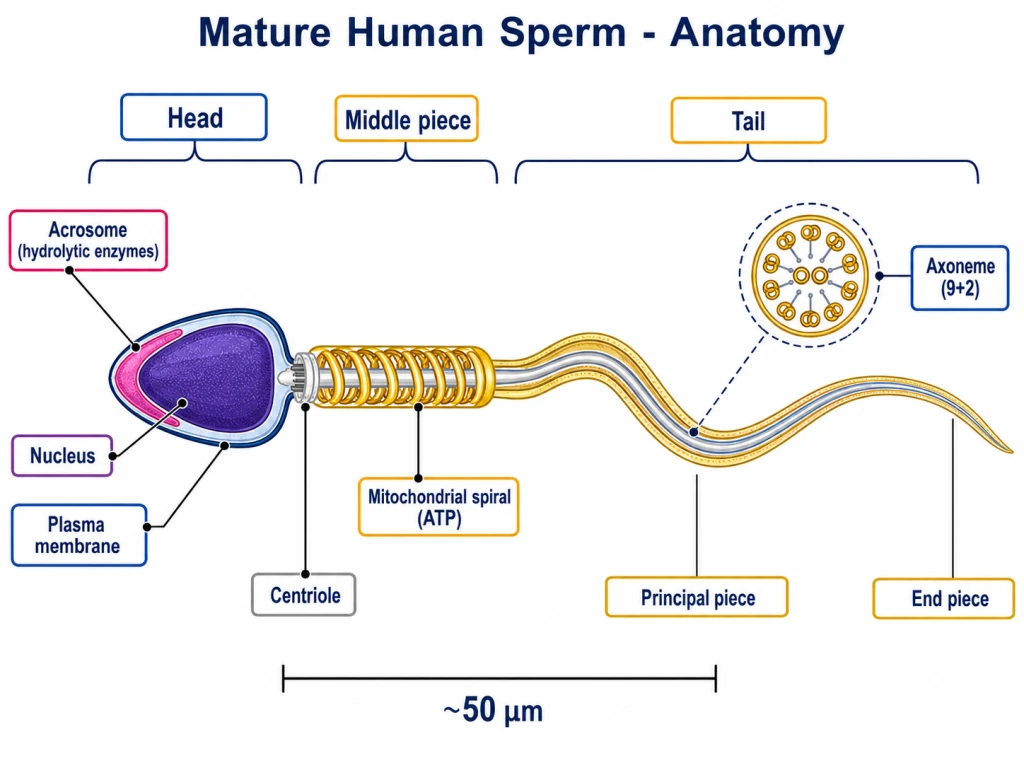
1. Head (~5 μm)
- Nucleus — extremely condensed haploid DNA (essential — this is the genetic material).
- Acrosome — cap-like structure on top of the nucleus; contains hydrolytic enzymes (especially acrosin, hyaluronidase) that digest the zona pellucida of the egg during fertilisation (acrosomal reaction).
2. Middle piece (~5 μm)
- Mitochondrial spiral — many mitochondria wrap helically around the central axoneme. They produce ATP to power the flagellum.
- This is the "engine room" of the sperm.
3. Tail / Flagellum (~40-50 μm)
- A long whip-like structure that propels the sperm forward.
- Contains the axoneme — a central core of microtubules in 9+2 arrangement (9 outer doublets + 2 central singlets).
- Movement is wave-like, similar to a fish swimming.
Total length
A mature sperm is ~50-60 μm long (mostly tail; head is only ~5 μm).
Summary
| Part | Length | Contents | Function |
|---|---|---|---|
| Head | ~5 μm | Nucleus + acrosome | Genetic material + zona pellucida penetration |
| Middle piece | ~5 μm | Mitochondrial spiral | ATP generation |
| Tail | ~40-50 μm | Axoneme (9+2 microtubules) | Motility |
[NEET Important] Common MCQ: "What does the acrosome contain?" Answer: hydrolytic enzymes (acrosin, hyaluronidase) — used to penetrate the zona pellucida of the egg.
Small Memory Capsule
Section 7 in 60 seconds.
Spermatogenesis = sperm formation
- Location: Seminiferous tubules
- Duration: ~64-72 days complete cycle
- Continuous from puberty to old age
4 phases
- Multiplication (mitosis) — spermatogonia divide
- Growth — spermatogonia → primary spermatocytes
- Maturation (meiosis) — primary spermatocyte → 4 spermatids
- Spermiogenesis — spermatids → mature sperms (no division); sperm heads stay embedded in Sertoli cells until spermiation — their release from the seminiferous tubule (NCERT)
Cell sequence + ploidy
1 primary spermatocyte → 4 sperms (fixed by meiosis).
Key meiosis facts
- Meiosis I: Primary → 2 secondary spermatocytes
- Meiosis II: Each secondary → 2 spermatids
- All 4 spermatids survive (unlike oogenesis where only 1 survives)
Hormonal control (master diagram)
Hypothalamus → GnRH → Pituitary → FSH (→Sertoli) + LH/ICSH (→Leydig)
Sertoli + testosterone → spermatogenesis
Inhibin (Sertoli) → inhibits FSH (negative feedback)
Sperm structure
| Part | Contains |
|---|---|
| Head | Nucleus + acrosome (with hydrolytic enzymes) |
| Neck | Contains the centrioles |
| Middle piece | Mitochondrial spiral (ATP) |
| Tail | Axoneme (9+2 microtubules) — propulsion |
Acrosome
- Cap on sperm head
- Contains hydrolytic enzymes (acrosin, hyaluronidase)
- Used to penetrate zona pellucida during fertilisation
Master arrow (memorise!)
One-line takeaway
"Spermatogenesis = continuous sperm production in seminiferous tubules; 1 primary spermatocyte (2n) → 4 sperms (n) via meiosis + spermiogenesis; controlled by FSH/LH/testosterone; sperm has 3 parts (head with acrosome, middle piece with mitochondria, tail with 9+2 axoneme)."
Solved Examples
Example 1: Define spermatogenesis
Define spermatogenesis. Where does it occur and what type of cell division is involved?
Solution:
Spermatogenesis = the process of formation of mature sperms from spermatogonia in the testis.
- Location: Inside the seminiferous tubules of the testis.
- Cell divisions involved: Both mitosis (multiplication phase + spermatogonia self-renewal) AND meiosis (maturation phase, primary spermatocyte → 4 spermatids).
- Plus: Spermiogenesis (NO division — just morphological reshaping of spermatid into sperm).
- Duration: ~64-72 days from spermatogonium to mature sperm.
Answer: Spermatogenesis = formation of sperms from spermatogonia in seminiferous tubules; involves mitosis (multiplication) + meiosis (maturation) + spermiogenesis.
Example 2: Four phases
Name the four phases of spermatogenesis.
Solution:
- Multiplication phase — spermatogonia divide mitotically (maintains stem cell pool + produces primary spermatocytes).
- Growth phase — spermatogonia enlarge to form primary spermatocytes.
- Maturation phase — primary spermatocytes undergo meiosis I and II to produce 4 spermatids.
- Spermiogenesis — spermatids transform into mature sperms (NO division).
Answer: Multiplication → Growth → Maturation (Meiosis) → Spermiogenesis.
Example 3: How many sperms from 1 PMC?
How many mature sperms are produced from one primary spermatocyte? Show the cellular calculations.
Solution:
Cellular sequence:
- 1 primary spermatocyte () → Meiosis I → 2 secondary spermatocytes ( each).
- 2 secondary spermatocytes → Meiosis II → 4 spermatids ( each).
- 4 spermatids → spermiogenesis (no division) → 4 mature sperms.
Answer: 1 primary spermatocyte → 4 mature sperms.
[NEET Important] Numerical NEET MCQ. Memorise the 1:4 ratio.
Compare with oogenesis: 1 primary oocyte → only 1 ovum (the asymmetric meiotic division produces 1 ovum + 3 polar bodies).
Example 4: Sperm structure
Describe the structure of a mature human sperm.
Solution:
A mature human sperm has four parts (NCERT) — head, neck, middle piece and tail:
1. Head (~5 μm)
- Nucleus — extremely condensed haploid DNA.
- Acrosome — cap-like structure containing hydrolytic enzymes (acrosin, hyaluronidase) that digest the zona pellucida during fertilisation.
2. Middle piece (~5 μm)
- Mitochondrial spiral — many mitochondria wrap helically around the axoneme. Produce ATP to power the tail.
3. Tail / Flagellum (~40-50 μm)
- Axoneme — central core of microtubules in 9+2 arrangement (9 outer doublets + 2 central singlets).
- Generates wave-like motion to propel the sperm.
Total length: ~50-60 μm.
Answer: Head (nucleus + acrosome) + Middle piece (mitochondrial spiral) + Tail (axoneme).
[Board Important] A standard 5-mark labelled-diagram CBSE question.
Example 5: Function of acrosome
What is the acrosome? What does it contain? What is its function?
Solution:
The acrosome is a cap-like structure on the tip of the sperm head. Derived from the Golgi apparatus during spermiogenesis.
Contents: Hydrolytic enzymes:
- Acrosin — a serine protease that digests the zona pellucida.
- Hyaluronidase — breaks down the cumulus cells around the egg.
- Other proteases.
Function: zona pellucida penetration during fertilisation.
When a sperm reaches the zona pellucida (glycoprotein layer around the egg), the acrosomal membrane fuses with the sperm membrane, releasing these enzymes. The enzymes locally digest a path through the zona pellucida, allowing the sperm to reach the egg's plasma membrane. This is called the acrosomal reaction.
Answer: Acrosome = cap on sperm head; contains hydrolytic enzymes (acrosin, hyaluronidase); penetrates zona pellucida of egg during fertilisation.
[NEET Important] Frequent NEET MCQ.
Example 6: Hormonal control
Describe the hormonal control of spermatogenesis.
Solution:
The HPG axis controls spermatogenesis:
- GnRH (hypothalamus) → triggers pituitary
- FSH (pituitary) → acts on Sertoli cells → spermatogenic support
- LH / ICSH (pituitary) → acts on Leydig cells → testosterone production
- Testosterone → drives spermatogenesis (acts on Sertoli + germ cells)
- Negative feedback:
- Inhibin (Sertoli) → inhibits FSH
- Testosterone → inhibits hypothalamus + pituitary
Key points:
- Without FSH: Sertoli cells don't function → spermatogenesis fails.
- Without LH: Leydig cells don't make testosterone → spermatogenesis fails.
- Both FSH and testosterone are required.
Answer: GnRH → FSH (→ Sertoli) + LH (→ Leydig → testosterone) → spermatogenesis. Inhibin and testosterone provide negative feedback.
[Board Important] Standard 5-mark CBSE essay.