
The Male Accessory Pipeline
Once sperms have exited the testis (via vas deferens), they need to be:
- Stored
- Mixed with fluids (to form semen)
- Delivered to the female reproductive tract
This is the job of the accessory ducts and glands of the male reproductive system.
Accessory ducts
We've already met rete testis, vasa efferentia, epididymis, and vas deferens in Section 2. Now we add two more:
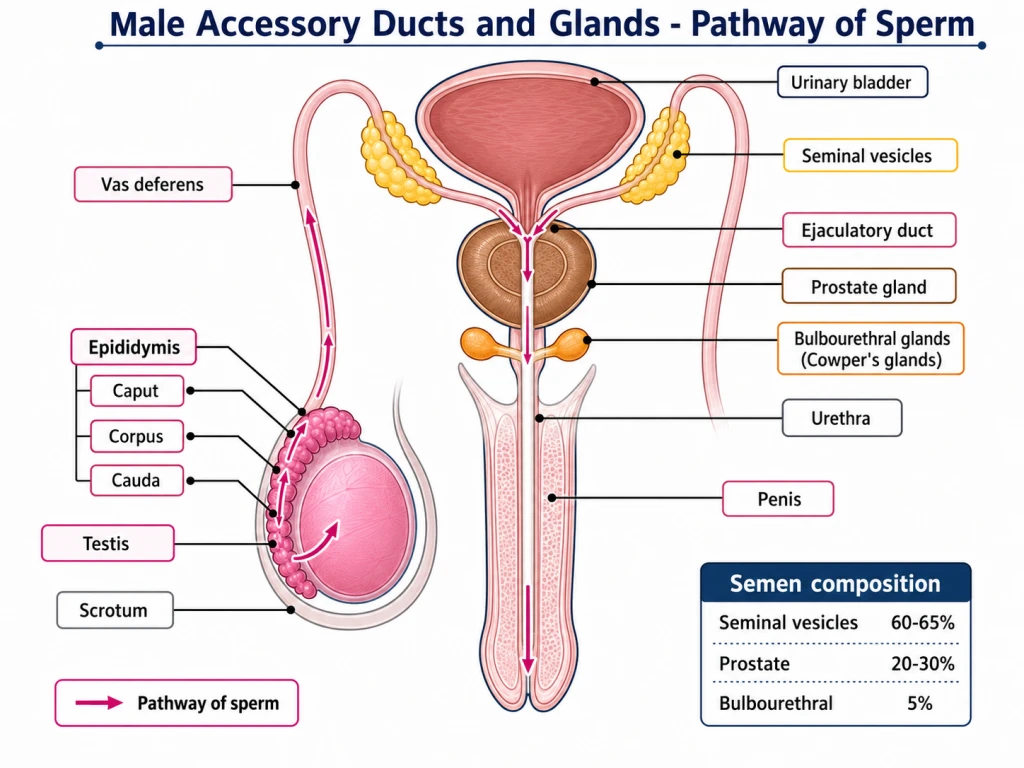
Ejaculatory duct — a short tube formed by the union of the vas deferens with the duct of the seminal vesicle. It opens into the urethra.
Urethra — the final tube; carries semen (and urine) out of the body via the penis. In males, this is one tube serving both functions.
The complete sperm pathway (memorise!)
That's 7 structures in total (8 steps counting the exit). Memorise them in order.
\
The Three Accessory Glands
Three accessory glands — the paired seminal vesicles, a single prostate and the paired bulbourethral glands (NCERT) — contribute fluids to semen (the ejaculate):
1. Seminal Vesicles
- Pair of pouches.
- Located behind the urinary bladder.
- Open into the vas deferens to form the ejaculatory duct.
- Secretion: fructose-rich, alkaline fluid that:
- Provides energy (fructose) for sperm motility. (NCERT: seminal plasma is rich in fructose, calcium and certain enzymes.)
- Neutralises the acidic vagina.
- Contributes ~60-65% of semen volume — the LARGEST contribution.
2. Prostate Gland
- Single gland.
- Surrounds the urethra just below the bladder (donut-shaped).
- Secretion: thin, milky alkaline fluid containing:
- Citrate (energy)
- Enzymes (PSA — prostate-specific antigen, helps liquefy semen)
- Zinc (sperm protection)
- Contributes ~20-30% of semen volume.
3. Bulbourethral Glands (Cowper's Glands)
- Pair of small glands.
- Located below the prostate.
- Secretion: clear, mucous fluid that:
- Lubricates the urethra before ejaculation.
- Neutralises traces of acidic urine in the urethra.
- Contributes ~5% of semen volume.
Summary table
| Gland | Number | Secretion | % of semen |
|---|---|---|---|
| Seminal vesicles | Pair | Fructose-rich alkaline fluid | 60-65% |
| Prostate | Single | Milky alkaline fluid + enzymes | 20-30% |
| Bulbourethral (Cowper's) | Pair | Clear lubricating mucous | ~5% |
[NEET Important] Standard MCQ: "Which gland contributes the largest volume to semen?" Answer: Seminal vesicles (60-65%).
Semen — What Sperms Travel In
Semen = sperms + secretions of the accessory glands.
Composition
A typical ejaculate is 2-5 mL of semen, containing:
- ~200-300 million sperms (~10% of volume — sperms are tiny)
- Seminal vesicle fluid (~60-65%) — fructose, alkaline
- Prostatic fluid (~20-30%) — citrate, enzymes, zinc
- Bulbourethral fluid (~5%) — lubricating mucous
Why this complex mixture?
- Energy: Fructose powers sperm flagellar movement.
- pH neutralisation: Vagina is acidic (pH ~3.5-4.5) to prevent infection. Sperms can't survive there. Alkaline semen (pH ~7.2-8) neutralises the vaginal pH temporarily, allowing sperms to swim.
- Liquefaction: Initial semen is gel-like (helps it stay in vagina). Prostate enzymes (PSA) liquefy it within ~20 min so sperms can swim.
- Lubrication: Cowper's mucous lubricates the urethra and helps sperms slide through.
- Protection: Zinc, antioxidants protect sperms from oxidative damage.
Sperm count and infertility
- Normal sperm count: million per mL of semen.
- Oligospermia: million per mL — common cause of male infertility.
- Azoospermia: zero sperms — severe infertility.
[NEET Important] "What is the normal sperm count in semen?" Answer: 60-150 million per mL, with normal ejaculate volume 2-5 mL → ~200-300 million sperms total.
Insemination and Fertilisation Site
Once the male ejaculates semen into the female vagina, the journey is far from over:
Sperm journey through female tract
- Vagina — sperms enter; need to survive acidic environment (~5% live through this).
- Cervix — passing through the cervical mucus (which is normally a barrier but becomes more permeable around ovulation).
- Uterus — sperms swim up through the uterus.
- Fallopian tube (oviduct) — sperms enter the tube, swim toward the egg.
- Ampulla of fallopian tube — fertilisation site! (Where sperms meet the egg.)
Of the ~200-300 million sperms in the ejaculate, only a few hundred reach the ampulla. Of those, only ONE typically fertilises the egg.
Capacitation
Before a sperm can fertilise, it must undergo capacitation — a maturation process in the female tract that takes ~5-6 hours. During this:
- Membrane changes occur on the sperm head.
- The acrosome (at the sperm head's tip) becomes "primed" for the acrosomal reaction.
- Sperm motility increases (hyperactivation).
Capacitation is REQUIRED for fertilisation. A sperm that hasn't capacitated cannot fertilise an egg.
[NEET Important] Capacitation occurs in the female tract, NOT in the male body. This is why human fertilisation cannot happen with freshly ejaculated sperm in vitro — they need conditions mimicking the female tract.
Small Memory Capsule
Section 4 in 60 seconds.
Complete sperm pathway (7 structures)
Seminiferous tubule → Rete testis → Vasa efferentia → Epididymis → Vas deferens → Ejaculatory duct → Urethra → Outside
Three accessory glands
| Gland | Number | Secretion | % of semen |
|---|---|---|---|
| Seminal vesicles | Pair | Fructose, alkaline | 60-65% (most!) |
| Prostate | Single | Milky, alkaline + enzymes | 20-30% |
| Bulbourethral (Cowper's) | Pair | Clear lubricating mucous | ~5% |
Semen
- Volume: 2-5 mL per ejaculate
- Sperm count: 200-300 million total; ~60-150 million per mL
- pH: ~7.2-8 (alkaline)
- Functions of accessory fluids:
- Energy (fructose)
- pH neutralisation (alkalinity)
- Liquefaction (PSA)
- Lubrication (Cowper's mucous)
- Protection (zinc, antioxidants)
Capacitation
- Sperm maturation in female tract.
- Takes ~5-6 hours.
- Required for fertilisation.
Fertilisation site
- Ampullary-isthmic junction of the fallopian tube (NOT the uterus!).
One-line takeaway
"Sperms exit the testis via 7 structures (seminiferous tubule → urethra), get mixed with seminal vesicle, prostate, and Cowper's gland fluids to form semen (200-300M sperms in 2-5 mL), are deposited in the vagina, must undergo capacitation in the female tract, and meet the egg in the ampulla of the fallopian tube — where ONLY ONE will fertilise it."
Solved Examples
Example 1: Complete sperm pathway
Trace the complete pathway of a sperm from its production site to the outside of the body.
Solution:
- Seminiferous tubule — production
- Rete testis — convergence
- Vasa efferentia — exit from testis
- Epididymis — maturation (caput → corpus → cauda)
- Vas deferens — long tube ascending into abdomen
- Ejaculatory duct — short tube formed by vas deferens + seminal vesicle duct
- Urethra — final tube through penis
- Outside — ejaculation
Answer: The 8-step pathway. NEET-classic — memorise.
Example 2: Three accessory glands
Name the three accessory glands of the male reproductive system. State the volume contribution of each to semen.
Solution:
- Seminal vesicles (pair) — secrete fructose-rich alkaline fluid → 60-65% of semen volume (largest!)
- Prostate gland (single) — secretes milky alkaline fluid with enzymes (PSA) → 20-30% of semen
- Bulbourethral / Cowper's glands (pair) — secrete clear lubricating mucous → ~5% of semen
Answer: Seminal vesicles (60-65%), Prostate (20-30%), Bulbourethral (5%). Together the accessory glands contribute ~90% of semen volume; the rest (~10%) is the testicular contribution (sperms plus testicular fluid).
Example 3: Why fructose in semen?
Why does seminal vesicle fluid contain fructose?
Solution:
Fructose in seminal vesicle fluid serves as the primary energy source for sperm motility. Sperms have a strong flagellum that powers their swim through the female tract — this requires ATP. Sperms metabolise fructose (via glycolysis) to produce the ATP needed for flagellar motility.
Why fructose specifically (not glucose)? Fructose is rapidly metabolised by sperms; glucose would be more readily used by other cells. Using fructose ensures the energy reaches sperms specifically.
Answer: Fructose provides energy for sperm flagellar movement (motility) via ATP production through glycolysis.
[NEET Important] Frequent NEET MCQ: "Source of energy for sperm motility?" Answer: fructose from seminal vesicles.
Example 4: Why is semen alkaline?
Why is semen alkaline (pH ~7.2-8) instead of neutral or acidic?
Solution:
The vaginal environment is acidic (pH ~3.5-4.5) due to lactobacilli that produce lactic acid (a defence mechanism against bacterial infections). Sperms cannot survive or swim well at this acidic pH.
To overcome this:
- Semen is alkaline (pH 7.2-8).
- The alkalinity is provided by seminal vesicle fluid and prostate fluid.
- When semen enters the vagina, it temporarily neutralises the acidity (raising vaginal pH for ~30 min), creating a window during which sperms can swim toward the cervix.
Without alkaline semen, sperms would die before reaching the cervix.
Answer: Alkaline semen neutralises the acidic vagina (pH ~3.5-4.5), creating a temporary pH window for sperm survival and motility.
Example 5: Largest gland contribution
Which accessory gland contributes the largest volume to semen?
Solution:
Seminal vesicles contribute the largest volume to semen — approximately 60-65% of the total volume.
This is by far the dominant contributor:
- Seminal vesicles: ~60-65%
- Prostate: ~20-30%
- Bulbourethral: ~5%
So if you ejaculate 4 mL of semen, ~2.5 mL is from seminal vesicles, ~1 mL from prostate, ~0.2 mL from Cowper's glands.
Answer: Seminal vesicles (60-65% of semen volume).
[NEET Important] A common MCQ — students often confuse this with the prostate.
Example 6: Where do sperms meet the egg?
Where exactly does fertilisation occur in the female reproductive tract?
Solution:
Fertilisation occurs in the AMPULLA of the fallopian tube — the wider, distal portion of the oviduct, far from the uterus.
Why ampulla?
- The egg is released from the ovary into the infundibulum (funnel-shaped end of fallopian tube near ovary).
- Cilia in the fallopian tube transport the egg toward the uterus.
- The egg passes through the ampulla (the longest, widest part) on its way down.
- Sperms swim UP from the uterus into the fallopian tube.
- They meet in the ampulla — the most common fertilisation site.
NOT the uterus — by the time the embryo reaches the uterus, fertilisation has long since occurred. The uterus is the implantation site, not the fertilisation site.
Answer: Ampulla of the fallopian tube (oviduct).
[NEET Important] A perennial NEET fact. Memorise — many students wrongly say "uterus.