
Location and Layout of the Male Reproductive System
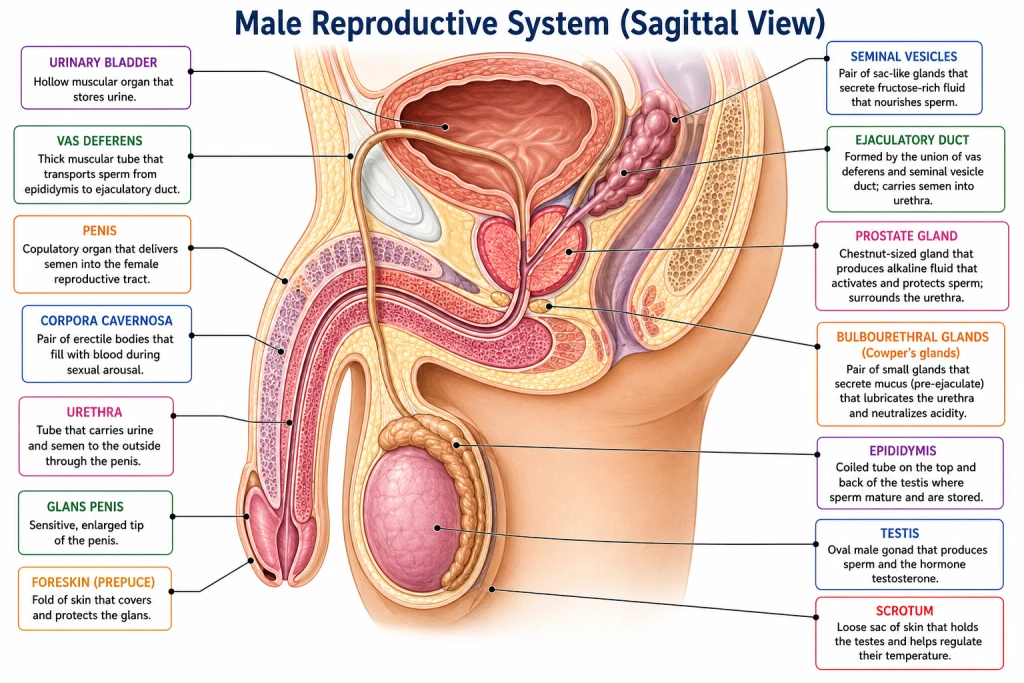
The male reproductive system is located in the pelvic region. It comprises:
- A pair of testes (the gonads — gamete-producing organs)
- Accessory ducts (rete testis, vasa efferentia, epididymis, vas deferens — NCERT's four; the ejaculatory duct and urethra continue the pathway)
- Accessory glands (seminal vesicles, prostate, bulbourethral glands)
- External genitalia (penis)
\
The Testes — Where it All Begins
The testes (singular: testis) are the male gonads:
- A pair of oval organs.
- Located outside the body, in a sac of skin called the scrotum.
- About 4-5 cm long, 2-3 cm wide in adult humans.
Why are testes external? (NEET-classic)
Spermatogenesis is temperature-sensitive — it requires a temperature about 2-2.5°C below the core body temperature (37°C), i.e., around 34.5°C.
If the testes were internal (at body temperature), sperm production would be severely impaired (this is why some men with undescended testes — cryptorchidism — are infertile).
The scrotum keeps the testes:
- Outside the body cavity for natural cooling.
- Has specialised muscles (cremaster + dartos) that retract the testes closer to body in cold and lower them away in heat — fine-tuning temperature.
[NEET Important] "Why are testes located outside the body in the scrotum?" Answer: spermatogenesis requires 2-2.5°C below body temperature.
Internal Compartmentalisation of the Testis
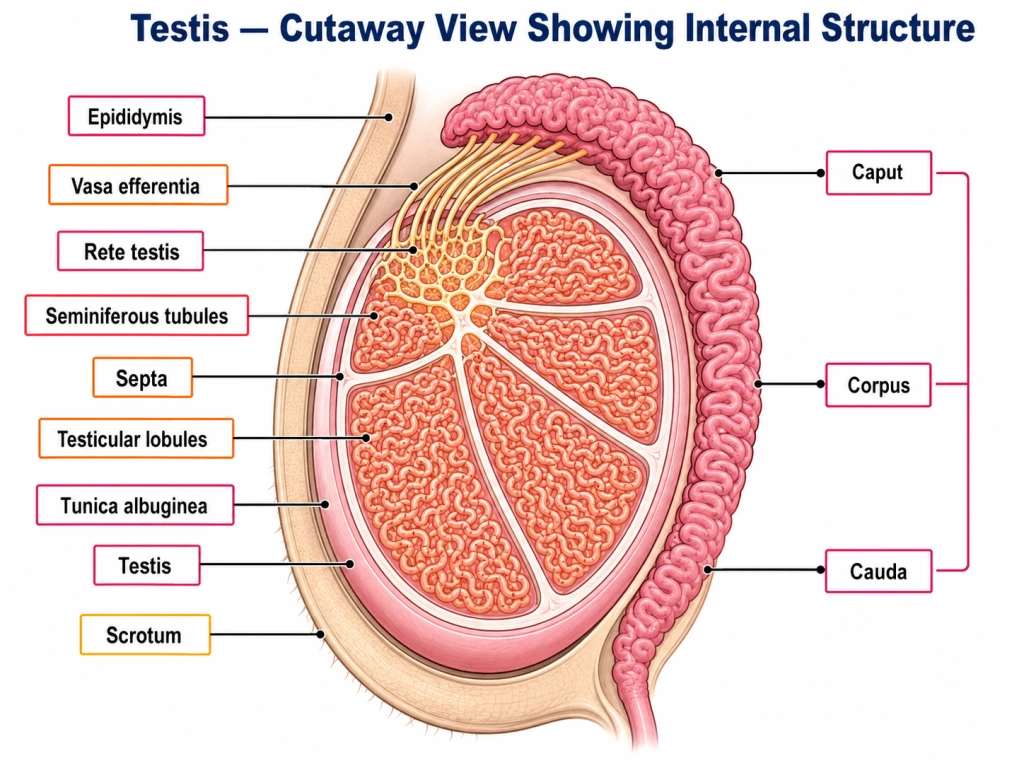
If you cut a testis open longitudinally, you'd see it divided into a series of compartments — like a citrus fruit divided into segments.
Testicular lobules
Each testis is divided into about 250 testicular lobules (compartments) by septa of connective tissue.
Each testicular lobule contains:
- 1 to 3 highly coiled tubules called seminiferous tubules.
- Connective tissue between the tubules — this is where Leydig (interstitial) cells are found.
Where sperms are made
Spermatogenesis (sperm formation) occurs INSIDE the seminiferous tubules.
Specifically, in the lining of these tubules.
Anatomy at a glance
\
NCERT direct quote: "Each lobule contains one to three highly coiled seminiferous tubules in which sperms are produced."
The Path Sperms Take Out of the Testis
Once a sperm has been produced inside the seminiferous tubule, it embarks on a long journey before it can leave the body. Here's the path through the testis itself:
Step 1: Seminiferous tubules → Rete testis
The seminiferous tubules from all the lobules converge into a network of tubules called the rete testis (located near the back of the testis).
Step 2: Rete testis → Vasa efferentia
From the rete testis, sperm move into a series of small ducts called vasa efferentia (efferent ducts).
Step 3: Vasa efferentia → Epididymis
The vasa efferentia open into the epididymis — a long, highly coiled tube located along the posterior surface of each testis.
The epididymis has 3 parts:
- Caput (head) — at top
- Corpus (body) — middle
- Cauda (tail) — at bottom; connects to vas deferens
Step 4: Epididymis → Vas deferens
The epididymis tail leads into the vas deferens (also called ductus deferens) — a longer tube that ascends out of the scrotum into the abdomen, eventually connecting to the ejaculatory duct.
The full sequence (memorise!)
[NEET Important] This 5-step pathway is a NEET classic. Memorise it word-for-word.
External Genitalia: Penis & Scrotum
The Penis
The penis is the male copulatory organ. Anatomy:
- Made up of erectile tissue (corpora cavernosa + corpus spongiosum) that fills with blood during sexual arousal, causing erection.
- Contains the urethra — a single tube that carries both urine (from bladder) and semen (during ejaculation).
- The end of the penis (glans penis) is the most sensitive part.
- Covered by a fold of skin called the foreskin (prepuce) — surgically removed in circumcision.
The Scrotum
The scrotum is a sac of skin that contains the testes. Structure:
- Two compartments — one for each testis.
- Loose, wrinkled skin allows for expansion/contraction with temperature.
- Contains the cremaster and dartos muscles for thermoregulation:
- When cold: muscles contract, pulling testes closer to body for warmth.
- When hot: muscles relax, allowing testes to hang lower for cooling.
- Maintains testicular temperature at 34.5°C (~2.5°C below core).
Quick anatomy summary
| Structure | Function |
|---|---|
| Penis | Insemination + urination |
| Scrotum | Houses testes; thermoregulation |
| Glans penis | Sensitive end of penis |
| Foreskin | Skin fold over glans |
| Urethra | Single tube for urine + semen |
[NEET Important] Note that in males, the urethra serves dual function — urine + semen. (In females, the urethra and vagina are completely separate.)
Small Memory Capsule
Section 2 in 60 seconds.
Male reproductive system components
- Testes (pair) — gametogenesis + testosterone
- Accessory ducts — rete testis, vasa efferentia, epididymis, vas deferens (NCERT)
- Accessory glands — seminal vesicles, prostate, bulbourethral
- External genitalia — penis, scrotum
Testes
- Location: scrotum (outside body)
- Why outside: spermatogenesis needs temperature 2-2.5°C below body temp (~34.5°C)
- Each testis: ~250 testicular lobules, each with 1-3 seminiferous tubules
- Spermatogenesis occurs IN seminiferous tubules
Path of sperm out of testis
Seminiferous tubule → Rete testis → Vasa efferentia → Epididymis → Vas deferens
Epididymis
- Long coiled tube on posterior surface of testis
- 3 parts: Caput (head), Corpus (body), Cauda (tail)
- Sperms mature here
External anatomy
- Penis: copulatory organ; erectile tissue (corpora cavernosa); contains urethra
- Scrotum: sac of skin containing testes; cremaster + dartos muscles for thermoregulation
- Urethra: SINGLE tube carrying both urine + semen (in males)
NEET-favourites
- Cryptorchidism = undescended testes → infertility (because of high temp)
- Number of testicular lobules: ~250
- Seminiferous tubules per lobule: 1-3
One-line takeaway
"The testes sit in the scrotum (cool environment) and make sperms in seminiferous tubules; sperms exit via rete testis → vasa efferentia → epididymis → vas deferens, ready to be ejaculated through the dual-purpose urethra of the penis."
Solved Examples
Example 1: Components of male reproductive system
List the four components of the male reproductive system.
Solution:
- Pair of testes — gonads (sperm and testosterone production)
- Accessory ducts — rete testis, vasa efferentia, epididymis, vas deferens (NCERT)
- Accessory glands — seminal vesicles, prostate, bulbourethral (Cowper's) glands
- External genitalia — penis, scrotum
Answer: Testes + accessory ducts + accessory glands + external genitalia.
Example 2: Why testes are external
Why are the testes located in the scrotum, outside the body cavity?
Solution:
Spermatogenesis is temperature-sensitive and requires a temperature about 2-2.5°C below the core body temperature (37°C), i.e., around 34.5°C.
If the testes were inside the body cavity (at 37°C), spermatogenesis would be severely impaired or fail entirely. The scrotum keeps the testes outside, where evaporative cooling and surface heat loss maintain the lower temperature.
Cremaster and dartos muscles in the scrotum further regulate testicular temperature by:
- Contracting in cold (pulling testes closer to body warmth)
- Relaxing in heat (lowering testes for more cooling)
Cryptorchidism (undescended testes) is a clinical condition where testes fail to descend into the scrotum — these men are typically infertile because internal testes are at body temperature, suppressing spermatogenesis.
Answer: Spermatogenesis requires temperature 2-2.5°C below body temperature; the scrotum's external position provides this cooler environment.
[NEET Important] Direct NCERT-canonical question.
Example 3: Testicular lobules
How many testicular lobules are present in each testis? How many seminiferous tubules per lobule?
Solution:
- ~250 testicular lobules per testis (NCERT-stated number)
- 1 to 3 seminiferous tubules per lobule
So in total: .
These tubules are highly coiled — if straightened out, the total length is about 150-300 metres in each testis!
Answer: ~250 lobules per testis; 1-3 seminiferous tubules per lobule.
[NEET Important] Specific numerical fact tested in NEET MCQs.
Example 4: Path of sperm
Trace the path of a sperm from its production site to the vas deferens.
Solution:
The sperm's exit pathway through the testis:
- Seminiferous tubule — site of spermatogenesis; sperm released into the lumen.
- Rete testis — network of tubules at the back of the testis where all seminiferous tubules converge.
- Vasa efferentia — small ducts that carry sperm from rete testis out of the testis.
- Epididymis — long highly coiled tube where sperms mature; has 3 parts (caput → corpus → cauda).
- Vas deferens — exit tube from the epididymis tail; ascends out of the scrotum into the abdomen.
Answer: Seminiferous tubule → Rete testis → Vasa efferentia → Epididymis (caput → corpus → cauda) → Vas deferens.
[NEET Important] Memorise this 5-step sequence — appears in NEET as 'arrange in correct order' MCQ every other year.
Example 5: Three parts of epididymis
Name the three parts of the epididymis.
Solution:
- Caput (head) — at the top, where sperm enters from the vasa efferentia.
- Corpus (body) — the middle, longest portion.
- Cauda (tail) — at the bottom, where sperm exits to the vas deferens.
The epididymis is highly coiled — if straightened, it would be ~6 metres long in adults.
Answer: Caput (head), Corpus (body), Cauda (tail).
Example 6: Function of epididymis
What is the function of the epididymis?
Solution:
The epididymis serves three main functions:
Sperm maturation — sperms entering the epididymis from the testis are not yet fully motile or fertile. As they pass through the head → body → tail, they undergo biochemical changes that make them motile and fertile.
Sperm storage — mature sperms are stored in the cauda (tail) of the epididymis until ejaculation.
Transport — propels sperms from the testis to the vas deferens via slow peristaltic contractions.
Answer: The epididymis matures, stores, and transports sperms.
[Board Important] Standard 2-mark CBSE question.