
Fertilisation — Sperm Meets Egg
Fertilisation = the fusion of a male gamete (sperm) with a female gamete (secondary oocyte/ovum) → produces a diploid zygote.
Where and when?
- Location: the ampullary-isthmic junction of the fallopian tube (NOT in the uterus). Fertilisation occurs only if ovum and sperms reach the junction simultaneously (NCERT).
- Timing: Within ~24 hours of ovulation (the egg's viability window).
- Sperm window: Sperms can survive ~3-5 days in the female tract.
Definition
Fertilisation = fusion of male and female gametes producing a diploid zygote.
Number of sperms vs egg
- ~200-300 million sperms in ejaculate
- Only a few hundred reach the ampulla
- ONLY ONE fuses with the egg
- The rest die or are cleared by the female immune system
Three big questions this section answers
- How does the sperm penetrate the egg?
- How does the egg block other sperms after fusion?
- How is the baby's sex determined?
[NEET Important] Fertilisation site = ampulla of fallopian tube. Memorise — common NEET MCQ.
The Steps of Fertilisation
Fertilisation has 4 distinct molecular events:
\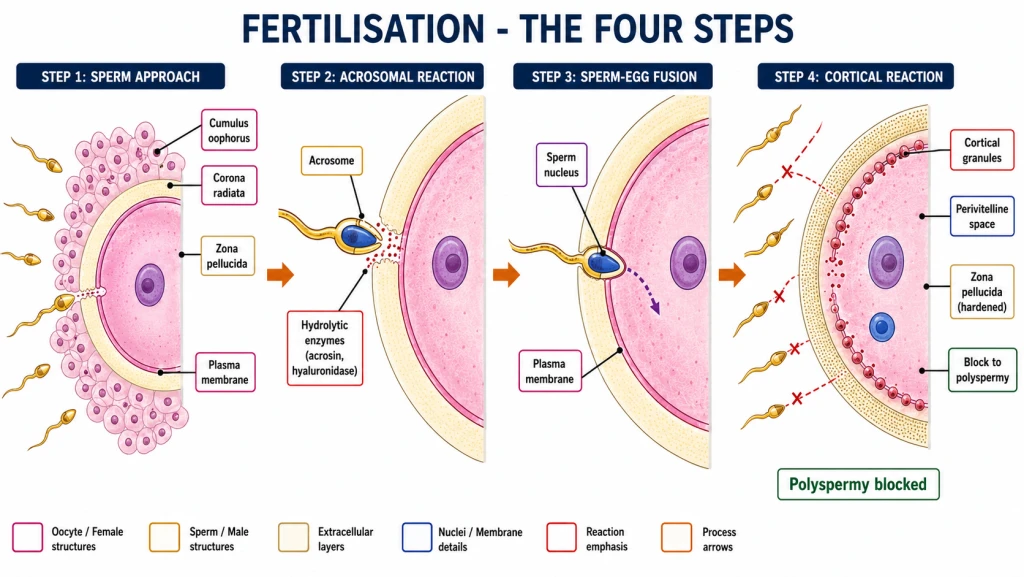
Step 1: Sperm reaches the egg
Sperm swims up from the vagina/uterus into the fallopian tube ampulla. After capacitation (5-6 hours in female tract), it's ready to fertilise.
It encounters the egg surrounded by:
- Cumulus oophorus — outermost layer of follicular cells.
- Corona radiata — middle layer of cells.
- Zona pellucida — innermost glycoprotein coat (just outside the egg's plasma membrane).
Step 2: Acrosomal reaction
When the sperm head contacts the zona pellucida:
- Acrosomal membrane fuses with sperm membrane → releases enzymes.
- Hydrolytic enzymes (acrosin, hyaluronidase) locally digest the zona pellucida.
- Creates a path for the sperm head to reach the egg's plasma membrane.
Step 3: Sperm-egg fusion (syngamy)
- Sperm membrane fuses with egg plasma membrane.
- Sperm nucleus enters the egg cytoplasm.
- This triggers calcium signalling in the egg.
Step 4: Cortical reaction (polyspermy block)
The egg immediately responds:
- Cortical granules (small vesicles just under the egg's plasma membrane) release their contents into the perivitelline space.
- These contents harden the zona pellucida → makes it impenetrable to other sperms.
- This prevents polyspermy (multiple sperms fertilising the egg).
Why polyspermy must be prevented
If 2 sperms fertilise an egg → triploid embryo (extra chromosomes) → not viable. The cortical reaction is critical for normal development.
Step 5: Meiosis II completion
Sperm entry triggers the secondary oocyte (arrested in metaphase-II) to complete Meiosis II → ovum + second polar body.
Step 6: Pronuclear fusion → zygote
- Sperm nucleus (♂ pronucleus) and egg nucleus (♀ pronucleus) fuse.
- This is syngamy in the strict sense.
- Result: diploid zygote (2n = 46 chromosomes in humans).
[NEET Important] All these events happen rapidly — within minutes of sperm entry. Memorise the sequence.
Sex Determination — XY System
In humans (and all mammals), sex is determined at fertilisation by the XY chromosome system.
The basics
| Sex | Chromosomes |
|---|---|
| Female | XX (homozygous for X) |
| Male | XY (heterozygous) |
Egg and sperm contributions
- Eggs: All eggs carry an X chromosome (since female is XX).
- Sperms: Half carry X, half carry Y (since male is XY).
Fertilisation outcomes
| Sperm contribution | Egg contribution | Zygote | Sex |
|---|---|---|---|
| X | X | XX | Female |
| Y | X | XY | Male |
Who determines the baby's sex?
The father. Specifically, his sperm — because the sperm provides either X (→ daughter) or Y (→ son), while the egg always provides X. The father is the sex-deciding parent.
Cultural impact
This biology is critical for combating gender bias and false claims that women are responsible for the baby's sex. Mothers cannot "produce" sons or daughters — the chromosome from the sperm decides.
[NEET Important + Social impact] "Who determines the baby's sex?" Answer: The father (via his sperm's X or Y chromosome).
Other sex determination systems (Class XI recall)
- XO system (some insects): female XX, male XO (single X).
- ZW system (birds): female ZW, male ZZ. Notice the reversal!
- Haplodiploidy (bees): female diploid, male haploid (from unfertilised eggs).
- Environmental (some reptiles): temperature-dependent.
Small Memory Capsule
Section 10 in 60 seconds.
Fertilisation = sperm + egg → zygote
- Where: Ampullary-isthmic junction of the fallopian tube
- When: Within ~24 hours of ovulation
- Result: Diploid zygote (2n = 46 in humans)
Steps of fertilisation
- Sperm reaches egg — passes through cumulus, corona radiata
- Acrosomal reaction — enzymes digest zona pellucida
- Sperm-egg fusion (syngamy)
- Cortical reaction — blocks polyspermy
- Meiosis II completes in oocyte
- Pronuclear fusion → zygote
Key terms
- Acrosomal reaction: sperm releases enzymes to digest zona pellucida
- Cortical reaction: egg hardens zona pellucida to block other sperms
- Polyspermy block: prevents multiple sperms (would cause triploid, non-viable embryo)
Sex determination
| Sperm chromosome | Egg chromosome | Zygote | Sex |
|---|---|---|---|
| X | X | XX | Female |
| Y | X | XY | Male |
Father determines sex
- All eggs carry X
- Sperms carry X or Y
- Father's sperm chromosome decides → father is the sex-deciding parent
Sperm window vs egg window
- Sperm survives ~3-5 days in female tract
- Egg viable ~24 hours after ovulation
- Fertile window: ~5-6 days around ovulation
One-line takeaway
"Fertilisation occurs in the ampulla within 24 hr of ovulation; sperm undergoes acrosomal reaction → fuses with egg → triggers cortical reaction (blocks other sperms) → completes meiosis II → pronuclear fusion → diploid zygote. Father's sperm (X or Y) determines baby's sex."
Solved Examples
Example 1: Define fertilisation
Define fertilisation. Where and when does it occur?
Solution:
Fertilisation = the fusion of a male gamete (sperm) with a female gamete (secondary oocyte/ovum) to form a diploid zygote.
- Location: Ampullary-isthmic junction of the fallopian tube (NOT the uterus).
- Timing: Within ~24 hours of ovulation (egg viability window).
Answer: Sperm-egg fusion → zygote; ampulla of fallopian tube; within 24 hr of ovulation.
Example 2: Acrosomal reaction
What is the acrosomal reaction? Why is it important?
Solution:
Acrosomal reaction = the release of hydrolytic enzymes from the sperm's acrosome when it contacts the zona pellucida of the egg. The acrosomal membrane fuses with the sperm membrane, releasing:
- Acrosin (serine protease)
- Hyaluronidase
These enzymes locally digest the zona pellucida, creating a path for the sperm head to reach the egg's plasma membrane.
Why important: Without the acrosomal reaction, the sperm cannot penetrate the zona pellucida — fertilisation fails.
Answer: Acrosomal reaction = enzyme release from sperm acrosome that digests zona pellucida, allowing sperm to reach egg.
Example 3: Cortical reaction
What is the cortical reaction? What does it accomplish?
Solution:
Cortical reaction = the release of contents from cortical granules (small vesicles just under the egg's plasma membrane) into the perivitelline space immediately after sperm-egg fusion.
What it accomplishes:
- Hardens the zona pellucida → makes it impenetrable to other sperms.
- This PREVENTS POLYSPERMY (multiple sperms fertilising the egg).
Why crucial: If 2+ sperms entered the egg, the embryo would be triploid (3 sets of chromosomes) → not viable. Cortical reaction ensures only ONE sperm fertilises.
Answer: Cortical reaction = egg hardens zona pellucida after first sperm enters; blocks polyspermy.
Example 4: Sex determination
In humans, who determines the sex of the baby?
Solution:
The FATHER.
- Females are XX: all eggs carry an X chromosome.
- Males are XY: sperms carry either X or Y (50:50 ratio).
When fertilisation occurs:
| Sperm | Egg | Zygote | Sex |
|---|---|---|---|
| X | X | XX | Female |
| Y | X | XY | Male |
Since the egg always provides X, the sperm's chromosome (X or Y) decides the baby's sex.
Answer: Father determines sex (via his sperm's X or Y chromosome). NOT mother.
Example 5: Why polyspermy is prevented
Why must fertilisation be limited to one sperm? What mechanism prevents multiple sperms from entering?
Solution:
Why limited to one: If 2+ sperms fertilise an egg, the resulting embryo would be triploid (3 sets of chromosomes instead of 2). Triploidy is incompatible with normal development — almost all triploid human embryos die early.
Mechanism — Cortical Reaction:
- As soon as one sperm fuses with the egg, calcium signalling triggers cortical granules.
- Cortical granules release their contents into the perivitelline space.
- The zona pellucida is chemically modified → becomes hard and impenetrable to additional sperms.
- Any other sperms approaching are blocked.
This is the fast block to polyspermy (within seconds of fertilisation).
Answer: Polyspermy → triploidy → embryonic death. Cortical reaction hardens zona pellucida, blocking additional sperms.
Example 6: Where exactly is the egg?
When fertilisation occurs, what is the technical state of the female gamete (the "egg")?
Solution:
What's released at ovulation and waiting in the ampulla is TECHNICALLY a SECONDARY OOCYTE, NOT a fully mature ovum.
State at ovulation:
- Haploid ()
- Arrested in metaphase-II of meiosis
- Surrounded by zona pellucida + corona radiata
When sperm enters:
- Calcium signalling → secondary oocyte completes Meiosis II
- Produces ovum + second polar body
- ONLY NOW it's a true ovum
So:
Answer: What's released is a secondary oocyte; it becomes a true ovum only after sperm entry triggers Meiosis II completion.