
Oogenesis — The Long Story of an Ovum
Oogenesis is the formation of the ovum (egg) from oogonia in the female ovary. Unlike spermatogenesis (which is continuous), oogenesis has a unique pattern with two long meiotic arrests — one before birth and one before fertilisation.
Definition (NCERT)
Oogenesis = the process of formation of the ovum from oogonia.
The story in one paragraph
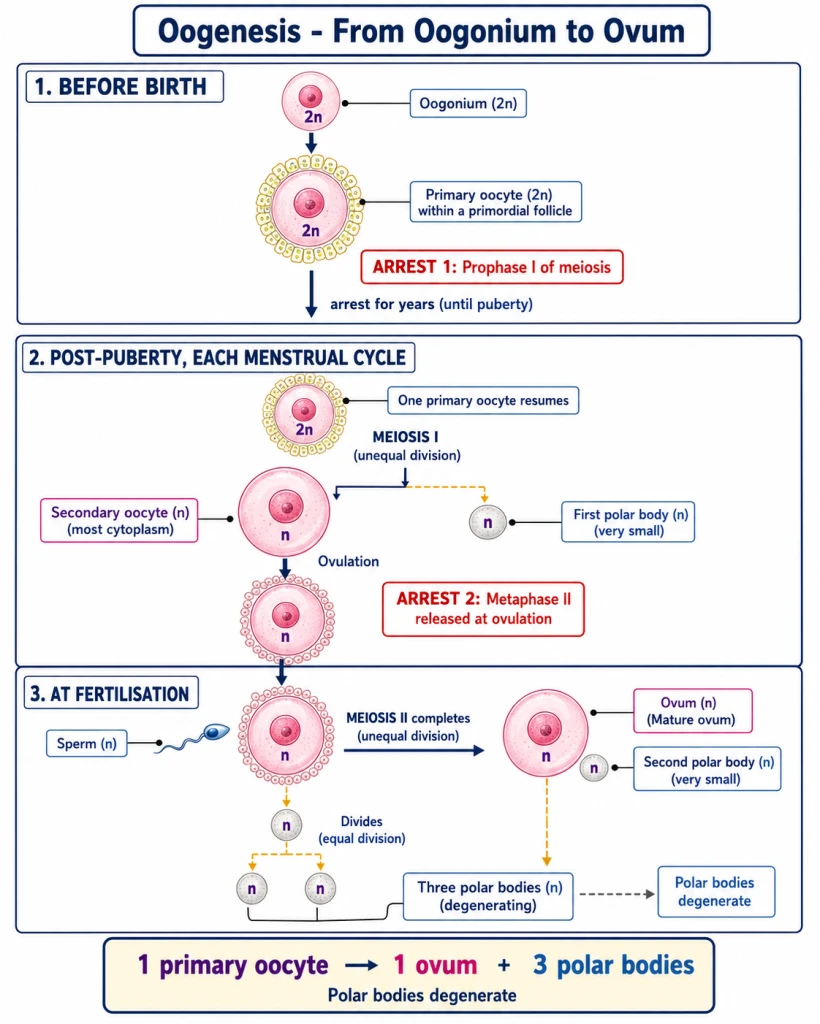
Female germ cells (oogonia) start dividing before birth to form primary oocytes, which then arrest in prophase-I of meiosis and remain dormant for years. At puberty, follicles begin to mature, but the primary oocyte only completes Meiosis I at ovulation (forming a secondary oocyte + first polar body). The secondary oocyte then arrests in metaphase-II, and only completes Meiosis II after fertilisation by a sperm — producing the ovum + second polar body. This double-arrest pattern is unique to female meiosis.
Why this matters
- Asymmetric division — meiosis produces 1 large ovum + 3 small polar bodies (vs 4 equal sperms in males).
- Pre-natal initiation — oogonia stop dividing before birth.
- Limited supply — finite stock of oocytes from birth; can't be replenished.
- Long delays — primary oocyte may arrest for decades before completing meiosis.
[NEET Important] Memorise: "Oogenesis is initiated before birth and completes only at fertilisation; female meiosis has 2 arrests (prophase-I, metaphase-II)."
The Three Phases of Oogenesis
Oogenesis has 3 phases (one fewer than spermatogenesis — there's no equivalent of spermiogenesis here):
Phase 1: Multiplication (Pre-natal)
- During fetal development, oogonia () multiply by mitosis.
- During fetal development, a couple of million (~2 million) oogonia are formed within each fetal ovary (NCERT).
- After this, no new oogonia are formed for the rest of the woman's life.
- Some oogonia enter meiosis to become primary oocytes; others degenerate.
Phase 2: Growth (Pre-natal → puberty)
- Primary oocytes form from oogonia, then enter meiosis I.
- They arrest in prophase-I of meiosis (specifically the diplotene stage).
- This arrest happens before birth — primary oocytes wait in this state for many years.
- At birth: ~2 million primary oocytes per ovary (most have already degenerated).
- At puberty: only 60,000-80,000 primary follicles remain in each ovary (NCERT).
- Only ~400 will be ovulated in a woman's lifetime; the rest degenerate.
Phase 3: Maturation (Puberty onwards)
This phase happens cyclically, with each menstrual cycle activating one primary oocyte.
\
Cyclic events for one cycle:
- Recruitment — at the start of cycle, several primary oocytes (in primordial follicles) are recruited.
- Follicular development — these follicles grow (primordial → primary → secondary → tertiary → Graafian).
- Meiosis I completes — at the tertiary follicle stage (NCERT), shortly before ovulation, the primary oocyte grows in size and completes Meiosis I (an unequal division), producing:
- 1 secondary oocyte (, large) — gets most of the cytoplasm.
- 1 first polar body (, tiny) — gets minimal cytoplasm; usually degenerates.
- Ovulation — the secondary oocyte forms a new membrane, the zona pellucida, around itself (NCERT); still arrested in metaphase-II, it is released from the Graafian follicle.
- At fertilisation — Meiosis II completes, producing:
- 1 ovum () — large, mature egg.
- 1 second polar body (, tiny) — degenerates.
Final result
[NEET Important] This 1:1 ratio (1 PMC → 1 ovum) is crucial — and dramatically different from the 1:4 in spermatogenesis.
Why Asymmetric Division?
In spermatogenesis, meiosis produces 4 equal sperms from 1 primary spermatocyte.
In oogenesis, meiosis produces 1 large ovum + 3 small polar bodies from 1 primary oocyte.
Why the asymmetry?
The asymmetric division is an evolutionary trade-off:
The egg needs to be HUGE because it must contain:
- All the cytoplasm that will support early embryo development.
- Stored mRNA, proteins, organelles for the first cell divisions.
- Lipid reserves (yolk-equivalent for nourishing the embryo).
- Cortical granules for blocking polyspermy.
If meiosis produced 4 small equal eggs (like sperm), each would lack the resources to support an embryo. So evolution favoured concentrating all cytoplasm in 1 egg + 3 nearly-cytoplasm-less polar bodies that simply degenerate.
What about the polar bodies?
- The first polar body may divide again (during Meiosis II) → 2 second-generation polar bodies. So at most 3 polar bodies form.
- All polar bodies degenerate within days — they have very little cytoplasm.
- They serve no biological purpose beyond carrying away "extra" chromosomes from the asymmetric division.
Summary of products
| Female meiosis | Cells produced | Sizes | Survival |
|---|---|---|---|
| Meiosis I | 1 secondary oocyte + 1 first polar body | Large + tiny | Secondary oocyte continues; polar body usually degenerates |
| Meiosis II | 1 ovum + 1 second polar body | Large + tiny | Ovum survives; polar body degenerates |
| Total | 1 ovum + 3 polar bodies | — | 1 ovum functional; 3 polar bodies degenerate |
[NEET Important] A common NEET MCQ: "Why is meiosis in the female asymmetric?" Answer: to concentrate cytoplasm in one large ovum capable of supporting early embryonic development.
The Two Meiotic Arrests
The double arrest of female meiosis is one of the most distinctive features of oogenesis.
Arrest 1: Prophase-I (specifically diplotene)
- When: Before birth.
- Where: Primary oocyte inside primordial follicle in fetal ovary.
- Duration: From fetal development until ovulation — potentially decades.
- Trigger to resume: LH surge at ovulation (around day 13-14 of cycle).
Arrest 2: Metaphase-II
- When: After Meiosis I (just before ovulation).
- Where: Secondary oocyte in the Graafian follicle, then in the fallopian tube after ovulation.
- Duration: From ovulation until fertilisation — up to 24 hours (the egg's window of viability).
- Trigger to resume: Sperm entry → calcium signalling → completion of Meiosis II.
The "if not fertilised" outcome
If the secondary oocyte is NOT fertilised within ~24 hours of ovulation:
- Meiosis II never completes.
- The egg degenerates.
- The next menstrual cycle begins (~14 days later, with menstruation).
Why two arrests?
- Prophase-I arrest allows the oocyte to be "stockpiled" before birth and selected one-by-one over the woman's life.
- Metaphase-II arrest ensures that the second meiotic division only happens IF a sperm fuses — saving the resources for an actually fertilised egg.
[NEET Important] Both arrests are favourite NEET facts:
- Primary oocyte arrests in prophase-I (specifically diplotene).
- Secondary oocyte arrests in metaphase-II.
- Meiosis II completes ONLY after fertilisation.
Small Memory Capsule
Section 8 in 60 seconds.
Oogenesis = ovum formation
- Location: Ovary (cortex)
- Pattern: Initiated before birth; completes only at fertilisation
- Cell counts over lifetime:
- Fetal: a couple of million (~2 million) oogonia per ovary
- At birth: ~2 million primary oocytes per ovary
- At puberty: 60,000-80,000 primary follicles per ovary
- Lifetime ovulations: ~400
3 phases (note: NO equivalent of spermiogenesis!)
- Multiplication (pre-natal) — oogonia divide mitotically; STOPS BEFORE BIRTH
- Growth (pre-natal → puberty) — primary oocytes form, ARREST IN PROPHASE-I
- Maturation (cyclically, post-puberty) — meiosis completes in 2 stages
The cyclical maturation (per menstrual cycle)
- Primary oocyte (, arrested in prophase-I) → resumes
- Meiosis I → secondary oocyte (, large) + first polar body (, tiny)
- Secondary oocyte ARRESTS IN METAPHASE-II
- Ovulation (~day 14): secondary oocyte released from Graafian follicle
- At fertilisation: Meiosis II completes → ovum (, large) + second polar body (, tiny)
Final 1:1 ratio
(Polar bodies all degenerate — only the ovum is functional.)
Why asymmetric?
Meiosis is unequal so that all cytoplasm goes to ONE large ovum (which must support early embryo development). 4 small ova wouldn't be viable.
Two arrests (UNIQUE to female meiosis!)
| Arrest | Stage | Resume trigger |
|---|---|---|
| Prophase-I (diplotene) | Primary oocyte | LH surge at ovulation |
| Metaphase-II | Secondary oocyte | Fertilisation by sperm |
Spermatogenesis vs Oogenesis (NEET classic)
| Feature | Spermatogenesis | Oogenesis |
|---|---|---|
| Mother cell | PMC () | Primary oocyte () |
| Products | 4 sperms | 1 ovum + 3 polar bodies |
| Continuous? | Yes | No (cyclic) |
| End | Old age | Menopause (~50) |
| Ploidy ratio | 1:4 functional | 1:1 functional |
| Asymmetry | Equal | Asymmetric |
One-line takeaway
"Oogenesis = primary oocytes formed before birth, arrested in prophase-I; one resumes meiosis per cycle, completes meiosis I to give a secondary oocyte + 1st polar body, ovulates at metaphase-II arrest; meiosis II completes ONLY at fertilisation, producing 1 ovum + 2nd polar body. 1 primary oocyte → 1 functional ovum (3 polar bodies degenerate)."
Solved Examples
Example 1: Define oogenesis
Define oogenesis. How does it differ from spermatogenesis in its final products?
Solution:
Oogenesis = the process of formation of the ovum (egg) from oogonia in the female ovary.
Difference in final products:
| Spermatogenesis | Oogenesis |
|---|---|
| 1 PMC → 4 spermatids → 4 sperms (all functional) | 1 primary oocyte → 1 ovum + 3 polar bodies (only ovum is functional; polar bodies degenerate) |
Why the difference? Asymmetric division in oogenesis concentrates all cytoplasm in 1 large ovum, ensuring it has enough resources to support early embryonic development.
Answer: Oogenesis = ovum formation; produces 1 functional ovum + 3 polar bodies (vs spermatogenesis 4 functional sperms).
Example 2: Three phases of oogenesis
Name and describe the three phases of oogenesis.
Solution:
Multiplication phase (pre-natal): Oogonia divide MITOTICALLY in the fetal ovary. By the 5th month of fetal development, a couple of million (~2 million) oogonia form per ovary (NCERT). After this, no new oogonia are produced.
Growth phase (pre-natal → puberty): Primary oocytes form, enter Meiosis I, and ARREST IN PROPHASE-I (specifically diplotene stage). They remain dormant for years (potentially decades).
Maturation phase (cyclically, after puberty): Each menstrual cycle, one primary oocyte resumes meiosis I → secondary oocyte + first polar body. Secondary oocyte arrests in metaphase-II until fertilisation, when meiosis II completes → ovum + second polar body.
Note: Unlike spermatogenesis, oogenesis has NO 4th phase (no equivalent of spermiogenesis).
Answer: Multiplication (pre-natal) → Growth (arrest in prophase-I) → Maturation (cyclic; meiosis II only at fertilisation).
Example 3: Key cell counts
State the approximate number of primary oocytes / oogonia at: (a) 5th month of fetal development (b) Birth (c) Puberty (d) Ovulated in a lifetime
Solution:
(a) Fetal: a couple of million (~2 million) oogonia formed per ovary (NCERT). This is when most oogonia exist. (b) Birth: ~2 million primary oocytes per ovary. Most have already degenerated (atresia). (c) Puberty (~12-14 years): 60,000-80,000 primary follicles per ovary (NCERT). Continuous loss during childhood. (d) Lifetime ovulations: Only ~400 secondary oocytes are released across a woman's reproductive lifespan.
Massive asymmetry: Of ~14 million oogonia at fetal peak, only ~400 ever ovulate — about 0.003%.
Answer: a couple of million oogonia per fetal ovary → 60,000-80,000 primary follicles per ovary at puberty → ~400 ovulated in a lifetime.
[NEET Important] Specific numbers tested in NEET MCQs.
Example 4: Two arrests
Where exactly does meiosis arrest in oogenesis?
Solution:
Female meiosis has TWO arrests — unique compared to male meiosis.
Arrest 1: Prophase-I (diplotene stage)
- The primary oocyte enters Meiosis I before birth and arrests at the diplotene stage of prophase-I.
- This arrest can last decades (from fetal life until that oocyte's cycle).
- Resumes at the LH surge before ovulation.
Arrest 2: Metaphase-II
- After Meiosis I completes (just before ovulation), the secondary oocyte arrests at metaphase-II.
- Lasts until fertilisation.
- If fertilisation doesn't occur within ~24 hours, the egg degenerates.
- Meiosis II resumes when a sperm enters.
Why two arrests?
- Prophase-I arrest = stockpile of oocytes for selective use.
- Metaphase-II arrest = save resources for fertilised eggs only.
Answer: Primary oocyte arrests in prophase-I (diplotene); secondary oocyte arrests in metaphase-II.
[NEET Important] A perennial NEET MCQ topic.
Example 5: When does meiosis II complete?
When does Meiosis II complete in oogenesis?
Solution:
Meiosis II completes ONLY AT FERTILISATION.
Sequence:
- Primary oocyte (, arrested in prophase-I) → Meiosis I resumes (just before ovulation).
- Meiosis I produces secondary oocyte () + first polar body ().
- Secondary oocyte ARRESTS in metaphase-II.
- Secondary oocyte is OVULATED (released into fallopian tube).
- If a sperm fertilises the secondary oocyte → Meiosis II completes → ovum + second polar body.
- If no sperm enters within ~24 hours → secondary oocyte degenerates without completing Meiosis II.
So the egg you see "released" at ovulation is technically a SECONDARY OOCYTE, NOT a fully mature ovum. Only after fertilisation does it become a true ovum.
Answer: Meiosis II completes ONLY when a sperm fertilises the secondary oocyte (~at fertilisation).
[NEET Important] A favourite NEET trap question.
Example 6: 1 PMC vs 1 PMC outcome
Compare the final outcome of meiosis in 1 primary spermatocyte vs 1 primary oocyte.
Solution:
| Feature | Primary spermatocyte () | Primary oocyte () |
|---|---|---|
| Meiosis I | Symmetric → 2 secondary spermatocytes ( each, equal size) | Asymmetric → 1 secondary oocyte (, LARGE) + 1 first polar body (, tiny) |
| Meiosis II | Each secondary spermatocyte → 2 spermatids ( each, equal) | Secondary oocyte → 1 ovum (, LARGE) + 1 second polar body (, tiny) |
| Final products | 4 functional spermatids → 4 sperms | 1 functional ovum + 3 polar bodies (all degenerate) |
| Functional cells | 4 | 1 |
Answer: 1 primary spermatocyte → 4 sperms; 1 primary oocyte → 1 ovum + 3 polar bodies.
[NEET Important] Frequent NEET comparison MCQ.