
Class Amphibia - Living the Dual Life
Amphi means dual and bios means life - amphibians can live in aquatic as well as terrestrial habitats.
Characters:
- Most of them have two pairs of limbs.
- Body is divisible into head and trunk. Tail may be present in some.
- The amphibian skin is moist (without scales).
- The eyes have eyelids. A tympanum represents the ear.
- Alimentary canal, urinary and reproductive tracts open into a common chamber called cloaca which opens to the exterior.
- Respiration is by gills, lungs and through skin.
- The heart is three-chambered (two auricles and one ventricle).
- These are cold-blooded animals.
- Sexes are separate. Fertilisation is external. They are oviparous and development is indirect.
Examples: Bufo (toad), Rana (frog), Hyla (tree frog), Salamandra (salamander), Ichthyophis (limbless amphibia).
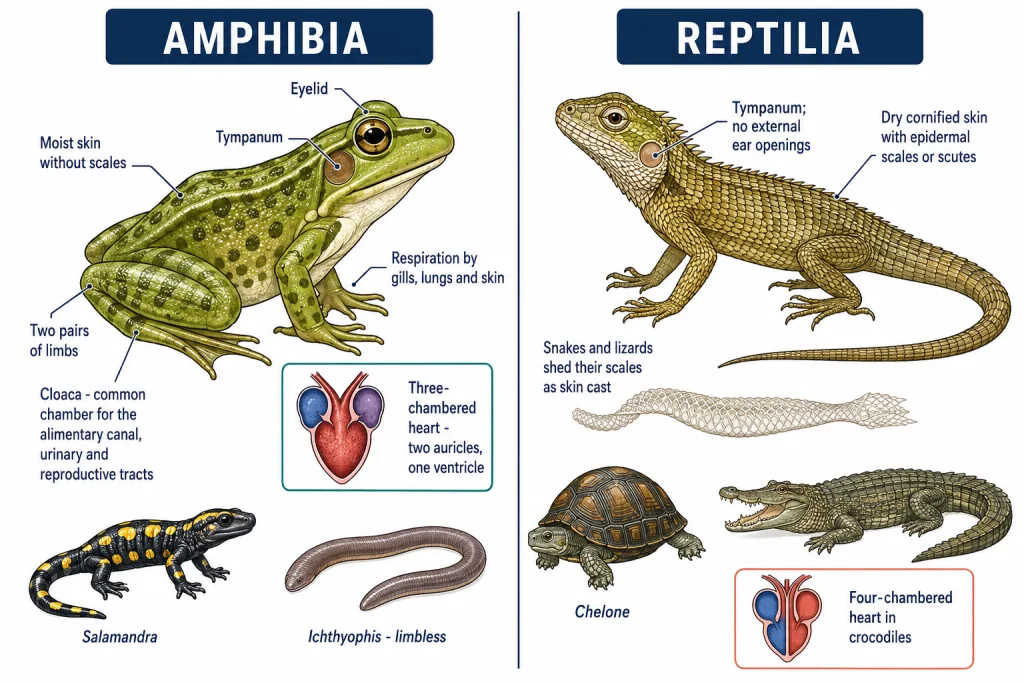
[NEET Important] Three features are asked over and over: moist skin without scales, respiration by gills, lungs and skin, and a three-chambered heart with two auricles and one ventricle. Add the cloaca - the common chamber for the alimentary canal, urinary and reproductive tracts - and remember that Ichthyophis is the limbless amphibian, which is why it appears in questions that begin "most of them have two pairs of limbs".
Class Reptilia - the Creeping Vertebrates
The name refers to their mode of locomotion - Latin repere or reptum, to creep or crawl.
Characters:
- They are mostly terrestrial animals.
- Their body is covered by dry and cornified skin, epidermal scales or scutes.
- They do not have external ear openings. Tympanum represents the ear.
- Limbs, when present, are two pairs; they are absent in snakes.
- Heart is usually three-chambered, but four-chambered in crocodiles.
- Reptiles are poikilotherms.
- Snakes and lizards shed their scales as skin cast.
- Sexes are separate. Fertilisation is internal. They are oviparous and development is direct.
Examples: Chelone (turtle), Testudo (tortoise), Chameleon (tree lizard), Calotes (garden lizard), Crocodilus (crocodile), Alligator (alligator), Hemidactylus (wall lizard). Poisonous snakes: Naja (cobra), Bangarus (krait), Vipera (viper).
[NEET Important] The crocodile exception is the most-asked line in the class: three-chambered heart, but four-chambered in crocodiles. Two more are near-certain: no external ear openings, only a tympanum, and dry cornified skin with epidermal scales or scutes. On development, note the pairing that separates this class from the one before it - amphibians are external fertilisation, indirect development; reptiles are internal fertilisation, direct development.
Amphibia Against Reptilia
| Feature | Amphibia | Reptilia |
|---|---|---|
| Habitat | Aquatic as well as terrestrial | Mostly terrestrial |
| Skin | Moist, without scales | Dry and cornified, with epidermal scales or scutes |
| Ear | Tympanum represents the ear; eyes have eyelids | No external ear openings; tympanum represents the ear |
| Limbs | Two pairs in most; Ichthyophis is limbless | Two pairs when present; absent in snakes |
| Respiration | Gills, lungs and skin | Lungs |
| Heart | Three-chambered (two auricles, one ventricle) | Three-chambered, but four-chambered in crocodiles |
| Body temperature | Cold-blooded (poikilothermous) | Cold-blooded (poikilothermous) |
| Fertilisation | External | Internal |
| Development | Indirect | Direct |
| Common chamber | Cloaca for alimentary, urinary and reproductive tracts | - |
| Examples | Bufo, Rana, Hyla, Salamandra, Ichthyophis | Chelone, Testudo, Chameleon, Calotes, Crocodilus, Alligator, Hemidactylus, Naja, Bangarus, Vipera |
The two-line summary that answers most comparison questions: amphibians keep a wet skin and a water-bound early life - external fertilisation, indirect development; reptiles seal themselves in a dry cornified skin and move reproduction onto land - internal fertilisation, direct development.
Quick Recap
Amphibia
- Amphi dual, bios life; live in aquatic as well as terrestrial habitats.
- Two pairs of limbs in most; body of head and trunk, tail in some.
- Moist skin without scales; eyes with eyelids; tympanum represents the ear.
- Cloaca - common chamber for the alimentary canal, urinary and reproductive tracts.
- Respiration by gills, lungs and skin; three-chambered heart (two auricles, one ventricle); cold-blooded.
- Sexes separate; fertilisation external; oviparous; development indirect.
- Bufo, Rana, Hyla, Salamandra, Ichthyophis (limbless).
Reptilia
- Latin repere / reptum - to creep or crawl; mostly terrestrial.
- Dry cornified skin, epidermal scales or scutes; no external ear openings, tympanum represents the ear.
- Limbs two pairs when present; snakes and lizards shed their scales as skin cast.
- Heart three-chambered, four-chambered in crocodiles; poikilotherms.
- Sexes separate; fertilisation internal; oviparous; development direct.
- Chelone, Testudo, Chameleon, Calotes, Crocodilus, Alligator, Hemidactylus; poisonous snakes Naja, Bangarus, Vipera.
Solved Examples
Question 1
Q. What does the name Amphibia mean?
Answer. Amphi means dual and bios means life, because amphibians can live in aquatic as well as terrestrial habitats.
Question 2
Q. Describe the amphibian skin.
Answer. It is moist and without scales.
Question 3
Q. What is a cloaca?
Answer. The common chamber into which the alimentary canal, urinary and reproductive tracts open, and which opens to the exterior.
Question 4
Q. By what routes does an amphibian respire?
Answer. By gills, lungs and through the skin.
Question 5
Q. From which Latin words does the name Reptilia come, and what do they mean?
Answer. Repere or reptum, meaning to creep or crawl.
Question 6
Q. Name the three poisonous snakes listed in your syllabus.
Answer. Naja (cobra), Bangarus (krait) and Vipera (viper).
Question 7
Q. How many chambers does the heart have in Amphibia and in Reptilia, and where is the exception?
Answer. Amphibians have a three-chambered heart with two auricles and one ventricle. Reptiles also have a three-chambered heart, but the crocodile is four-chambered. That exception is asked far more often than the rule.
Question 8
Q. Give three points that distinguish reptilian skin and hearing from those of an amphibian.
Answer.
- Skin: dry and cornified with epidermal scales or scutes in reptiles; moist and without scales in amphibians.
- Ear: reptiles have no external ear openings and the tympanum represents the ear; the amphibian ear is also represented by a tympanum, but the amphibian additionally has eyes with eyelids as a listed feature.
- Scale shedding: snakes and lizards shed their scales as skin cast - amphibians have no scales to shed.
Question 9
Q. Compare fertilisation and development in Amphibia and Reptilia.
Answer. Amphibians have external fertilisation and indirect development; the young hatch as larvae that must change form. Reptiles have internal fertilisation and direct development; the young resemble the adult on hatching. Both are oviparous and both have separate sexes.
Question 10
Q. An animal has moist scaleless skin, breathes through gills, lungs and skin, has a three-chambered heart and lays eggs that hatch into larvae. Name its class and give two examples.
Answer. Class Amphibia. Examples: Rana (frog) and Bufo (toad). You spot it from the moist skin without scales and from respiration by all three of gills, lungs and skin - no other vertebrate class does all three.
Question 11
Q. Identify the odd one out and explain: Ichthyophis, Hemidactylus, Hyla, Salamandra.
Answer. Hemidactylus is the odd one - it is the wall lizard, a reptile. Ichthyophis, Hyla and Salamandra are all amphibians, and Ichthyophis is the limbless one among them.
Question 12
Q. A four-chambered heart is found in a reptile. Name the animal, and state why this makes the reptilian heart a poor single-word answer in an examination.
Answer. The crocodile (Crocodilus) has a four-chambered heart. The class as a whole is described as usually three-chambered, so a bare "three" is incomplete whenever crocodiles are in the picture. The safe answer is the full sentence: usually three-chambered, but four-chambered in crocodiles.