
Class Cyclostomata - the Jawless Vertebrates
Characters:
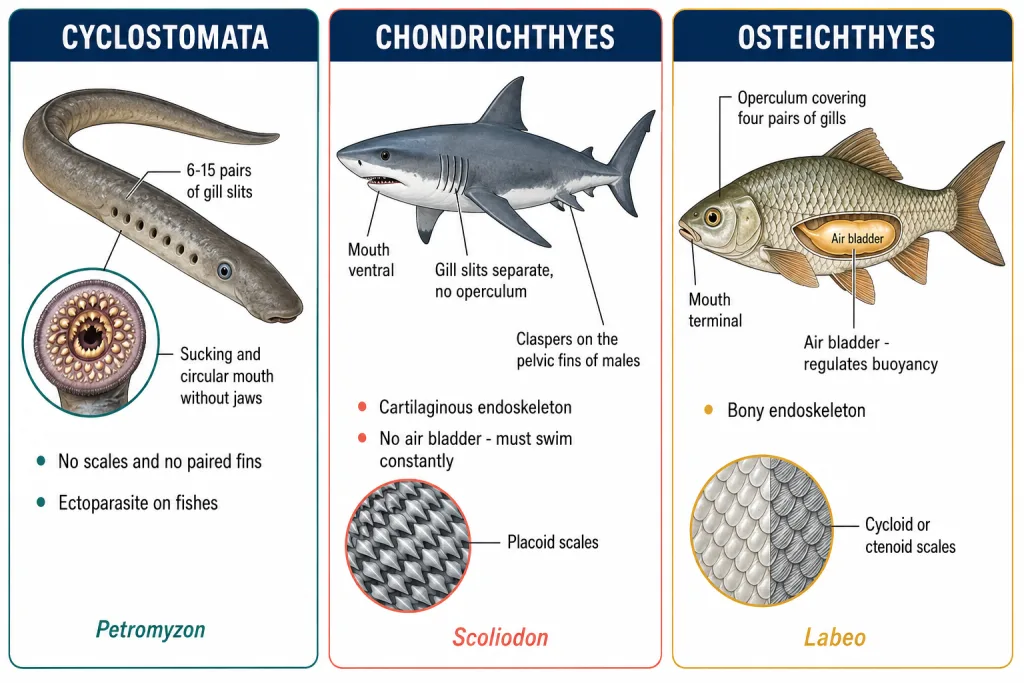
- All living members of the class Cyclostomata are ectoparasites on some fishes.
- They have an elongated body bearing 6-15 pairs of gill slits for respiration.
- Cyclostomes have a sucking and circular mouth without jaws.
- Their body is devoid of scales and paired fins.
- Cranium and vertebral column are cartilaginous.
- Circulation is of closed type.
- Cyclostomes are marine but migrate for spawning to fresh water. After spawning, within a few days, they die. Their larvae, after metamorphosis, return to the ocean.
Examples: Petromyzon (lamprey), Myxine (hagfish).
[NEET Important] Cyclostomata is the only class under Agnatha, so no jaw is the defining fact. Three more are asked directly: all living members are ectoparasites on fishes, 6-15 pairs of gill slits, and no scales and no paired fins. The life story is also a question in itself - marine, migrate to fresh water to spawn, die within a few days, larvae return to the ocean after metamorphosis.
Class Chondrichthyes - the Cartilaginous Fishes
Characters:
- They are marine animals with a streamlined body and have a cartilaginous endoskeleton.
- Mouth is located ventrally.
- Notochord is persistent throughout life.
- Gill slits are separate and without operculum (gill cover).
- The skin is tough, containing minute placoid scales. Teeth are modified placoid scales which are backwardly directed.
- Their jaws are very powerful. These animals are predaceous.
- Due to the absence of air bladder, they have to swim constantly to avoid sinking.
- Heart is two-chambered (one auricle and one ventricle).
- Some of them have electric organs (Torpedo) and some possess poison sting (Trygon).
- They are cold-blooded (poikilothermous) animals, that is, they lack the capacity to regulate their body temperature.
- Sexes are separate. In males, pelvic fins bear claspers. They have internal fertilisation and many of them are viviparous.
Examples: Scoliodon (dog fish), Pristis (saw fish), Carcharodon (great white shark), Trygon (sting ray).
[NEET Important] The absence of an air bladder is the fact that generates the most questions, because it explains the behaviour - they must swim constantly to avoid sinking. Pair it with ventral mouth, placoid scales, gill slits without an operculum and claspers on the pelvic fins of males, and you have the whole class.
Class Osteichthyes - the Bony Fishes
Characters:
- It includes both marine and fresh water fishes with a bony endoskeleton.
- There is a terminal mouth in most of them.
- They have four pairs of gills which are covered by an operculum on each side.
- Skin is covered with cycloid or ctenoid scales.
- Air bladder is present which regulates buoyancy.
- Heart is two-chambered (one auricle and one ventricle).
- They are cold-blooded animals.
- Sexes are separate. Fertilisation is usually external. They are mostly oviparous and development is direct.
Examples:
- Marine: Exocoetus (flying fish), Hippocampus (sea horse).
- Freshwater: Labeo (rohu), Catla (katla), Clarias (magur).
- Aquarium: Betta (fighting fish), Pterophyllum (angel fish).
[NEET Important] The air bladder that regulates buoyancy is the single most-asked feature of this class, and the standard question is the paired one: why is the air bladder important, and what happens in a fish that lacks it? Osteichthyes rises and sinks without effort; Chondrichthyes must swim constantly.
The Three Compared
| Feature | Cyclostomata | Chondrichthyes | Osteichthyes |
|---|---|---|---|
| Jaw | Absent (Agnatha) | Present | Present |
| Habitat | Marine, spawn in fresh water | Marine | Marine and fresh water |
| Endoskeleton | Cartilaginous cranium and vertebral column | Cartilaginous | Bony |
| Notochord | - | Persistent throughout life | - |
| Mouth | Sucking and circular, without jaws | Ventral | Terminal in most |
| Gills | 6-15 pairs of gill slits | Separate slits, no operculum | Four pairs, covered by an operculum |
| Scales | Absent | Placoid | Cycloid or ctenoid |
| Paired fins | Absent | Present; claspers on male pelvic fins | Present |
| Air bladder | - | Absent - must swim constantly | Present - regulates buoyancy |
| Heart | Closed circulation | Two-chambered | Two-chambered |
| Body temperature | - | Cold-blooded | Cold-blooded |
| Fertilisation | External, in fresh water | Internal; many viviparous | Usually external; mostly oviparous, direct development |
| Examples | Petromyzon, Myxine | Scoliodon, Pristis, Carcharodon, Trygon, Torpedo | Exocoetus, Hippocampus, Labeo, Catla, Clarias, Betta, Pterophyllum |
The scale ladder, in one line: no scales in Cyclostomata, placoid in Chondrichthyes, cycloid or ctenoid in Osteichthyes. Questions that give you a scale type are giving you the class.
Quick Recap
Cyclostomata
- Agnatha - no jaws; sucking circular mouth.
- All living members ectoparasites on fishes; elongated body; 6-15 pairs of gill slits.
- No scales, no paired fins; cartilaginous cranium and vertebral column; closed circulation.
- Marine, migrate to fresh water to spawn, die within a few days after spawning; larvae metamorphose and return to the ocean.
- Petromyzon (lamprey), Myxine (hagfish).
Chondrichthyes
- Marine, streamlined, cartilaginous endoskeleton; mouth ventral; notochord persistent throughout life.
- Gill slits separate, without operculum; tough skin with placoid scales; teeth are backwardly directed modified placoid scales.
- Powerful jaws, predaceous; no air bladder, so they swim constantly to avoid sinking.
- Two-chambered heart; cold-blooded; electric organs in Torpedo, poison sting in Trygon.
- Sexes separate; claspers on male pelvic fins; internal fertilisation; many viviparous.
- Scoliodon, Pristis, Carcharodon, Trygon.
Osteichthyes
- Marine and fresh water; bony endoskeleton; mouth terminal in most.
- Four pairs of gills covered by an operculum; cycloid or ctenoid scales.
- Air bladder present, regulates buoyancy; two-chambered heart; cold-blooded.
- Sexes separate; fertilisation usually external; mostly oviparous; development direct.
- Exocoetus, Hippocampus, Labeo, Catla, Clarias, Betta, Pterophyllum.
Solved Examples
Question 1
Q. What kind of mouth do cyclostomes have?
Answer. A sucking and circular mouth without jaws.
Question 2
Q. How many pairs of gill slits does a cyclostome bear?
Answer. 6-15 pairs.
Question 3
Q. Name the two examples of Cyclostomata with their common names.
Answer. Petromyzon (lamprey) and Myxine (hagfish).
Question 4
Q. Which type of scales does a cartilaginous fish carry, and what are its teeth?
Answer. Placoid scales. The teeth are modified placoid scales which are backwardly directed.
Question 5
Q. How many pairs of gills does a bony fish have, and what covers them?
Answer. Four pairs of gills, covered by an operculum on each side.
Question 6
Q. Name the cartilaginous fish with electric organs and the one with a poison sting.
Answer. Electric organs: Torpedo. Poison sting: Trygon.
Question 7
Q. What is the importance of the air bladder in Pisces?
Answer. The air bladder regulates buoyancy. A fish that has one can just hang at a given depth without wasting muscular effort, and it rises or sinks by adjusting the gas inside the bladder. The contrast makes it obvious - Chondrichthyes lack an air bladder, and because of that absence they have to swim constantly to avoid sinking.
This is one of the chapter-end exercises.
Question 8
Q. Give three features that separate Chondrichthyes from Osteichthyes.
Answer.
- Endoskeleton: cartilaginous in Chondrichthyes, bony in Osteichthyes.
- Gills: separate slits without an operculum against four pairs covered by an operculum.
- Air bladder: absent against present, regulating buoyancy.
Two more, if the question asks for them: the mouth is ventral in Chondrichthyes and terminal in most Osteichthyes, and the scales are placoid against cycloid or ctenoid.
Question 9
Q. Describe the spawning migration of a cyclostome.
Answer. Cyclostomes are marine but migrate for spawning to fresh water. After spawning, within a few days, they die. Their larvae, after metamorphosis, return to the ocean.
Question 10
Q. A marine fish has a streamlined body, a cartilaginous endoskeleton, a ventral mouth, gill slits without an operculum and claspers on the pelvic fins. Identify the class, the sex of this individual, and its mode of fertilisation.
Answer. Class Chondrichthyes. The claspers on the pelvic fins mark it as a male. Fertilisation is internal, and many members of the class are viviparous.
Question 11
Q. Classify these fishes as marine, freshwater or aquarium forms: Hippocampus, Catla, Pterophyllum, Exocoetus, Clarias, Betta.
Answer.
- Marine: Hippocampus (sea horse), Exocoetus (flying fish).
- Freshwater: Catla (katla), Clarias (magur).
- Aquarium: Pterophyllum (angel fish), Betta (fighting fish).
Question 12
Q. Three vertebrates are placed before you: one has no jaws and no paired fins, one has a cartilaginous skeleton and placoid scales, and one has a bony skeleton and an operculum. Name the class of each and state which division or superclass each belongs to.
Answer.
- No jaws, no paired fins - class Cyclostomata, division Agnatha.
- Cartilaginous skeleton, placoid scales - class Chondrichthyes, superclass Pisces under Gnathostomata.
- Bony skeleton, operculum - class Osteichthyes, superclass Pisces under Gnathostomata.
The first split you applied was the jaw; the second was fins against limbs.