
Symmetry
Animals can be categorised on the basis of their symmetry, and there are three states.
Asymmetrical
Sponges are mostly asymmetrical - any plane that passes through the centre does not divide them into equal halves.
Radial symmetry
When any plane passing through the central axis of the body divides the organism into two identical halves, it is called radial symmetry.
Shown by coelenterates, ctenophores and echinoderms.
Bilateral symmetry
Animals like annelids and arthropods, where the body can be divided into identical left and right halves in only one plane, exhibit bilateral symmetry.
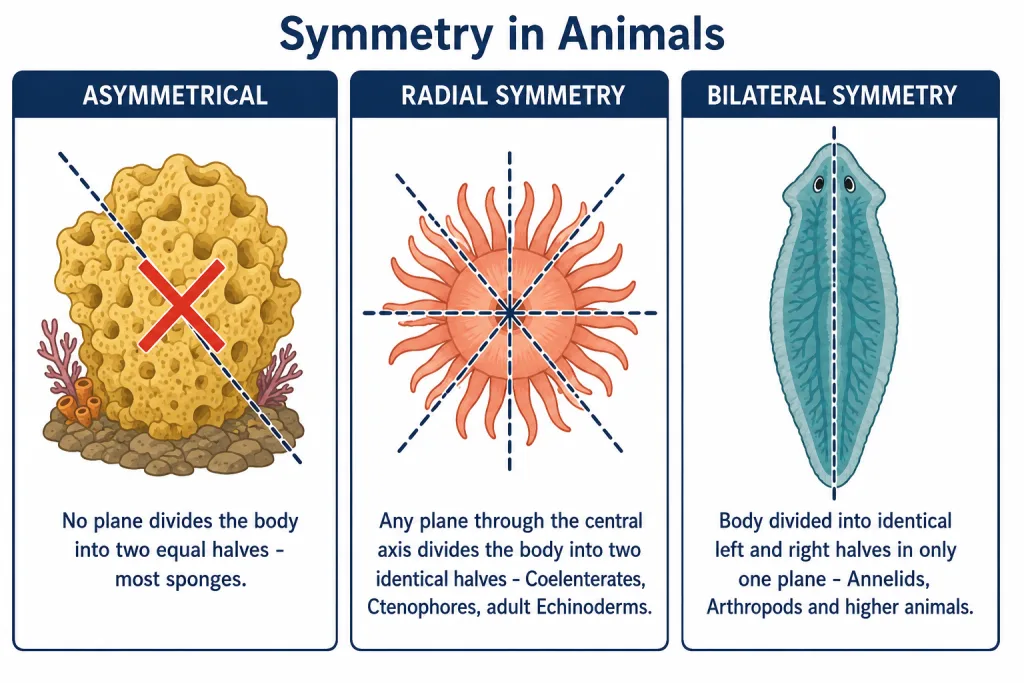
[NEET Important] The difference is in how many planes work: any plane through the central axis for radial, only one plane for bilateral, none for asymmetrical. And note the echinoderm complication - adults are radially symmetrical but larvae are bilaterally symmetrical, which is why the classification chart footnotes echinoderms as radial or bilateral depending on the stage.
Diploblastic and Triploblastic Organisation
Diploblastic
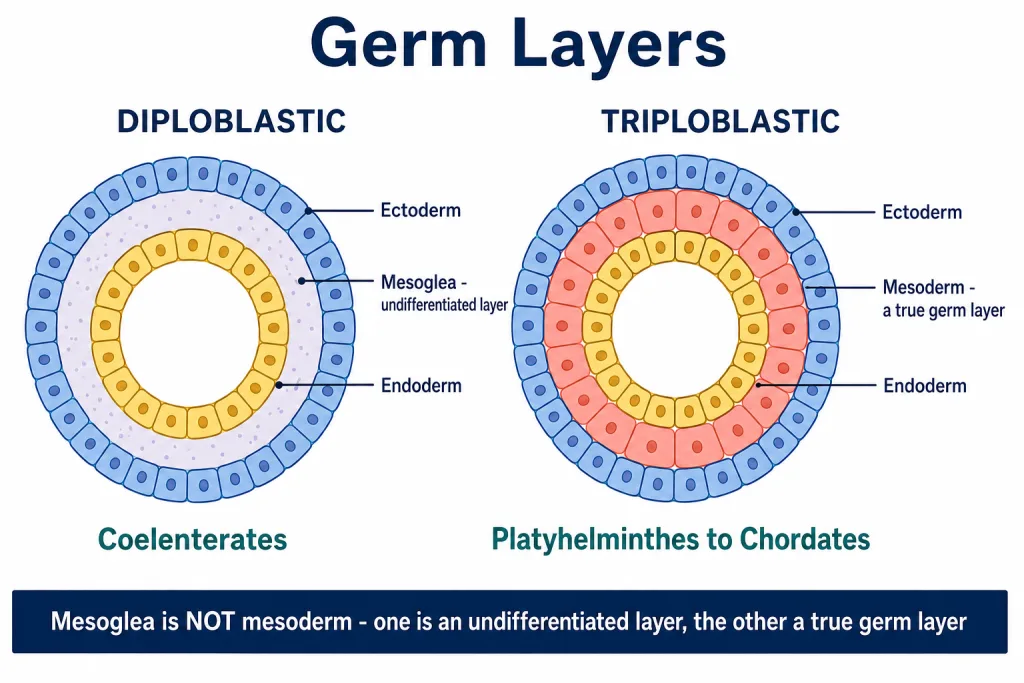
Animals in which the cells are arranged in two embryonic layers, an external ectoderm and an internal endoderm, are called diploblastic animals - e.g. coelenterates.
An undifferentiated layer, mesoglea, is present in between the ectoderm and the endoderm.
Triploblastic
Those animals in which the developing embryo has a third germinal layer, mesoderm, in between the ectoderm and endoderm, are called triploblastic animals - platyhelminthes to chordates.
| Diploblastic | Triploblastic | |
|---|---|---|
| Layers | Ectoderm + endoderm | Ectoderm + mesoderm + endoderm |
| In between | Mesoglea - undifferentiated | Mesoderm - a true germinal layer |
| Groups | Coelenterata, Ctenophora | Platyhelminthes to Chordata |
[NEET Important] Mesoglea is not mesoderm. Mesoglea is an undifferentiated layer sitting between two germ layers; mesoderm is a third germinal layer in the developing embryo. Options that call mesoglea a germ layer are testing exactly this.
Coelom
Presence or absence of a cavity between the body wall and the gut wall is very important in classification.
Three states, each defined by the relationship of the cavity to the mesoderm:
Coelomates
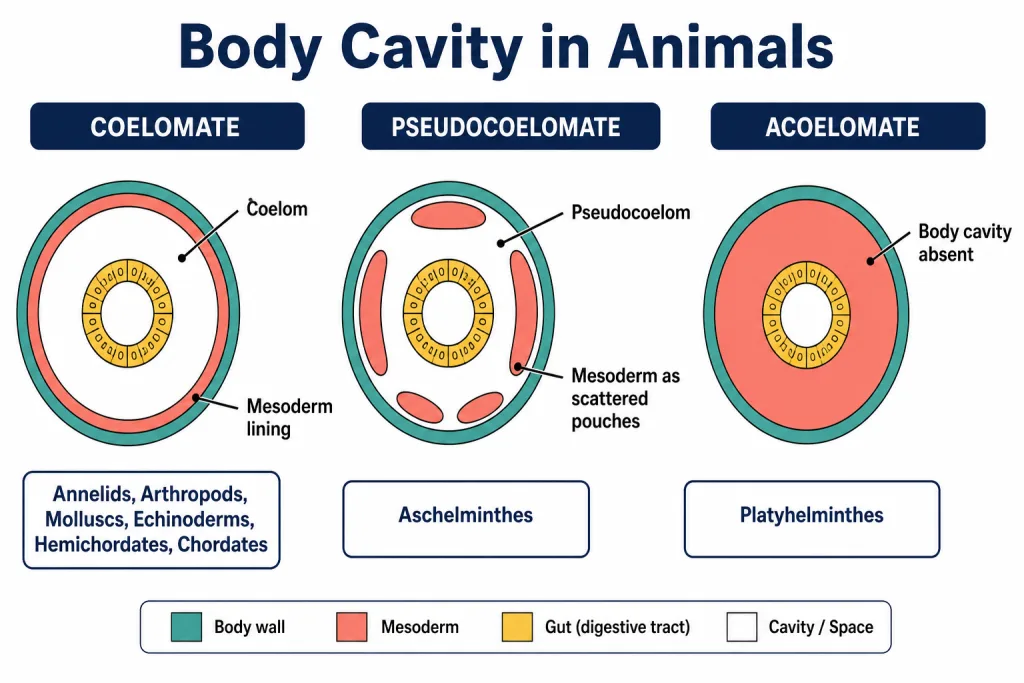
The body cavity which is lined by mesoderm is called coelom. Animals possessing coelom are coelomates - annelids, molluscs, arthropods, echinoderms, hemichordates and chordates.
Pseudocoelomates
In some animals the body cavity is not lined by mesoderm; instead the mesoderm is present as scattered pouches in between the ectoderm and endoderm. Such a cavity is a pseudocoelom and the animals are pseudocoelomates - aschelminthes.
Acoelomates
The animals in which the body cavity is absent are called acoelomates - platyhelminthes.
| Condition | Body cavity | Mesoderm | Example phylum |
|---|---|---|---|
| Coelomate | Present, lined by mesoderm | Full lining | Annelida, Mollusca, Arthropoda, Echinodermata, Hemichordata, Chordata |
| Pseudocoelomate | Present, not lined by mesoderm | Scattered pouches between ectoderm and endoderm | Aschelminthes |
| Acoelomate | Absent | - | Platyhelminthes |
[NEET Important] The whole distinction turns on the word lined. A pseudocoelomate has a cavity - it is not acoelomate - but the cavity is not lined by mesoderm. Only Aschelminthes is pseudocoelomate and only Platyhelminthes is acoelomate among the phyla studied here, so these two are one-to-one mappings worth memorising.
Segmentation
In some animals, the body is externally and internally divided into segments with a serial repetition of at least some organs. For example, in earthworm the body shows this pattern called metameric segmentation, and the phenomenon is known as metamerism.
Three points that get tested:
- The division is both external and internal - not merely surface rings.
- There is a serial repetition of at least some organs.
- The example is the earthworm, and the phyla showing segmentation are Annelida, Arthropoda and Chordata.
[NEET Important] "Segmentation is first observed in which phylum?" is a standard question, and the answer is Annelida. Mollusca is unsegmented, even though it sits between two segmented phyla in the sequence.
Notochord
Notochord is a mesodermally derived rod-like structure formed on the dorsal side during embryonic development in some animals.
And the split it creates:
Animals with notochord are called chordates; those animals which do not form this structure are non-chordates - porifera to echinoderms.
Three words in that definition each carry a mark: mesodermally derived, rod-like, dorsal side during embryonic development.
[NEET Important] Hemichordata is a non-chordate. It was once treated as a sub-phylum of Chordata, and it has a stomochord in the collar region that resembles a notochord - but it is now a separate phylum under non-chordata. Questions exploit that history.
The Six Tools Side by Side
This is the whole first half of the chapter in one table. Every phylum description in sections 3 to 11 is built from these six columns.
| Tool | The states it distinguishes |
|---|---|
| Level of organisation | Cellular / tissue / organ / organ system |
| Symmetry | Asymmetrical / radial / bilateral |
| Germ layers | Diploblastic (ectoderm + endoderm + mesoglea) / triploblastic (with mesoderm) |
| Coelom | Acoelomate / pseudocoelomate / coelomate |
| Segmentation | Present / absent |
| Notochord | Chordate / non-chordate |
And the two system patterns from section 1: digestive incomplete or complete, circulation open or closed.
The transition points to remember:
- Tissue level begins at Coelenterata; organ level at Platyhelminthes; organ system level at Platyhelminthes in the comparison table, which credits it organ and organ-system, and at every phylum from Aschelminthes onwards.
- Triploblasty begins at Platyhelminthes.
- A body cavity first appears at Aschelminthes (as a pseudocoelom); a true coelom at Annelida.
- Segmentation first appears at Annelida.
- A complete gut first appears at Aschelminthes.
- The notochord appears only in Chordata.
Quick Recap
- Asymmetrical: no plane through the centre divides into equal halves - sponges.
- Radial: any plane through the central axis gives two identical halves - coelenterates, ctenophores, echinoderms.
- Bilateral: identical left and right halves in only one plane - annelids, arthropods and the rest.
- Diploblastic: ectoderm and endoderm with an undifferentiated mesoglea between - coelenterates.
- Triploblastic: a third germinal layer, mesoderm, between ectoderm and endoderm - platyhelminthes to chordates.
- Coelom = the body cavity lined by mesoderm. Coelomates: annelids, molluscs, arthropods, echinoderms, hemichordates, chordates. Pseudocoelomates: aschelminthes - mesoderm as scattered pouches, cavity not lined. Acoelomates: platyhelminthes - no body cavity.
- Metameric segmentation: body divided externally and internally into segments with serial repetition of at least some organs - the earthworm; the phenomenon is metamerism.
- Notochord: a mesodermally derived rod-like structure on the dorsal side in embryonic development. With it, chordates; without, non-chordates - porifera to echinoderms.
Solved Examples
Question 1
Q. Define radial symmetry.
Answer. Symmetry in which any plane passing through the central axis of the body divides the organism into two identical halves.
Question 2
Q. Which three groups show radial symmetry?
Answer. Coelenterates, ctenophores and echinoderms.
Question 3
Q. What is mesoglea?
Answer. An undifferentiated layer present in between the ectoderm and the endoderm in diploblastic animals.
Question 4
Q. Define coelom.
Answer. The body cavity which is lined by mesoderm.
Question 5
Q. Which phylum is acoelomate, and which is pseudocoelomate?
Answer. Acoelomate: Platyhelminthes. Pseudocoelomate: Aschelminthes.
Question 6
Q. What is metamerism, and give the example animal.
Answer. The body is externally and internally divided into segments with a serial repetition of at least some organs. That is metameric segmentation. Example: the earthworm.
Question 7
Q. Distinguish diploblastic from triploblastic animals.
Answer.
- Diploblastic: cells arranged in two embryonic layers - an external ectoderm and an internal endoderm - with an undifferentiated mesoglea in between. Example: coelenterates.
- Triploblastic: the developing embryo has a third germinal layer, mesoderm, between ectoderm and endoderm. Range: platyhelminthes to chordates.
Question 8
Q. How is a pseudocoelom different from a coelom?
Answer. A coelom is lined by mesoderm. In a pseudocoelom the body cavity is not lined by mesoderm; instead the mesoderm is present as scattered pouches in between the ectoderm and endoderm. Both are cavities - the difference is the lining.
Question 9
Q. Define notochord, giving all three parts of the definition.
Answer. A mesodermally derived, rod-like structure formed on the dorsal side during embryonic development in some animals.
Question 10
Q. An animal is bilaterally symmetrical, triploblastic, has a body cavity that is not lined by mesoderm, and has a complete gut. Name the phylum.
Answer. Aschelminthes. The giveaway is the cavity not lined by mesoderm - that is the pseudocoelom, and Aschelminthes is the only pseudocoelomate phylum here. The complete alimentary canal confirms it, because Aschelminthes is the first phylum to have one.
Question 11
Q. Arrange these phyla in the order in which each character first appears: complete digestive system, true coelom, triploblasty, notochord, segmentation.
Answer.
| Character | First appears in |
|---|---|
| Triploblasty | Platyhelminthes |
| Complete digestive system | Aschelminthes |
| True coelom | Annelida |
| Segmentation | Annelida |
| Notochord | Chordata |
So the order is triploblasty to complete gut to true coelom and segmentation together to notochord.
Question 12
Q. How useful is the study of the nature of body cavity and coelom in the classification of animals?
Answer. Very useful. Just asking about the presence or absence of a cavity between the body wall and the gut wall splits the triploblastic phyla into three clean groups that do not overlap.
- Acoelomates have no body cavity at all - platyhelminthes. The gut sits in solid tissue, so organ development and movement are both limited.
- Pseudocoelomates have a cavity not lined by mesoderm, with the mesoderm sitting as scattered pouches between ectoderm and endoderm - aschelminthes. Now there is a fluid-filled space, so a complete gut can run right through the body.
- Coelomates have a cavity lined by mesoderm - annelids, molluscs, arthropods, echinoderms, hemichordates and chordates. A proper lining lets the gut move independently of the body wall, supports a hydrostatic skeleton, and leaves room for large organs and organ systems.
Each state belongs to particular phyla, so the coelom on its own will often place an unknown animal, and it tracks how complex that animal can get.
Takeaway: This is one of the chapter-end exercises. Answer it as three named states, each with its phyla and what the state permits.
Question 13
Q. Echinoderms appear under both radial and bilateral symmetry in different places. Resolve the apparent contradiction.
Answer. No contradiction - the symmetry changes with the stage of the life cycle. The adult echinoderms are radially symmetrical but larvae are bilaterally symmetrical. The group gets listed with the radially symmetrical animals because of the adult, while the broad classification chart footnotes that echinodermata exhibits radial or bilateral symmetry depending on the stage.
For working out relationships the larva tells you more. A bilaterally symmetrical larva puts echinoderms with the bilaterally symmetrical animals, and the adult's radial body plan is a secondary acquisition on top of that.
Question 14
Q. If you are given a specimen, what steps would you follow to classify it?
Answer. Work through the fundamental features in order, because each one narrows the field.
- Level of organisation - are the cells loose aggregates (cellular), grouped into tissues, into organs, or into organ systems?
- Symmetry - asymmetrical, radial (any plane through the central axis gives identical halves), or bilateral (only one plane does)?
- Germ layers - diploblastic with ectoderm, endoderm and an undifferentiated mesoglea, or triploblastic with a true mesoderm?
- Coelom - acoelomate, pseudocoelomate (cavity present but not lined by mesoderm), or coelomate (cavity lined by mesoderm)?
- Segmentation - is the body divided externally and internally into segments with serial repetition of at least some organs?
- Notochord - is a mesodermally derived dorsal rod formed in the embryo? If yes it is a chordate; if not, a non-chordate.
- Then use the system patterns - digestive incomplete or complete, circulation open or closed - and finally the distinctive feature of the phylum, such as choanocytes, cnidoblasts, comb plates, flame cells, parapodia, jointed appendages, a radula or a water vascular system.
Takeaway: One of the chapter-end exercises, and the answer is simply the chapter's own toolkit applied in sequence. Numbering the steps is what earns the marks.