
The Chapter in One Read
Over a million animal species have been described, and no student can hold a million descriptions. The chapter's answer to that problem is a small set of fundamental features that apply to every animal regardless of habit and habitat: level of organisation, symmetry, germ layers, coelom, segmentation and the notochord, together with the patterns of the digestive and circulatory systems.
Those tools come first. Cells may be arranged as loose aggregates (sponges), gathered into tissues (coelenterates, ctenophores), grouped into organs (platyhelminthes), or organised into systems (platyhelminthes in the comparison grid, and every phylum from aschelminthes onwards). A body may be asymmetrical, radial or bilateral. It may have two germ layers with a mesoglea or three with a true mesoderm. Its cavity may be absent, a pseudocoelom or a true coelom. It may be segmented or not, and it may carry a notochord or not. Two more contrasts run through everything: an incomplete gut with one opening against a complete gut with mouth and anus, and an open circulation in which tissues are bathed in blood against a closed circulation with arteries, veins and capillaries.
With those tools in hand the phyla fall into place. Porifera filters water through ostia, spongocoel and osculum using choanocytes. Coelenterata stings with cnidoblasts and alternates polyp and medusa. Ctenophora swims on eight rows of comb plates and glows. Platyhelminthes flattens itself, grips with hooks and suckers and excretes through flame cells. Aschelminthes brings the first complete gut and a pseudocoelom. Annelida brings the true coelom and metameric segmentation, with nephridia and a closed circulation. Arthropoda, the largest phylum, adds a chitinous exoskeleton, jointed appendages, open circulation and malpighian tubules. Mollusca, the second largest, adds the mantle, visceral hump and radula. Echinodermata is all marine with calcareous ossicles and the water vascular system, and has no excretory system. Hemichordata carries proboscis, collar and trunk and a stomochord - the structure that once put it inside Chordata.
Then the door opens. Chordata is defined by the notochord, dorsal hollow nerve cord, paired pharyngeal gill slits and post-anal tail, with a ventral heart. Its three subphyla are Urochordata, where the notochord sits only in the larval tail; Cephalochordata, where it runs head to tail for life; and Vertebrata, where it is replaced by a vertebral column. Vertebrata splits on the jaw - Agnatha holding Cyclostomata, Gnathostomata holding Pisces and Tetrapoda - and then class by class: the jawless Cyclostomata, the cartilaginous Chondrichthyes with no air bladder, the bony Osteichthyes with an operculum and an air bladder, the moist-skinned Amphibia with a three-chambered heart, the dry-scaled Reptilia with the crocodile exception, the feathered Aves with pneumatic bones and air sacs, and the Mammalia with mammary glands and hair.
Almost every mark in this chapter rides on a named example or an exact character. That is the whole strategy.
Master Quick Recap
The six fundamental features
- Level of organisation - cellular (Porifera), tissue (Coelenterata, Ctenophora), organ (Platyhelminthes), organ-system (Platyhelminthes in the comparison grid, and every phylum from Aschelminthes onwards).
- Symmetry - asymmetrical (most sponges), radial (coelenterates, ctenophores, adult echinoderms), bilateral (the rest).
- Germ layers - diploblastic with a mesoglea (coelenterates), triploblastic with a mesoderm (platyhelminthes to chordates).
- Coelom - acoelomate (Platyhelminthes), pseudocoelomate (Aschelminthes), coelomate (Annelida onwards).
- Segmentation - metameric, first in Annelida.
- Notochord - mesodermally derived; present in chordates, absent in non-chordates.
The two system contrasts
- Digestive - incomplete, one opening; complete, mouth and anus, first in Aschelminthes.
- Circulatory - open (Arthropoda, Mollusca, Echinodermata, Hemichordata); closed (Annelida, Chordata).
Signature structures, one per phylum
- Porifera - choanocytes, spongocoel, ostia, osculum
- Coelenterata - cnidoblasts with nematocysts
- Ctenophora - eight rows of comb plates, bioluminescence
- Platyhelminthes - flame cells, hooks and suckers
- Aschelminthes - complete gut with a muscular pharynx, excretory pore
- Annelida - nephridia, parapodia, double ventral nerve cord
- Arthropoda - chitinous exoskeleton, jointed appendages, malpighian tubules
- Mollusca - radula, mantle cavity, visceral hump, calcareous shell
- Echinodermata - water vascular system, calcareous ossicles, no excretory system
- Hemichordata - proboscis, collar, trunk, stomochord, proboscis gland
- Chordata - notochord, dorsal hollow nerve cord, pharyngeal gill slits, post-anal tail
Heart chambers
- Two - Chondrichthyes, Osteichthyes
- Three - Amphibia, and Reptilia except crocodiles
- Four - crocodiles, Aves, Mammalia
The exceptions that carry marks
- Ichthyophis - the limbless amphibian
- Crocodilus - the four-chambered reptile
- Struthio - the flightless bird
- Ornithorhynchus - the oviparous mammal
- Echinodermata - no excretory system; larva bilateral, adult radial
Salient Features of the Phyla
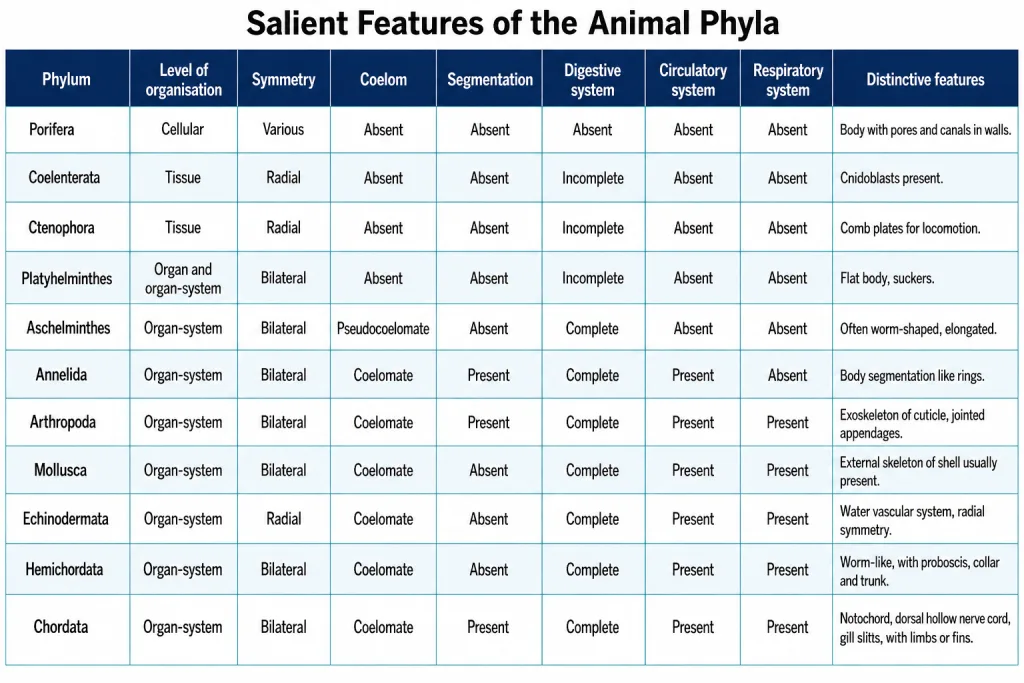
| Phylum | Level of organisation | Symmetry | Coelom | Segmentation | Digestive system | Circulatory system | Respiratory system | Distinctive features |
|---|---|---|---|---|---|---|---|---|
| Porifera | Cellular | Various | Absent | Absent | Absent | Absent | Absent | Body with pores and canals in walls |
| Coelenterata (Cnidaria) | Tissue | Radial | Absent | Absent | Incomplete | Absent | Absent | Cnidoblasts present |
| Ctenophora | Tissue | Radial | Absent | Absent | Incomplete | Absent | Absent | Comb plates for locomotion |
| Platyhelminthes | Organ and organ-system | Bilateral | Absent | Absent | Incomplete | Absent | Absent | Flat body, suckers |
| Aschelminthes | Organ-system | Bilateral | Pseudocoelomate | Absent | Complete | Absent | Absent | Often worm-shaped, elongated |
| Annelida | Organ-system | Bilateral | Coelomate | Present | Complete | Present | Absent | Body segmentation like rings |
| Arthropoda | Organ-system | Bilateral | Coelomate | Present | Complete | Present | Present | Exoskeleton of cuticle, jointed appendages |
| Mollusca | Organ-system | Bilateral | Coelomate | Absent | Complete | Present | Present | External skeleton of shell usually present |
| Echinodermata | Organ-system | Radial | Coelomate | Absent | Complete | Present | Present | Water vascular system, radial symmetry |
| Hemichordata | Organ-system | Bilateral | Coelomate | Absent | Complete | Present | Present | Worm-like, with proboscis, collar and trunk |
| Chordata | Organ-system | Bilateral | Coelomate | Present | Complete | Present | Present | Notochord, dorsal hollow nerve cord, gill slits, with limbs or fins |
How this table is examined. Almost never as a whole. The examiner takes one cell and asks it as a single question - "in which phylum is the digestive system incomplete but the coelom absent", "which coelomate phylum is unsegmented". Read the table column by column rather than row by row, and those questions answer themselves. The three columns that generate the most questions are coelom, segmentation and circulatory system.
The Vertebrate Classes at a Glance
| Character | Cyclostomata | Chondrichthyes | Osteichthyes | Amphibia | Reptilia | Aves | Mammalia |
|---|---|---|---|---|---|---|---|
| Jaw | Absent | Present | Present | Present | Present | Present | Present |
| Skeleton | Cartilaginous | Cartilaginous | Bony | Bony | Bony | Fully ossified, pneumatic long bones | Bony |
| Body covering | No scales | Placoid scales | Cycloid or ctenoid scales | Moist skin, no scales | Dry cornified skin, scales or scutes | Feathers | Hair |
| Respiration | 6-15 pairs of gill slits | Gill slits, no operculum | Four pairs of gills under an operculum | Gills, lungs and skin | Lungs | Lungs with air sacs | Lungs |
| Heart | Closed circulation | Two-chambered | Two-chambered | Three-chambered | Three-chambered; four in crocodiles | Four-chambered | Four-chambered |
| Body temperature | - | Cold-blooded | Cold-blooded | Cold-blooded | Poikilothermous | Homoiothermous | Homoiothermous |
| Fertilisation | External, in fresh water | Internal | Usually external | External | Internal | Internal | Internal |
| Development | Indirect, larva returns to the ocean | Many viviparous | Oviparous, direct | Oviparous, indirect | Oviparous, direct | Oviparous, direct | Viviparous with few exceptions, direct |
| Special feature | Ectoparasites on fishes; sucking circular mouth | No air bladder; claspers on male pelvic fins | Air bladder regulates buoyancy | Cloaca; tympanum | No external ear openings; skin cast | Beak; crop and gizzard; oil gland only | Mammary glands; pinnae; different types of teeth |
Read this table twice in a row down the "Body covering" line. No scales, placoid, cycloid or ctenoid, moist and bare, dry and cornified, feathers, hair. That single line separates all seven classes, and it is the fastest route through a vertebrate identification question.
Index of Named Animals
Porifera - Sycon (Scypha), Spongilla (fresh water sponge), Euspongia (bath sponge).
Coelenterata - Physalia (Portuguese man of war), Adamsia (sea anemone), Pennatula (sea pen), Gorgonia (sea fan), Meandrina (brain coral), Obelia (shows metagenesis), Aurelia (jelly fish).
Ctenophora - Pleurobrachia, Ctenoplana.
Platyhelminthes - Taenia (tapeworm), Fasciola (liver fluke), Planaria (high regeneration).
Aschelminthes - Ascaris (round worm), Wuchereria (filaria worm), Ancylostoma (hookworm).
Annelida - Nereis (aquatic, parapodia, dioecious), Pheretima (earthworm), Hirudinaria (blood sucking leech).
Arthropoda - Apis (honey bee), Bombyx (silkworm), Laccifer (lac insect); Anopheles, Culex, Aedes (mosquito vectors); Locusta (gregarious pest); Limulus (king crab, living fossil).
Mollusca - Pila (apple snail), Pinctada (pearl oyster), Sepia (cuttlefish), Loligo (squid), Octopus (devil fish), Aplysia (sea hare), Dentalium (tusk shell), Chaetopleura (chiton).
Echinodermata - Asterias (star fish), Echinus (sea urchin), Antedon (sea lily), Cucumaria (sea cucumber), Ophiura (brittle star).
Hemichordata - Balanoglossus, Saccoglossus.
Urochordata - Ascidia, Salpa, Doliolum.
Cephalochordata - Branchiostoma (Amphioxus, Lancelet).
Cyclostomata - Petromyzon (lamprey), Myxine (hagfish).
Chondrichthyes - Scoliodon (dog fish), Pristis (saw fish), Carcharodon (great white shark), Trygon (sting ray), Torpedo (electric ray).
Osteichthyes - Exocoetus (flying fish), Hippocampus (sea horse), Labeo (rohu), Catla (katla), Clarias (magur), Betta (fighting fish), Pterophyllum (angel fish).
Amphibia - Bufo (toad), Rana (frog), Hyla (tree frog), Salamandra (salamander), Ichthyophis (limbless amphibia).
Reptilia - Chelone (turtle), Testudo (tortoise), Chameleon (tree lizard), Calotes (garden lizard), Crocodilus (crocodile), Alligator (alligator), Hemidactylus (wall lizard); Naja (cobra), Bangarus (krait), Vipera (viper).
Aves - Corvus (crow), Columba (pigeon), Psittacula (parrot), Struthio (ostrich), Pavo (peacock), Aptenodytes (penguin), Neophron (vulture).
Mammalia - Ornithorhynchus (platypus, oviparous); Macropus (kangaroo), Pteropus (flying fox), Camelus (camel), Macaca (monkey), Rattus (rat), Canis (dog), Felis (cat), Elephas (elephant), Equus (horse), Delphinus (common dolphin), Balaenoptera (blue whale), Panthera tigris (tiger), Panthera leo (lion).
Writing the Chapter-End Exercises Well
Class 11 has no board paper, but the chapter-end exercises and your school tests are still written answers, and a written answer is marked on what you put down rather than on what you recognise. Everything below is about writing, not about choosing.
What gets asked. Definitions with an example, two-point distinctions, comparison tables, and the fifteen chapter-end exercises. Nothing else appears with any regularity.
Four rules that convert knowledge into marks.
- Every character gets its example. "Metameric segmentation occurs in annelids" earns less than "metameric segmentation occurs in annelids, as in Pheretima". Italicise the name.
- Comparisons go in tables. The same characters, in the same order, on both sides. A marker reading two loose paragraphs finds one point; the same content in a five-row table shows five.
- State the exception with the rule. Reptiles - three-chambered, but four in crocodiles. Mammals - viviparous, with few exceptions such as Ornithorhynchus. Birds - most fly, except flightless birds such as the ostrich.
- Number your points in long answers. A five-mark question is marked point by point. Eight numbered one-line points beat three dense paragraphs saying the same thing.
The exercises to be able to write from memory: the reasons arthropods form the largest group, the modifications that help birds fly, the difficulties of classifying without fundamental features, the justification that all vertebrates are chordates but not the reverse, and the match-the-column of signature structures. Those five carry the heaviest weight.
NEET Strategy
What the paper asks. A signature structure, a named example, or an exact character - dressed in a distractor drawn from the neighbouring phylum.
How to prepare specifically for that.
- Learn the phylum comparison table by column, not by row. Questions are built from single cells: "which coelomate phylum lacks segmentation" is answered instantly by anyone who has read the coelom and segmentation columns together.
- Drill the exceptions. Ichthyophis, Crocodilus, Struthio, Ornithorhynchus, and the absent excretory system of echinoderms. An exception is the cheapest question an examiner can set.
- Fix the excretory sequence in order. Flame cells, excretory pore, nephridia, malpighian tubules, gills, none, proboscis gland - Platyhelminthes through Hemichordata. Recite it as a chain.
- Watch the absolute words. Exclusively marine (Ctenophora, protochordates), all marine (Echinodermata), all living members ectoparasites (Cyclostomata). If a stem softens one of these to "mostly", it is wrong.
- Answer two-part characters in full. Echinoderm symmetry is bilateral larva and radial adult. Reptilian heart is three-chambered, four in crocodiles. A single-word option that covers only half is the standard trap.
- Never guess an example from its sound. Aplysia is a sea hare and not an echinoderm; Hemidactylus is a wall lizard and not an amphibian; Balanoglossus is a hemichordate and not a chordate.
Time discipline. These are one-line recall questions. If a question takes more than 45 seconds you do not know the fact, and rereading the options will not create it - mark it and move on.
The Mistakes That Cost the Most Marks
- Mesoglea called mesoderm. The mesoglea is an undifferentiated layer in diploblastic animals; the mesoderm is a true germ layer.
- Pseudocoelom called a coelom. In a pseudocoelom the mesoderm lies as scattered pouches and does not line the cavity.
- Excretory structures swapped. Flame cells - Platyhelminthes. Nephridia - Annelida. Malpighian tubules - Arthropoda. Getting two of these right and one wrong loses the whole match-the-column mark.
- Circulation swapped between neighbours. Annelida is closed; Arthropoda is open. They sit next to each other in the chapter for exactly that reason.
- The echinoderm excretory system invented. It is absent. Do not supply one.
- Echinoderm symmetry answered in one word. Larva bilateral, adult radial.
- The reptilian heart answered without the crocodile.
- Mammals called viviparous without the exception. Ornithorhynchus is oviparous.
- Hemichordata still called a sub-phylum of Chordata. It is a separate phylum under non-chordata; the stomochord is not a notochord.
- "All chordates are vertebrates." False - the protochordates are chordates without a vertebral column.
- Segmentation credited to Arthropoda. It is first observed in Annelida.
- The air bladder given to sharks. Chondrichthyes have none, which is why they swim constantly.
- Ctenophore reproduction given an asexual route. Reproduction is only by sexual means.
- Common names mixed up. Sepia cuttlefish and Loligo squid; Chelone turtle and Testudo tortoise; Petromyzon lamprey and Myxine hagfish.
A Short Revision Plan
First pass - two hours. Read the phylum comparison table, then the chapter's phylum accounts in order, marking only the signature structure of each phylum in the margin. Do not attempt the examples yet.
Second pass - ninety minutes. Cover the table and rebuild it from memory, column by column: level of organisation, symmetry, coelom, segmentation, digestive, circulatory, respiratory. Check, and rewrite only the cells you missed.
Third pass - one hour. The index of named animals. Read it aloud with the common name, then cover the common names and recover them. This is the single highest-return hour in the chapter.
Fourth pass - ninety minutes. The fifteen chapter-end exercises, written out in full in the format described above. The five heavy ones - arthropod dominance, bird flight, classification without fundamental features, the vertebrate justification, and the match-the-column - should be written from memory without looking.
Fifth pass - one hour. The 40 NEET-pattern questions under time. Then return only to the questions where you were choosing between two options, and read the two paragraphs those two options came from.
On the day before the exam - twenty minutes. The master quick recap and the list of exceptions. Nothing else. By then the chapter is either in place or it is not, and the exceptions are what slip first.