
Phylum Aschelminthes - the Roundworms
The body is circular in cross-section, and that single fact gives the group its common name - roundworms.
Characters:
- They may be free-living, aquatic and terrestrial, or parasitic in plants and animals.
- Organ-system level of organisation.
- Bilaterally symmetrical, triploblastic and pseudocoelomate.
- Alimentary canal is complete with a well-developed muscular pharynx.
- An excretory tube removes body wastes from the body cavity through the excretory pore.
- Sexes are separate (dioecious), i.e. males and females are distinct. Often females are longer than males.
- Fertilisation is internal. Development may be direct - the young ones resemble the adult - or indirect.
Examples: Ascaris (round worm), Wuchereria (filaria worm), Ancylostoma (hookworm).
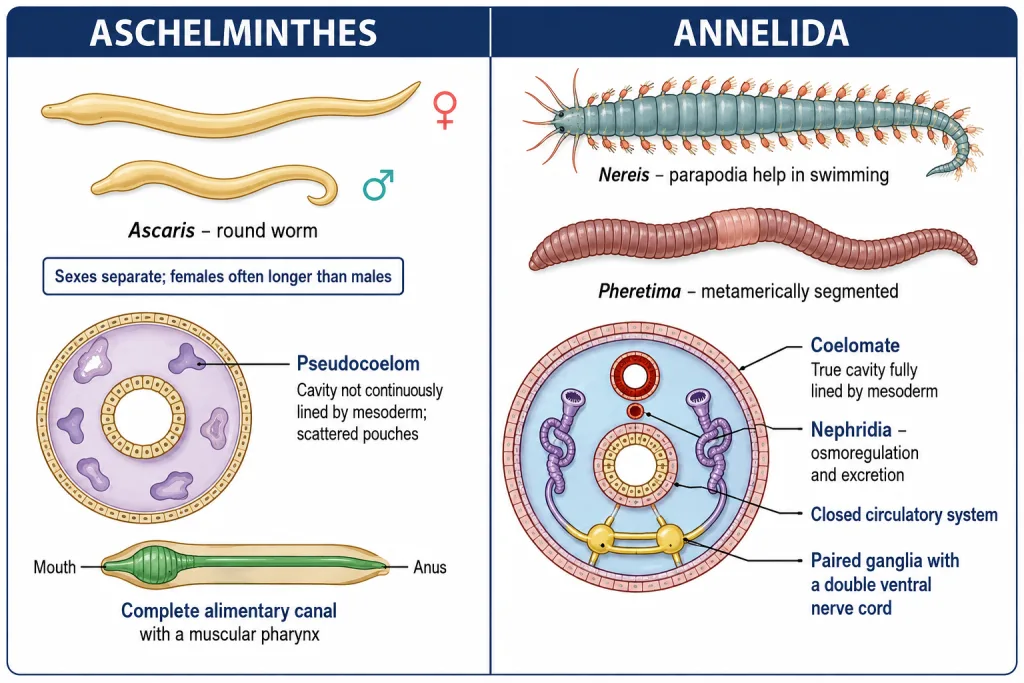
[NEET Important] Two firsts sit here. This is the first phylum in the sequence you are studying with a complete alimentary canal - a separate mouth and anus, food travelling one way - and it is the only pseudocoelomate phylum in the chapter. A body cavity that is present but not lined by mesoderm on all sides is a pseudocoelom, and roundworms are the standard example. Add the third favourite: females are often longer than males.
Phylum Annelida - the Segmented Worms
The name comes from the Latin annulus, meaning little ring - the body is built as a series of rings.
Characters:
- They may be aquatic (marine and fresh water) or terrestrial, free-living and sometimes parasitic.
- Organ-system level of organisation.
- Bilaterally symmetrical, triploblastic, metamerically segmented and coelomate.
- They possess longitudinal and circular muscles which help in locomotion.
- Aquatic annelids like Nereis possess lateral appendages, parapodia, which help in swimming.
- Closed circulatory system.
- Nephridia help in osmoregulation and excretion.
- The neural system consists of paired ganglia connected by lateral nerves to a double ventral nerve cord.
- Nereis, an aquatic form, is dioecious, but earthworms and leeches are monoecious.
- Reproduction is sexual.
Examples: Nereis, Pheretima (earthworm), Hirudinaria (blood sucking leech).
[NEET Important] Annelida is where two structural landmarks appear together for the first time: a true coelom (lined by mesoderm on both sides) and metameric segmentation. Pair that with the closed circulatory system, because the very next phylum, Arthropoda, is open - and that contrast is one of the most reliably asked pairs in the whole chapter.
Reading the Two Side by Side
| Feature | Aschelminthes | Annelida |
|---|---|---|
| Common name | Roundworms | Segmented worms / ringed worms |
| Body shape | Circular in cross-section | Metamerically segmented, ring after ring |
| Level of organisation | Organ-system | Organ-system |
| Symmetry | Bilateral | Bilateral |
| Germ layers | Triploblastic | Triploblastic |
| Body cavity | Pseudocoelomate | Coelomate (true coelom) |
| Digestive system | Complete, with a well-developed muscular pharynx | Complete |
| Circulatory system | Absent | Closed |
| Excretion | Excretory tube opening at the excretory pore | Nephridia |
| Locomotion | Body muscles | Longitudinal and circular muscles; parapodia in Nereis |
| Neural system | - | Paired ganglia and a double ventral nerve cord |
| Sexes | Separate; females often longer | Nereis dioecious; earthworms and leeches monoecious |
| Examples | Ascaris, Wuchereria, Ancylostoma | Nereis, Pheretima, Hirudinaria |
The milestone line, worth memorising in order:
- Acoelomate - Platyhelminthes
- Pseudocoelomate - Aschelminthes
- Coelomate - Annelida onwards
A question that gives you a body cavity and asks for the phylum is really asking you to recite that three-step ladder.
Quick Recap
Aschelminthes
- Roundworms; body circular in cross-section.
- Free-living aquatic and terrestrial, or parasitic in plants and animals.
- Organ-system level, bilateral, triploblastic, pseudocoelomate.
- Complete alimentary canal with a well-developed muscular pharynx; excretory tube opening at the excretory pore.
- Sexes separate, females often longer than males; fertilisation internal; development direct or indirect.
- Ascaris (round worm), Wuchereria (filaria worm), Ancylostoma (hookworm).
Annelida
- Latin annulus = little ring; metamerically segmented.
- Aquatic or terrestrial, free-living and sometimes parasitic.
- Organ-system level, bilateral, triploblastic, coelomate.
- Longitudinal and circular muscles for locomotion; parapodia in Nereis for swimming.
- Closed circulatory system; nephridia for osmoregulation and excretion.
- Paired ganglia connected by lateral nerves to a double ventral nerve cord.
- Nereis dioecious; earthworms and leeches monoecious; reproduction sexual.
- Nereis, Pheretima, Hirudinaria.
Solved Examples
Question 1
Q. Why are aschelminthes called roundworms?
Answer. Because the body is circular in cross-section.
Question 2
Q. What kind of body cavity do roundworms have?
Answer. A pseudocoelom - they are pseudocoelomate. The cavity is present but is not a true coelom.
Question 3
Q. Name the three examples of Aschelminthes with their common names.
Answer. Ascaris (round worm), Wuchereria (filaria worm) and Ancylostoma (hookworm).
Question 4
Q. What does the word annulus mean, and why is it a good name for the phylum?
Answer. Annulus is Latin for little ring. Annelids are metamerically segmented, so the body reads as a series of rings placed one behind the other.
Question 5
Q. Which structures carry out osmoregulation and excretion in annelids?
Answer. Nephridia.
Question 6
Q. What are parapodia and which animal has them?
Answer. Parapodia are lateral appendages that help in swimming. Aquatic annelids such as Nereis possess them.
Question 7
Q. State two features of the digestive system of Aschelminthes that separate it from that of Platyhelminthes.
Answer.
- The alimentary canal is complete in Aschelminthes - there is a separate mouth and anus - whereas flatworms have an incomplete gut.
- Aschelminthes have a well-developed muscular pharynx, a pumping structure that a flatworm's simple gut lacks.
Question 8
Q. Describe the neural system of Annelida.
Answer. There are paired ganglia, joined by lateral nerves to a double ventral nerve cord. Note that the cord is ventral and double - the exact opposite of the dorsal, hollow, single nerve cord you meet later in chordates.
Question 9
Q. How does sexuality differ within Annelida? Give the examples.
Answer. It is not uniform across the phylum. Nereis, an aquatic form, is dioecious - sexes separate. Earthworms and leeches are monoecious - both sexes in one animal. Reproduction is sexual throughout.
Question 10
Q. An animal is bilaterally symmetrical and triploblastic, has an organ-system level of organisation, a complete gut with a muscular pharynx, and a body cavity that is not a true coelom. Sexes are separate and the female is longer than the male. Identify the phylum.
Answer. Aschelminthes. The giveaway is the pseudocoelom together with the complete alimentary canal and muscular pharynx; females longer than males confirms it.
Question 11
Q. A marine worm has a segmented body, lateral appendages used for swimming, a closed circulatory system and nephridia. Name the phylum and the most likely genus.
Answer. Phylum Annelida; the genus is Nereis, since parapodia for swimming are the aquatic annelid's feature.
Question 12
Q. Segmentation is first observed in which phylum, and what other structural first appears in the same phylum?
Answer. Metameric segmentation is first observed in Annelida. The true coelom appears in the same phylum, so Annelida is the point at which the body plan becomes both segmented and coelomate. Everything after it in the chapter inherits the coelom.