
Class Aves - the Birds
Characters:
- The characteristic features of Aves are the presence of feathers, and most of them can fly except flightless birds such as the ostrich.
- They possess a beak.
- The forelimbs are modified into wings.
- The hind limbs generally have scales and are modified for walking, swimming or clasping the tree branches.
- Skin is dry without glands, except the oil gland at the base of the tail.
- Endoskeleton is fully ossified (bony) and the long bones are hollow with air cavities (pneumatic).
- The digestive tract of birds has additional chambers, the crop and gizzard.
- Heart is completely four-chambered.
- They are warm-blooded (homoiothermous) animals, that is, they are able to maintain a constant body temperature.
- Respiration is by lungs. Air sacs connected to lungs supplement respiration.
- Sexes are separate. Fertilisation is internal. They are oviparous and development is direct.
Examples: Corvus (crow), Columba (pigeon), Psittacula (parrot), Struthio (ostrich), Pavo (peacock), Aptenodytes (penguin), Neophron (vulture).
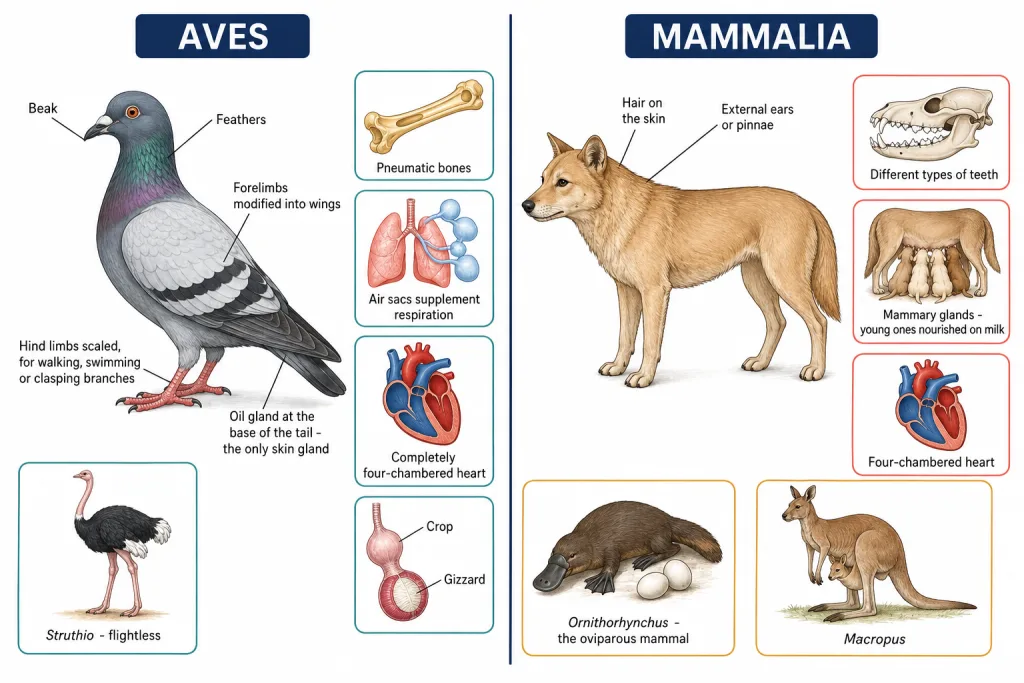
[NEET Important] Every feature in this list is an answer to the exercise "what modifications help birds fly?" - feathers, forelimbs as wings, pneumatic long bones, air sacs supplementing the lungs, a completely four-chambered heart and no skin glands except the oil gland. Two single-fact favourites: the only skin gland is the oil gland at the base of the tail, and the crop and gizzard are the extra chambers of the digestive tract.
Class Mammalia - the Milk-Producing Vertebrates
Mammals are found in a variety of habitats - polar ice caps, deserts, mountains, forests, grasslands and dark caves. Some of them have adapted to fly or live in water.
Characters:
- The most unique mammalian characteristic is the presence of milk-producing glands (mammary glands) by which the young ones are nourished.
- They have two pairs of limbs, adapted for walking, running, climbing, burrowing, swimming or flying.
- The skin of mammals is unique in possessing hair.
- External ears or pinnae are present.
- Different types of teeth are present in the jaw.
- Heart is four-chambered.
- They are homoiothermous.
- Respiration is by lungs.
- Sexes are separate and fertilisation is internal. They are viviparous with few exceptions and development is direct.
Examples:
- Oviparous: Ornithorhynchus (platypus).
- Viviparous: Macropus (kangaroo), Pteropus (flying fox), Camelus (camel), Macaca (monkey), Rattus (rat), Canis (dog), Felis (cat), Elephas (elephant), Equus (horse), Delphinus (common dolphin), Balaenoptera (blue whale), Panthera tigris (tiger), Panthera leo (lion).
[NEET Important] Two words define the class - mammary glands and hair - and the examiner's favourite is the exception: mammals are viviparous with few exceptions, and Ornithorhynchus, the platypus, is the oviparous mammal you are given. External ears or pinnae and different types of teeth in the jaw round out the set.
Aves Against Mammalia
| Feature | Aves | Mammalia |
|---|---|---|
| Body covering | Feathers | Hair |
| Skin glands | Dry, no glands except the oil gland at the base of the tail | Skin possesses hair; mammary glands present |
| Forelimbs | Modified into wings | Two pairs of limbs for walking, running, climbing, burrowing, swimming or flying |
| Mouth | Beak | Different types of teeth in the jaw |
| Ear | - | External ears or pinnae present |
| Skeleton | Fully ossified; long bones hollow with air cavities (pneumatic) | Bony |
| Digestive tract | Additional chambers - crop and gizzard | - |
| Heart | Completely four-chambered | Four-chambered |
| Body temperature | Warm-blooded (homoiothermous) | Homoiothermous |
| Respiration | Lungs, supplemented by air sacs | Lungs |
| Reproduction | Internal fertilisation; oviparous; development direct | Internal fertilisation; viviparous with few exceptions; development direct |
| Examples | Corvus, Columba, Psittacula, Struthio, Pavo, Aptenodytes, Neophron | Ornithorhynchus (oviparous); Macropus, Pteropus, Camelus, Macaca, Elephas, Balaenoptera, Panthera tigris |
What the two classes share is worth stating plainly, because questions often test it: both have a four-chambered heart, both are homoiothermous, both breathe by lungs, both have internal fertilisation and both have direct development. Everything else separates them.
Quick Recap
Aves
- Feathers; most can fly except flightless birds such as the ostrich; beak present.
- Forelimbs modified into wings; hind limbs scaled, for walking, swimming or clasping tree branches.
- Skin dry without glands except the oil gland at the base of the tail.
- Endoskeleton fully ossified; long bones hollow with air cavities (pneumatic).
- Digestive tract has the crop and gizzard.
- Completely four-chambered heart; warm-blooded (homoiothermous).
- Lungs, with air sacs supplementing respiration.
- Sexes separate; fertilisation internal; oviparous; development direct.
- Corvus, Columba, Psittacula, Struthio, Pavo, Aptenodytes, Neophron.
Mammalia
- Found in polar ice caps, deserts, mountains, forests, grasslands and dark caves.
- Mammary glands - the most unique character; hair on the skin; external ears or pinnae.
- Two pairs of limbs; different types of teeth in the jaw.
- Four-chambered heart; homoiothermous; respiration by lungs.
- Sexes separate; fertilisation internal; viviparous with few exceptions; development direct.
- Oviparous: Ornithorhynchus. Viviparous: Macropus, Pteropus, Camelus, Macaca, Rattus, Canis, Felis, Elephas, Equus, Delphinus, Balaenoptera, Panthera tigris, Panthera leo.
Solved Examples
Question 1
Q. What is the characteristic body covering of a bird, and which bird cannot fly?
Answer. Feathers. The ostrich (Struthio) is the flightless example.
Question 2
Q. Which is the only skin gland of a bird, and where does it lie?
Answer. The oil gland, at the base of the tail. The rest of the skin is dry and without glands.
Question 3
Q. Name the two additional chambers of the avian digestive tract.
Answer. The crop and the gizzard.
Question 4
Q. What is the most unique characteristic of mammals?
Answer. The presence of milk-producing glands (mammary glands), by which the young ones are nourished.
Question 5
Q. Which mammal is oviparous?
Answer. Ornithorhynchus, the platypus.
Question 6
Q. Give the common names of Pteropus, Balaenoptera and Macropus.
Answer. Pteropus is the flying fox, Balaenoptera the blue whale and Macropus the kangaroo.
Question 7
Q. What are the modifications that are found in birds which help them fly?
Answer.
- The body is covered with feathers, and the forelimbs are modified into wings.
- The endoskeleton is fully ossified and the long bones are hollow with air cavities, so the skeleton is pneumatic and light.
- Air sacs connected to the lungs supplement respiration, keeping oxygen supply high during flight.
- The heart is completely four-chambered, so oxygenated and deoxygenated blood never mix and the flight muscles are supplied efficiently.
- The skin is dry without glands except the oil gland at the base of the tail, which keeps weight down and keeps the feathers in condition.
- The crop and gizzard in the digestive tract let a bird gather food fast and grind it without teeth, which keeps the head light.
This is one of the chapter-end exercises.
Question 8
Q. List four features that Aves and Mammalia have in common.
Answer. A four-chambered heart; homoiothermous body temperature; respiration by lungs; internal fertilisation with direct development. Sexes are separate in both.
Question 9
Q. Could the number of eggs or young ones produced by an oviparous and a viviparous mother be equal? Why?
Answer. Usually not equal. An oviparous mother lays her eggs outside the body, and out there they face predation, drying and changes of temperature with nothing from her to protect them - so she produces a large number and only a few survive. A viviparous mother retains the developing young inside her body, where they are protected and nourished until birth, so the survival rate is far higher and far fewer young are enough. The number produced matches the risk each mode carries.
This is one of the chapter-end exercises.
Question 10
Q. An animal has hair on its skin, external pinnae, different types of teeth, a four-chambered heart, and lays eggs. Name the animal and explain why the last feature does not remove it from its class.
Answer. The animal is Ornithorhynchus, the platypus, a mammal. Mammals are viviparous with few exceptions, and the platypus is that exception. It still has mammary glands, hair, pinnae, varied teeth and a four-chambered heart, so it belongs to Mammalia despite being oviparous.
Question 11
Q. Sort these into Aves and Mammalia: Neophron, Delphinus, Aptenodytes, Equus, Psittacula, Macaca.
Answer.
- Aves: Neophron (vulture), Aptenodytes (penguin), Psittacula (parrot).
- Mammalia: Delphinus (common dolphin), Equus (horse), Macaca (monkey).
Question 12
Q. Two vertebrates both have a four-chambered heart and maintain a constant body temperature. One has pneumatic long bones and air sacs, the other has mammary glands and pinnae. Name the classes and state which single character in each is described as the most defining.
Answer. The first is Aves, and what defines it is the presence of feathers. The second is Mammalia, whose most unique characteristic is the presence of mammary glands. Both classes are homoiothermous with a four-chambered heart, and that is exactly why you separate them on feathers and mammary glands rather than on the heart.