
Phylum Echinodermata - the Spiny-Skinned Animals
These animals have an endoskeleton of calcareous ossicles, and that is what the name refers to - spiny bodied.
Characters:
- All are marine. No fresh water and no terrestrial form exists.
- Organ-system level of organisation.
- The adults are radially symmetrical but the larvae are bilaterally symmetrical.
- Triploblastic and coelomate.
- Digestive system is complete, with the mouth on the lower (ventral) side and the anus on the upper (dorsal) side.
- The most distinctive feature is the presence of the water vascular system, which helps in locomotion, capture and transport of food, and respiration.
- An excretory system is absent.
- Sexes are separate. Reproduction is sexual. Fertilisation is usually external. Development is indirect with a free-swimming larva.
Examples: Asterias (star fish), Echinus (sea urchin), Antedon (sea lily), Cucumaria (sea cucumber), Ophiura (brittle star).
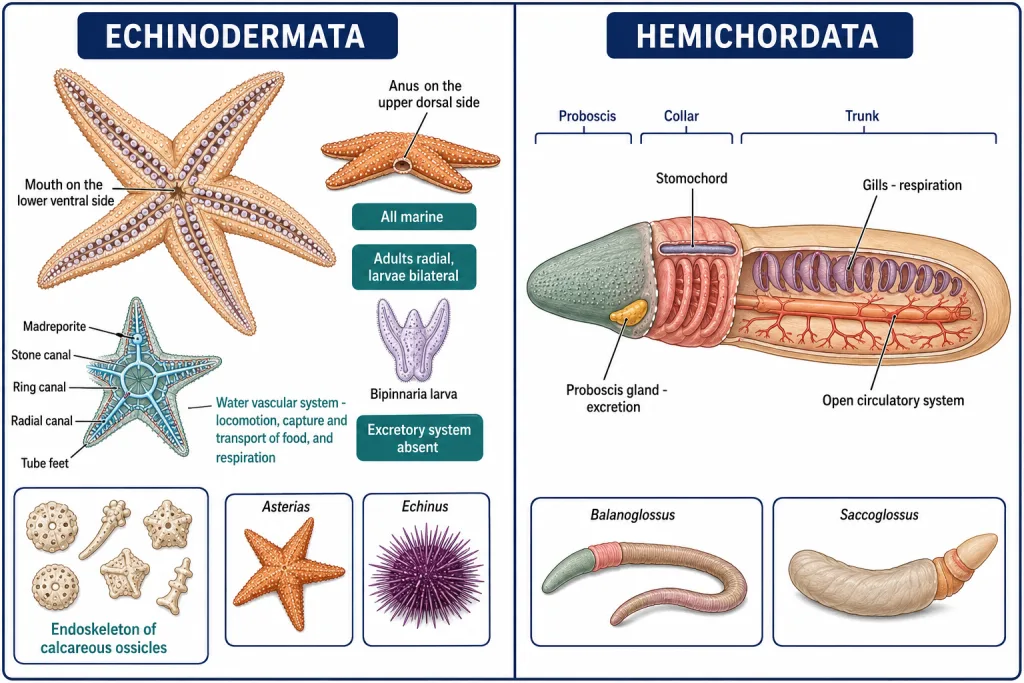
[NEET Important] Three things are asked from this phylum almost every year. The water vascular system is characteristic of Echinodermata alone - and the three jobs it does must be recited in full: locomotion, capture and transport of food, and respiration. The excretory system is absent, which is unusual enough to be a favourite one-liner. And the symmetry flips with age: larva bilateral, adult radial.
Phylum Hemichordata
Hemichordata was earlier considered as a sub-phylum under phylum Chordata. It is now placed as a separate phylum under non-chordata.
Characters:
- A small group of worm-like marine animals with an organ-system level of organisation.
- Bilaterally symmetrical, triploblastic and coelomate.
- The body is cylindrical and composed of an anterior proboscis, a collar and a long trunk.
- They possess a rudimentary structure in the collar region called the stomochord. It was once read as a notochord, and that misreading is why the group sat inside Chordata for so long.
- Circulatory system is of open type.
- Respiration takes place through gills.
- The excretory organ is the proboscis gland.
- Sexes are separate. Fertilisation is external. Development is indirect.
Examples: Balanoglossus, Saccoglossus.
[NEET Important] The reclassification is itself an exam question: hemichordates are no longer a sub-phylum of Chordata but a separate phylum under non-chordata, because the stomochord is not a true notochord. Learn the body as proboscis, collar, trunk, and the excretory organ as the proboscis gland - the name follows the body part, which makes it easy to hold.
Reading the Two Side by Side
| Feature | Echinodermata | Hemichordata |
|---|---|---|
| Habitat | All marine | Marine, worm-like |
| Level of organisation | Organ-system | Organ-system |
| Symmetry | Adults radial, larvae bilateral | Bilateral |
| Germ layers | Triploblastic | Triploblastic |
| Body cavity | Coelomate | Coelomate |
| Body plan | Endoskeleton of calcareous ossicles | Proboscis, collar and trunk |
| Digestive system | Complete; mouth ventral, anus dorsal | Complete |
| Circulation | - | Open |
| Respiration | Through the water vascular system | Through gills |
| Excretion | Absent | Proboscis gland |
| Distinctive feature | Water vascular system | Stomochord in the collar region |
| Sexes and development | Separate; fertilisation usually external; development indirect with a free-swimming larva | Separate; fertilisation external; development indirect |
| Examples | Asterias, Echinus, Antedon, Cucumaria, Ophiura | Balanoglossus, Saccoglossus |
Where these two sit in the chapter: they are the last two non-chordate phyla. Everything after them - Chordata - is defined by a notochord, and the reason Hemichordata is placed just before that door is that it once looked as though it had one.
Quick Recap
Echinodermata
- Endoskeleton of calcareous ossicles; the name means spiny bodied.
- All marine; organ-system level; triploblastic; coelomate.
- Adults radially symmetrical, larvae bilaterally symmetrical.
- Complete digestive system; mouth ventral, anus dorsal.
- Water vascular system - the most distinctive feature - helps in locomotion, capture and transport of food, and respiration.
- Excretory system absent.
- Sexes separate; fertilisation usually external; development indirect with a free-swimming larva.
- Asterias (star fish), Echinus (sea urchin), Antedon (sea lily), Cucumaria (sea cucumber), Ophiura (brittle star).
Hemichordata
- Earlier a sub-phylum of Chordata, now a separate phylum under non-chordata.
- Worm-like marine animals; organ-system level; bilateral; triploblastic; coelomate.
- Body cylindrical: proboscis, collar and trunk; stomochord in the collar region.
- Open circulatory system; respiration through gills; excretory organ the proboscis gland.
- Sexes separate; fertilisation external; development indirect.
- Balanoglossus, Saccoglossus.
Solved Examples
Question 1
Q. Why is the phylum named Echinodermata?
Answer. Because these animals have an endoskeleton of calcareous ossicles; the name refers to a spiny body.
Question 2
Q. Where are echinoderms found?
Answer. All are marine. There is no fresh water or terrestrial echinoderm.
Question 3
Q. State the three functions of the water vascular system.
Answer. Locomotion, capture and transport of food, and respiration.
Question 4
Q. Which excretory system do echinoderms use?
Answer. None. An excretory system is absent in Echinodermata.
Question 5
Q. Name the three parts of a hemichordate body.
Answer. An anterior proboscis, a collar and a long trunk.
Question 6
Q. What is the excretory organ of Hemichordata?
Answer. The proboscis gland.
Question 7
Q. Water vascular system is a characteristic of which group of animals?
Answer. Echinodermata. No other phylum has it, which is why it is called the most distinctive feature of the group. It helps in locomotion, capture and transport of food, and respiration. This is one of the chapter-end exercises.
Question 8
Q. Describe the symmetry of an echinoderm and explain why the answer needs two parts.
Answer. The adults are radially symmetrical but the larvae are bilaterally symmetrical. A single-word answer is wrong here, because the symmetry changes during development. A question that says "the larva of this animal is bilateral but the adult is radial" is pointing at Echinodermata and nothing else.
Question 9
Q. Why was Hemichordata moved out of Chordata?
Answer. Hemichordates have a rudimentary structure in the collar region called the stomochord, and people once took it for a notochord. It is not a true notochord, so the group could not stay inside Chordata; it is now placed as a separate phylum under non-chordata.
Question 10
Q. A marine animal has a calcareous endoskeleton of ossicles, a mouth on the ventral side and an anus on the dorsal side, and no excretory system. Identify the phylum and name two examples.
Answer. Phylum Echinodermata. The giveaway is the absent excretory system plus the ventral mouth and dorsal anus. Examples: Asterias (star fish) and Echinus (sea urchin).
Question 11
Q. A worm-like marine animal has a cylindrical body of proboscis, collar and trunk, an open circulatory system and gills for respiration. Which phylum does it belong to, and which phylum did it once belong to?
Answer. It belongs to Hemichordata, which was earlier considered a sub-phylum under Chordata and is now a separate phylum under non-chordata.
Question 12
Q. Arrange these five animals under their phyla and state one deciding feature each: Ophiura, Saccoglossus, Cucumaria, Antedon, Balanoglossus.
Answer.
- Ophiura (brittle star), Cucumaria (sea cucumber) and Antedon (sea lily) - Echinodermata; each has the water vascular system and a calcareous ossicle endoskeleton.
- Saccoglossus and Balanoglossus - Hemichordata; each has a body of proboscis, collar and trunk and a proboscis gland for excretion.