
Phylum Arthropoda - the Largest Phylum
This is the largest phylum of Animalia, and it includes insects. Over two-thirds of all named species on earth are arthropods.
Characters:
- Organ-system level of organisation.
- Bilaterally symmetrical, triploblastic, segmented and coelomate.
- The body is covered by a chitinous exoskeleton.
- The body consists of head, thorax and abdomen.
- They have jointed appendages - the name says it: arthros = joint, poda = appendages.
- Respiratory organs are gills, book gills, book lungs or tracheal system.
- Circulatory system is of open type.
- Sensory organs are antennae, eyes (compound and simple) and statocysts or balance organs.
- Excretion takes place through malpighian tubules.
- They are mostly dioecious. Fertilisation is usually internal. They are mostly oviparous, and development may be direct or indirect.
Examples, grouped the way they are asked:
- Economically important insects: Apis (honey bee), Bombyx (silkworm), Laccifer (lac insect).
- Vectors: Anopheles, Culex and Aedes (mosquitoes).
- Gregarious pest: Locusta (locust).
- Living fossil: Limulus (king crab).
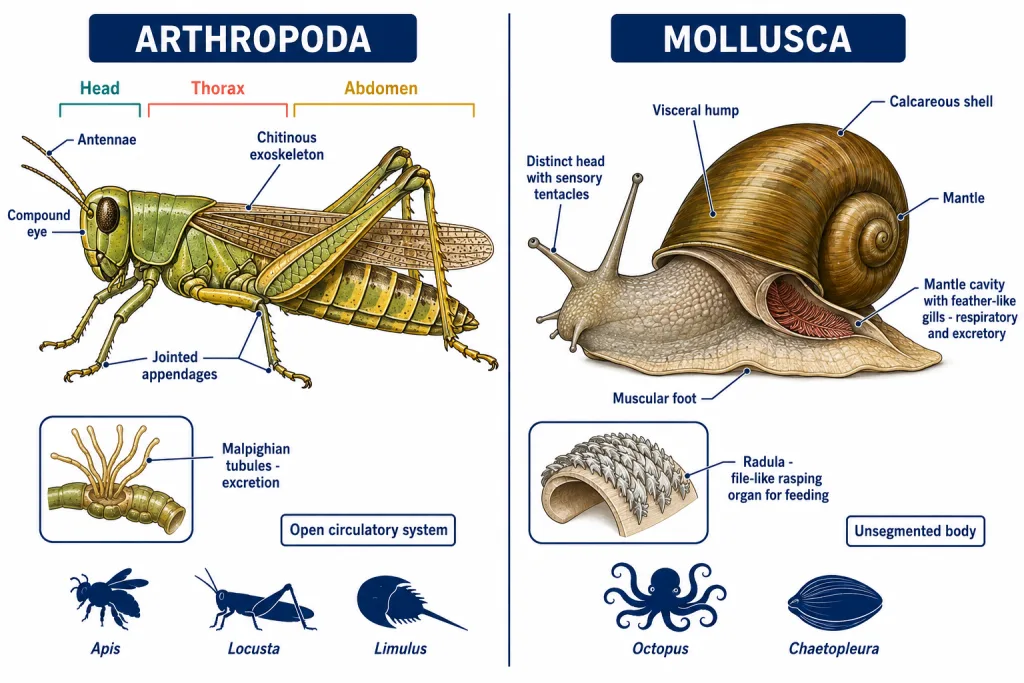
[NEET Important] Four facts carry this phylum: largest phylum, over two-thirds of all named species, open circulation, and malpighian tubules for excretion. The example groups are asked as straight matching - Limulus is the living fossil, Locusta the gregarious pest, Laccifer the lac insect. Learn them as labelled pairs, not as a list.
Phylum Mollusca - the Second Largest Phylum
Mollusca is the second largest animal phylum.
Characters:
- Terrestrial or aquatic (marine or fresh water).
- Organ-system level of organisation.
- Bilaterally symmetrical, triploblastic and coelomate.
- The body is covered by a calcareous shell and is unsegmented, with a distinct head, muscular foot and visceral hump.
- A soft and spongy layer of skin forms a mantle over the visceral hump. The space between the hump and the mantle is called the mantle cavity, in which feather-like gills are present. These gills have respiratory and excretory functions.
- The anterior head region has sensory tentacles. The mouth contains a file-like rasping organ for feeding, called radula.
- They are usually dioecious and oviparous with indirect development.
Examples: Pila (apple snail), Pinctada (pearl oyster), Sepia (cuttlefish), Loligo (squid), Octopus (devil fish), Aplysia (sea hare), Dentalium (tusk shell), Chaetopleura (chiton).
[NEET Important] The radula is the single word most often asked from this phylum, and the answer wanted is usually the full phrase: a file-like rasping organ for feeding. The second favourite is that the gills in the mantle cavity are both respiratory and excretory. Remember also that molluscs are unsegmented - segmentation stops being a shared feature once you leave Arthropoda.
Reading the Two Side by Side
| Feature | Arthropoda | Mollusca |
|---|---|---|
| Size of phylum | Largest; over two-thirds of all named species | Second largest |
| Body covering | Chitinous exoskeleton | Calcareous shell |
| Segmentation | Segmented | Unsegmented |
| Body divisions | Head, thorax, abdomen | Head, muscular foot, visceral hump |
| Appendages | Jointed appendages | Muscular foot for locomotion |
| Respiration | Gills, book gills, book lungs or tracheal system | Feather-like gills in the mantle cavity |
| Circulation | Open | Present; open in most molluscs |
| Excretion | Malpighian tubules | Gills also carry out excretion |
| Feeding structure | Mouth parts on jointed appendages | Radula - a file-like rasping organ |
| Sensory organs | Antennae, compound and simple eyes, statocysts | Sensory tentacles on the head |
| Sexes | Mostly dioecious, mostly oviparous | Usually dioecious and oviparous |
| Development | Direct or indirect | Indirect |
| Examples | Apis, Bombyx, Laccifer, Anopheles, Locusta, Limulus | Pila, Pinctada, Sepia, Loligo, Octopus, Aplysia, Dentalium, Chaetopleura |
The exoskeleton pair to keep straight: chitinous in Arthropoda, calcareous in Mollusca. One word in a question is often the whole question.
Quick Recap
Arthropoda
- Largest phylum; over two-thirds of all named species are arthropods.
- Organ-system level, bilateral, triploblastic, segmented, coelomate.
- Chitinous exoskeleton; body of head, thorax and abdomen; jointed appendages (arthros joint, poda appendages).
- Respiration by gills, book gills, book lungs or tracheal system; open circulatory system.
- Sensory organs: antennae, compound and simple eyes, statocysts.
- Excretion by malpighian tubules.
- Mostly dioecious, fertilisation usually internal, mostly oviparous, development direct or indirect.
- Apis, Bombyx, Laccifer; Anopheles, Culex, Aedes; Locusta; Limulus.
Mollusca
- Second largest phylum; terrestrial or aquatic.
- Organ-system level, bilateral, triploblastic, coelomate, unsegmented.
- Calcareous shell; distinct head, muscular foot and visceral hump.
- Mantle over the visceral hump; mantle cavity holds feather-like gills with respiratory and excretory functions.
- Sensory tentacles on the head; radula, a file-like rasping organ for feeding.
- Usually dioecious and oviparous; development indirect.
- Pila, Pinctada, Sepia, Loligo, Octopus, Aplysia, Dentalium, Chaetopleura.
Solved Examples
Question 1
Q. Which is the largest phylum of Animalia, and what fraction of named species does it hold?
Answer. Arthropoda. Over two-thirds of all named species on earth are arthropods.
Question 2
Q. What does the name Arthropoda mean?
Answer. Arthros means joint and poda means appendages - animals with jointed appendages.
Question 3
Q. Name the excretory structures of arthropods.
Answer. Malpighian tubules.
Question 4
Q. List the respiratory organs found across Arthropoda.
Answer. Gills, book gills, book lungs and the tracheal system.
Question 5
Q. What is a radula and where is it found?
Answer. The radula is a file-like rasping organ for feeding, present in the mouth of molluscs.
Question 6
Q. What is the mantle cavity and what lies inside it?
Answer. The mantle is a soft and spongy layer of skin over the visceral hump. The space between the hump and the mantle is the mantle cavity, and it holds feather-like gills which are respiratory and excretory.
Question 7
Q. Give the reasons that arthropods constitute the largest group of animals.
Answer. Several features act together.
- The chitinous exoskeleton protects the body and limits water loss, which allowed arthropods to colonise land, fresh water and the sea.
- Jointed appendages can be modified for walking, swimming, feeding, sensing or mating, so one body plan serves many ways of life.
- A body divided into head, thorax and abdomen lets each region specialise.
- A wide range of respiratory organs - gills, book gills, book lungs, tracheal system - suits both aquatic and terrestrial life.
- Well-developed sensory organs: antennae, compound and simple eyes and statocysts.
- Mostly oviparous with direct or indirect development, and in many forms a larval stage lets the young feed on something different from the adult.
This is one of the chapter-end exercises.
Question 8
Q. Compare the body covering and segmentation of Arthropoda with that of Mollusca.
Answer. Arthropods have a chitinous exoskeleton and a segmented body. Molluscs have a calcareous shell and are unsegmented; their body is organised instead into a distinct head, muscular foot and visceral hump.
Question 9
Q. Classify these arthropods by why they are named in your syllabus: Apis, Aedes, Limulus, Locusta, Laccifer.
Answer.
- Apis and Laccifer - economically important insects (honey bee and lac insect).
- Aedes - a vector (mosquito).
- Locusta - a gregarious pest.
- Limulus - a living fossil (king crab).
Question 10
Q. An unsegmented, bilaterally symmetrical coelomate is covered by a calcareous shell, has a muscular foot and a visceral hump, and feeds using a file-like rasping organ. Identify the phylum and name any two examples.
Answer. Phylum Mollusca. The radula and the visceral hump with a calcareous shell settle it. Examples: Pila (apple snail) and Sepia (cuttlefish).
Question 11
Q. A segmented, coelomate animal has a chitinous exoskeleton, jointed appendages, compound eyes and an open circulatory system. Which phylum is it, and how would you tell its excretory organ apart from that of an annelid?
Answer. Phylum Arthropoda. Its excretion is by malpighian tubules, whereas an annelid uses nephridia. The circulation also separates them - open in arthropods, closed in annelids.
Question 12
Q. Match each structure with its phylum: comb plates, flame cells, nephridia, malpighian tubules, radula.
Answer.
- Comb plates - Ctenophora
- Flame cells - Platyhelminthes
- Nephridia - Annelida
- Malpighian tubules - Arthropoda
- Radula - Mollusca
Read down that list and you have the excretory and feeding structures of five phyla in the order the chapter introduces them.