
Phylum Chordata - the Defining Characters
Animals belonging to phylum Chordata are characterised by the presence of a notochord, a dorsal hollow nerve cord and paired pharyngeal gill slits.
Characters:
- Notochord present, at least at some stage of life.
- Dorsal, hollow, single nerve cord.
- Paired pharyngeal gill slits.
- Bilaterally symmetrical, triploblastic, coelomate with an organ-system level of organisation.
- They possess a post-anal tail and a closed circulatory system.
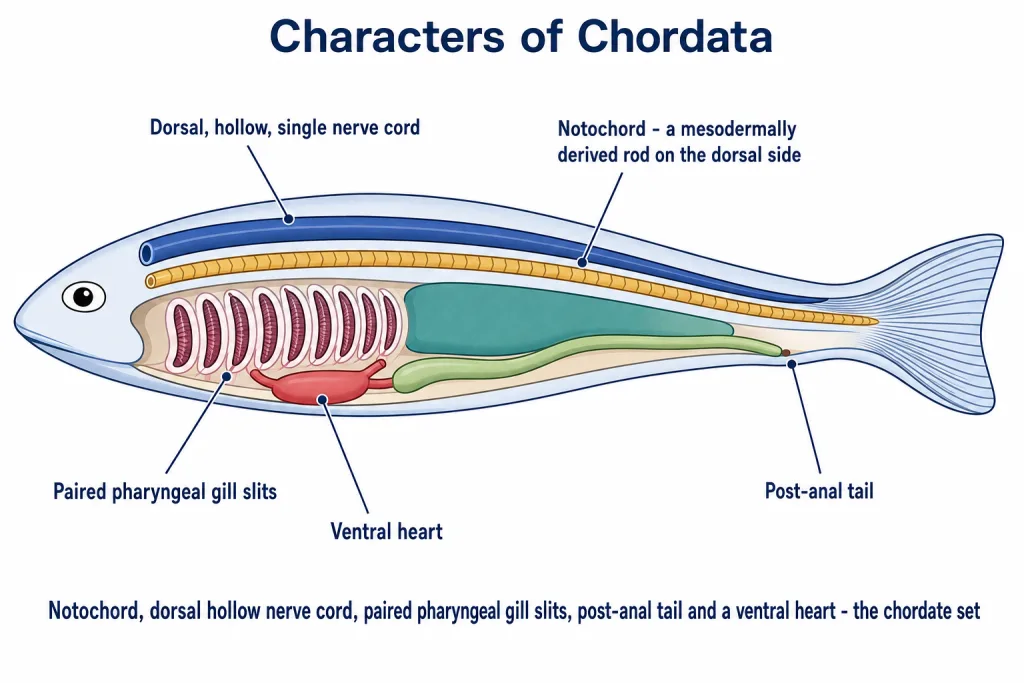
[NEET Important] The four chordate characters are asked as a set: notochord, dorsal hollow nerve cord, paired pharyngeal gill slits, post-anal tail. A fifth, the ventral heart, is the one students forget, and it is exactly the one the comparison table below turns into a question.
Chordates Against Non-chordates
| Chordates | Non-chordates |
|---|---|
| Notochord present | Notochord absent |
| Central nervous system is dorsal, hollow and single | Central nervous system is ventral, solid and double |
| Pharynx perforated by gill slits | Gill slits absent |
| Heart is ventral | Heart is dorsal (if present) |
| A post-anal part (tail) is present | Post-anal tail is absent |
Read the middle row against what you already know. An annelid has paired ganglia and a double ventral nerve cord - the exact opposite of the chordate arrangement. That one contrast is worth more marks than any other line in the table.
The Three Subphyla
Phylum Chordata is divided into three subphyla: Urochordata or Tunicata, Cephalochordata and Vertebrata.
- In Urochordata, the notochord is present only in the larval tail.
- In Cephalochordata, the notochord extends from head to tail region and is persistent throughout their life.
Urochordata and Cephalochordata are often referred to as protochordates and are exclusively marine.
Examples:
- Urochordata: Ascidia, Salpa, Doliolum.
- Cephalochordata: Branchiostoma (Amphioxus or Lancelet).
Subphylum Vertebrata
Members of subphylum Vertebrata possess notochord during the embryonic period. The notochord is replaced by a cartilaginous or bony vertebral column in the adult.
Thus, all vertebrates are chordates but all chordates are not vertebrates.
Besides the basic chordate characters, vertebrates have:
- A ventral muscular heart with two, three or four chambers.
- Kidneys for excretion and osmoregulation.
- Paired appendages which may be fins or limbs.
[NEET Important] The sentence "all vertebrates are chordates but all chordates are not vertebrates" is asked directly, and the justification it wants is short: every vertebrate has the notochord, dorsal hollow nerve cord and gill slits, so it satisfies Chordata; but protochordates never develop a vertebral column, so they remain chordates without being vertebrates.
How Vertebrata Is Divided
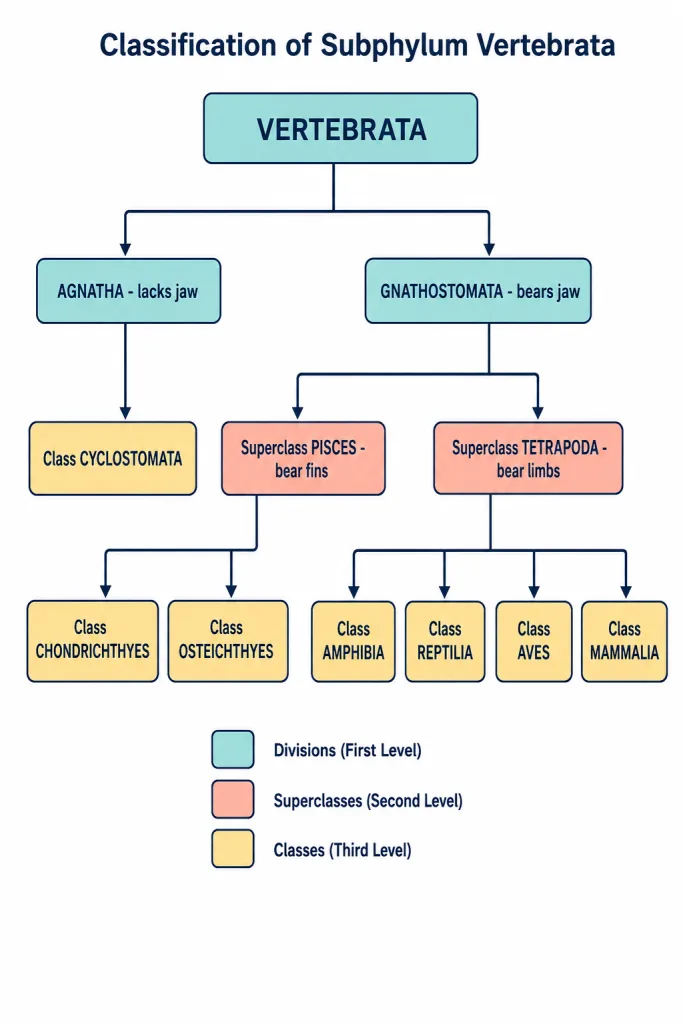
Vertebrata splits first on the jaw:
- Agnatha - lacks jaw. It holds one class you study: Cyclostomata.
- Gnathostomata - bears jaw.
Gnathostomata then splits into two superclasses:
- Pisces - bear fins: classes Chondrichthyes and Osteichthyes.
- Tetrapoda - bear limbs: classes Amphibia, Reptilia, Aves and Mammalia.
| Division | Basis | What it contains |
|---|---|---|
| Agnatha | Lacks jaw | Class Cyclostomata |
| Gnathostomata | Bears jaw | Superclasses Pisces and Tetrapoda |
| Pisces | Bear fins | Chondrichthyes, Osteichthyes |
| Tetrapoda | Bear limbs | Amphibia, Reptilia, Aves, Mammalia |
Two words carry the whole chart: jaw at the first split, and then fins against limbs. Any question asking why a lamprey sits apart from a shark is asking about the first split; any question separating a shark from a frog is asking about the second.
Quick Recap
Chordate characters
- Notochord, dorsal hollow nerve cord, paired pharyngeal gill slits.
- Bilateral, triploblastic, coelomate, organ-system level.
- Post-anal tail and closed circulatory system; heart ventral.
Chordate against non-chordate
- Notochord present / absent.
- CNS dorsal, hollow, single / ventral, solid, double.
- Pharynx perforated by gill slits / gill slits absent.
- Heart ventral / dorsal if present.
- Post-anal tail present / absent.
Subphyla
- Urochordata (Tunicata) - notochord only in the larval tail; Ascidia, Salpa, Doliolum.
- Cephalochordata - notochord from head to tail, persistent throughout life; Branchiostoma (Amphioxus or Lancelet).
- Both are protochordates and exclusively marine.
- Vertebrata - notochord present in the embryonic period, later replaced by a cartilaginous or bony vertebral column; ventral muscular heart with two, three or four chambers; kidneys; paired fins or limbs.
- All vertebrates are chordates but all chordates are not vertebrates.
Vertebrata chart
- Agnatha (lacks jaw) - Cyclostomata.
- Gnathostomata (bears jaw) - Pisces (bear fins: Chondrichthyes, Osteichthyes) and Tetrapoda (bear limbs: Amphibia, Reptilia, Aves, Mammalia).
Solved Examples
Question 1
Q. List the characters that define phylum Chordata.
Answer. A notochord, a dorsal hollow nerve cord and paired pharyngeal gill slits. Chordates are also bilaterally symmetrical, triploblastic and coelomate with an organ-system level of organisation, and they possess a post-anal tail and a closed circulatory system.
Question 2
Q. Where is the heart placed in a chordate, and where in a non-chordate?
Answer. Ventral in chordates; dorsal, if present at all, in non-chordates.
Question 3
Q. Name the three subphyla of Chordata.
Answer. Urochordata (or Tunicata), Cephalochordata and Vertebrata.
Question 4
Q. Which two subphyla are called protochordates, and where do they live?
Answer. Urochordata and Cephalochordata. They are exclusively marine.
Question 5
Q. Give the examples of Urochordata and of Cephalochordata.
Answer. Urochordata: Ascidia, Salpa, Doliolum. Cephalochordata: Branchiostoma, also called Amphioxus or Lancelet.
Question 6
Q. How does the notochord differ between Urochordata and Cephalochordata?
Answer. In Urochordata it is present only in the larval tail, so the adult has none. In Cephalochordata it extends from head to tail region and is persistent throughout life.
Question 7
Q. Compare the central nervous system of a chordate with that of a non-chordate.
Answer. In chordates the central nervous system is dorsal, hollow and single. In non-chordates it is ventral, solid and double - the annelid pattern of paired ganglia with a double ventral nerve cord is the clearest example of the second type.
Question 8
Q. "All vertebrates are chordates but all chordates are not vertebrates." Justify the statement.
Answer. Every vertebrate has the three basic chordate characters - a notochord at some stage, a dorsal hollow nerve cord and paired pharyngeal gill slits - so every vertebrate counts as a chordate. It does not work the other way round. Protochordates like Ascidia and Branchiostoma have those chordate characters but never develop a cartilaginous or bony vertebral column, so they are chordates that are not vertebrates. An animal is a vertebrate only if the embryonic notochord is succeeded by a cartilaginous or bony vertebral column - the column is the test, not the disappearance of the notochord.
This is one of the chapter-end exercises.
Question 9
Q. State the features vertebrates have in addition to the basic chordate characters.
Answer. A ventral muscular heart with two, three or four chambers; kidneys for excretion and osmoregulation; and paired appendages which may be fins or limbs.
Question 10
Q. On what basis is Vertebrata first divided, and what are the two resulting groups?
Answer. On the presence or absence of a jaw. Agnatha lacks a jaw and holds Cyclostomata; Gnathostomata bears a jaw and holds the superclasses Pisces and Tetrapoda.
Question 11
Q. Which classes fall under Pisces and which under Tetrapoda, and what does each superclass name mean?
Answer. Pisces means bear fins, and it holds Chondrichthyes and Osteichthyes. Tetrapoda means bear limbs, and it holds Amphibia, Reptilia, Aves and Mammalia.
Question 12
Q. A marine animal has a notochord that runs from head to tail and stays there all its life, a dorsal hollow nerve cord and gill slits, but no vertebral column. Place it in a subphylum, name it, and say whether it is a vertebrate.
Answer. It belongs to Cephalochordata, and the animal is Branchiostoma (Amphioxus or Lancelet). It is not a vertebrate, because the notochord is never replaced by a cartilaginous or bony vertebral column. It is a protochordate - a chordate that is not a vertebrate.