
Why This Chapter Needs a Method
Look around and you see animals of wildly different structures and forms. Over a million species of animals have been described till now, which makes classification not a convenience but a necessity - and it does a second job too:
Classification helps in assigning a systematic position to newly described species.
So the scheme has to be built on characters general enough that a brand-new animal can be slotted in.
What those characters are:
Inspite of differences in structure and form, there are fundamental features common to various individuals in relation to:
- the arrangement of cells
- body symmetry
- the nature of coelom
- patterns of digestive, circulatory or reproductive systems
This section takes the first of those - arrangement of cells - plus the digestive and circulatory patterns. Section 2 takes symmetry, germ layers, coelom, segmentation and notochord.
The Four Levels of Organisation
All members of Animalia are multicellular, but they do not all organise those cells the same way. There are four levels, and each is tied to specific groups.
- Cellular level
- In sponges, the cells are arranged as loose cell aggregates.
- Some division of labour occurs among the cells - but no more than that.
- Tissue level
- In coelenterates, the arrangement is more complex: cells performing the same function are arranged into tissues.
- Organ level
- Exhibited by Platyhelminthes and other higher phyla, where tissues are grouped together to form organs, each specialised for a particular function.
- Organ system level
- In annelids, arthropods, molluscs, echinoderms and chordates, organs have associated to form functional systems, each system concerned with a specific physiological function.
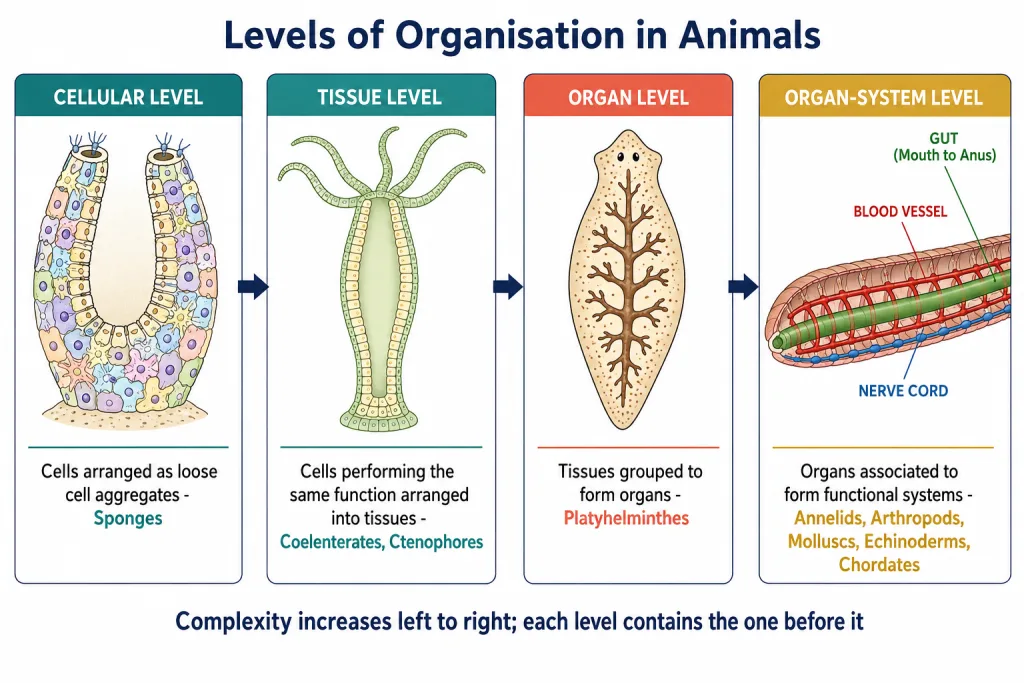
[NEET Important] Learn the level-to-group mapping in both directions. Sponges are the only cellular-level phylum; coelenterates and ctenophores are tissue level; Platyhelminthes is the first organ level - and the comparison table credits it organ and organ-system, which is what to answer when a question asks which phylum shows the organ-system level first. Every phylum from Aschelminthes onwards is organ-system level. A question naming a phylum expects the level, and a question naming a level expects the phyla.
Incomplete and Complete Digestive Systems
Organ systems in different groups show various patterns of complexities, and two of those patterns are used again and again in the phylum descriptions.
The digestive system
In Platyhelminthes the digestive system has only a single opening to the outside of the body that serves as both mouth and anus, and is hence called incomplete.
A complete digestive system has two openings, mouth and anus.
| Type | Openings | Seen in |
|---|---|---|
| Incomplete | One - serves as both mouth and anus | Coelenterata, Ctenophora, Platyhelminthes |
| Complete | Two - mouth and anus | Aschelminthes onwards |
[NEET Important] Aschelminthes is the first phylum with a complete alimentary canal. That transition point is asked directly, and it is easy to remember alongside the other Aschelminthes first - the pseudocoelom.
Open and Closed Circulatory Systems
The circulatory system may be of two types:
(i) Open type - in which the blood is pumped out of the heart and the cells and tissues are directly bathed in it.
(ii) Closed type - in which the blood is circulated through a series of vessels of varying diameters (arteries, veins and capillaries).
| Type | How blood travels | Phyla |
|---|---|---|
| Open | Pumped out of the heart; tissues bathed directly | Arthropoda, Mollusca, Hemichordata |
| Closed | Through arteries, veins and capillaries | Annelida, Chordata |
[NEET Important] The pairing students most often get wrong is Annelida - closed against Arthropoda - open. Two segmented coelomate phyla side by side in the chapter, opposite circulatory types. And Hemichordata is open even though it sits right next to the chordates.
Quick Recap
- Over a million animal species have been described; classification also assigns a systematic position to newly described species.
- The fundamental features used: arrangement of cells, body symmetry, nature of coelom, and patterns of digestive, circulatory and reproductive systems.
- All members of Animalia are multicellular, but at four levels of organisation:
- Cellular - sponges; cells as loose cell aggregates with some division of labour.
- Tissue - coelenterates; cells performing the same function arranged into tissues.
- Organ - Platyhelminthes and other higher phyla; tissues grouped into organs, each specialised.
- Organ system - annelids, arthropods, molluscs, echinoderms, chordates; organs associated into functional systems.
- Incomplete digestive system: one opening serving as both mouth and anus. Complete: two openings, mouth and anus.
- Open circulation: blood pumped out of the heart, tissues bathed directly. Closed circulation: blood through arteries, veins and capillaries.
Solved Examples
Question 1
Q. Why has classification of animals become so important?
Answer. Because over a million species of animals have been described till now. Classification also helps in assigning a systematic position to newly described species.
Question 2
Q. Which animals show the cellular level of organisation?
Answer. Sponges. Their cells just sit together as loose cell aggregates, with some division of labour among them.
Question 3
Q. What is the tissue level of organisation, and which group shows it?
Answer. This is where cells performing the same function are arranged into tissues. You see it in coelenterates.
Question 4
Q. Name three phyla with organ-system level of organisation.
Answer. Any three of Annelida, Arthropoda, Mollusca, Echinodermata and Chordata.
Question 5
Q. What makes a digestive system incomplete?
Answer. Having only a single opening to the outside of the body that serves as both mouth and anus.
Question 6
Q. List the four levels of organisation in order, with one group for each.
Answer.
- Cellular - sponges.
- Tissue - coelenterates.
- Organ - Platyhelminthes.
- Organ system - annelids, arthropods, molluscs, echinoderms, chordates.
Takeaway: The order is a genuine progression - cells to tissues to organs to systems - so if you remember the sequence you can reconstruct the mapping.
Question 7
Q. Distinguish open and closed circulatory systems.
Answer.
- Open type: the blood is pumped out of the heart and the cells and tissues are directly bathed in it.
- Closed type: the blood is circulated through a series of vessels of varying diameters - arteries, veins and capillaries.
Question 8
Q. Which fundamental features are used as the basis of animal classification?
Answer. The arrangement of cells, body symmetry, the nature of coelom, and the patterns of the digestive, circulatory and reproductive systems.
Question 9
Q. An animal has organs, but those organs do not work together as systems. Which level of organisation is this, and which phylum first shows it?
Answer. This is the organ level, where tissues are grouped together to form organs, each specialised for a particular function, but those organs have not yet associated to form functional systems. The first phylum to show it is Platyhelminthes.
Question 10
Q. What difficulties would you face in classifying animals if common fundamental features were not taken into account?
Answer.
- There are over a million described species with a huge variety of structure and form, so you would have no shared basis on which to group them - every animal would have to be studied on its own.
- Grouping would fall back on superficial resemblance, so unrelated animals that happen to look alike get put together and real relatives get split up.
- When a new species turns up there would be no way to assign a systematic position to a newly described species, because you have no criteria to test it against.
- You could not compare groups at all. Saying one phylum is more complex than another works only because level of organisation, symmetry, coelom and the rest are the yardsticks doing the measuring.
- The scheme would not be stable - every worker would pick different characters and end up with a different classification.
Takeaway: This is one of the chapter-end exercises. The marks are in naming the fundamental features and showing what each one buys you.
Question 11
Q. Two animals both have an organ-system level of organisation, yet one has an incomplete digestive system. Is that possible? Explain.
Answer. Yes - Platyhelminthes is exactly that case. An incomplete digestive system means a single opening serving as both mouth and anus, and you find it in Coelenterata and Ctenophora, which sit at tissue level, and in Platyhelminthes, which reaches organ and organ-system level in its more advanced members but still has an incomplete gut. From Aschelminthes onwards, once organ-system organisation is established, the alimentary canal is complete.
So the two go together, but they are not the same thing. Level of organisation is about how cells are arranged; completeness of the gut is about how many openings it has. They track each other because a through-gut with a mouth and an anus lets different regions specialise - a pharynx, an intestine, an excretory pore - and that is exactly what an organ-system grade of construction makes possible.
Question 12
Q. Explain why an open circulatory system is workable in an arthropod but not in a large active vertebrate.
Answer. In an open system the blood is pumped out of the heart and the cells and tissues are directly bathed in it. That is fine when the body is small, the tissues sit close to the blood spaces, and oxygen demand can be met without aiming the flow anywhere in particular. Arthropods fit that description, and their respiration is handled separately anyway by gills, book gills, book lungs or a tracheal system that carries air right up to the tissues.
A large, active vertebrate cannot manage on that. It needs blood pushed at pressure to particular organs on demand, and that takes a closed system circulating blood through a series of vessels of varying diameters - arteries, veins and capillaries. The capillaries also give the huge surface area a big body needs for exchange. So Chordata is closed, and so is Annelida, while Arthropoda, Mollusca and Hemichordata are open.