
Phylum Ctenophora - the Comb Jellies
Commonly known as sea walnuts or comb jellies.
Characters, in the order they are asked:
- Exclusively marine - note the strength of that word; not "mostly", but exclusively.
- Radially symmetrical.
- Diploblastic.
- Tissue level of organisation.
- The body bears eight external rows of ciliated comb plates, which help in locomotion.
- Digestion is both extracellular and intracellular.
- Bioluminescence - the property of a living organism to emit light - is well-marked in ctenophores.
- Sexes are not separate.
- Reproduction takes place only by sexual means.
- Fertilisation is external with indirect development.
Examples: Pleurobrachia and Ctenoplana.
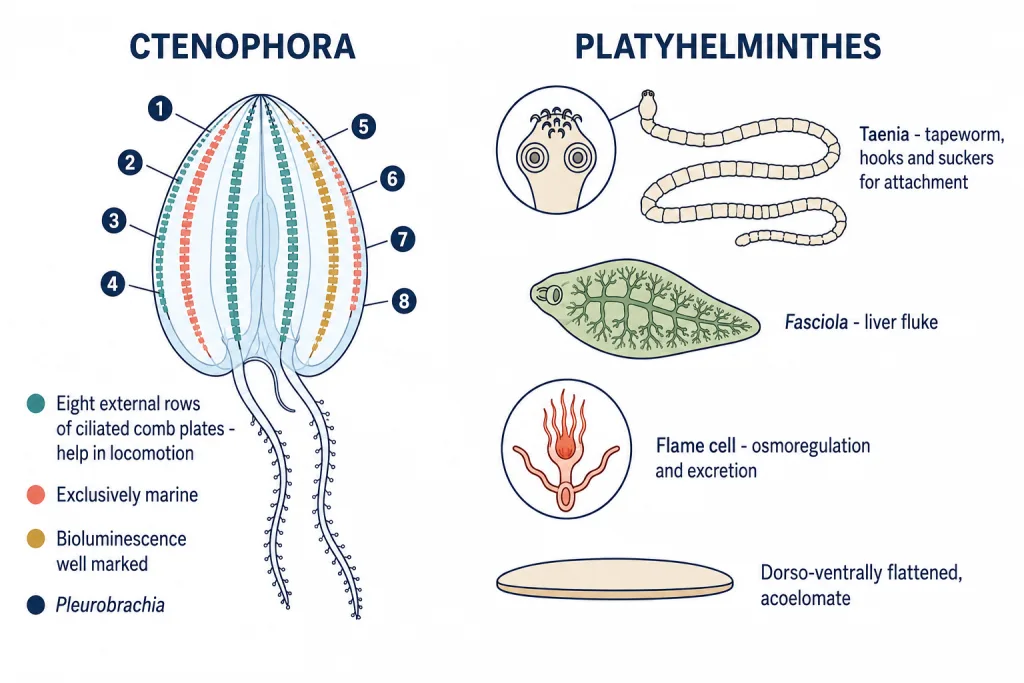
[NEET Important] Three numbers and words carry this phylum: eight rows of comb plates, exclusively marine, and only by sexual means - ctenophores are the group with no asexual reproduction at all. Bioluminescence is their signature, and the definition in brackets is often the answer wanted.
Phylum Platyhelminthes - the Flatworms
Why the name: they have a dorso-ventrally flattened body, hence flatworms.
Habit and body plan
- Mostly endoparasites found in animals including human beings.
- Bilaterally symmetrical, triploblastic and acoelomate, with organ level of organisation.
This is a phylum of firsts: the first bilaterally symmetrical phylum, the first triploblastic phylum, and the first with organ level of organisation - all three at once.
Parasitic adaptations
- Hooks and suckers are present in the parasitic forms.
- Some of them absorb nutrients from the host directly through their body surface.
Excretion
Specialised cells called flame cells help in osmoregulation and excretion.
Reproduction
- Sexes are not separate.
- Fertilisation is internal and development is through many larval stages.
- Some members like Planaria possess high regeneration capacity.
Examples: Taenia (tapeworm), Fasciola (liver fluke).
[NEET Important] Flame cells - osmoregulation and excretion - Platyhelminthes is one of the chapter's most reliable match-the-column entries. And Planaria - high regeneration capacity is asked as a straight recall item.
The Two Phyla Side by Side
| Ctenophora | Platyhelminthes | |
|---|---|---|
| Common name | Sea walnuts, comb jellies | Flatworms |
| Habitat | Exclusively marine | Mostly endoparasites in animals including humans |
| Level of organisation | Tissue | Organ |
| Symmetry | Radial | Bilateral |
| Germ layers | Diploblastic | Triploblastic |
| Coelom | Absent | Absent - in a triploblastic animal this condition is called acoelomate |
| Digestion | Extracellular and intracellular; gut incomplete | Gut incomplete |
| Locomotion / distinctive structure | Eight external rows of ciliated comb plates | Hooks and suckers in parasitic forms; flame cells |
| Special property | Bioluminescence well-marked | High regeneration in Planaria |
| Sexes | Not separate | Not separate |
| Reproduction | Only sexual | Sexual; many larval stages |
| Fertilisation | External | Internal |
| Development | Indirect | Through many larval stages |
| Examples | Pleurobrachia, Ctenoplana | Taenia, Fasciola, Planaria |
The one thing they share: in both, sexes are not separate. Everything else differs, including the direction of fertilisation - external in ctenophores, internal in flatworms.
Quick Recap
Ctenophora
- Sea walnuts / comb jellies; exclusively marine, radially symmetrical, diploblastic, tissue level.
- Eight external rows of ciliated comb plates help in locomotion.
- Digestion extracellular and intracellular; bioluminescence - the property of a living organism to emit light - is well-marked.
- Sexes not separate; reproduction only by sexual means; fertilisation external; development indirect.
- Pleurobrachia, Ctenoplana.
Platyhelminthes
- Flatworms - dorso-ventrally flattened; mostly endoparasites in animals including human beings.
- Bilaterally symmetrical, triploblastic, acoelomate, organ level of organisation.
- Hooks and suckers in parasitic forms; some absorb nutrients from the host directly through their body surface.
- Flame cells help in osmoregulation and excretion.
- Sexes not separate; fertilisation internal; development through many larval stages; Planaria has high regeneration capacity.
- Taenia (tapeworm), Fasciola (liver fluke).
Solved Examples
Question 1
Q. What are the comb plates of a ctenophore, and how many rows are there?
Answer. Eight external rows of ciliated comb plates, which help in locomotion.
Question 2
Q. Define bioluminescence.
Answer. The property of a living organism to emit light. It is well-marked in ctenophores.
Question 3
Q. Give the two examples of Ctenophora.
Answer. Pleurobrachia and Ctenoplana.
Question 4
Q. Why are platyhelminths called flatworms?
Answer. Because they have a dorso-ventrally flattened body.
Question 5
Q. What do flame cells do?
Answer. They are specialised cells that help in osmoregulation and excretion in Platyhelminthes.
Question 6
Q. Name the tapeworm and the liver fluke.
Answer. Tapeworm: Taenia. Liver fluke: Fasciola.
Question 7
Q. What are the peculiar features that you find in parasitic platyhelminthes?
Answer.
- They are mostly endoparasites found in animals including human beings.
- Hooks and suckers are present in the parasitic forms, for attachment to the host.
- Some of them absorb nutrients from the host directly through their body surface, because a worm sitting in the host's digested food does not need a gut of its own.
- Specialised cells called flame cells help in osmoregulation and excretion.
- Sexes are not separate, fertilisation is internal, and development is through many larval stages - a life cycle spread over more than one host needs huge numbers of offspring and several larval forms.
Takeaway: This is one of the chapter-end exercises. Attachment, nutrition and reproduction are the three headings that organise the answer.
Question 8
Q. Ctenophores are diploblastic with tissue-level organisation, like coelenterates. Name three ways they differ.
Answer.
- Ctenophores are exclusively marine, while cnidarians are aquatic, mostly marine.
- Ctenophores have eight external rows of ciliated comb plates for locomotion, while cnidarians have cnidoblasts with nematocysts on the tentacles and body.
- Ctenophores show well-marked bioluminescence and reproduce only by sexual means, with external fertilisation; cnidarians show polyp and medusa forms and metagenesis.
Question 9
Q. An animal is bilaterally symmetrical, triploblastic and acoelomate, has an incomplete gut, and bears hooks and suckers. Name the phylum and one example.
Answer. Phylum Platyhelminthes. Among the lower groups only this phylum puts bilateral symmetry, triploblasty and the acoelomate condition together, and hooks and suckers are its parasitic adaptation. Example: Taenia (tapeworm) or Fasciola (liver fluke).
Question 10
Q. What is the difference between direct and indirect development?
Answer.
- Direct development: the young ones resemble the adult - there is no distinct larval stage. Seen in Aschelminthes (in some), Reptilia, Aves and Mammalia, and in Osteichthyes.
- Indirect development: there is a larval stage which is morphologically distinct from the adult, and the larva must metamorphose. Seen in Porifera, Ctenophora, Echinodermata, Hemichordata and Amphibia.
Takeaway: One of the chapter-end exercises. The phrase to quote is morphologically distinct from the adult.
Question 11
Q. Platyhelminthes is described as a phylum of firsts. List them and say why they matter.
Answer. Three characters appear here for the first time in the sequence of phyla:
- Bilateral symmetry. Porifera is asymmetrical, and Coelenterata and Ctenophora are radial. Bilateral symmetry gives a definite front end, and you need that before you can have a head or move in one direction on purpose.
- Triploblastic organisation. The third germinal layer, mesoderm, appears between ectoderm and endoderm. Mesoderm is what later builds muscle, the coelomic lining, and most internal organs.
- Organ level of organisation. Tissues are grouped together to form organs, each specialised for a particular function - a step beyond the tissue level of the two diploblastic phyla.
What they do not have yet is a body cavity - Platyhelminthes is acoelomate - and the gut is still incomplete, with a single opening. So the phylum sits right at the point where the middle germ layer has arrived but has not yet been hollowed out into a coelom.
Question 12
Q. Ctenophores reproduce only by sexual means, while sponges reproduce both ways. What does this contrast illustrate about reading phylum descriptions?
Answer. It shows that the reproductive lines in each phylum description are specific claims, not boilerplate, and exams treat them that way.
Sponges: asexually by fragmentation and sexually by formation of gametes, fertilisation internal, development indirect. Ctenophores: reproduction takes place only by sexual means, fertilisation external, development indirect.
So two groups that share indirect development still differ on whether asexual reproduction occurs at all and on where fertilisation happens. When a question offers "reproduces both sexually and asexually" as an option for ctenophores, it is testing whether you read the word only.
Takeaway: For every phylum, hold four reproductive facts separately - sexes separate or not, sexual and asexual or sexual alone, fertilisation internal or external, development direct or indirect.