
The Actin (Thin) Filament
The thin filament is not one strand of one protein. It is three proteins wound together, and the chapter names all three.
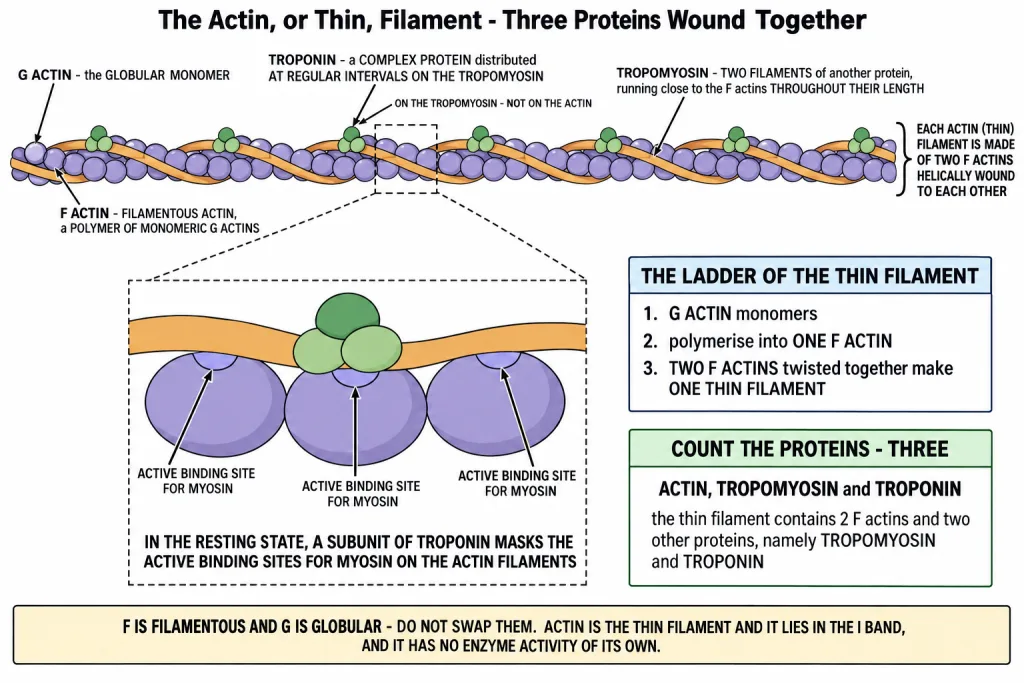
- Each actin (thin) filament is made of TWO 'F' (filamentous) actins HELICALLY WOUND to each other.
- Each 'F' actin is a polymer of monomeric 'G' (globular) actins. So the ladder here is 'G' actin monomers -> one 'F' actin polymer -> two 'F' actins twisted together = one thin filament.
- Two filaments of another protein, TROPOMYOSIN, also run close to the 'F' actins throughout their length.
- A complex protein TROPONIN is distributed at regular intervals on the tropomyosin.
- In the resting state, a subunit of troponin MASKS the active binding sites for myosin on the actin filaments.
Note where troponin sits. Troponin is not on the actin - it is on the TROPOMYOSIN, at regular intervals along it.
| Part of the thin filament | What it is |
|---|---|
| 'F' actin | filamentous actin; two of them are helically wound to each other |
| 'G' actin | the globular monomer; an 'F' actin is a polymer of 'G' actins |
| Tropomyosin | two filaments running close to the 'F' actins throughout their length |
| Troponin | a complex protein distributed at regular intervals on the tropomyosin |
[NEET Important] Count the proteins in a thin filament: THREE - actin, tropomyosin and troponin - and remember two 'F' actins, two tropomyosin filaments. The fill in the blank runs "thin filament of myofibril contains 2 'F' actins and two other proteins namely _ and _", and the answers are tropomyosin and troponin. 'F' is filamentous and 'G' is globular - do not swap them.
The Myosin (Thick) Filament
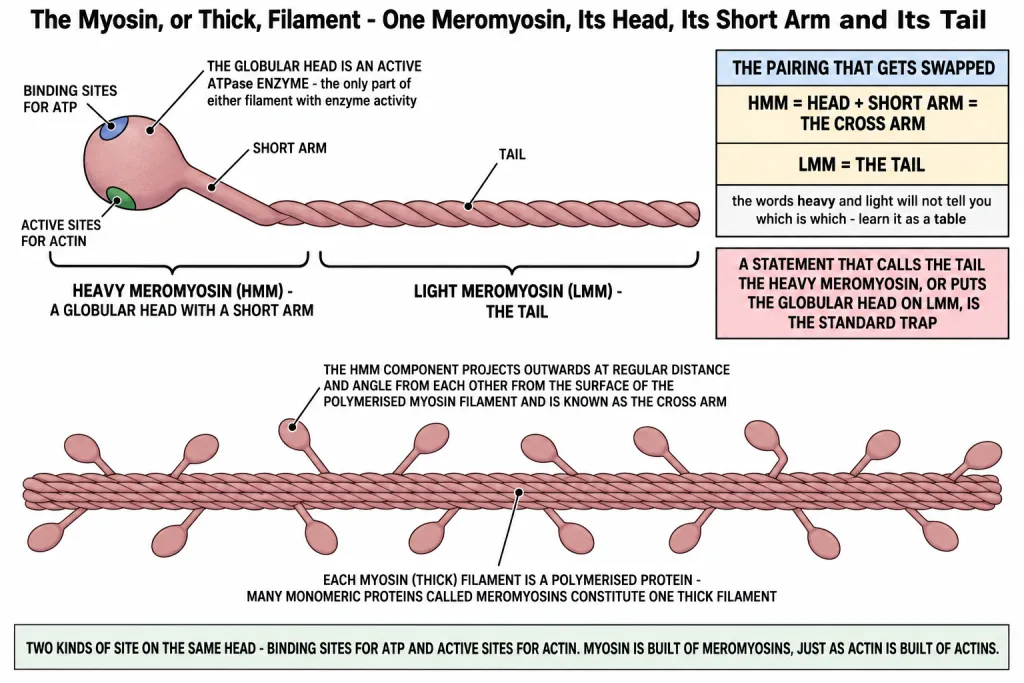
Each myosin (thick) filament is also a polymerised protein. Many monomeric proteins called MEROMYOSINS constitute one thick filament.
Each meromyosin has two important parts, and this is the pairing that gets swapped in every exam:
| Part of the meromyosin | Its name |
|---|---|
| A GLOBULAR HEAD WITH A SHORT ARM | HEAVY MEROMYOSIN (HMM) |
| The TAIL | LIGHT MEROMYOSIN (LMM) |
Say it once more the right way round: HMM is the head with the short arm, LMM is the tail. The letters do not help you here, so learn the table as a table.
The HMM component, that is the head and the short arm, projects outwards at regular distance and angle from each other from the surface of the polymerised myosin filament, and is known as the CROSS ARM.
The globular head is an active ATPase ENZYME, and it carries two kinds of site:
- BINDING SITES FOR ATP
- ACTIVE SITES FOR ACTIN
That single globular head is therefore the only part of either filament with enzyme activity.
[NEET Important] HMM = head + short arm = the cross arm; LMM = tail. A question that calls the tail the heavy meromyosin is the standard trap. The other guaranteed item is the globular head is an active ATPase enzyme with binding sites for ATP and active sites for actin - ATP and actin, two different kinds of site on the same head.
Actin Against Myosin - the Comparison That Is Set Directly
These two are the pair the chapter-end exercise asks you to separate, and the differences run all the way from the filament they build to what each one does.
| ACTIN | MYOSIN | |
|---|---|---|
| Filament it forms | the THIN filament | the THICK filament |
| Band it occupies | the 'I' band, the light or isotropic band | the 'A' band, the dark or anisotropic band |
| What it is built from | two 'F' (filamentous) actins helically wound, each a polymer of monomeric 'G' (globular) actins | many monomeric proteins called MEROMYOSINS, each with a head with short arm (HMM) and a tail (LMM) |
| Associated proteins | TROPOMYOSIN (two filaments running along it) and TROPONIN (at regular intervals on the tropomyosin) | no associated protein is named |
| Enzyme activity | none | the globular head is an active ATPase enzyme, with binding sites for ATP and active sites for actin |
| Attachment | firmly attached to the 'Z' line | held together in the middle of the 'A' band by the 'M' line |
| Role in contraction | it is the filament that SLIDES | its head is the part that PULLS the actin |
Read the "what it is built from" row twice. Actin is built of actins - myosin is built of meromyosins. That single sentence carries three of the marks in this comparison.
[NEET Important] Actin is thin, myosin is thick - and thin does not mean short or weak, it means narrower. The other high-value contrast is enzyme activity: actin has none; the globular head of myosin is an ATPase. A matching question that puts ATPase activity on actin is wrong.
Quick Recap
- Each actin (thin) filament is made of TWO 'F' (filamentous) actins HELICALLY WOUND to each other.
- Each 'F' actin is a polymer of monomeric 'G' (globular) actins.
- Two filaments of another protein, TROPOMYOSIN, also run close to the 'F' actins throughout their length.
- A complex protein TROPONIN is distributed at regular intervals on the tropomyosin.
- In the resting state a subunit of troponin MASKS the active binding sites for myosin on the actin filaments.
- Each myosin (thick) filament is also a polymerised protein, and many monomeric proteins called MEROMYOSINS constitute one thick filament.
- Each meromyosin has two important parts: a GLOBULAR HEAD WITH A SHORT ARM, the HEAVY MEROMYOSIN (HMM), and a TAIL, the LIGHT MEROMYOSIN (LMM).
- The HMM component - the head and short arm - projects outwards at regular distance and angle from each other from the surface of the polymerised myosin filament, and is known as the CROSS ARM.
- The globular head is an active ATPase ENZYME and has BINDING SITES FOR ATP and ACTIVE SITES FOR ACTIN.
- Actin builds the thin filament of the 'I' band; myosin builds the thick filament of the 'A' band.
- Actin has no enzyme activity; the globular head of myosin does.
Solved Examples
Question 1
Q. What is each actin filament made of?
Answer. Two 'F' (filamentous) actins helically wound to each other. Each 'F' actin is itself a polymer of monomeric 'G' (globular) actins.
Question 2
Q. Distinguish between 'F' actin and 'G' actin.
Answer. 'G' actin is the globular MONOMER. 'F' actin is the filamentous POLYMER of those 'G' actins, and two 'F' actins helically wound together form one thin filament.
Question 3
Q. Which protein runs close to the 'F' actins throughout their length, and how many filaments of it are there?
Answer. TROPOMYOSIN, and two filaments of it run close to the 'F' actins throughout their length.
Question 4
Q. Where exactly is troponin located on the thin filament?
Answer. Troponin is a complex protein distributed at regular intervals ON THE TROPOMYOSIN - not directly on the actin.
Question 5
Q. What does troponin do in the resting state?
Answer. In the resting state a subunit of troponin MASKS the active binding sites for myosin on the actin filaments. So in a muscle at rest, the sites that myosin would bind to are covered.
Question 6
Q. What is a meromyosin?
Answer. The monomeric protein of which the thick filament is built. Each myosin (thick) filament is a polymerised protein, and many monomeric proteins called meromyosins constitute one thick filament.
Question 7
Q. Name the two parts of a meromyosin and say which is which.
Answer.
| Part | Name |
|---|---|
| A globular head with a short arm | HEAVY MEROMYOSIN (HMM) |
| The tail | LIGHT MEROMYOSIN (LMM) |
HMM is the head with the short arm; LMM is the tail. This is the pairing most often written the wrong way round.
Question 8
Q. What is the cross arm?
Answer. The HMM component, that is the head and short arm. It projects outwards at regular distance and angle from each other from the surface of the polymerised myosin filament, and is known as the cross arm.
Question 9
Q. What kind of enzyme is the globular head of myosin, and what sites does it carry?
Answer. The globular head is an active ATPase enzyme. It has BINDING SITES FOR ATP and ACTIVE SITES FOR ACTIN - two different kinds of site on the same head.
Question 10
Q. Which of the two contractile proteins shows enzyme activity?
Answer. Myosin. The globular head of the meromyosin is an active ATPase enzyme. Actin shows no enzyme activity; what it carries instead are the tropomyosin and troponin proteins along its length.
Question 11
Q. State whether true or false, and if false change the statement so that it is true: "Actin is present in thin filament." This is one of the chapter-end exercises.
Answer. TRUE. No correction is needed.
Why. The light 'I' bands contain actin, and actin filaments are thinner as compared to the myosin filaments, hence they are commonly called thin filaments while the myosin filaments are called thick filaments. So actin is indeed the protein of the thin filament.
Question 12
Q. Write the difference between actin and myosin. This is one of the chapter-end exercises.
Answer.
| ACTIN | MYOSIN | |
|---|---|---|
| Filament it forms | the THIN filament | the THICK filament |
| Band it occupies | the 'I' band - the light, isotropic band | the 'A' band - the dark, anisotropic band |
| Built from | two 'F' (filamentous) actins helically wound, each a polymer of monomeric 'G' (globular) actins | many monomeric proteins called MEROMYOSINS, each with a globular head and short arm (HMM) and a tail (LMM) |
| Associated proteins | TROPOMYOSIN, two filaments running along it, and TROPONIN, at regular intervals on the tropomyosin | none is named |
| Enzyme activity | none | the globular head is an active ATPase enzyme, with binding sites for ATP and active sites for actin |
| Role in contraction | it is the filament that SLIDES | its head is the part that PULLS the actin filament |
Question 13
Q. Fill in the blanks and restate the sentence: "Thin filament of myofibril contains 2 'F' actins and two other proteins namely _ and _." This is one of the chapter-end exercises.
Answer. Thin filament of myofibril contains 2 'F' actins and two other proteins namely TROPOMYOSIN and TROPONIN.
Tropomyosin runs as two filaments close to the 'F' actins throughout their length, and troponin is a complex protein distributed at regular intervals on the tropomyosin.
Question 14
Q. A student writes that the tail of a meromyosin is the heavy meromyosin. Correct him.
Answer. The tail is the LIGHT meromyosin (LMM). The HEAVY meromyosin (HMM) is the globular head with the short arm, and it is the HMM that projects outwards from the surface of the filament as the cross arm.