
What Muscle Is
Muscle is a specialised tissue of MESODERMAL origin.
About 40-50 PER CENT of the body weight of a human adult is contributed by muscles. That figure is asked directly, and it is worth pausing on - nearly half of you is muscle.
Muscles have four special properties, and they are asked as a set of four:
| Property | What it means |
|---|---|
| Excitability | it responds to a stimulus |
| Contractility | it can shorten and generate force |
| Extensibility | it can be stretched |
| Elasticity | it returns to its original length after being stretched |
[NEET Important] Four properties, and "contractility" is only one of them. A question asking which of four listed properties muscle does NOT have is testing whether you know all four rather than just the obvious one. Mesodermal origin and 40-50 per cent of body weight are the other two guaranteed single-mark facts here.
Three Muscles, Three Criteria
Muscles have been classified using different criteria, namely LOCATION, APPEARANCE and the NATURE OF REGULATION of their activities.
Based on their LOCATION, three types are identified: skeletal, visceral and cardiac. But each type then gets a second name from its appearance and a third from its regulation, and that is where the marks are.
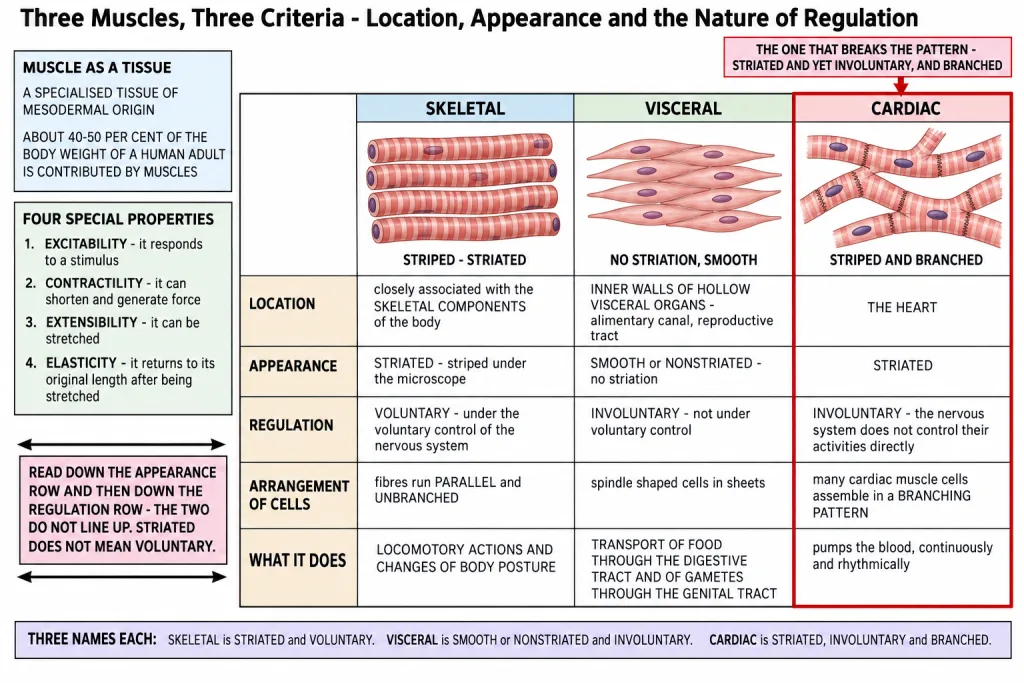
| Skeletal | Visceral | Cardiac | |
|---|---|---|---|
| Location | closely associated with the skeletal components of the body | inner walls of hollow visceral organs - alimentary canal, reproductive tract | the heart |
| Appearance | striped under the microscope - STRIATED | no striation, smooth - SMOOTH or NONSTRIATED | STRIATED |
| Regulation | under voluntary control - VOLUNTARY | not under voluntary control - INVOLUNTARY | INVOLUNTARY - the nervous system does not control their activities directly |
| Arrangement | - | - | many cardiac muscle cells assemble in a BRANCHING pattern |
| What it does | locomotory actions and changes of body posture | transport of food through the digestive tract and gametes through the genital tract | pumps the blood |
Read down the appearance row and then down the regulation row, because the two do not line up. Striated does not mean voluntary. Cardiac muscle is striated AND involuntary - it is the one type that breaks the pattern, and that is exactly why it is asked.
[NEET Important] Learn the three names each muscle carries. Skeletal = striated = voluntary. Visceral = smooth = nonstriated = involuntary. Cardiac = striated = involuntary = branched. A matching question will give you one name and want another.
Skeletal Against Cardiac - the Comparison the Exercise Wants
These two are the pair the chapter asks you to separate, and they are genuinely alike in one respect and different in every other.
What they share: both are STRIATED. That single shared feature is why the comparison is set at all.
Where they differ:
| Skeletal muscle | Cardiac muscle | |
|---|---|---|
| Location | attached to the skeletal components of the body | the heart only |
| Control | VOLUNTARY - under the voluntary control of the nervous system | INVOLUNTARY - the nervous system does not control its activity directly |
| Arrangement of cells | fibres run parallel, unbranched | cells assemble in a BRANCHING pattern |
| Function | locomotory actions and changes of body posture | pumping blood, continuously and rhythmically |
The "does not control directly" wording matters. Ch 15 said the heart is myogenic - its beat starts in its own nodal tissue and the nervous system only moderates it. That is the same fact in two chapters, and this chapter's phrasing is the one an examiner quotes.
[NEET Important] Striated is not the answer to "how do skeletal and cardiac muscle differ" - it is what they have in common. Lead with voluntary against involuntary and unbranched against branched.
Quick Recap
- Muscle is a specialised tissue of mesodermal origin, contributing about 40-50 per cent of the body weight of a human adult.
- Four properties: excitability, contractility, extensibility and elasticity.
- Muscles are classified by location, appearance and nature of regulation.
- By location: skeletal, visceral and cardiac.
- Skeletal - associated with skeletal components; striated; voluntary; does locomotory actions and changes of body posture.
- Visceral - inner walls of hollow visceral organs such as the alimentary canal and reproductive tract; smooth or nonstriated; involuntary; transports food through the digestive tract and gametes through the genital tract.
- Cardiac - the muscles of the heart; cells assemble in a branching pattern; striated; involuntary, because the nervous system does not control their activities directly.
- Cardiac muscle is the one that is striated AND involuntary.
Solved Examples
Question 1
Q. What is the embryonic origin of muscle, and how much of the body does it make up?
Answer. Mesodermal origin. About 40-50 per cent of the body weight of a human adult is contributed by muscles.
Question 2
Q. Name the four special properties of muscle.
Answer. Excitability, contractility, extensibility and elasticity.
Question 3
Q. On what three criteria are muscles classified?
Answer. Location, appearance, and the nature of regulation of their activities.
Question 4
Q. Name the three types of muscle identified by location.
Answer. Skeletal, visceral and cardiac.
Question 5
Q. Why are skeletal muscles also called striated and voluntary?
Answer. Striated because they have a striped appearance under the microscope; voluntary because their activities are under the voluntary control of the nervous system.
Question 6
Q. Where are visceral muscles found, and what do they do?
Answer. In the inner walls of hollow visceral organs of the body, such as the alimentary canal and the reproductive tract. They assist in the transportation of food through the digestive tract and of gametes through the genital tract.
Question 7
Q. Give the two other names for visceral muscle and say where each comes from.
Answer. Smooth muscle or nonstriated muscle, because they do not exhibit any striation and are smooth in appearance; and involuntary muscle, because their activities are not under the voluntary control of the nervous system.
Question 8
Q. Describe the arrangement of cardiac muscle cells.
Answer. Many cardiac muscle cells assemble in a BRANCHING pattern to form a cardiac muscle.
Question 9
Q. Cardiac muscle is striated. Is it therefore voluntary?
Answer. No. Cardiac muscle is striated by appearance but involuntary in nature, because the nervous system does not control its activities directly. Striation and voluntary control are two separate criteria, and cardiac muscle is the type where they come apart.
Question 10
Q. How do you distinguish between a skeletal muscle and a cardiac muscle? This is one of the chapter-end exercises.
Answer. Both are striated - that is what they share. They differ in everything else.
| Skeletal muscle | Cardiac muscle | |
|---|---|---|
| Location | closely associated with the skeletal components of the body | found only in the heart |
| Control | VOLUNTARY - under the voluntary control of the nervous system | INVOLUNTARY - the nervous system does not control its activities directly |
| Arrangement | fibres are parallel and unbranched | cells assemble in a branching pattern |
| Function | locomotory actions and changes of body posture | rhythmic pumping of blood |
Question 11
Q. Which muscle type would you expect in the wall of the alimentary canal, and why?
Answer. Visceral, that is smooth muscle. The alimentary canal is a hollow visceral organ, and the movement of food along it is not under voluntary control - which is exactly the description of visceral muscle.
Question 12
Q. Match each muscle type with its appearance and its control: skeletal, visceral, cardiac.
Answer. Skeletal - striated, voluntary. Visceral - smooth or nonstriated, involuntary. Cardiac - striated, involuntary.
Question 13
Q. A muscle sample is striated, branched and involuntary. Where is it from?
Answer. The heart - it is cardiac muscle. Branching is the giveaway: skeletal muscle is striated but neither branched nor involuntary, and visceral muscle is involuntary but not striated.