
Movement, and the Kind of Movement That Is Locomotion
Movement is one of the significant features of living beings. Human beings can move limbs, jaws, eyelids and the tongue - but not every movement counts as locomotion.
A voluntary movement which causes the animal to change its place is called LOCOMOTION. Walking, running, climbing and flying are locomotion; blinking and chewing are movement but not locomotion.
Animals move generally in search of food, shelter, a mate, a breeding ground, a better climate, or to protect themselves. That list of six is a one-mark answer on its own.
[NEET Important] All locomotion is movement, but not all movement is locomotion. The test is whether the animal changes its place, and whether the movement is voluntary. A question offering "movement of the tongue" as an example of locomotion is testing exactly that.
Three Types of Movement Shown by Human Cells
Cells of the human body exhibit three main types of movements, namely AMOEBOID, CILIARY and MUSCULAR.
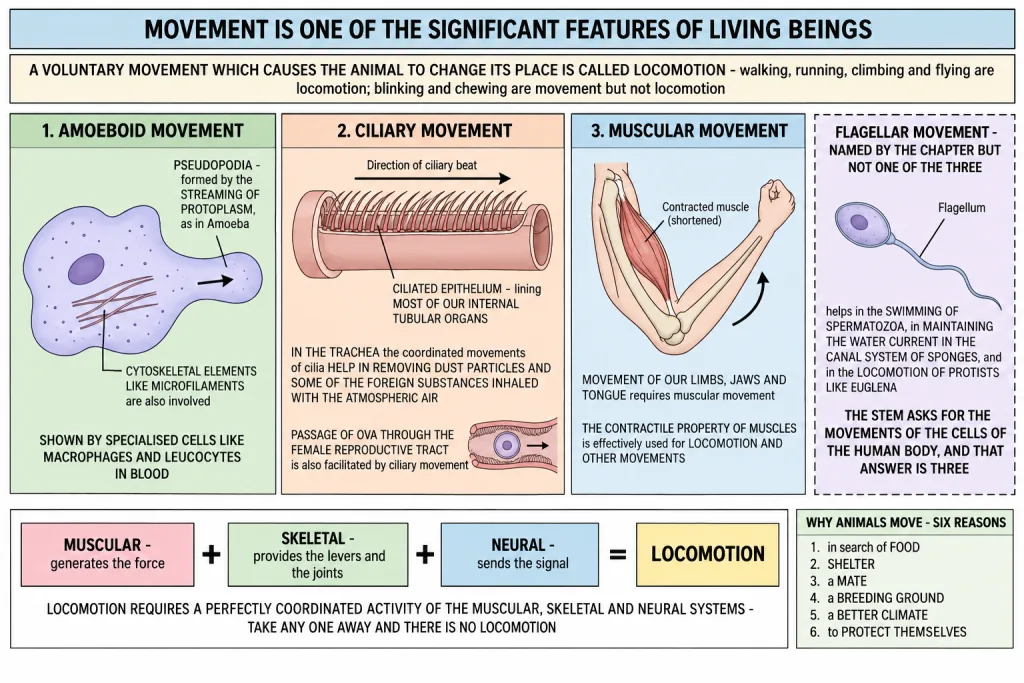
1. AMOEBOID movement.
- Shown by some specialised cells in our body like MACROPHAGES and LEUCOCYTES in blood.
- It is effected by PSEUDOPODIA formed by the streaming of protoplasm, as in Amoeba.
- Cytoskeletal elements like MICROFILAMENTS are also involved.
2. CILIARY movement.
- Occurs in most of our internal tubular organs which are lined by ciliated epithelium.
- The coordinated movements of cilia in the TRACHEA help in removing dust particles and some of the foreign substances inhaled with the atmospheric air.
- Passage of OVA through the female reproductive tract is also facilitated by ciliary movement.
3. MUSCULAR movement.
- Movement of our limbs, jaws and tongue requires muscular movement.
- The contractile property of muscles is effectively used for locomotion and other movements by human beings and the majority of multicellular organisms.
And there is a fourth kind that the chapter mentions but does not count among the three, because it does not occur in human body cells: FLAGELLAR movement, which helps in the swimming of spermatozoa, in maintaining the water current in the canal system of sponges, and in the locomotion of protists like Euglena.
[NEET Important] The question "what are the different types of movements exhibited by the cells of the human body" has exactly three answers - amoeboid, ciliary and muscular. Flagellar movement is mentioned in the same chapter and is the standard fourth option offered; the human sperm does swim by a flagellum, but the chapter's list of three is what the exercise asks for. Read the stem: "cells of the human body" wants three.
Locomotion Needs Three Systems at Once
Locomotion requires a perfectly coordinated activity of the MUSCULAR, SKELETAL and NEURAL systems.
That sentence is the plan of the whole chapter and it explains why a chapter called "Locomotion and Movement" spends most of its length on muscle and bone:
- The neural system sends the signal.
- The muscular system generates the force.
- The skeletal system provides the levers and the joints that turn that force into movement.
Take any one away and there is no locomotion. A muscle with no bone to pull on cannot move the body; a bone with no muscle cannot move itself; and neither acts without the signal.
[NEET Important] Three systems, and the chapter names them in that order. An assertion-reason item that credits locomotion to the muscular system alone is wrong on the chapter's own words.
Quick Recap
- Movement is a significant feature of living beings; a voluntary movement which causes the animal to change its place is LOCOMOTION.
- Animals move in search of food, shelter, a mate, a breeding ground, a better climate, or to protect themselves.
- Cells of the human body show three types of movement: amoeboid, ciliary and muscular.
- Amoeboid - macrophages and leucocytes; by pseudopodia formed by the streaming of protoplasm, with microfilaments involved.
- Ciliary - in internal tubular organs lined by ciliated epithelium; removes dust in the trachea and moves ova through the female reproductive tract.
- Muscular - limbs, jaws, tongue; uses the contractile property of muscles.
- Flagellar movement is named separately - swimming of spermatozoa, water current in sponges, locomotion of Euglena.
- Locomotion requires the coordinated activity of the muscular, skeletal and neural systems.
Solved Examples
Question 1
Q. What is locomotion, and how does it differ from movement in general?
Answer. Locomotion is a voluntary movement which causes the animal to change its place. Movement is the wider word - blinking, chewing and moving the tongue are movements but not locomotion, because the animal stays where it is.
Question 2
Q. Why do animals move?
Answer. Generally in search of food, shelter, a mate, a breeding ground or a better climate, or to protect themselves.
Question 3
Q. What are the different types of movements exhibited by the cells of the human body? This is one of the chapter-end exercises.
Answer. Three - amoeboid, ciliary and muscular.
- Amoeboid movement. Shown by specialised cells such as macrophages and leucocytes in blood. It is effected by pseudopodia formed by the streaming of protoplasm, as in Amoeba, and cytoskeletal elements like microfilaments are also involved.
- Ciliary movement. Occurs in most of our internal tubular organs, which are lined by ciliated epithelium. The coordinated movement of cilia in the trachea removes dust particles and foreign substances inhaled with the air, and the passage of ova through the female reproductive tract is also facilitated by it.
- Muscular movement. Movement of the limbs, jaws and tongue requires it, and the contractile property of muscles is used for locomotion and other movements.
Question 4
Q. Which cells of the body show amoeboid movement, and how do they do it?
Answer. Macrophages and leucocytes in blood. They move by pseudopodia formed by the streaming of protoplasm, helped by cytoskeletal elements like microfilaments.
Question 5
Q. Give two places in the human body where ciliary movement does useful work.
Answer. In the trachea, where the coordinated movement of cilia removes dust particles and foreign substances inhaled with the atmospheric air; and in the female reproductive tract, where it facilitates the passage of ova.
Question 6
Q. What kind of epithelium lines the organs that show ciliary movement?
Answer. Ciliated epithelium, lining most of our internal tubular organs.
Question 7
Q. Where does flagellar movement occur, and why is it not on the list of three?
Answer. It occurs in the swimming of spermatozoa, in maintaining the water current in the canal system of sponges, and in the locomotion of protists like Euglena. The chapter's list of three - amoeboid, ciliary and muscular - is specifically the movements exhibited by the cells of the human body, and flagellar movement is introduced separately alongside cilia as an outgrowth of the cell membrane.
Question 8
Q. Which property of muscle makes muscular movement possible?
Answer. Contractility. The contractile property of muscles is effectively used for locomotion and other movements by humans and the majority of multicellular organisms.
Question 9
Q. Which three systems must work together for locomotion?
Answer. The muscular, skeletal and neural systems, and the chapter insists on a perfectly coordinated activity of all three.
Question 10
Q. A student says walking is locomotion but running is only movement. Correct him.
Answer. Both are locomotion. The chapter names walking, running, climbing and flying together as locomotion, because in each of them the animal voluntarily changes its place. The distinction is not about speed - it is about whether the place changes and whether the movement is voluntary.
Question 11
Q. Cilia and flagella are described as outgrowths of what?
Answer. The cell membrane. The chapter carries that forward from the cell chapter before using it to explain flagellar movement.
Question 12
Q. Why does a chapter about locomotion spend most of its length on muscle and bone?
Answer. Because locomotion requires the coordinated activity of the muscular, skeletal and neural systems, and two of those three are what the chapter can show you in detail - the muscle that generates the force and the skeleton that provides the levers and joints through which that force becomes movement.