
What This Section Is - and the Axial Total of 80
This section introduces nothing new. It gathers the counts already taught in the sections before it and does the arithmetic that the chapter leaves to the reader. The chapter tells you there are 206 bones, that 80 of them are axial, and that each limb has 30 - but it never adds any of it up. Every number below has already appeared, in the skull block, the vertebral column block, the sternum and ribs block, the limb block or the girdle block. Nothing here has to be learnt afresh; it only has to be lined up.
Start with the axial skeleton, which the chapter states as 80 bones. Line up its parts and they come to exactly that:
| Part of the axial skeleton | Count |
|---|---|
| Skull (cranial 8 + facial 14) | 22 |
| Hyoid | 1 |
| Ear ossicles (3 in each middle ear) | 6 |
| Vertebral column | 26 |
| Sternum | 1 |
| Ribs (12 pairs) | 24 |
| Total axial | 80 |
Check it: 22 + 1 + 6 + 26 + 1 + 24 = 80.
Two rows deserve a second look because they are the ones a student loses.
- The ear ossicles are 6, not 3. The chapter says three tiny bones - malleus, incus and stapes - in EACH middle ear, and there are two middle ears, so 3 times 2 = 6.
- The ribs are 24 bones, not 12. The chapter says 12 PAIRS of ribs, and 12 pairs = 24 bones.
[NEET Important] The two rows that break the sum are the ear ossicles and the ribs, because both are stated per side or per pair and have to be doubled. Ossicles 3 in each ear gives 6; 12 pairs of ribs gives 24. A student who enters 3 and 12 gets 65 and concludes he has misremembered the 80 - he has not, he has forgotten to double.
The Appendicular Total of 126
The chapter never gives the appendicular figure at all. It gives you 206 in total and 80 axial, and it gives you 30 bones per limb and the make-up of both girdles. Line those up the same way:
| Part of the appendicular skeleton | Count |
|---|---|
| Fore limbs (30 each) | 60 |
| Hind limbs (30 each) | 60 |
| Pectoral girdle (2 clavicles + 2 scapulae) | 4 |
| Pelvic girdle (2 coxal bones) | 2 |
| Total appendicular | 126 |
Check it: 60 + 60 + 4 + 2 = 126.
Again, two rows carry the risk.
- A limb has 30 bones, so a PAIR of limbs has 60. There are two fore limbs and two hind limbs, which is why the number 30 appears twice in the table as 60 and 60. Four limbs at 30 each is 120.
- The girdles come to 6 between them, not more. The pectoral girdle is 4 bones - each of its two halves is a clavicle and a scapula, so two clavicles plus two scapulae. The pelvic girdle is only 2 bones - each of its two halves is a single coxal bone, because the ilium, ischium and pubis have already fused into one.
That last point is the whole reason the two girdles have different totals. Both girdles are formed of two halves, but a pectoral half is two bones while a pelvic half is one.
[NEET Important] The pelvic girdle contributes 2 bones, not 6. The three names ilium, ischium and pubis tempt a student into counting three bones per side; they are FUSED into one coxal bone, and the coxal bone is what gets counted. Fusion removes bones from the count - the same thing happens in the vertebral column, where the sacral and coccygeal regions count as 1 fused unit each.
80 + 126 = 206
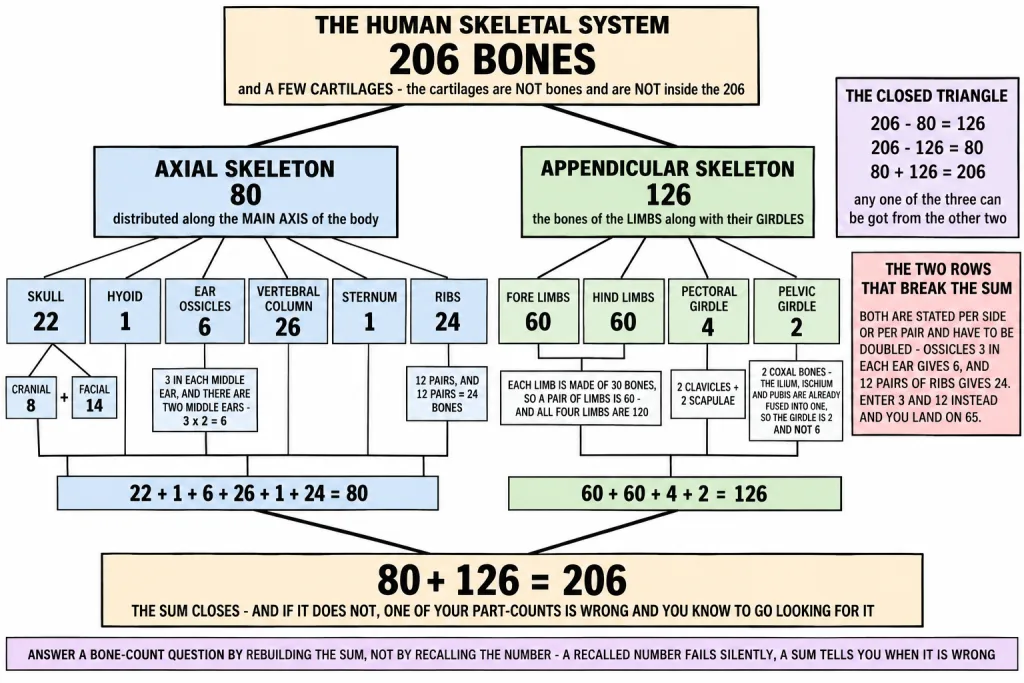
Put the two totals together:
| Division | Count |
|---|---|
| Axial skeleton | 80 |
| Appendicular skeleton | 126 |
| Total | 206 |
80 + 126 = 206, which is the figure the chapter states at the start of the skeletal system - "in human beings this system is made up of 206 bones and a few cartilages".
The sum closes. That is the point of the whole section: the chapter's 206 and its 80 are not two unrelated facts to be memorised, they are the two ends of one arithmetic and the 126 in the middle is recoverable from either direction. If you are given 206 and 80, the appendicular figure is 206 - 80 = 126. If you have built 80 and 126 from their parts, the total has to be 206 - and if it is not, one of your part-counts is wrong and you know to go looking for it.
Notice also what the total does NOT include. The chapter says 206 bones AND A FEW CARTILAGES. The cartilages are not bones and are not in the 206 - the hyaline cartilage joining the true ribs to the sternum, and the fibrous cartilage of the pubic symphysis, are cartilage, not bone.
[NEET Important] 206, 80 and 126 form a closed triangle and each can be got from the other two. The standard distractors are 216 and 208 for the total and 30 or 60 for the axial count. Remember also that 206 is the adult figure the chapter gives; the phrase "and a few cartilages" is part of the same sentence and an item that asks what else the skeletal system contains besides bones wants cartilages.
The Counts Most Often Asked on Their Own
Every number below has already been used in one of the two sums above or in the sections that fed them. This is the single table to revise from.
| What is counted | Number |
|---|---|
| Cranial bones | 8 |
| Facial bones | 14 |
| Skull, in total | 22 |
| Vertebrae | 26 |
| Cervical vertebrae | 7 |
| Thoracic vertebrae | 12 |
| Lumbar vertebrae | 5 |
| Ribs | 12 pairs |
| True ribs | 7 pairs |
| False (vertebrochondral) ribs | 3 pairs |
| Floating ribs | 2 pairs |
| Carpals - wrist bones | 8 |
| Metacarpals - palm bones | 5 |
| Phalanges, per limb | 14 |
| Tarsals - ankle bones | 7 |
| Metatarsals | 5 |
| Bones per limb | 30 |
| Axial skeleton | 80 |
| Appendicular skeleton | 126 |
| Total bones | 206 |
Read the table for its collisions rather than its rows. The numbers that get confused are always the ones that live near each other:
- 8 and 14 and 22 all belong to the skull - 8 cranial, 14 facial, 22 in total.
- 22 and 26 are the skull and the vertebral column, in that order.
- 7 appears three times - 7 cervical vertebrae, 7 pairs of true ribs, 7 tarsals - and 8 appears twice, as 8 cranial bones and 8 carpals.
- 12 appears twice - 12 thoracic vertebrae and 12 pairs of ribs - and that is not a coincidence: each pair of ribs attaches to a thoracic vertebra.
- 5 appears three times - 5 lumbar vertebrae, 5 metacarpals, 5 metatarsals.
- 14 appears twice - 14 facial bones and 14 phalanges per limb.
[NEET Important] A bone-count question is answered by rebuilding the sum, not by recalling the number. If you can rebuild 80 from 22 + 1 + 6 + 26 + 1 + 24 and 126 from 60 + 60 + 4 + 2, then every individual count in this chapter is checkable against them. Recall fails under pressure and it fails silently; a sum tells you when it is wrong, because it stops adding to 80 or to 126 or to 206. Write the two sums out once in the margin at the start of the paper and every count question in the skeletal section becomes a lookup.
Quick Recap
- This section adds up counts taught elsewhere in the chapter; every number in it has already appeared.
- Axial skeleton: skull 22 + hyoid 1 + ear ossicles 6 + vertebral column 26 + sternum 1 + ribs 24 = 80.
- The skull's 22 is 8 cranial + 14 facial.
- The ear ossicles are 3 in EACH middle ear, so 6 in all.
- The ribs are 12 PAIRS, so 24 bones.
- Appendicular skeleton: fore limbs 60 + hind limbs 60 + pectoral girdle 4 + pelvic girdle 2 = 126.
- Each limb has 30 bones, so a pair of limbs has 60 and all four limbs have 120.
- The pectoral girdle is 4 bones - two clavicles and two scapulae.
- The pelvic girdle is 2 bones - two coxal bones, each already the fusion of ilium, ischium and pubis.
- Grand total: 80 + 126 = 206, the figure the chapter states at the start of the skeletal system.
- The 206 does not include the cartilages - the chapter says 206 bones AND A FEW CARTILAGES.
- The counts to have ready: cranial 8, facial 14, skull 22, vertebrae 26, cervical 7, thoracic 12, lumbar 5, ribs 12 pairs, true 7, false 3, floating 2, carpals 8, metacarpals 5, phalanges 14 per limb, tarsals 7, metatarsals 5, 30 per limb, axial 80, appendicular 126, total 206.
- Answer a bone-count question by rebuilding the sum, not by recalling the number.
Solved Examples
Question 1
Q. Show that the axial skeleton comes to 80 bones.
Answer.
| Part | Count |
|---|---|
| Skull (cranial 8 + facial 14) | 22 |
| Hyoid | 1 |
| Ear ossicles (3 in each middle ear) | 6 |
| Vertebral column | 26 |
| Sternum | 1 |
| Ribs (12 pairs) | 24 |
| Total axial | 80 |
22 + 1 + 6 + 26 + 1 + 24 = 80, which is the figure the chapter gives for the axial skeleton.
Question 2
Q. Show that the appendicular skeleton comes to 126 bones.
Answer.
| Part | Count |
|---|---|
| Fore limbs (30 each) | 60 |
| Hind limbs (30 each) | 60 |
| Pectoral girdle (2 clavicles + 2 scapulae) | 4 |
| Pelvic girdle (2 coxal bones) | 2 |
| Total appendicular | 126 |
60 + 60 + 4 + 2 = 126. The chapter does not state this number, but it states each limb is made of 30 bones and gives the make-up of both girdles, and those are all the figures the sum needs.
Question 3
Q. Human skeleton has 206 bones. True or false? This is one of the chapter-end exercises.
Answer. TRUE.
In human beings the skeletal system is made up of 206 bones and a few cartilages, so the statement stands as it is and needs no change.
Show the sum rather than quoting the number:
| Division | Count |
|---|---|
| Axial skeleton | 80 |
| Appendicular skeleton | 126 |
| Total | 206 |
80 axial plus 126 appendicular gives 206. The 80 is skull 22 + hyoid 1 + ear ossicles 6 + vertebral column 26 + sternum 1 + ribs 24, and the 126 is fore limbs 60 + hind limbs 60 + pectoral girdle 4 + pelvic girdle 2. One point of care: the chapter says 206 bones AND A FEW CARTILAGES, so the cartilages are not counted in the 206.
Question 4
Q. Why are the ear ossicles counted as 6 and not as 3?
Answer. Because there are three ear ossicles - malleus, incus and stapes - in EACH middle ear, and there are two middle ears. 3 in each ear times 2 ears = 6.
Question 5
Q. Why are the ribs counted as 24 in the axial sum?
Answer. Because the chapter gives 12 PAIRS of ribs, and 12 pairs = 24 individual bones. The word "pairs" is what has to be read.
Question 6
Q. How many bones does the pectoral girdle contribute to the skeleton, and which are they?
Answer. Four. Each girdle is formed of two halves, and each half of the pectoral girdle consists of a clavicle and a scapula, so the whole girdle is two clavicles and two scapulae.
Question 7
Q. How many bones does the pelvic girdle contribute, and why is it not six?
Answer. Two - the two coxal bones. It is not six because each coxal bone is formed by the FUSION of the ilium, the ischium and the pubis. The three names describe parts of one fused bone, and the fused bone is what is counted.
Question 8
Q. How many bones are there in all four limbs together, without the girdles?
Answer. 120. Each limb is made of 30 bones, and 30 times 4 limbs = 120. Add the girdles - 4 for the pectoral and 2 for the pelvic - and the appendicular total is 126.
Question 9
Q. If a question gives you 206 total and 80 axial, how do you get the appendicular figure?
Answer. Subtract: 206 - 80 = 126. The three numbers form a closed triangle and any one of them can be recovered from the other two.
Question 10
Q. Which numbers in the skeletal chapter is 22 most often confused with, and what is each?
Answer. With 8, 14 and 26. 8 is the cranial bones, 14 is the facial bones, 8 + 14 = 22 is the whole skull, and 26 is the vertebral column. 22 and 26 sit next to each other in the axial sum, which is why they get swapped.
Question 11
Q. The number 7 appears three times among the counts of this chapter. Where?
Answer. 7 cervical vertebrae, 7 pairs of true ribs, and 7 tarsals in the ankle. The number 8 appears twice as well - 8 cranial bones and 8 carpals in the wrist.
Question 12
Q. Why does 12 appear both as the number of thoracic vertebrae and as the number of rib pairs?
Answer. Because each pair of ribs is attached dorsally to a thoracic vertebra. 12 thoracic vertebrae carry 12 pairs of ribs - the two counts are the same number for a reason, not by accident.
Question 13
Q. A student adds the axial parts and gets 65 instead of 80. What has gone wrong?
Answer. He has not doubled the two rows that are stated per side. He has probably entered 3 for the ear ossicles instead of 6 and 12 for the ribs instead of 24. The ossicles are 3 in EACH middle ear, so 6, and the ribs are 12 PAIRS, so 24. Putting both right adds 15 and brings 65 to 80.
Question 14
Q. What is the safest way to answer a bone-count question in an exam?
Answer. Rebuild the sum instead of recalling the number. If you can rebuild 80 from 22 + 1 + 6 + 26 + 1 + 24 and 126 from 60 + 60 + 4 + 2, every individual count in the chapter is checkable against them. Recall fails silently; a sum tells you when it is wrong, because it stops adding to 80, or to 126, or to 206.
Question 15
Q. Besides bones, what else does the human skeletal system contain?
Answer. A few cartilages. The chapter's sentence is "made up of 206 bones and a few cartilages", and the cartilages are not part of the 206.