
What a Joint Is, and Why It Matters
Joints are essential for all types of movements involving the bony parts of the body. Locomotory movements are no exception to this - every step you take is a set of bones swinging about their joints.
Joints are POINTS OF CONTACT between bones, or between bones and cartilages.
Now the sentence that gets asked word for word. Force generated by the muscles is used to carry out movement through joints, where THE JOINT ACTS AS A FULCRUM.
Think of the arm as a lever. The muscle supplies the force, the bone is the rigid bar, and the joint is the fixed point the bar turns about - the fulcrum. The muscle cannot move anything by shortening on its own; it moves the body because the bone it pulls on is hinged at a joint.
The movability at these joints varies depending on different factors. Some joints do not move at all, some move a little, and some move freely - and that range is exactly what the classification below captures.
[NEET Important] The joint acts as a FULCRUM, not as the force and not as the load. That is the single most quoted line of this section, and the standard distractors are "lever", "effort" and "load". Pair it with the definition - points of contact between bones, or between bones and cartilages - and you have covered the two one-mark facts here.
The Three Structural Types of Joint
Joints are classified into THREE major structural forms: FIBROUS, CARTILAGINOUS and SYNOVIAL.
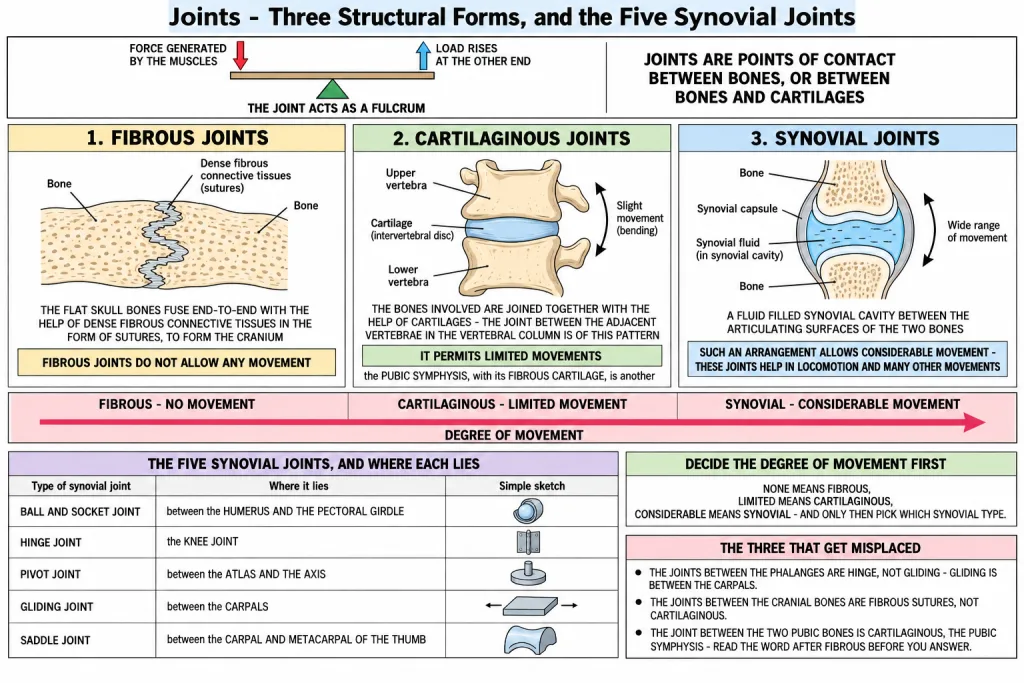
1. FIBROUS joints.
- Fibrous joints DO NOT ALLOW ANY MOVEMENT.
- This type is shown by the flat skull bones, which fuse end-to-end with the help of dense fibrous connective tissues in the form of SUTURES, to form the cranium.
- So the sutures of the cranium are the standard example, and "no movement" is the standard answer.
2. CARTILAGINOUS joints.
- In cartilaginous joints the bones involved are joined together with the help of CARTILAGES.
- The joint between the ADJACENT VERTEBRAE in the vertebral column is of this pattern, and it permits LIMITED movements.
- The pubic symphysis, where the two halves of the pelvic girdle meet ventrally through fibrous cartilage, is the other cartilaginous joint this chapter has already shown you.
3. SYNOVIAL joints.
- Synovial joints are characterised by the presence of a FLUID FILLED SYNOVIAL CAVITY between the articulating surfaces of the two bones.
- Such an arrangement allows CONSIDERABLE movement.
- These joints help in locomotion and many other movements.
Now line the three up by how much they move. This ladder is the fastest way into any joint question - read the joint type, say the degree of movement, or read the degree of movement and name the type.
| Joint type | Degree of movement |
|---|---|
| Fibrous | No movement |
| Cartilaginous | Limited movement |
| Synovial | Considerable movement |
[NEET Important] Three structural forms, and the ladder runs none - limited - considerable. The trap is the word "cartilaginous": a fibrous joint is held by dense fibrous connective tissue in the form of sutures and moves not at all, while a cartilaginous joint is held by cartilage and moves a little. The synovial cavity is filled with fluid - a question that describes a cavity filled with cartilage is describing nothing that exists.
The Five Synovial Joints and Where Each Lies
Synovial joints are the ones that do the locomotion, and the chapter names five of them with the bones each lies between. Learn this table as a table - a whole chapter-end exercise is nothing but this list, asked backwards.
| Synovial joint | Lies between |
|---|---|
| Ball and socket joint | the HUMERUS and the PECTORAL GIRDLE |
| Hinge joint | the KNEE JOINT |
| Pivot joint | the ATLAS and the AXIS |
| Gliding joint | between the CARPALS |
| Saddle joint | between the CARPAL AND METACARPAL OF THE THUMB |
A few of these you can reason out instead of memorising.
- Ball and socket - a rounded head sitting in a cup. The head of the humerus in the glenoid cavity of the pectoral girdle is one; the head of the femur in the acetabulum of the pelvic girdle is the other, and that is the hip joint. Ball and socket joints allow movement in all planes.
- Hinge - movement in one plane only, like a door. The knee is the chapter's example, and the joints between the phalanges are hinge joints too.
- Pivot - one bone turning about another. The atlas turning on the axis is what lets you shake your head.
- Gliding - flat surfaces sliding over each other, between the carpals of the wrist.
- Saddle - between the carpal and the metacarpal of the thumb, and it is what makes the human thumb opposable.
[NEET Important] Three parts of the joint exercise are where students lose the mark. The joints between the PHALANGES are HINGE joints, not gliding - gliding is between the carpals. The joints between the CRANIAL BONES are FIBROUS sutures, not cartilaginous - they allow no movement at all. The joint between the two PUBIC BONES is CARTILAGINOUS, the pubic symphysis with its fibrous cartilage - not fibrous, even though the word "fibrous" appears in "fibrous cartilage". Read the word after "fibrous" before you answer.
Quick Recap
- Joints are essential for all types of movements involving the bony parts of the body, locomotion included.
- Joints are points of contact between bones, or between bones and cartilages.
- Force generated by the muscles carries out movement through joints, where the joint acts as a FULCRUM.
- The movability at these joints varies depending on different factors.
- Three major structural forms: fibrous, cartilaginous and synovial.
- Fibrous - no movement; shown by the flat skull bones, which fuse end-to-end with dense fibrous connective tissue in the form of SUTURES to form the cranium.
- Cartilaginous - the bones are joined with the help of CARTILAGES; the joint between adjacent vertebrae in the vertebral column, permitting limited movements; the pubic symphysis is another.
- Synovial - a FLUID FILLED SYNOVIAL CAVITY between the articulating surfaces of the two bones, allowing considerable movement; these joints help in locomotion and many other movements.
- Ball and socket - between the humerus and the pectoral girdle.
- Hinge - the knee joint.
- Pivot - between the atlas and the axis.
- Gliding - between the carpals.
- Saddle - between the carpal and metacarpal of the thumb.
- Degree of movement: fibrous none, cartilaginous limited, synovial considerable.
- Femur and acetabulum - ball and socket, the hip joint. Between phalanges - hinge. Between cranial bones - fibrous sutures. Between pubic bones - cartilaginous.
Solved Examples
Question 1
Q. What is a joint, and why does the body need joints at all?
Answer. Joints are points of contact between bones, or between bones and cartilages. The body needs them because joints are essential for all types of movements involving the bony parts of the body, and locomotory movements are no exception - a bone can only move if it is hinged somewhere.
Question 2
Q. What part does a joint play when a muscle contracts?
Answer. The joint acts as a FULCRUM. The force is generated by the muscles, and that force is used to carry out movement through the joint - the bone swings about the joint the way a lever swings about its fixed point.
Question 3
Q. Name the three major structural forms of joints.
Answer. Fibrous, cartilaginous and synovial. The movability at joints varies depending on different factors, and these three forms are how that variation is organised.
Question 4
Q. Describe a fibrous joint and give the chapter's example.
Answer. Fibrous joints do not allow any movement. The flat skull bones fuse end-to-end with the help of dense fibrous connective tissues in the form of SUTURES, to form the cranium - that is the example.
Question 5
Q. How much movement does a cartilaginous joint allow, and where is one found?
Answer. Limited movement. In cartilaginous joints the bones involved are joined together with the help of CARTILAGES, and the joint between the adjacent vertebrae in the vertebral column is of this pattern.
Question 6
Q. What is the defining feature of a synovial joint?
Answer. The presence of a FLUID FILLED SYNOVIAL CAVITY between the articulating surfaces of the two bones. Such an arrangement allows considerable movement, and these joints help in locomotion and many other movements.
Question 7
Q. Give the five kinds of synovial joint named in the chapter along with where each lies.
Answer.
| Synovial joint | Lies between |
|---|---|
| Ball and socket | the humerus and the pectoral girdle |
| Hinge | the knee joint |
| Pivot | the atlas and the axis |
| Gliding | between the carpals |
| Saddle | between the carpal and metacarpal of the thumb |
Question 8
Q. Name the type of joint between the atlas and the axis. This is one of the chapter-end exercises.
Answer. A PIVOT joint, which is a synovial joint. The atlas, the first vertebra, turns about the axis, the second vertebra, and that is what lets the head rotate on the vertebral column when you shake your head.
Question 9
Q. Name the type of joint between the carpal and the metacarpal of the thumb. This is one of the chapter-end exercises.
Answer. A SADDLE joint, which is a synovial joint. It is what makes the human thumb opposable - the thumb can be brought across to touch the other fingers.
Question 10
Q. Name the type of joint between the phalanges. This is one of the chapter-end exercises.
Answer. A HINGE joint, which is a synovial joint. It allows movement in one plane only, exactly like the knee joint, so the finger bends and straightens but does not twist.
Question 11
Q. Name the type of joint between the femur and the acetabulum. This is one of the chapter-end exercises.
Answer. A BALL AND SOCKET joint, which is a synovial joint. The rounded head of the femur sits in the acetabulum of the pelvic girdle to form the hip joint, and it allows movement in all planes.
Question 12
Q. Name the type of joint between the cranial bones. This is one of the chapter-end exercises.
Answer. A FIBROUS joint, in the form of SUTURES. The flat skull bones fuse end-to-end with the help of dense fibrous connective tissue to form the cranium, and this joint allows no movement at all.
Question 13
Q. Name the type of joint between the pubic bones in the pelvic girdle. This is one of the chapter-end exercises.
Answer. A CARTILAGINOUS joint - the PUBIC SYMPHYSIS, where the two halves of the pelvic girdle meet ventrally. It contains FIBROUS CARTILAGE, and being cartilaginous it permits only limited movement.
Question 14
Q. A student writes that the joint between the phalanges is a gliding joint and that the joint between the pubic bones is fibrous. Correct both.
Answer. Both are wrong. The joints between the phalanges are HINGE joints - they move in one plane, like the knee; the gliding joint is the one between the CARPALS. The joint between the two pubic bones is CARTILAGINOUS, the pubic symphysis, and it is called that because it contains fibrous CARTILAGE - the word to read is "cartilage", not "fibrous".
Question 15
Q. Arrange the three structural types of joint in order of how much they move, and say why a synovial joint moves most.
Answer. Fibrous - no movement; cartilaginous - limited movement; synovial - considerable movement. The synovial joint moves most because it has a fluid filled synovial cavity between the articulating surfaces of the two bones, so the bones are separated by fluid instead of being tied together by fibrous tissue or cartilage.