
The Sternum and the Plan of a Rib
The STERNUM is a FLAT BONE on the VENTRAL MIDLINE of the THORAX.
That one sentence is worth its own line, because it is set as a true-or-false statement at the end of the chapter. Ventral means the front of the body, so the sternum is the bone you can feel down the centre of your chest. It is one of the four parts of the axial skeleton, along with the skull, the vertebral column and the ribs.
There are 12 PAIRS OF RIBS. Every rib in the human body follows the same plan:
- Each rib is a THIN FLAT BONE.
- It is connected DORSALLY to the VERTEBRAL COLUMN - that is, at the back.
- and VENTRALLY to the STERNUM - that is, at the front.
- It has TWO ARTICULATION SURFACES on its DORSAL END and is hence called BICEPHALIC.
Bicephalic means two-headed, and the two heads are at the dorsal end, where the rib meets the vertebral column. Not at the sternal end - that detail is the whole question.
[NEET Important] Three separate facts here, and each has its own question. Sternum - flat bone, ventral midline of the thorax. 12 pairs of ribs, with 11 pairs offered as the wrong figure. And bicephalic comes from two articulation surfaces on the DORSAL end; an option that places the two surfaces on the ventral end is the standard distractor.
The Three Kinds of Rib - 7, 3 and 2
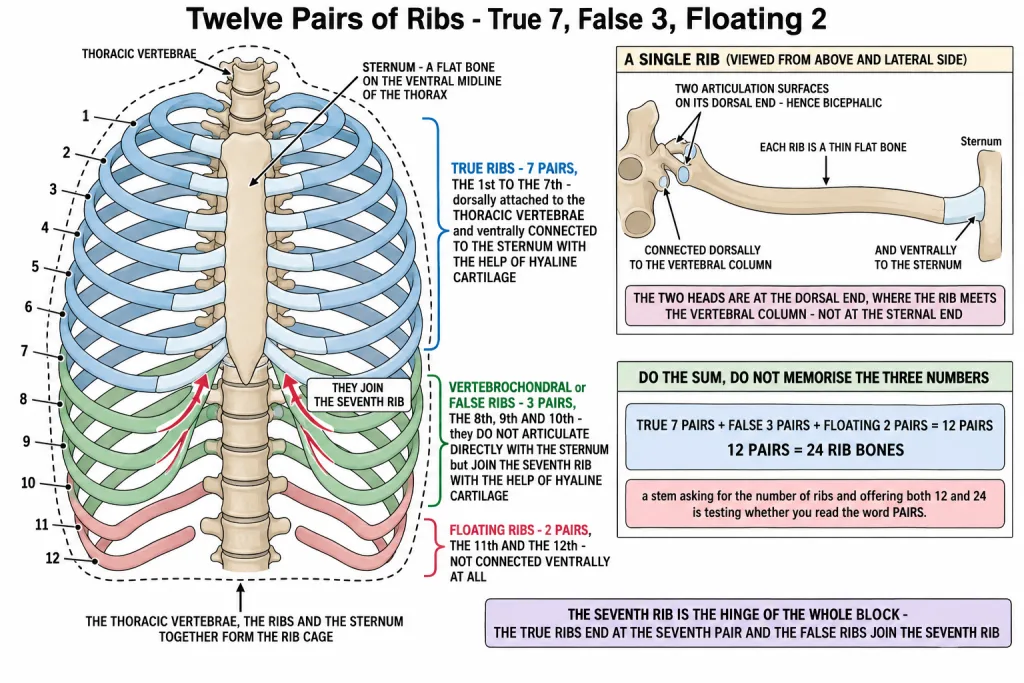
The 12 pairs of ribs are not all attached the same way at the front, and that is what splits them into three kinds. Learn the pair numbers, not just the names.
| Kind of rib | How many pairs | Which pairs | Dorsal attachment | Ventral attachment |
|---|---|---|---|---|
| TRUE ribs | 7 pairs | the 1st to the 7th | attached to the THORACIC VERTEBRAE | connected to the STERNUM with the help of HYALINE CARTILAGE |
| VERTEBROCHONDRAL or FALSE ribs | 3 pairs | the 8th, 9th and 10th | attached to the thoracic vertebrae | do NOT articulate directly with the sternum; they JOIN THE SEVENTH RIB with the help of HYALINE CARTILAGE |
| FLOATING ribs | 2 pairs | the 11th and the 12th | attached to the thoracic vertebrae | NOT CONNECTED VENTRALLY at all |
| Total | 12 pairs | the 1st to the 12th | - | - |
Say the pairing out loud in the order the table gives it: true 7, false 3, floating 2.
- TRUE ribs, the first seven pairs. Dorsally they are attached to the thoracic vertebrae and ventrally they are connected to the sternum with the help of hyaline cartilage. They are "true" because they reach the sternum themselves.
- VERTEBROCHONDRAL or FALSE ribs, the 8th, 9th and 10th pairs. They do not articulate directly with the sternum but join the SEVENTH rib with the help of hyaline cartilage. The name says it - vertebro for the vertebral column at the back and chondral for the cartilage at the front.
- FLOATING ribs, the last 2 pairs, the 11th and the 12th. They are not connected ventrally at all, which is exactly why they are called floating.
[NEET Important] The seventh rib is the hinge of this whole block. True ribs end at the seventh pair, and the false ribs join the seventh rib rather than the sternum. An option saying the false ribs join the eighth rib, or that they join the sternum directly, is wrong. The other guaranteed item is which pairs float - the 11th and the 12th, and the distractor is the 10th and 11th.
The Rib Cage, and the Arithmetic That Has to Add Up
The THORACIC VERTEBRAE, the RIBS and the STERNUM together form the RIB CAGE.
Read that list of three carefully. The rib cage is not just ribs. It needs the thoracic vertebrae behind, the ribs curving round the sides, and the sternum in front - a bony box that protects the heart and the lungs, and whose movements you already met in the breathing chapter.
Now the counting, because the axial total depends on it:
| Kind of rib | Pairs | Individual bones |
|---|---|---|
| True ribs | 7 | 14 |
| False (vertebrochondral) ribs | 3 | 6 |
| Floating ribs | 2 | 4 |
| Total | 12 pairs | 24 rib bones |
7 true + 3 false + 2 floating = 12 pairs. 12 pairs = 24 rib bones.
Those 24 bones, plus the 1 sternum, plus the 26 vertebrae, plus the bones of the skull region, are what build the 80 bones of the axial skeleton.
[NEET Important] Do the sum in the exam hall, do not memorise the three numbers separately. If you can only recall two of the three kinds, 7 + 3 + 2 = 12 recovers the third. And note the two different units - 12 PAIRS of ribs but 24 rib BONES; a stem asking for "the number of ribs" and offering both 12 and 24 is testing whether you read the word "pairs".
Quick Recap
- The STERNUM is a FLAT BONE on the VENTRAL MIDLINE of the THORAX.
- There are 12 PAIRS OF RIBS.
- Each rib is a THIN FLAT BONE connected DORSALLY to the vertebral column and VENTRALLY to the sternum.
- It has TWO ARTICULATION SURFACES on its DORSAL end and is hence called BICEPHALIC.
- TRUE ribs - the first SEVEN pairs. Dorsally attached to the THORACIC VERTEBRAE and ventrally connected to the STERNUM with the help of HYALINE CARTILAGE.
- VERTEBROCHONDRAL or FALSE ribs - the 8th, 9th and 10th pairs. They do not articulate directly with the sternum but JOIN THE SEVENTH RIB with the help of hyaline cartilage.
- FLOATING ribs - the last 2 pairs, the 11th and the 12th. They are NOT CONNECTED VENTRALLY at all.
- The pairing to memorise: true 7, false 3, floating 2. 7 + 3 + 2 = 12 pairs, and 12 pairs = 24 rib bones.
- The THORACIC VERTEBRAE, RIBS and STERNUM together form the RIB CAGE.
- The sternum and the ribs are two of the four parts of the AXIAL SKELETON, along with the skull and the vertebral column.
Solved Examples
Question 1
Q. Describe the sternum in one sentence.
Answer. The sternum is a FLAT BONE on the VENTRAL MIDLINE of the THORAX. It is part of the axial skeleton.
Question 2
Q. Sternum is present on the ventral side of the body. True or false? This is one of the chapter-end exercises.
Answer. TRUE.
The sternum is a flat bone on the VENTRAL MIDLINE of the THORAX. Ventral means the front of the body, so the statement is correct as it stands and needs no change. It is the bone you can feel running down the centre of the chest, and the true ribs reach it from either side.
Question 3
Q. There are 11 pairs of ribs in man. True or false? This is one of the chapter-end exercises.
Answer. FALSE.
The corrected statement is: THERE ARE 12 PAIRS OF RIBS IN MAN.
Where the wrong figure comes from: 11 is the number of the FIRST FLOATING pair, not the number of pairs. The last 2 pairs - the 11th and the 12th - are the floating ribs, so the number 11 does appear in this topic, but as an ordinal for one pair, not as a total. Check the sum: 7 true + 3 false + 2 floating = 12 pairs.
Question 4
Q. _ and _ pairs of ribs are called floating ribs. This is one of the chapter-end exercises.
Answer. The 11TH and 12TH pairs of ribs are called floating ribs.
Why they are called floating: the last 2 pairs of ribs are NOT CONNECTED VENTRALLY at all. Every other rib reaches the front of the chest somehow - the first seven pairs reach the sternum directly with hyaline cartilage, and the 8th, 9th and 10th pairs reach it indirectly by joining the seventh rib - but the 11th and 12th pairs end free in the body wall, attached only at the back to the thoracic vertebrae.
Question 5
Q. Describe a single rib - its shape and its two attachments.
Answer. Each rib is a THIN FLAT BONE. It is connected DORSALLY to the VERTEBRAL COLUMN and VENTRALLY to the STERNUM.
Question 6
Q. Why is a rib called bicephalic?
Answer. Because it has TWO ARTICULATION SURFACES on its DORSAL END. Bicephalic means two-headed, and the two heads are at the back end, where the rib meets the vertebral column.
Question 7
Q. Name the three kinds of rib and give the pairs in each.
Answer.
| Kind | Pairs | Which pairs |
|---|---|---|
| True ribs | 7 pairs | 1st to 7th |
| Vertebrochondral or false ribs | 3 pairs | 8th, 9th, 10th |
| Floating ribs | 2 pairs | 11th, 12th |
True 7, false 3, floating 2 - and 7 + 3 + 2 = 12 pairs in all.
Question 8
Q. How are the true ribs attached at each end?
Answer. Dorsally they are attached to the THORACIC VERTEBRAE, and ventrally they are connected to the STERNUM with the help of HYALINE CARTILAGE. The first seven pairs of ribs are the true ribs.
Question 9
Q. How do the 8th, 9th and 10th pairs of ribs reach the front of the chest?
Answer. They do not articulate directly with the sternum. They join the SEVENTH RIB with the help of hyaline cartilage. Because of that indirect attachment they are called vertebrochondral ribs, or false ribs.
Question 10
Q. What makes the floating ribs different from every other rib?
Answer. They are not connected ventrally at all. The last 2 pairs - the 11th and the 12th - are the floating ribs, attached only at the back to the vertebral column.
Question 11
Q. Which cartilage attaches the true ribs to the sternum?
Answer. HYALINE CARTILAGE. The same cartilage joins the 8th, 9th and 10th pairs to the seventh rib.
Question 12
Q. What forms the rib cage?
Answer. The THORACIC VERTEBRAE, the RIBS and the STERNUM together form the RIB CAGE. All three are needed - the vertebrae behind, the ribs around, and the sternum in front.
Question 13
Q. A question asks for "the number of ribs in man". Is the answer 12 or 24?
Answer. Read the unit in the stem. There are 12 PAIRS of ribs, which means 24 individual rib bones. If the stem says "pairs", answer 12; if it says "ribs" or "rib bones", answer 24.
Question 14
Q. A rib is attached to a thoracic vertebra at the back but ends free in the body wall at the front. Which pair could it be?
Answer. The 11th or the 12th pair - a FLOATING rib. The floating ribs are not connected ventrally at all. It cannot be one of the first seven pairs, because those reach the sternum with hyaline cartilage, and it cannot be the 8th, 9th or 10th, because those join the seventh rib.