
The Skeletal System - Bone, Cartilage and the Two Divisions
The skeletal system consists of a framework of BONES and a few CARTILAGES. This system has a significant role in the movement shown by the body - imagine chewing food without jaw bones, or walking around without the limb bones.
Bone and cartilage are both specialised connective tissues, and the one line that separates them is asked directly:
| Tissue | Matrix | Why |
|---|---|---|
| BONE | very HARD | due to CALCIUM SALTS in it |
| CARTILAGE | slightly PLIABLE | due to CHONDROITIN SALTS in it |
In human beings this system is made up of 206 BONES and a few cartilages. It is grouped into two principal divisions - the AXIAL and the APPENDICULAR skeleton.
| Division | Number of bones | What it is made of |
|---|---|---|
| AXIAL skeleton | 80 bones | the SKULL, the VERTEBRAL COLUMN, the STERNUM and the RIBS |
| APPENDICULAR skeleton | the remaining bones | the bones of the limbs along with their girdles |
| Total | 206 bones | plus a few cartilages |
The axial skeleton comprises 80 bones distributed along the MAIN AXIS of the body - that is what its name means. The skull, vertebral column, sternum and ribs constitute the axial skeleton, and this section takes the first two of those four.
[NEET Important] Two one-mark facts live in this block. First, bone is hard because of calcium salts and cartilage is pliable because of chondroitin salts - the two salts get swapped in options, so tie each name to its tissue now. Second, 206 total and 80 axial are both quoted figures; the standard distractor for 206 is 208 or 216, and for 80 it is 30 (which is the number of bones in ONE limb, not in the axial skeleton).
The Skull - 22 Bones in Two Sets
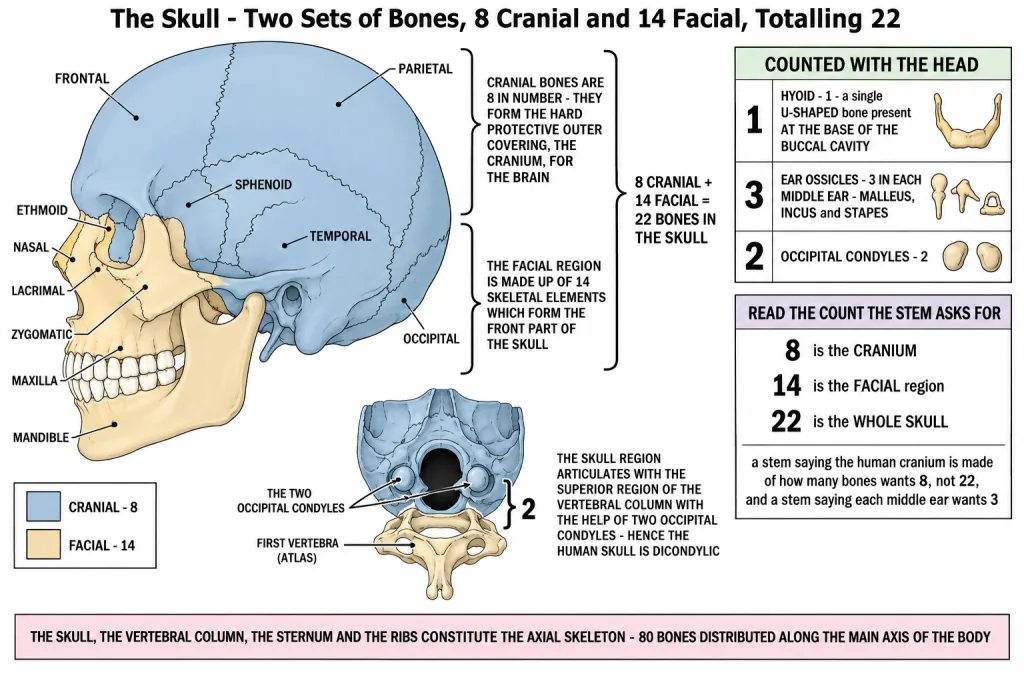
The skull is composed of two sets of bones - CRANIAL and FACIAL - that totals to 22 BONES.
- CRANIAL BONES ARE 8 IN NUMBER. They form the hard protective outer covering, the CRANIUM, for the brain. In the figure the frontal, parietal, temporal, occipital, sphenoid and ethmoid bones belong to this set.
- The FACIAL region is made up of 14 SKELETAL ELEMENTS which form the front part of the skull. The lacrimal, nasal, zygomatic, maxilla and mandible are labelled here.
Three more skeletal items are counted with the head, and each is a favourite single-mark question:
| Item | Number | Where it is and what it does |
|---|---|---|
| Cranial bones | 8 | form the CRANIUM, the hard protective outer covering for the brain |
| Facial bones | 14 | the front part of the skull - the face |
| Total skull bones | 22 | two sets, cranial and facial |
| HYOID | 1 | a single U-SHAPED bone present at the base of the BUCCAL CAVITY |
| EAR OSSICLES | 3 in EACH middle ear | MALLEUS, INCUS and STAPES - three tiny bones |
| OCCIPITAL CONDYLES | 2 | the skull articulates through them with the vertebral column |
The skull region articulates with the SUPERIOR REGION of the vertebral column with the help of TWO OCCIPITAL CONDYLES, and because there are two of them the human skull is described as DICONDYLIC.
[NEET Important] Read the count the stem asks for. 8 is cranial, 14 is facial, 22 is the whole skull - a question that says "the human cranium is made of _ bones" wants 8, not 22. Two more traps: the ear ossicles are three in EACH middle ear, so a stem saying "each middle ear" wants three; and dicondylic comes from two occipital condyles, not from two sets of skull bones.
The Vertebral Column - 26 Vertebrae, Dorsally Placed
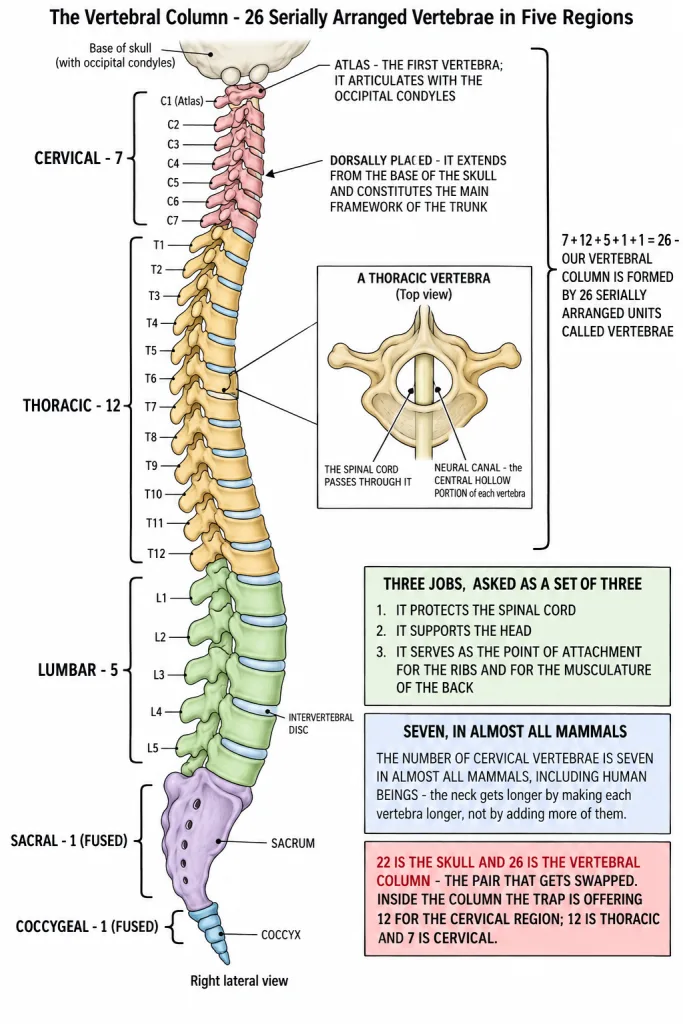
Our vertebral column is formed by 26 SERIALLY ARRANGED UNITS called VERTEBRAE and is DORSALLY PLACED. It extends from the base of the skull and constitutes the main framework of the trunk.
Each vertebra has a central hollow portion, the NEURAL CANAL, through which the SPINAL CORD passes. The FIRST vertebra is the ATLAS, and it articulates with the OCCIPITAL CONDYLES of the skull - which is how the head sits on the neck.
The vertebral column is differentiated into five regions, starting from the skull, and the counts have to be learnt as a column of numbers that adds to 26:
| Region (in order, starting from the skull) | Number of vertebrae |
|---|---|
| CERVICAL | 7 |
| THORACIC | 12 |
| LUMBAR | 5 |
| SACRAL | 1 (fused) |
| COCCYGEAL | 1 (fused) |
| Total | 26 |
The number of cervical vertebrae is SEVEN in almost all mammals, including human beings. That is worth saying slowly, because it is counter-intuitive: a giraffe and a mouse and you all have seven cervical vertebrae - the neck gets longer by making each vertebra longer, not by adding more of them.
The vertebral column does three jobs, and they are asked as a set of three:
- It PROTECTS the SPINAL CORD, which runs through the neural canals.
- It SUPPORTS the HEAD.
- It serves as the POINT OF ATTACHMENT for the RIBS and for the MUSCULATURE OF THE BACK.
Two more labels appear on the figure and are worth knowing: the INTERVERTEBRAL DISC lying between successive vertebrae, and the SACRUM and COCCYX at the lower end, which are the fused sacral and coccygeal regions.
[NEET Important] 26 is the count of vertebrae, not of bones in the skull - 22 and 26 are the pair that gets swapped. Inside the column, cervical 7 and thoracic 12 are the two most-asked rows, and the trap is offering 12 for cervical. Remember also that the atlas is the FIRST vertebra and it is the one that meets the two occipital condyles; a stem naming the axis instead is wrong.
Quick Recap
- The skeletal system consists of a framework of BONES and a few CARTILAGES; both are specialised connective tissues.
- Bone has a very HARD matrix due to CALCIUM SALTS; cartilage has a slightly PLIABLE matrix due to CHONDROITIN SALTS.
- In human beings the system is made up of 206 BONES and a few cartilages, grouped into two principal divisions - the AXIAL and the APPENDICULAR skeleton.
- The AXIAL SKELETON comprises 80 BONES distributed along the main axis of the body. The SKULL, VERTEBRAL COLUMN, STERNUM and RIBS constitute the axial skeleton.
- The skull is composed of two sets of bones - cranial and facial - totalling 22 BONES.
- Cranial bones are 8 in number; they form the hard protective outer covering, the CRANIUM, for the brain.
- The facial region is made up of 14 SKELETAL ELEMENTS which form the front part of the skull.
- A single U-SHAPED bone called the HYOID is present at the base of the buccal cavity.
- Each middle ear contains three tiny bones - MALLEUS, INCUS and STAPES - collectively called EAR OSSICLES.
- The skull articulates with the superior region of the vertebral column with the help of TWO OCCIPITAL CONDYLES, and is therefore a DICONDYLIC skull.
- The vertebral column is formed by 26 serially arranged units called VERTEBRAE and is DORSALLY placed; it extends from the base of the skull and constitutes the main framework of the trunk.
- Each vertebra has a central hollow portion, the NEURAL CANAL, through which the SPINAL CORD passes.
- The first vertebra is the ATLAS, and it articulates with the occipital condyles.
- Regions from the skull downwards: cervical 7, thoracic 12, lumbar 5, sacral 1 (fused), coccygeal 1 (fused) - total 26.
- The number of cervical vertebrae is SEVEN in almost all mammals, including human beings.
- The vertebral column PROTECTS the spinal cord, SUPPORTS the head, and serves as the POINT OF ATTACHMENT for the ribs and the musculature of the back.
Solved Examples
Question 1
Q. What does the skeletal system consist of, and what kind of tissues are its two components?
Answer. The skeletal system consists of a framework of BONES and a few CARTILAGES. Bone and cartilage are both specialised connective tissues.
Question 2
Q. Why is bone hard while cartilage is pliable?
Answer. Bone has a very HARD matrix because of the CALCIUM SALTS in it. Cartilage has a slightly PLIABLE matrix because of the CHONDROITIN SALTS in it. The difference is in the matrix, not in the cells.
Question 3
Q. How many bones are there in the human skeletal system, and how is it divided?
Answer. 206 bones and a few cartilages. It is grouped into two principal divisions - the AXIAL skeleton and the APPENDICULAR skeleton.
Question 4
Q. Name the parts of the axial skeleton and give the number of bones in it.
Answer. The axial skeleton comprises 80 BONES distributed along the main axis of the body. It is made up of the SKULL, the VERTEBRAL COLUMN, the STERNUM and the RIBS.
Question 5
Q. How many bones make up the skull, and how are they grouped?
Answer. 22 bones in all. They come in two sets - CRANIAL and FACIAL. Cranial bones are 8 in number and the facial region is made up of 14 skeletal elements, and 8 plus 14 gives the 22.
Question 6
Q. The human cranium is made of __ bones. This is one of the chapter-end exercises.
Answer. The human cranium is made of EIGHT bones.
Do not confuse the three numbers that live in the same sentence of the chapter:
| What is being counted | Number |
|---|---|
| CRANIAL bones - the cranium | 8 |
| FACIAL bones - the front part of the skull | 14 |
| The WHOLE SKULL, cranial plus facial | 22 |
The cranium is only the hard protective outer covering for the brain, so the answer is 8. 22 is the trap, because it is the number the chapter gives first, and 14 is the face.
Question 7
Q. All mammals (except a few) have __ cervical vertebra. This is one of the chapter-end exercises.
Answer. All mammals (except a few) have SEVEN cervical vertebrae.
The number of cervical vertebrae is seven in almost all mammals, including human beings. What makes this worth remembering is that it holds across mammals of very different neck lengths - a giraffe, a horse, a whale and a human being all have seven cervical vertebrae. A long neck is built from longer cervical vertebrae, not from more of them.
Question 8
Q. What is the hyoid bone, and where is it found?
Answer. A single U-SHAPED bone. It is present at the base of the BUCCAL CAVITY. It is counted with the skull region but is not one of the 22 cranial and facial bones.
Question 9
Q. Name the ear ossicles and say how many there are.
Answer. Each middle ear contains THREE tiny bones - the MALLEUS, the INCUS and the STAPES, and they are collectively called the EAR OSSICLES. Note the wording: three in EACH middle ear.
Question 10
Q. Why is the human skull called dicondylic?
Answer. Because the skull region articulates with the superior region of the vertebral column with the help of TWO OCCIPITAL CONDYLES. Di- means two and condyle is the rounded articulating knob, so two occipital condyles make the skull DICONDYLIC.
Question 11
Q. Describe the vertebral column - how many units, where it is placed, and how far it extends.
Answer. It is formed by 26 serially arranged units called VERTEBRAE and it is DORSALLY placed. It extends from the base of the skull and constitutes the main framework of the trunk.
Question 12
Q. What passes through the neural canal?
Answer. The SPINAL CORD. Each vertebra has a central hollow portion called the NEURAL CANAL, and the cord runs down through the canals of the vertebrae stacked one above another.
Question 13
Q. Give the five regions of the vertebral column in order from the skull, with the number of vertebrae in each.
Answer.
| Region (starting from the skull) | Number |
|---|---|
| Cervical | 7 |
| Thoracic | 12 |
| Lumbar | 5 |
| Sacral | 1 (fused) |
| Coccygeal | 1 (fused) |
| Total | 26 |
Add them down the column: 7 + 12 + 5 + 1 + 1 = 26.
Question 14
Q. Which is the first vertebra, and what does it articulate with?
Answer. The first vertebra is the ATLAS, and it articulates with the OCCIPITAL CONDYLES of the skull.
Question 15
Q. State the three functions of the vertebral column.
Answer. The vertebral column protects the SPINAL CORD, supports the HEAD, and serves as the POINT OF ATTACHMENT for the RIBS and the MUSCULATURE OF THE BACK. All three are wanted when the question says "functions" in the plural.