
Myoglobin, the Pigment That Colours a Muscle
Muscle contains a red coloured OXYGEN STORING pigment called MYOGLOBIN.
Read that description again, because every word in it is examinable. Myoglobin is red, it stores oxygen, and it sits inside the muscle - it is not the pigment that carries oxygen in the blood. How much myoglobin a muscle holds decides both its colour and the way it makes its ATP, and that single variable splits skeletal muscle into two kinds.
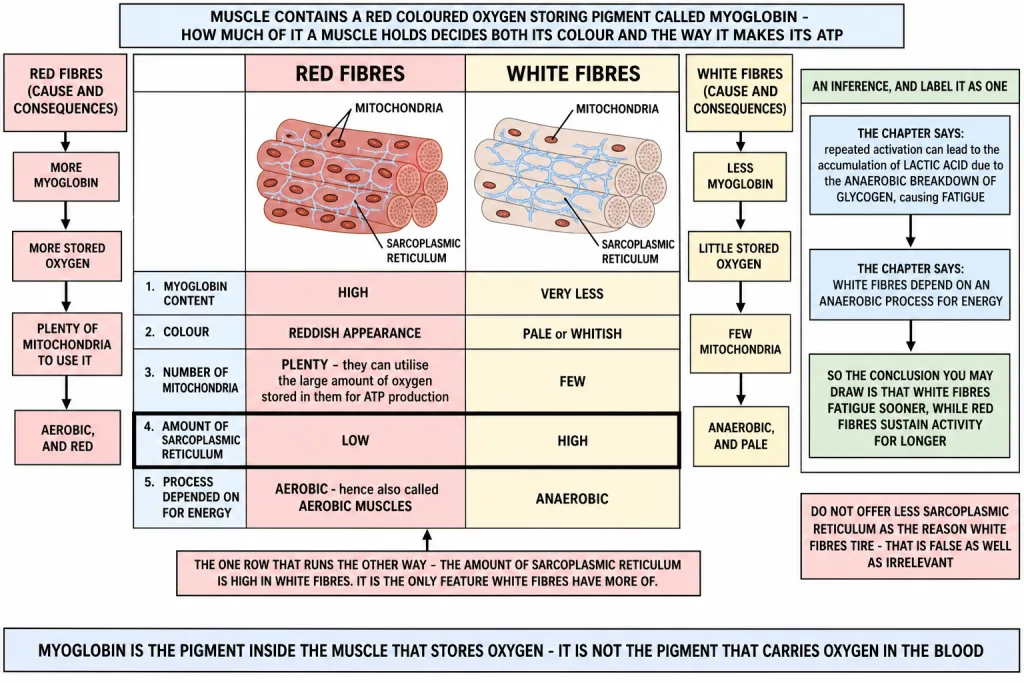
RED FIBRES.
- Myoglobin content is HIGH in some of the muscles, which gives them a reddish appearance. Such muscles are called the red fibres.
- These muscles also contain PLENTY OF MITOCHONDRIA, which can utilise the large amount of oxygen stored in them for ATP production.
- They can therefore also be called AEROBIC MUSCLES.
WHITE FIBRES.
- Some of the muscles possess VERY LESS quantity of myoglobin and therefore appear PALE or WHITISH. These are the white fibres.
- The number of mitochondria is also FEW in them, but the amount of SARCOPLASMIC RETICULUM IS HIGH.
- They depend on an ANAEROBIC process for energy.
[NEET Important] Myoglobin is the cause and everything else follows from it. More myoglobin means more stored oxygen, which needs plenty of mitochondria to use it, which makes the fibre aerobic and red. Less myoglobin means little stored oxygen, few mitochondria, and an anaerobic fibre that looks pale. A question that describes a pale muscle with few mitochondria wants the answer white fibre.
Red Against White - the Five-Row Comparison
This comparison is set directly as a chapter-end exercise, and it is worth learning as five rows rather than as a paragraph, because the examiner marks it row by row.
| Feature | Red fibres | White fibres |
|---|---|---|
| Myoglobin content | HIGH | VERY LESS |
| Colour | reddish appearance | pale or whitish |
| Number of mitochondria | PLENTY | FEW |
| Amount of sarcoplasmic reticulum | LOW | HIGH |
| Process depended on for energy | AEROBIC - hence also called aerobic muscles | ANAEROBIC |
Four of those five rows run the same way - red fibres have more myoglobin, more colour, more mitochondria and the aerobic route. The sarcoplasmic reticulum row is the one that runs the other way, and it is the row students forget precisely because it is the only feature where white fibres have MORE of something than red fibres do. The amount of sarcoplasmic reticulum is high in white fibres.
Two of the rows are really one fact stated twice. The colour follows from the myoglobin - the pigment is red, so a muscle full of it looks reddish and a muscle nearly without it looks pale. If you remember the myoglobin row you can always rebuild the colour row.
[NEET Important] Write all five rows, and get the sarcoplasmic reticulum row the right way round. The standard trap option says white fibres have less of everything, including sarcoplasmic reticulum. They have less myoglobin and fewer mitochondria, but MORE sarcoplasmic reticulum. The second trap swaps the energy process - red is aerobic, white is anaerobic.
Why White Fibres Tire Sooner
The chapter does not say this in a single sentence - it follows from two statements that it does make, one at the end of the contraction section and one here. Put them together and the conclusion is unavoidable:
- The chapter says: repeated activation of the muscles can lead to the accumulation of LACTIC ACID due to the ANAEROBIC BREAKDOWN OF GLYCOGEN in them, causing FATIGUE.
- The chapter says: white fibres depend on an ANAEROBIC process for energy, while red fibres, with plenty of myoglobin and plenty of mitochondria, work AEROBICALLY on their stored oxygen.
So the conclusion you may draw is that white fibres fatigue sooner, while red fibres sustain activity for longer. The anaerobic route is the one that accumulates lactic acid, and lactic acid is what causes fatigue; the aerobic route in red fibres runs on the large amount of oxygen stored in their myoglobin and used by plenty of mitochondria, so it does not build lactic acid the same way.
Treat this as an inference and label it as one. In an examination, quote the two chapter statements first - the anaerobic breakdown of glycogen causing fatigue, and white fibres depending on an anaerobic process - and then state the conclusion. That is how a reasoning question on this pair is expected to be answered.
[NEET Important] Assertion-reason questions live here. "White fibres fatigue earlier than red fibres" is the assertion; "white fibres depend on an anaerobic process, and the anaerobic breakdown of glycogen accumulates lactic acid" is the reason, and the reason correctly explains the assertion. Do not offer "white fibres have less sarcoplasmic reticulum" as the reason - that is false as well as irrelevant.
Quick Recap
- Muscle contains a red coloured OXYGEN STORING pigment called MYOGLOBIN.
- Myoglobin content is HIGH in some muscles, which gives them a reddish appearance - these are the RED FIBRES.
- Red fibres also contain PLENTY OF MITOCHONDRIA, which can utilise the large amount of oxygen stored in them for ATP production.
- Red fibres can therefore also be called AEROBIC MUSCLES.
- Some muscles possess VERY LESS quantity of myoglobin and therefore appear PALE or WHITISH - these are the WHITE FIBRES.
- The number of mitochondria is FEW in white fibres, but the amount of SARCOPLASMIC RETICULUM IS HIGH.
- White fibres depend on an ANAEROBIC process for energy.
- The five rows of the comparison: myoglobin content, colour, number of mitochondria, amount of sarcoplasmic reticulum, and the process depended on for energy.
- Sarcoplasmic reticulum is the only feature that is HIGHER in white fibres.
- Putting the chapter's two statements together: white fibres work anaerobically, the anaerobic breakdown of glycogen accumulates lactic acid, and lactic acid causes fatigue - so white fibres fatigue sooner while red fibres sustain activity longer.
Solved Examples
Question 1
Q. What is myoglobin, and where is it found?
Answer. Myoglobin is a red coloured OXYGEN STORING pigment, and it is contained in muscle. Its amount in a muscle decides the muscle's colour and the way that muscle makes its ATP.
Question 2
Q. Why do some muscles look reddish?
Answer. Because myoglobin content is high in them. Myoglobin is a red pigment, so a muscle holding plenty of it gives a reddish appearance. Such muscles are the red fibres.
Question 3
Q. Why are red fibres also called aerobic muscles?
Answer. Because they contain plenty of mitochondria, which can utilise the large amount of oxygen stored in them for ATP production. The oxygen is stored by their high myoglobin content, and the mitochondria use it aerobically - so these muscles can also be called aerobic muscles.
Question 4
Q. Why do white fibres appear pale or whitish?
Answer. Because they possess a very less quantity of myoglobin. With almost none of the red pigment present, the muscle appears pale or whitish.
Question 5
Q. Describe the mitochondria and the sarcoplasmic reticulum of a white fibre.
Answer. The number of mitochondria is few in them, but the amount of sarcoplasmic reticulum is high. That pairing is worth memorising as it stands, because sarcoplasmic reticulum is the one thing a white fibre has more of than a red fibre.
Question 6
Q. On which process do white fibres depend for energy?
Answer. They depend on an ANAEROBIC process for energy - unlike red fibres, which work aerobically on the oxygen stored in their myoglobin.
Question 7
Q. Write the difference between Red and White muscles. This is one of the chapter-end exercises.
Answer.
| Feature | Red muscle fibres | White muscle fibres |
|---|---|---|
| Myoglobin content | HIGH | VERY LESS |
| Colour | reddish appearance | pale or whitish |
| Number of mitochondria | PLENTY | FEW |
| Amount of sarcoplasmic reticulum | LOW | HIGH |
| Process depended on for energy | AEROBIC, and so they are also called aerobic muscles | ANAEROBIC |
The mitochondria of red fibres can utilise the large amount of oxygen stored in them for ATP production, which is why the aerobic route is open to them; white fibres, with little stored oxygen and few mitochondria, depend on an anaerobic process instead.
Question 8
Q. Name the one feature in which white fibres exceed red fibres.
Answer. The amount of sarcoplasmic reticulum, which is high in white fibres. In every other feature of the comparison - myoglobin, colour and the number of mitochondria - the red fibre is the one with more.
Question 9
Q. Which type of fibre would you expect to fatigue sooner, and why?
Answer. White fibres. This follows from two statements the chapter makes. First, repeated activation of the muscles can lead to the accumulation of lactic acid due to the anaerobic breakdown of glycogen in them, causing fatigue. Second, white fibres depend on an anaerobic process for energy. Put together, the white fibre is the one running the route that accumulates lactic acid, so it tires first. Red fibres, working aerobically on the large amount of oxygen stored in their myoglobin, can sustain activity for longer.
Question 10
Q. What is the stored oxygen of a red fibre used for?
Answer. For ATP production. The plenty of mitochondria in red fibres can utilise the large amount of oxygen stored in them for ATP production, which is why they are aerobic muscles.
Question 11
Q. A muscle sample is pale, has few mitochondria and an abundant sarcoplasmic reticulum. Which fibre type is it, and what does it use for energy?
Answer. A white fibre. Pale colour means very less myoglobin, and few mitochondria with a high amount of sarcoplasmic reticulum completes the description. It depends on an anaerobic process for energy.
Question 12
Q. A muscle has to hold a posture for a long period without tiring. Which fibre type suits it, and give two reasons.
Answer. Red fibres. First, their myoglobin content is high, so a large amount of oxygen is stored in them. Second, they contain plenty of mitochondria, which can utilise that stored oxygen for ATP production - they are aerobic muscles, and so they do not depend on the anaerobic route that accumulates lactic acid and causes fatigue.