
Same Syllabus. A Different Exam.
The Solved Examples section worked this chapter the way a written paper does - describe the sarcomere, explain the sliding, compare the girdles. NEET does not ask you to describe anything here. It names one band, one bone count or one joint, gives four options, and you have about half a minute.
The marking is +4 for a correct answer and -1 for a wrong one. In a written answer, saying "the wrist has seven or eight small bones" still earns something. Here, 7 where the answer is 8 is worth -1, which is five marks behind someone who skipped it.
This chapter is two different exams stitched together. The first half is a MECHANISM - the sliding filament theory, which is a sequence of events you have to be able to run forwards. The second half is a COUNT - the most number-dense list in the whole book, and pure recall.
Treat them differently. For the mechanism, learn the order and the two ATP events. For the skeleton, learn the sums, not the individual numbers - if you can rebuild 80 and 126 you can check any single count against them.
The Four Shapes This Chapter Is Asked In
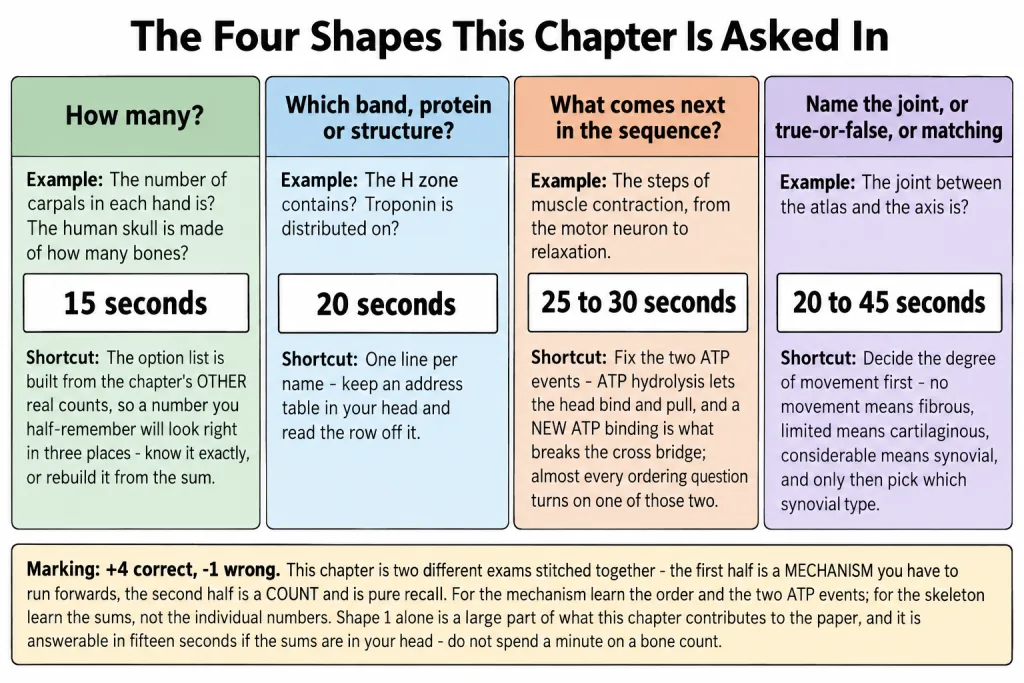
Shape 1 - How many? "The number of carpals in each hand is?" "The human skull is made of how many bones?" Budget 15 seconds. The shortcut: the option list is built from the chapter's OTHER real counts, so a number you half-remember will look right in three places. Know it exactly, or rebuild it from the sum.
Shape 2 - Which band, protein or structure? "The 'H' zone contains?" "Troponin is distributed on?" Budget 20 seconds. The shortcut: one line per name, and the address table below is that list.
Shape 3 - What comes next in the sequence? The steps of muscle contraction, from the motor neuron to relaxation. Budget 25 to 30 seconds. The shortcut: fix the two ATP events. ATP hydrolysis lets the head bind and pull; a NEW ATP binding is what breaks the cross bridge. Almost every ordering question turns on one of those two.
Shape 4 - Name the joint, or true-or-false, or matching. "The joint between the atlas and the axis is?" Budget 20 to 45 seconds. The shortcut: decide the degree of movement first. No movement means fibrous; limited means cartilaginous; considerable means synovial, and only then pick which synovial type.
[NEET Important] Shape 1 alone is a large part of what this chapter contributes to the paper, and it is answerable in fifteen seconds if the sums are in your head. Do not spend a minute on a bone count.
Every Number in the Chapter
Learn these as a block, because the wrong options are drawn from this same block.
Muscle
- Muscle is 40-50 per cent of the body weight of a human adult.
- Actin filament: 2 'F' actins, plus 2 filaments of tropomyosin, with troponin at regular intervals on the tropomyosin.
The skeleton, as sums
| Division | Parts | Total |
|---|---|---|
| Axial | skull 22 + hyoid 1 + ear ossicles 6 + vertebrae 26 + sternum 1 + ribs 24 | 80 |
| Appendicular | fore limbs 60 + hind limbs 60 + pectoral girdle 4 + pelvic girdle 2 | 126 |
| Whole skeleton | 80 + 126 | 206 |
The individual counts
- Skull 22 = cranial 8 + facial 14. Hyoid 1, U-shaped, at the base of the buccal cavity.
- Ear ossicles: 3 in EACH middle ear - malleus, incus, stapes - so 6 in the skeleton.
- Occipital condyles: 2 - the skull is dicondylic.
- Vertebrae 26: cervical 7, thoracic 12, lumbar 5, sacral 1 fused, coccygeal 1 fused.
- Cervical vertebrae are 7 in almost all mammals.
- Ribs: 12 pairs. True 7, vertebrochondral or false 3 (the 8th, 9th and 10th), floating 2 (the 11th and 12th). Each rib is bicephalic - 2 articulation surfaces on its dorsal end.
- Each limb: 30 bones. Fore limb: humerus 1, radius and ulna 2, carpals 8, metacarpals 5, phalanges 14. Hind limb: femur 1, tibia and fibula 2, tarsals 7, metatarsals 5, phalanges 14, plus the patella 1.
- The scapula lies between the 2nd and the 7th ribs.
- Each coxal bone is 3 bones fused - ilium, ischium and pubis.
[NEET Important] The wrist has 8 carpals and the ankle has 7 tarsals - one apart, and swapped constantly. The patella is what brings the hind limb up to the same 30 as the fore limb, which is the cleanest way to remember both lists at once.
One Name, One Line
Every Shape 2 question is one row of this table.
| Name | Its one line |
|---|---|
| Fascia | the collagenous connective tissue holding the muscle bundles together |
| Fascicle | a muscle bundle, containing many muscle fibres |
| Sarcolemma | the plasma membrane of the muscle fibre |
| Sarcoplasmic reticulum | the store house of calcium ions |
| Syncitium | what a muscle fibre is - its sarcoplasm contains many nuclei |
| 'I' band | light, ISOtropic, contains actin |
| 'A' band | dark, ANIsotropic, contains myosin |
| 'Z' line | elastic fibre bisecting the 'I' band; the thin filaments attach to it |
| 'M' line | thin fibrous membrane holding the thick filaments in the middle of the 'A' band |
| 'H' zone | the central part of the thick filament NOT overlapped by thin filaments |
| Sarcomere | the portion between two successive 'Z' lines; the functional unit of contraction |
| 'F' actin | a polymer of 'G' (globular) actins; two are helically wound per thin filament |
| Tropomyosin | two filaments running along the 'F' actins |
| Troponin | distributed at regular intervals on the tropomyosin; masks the active sites |
| Meromyosin | the monomer of the thick filament |
| HMM | heavy meromyosin - the globular head with a short arm, the cross arm; an ATPase |
| LMM | light meromyosin - the tail |
| Motor unit | a motor neuron plus the muscle fibres connected to it |
| Neuromuscular junction | the motor-end plate, between motor neuron and sarcolemma |
| Acetyl choline | the neurotransmitter released there |
| Myoglobin | the red, oxygen storing pigment of muscle |
| Hyoid | U-shaped, at the base of the buccal cavity |
| Atlas | the first vertebra, articulating with the occipital condyles |
| Acromion | the flat expanded process of the scapula's spine; the clavicle articulates with it |
| Glenoid cavity | receives the head of the humerus - the shoulder joint |
| Acetabulum | receives the thigh bone - the hip joint |
| Pubic symphysis | where the two halves of the pelvic girdle meet ventrally; fibrous cartilage |
| Sutures | the fibrous joints of the flat skull bones |
| Patella | the cup shaped knee cap, covering the knee ventrally |
[NEET Important] Two rows carry more marks than the rest: 'I' band and 'A' band. I is Isotropic and holds Actin; A is Anisotropic and holds Myosin. The letters do not match the proteins, which is exactly why it is asked.
The Negatives, and the Pairs That Get Swapped
The negatives
- The 'H' zone does NOT contain both filaments. It is thick filaments only - the part not overlapped by thin.
- The 'A' band does NOT shorten during contraction. The 'I' bands get reduced; the 'A' bands retain their length.
- The filaments themselves do NOT shorten. They slide - which is the whole reason the theory has that name.
- Cardiac muscle is striated but NOT voluntary.
- Fibrous joints do NOT allow any movement.
- The joint between phalanges is NOT a gliding joint - it is a hinge. Gliding is between the carpals.
- The joint between cranial bones is NOT cartilaginous - it is fibrous, in the form of sutures.
- The joint between the pubic bones is NOT fibrous - it is cartilaginous, the pubic symphysis.
- There are NOT 11 pairs of ribs. There are 12; the 11th is the first floating pair.
- Kinetin, ADH and renin belong to other chapters. In this one the only chemical names that matter are acetyl choline, ATP, calcium and myoglobin.
The pairs
| If the question says | The answer is | The trap option is |
|---|---|---|
| light, isotropic | 'I' band, containing actin | the 'A' band, which is dark, anisotropic and myosin |
| thin filament | actin | myosin, which is the thick filament |
| the globular head with a short arm | HMM | LMM, which is the tail |
| shortens during contraction | the 'I' band and the 'H' zone | the 'A' band, which does not change |
| plenty of mitochondria, aerobic | red fibres | white fibres, which are anaerobic |
| more sarcoplasmic reticulum | white fibres | red fibres - this is the one feature white fibres have more of |
| 8 of them in each hand | carpals | tarsals, which are 7, in the ankle |
| the 8th, 9th and 10th pairs | false or vertebrochondral ribs | floating ribs, which are the 11th and 12th |
| receives the head of the humerus | glenoid cavity | acetabulum, which receives the femur |
| between the atlas and the axis | pivot joint | gliding, which is between the carpals |
| inflammation of joints from uric acid crystals | gout | arthritis, which is inflammation without a named cause |
| auto immune, at the neuromuscular junction | myasthenia gravis | muscular dystrophy, which is genetic and degenerates the muscle |
[NEET Important] On a joint question, decide the degree of movement first. None means fibrous, limited means cartilaginous, considerable means synovial - and only then choose which synovial type. That one habit answers all six parts of the chapter's joint exercise.
Solved Examples at NEET Pace
Each item names the shortcut it uses, because the shortcut is the thing worth carrying into the exam hall.
Question 1
Q. How many bones are there in the human skull, and how do they divide?
Answer. 22 in total - 8 cranial and 14 facial. Shortcut: 8 + 14 = 22. A question offering 8 when it asked for the skull, or 22 when it asked for the cranium, is testing exactly that split.
Question 2
Q. Which band of the sarcomere is isotropic, and what does it contain?
Answer. The 'I' band, which is light and contains actin. Shortcut: I for Isotropic, and I for the thin filament. The 'A' band is Anisotropic, dark, and holds myosin.
Question 3
Q. What exactly is the 'H' zone?
Answer. The central part of the thick filament that is NOT overlapped by thin filaments. Shortcut: H is what is left over. It therefore contains thick filaments only, and it narrows during contraction as the thin filaments slide further in.
Question 4
Q. During contraction, which band shortens and which does not?
Answer. The 'I' band shortens; the 'A' band retains its length. Shortcut: the 'A' band is the length of the thick filament, and the thick filament never changes length. Nothing in the sarcomere shortens by contracting - only by sliding.
Question 5
Q. Where is calcium stored in a muscle fibre?
Answer. In the sarcoplasmic reticulum, which the chapter calls the store house of calcium ions. Shortcut: the muscle's endoplasmic reticulum has one job and one name.
Question 6
Q. What does a subunit of troponin do in the resting state?
Answer. It masks the active binding sites for myosin on the actin filaments. Shortcut: troponin sits on tropomyosin, and its job is to hide. Calcium binding to it is what removes the mask.
Question 7
Q. Name the two parts of a meromyosin.
Answer. Heavy meromyosin (HMM) - the globular head with a short arm, which projects as the cross arm and is an active ATPase - and light meromyosin (LMM), the tail. Shortcut: Heavy has the Head.
Question 8
Q. Which two ATP events occur in one cross bridge cycle?
Answer. ATP hydrolysis provides the energy for the myosin head to bind actin and pull; then a NEW ATP binds and the cross bridge is broken. Shortcut: ATP is spent to pull and spent again to let go - and a muscle without ATP cannot release, which is why the second event is the one questions target.
Question 9
Q. How many pairs of ribs are true, false and floating?
Answer. 7 true, 3 false (the 8th, 9th and 10th), 2 floating (the 11th and 12th). Shortcut: 7 + 3 + 2 = 12 pairs. If the three numbers do not add to twelve, one of them is wrong.
Question 10
Q. How many bones are in each limb, and how do the two limbs reach the same number?
Answer. 30 each. Fore limb: 1 + 2 + 8 + 5 + 14 = 30. Hind limb: 1 + 2 + 7 + 5 + 14 = 29, plus the patella = 30. Shortcut: the ankle has one fewer bone than the wrist, and the knee cap makes up the difference.
Question 11
Q. Where does the head of the humerus articulate, and where does the femur?
Answer. The humerus at the GLENOID CAVITY of the scapula, forming the shoulder joint; the femur at the ACETABULUM of the coxal bone, forming the hip joint. Shortcut: glenoid goes with the pectoral girdle, acetabulum with the pelvic.
Question 12
Q. Name the joint between the carpal and the metacarpal of the thumb.
Answer. A saddle joint, which is synovial. Shortcut: the thumb is the odd digit, so it gets the odd joint. Gliding is between the carpals; saddle is only at the thumb.
Question 13
Q. Which muscle fibres have more sarcoplasmic reticulum, and what does that tell you?
Answer. White fibres. It is the one feature where white fibres have more than red, and it goes with less myoglobin, fewer mitochondria and dependence on the anaerobic process. Shortcut: red stores oxygen, white stores calcium.
Question 14
Q. Distinguish gout from arthritis in one line.
Answer. Both are inflammation of joints; gout names its cause - the accumulation of uric acid crystals. Shortcut: if the stem mentions uric acid, it is gout; if it mentions nothing, it is arthritis.
A Drill Before You Move On
Decide each one before you read the verdict. Aim for 15 to 20 seconds per question.
- The human skeleton has 206 bones. - True. 80 axial plus 126 appendicular.
- The 'A' band contains actin. - False. The 'A' band is anisotropic and contains myosin; actin is in the 'I' band.
- The H zone represents both thick and thin filaments. - False. Thick filaments only.
- During contraction the 'A' band shortens. - False. The 'I' band shortens; the 'A' band retains its length.
- Light meromyosin carries the globular head. - False. That is heavy meromyosin. LMM is the tail.
- The sarcoplasmic reticulum stores calcium ions. - True.
- There are 11 pairs of ribs in man. - False. 12 pairs.
- The cranium is made of 8 bones. - True, out of 22 in the whole skull.
- Carpals are 7 and tarsals are 8. - False. Carpals 8, tarsals 7.
- The joint between cranial bones is cartilaginous. - False. Fibrous, in the form of sutures, and it allows no movement.
- Cardiac muscle is striated and voluntary. - False. Striated and involuntary.
- Red fibres depend on the anaerobic process. - False. Red fibres are aerobic; white fibres are anaerobic.