
Six Disorders, One Table
The chapter closes with six disorders of the muscular and skeletal system. Each is a one-line definition, and each definition carries one giveaway word that identifies it. Learn the table first, then read the paragraphs below it.
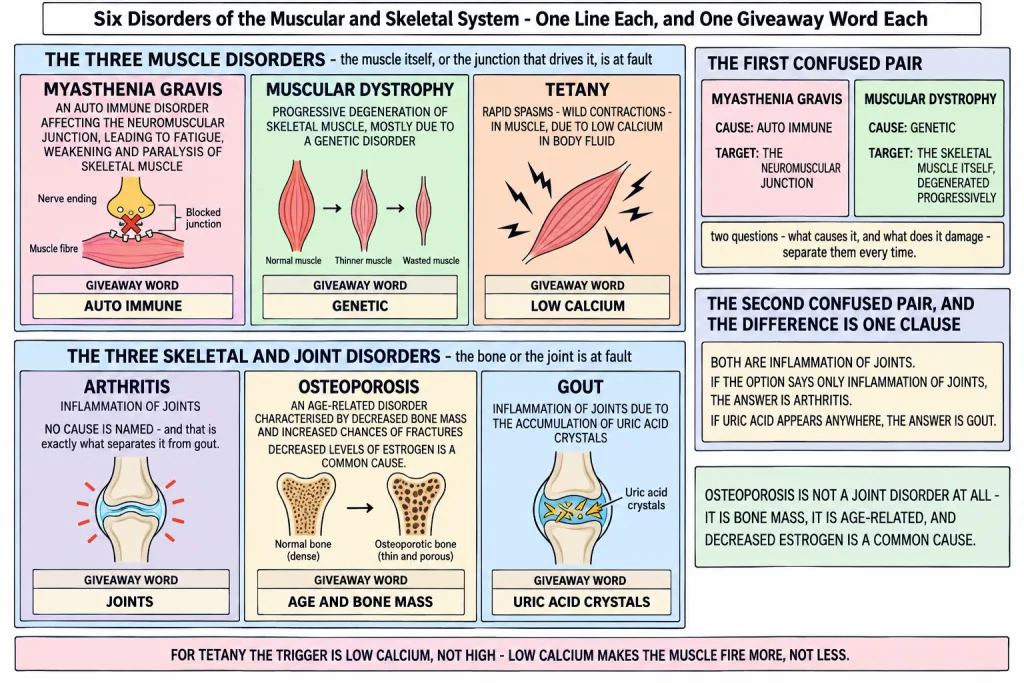
| Disorder | What it is | The giveaway word |
|---|---|---|
| Myasthenia gravis | an AUTO IMMUNE disorder affecting the NEUROMUSCULAR JUNCTION, leading to fatigue, weakening and paralysis of skeletal muscle | auto immune |
| Muscular dystrophy | progressive DEGENERATION of skeletal muscle, mostly due to a GENETIC disorder | genetic |
| Tetany | rapid SPASMS - wild contractions - in muscle, due to LOW CALCIUM in body fluid | low calcium |
| Arthritis | INFLAMMATION OF JOINTS | joints |
| Osteoporosis | an AGE-RELATED disorder characterised by DECREASED BONE MASS and INCREASED CHANCES OF FRACTURES | age and bone mass |
| Gout | INFLAMMATION OF JOINTS due to the accumulation of URIC ACID CRYSTALS | uric acid crystals |
Notice how the six split. The first three are muscle disorders - the muscle itself, or the junction that drives it, is at fault. The last three are skeletal and joint disorders - the bone or the joint is at fault.
[NEET Important] These six are asked as one-line matching items, so the definition must be exact. Myasthenia gravis is auto immune, muscular dystrophy is genetic, tetany is a calcium problem, arthritis and gout inflame joints, osteoporosis loses bone mass. A question that swaps "auto immune" and "genetic" between the first two is the commonest single item from this section.
The Three Muscle Disorders
1. MYASTHENIA GRAVIS.
Myasthenia gravis is an AUTO IMMUNE disorder affecting the NEUROMUSCULAR JUNCTION, leading to fatigue, weakening and paralysis of skeletal muscle.
Read the address carefully: the fault is at the NEUROMUSCULAR JUNCTION, the place where the motor neuron meets the muscle fibre. The muscle fibre itself is not degenerating - the signal simply stops getting across, so the muscle tires, weakens and finally becomes paralysed. And the cause is auto immune - the body's own immune system attacking the junction.
2. MUSCULAR DYSTROPHY.
Muscular dystrophy is progressive DEGENERATION of skeletal muscle, mostly due to a GENETIC disorder.
Here the muscle tissue itself is being destroyed, and it is destroyed progressively - a little more with time. The cause is genetic, not immune, which is why it usually shows up early in life and runs in families.
3. TETANY.
Tetany is rapid SPASMS - wild contractions - in muscle, due to LOW CALCIUM in body fluid.
This one follows straight from the sliding filament theory. Calcium ions, , control whether actin is active, so the level of calcium in the body fluid controls how easily a muscle fires. When the calcium level in body fluid falls, the muscle fires uncontrollably and you get rapid spasms, that is wild contractions.
[NEET Important] Myasthenia gravis and muscular dystrophy are the pair that gets confused. Myasthenia gravis is AUTO IMMUNE and its target is the NEUROMUSCULAR JUNCTION. Muscular dystrophy is GENETIC and its target is the SKELETAL MUSCLE ITSELF, which it degenerates progressively. Two questions - what causes it, and what does it damage - separate them every time. For tetany, remember that the trigger is LOW calcium, not high - low calcium makes the muscle fire more, not less.
The Three Skeletal and Joint Disorders
4. ARTHRITIS.
Arthritis is INFLAMMATION OF JOINTS. That is the whole definition the chapter gives - no cause is named, which is exactly what separates it from gout.
5. OSTEOPOROSIS.
Osteoporosis is an AGE-RELATED disorder characterised by DECREASED BONE MASS and INCREASED CHANCES OF FRACTURES.
Decreased levels of ESTROGEN is a common cause. That is why the disorder is seen so much more often in women after menopause, when estrogen falls. Two features are asked together - less bone mass, and more fractures.
6. GOUT.
Gout is INFLAMMATION OF JOINTS due to the accumulation of URIC ACID CRYSTALS.
Gout is arthritis with a named cause. The uric acid crystals settle in the joint and inflame it, which is why gout classically strikes one joint at a time and hurts sharply.
[NEET Important] Arthritis and gout are the second confused pair, and the difference is one clause. Both are inflammation of joints - so if an option says only "inflammation of joints", the answer is arthritis. Gout NAMES ITS CAUSE: the accumulation of URIC ACID CRYSTALS. If uric acid appears anywhere in the stem or the option, the answer is gout. And osteoporosis is not a joint disorder at all - it is bone mass, it is age-related, and decreased estrogen is a common cause.
Quick Recap
- Myasthenia gravis - an auto immune disorder affecting the neuromuscular junction, leading to fatigue, weakening and paralysis of skeletal muscle.
- Muscular dystrophy - progressive degeneration of skeletal muscle, mostly due to a genetic disorder.
- Tetany - rapid spasms, that is wild contractions, in muscle, due to low calcium in body fluid.
- Arthritis - inflammation of joints, with no cause named.
- Osteoporosis - an age-related disorder characterised by decreased bone mass and increased chances of fractures; decreased levels of estrogen is a common cause.
- Gout - inflammation of joints due to the accumulation of uric acid crystals.
- The first three are muscle disorders, the last three are skeletal and joint disorders.
- Auto immune and the neuromuscular junction means myasthenia gravis; genetic and degeneration of the muscle means muscular dystrophy.
- Inflammation of joints alone means arthritis; inflammation of joints plus uric acid crystals means gout.
Solved Examples
Question 1
Q. What is myasthenia gravis?
Answer. An AUTO IMMUNE disorder affecting the NEUROMUSCULAR JUNCTION, leading to fatigue, weakening and paralysis of skeletal muscle.
Question 2
Q. Which structure does myasthenia gravis damage, and what is the cause?
Answer. It damages the neuromuscular junction - the point where the motor neuron meets the muscle fibre. The cause is auto immune, that is the body's own immune system attacking that junction.
Question 3
Q. Define muscular dystrophy.
Answer. Progressive DEGENERATION of skeletal muscle, mostly due to a GENETIC disorder.
Question 4
Q. How would you tell muscular dystrophy from myasthenia gravis?
Answer. By the cause and by what is damaged. Muscular dystrophy is GENETIC and it degenerates the SKELETAL MUSCLE ITSELF, progressively. Myasthenia gravis is AUTO IMMUNE and it attacks the NEUROMUSCULAR JUNCTION, so the muscle is not destroyed - the signal to it fails, giving fatigue, weakening and paralysis.
Question 5
Q. What is tetany, and what causes it?
Answer. Rapid SPASMS - wild contractions - in muscle. It is due to LOW CALCIUM in body fluid.
Question 6
Q. Why does a fall in the calcium level of body fluid produce wild contractions?
Answer. Because calcium ions control muscle contraction. In the sliding filament theory, released from the sarcoplasmic reticulum activates actin so that cross bridges can form. The calcium level in the body fluid sets how easily a muscle fibre fires, and when it falls too low the muscle fires uncontrollably, giving the rapid spasms of tetany.
Question 7
Q. Define arthritis.
Answer. Inflammation of joints. The chapter gives no cause for it - that plain definition is the answer.
Question 8
Q. What is osteoporosis?
Answer. An AGE-RELATED disorder characterised by DECREASED BONE MASS and INCREASED CHANCES OF FRACTURES.
Question 9
Q. Name a common cause of osteoporosis.
Answer. Decreased levels of ESTROGEN.
Question 10
Q. What is gout?
Answer. Inflammation of joints due to the accumulation of URIC ACID CRYSTALS.
Question 11
Q. Both arthritis and gout are inflammation of joints. How do you separate them?
Answer. By the cause. Arthritis is simply inflammation of joints, with no cause named. Gout is inflammation of joints due to the accumulation of uric acid crystals. If uric acid is mentioned, the answer is gout; if only the inflammation is described, the answer is arthritis.
Question 12
Q. An elderly woman fractures her wrist after a small fall, and her bones are found to have lost mass. Name the disorder and give a common cause.
Answer. Osteoporosis - an age-related disorder characterised by decreased bone mass and increased chances of fractures. Decreased levels of estrogen is a common cause, which is why it is seen so often in women after menopause.
Question 13
Q. Group the six disorders of this section into muscle disorders and skeletal or joint disorders.
Answer. Muscle disorders - myasthenia gravis, muscular dystrophy and tetany. Skeletal and joint disorders - arthritis, osteoporosis and gout.
Question 14
Q. Match each disorder with its cause: myasthenia gravis, muscular dystrophy, tetany, gout, osteoporosis.
Answer. Myasthenia gravis - auto immune, at the neuromuscular junction. Muscular dystrophy - genetic. Tetany - low calcium in body fluid. Gout - accumulation of uric acid crystals in the joints. Osteoporosis - age-related, with decreased levels of estrogen a common cause.