
What a Girdle Is For, and the Rule of Two Halves
Pectoral and pelvic girdle bones help in the ARTICULATION of the UPPER and the LOWER limbs respectively with the AXIAL SKELETON.
Read that sentence with the pairing kept straight, because both halves of it are asked:
| Girdle | Which limb it attaches | Where it attaches it |
|---|---|---|
| PECTORAL girdle | the UPPER limbs | to the axial skeleton |
| PELVIC girdle | the LOWER limbs | to the axial skeleton |
A girdle is a joining device. The limb bones cannot hang off the vertebral column by themselves; the girdles are what fasten them on, which is why the girdles are counted with the limbs in the appendicular skeleton rather than with the axial skeleton.
Each girdle is formed of TWO HALVES. That is true of both of them - two halves in the pectoral girdle and two halves in the pelvic girdle - and it is the reason every girdle bone comes in a pair.
[NEET Important] Pectoral goes with the UPPER limb and pelvic with the LOWER limb, and the word "respectively" in the chapter's sentence is what an exam item flips. Each girdle is formed of two halves is quoted directly and is the safest one-mark line in this section.
The Pectoral Girdle - Clavicle and Scapula
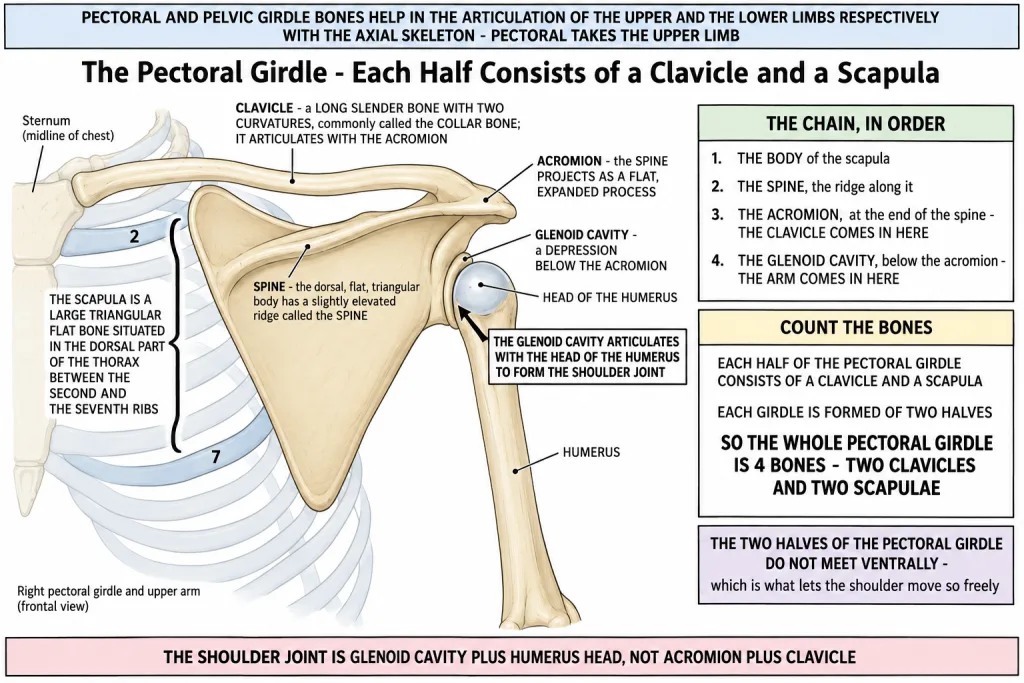
Each half of the pectoral girdle consists of a CLAVICLE and a SCAPULA. Two bones per half, so four bones in the whole pectoral girdle.
THE SCAPULA
The scapula is a large TRIANGULAR FLAT bone situated in the DORSAL part of the thorax BETWEEN THE SECOND AND THE SEVENTH RIBS. Every word of that is examinable, so take it apart:
| Feature of the scapula | The chapter's words |
|---|---|
| Size and shape | a large TRIANGULAR FLAT bone |
| Where it lies | in the DORSAL part of the thorax - on the back |
| How far it extends | between the SECOND and the SEVENTH ribs |
| Ridge on its body | the dorsal, flat, triangular body has a slightly elevated ridge called the SPINE |
| What the spine becomes | it projects as a flat, expanded process called the ACROMION |
| What meets the acromion | the CLAVICLE articulates with it |
| Below the acromion | a depression called the GLENOID CAVITY |
| What the glenoid cavity holds | it articulates with the HEAD OF THE HUMERUS to form the SHOULDER JOINT |
So the chain runs: body of the scapula, then the spine along it, then the acromion at the end of the spine where the clavicle comes in, and below the acromion the glenoid cavity where the arm comes in.
THE CLAVICLE
Each clavicle is a long slender bone with TWO CURVATURES. This bone is commonly called the COLLAR BONE. It is the bone you can feel running from the base of the neck out to the point of the shoulder, and its outer end articulates with the acromion of the scapula.
[NEET Important] Between the SECOND and the SEVENTH ribs is the detail most often changed in a false statement - the numbers offered are the first and the sixth, or the third and the eighth. Keep three names apart: the SPINE is the ridge, the ACROMION is the flat expanded process the spine projects into and it takes the clavicle, and the GLENOID CAVITY is the depression below the acromion and it takes the head of the humerus. The shoulder joint is glenoid cavity plus humerus head, not acromion plus clavicle.
The Pelvic Girdle - Two Coxal Bones
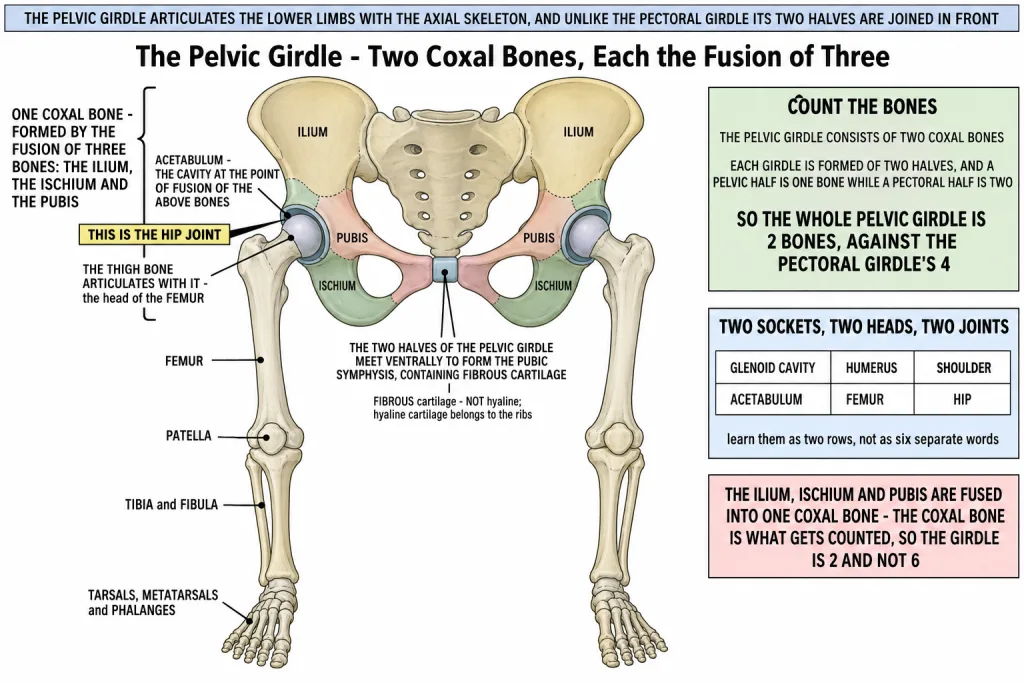
The pelvic girdle consists of TWO COXAL BONES - one for each half, so two bones in the whole girdle, against the pectoral girdle's four.
Each coxal bone is formed by the FUSION OF THREE BONES - the ILIUM, the ISCHIUM and the PUBIS. They are separate bones early in life and fuse into one; that is why a single coxal bone carries three names.
| Part of the pelvic girdle | The fact |
|---|---|
| Number of coxal bones | 2, one in each half |
| Bones fused in each coxal bone | ILIUM, ISCHIUM and PUBIS - three |
| The cavity at the point of fusion | the ACETABULUM |
| What the acetabulum holds | the THIGH BONE articulates with it - the head of the femur |
| Where the two halves meet in front | ventrally, at the PUBIC SYMPHYSIS |
| What the pubic symphysis contains | FIBROUS CARTILAGE |
At the point of fusion of the above bones is a cavity called the ACETABULUM, to which the THIGH BONE articulates. That is the hip joint - the socket of the pelvic girdle taking the head of the femur, exactly as the glenoid cavity of the scapula takes the head of the humerus.
The two halves of the pelvic girdle meet VENTRALLY to form the PUBIC SYMPHYSIS, containing FIBROUS CARTILAGE. This is a point of difference worth noticing now: the two halves of the pelvic girdle join each other in front, and the two halves of the pectoral girdle do not.
[NEET Important] Three fused bones, one cavity, one joint in front. Ilium, ischium and pubis are asked as a set of three, and the trap is slipping ischium and ilium past each other in a matching item. The acetabulum takes the thigh bone - if an option says it takes the humerus, it has swapped the two girdles. The pubic symphysis contains FIBROUS cartilage, not hyaline cartilage - hyaline cartilage belongs to the ribs.
Pectoral Against Pelvic - the Comparison, Line by Line
These two girdles do the same job at opposite ends of the body, which is what makes them a set comparison. Take them line by line and the answer writes itself.
| Point of difference | PECTORAL girdle | PELVIC girdle |
|---|---|---|
| Which limb it attaches | attaches the UPPER limbs to the axial skeleton | attaches the LOWER limbs to the axial skeleton |
| What each half is made of | a CLAVICLE and a SCAPULA - two bones | one COXAL BONE, itself formed by the fusion of three bones - ILIUM, ISCHIUM and PUBIS |
| Total bones in the girdle | 4 - two clavicles and two scapulae | 2 - two coxal bones |
| The socket | the GLENOID CAVITY, a depression below the acromion | the ACETABULUM, a cavity at the point of fusion of the three bones |
| Which bone head it receives | the head of the HUMERUS | the head of the FEMUR, the thigh bone |
| The joint formed | the SHOULDER joint | the HIP joint |
| How the two halves meet ventrally | they do NOT meet ventrally | they MEET VENTRALLY to form the PUBIC SYMPHYSIS, containing FIBROUS CARTILAGE |
Read the last row twice. The pectoral girdle has no ventral union between its halves - each half is held on by the clavicle in front and by muscle, which is what lets the shoulder move so freely. The pelvic girdle is closed in front at the pubic symphysis, which is what makes the hip a firm weight-bearing ring.
Two sockets, two heads, two joints: glenoid cavity - humerus - shoulder on the top, acetabulum - femur - hip at the bottom. Learn them as two rows, not as six separate words.
[NEET Important] This comparison is set as a "write the difference" exercise, so it must come out as a TABLE with the points of difference named. The single most confused pair is glenoid cavity against acetabulum; the second is which girdle has the fused bones - it is the PELVIC girdle whose coxal bone is three bones fused, not the pectoral.
Quick Recap
- Pectoral and pelvic girdle bones help in the ARTICULATION of the UPPER and the LOWER limbs respectively with the AXIAL SKELETON.
- Each girdle is formed of TWO HALVES.
- Each half of the pectoral girdle consists of a CLAVICLE and a SCAPULA - so 4 bones in the whole pectoral girdle.
- The SCAPULA is a large TRIANGULAR FLAT bone situated in the DORSAL part of the thorax BETWEEN THE SECOND AND THE SEVENTH RIBS.
- Its dorsal, flat, triangular body has a slightly elevated ridge called the SPINE, which projects as a flat, expanded process called the ACROMION.
- The CLAVICLE articulates with the acromion.
- Below the acromion is a depression called the GLENOID CAVITY, which articulates with the HEAD OF THE HUMERUS to form the SHOULDER JOINT.
- Each CLAVICLE is a long slender bone with TWO CURVATURES, commonly called the COLLAR BONE.
- The PELVIC girdle consists of TWO COXAL BONES.
- Each coxal bone is formed by the FUSION OF THREE BONES - ILIUM, ISCHIUM and PUBIS.
- At the point of fusion of those bones is a cavity called the ACETABULUM, to which the THIGH BONE articulates - the hip joint.
- The two halves of the pelvic girdle meet VENTRALLY to form the PUBIC SYMPHYSIS, containing FIBROUS CARTILAGE.
- The two halves of the pectoral girdle do NOT meet ventrally.
- The two sockets: GLENOID CAVITY takes the humerus and makes the shoulder; ACETABULUM takes the femur and makes the hip.
Solved Examples
Question 1
Q. What do the girdle bones do?
Answer. Pectoral and pelvic girdle bones help in the articulation of the upper and the lower limbs respectively with the axial skeleton. In plain words, the girdles are what fasten the limbs onto the main axis of the body, and they are counted with the limbs in the appendicular skeleton.
Question 2
Q. How many halves does a girdle have?
Answer. Each girdle is formed of two halves - both the pectoral girdle and the pelvic girdle.
Question 3
Q. What does each half of the pectoral girdle consist of?
Answer. A clavicle and a scapula. So the whole pectoral girdle has 4 bones - two clavicles and two scapulae.
Question 4
Q. Describe the scapula - its shape, its position and its extent.
Answer. The scapula is a large TRIANGULAR FLAT bone. It is situated in the DORSAL part of the thorax, that is on the back, between the SECOND and the SEVENTH ribs.
Question 5
Q. What are the spine and the acromion of the scapula?
Answer. The dorsal, flat, triangular body of the scapula has a slightly elevated ridge called the SPINE. The spine projects as a flat, expanded process called the ACROMION, and the clavicle articulates with the acromion.
Question 6
Q. What is the glenoid cavity and what does it do?
Answer. The glenoid cavity is a depression below the acromion. It articulates with the head of the humerus to form the SHOULDER JOINT.
Question 7
Q. Describe the clavicle and give its common name.
Answer. Each clavicle is a long slender bone with TWO CURVATURES. It is commonly called the COLLAR BONE, and its outer end articulates with the acromion of the scapula.
Question 8
Q. What is the pelvic girdle made of?
Answer. Two coxal bones, one in each half. Each coxal bone is formed by the fusion of three bones - the ilium, the ischium and the pubis.
Question 9
Q. What is the acetabulum?
Answer. A cavity at the point of fusion of the ilium, the ischium and the pubis. The thigh bone articulates with it, which is how the hind limb is hung on the pelvic girdle.
Question 10
Q. How do the two halves of the pelvic girdle meet, and what is at the junction?
Answer. They meet VENTRALLY to form the PUBIC SYMPHYSIS, and the pubic symphysis contains FIBROUS CARTILAGE.
Question 11
Q. Write the difference between the Pectoral and the Pelvic girdle. This is one of the chapter-end exercises.
Answer.
| Point of difference | PECTORAL girdle | PELVIC girdle |
|---|---|---|
| Which limb it attaches to the axial skeleton | the UPPER limbs | the LOWER limbs |
| What each half is made of | a CLAVICLE and a SCAPULA - two separate bones | a single COXAL BONE, formed by the FUSION OF THREE BONES - ilium, ischium and pubis |
| Total bones in the girdle | 4 - two clavicles and two scapulae | 2 - two coxal bones |
| The socket it carries | the GLENOID CAVITY, a depression below the acromion of the scapula | the ACETABULUM, a cavity at the point of fusion of the three bones |
| Which bone head the socket receives | the head of the HUMERUS | the THIGH BONE, that is the head of the FEMUR |
| The joint formed | the SHOULDER joint | the HIP joint |
| How the two halves meet ventrally | they do NOT meet ventrally | they MEET VENTRALLY at the PUBIC SYMPHYSIS, which contains FIBROUS CARTILAGE |
Both girdles are formed of two halves, and both fasten a pair of limbs onto the axial skeleton - that is what they have in common. Everything in the table above is where they part company.
Question 12
Q. Which girdle has a bone formed by fusion, and which three bones fuse?
Answer. The pelvic girdle. Each coxal bone is formed by the fusion of the ILIUM, the ISCHIUM and the PUBIS. The pectoral girdle has no fused bone - its clavicle and scapula stay separate.
Question 13
Q. Name the socket of each girdle and the bone head it receives.
Answer. Pectoral girdle - the GLENOID CAVITY, which receives the head of the HUMERUS and forms the shoulder joint. Pelvic girdle - the ACETABULUM, which receives the THIGH BONE and forms the hip joint.
Question 14
Q. Why can the shoulder move more freely than the hip?
Answer. Because the two halves of the pectoral girdle do not meet ventrally, while the two halves of the pelvic girdle are joined in front at the pubic symphysis. The pelvic girdle is a closed, firm ring that carries the weight of the body; the pectoral girdle is open in front, so the scapula can slide and the arm can swing.
Question 15
Q. Which cartilage is present at the pubic symphysis?
Answer. Fibrous cartilage. The two halves of the pelvic girdle meet ventrally to form the pubic symphysis containing fibrous cartilage. Do not write hyaline cartilage here - hyaline cartilage is what attaches the true ribs to the sternum.