
The Appendicular Skeleton - and the 30 Bones of One Limb
The bones of the limbs along with their girdles constitute the APPENDICULAR SKELETON.
That is the second of the two principal divisions of the skeleton. The axial skeleton is the 80 bones along the main axis of the body - skull, vertebral column, sternum and ribs. Everything else, the arms and legs and the two girdles that hang them on the axis, is appendicular.
Each limb is made of 30 BONES.
That single number covers both kinds of limb. A fore limb has 30 bones and a hind limb has 30 bones, even though the two lists are not identical - and the way they are made equal is a question in itself, which the block on the arithmetic below settles.
| Division | Number of bones | What it is made of |
|---|---|---|
| AXIAL skeleton | 80 bones | skull, vertebral column, sternum, ribs |
| APPENDICULAR skeleton | the limb bones plus the girdles | the bones of the limbs along with their girdles |
| One limb | 30 bones | true of a fore limb and of a hind limb alike |
[NEET Important] "Each limb is made of 30 bones" is a quoted sentence and it is asked as it stands. The standard distractor is 80, which is the axial count, and 60, which is two limbs of the same kind added together. Read whether the stem says a limb, the limbs of one side, or the whole appendicular skeleton - three different numbers.
The Bones of the Hand - the Fore Limb
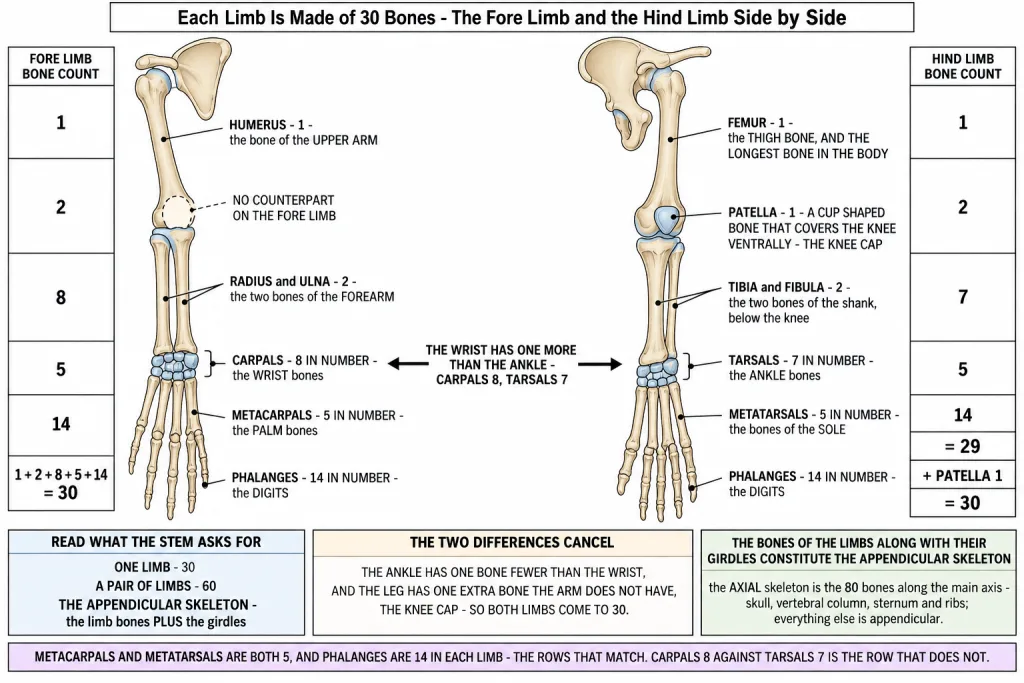
The bones of the hand (fore limb) are the HUMERUS, the RADIUS and ULNA, the CARPALS, the METACARPALS and the PHALANGES. Learn them as a table of counts, from the shoulder downwards:
| Bone | How many | What it is |
|---|---|---|
| HUMERUS | 1 | the bone of the upper arm |
| RADIUS and ULNA | 2 | the two bones of the forearm |
| CARPALS | 8 in number | the WRIST bones |
| METACARPALS | 5 in number | the PALM bones |
| PHALANGES | 14 in number | the DIGITS - the finger bones |
| Total | 30 | the bones of one fore limb |
Three of those rows carry their number in the chapter's own words: carpals (wrist bones - 8 in number), metacarpals (palm bones - 5 in number) and phalanges (digits - 14 in number). The humerus and the radius and ulna are not given a number in the text because they are obvious - one bone above the elbow, two below it.
Why the phalanges come to 14 and not 15, if you want the reason rather than the number: the thumb has two phalanges while each of the other four digits has three, so 2 + 3 + 3 + 3 + 3 = 14. The chapter only gives you the total, and the total is what is asked.
[NEET Important] Carpals 8, metacarpals 5, phalanges 14 is the most-asked row of numbers in the skeletal section. The trap is the carpal/metacarpal swap - the wrist has 8 and the palm has 5, never the other way round. And note the radius and the ulna belong to the forearm, below the elbow; an option putting the humerus in the forearm is wrong.
The Bones of the Leg - the Hind Limb, and the Patella
Femur (thigh bone - the longest bone), tibia and fibula, tarsals (ankle bones - 7 in number), metatarsals (5 in number) and phalanges (digits - 14 in number) are the bones of the legs (hind limb).
| Bone | How many | What it is |
|---|---|---|
| FEMUR | 1 | the THIGH bone, and THE LONGEST BONE in the body |
| TIBIA and FIBULA | 2 | the two bones of the shank, below the knee |
| TARSALS | 7 in number | the ANKLE bones |
| METATARSALS | 5 in number | the bones of the sole |
| PHALANGES | 14 in number | the DIGITS - the toe bones |
| PATELLA | 1 | the KNEE CAP |
| Total | 30 | the bones of one hind limb |
A cup shaped bone called the PATELLA covers the knee VENTRALLY. It is the knee cap. Three things are asked about it and all three are in that one sentence: it is CUP SHAPED, it covers the KNEE, and it lies VENTRALLY - on the front of the joint, not behind it.
The femur carries a title: it is the longest bone of the human body. The chapter states this in passing, in brackets, and it is asked as a straight one-mark question.
[NEET Important] The patella is the answer to two different questions - "name the knee cap" and "which bone covers the knee ventrally". The word VENTRALLY is the one that gets changed in a false statement; dorsally is wrong. The other guaranteed item here is the femur as the longest bone, with the humerus and the tibia offered beside it.
The Arithmetic That Makes 30 - and the Pair That Gets Swapped
The chapter says each limb has 30 bones but never adds either list up. Do it once and you will never mix the two lists again.
The FORE LIMB:
| Bone | Count |
|---|---|
| Humerus | 1 |
| Radius and ulna | 2 |
| Carpals | 8 |
| Metacarpals | 5 |
| Phalanges | 14 |
| Total | 30 |
1 + 2 + 8 + 5 + 14 = 30.
The HIND LIMB:
| Bone | Count |
|---|---|
| Femur | 1 |
| Tibia and fibula | 2 |
| Tarsals | 7 |
| Metatarsals | 5 |
| Phalanges | 14 |
| Sub-total | 29 |
| Patella | 1 |
| Total | 30 |
1 + 2 + 7 + 5 + 14 = 29, plus the patella = 30.
The patella is what makes the hind limb reach the same 30. Say that plainly, because it is the neatest way to hold both lists in the head at once: the two lists run parallel bone for bone - one thigh bone against one upper arm bone, two shank bones against two forearm bones, five sole bones against five palm bones, fourteen toe bones against fourteen finger bones - and they differ in exactly two places. The ankle has one bone fewer than the wrist, and the leg has one extra bone that the arm does not have, the knee cap. The two differences cancel, and both limbs come to 30.
Now the pair that gets swapped in every second question:
| Wrist and ankle | Count |
|---|---|
| CARPALS - the wrist bones | 8 |
| TARSALS - the ankle bones | 7 |
The wrist has one more than the ankle. Carpals 8, tarsals 7. If you can hold that one line, the rest of both limb lists is symmetrical.
[NEET Important] Do not memorise 30 as a bare fact - rebuild it. Fore limb 1 + 2 + 8 + 5 + 14 = 30. Hind limb 1 + 2 + 7 + 5 + 14 = 29, and the patella makes it 30. A question asking "how many bones in the hind limb excluding the patella" wants 29, and a student who only remembers the number 30 has nothing to work with. The single most examined confusion is carpals 8 against tarsals 7; the second is metacarpals and metatarsals, which are BOTH 5.
Quick Recap
- The bones of the limbs along with their girdles constitute the APPENDICULAR SKELETON.
- Each limb is made of 30 BONES - true of a fore limb and of a hind limb alike.
- Fore limb (the hand): HUMERUS, RADIUS and ULNA, CARPALS (wrist bones - 8 in number), METACARPALS (palm bones - 5 in number), PHALANGES (digits - 14 in number).
- Hind limb (the leg): FEMUR (thigh bone - the LONGEST BONE), TIBIA and FIBULA, TARSALS (ankle bones - 7 in number), METATARSALS (5 in number), PHALANGES (digits - 14 in number).
- A cup shaped bone called the PATELLA covers the knee VENTRALLY - the KNEE CAP.
- Fore limb sum: 1 + 2 + 8 + 5 + 14 = 30.
- Hind limb sum: 1 + 2 + 7 + 5 + 14 = 29, plus the patella = 30.
- The patella is what makes the hind limb reach the same 30 as the fore limb.
- The pair that gets swapped: CARPALS 8 and TARSALS 7 - the wrist has one more than the ankle.
- Metacarpals and metatarsals are both 5, and phalanges are 14 in each limb.
- The femur is the longest bone in the human body.
Solved Examples
Question 1
Q. What does the appendicular skeleton consist of?
Answer. The bones of the limbs along with their girdles constitute the appendicular skeleton. It is one of the two principal divisions of the skeleton, the other being the axial skeleton of 80 bones - skull, vertebral column, sternum and ribs.
Question 2
Q. How many bones make up one limb?
Answer. Each limb is made of 30 bones. That holds for a fore limb and for a hind limb alike.
Question 3
Q. Name the bones of the fore limb in order, with their numbers.
Answer. From the shoulder downwards: humerus (1), radius and ulna (2), carpals - the wrist bones, 8 in number, metacarpals - the palm bones, 5 in number, and phalanges - the digits, 14 in number. They add to 30.
Question 4
Q. Name the bones of the hind limb in order, with their numbers.
Answer. From the hip downwards: femur - the thigh bone, and the longest bone (1), tibia and fibula (2), tarsals - the ankle bones, 7 in number, metatarsals, 5 in number, and phalanges - the digits, 14 in number. Add the patella and they come to 30.
Question 5
Q. The number of phalanges in each limb of human is __. This is one of the chapter-end exercises.
Answer. The number of phalanges in each limb of human is 14.
The whole sentence, with the blank filled, is: "The number of phalanges in each limb of human is FOURTEEN."
Why the exercise can say "each limb": the phalanges are 14 in the fore limb and 14 in the hind limb. The chapter gives the count twice, once in each list - phalanges (digits - 14 in number) among the bones of the hand, and phalanges (digits - 14 in number) again among the bones of the leg. The number is the same in both, which is exactly why the question does not need to say which limb it means.
| Limb | Phalanges |
|---|---|
| Fore limb (the hand) | 14 |
| Hind limb (the leg) | 14 |
If you want the reason behind the 14: the thumb, and the big toe, have two phalanges each while the other four digits have three each - 2 + 3 + 3 + 3 + 3 = 14. The chapter asks only for the total.
Question 6
Q. How many carpals and how many tarsals are there, and which is which?
Answer. Carpals are the WRIST bones and there are 8 of them. Tarsals are the ANKLE bones and there are 7 of them. The wrist has one more than the ankle.
Question 7
Q. How many metacarpals and metatarsals are there?
Answer. Five each. Metacarpals are the palm bones, 5 in number, and metatarsals are 5 in number in the sole of the foot. This is the one pair of numbers in the two limbs that is genuinely the same, so it is safe to remember them together.
Question 8
Q. Which is the longest bone in the human body?
Answer. The femur, the thigh bone of the hind limb.
Question 9
Q. Describe the patella in one sentence, and say where it lies.
Answer. The patella is a cup shaped bone that covers the knee ventrally, and it is commonly called the knee cap. Ventrally means on the front of the joint.
Question 10
Q. Show that the fore limb has 30 bones.
Answer. Humerus 1 + radius and ulna 2 + carpals 8 + metacarpals 5 + phalanges 14 = 30.
Question 11
Q. Show that the hind limb also has 30 bones, and say which bone makes up the difference.
Answer. Femur 1 + tibia and fibula 2 + tarsals 7 + metatarsals 5 + phalanges 14 = 29, and the patella adds 1 to give 30.
The patella is what makes the hind limb reach the same 30 as the fore limb. The two lists run parallel bone for bone, and they differ in exactly two places: the ankle has 7 tarsals against the wrist's 8 carpals, one bone fewer, and the leg has an extra bone the arm does not have, the knee cap. The two differences cancel.
Question 12
Q. How many bones are there in the hind limb if the patella is not counted?
Answer. 29. Femur 1 + tibia and fibula 2 + tarsals 7 + metatarsals 5 + phalanges 14 = 29, and the count of 30 includes the patella.
Question 13
Q. Which bones lie in the forearm, and which in the shank?
Answer. The radius and the ulna lie in the forearm, below the elbow, with the humerus above the elbow. The tibia and the fibula lie in the shank, below the knee, with the femur above it.
Question 14
Q. A student writes that the palm has 8 bones and the wrist has 5. Correct him.
Answer. He has swapped them. The carpals are the wrist bones and there are 8; the metacarpals are the palm bones and there are 5. The prefix helps: meta- means "after", so the metacarpals come after the carpals, further out towards the fingers.