
How Many Numbers Does It Take to Describe a Molecule?
The last two sections treated a gas molecule as a moving dot. That was enough to get the pressure and to find out what temperature really is. But a dot is a lie, and it is about to cost us.
Oxygen is not a dot. It is two atoms bonded together — a tiny dumbbell. It can fly across the room, and it can also tumble, and the bond between the atoms can stretch and squash like a spring. Every one of those is somewhere to put energy. Heat a gas of dumbbells and the heat has more places to go than it does in a gas of dots.
So before we can say anything about how much energy a gas holds, we have to count the places. That counting is this section, and the number it produces feeds straight into the next two.
The definition
Key Point — degree of freedom:
A degree of freedom is one independent coordinate that you must specify in order to fix the state of motion of a molecule completely.Count them by asking a simple question: how many numbers do I have to hand you before you know exactly where every atom of this molecule is? That count is the number of degrees of freedom.
The picture below is the whole idea in three steps.
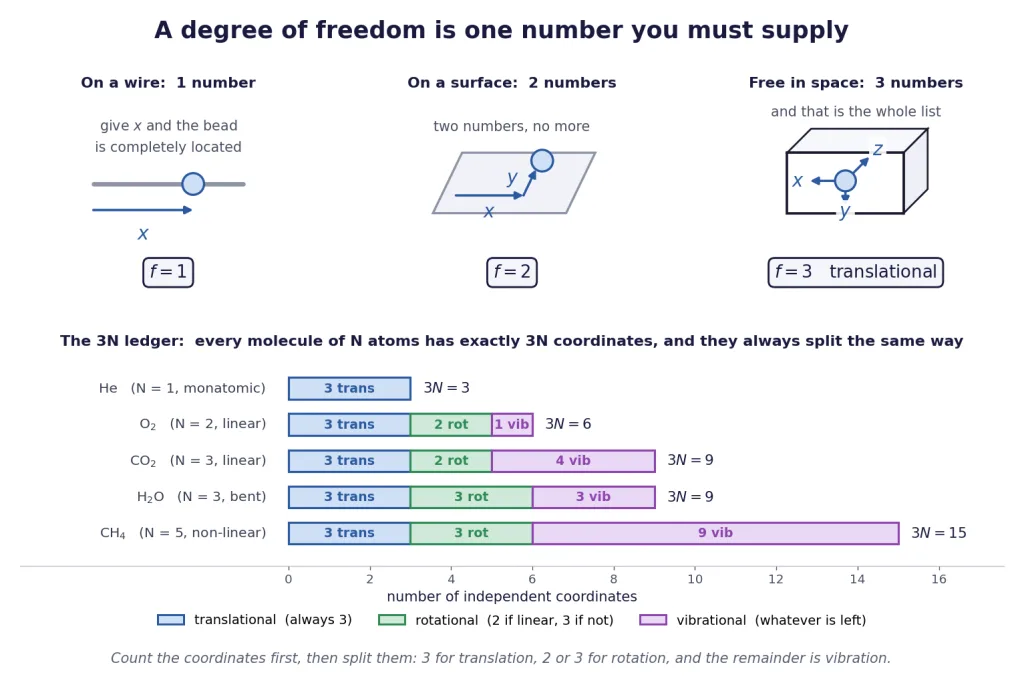
- A bead threaded on a straight wire can only slide along it. One number, , and you have it. That is 1 degree of freedom.
- A puck sliding on a tabletop needs two, and . That is 2.
- A molecule flying freely inside a container needs three, , and . That is 3.
Nothing subtle has happened yet. But notice what we counted: not "how many directions can it move in" in some vague sense, but how many numbers are genuinely independent. That distinction is what makes the counting reliable later on, when the molecule stops being a dot.
The 3N rule — the only counting rule you need
Here is the whole of the bookkeeping, and it is exact.
Key Point — the 3N rule:
A molecule made of atoms has exactly degrees of freedom, because each of its atoms needs three coordinates of its own to be located. Those coordinates are then re-labelled — never added to, never lost — into three families:
Read that again, because it is the trick that makes every question in this section a twenty-second question. You do not count translations, then rotations, then vibrations, and hope they add up. You count the total first — that is just — then take out the 3 translations, then take out the rotations, and whatever is left over must be vibration. The books never run out and never over-count.
Why is it ? Because a molecule is nothing but its atoms. If you told me the , and of every atom in a water molecule — nine numbers — I would know the molecule's position, its orientation and exactly how stretched its bonds are. There is nothing left to ask. Nine numbers, nine degrees of freedom.
A note on symbols, because this one bites. In this section means the number of atoms inside one molecule — 1 for helium, 2 for oxygen, 3 for water. Elsewhere in this chapter is the number of molecules in a sample and is the Avogadro number. Same letter, completely different job. Read the sentence around it, always.
The three families
Translational — the molecule as a whole moves from one place to another. Always 3, for every molecule from helium to a protein, because a centre of mass is a point and a point in space needs three coordinates. This never changes, and it is the only part of the count that never changes.
Rotational — the molecule tumbles about its centre of mass without going anywhere. Either 2 or 3, and which one it is depends only on the molecule's shape. Sections below deal with each case.
Vibrational — the atoms move relative to each other: bonds stretch, compress, and bend. This is the leftover, minus the translations minus the rotations.
Key Point — the number we are really after:
We will call the final count . Strictly, is the number of quadratic terms in the molecule's energy — the number of independent squared quantities like or that appear when you write down its energy. For translation and rotation, one degree of freedom gives exactly one quadratic term, so the two counts are the same. For vibration they are not, as the fourth block shows. Whenever an exam says "degrees of freedom" and expects a number to put into a formula, it wants .
[Board Important] The phrase "degrees of freedom" is used loosely by almost everyone to mean . Learn to count , and translate on the fly.
Everything from here is just applying the rule to a molecule of a particular shape — and then asking a harder question: of the modes we counted, which ones are actually awake at the temperature we care about?
Monatomic and Diatomic: Where the Missing Rotation Went
Monatomic — the easy case
Helium, neon, argon, and the vapours of metals such as mercury and sodium go around as single atoms. , so the rule gives coordinates in total, and all three are used up locating the atom. There is nothing left.
A single atom has no orientation you could meaningfully specify — "which way is the helium atom facing?" is not a question about anything — and with only one atom there is no bond to stretch. So a monatomic gas has three degrees of freedom and only three, at every temperature you can reach before the atom itself starts falling apart. It is the one entry in the whole table that never changes.
Diatomic — the interesting case
Now oxygen, nitrogen, hydrogen, carbon monoxide, chlorine: two atoms joined by a bond. , so
Three of them are the translation of the centre of mass. That leaves three to account for. Where do they go?
One of them is easy. The distance between the two atoms can change — the bond can stretch and compress. That is 1 vibrational degree of freedom.
So there are exactly 2 rotational degrees of freedom left. And now the good question: a rigid body in three dimensions can spin about three perpendicular axes. Why do we get 2 here and not 3?
Why rotation about the bond axis does not count
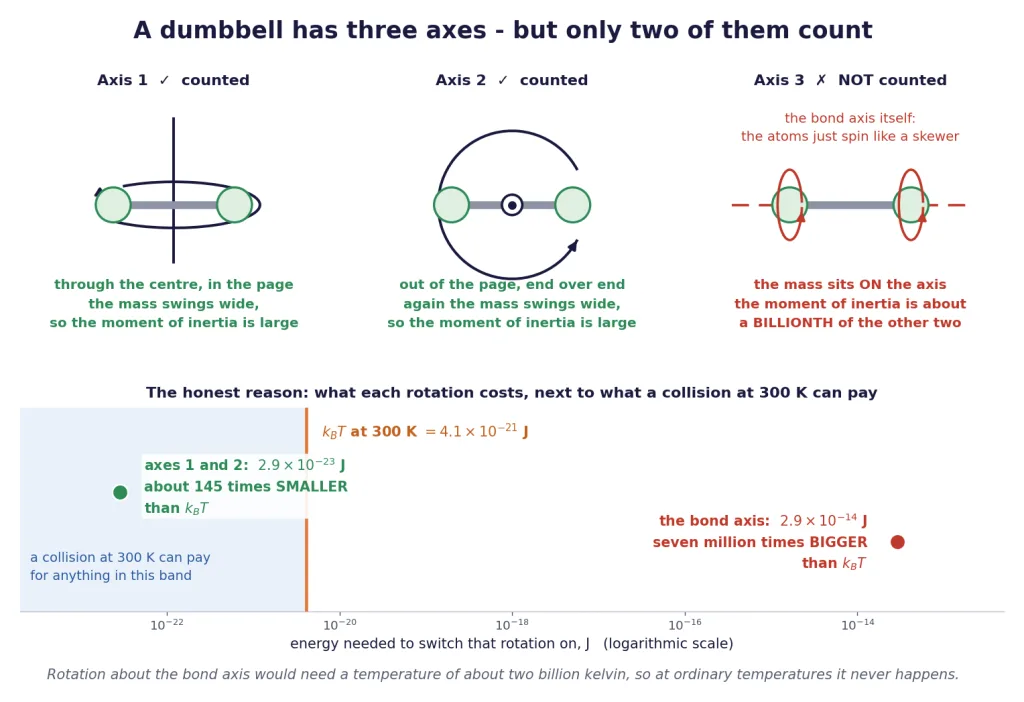
Look at the three axes through the centre of the dumbbell.
Axes 1 and 2 are perpendicular to the bond — one in the page, one coming out of it. Spin the molecule about either and the two atoms swing around in wide circles, well away from the axis. The moment of inertia is respectable. Put in an oxygen molecule's numbers: each atom has mass
(the molar mass had to go in as 0.032 kg/mol, not as 32 — that conversion is the single most common wrecked answer in this chapter), and each sits half a bond length, m, from the axis. So
Axis 3 is the bond axis itself — the line joining the two atoms. Spin the molecule about that and nothing much moves at all. The atoms are already sitting on the axis. All that turns is the substance of the two atoms about their own centres, and essentially all of an atom's mass is packed into a nucleus whose radius is around m, roughly a hundred thousand times smaller than the bond length. Squaring that ratio,
The moment of inertia about the bond axis is about a billionth of the moment of inertia about the other two. That is the classical half of the answer: there is nothing there to rotate.
The honest half of the answer
"Very small" is not the same as "zero", and a sceptical student is right to push. If were merely small, the mode would still be there, and would still take its share of energy. The real reason it does not is quantum mechanical, and it is worth seeing once even though the full theory comes years later.
Rotational energy is not continuous. A molecule cannot spin at just any rate: the smallest amount of rotational energy it can accept about an axis of moment of inertia is of order
Notice that is in the denominator. A small moment of inertia means a huge minimum energy — exactly backwards from the classical intuition. Run the two numbers for oxygen at room temperature, where a typical collision has about J to spend:
| Axis | (kg m) | Smallest energy it will accept | Compared with at 300 K |
|---|---|---|---|
| Perpendicular (axes 1, 2) | J | about 145 times smaller — easily paid | |
| Along the bond (axis 3) | J | about 7 million times bigger — impossible |
To excite rotation about the bond axis you would need a temperature of roughly two billion kelvin. At any temperature at which oxygen is still oxygen, that mode is not merely small — it is completely unavailable. It contributes nothing, and it is not counted.
Key Point — the diatomic count: Rotation about the bond axis is excluded: its moment of inertia is about of the others, and quantum mechanically the energy needed to start it is millions of times more than a collision at ordinary temperature can supply.
Treating the molecule as a rigid rotator — a dumbbell whose bond cannot stretch — gives
[JEE Tip] "Why 2 and not 3?" is asked in words at Boards and hidden inside numericals at JEE. Give both halves of the answer: negligible moment of inertia about the bond axis, and the quantum-mechanical fact that the mode cannot be excited at ordinary temperatures. The second half is what turns a 2-mark answer into a 3-mark one.
If the bond is not treated as rigid, that leftover vibrational degree of freedom comes back into play — and as the fourth block shows, it is worth double.
Linear or Bent? The Distinction That Changes Every Answer
Three atoms. Same coordinates. Two completely different answers, depending on nothing but the shape.
This is the point at which a lot of students — and a lot of quick summaries, which lump every three-atom molecule into a single "triatomic" row — go wrong, and it is worth getting right the first time, because everything downstream inherits the error.
Carbon dioxide is a straight line
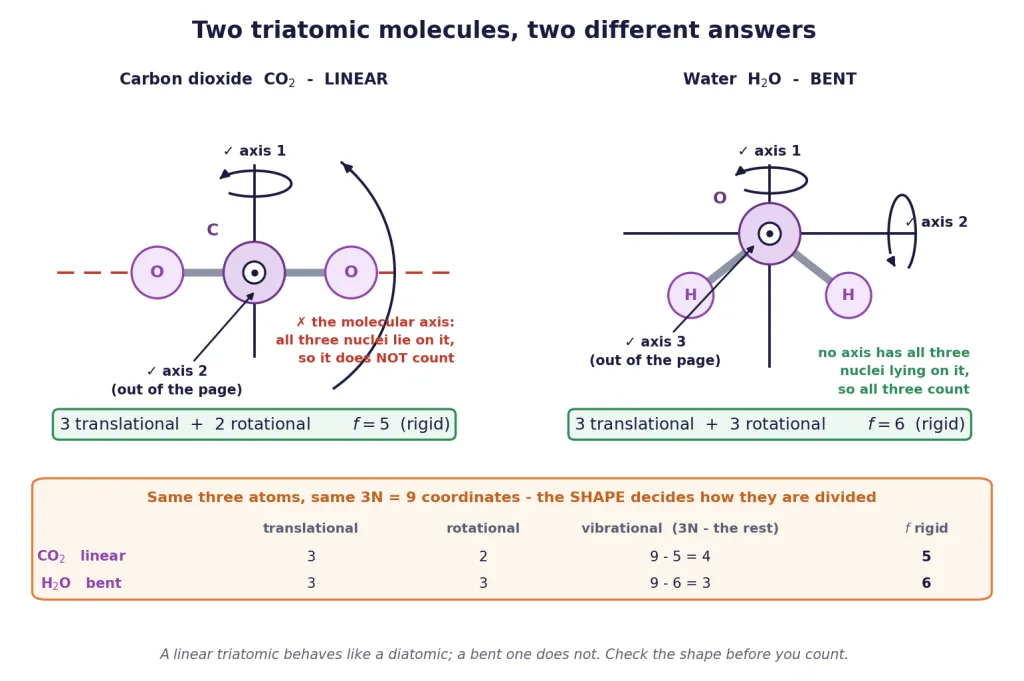
In the two oxygens sit on opposite sides of the carbon, and all three nuclei lie on one straight line: . The bond angle is .
Now run the same axis argument as for the dumbbell. There is an axis along which all three nuclei lie. Rotation about that axis moves nothing, its moment of inertia is a billionth of the others, and its energy quantum is out of reach. It does not count. The other two axes, both perpendicular to the molecular line, count normally.
A linear molecule behaves, for counting purposes, exactly like a diatomic — however many atoms it has strung along the line. Carbon dioxide, nitrous oxide , acetylene , hydrogen cyanide : all of them, rigid, come out at .
Water is bent
In the two hydrogens sit at about to each other, not . The three nuclei form a triangle.
Try to find an axis with all three nuclei on it. There isn't one — you cannot draw a straight line through three points that are not collinear. Every axis you pick has at least one atom sitting a real distance away from it, so every axis has a decent moment of inertia, and every one of the three is a genuine rotation.
Key Point — the shape rule:
- Linear molecule (all nuclei on one straight line): 2 rotational degrees of freedom, and vibrational modes.
- Non-linear molecule (they are not): 3 rotational degrees of freedom, and vibrational modes.
Rigid, that means for every linear molecule and for every non-linear one, whatever is. A rigid non-linear molecule of forty atoms still has : the extra atoms all go into vibrations, and vibrations are what get frozen out.
Which is which
You cannot deduce the shape from the formula — you have to know it. The ones that come up are short enough to learn.
| Shape | Molecules you will meet | Rotational | rigid |
|---|---|---|---|
| Linear | , , , , (acetylene), and every diatomic | 2 | 5 |
| Bent / non-linear | , , , (ozone), , , , | 3 | 6 |
[NEET Important] and are the two that get asked, and they are on opposite sides of the line. Carbon dioxide is linear, so it counts like a diatomic; water is bent, so it does not. If a question just says "a triatomic gas" without telling you the shape, the intended answer is almost always the non-linear one with — but if it names , it wants 5.
[JEE Tip] The trap is set with a molecule you have to think about. Acetylene has four atoms, which sounds polyatomic and non-linear — but it is , a straight line, so rigid it has , not 6. Count atoms second; check the shape first.
Why the rotational count differs at all
It is worth seeing that the two rules are not two rules. They are one rule applied twice: a rotation counts if, and only if, moving about that axis actually moves the atoms. A linear molecule has one direction along which its atoms are already lined up, so that one rotation is dead. A bent molecule has no such direction, so none of its rotations is dead. That is the entire difference, and it is why the vibrational leftovers differ too: linear molecules give up one fewer coordinate to rotation, so they keep one more for vibration, against .
Vibration: The Mode That Counts Twice
We have been putting the leftover coordinates into a box marked "vibrational" without looking inside. Time to look, because vibration behaves differently from everything else in this section, and the difference is worth exactly one factor of two.
What a vibrational mode actually is
In a vibrational mode the molecule's centre of mass stays put and its overall orientation stays put, but the atoms move relative to one another. In a diatomic there is only one way to do that: the two atoms move in and out along the bond, like two masses joined by a spring. Call the stretch — how much longer or shorter the bond is than its relaxed length.
For a polyatomic there is more than one way. Water's three modes are a symmetric stretch (both bonds lengthen together), an asymmetric stretch (one lengthens as the other shortens) and a bend (the angle opens and closes). Carbon dioxide has four, its bend counting twice because the molecule can bend in two independent planes. You are never asked to list them by name — only to count them, and the rule does the counting for you.
Why it is worth two
Here is the part that matters. Write down the energy of a single vibrating bond. It has two pieces:
where is the force constant of the bond. Both terms are quadratic — one in the vibrational velocity , one in the vibrational coordinate itself.
Compare that with the other two families:
- Translation along contributes . One squared quantity. One quadratic term.
- Rotation about axis 1 contributes . One squared quantity. One quadratic term.
- Vibration in one mode contributes both and . Two quadratic terms.
The asymmetry is not a convention. It is physical. A translating molecule stores energy in its motion and nowhere else — there is no potential energy associated with simply being at rather than at . A rotating rigid molecule likewise stores energy in its motion only; no orientation costs more than any other. But a stretched bond stores energy even when it is momentarily at rest, at the ends of its swing, in exactly the way a compressed spring does. That stored potential energy is a second, independent place to keep energy, and the counting has to reflect it.
Key Point — vibration counts double:
Every vibrational mode supplies two quadratic terms, one kinetic and one potential, and therefore adds 2 to , not 1. where for a linear molecule and for a non-linear one.
So a diatomic whose bond really is vibrating has
not 6. Getting 6 here — counting the one vibrational mode once — is the commonest arithmetic slip in the whole topic.
[JEE Tip] Read the question for the word rigid. "A rigid diatomic molecule" means ignore vibration: . "A diatomic molecule which also vibrates", or "at high temperature", means include it: . If the question says nothing at all, the intended answer at Class 11 level is the rigid one — but a question that hands you a temperature of a few thousand kelvin is telling you something.
The quick table of leftovers
| Molecule | Shape | if rigid | if every vibration is active | ||
|---|---|---|---|---|---|
| , , | 2 | linear | 5 | ||
| 3 | linear | 5 | |||
| , | 3 | bent | 6 | ||
| 4 | non-linear | 6 | |||
| 5 | non-linear | 6 |
Those right-hand numbers look enormous, and they raise an obvious objection: methane at room temperature does not behave as though it had 24 places to store energy. Nothing like it. So which of these modes are real?
That is the next block, and the answer is one of the loveliest things in Class 11 physics.
Frozen Modes, and the Staircase That Gave Quantum Theory Away
Classical physics is unambiguous here: if a mode exists, it takes its share of energy. Always. At every temperature. There is no mechanism in Newtonian mechanics for a mode to sit an argument out.
Measurement flatly disagrees, and the disagreement is where quantum theory came from.
What is actually observed
Take hydrogen and measure how much heat it takes to warm it by one kelvin, over the widest range of temperature you can manage. If the counting were the whole story you would get a horizontal line. Instead you get a staircase.
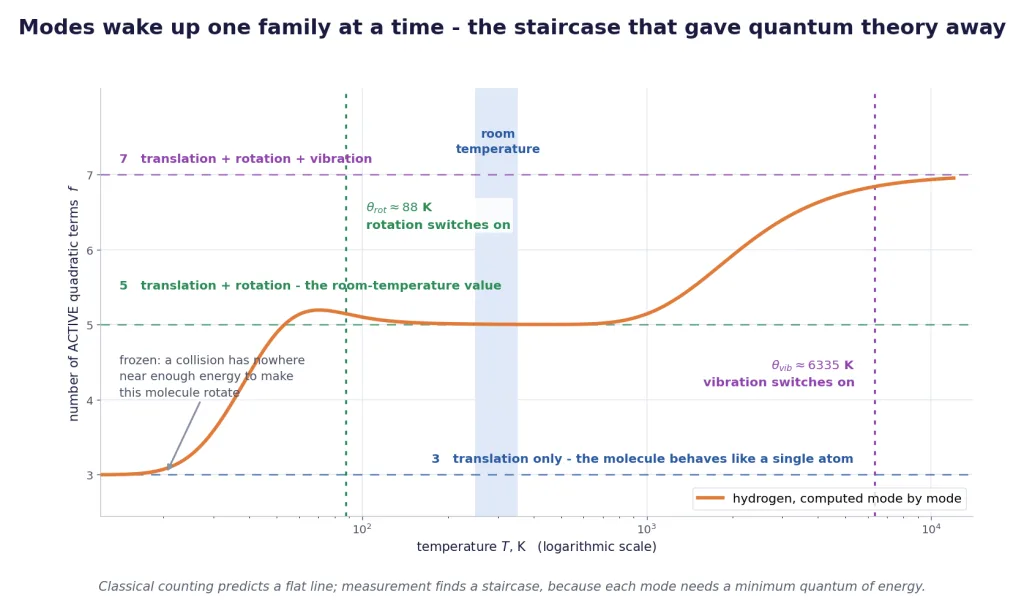
- Below about 30 K, hydrogen behaves as though — like a monatomic gas. Its molecules are unmistakably dumbbells, and yet they refuse to rotate.
- Through a broad plateau covering room temperature, . Translation and rotation, no vibration.
- Above about a thousand kelvin, climbs again — past 6 by around 3000 K and on towards 7 — as the bond finally starts to stretch.
The modes do not fade in gradually across the whole range. They switch on, one family at a time, each near its own characteristic temperature.
Why: energy comes in lumps
The same argument that killed rotation about the bond axis explains the whole staircase. A mode cannot accept an arbitrarily small dribble of energy. It has a minimum quantum — a smallest instalment it will take, or nothing at all.
Compare that instalment with , the rough energy available in a collision at temperature . Two outcomes, and no middle ground worth speaking of:
- If the instalment is much smaller than , collisions pay it constantly. The mode is fully awake and behaves exactly as classical counting says.
- If the instalment is much bigger than , almost no collision can pay it. The mode is frozen out: it exists, but it holds no energy and contributes nothing to .
It is convenient to turn each instalment into a temperature — the temperature at which is comparable to it. Call them and . Then the rule of thumb is as simple as it could be: a mode is awake when is well above its characteristic temperature and frozen when is well below it.
The numbers, and why room temperature lands where it does
| Gas | (K) | (K) | At 300 K: rotation | At 300 K: vibration |
|---|---|---|---|---|
| Hydrogen | 88 | 6335 | fully awake | frozen (under 0.01% active) |
| Nitrogen | 2.9 | 3396 | fully awake | frozen (about 0.15%) |
| Oxygen | 2.1 | 2274 | fully awake | frozen (about 3%) |
| Carbon monoxide | 2.8 | 3124 | fully awake | frozen (about 0.3%) |
| Chlorine | 0.35 | 806 | fully awake | partly awake (about 57%) |
| Iodine | 0.05 | 308 | fully awake | largely awake (about 92%) |
Read the two middle columns and the whole picture falls out.
Rotation is awake for everything. Every in that column is tiny compared with 300 — even hydrogen's 88 K, the largest of them by a wide margin, is comfortably below room temperature. This is why , not 3, is the room-temperature answer for the air you are breathing.
Vibration is asleep for the light, strongly bonded molecules. Oxygen's is 2274 K; at 300 K only about 3% of that mode is active, which rounds to nothing. Nitrogen's is worse. So for and — which is to say, for air — you count the vibration as absent and use .
But it is not asleep for everything. Look at chlorine and iodine. Heavy atoms on a weak bond vibrate slowly, so their quantum is small, so their characteristic temperature is low — and at 300 K those modes are already half awake or better. This is not a curiosity: it is why measured specific heats for chlorine and the heavier gases come out above the rigid-molecule prediction, a discrepancy the next-but-one section takes up in detail. Carbon monoxide is the molecule usually put forward as the diatomic whose vibration you should keep in mind; its of about 3100 K means that at room temperature it is in fact still frozen, and only well above a thousand kelvin does it start to matter.
Polyatomic molecules make the point again. Carbon dioxide's four vibrational modes are not equal: its bending modes have a characteristic temperature of about 960 K and are already roughly 45% awake at 300 K, while its asymmetric stretch, at about 3400 K, is completely dead. That mixture is exactly why misbehaves in specific-heat tables.
Why this mattered so much
Key Point — what the staircase means:
If energy could be transferred in arbitrarily small amounts, every mode would take its share at every temperature and would be a constant for each gas. That measured specific heats rise in steps, each step tied to a particular family of modes and a particular temperature, was among the earliest hard evidence that energy is exchanged in quanta.
It is worth pausing on how strange this was in 1900. The counting rules of this section are pure classical mechanics, and they are correct — the modes are all there, exactly as counted. What classical mechanics got wrong was assuming that every mode must be used. The resolution required a new physics, and specific heats measured in a laboratory, along with the spectrum of a hot object, were the two experiments that forced it.
[Board Important] Two sentences will earn the marks: at room temperature the vibrational modes of and are frozen out because the energy needed to excite them is far greater than , so those gases behave as rigid rotators with ; and the step-like temperature dependence of measured specific heats is evidence that molecular energy levels are quantised.
The Lookup Table, and How to Count Anything in Twenty Seconds
Everything in this section reduces to one table and one habit. The table is what the next two sections run on — they take and turn it into internal energy and then into specific heats — so it needs to be exactly right.
The table
Key Point — degrees of freedom, , for every case:
| Type of molecule | Examples | Total | Trans. | Rot. | Vib. modes | rigid | with all vibrations | |
|---|---|---|---|---|---|---|---|---|
| Monatomic | He, Ne, Ar, Kr, Hg vapour | 1 | 3 | 3 | 0 | 0 | 3 | 3 |
| Diatomic | , , , , , | 2 | 6 | 3 | 2 | 1 | 5 | 7 |
| Linear triatomic | , , | 3 | 9 | 3 | 2 | 4 | 5 | 13 |
| Bent triatomic | , , , | 3 | 9 | 3 | 3 | 3 | 6 | 12 |
| Linear, any | , | 3 | 2 | 5 | ||||
| Non-linear, any | , , | 3 | 3 | 6 |
Three numbers carry almost every question you will ever be asked: 3 for a single atom, 5 for anything linear, 6 for anything that is not. Vibration is what pushes you off those three values, and only when the question tells you it should.
The twenty-second recipe
- Count the atoms. That fixes the total at .
- Write down 3 for translation. Always 3, never anything else.
- Ask the shape. Straight line — including every diatomic — gives 2 rotational. Anything else gives 3.
- Subtract: vibrational modes .
- Decide whether vibration is on. Rigid, or room temperature, or nothing said: it is off, and . Vibrating, or a few thousand kelvin: it is on, and add 2 for each mode.
The five traps, in the order they catch people
1. Treating every three-atom molecule the same. and both have three atoms and different answers, 5 and 6. Always ask whether the molecule is linear. A summary that offers you a single "triatomic" row has quietly assumed the bent case.
2. Counting a vibrational mode once. Each one is worth 2, because a vibrating bond stores kinetic and potential energy. A vibrating diatomic has , not 6.
3. Counting a rotation about the bond axis. For any linear molecule that axis is dead, both because its moment of inertia is a billionth of the others and because the energy needed to excite it is millions of times .
4. Assuming a big molecule has a big . Rigid, a forty-atom non-linear molecule has , the same as water. Extra atoms buy you vibrational modes, and vibrational modes are precisely what is frozen out at ordinary temperatures.
5. Forgetting that the count depends on temperature. Hydrogen has below about 30 K, across a broad band that includes room temperature, and heads towards once it is a few thousand kelvin. The molecule never changes; what changes is which of its modes a collision can afford to excite.
What happens to this number next
You now have a count of the independent places a molecule can store energy. What you do not yet have is how much energy goes into each one — that is the law of equipartition, which is the next section, and it turns each of these quadratic terms into a definite number of joules. After that, one more short step converts the same into the specific heats that were measured in the previous chapter. One integer, honestly counted, produces every one of those numbers.
Which is why it is worth counting it honestly.
Solved Examples
Constants used throughout: J/K, per mol, J s (so Js). Room temperature means 300 K.
Example 1: Oxygen, counted properly
A molecule of oxygen, , is treated (a) as a rigid rotator and (b) as a molecule whose bond can also vibrate. Find the total number of coordinates, the split into the three families, and in each case.
Solution:
Total. Oxygen has atoms, so the total number of independent coordinates is
Translational. Always 3 — the centre of mass needs , , .
Rotational. is a straight line (every diatomic is), so one of the three possible axes — the bond axis — is dead. That leaves 2.
Vibrational, by subtraction. mode: the bond stretching.
(a) Rigid. The vibration is switched off, so only translation and rotation carry energy:
(b) Vibrating. The single vibrational mode contributes two quadratic terms, kinetic and potential:
Final Answer: , split as 3 translational, 2 rotational, 1 vibrational mode. rigid, vibrating.
Takeaway: The split is a count of coordinates; or is a count of quadratic terms. They differ because the one vibration is worth two. Never quote 6.
Example 2: Two triatomics that answer differently
Carbon dioxide is a linear molecule; sulphur dioxide is bent. For each, find the number of rotational degrees of freedom, the number of vibrational modes, and treating the molecule as rigid.
Solution:
Both have , so both have coordinates in total. Whatever separates them is not the atom count.
— linear. All three nuclei lie on one line, so the axis along that line has effectively no moment of inertia and cannot be excited. Rotational .
— bent. The three nuclei form a triangle, so no axis has all of them lying on it and all three rotations are real. Rotational .
Check the books balance. : . : . Both close on , as they must.
Final Answer: : 2 rotational, 4 vibrational modes, . : 3 rotational, 3 vibrational modes, .
Takeaway: Same , same , different — the shape is doing all the work. A linear triatomic counts as a diatomic; a bent one does not.
Example 3: Methane, and the myth that bigger means more
For a molecule of methane, (non-linear), find the total number of coordinates, the number of vibrational modes, as a rigid molecule, and if every vibrational mode were fully active.
Solution:
Total. atoms, so .
Translational 3, rotational 3 (methane is non-linear — a carbon with four hydrogens around it in a tetrahedron, nothing like a straight line).
Vibrational modes.
Rigid. Vibration off: Exactly the same as water, which has three atoms to methane's five.
All vibrations active. Each of the 9 modes is worth 2:
Final Answer: ; 9 vibrational modes; rigid, fully vibrating.
Takeaway: A big molecule does not have a big rigid . Every non-linear molecule, from water to a protein, has when rigid. All the extra atoms buy is vibrational modes — and those are the first thing to freeze out.
Example 4: Putting a number on the dead axis
For an oxygen molecule the bond length is m and the molar mass is 32 g/mol. Estimate the moment of inertia about an axis through the centre of mass perpendicular to the bond, and compare it with the moment of inertia about the bond axis itself, given that essentially all of an atom's mass sits inside a nucleus of radius about m.
Solution:
Convert the molar mass first — this is where answers die.
Mass of one oxygen atom. One molecule has mass , and it contains two atoms:
Perpendicular axis. Each atom sits at m from the axis, so
Bond axis. Now the atoms are on the axis, and only their nuclei have any mass worth counting. Treating each as a small solid sphere of radius ,
Compare.
Final Answer: kg m; kg m, smaller by a factor of about .
Takeaway: "Negligible moment of inertia" is not hand-waving — it is a factor of a billion, and it comes entirely from the fact that the mass sits on the axis rather than away from it.
Example 5: And the quantum half of the same argument
Using the two moments of inertia from the previous example, estimate the smallest energy each rotation will accept, , and compare each with at 300 K. Which rotations can a collision start?
Solution:
The energy available. A collision at 300 K has of order (300 K is already an absolute temperature — never put a Celsius figure into this.)
Perpendicular axis. With kg m and Js: The collision has about 145 times more than it needs. This rotation is switched on and stays on.
Bond axis. With kg m: The collision is short by a factor of seven million.
The temperature that would be needed. Setting ,
Final Answer: J, about 145 times less than — excited freely. J, about seven million times more — never excited; it would take about K, some two billion kelvin.
Takeaway: has downstairs, so a tiny moment of inertia means an enormous energy quantum. That inversion is the real reason the bond axis does not count, and it is the same reason vibrations freeze out.
Example 6: Which rotations survive the cold
The moment of inertia of a hydrogen molecule about a perpendicular axis is kg m, and that of nitrogen is kg m. Estimate the characteristic rotational temperature for each, and say what each gas shows at 20 K and at 300 K.
Solution:
Hydrogen.
Nitrogen. Its moment of inertia is about 30 times larger, so its characteristic temperature is about 30 times smaller:
At 300 K. For both gases — by a factor of 3.4 for hydrogen and over 100 for nitrogen — so rotation is fully awake in both. Vibration is far from awake in either. Both show
At 20 K. For nitrogen, is still seven times , so rotation would be fine — except that nitrogen is a solid long before 20 K, so the question is academic. For hydrogen, : the collisions cannot pay the rotational quantum, rotation freezes out, and hydrogen gas behaves as though its molecules were single atoms:
Final Answer: K for and K for . At 300 K both have ; at 20 K hydrogen has .
Takeaway: Light atoms on a short bond mean a small , which means a large — which is why hydrogen is the one gas whose rotation you can actually freeze out in a laboratory.
Solved Examples (continued)
Example 7: When is a vibration awake?
The vibration of an oxygen molecule corresponds to a characteristic temperature K; for chlorine, K. Which of these vibrations is significantly active at 300 K, and what should be used for each gas at room temperature?
Solution:
The test. A mode is awake when , frozen when , and partly awake in between. So form the ratio for each.
Oxygen. Room temperature is about an eighth of what is needed. A detailed calculation puts the mode at roughly 3% active — small enough to ignore. Oxygen at 300 K is a rigid rotator:
Chlorine. Nearly three times bigger, and because the dependence is steep this makes an enormous difference: the mode comes out roughly 57% active. Chlorine's at room temperature is therefore between 5 and 7 — around 6.1 — and it is not a whole number at all.
Why chlorine and not oxygen. is small when the atoms are heavy and the bond is weak, because such a molecule vibrates slowly and its energy quantum is correspondingly small. Chlorine atoms are more than twice as heavy as oxygen atoms and the bond is much weaker than the double bond.
Final Answer: Oxygen's vibration is frozen at 300 K, so . Chlorine's is more than half awake, so its effective is roughly 6, between the rigid value 5 and the fully vibrating value 7.
Takeaway: Frozen and awake are the two clean cases, and most exam gases are cleanly in one or the other. Heavy, weakly bonded molecules such as , and are the ones that land awkwardly in between — which is exactly why their measured specific heats sit above the simple prediction.
Example 8: The four-atom molecule that counts like a diatomic
Acetylene, , has the structure with all four nuclei on a straight line. Find its total number of coordinates, its rotational and vibrational counts, and treating it as rigid.
Solution:
Total. , so .
Rotational — check the shape, not the size. All four nuclei lie on one line, so acetylene is linear. The axis along that line is dead, exactly as for and for any diatomic. Rotational .
Vibrational.
Rigid .
Final Answer: , split 3 translational, 2 rotational, 7 vibrational modes; when rigid.
Takeaway: Four atoms, and still . "Polyatomic" is not a value of — linear or not is. Check the geometry before you reach for 6.
Example 9: Reading the count backwards
A gas is found to have 3 rotational degrees of freedom and 3 vibrational modes. How many atoms are in one of its molecules, what is its shape, and what is when rigid? Name a molecule that fits.
Solution:
Shape from the rotations. 3 rotational degrees of freedom means no axis has all the nuclei lying on it, so the molecule is non-linear.
Atom count from the vibrations. For a non-linear molecule , so
Check the total. . It closes.
Rigid .
A molecule that fits: water , or sulphur dioxide , or ozone — any bent triatomic.
Final Answer: 3 atoms, bent (non-linear), when rigid. Water is the standard example.
Takeaway: The ledger runs in both directions. Given any two of {atom count, shape, vibrational modes} you can always recover the third, because the three families must add to exactly.
Example 10: A mixture
A container holds 2 moles of helium and 3 moles of oxygen, the oxygen behaving as a rigid rotator. Find the average number of quadratic terms per molecule for the mixture as a whole.
Solution:
Count each gas separately. Helium is monatomic: . Oxygen is a rigid diatomic: .
Count the molecules, not the moles — except that the two are proportional, since every mole holds the same molecules. So the molecules divide in the ratio 2 to 3, a total of 5 parts.
Weighted average.
Sanity check. The answer must lie between 3 and 5, and closer to 5 because there is more oxygen than helium. The value 4.2 does both.
Final Answer: quadratic terms per molecule.
Takeaway: A mixture's is the mole-weighted average of the components' values, and it need not be a whole number. What the mixture then does with that number is a question for the sections that follow.
Example 11: When the container does the constraining
Find the number of degrees of freedom of (a) a helium atom adsorbed on a solid surface, free to move over the surface but not to leave it, and (b) a rigid diatomic molecule confined to move in a single plane.
Solution:
(a) Helium on a surface. The atom has no rotation and no vibration to worry about — it is a single atom. Its position on the surface needs two numbers and no more, since it cannot move perpendicular to the surface: Down from 3 in free space.
(b) A rigid dumbbell in a plane. Ask the standard question: how many numbers locate every atom?
- Two for the centre of mass, and , since it cannot leave the plane. 2 translational.
- One more for the direction the dumbbell points within the plane — an angle. That is a rotation about the axis perpendicular to the plane. 1 rotational.
- The bond is rigid, so nothing else is free.
- Cross-check against the free-space count. Free in three dimensions the same molecule has . Confining it to a plane removes one translation and one rotation, leaving 3. Consistent.
Final Answer: (a) ; (b) .
Takeaway: The rule assumes the molecule is free in three dimensions. Constrain it and you must go back to the defining question — how many numbers do I need? — rather than reaching for a memorised row of the table.