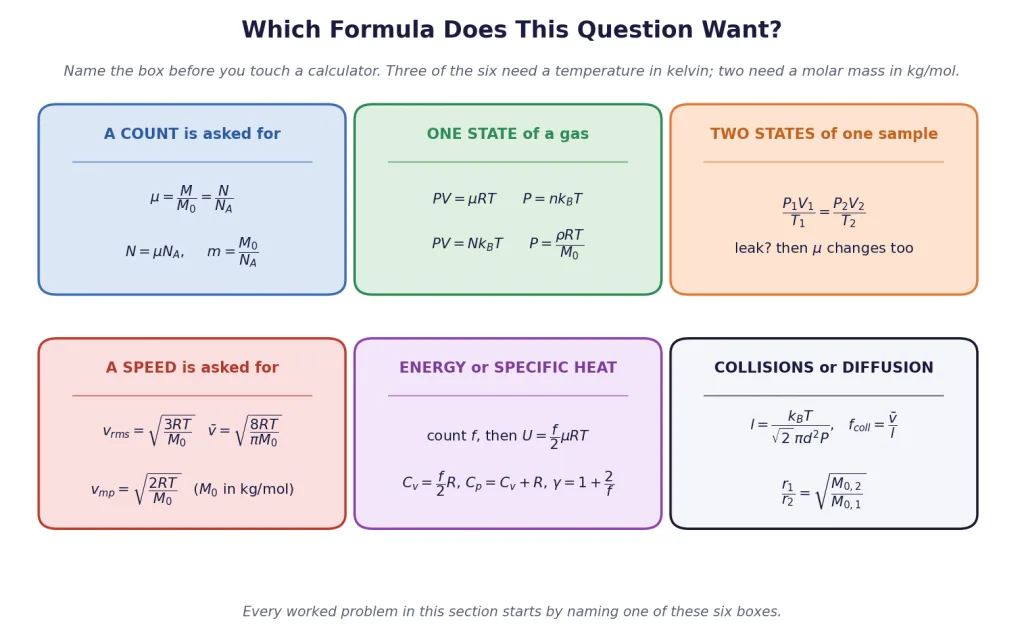
Ten sections of theory, and now the part that actually earns marks. What follows is 48 worked problems covering the whole chapter, from single-substitution drills up to the multi-step questions that decide ranks. They are arranged easy first, hard last, in eight parts that follow the order the chapter was taught in.
Work them with a pen. Cover the solution, try it, then compare — and read the check at the end of each one, because the check is where the marks usually leak away.
Notation for This Chapter
Key Point — THIS CHAPTER'S NOTATION:
n is the NUMBER DENSITY, molecules per cubic metre, n=VN.
μ is the number of MOLES. The previous chapter used n for moles; here it is the reverse, and so is every kinetic-theory formula and every exam paper.
N is the number of molecules, NA the Avogadro number, and μ=NAN=M0M.
M0 is the molar mass in kg/mol; M is the total mass of the sample; m=NAM0 is the mass of one molecule.
E is translational kinetic energy only. U is the full internal energy. They coincide only for a monatomic gas.
Cp and Cv are molar specific heats in J/(mol K); lowercase cp, cv are per kilogram.
So every formula carried over from thermodynamics gets rewritten here: PV=μRT, not nRT; ΔQ=μCvΔT, not nCvΔT. Get used to it now — it is the convention you will meet in the question paper.
The four questions to ask before you write anything
Is the temperature in kelvin? Every ratio T1T2, every speed formula, every gas-law step needs absolute temperature. Only a bare differenceΔT is the same number in Celsius and in kelvin. This is the single commonest wrong answer in the chapter.
Is the molar mass in kilograms per mole? Oxygen is 0.032, not 32. Getting this wrong makes a speed come out 1000=31.6 times too small, and the answer still looks like a number, which is why it slips through.
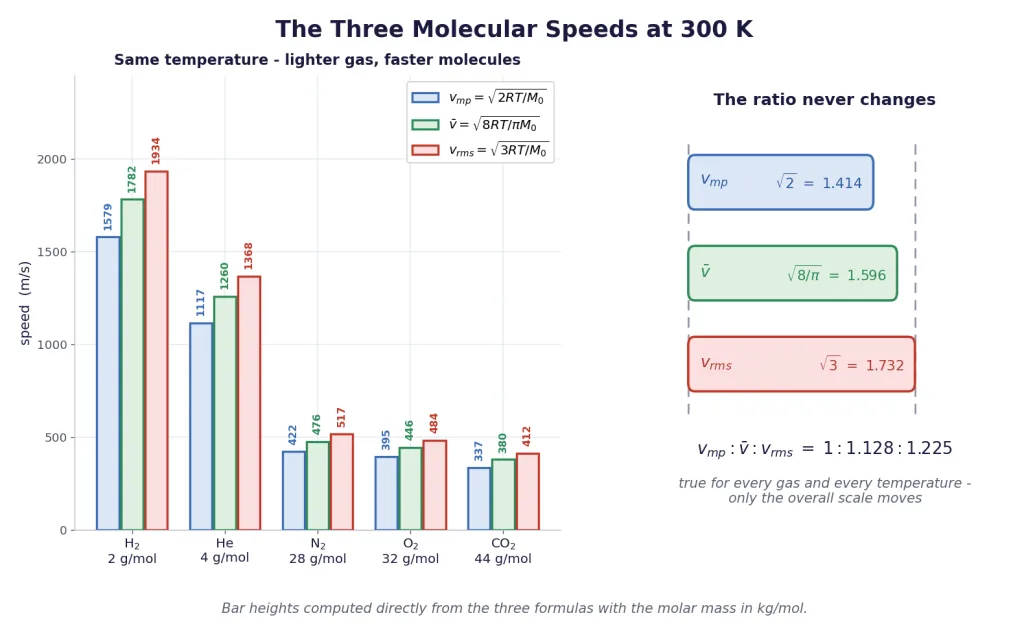
Which of the three speeds does the question want? Energy wants vrms; a collision count wants vˉ; the peak of the distribution is vmp. Name it out loud before you substitute.
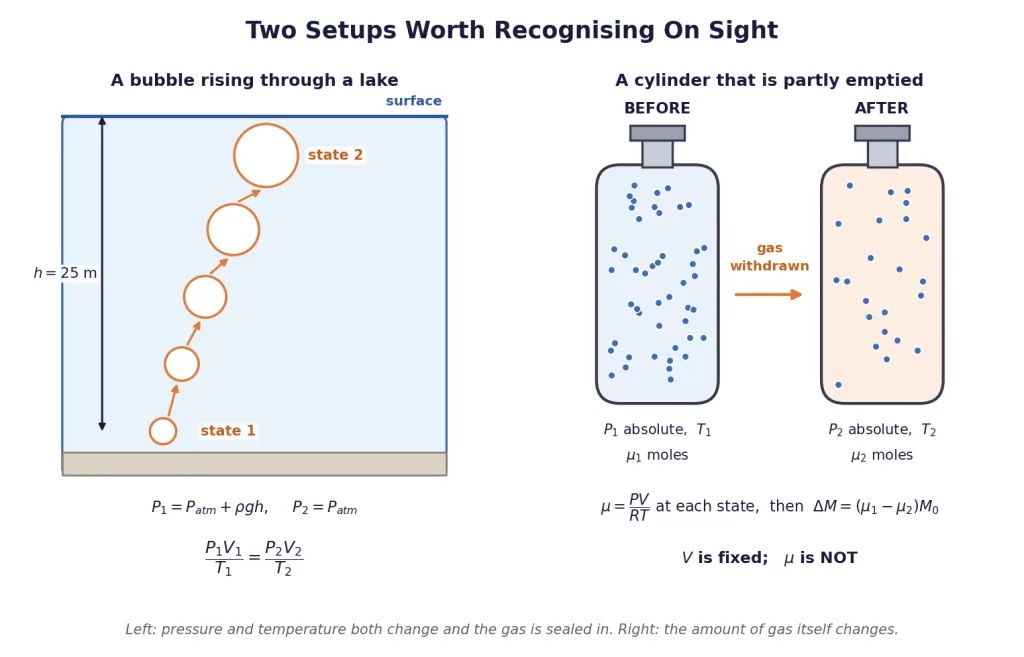
Is the amount of gas fixed? If it is, T1P1V1=T2P2V2 does the whole job. If gas leaks in or out, μ changes and you must go through PV=μRTtwice, once at each state.
Key Point — every formula this section uses, in one place:μ=M0M=NAN,m=NAM0,n=VNPV=μRT,PV=NkBT,P=nkBT,P=M0ρRTT1P1V1=T2P2V2,Ptotal=P1+P2+P3+…P=31nmv2=31ρv2,PV=32E,E=23NkBT21mv2=23kBT,vrms=M03RT=m3kBTvˉ=πM08RT,vmp=M02RT,vmp:vˉ:vrms=2:π8:3U=2fμRT,Cv=2fR,Cp=Cv+R,γ=1+f2l=2nπd21=2πd2PkBT,fcoll=lvˉ,τ=fcoll1r2r1=M0,1M0,2(equal P and T)
The Maxwell distribution, the formulas for vˉ and vmp, Graham's law and the pressure law all sit outside the rationalised syllabus body text, yet a large fraction of the problems below cannot be done without them, and Boards, JEE and NEET ask about them every year. They are used freely here.
The constants used throughout
Every solution also restates the constants it uses inside itself, so you never have to scroll back.
[Board Important] Every solution below writes the formula on its own line before any number goes into it, converts the molar mass on a line of its own, and names which speed it is using. Do all three in the exam. A correct formula with an arithmetic slip still earns most of the marks; a gram-per-mole inside a square root loses them all.
Solved Examples
Part 1: Molecules, Sizes and Counting
Six warm-ups. No gas laws yet — just Avogadro's number used carefully, and the two length scales that make a gas a gas.
Example 1: From grams to molecules, and back
A sealed flask holds 5.6 g of nitrogen gas (M0=28 g/mol). Find (a) the number of moles, (b) the number of molecules, (c) the number of nitrogen atoms, and (d) the mass of a single molecule.
Solution:
Constants:NA=6.022×10²³ per mole.
Convert the molar mass first, as a habit, even where the answer does not need it:
M0=28g/mol=0.028kg/mol
(a) Moles.μ=M0M, with both masses in the same unit:
μ=285.6=0.20mol
(b) Molecules.N=μNA=0.20×6.022×1023=1.20×10²³
(c) Atoms. Nitrogen gas is N2 — two atoms per molecule:
atoms=2N=2.41×10²³
(d) Mass of one molecule.m=NAM0=6.022×10230.028=4.65×10⁻²⁶kg
Check: N×m=1.204×1023×4.65×10−26=5.6×10⁻³ kg, which is the 5.6 g we started from.
Final Answer:0.20 mol; 1.20×10²³ molecules; 2.41×10²³ atoms; 4.65×10⁻²⁶ kg per molecule.
Takeaway:Molecules and atoms are not the same count. Any diatomic gas doubles the atom count, and questions that ask for "the number of atoms in 5.6 g of nitrogen" are testing exactly that.
Example 2: Sizing a single atom from a bucket of liquid
Liquid argon has a density of about 1400 kg/m3 and a molar mass of 39.9 g/mol. Estimate the diameter of one argon atom, assuming the atoms in the liquid are packed so as to fill the space.
Solution:
Constants:NA=6.022×10²³ per mole.
Volume of one mole of the liquid. Convert the molar mass:
M0=39.9g/mol=0.0399kg/molVmole=ρM0=14000.0399=2.85×10−5m3
Volume per atom.Vatom=NAVmole=6.022×10232.85×10−5=4.73×10⁻²⁹m3
Turn a volume into a diameter. Model the atom as a sphere of diameter d, so Vatom=6πd3:
d=(π6Vatom)1/3=(3.14166×4.73×10−29)1/3=(9.04×10−29)1/3d=4.49×10−10m=4.5A˚
Sanity check. Atoms come out a few angstroms across whatever substance you start from. A liquid is close-packed rather than perfectly space-filling, so this slightly overestimates d — an estimate, not a measurement.
Final Answer:d≈4.5×10⁻¹⁰ m, about 4.5 Å.
Takeaway:A density plus a molar mass gives you the size of an atom. The whole trick is Vatom=ρNAM0, and then a cube root. It works for any liquid or solid.
Example 3: How far apart are the molecules of a gas?
Nitrogen gas is held at 1 atm and 27°C. Find its number density, the volume available to each molecule, and the average spacing between neighbouring molecules. Compare that spacing with a molecular diameter of 3.7 Å.
Number density from P=nkBT. Here n is molecules per cubic metre, not moles:
n=kBTP=1.38×10−23×3001.013×105=2.45×1025per m3
Volume per molecule is just the reciprocal:
V1=n1=2.45×10251=4.09×10⁻²⁶m3
Spacing. Give each molecule a little cube of side rˉ:
rˉ=V11/3=(4.09×10−26)1/3=3.44×10−9m=34.4A˚
Compare with the molecule itself.drˉ=3.734.4=9.3
Final Answer:n=2.45×1025 per m3; 4.09×10⁻²⁶ m3 each; spacing 34.4 Å, about 9 molecular diameters.
Takeaway:In a gas at ordinary pressure the molecules sit roughly ten diameters apart. That single number is why the ideal gas model works: for most of its life a molecule is nowhere near another one, so the intermolecular forces have nothing to act on.
Example 4: What fraction of a compressed gas is actually molecule?
Nitrogen is compressed to 5 atm at 300 K. Taking the molecular diameter as 3.7 Å, find the fraction of the container's volume that the molecules themselves occupy.
Number density at 5 atm.n=kBTP=1.38×10−23×3005×1.013×105=1.22×1026per m3
Volume of one molecule, treated as a sphere of diameter d=3.7×10⁻¹⁰ m:
vmol=6πd3=63.1416(3.7×10⁻¹⁰)3=2.65×10⁻²⁹m3
Fraction. Molecular volume per cubic metre of gas, divided by that cubic metre:
fraction=nvmol=1.22×1026×2.65×10−29=3.24×10−3=0.32%
What it means. Even at five atmospheres, 99.7% of the vessel is empty space. But notice the fraction is proportional to P at fixed T — squeeze the same gas to 100 atm and it rises to about 6.5%, and at that point the finite size of the molecules is no longer negligible and the gas stops being ideal.
Final Answer: about 3.2×10⁻³, i.e. 0.32% of the volume.
Takeaway:The "molecules are point-like" assumption is a statement about pressure, not about molecules. It holds because nvmol≪1, and that fails the moment you compress hard enough.
Example 5: The molecules in one breath
A quiet breath draws in about 500 cm3 of air at 1 atm and body temperature, 37°C. Find the number of moles, the number of molecules, and the mass of that air. Take the mean molar mass of air to be 28.9 g/mol.
Everything into SI.T=37+273.15=310.15K,V=500cm3=5.00×10⁻⁴m3
Moles, from PV=μRT:μ=RTPV=8.314×310.151.013×105×5.00×10−4=2578.650.65=1.96×10⁻²mol
Molecules.N=μNA=1.964×10−2×6.022×1023=1.18×10²²
Cross-check by the other road, using P=nkBT:
n=kBTP=1.38×10−23×310.151.013×105=2.37×1025per m3N=nV=2.37×1025×5.00×10−4=1.18×10²²✓
Mass.M=μM0=1.964×10−2×28.9=0.568g
Final Answer:0.0196 mol, 1.18×10²² molecules, mass about 0.57 g.
Takeaway:PV=μRT and P=nkBT are the same equation divided by NA. Solving a counting problem both ways costs thirty seconds and catches a stray factor of 6×10²³ instantly.
Example 6: A drop of water, counted three ways
A drop of water has a mass of 1.8 g. Find the number of water molecules in it, the total number of atoms, and the average spacing between neighbouring molecules. Molar mass of water is 18 g/mol and its density is 1000 kg/m3.
Solution:
Constants:NA=6.022×10²³ per mole.
Moles and molecules.μ=181.8=0.10mol,N=0.10×6.022×1023=6.02×10²²
Atoms. Each H2O carries 3 nuclei:
atoms=3N=1.81×10²³
Volume of the drop.V=ρM=10001.8×10−3=1.8×10⁻⁶m3
Volume per molecule, then spacing.V1=NV=6.022×10221.8×10−6=2.99×10⁻²⁹m3rˉ=V11/3=3.10×10−10m=3.1A˚
Compare with Example 3. In the gas the spacing was 34.4 Å; in the liquid it is 3.1 Å — about 11 times smaller, so about 113≈1300 times denser. That is the whole difference between a liquid and a gas in one number.
Final Answer:6.02×10²² molecules, 1.81×10²³ atoms, spacing ≈3.1 Å.
Takeaway:In a liquid the spacing is essentially the molecular size; in a gas it is ten times larger. Every difference between the two phases — compressibility, fixed volume, intermolecular forces mattering — follows from that one factor of ten.
Part 2: The Ideal Gas Equation in All Four Forms
Six problems on the one equation that appears in four disguises. Pick the form whose symbols match the data you were handed, and check with a second form whenever you can.
Key Point: The four forms are PV=μRT (moles), PV=NkBT (molecules), P=nkBT (number density) and P=M0ρRT (density). They are one equation. R=kBNA and M0=mNA are the only bridges you need.
Example 7: One gas sample, all four forms
A rigid 2.0-litre vessel holds 8.0 g of oxygen (M0=32 g/mol) at 300 K. Find its pressure four separate times, once from each form of the ideal gas equation.
Solution:
Constants:R=8.314 J/(mol K); kB=1.38×10⁻²³ J/K; NA=6.022×10²³ per mole.
The data in SI.V=2.0L=2.0×10⁻³m3,M=8.0g=8.0×10⁻³kgM0=32g/mol=0.032kg/mol
Form 1 — moles.μ=M0M=328.0=0.25molP=VμRT=2.0×10−30.25×8.314×300=3.12×10⁵Pa
Form 2 — molecules.N=μNA=0.25×6.022×1023=1.51×10²³P=VNkBT=2.0×10−31.51×1023×1.38×10−23×300=3.12×10⁵Pa
Form 3 — number density.n=VN=2.0×10−31.5055×1023=7.53×1025per m3P=nkBT=7.53×1025×1.38×10−23×300=3.12×10⁵Pa
Form 4 — density.ρ=VM=2.0×10−38.0×10−3=4.0kg/m3P=M0ρRT=0.0324.0×8.314×300=3.12×105Pa
Final Answer:P=3.12×10⁵ Pa ≈3.08 atm, by all four routes.
Takeaway:Choose the form whose symbols the question already gives you. Given a mass, use μ or ρ; given a count, use N or n. Converting the data to fit a memorised form is where the time and the marks go.
Example 8: Molar volume, at 27°C and at 0°C
Find the volume occupied by one mole of an ideal gas at 1 atm and 27°C. Then show that the same calculation at 0°C gives the familiar 22.4 litres.
Solution:
Constants:R=8.314 J/(mol K); 1 atm =1.013×10⁵ Pa.
At 27°C. Kelvin first:
T=27+273.15=300.15KV=PμRT=1.013×1051×8.314×300.15=2.463×10⁻²m3=24.63L
At 0°C, which is T=273.15 K:
V=1.013×1051×8.314×273.15=2.242×10⁻²m3=22.42L
Why the number is famous. Nothing in that line refers to which gas it is. One mole of helium, of oxygen and of carbon dioxide all occupy 22.4 L at 0°C and 1 atm — which is Avogadro's hypothesis, arriving as a consequence rather than an assumption.
The ratio check. The two volumes should be in the ratio of the absolute temperatures:
22.4224.63=1.0986,273.15300.15=1.0988✓
Final Answer:24.63 L at 27°C; 22.42 L at 0°C.
Takeaway:22.4 litres is not a property of a gas — it is a property of a temperature and a pressure. Quoting it at room temperature is a standard slip; at 27°C the molar volume is nearly 25 litres.
Example 9: What does the air in a classroom weigh?
A classroom measures 8.0 m by 6.0 m by 3.5 m. The air in it is at 1 atm and 300 K, and its mean molar mass is 28.9 g/mol. Find the density of the air, the mass of air in the room, and the number of moles.
Solution:
Constants:R=8.314 J/(mol K); 1 atm =1.013×10⁵ Pa.
Volume.V=8.0×6.0×3.5=168m3
Density, from the density form. Convert the molar mass first:
M0=28.9g/mol=0.0289kg/molρ=RTPM0=8.314×3001.013×105×0.0289=2494.22927.6=1.17kg/m3
Mass.M=ρV=1.174×168=197kg
Cross-check through moles.μ=RTPV=8.314×3001.013×105×168=6823molM=μM0=6823×0.0289=197kg✓
Final Answer:ρ=1.17 kg/m3; about 197 kg of air; 6823 moles.
Takeaway:Air is not weightless — a small classroom holds about two hundred kilograms of it. You do not feel it because it pushes up on you as hard as it pushes down.
Example 10: Compressed and heated at the same time
A fixed mass of gas is at 2.0×10⁵ Pa in a volume of 3.0 litres at 300 K. It is compressed to 1.2 litres and simultaneously heated to 400 K. Find the new pressure.
Solution:
Is the amount of gas fixed? Yes — nothing leaks. So μ cancels and the combined form applies:
T1P1V1=T2P2V2
Both temperatures are already absolute (300 K, 400 K), so no conversion is needed. Volumes may stay in litres because they appear as a ratio.
Rearrange, then substitute.P2=P1×V2V1×T1T2=2.0×105×1.23.0×300400P2=2.0×105×2.5×1.333=6.67×10⁵Pa
Sense check. Squeezing raises the pressure, heating raises it further, so the answer must exceed 2.0×10⁵ Pa — and it does, by a factor of 310.
Final Answer:P2=6.67×10⁵ Pa.
Takeaway:Write the ratio form, not PV=μRT, whenever the amount of gas is unchanged. Units that appear on both sides cancel, so litres and atmospheres are perfectly safe there — but kelvin is not optional.
Example 11: A gauge that does not read what you think
A nitrogen cylinder of volume 15 litres has a pressure gauge reading 12 atm at 300 K. Find the number of moles and the mass of nitrogen inside. Molar mass of nitrogen is 28 g/mol.
Solution:
Constants:R=8.314 J/(mol K); 1 atm =1.013×10⁵ Pa.
The trap, dealt with first. A pressure gauge reads the excess over atmospheric. The gas equation wants the absolute pressure:
P=Pgauge+Patm=12+1=13atm=13×1.013×105=1.317×10⁶Pa
What the trap costs. Using the gauge reading of 12 atm instead would give μ=7.31 mol and 205 g — an error of nearly 8%, and it grows as the cylinder empties.
Final Answer:7.92 mol, about 222 g of nitrogen.
Takeaway:Gauge pressure plus one atmosphere equals absolute pressure. Any problem that says "gauge" is testing that line and nothing else. Bubbles, tyres and cylinders are the usual settings.
Example 12: Pumping a room down to two per cent
A sealed room of volume 60 m3 contains air at 1 atm and 300 K. A pump reduces the pressure to 2% of atmospheric at the same temperature. How many molecules were removed, and what mass of air is that? Take the mean molar mass of air as 28.9 g/mol.
Solution:
Constants:R=8.314 J/(mol K); kB=1.38×10⁻²³ J/K; NA=6.022×10²³ per mole.
Moles at the start.μ1=RTP1V=8.314×3001.013×105×60=2494.26.078×106=2437mol
Moles at the end. Same V, same T, so μ∝P:
μ2=0.02×2437=48.7mol
Cross-check the count directly. At the start,
n1=kBTP1=1.38×10−23×3001.013×105=2.45×1025per m3N1=n1V=1.47×1027,0.98N1=1.44×1027✓
Final Answer: about 1.44×1027 molecules, a mass of about 69 kg.
Takeaway:At constant volume and temperature, μ, N, n and ρ are all proportional to P. Once you see that, "reduce the pressure to 2%" means "remove 98% of everything" without any further arithmetic.
Part 3: Leaks, Bubbles, Mixtures and Partial Pressures
Seven problems where either the amount of gas changes or there is more than one gas in the box. Both cases break the habit of reaching straight for T1P1V1=T2P2V2.
Example 13: The oxygen cylinder after a day's use
An oxygen cylinder of volume 40 litres has an initial gauge pressure of 20 atm at 27°C. After some oxygen is used, the gauge pressure has fallen to 14 atm and the temperature to 12°C. Estimate the mass of oxygen taken out. Molar mass of oxygen is 32 g/mol.
Solution:
Constants:R=8.314 J/(mol K); 1 atm =1.013×10⁵ Pa.
Why the combined gas law is useless here. Gas has left the cylinder, so μ is not the same at the two states. We must apply PV=μRT separately at each state and subtract.
State 1, in absolute units.P1=(20+1)atm=21×1.013×105=2.127×10⁶PaT1=27+273.15=300.15K,V=40L=4.0×10⁻²m3μ1=RT1P1V=8.314×300.152.127×106×4.0×10−2=2495.485092=34.10mol
State 2.P2=(14+1)×1.013×105=1.520×10⁶Pa,T2=12+273.15=285.15Kμ2=8.314×285.151.520×106×4.0×10−2=2370.660780=25.64mol
Convert both to mass. With M0=32 g/mol:
M1=34.10×32=1091g,M2=25.64×32=820g
Subtract.ΔM=1091−820=271g
Final Answer: about 271 g of oxygen was withdrawn.
Takeaway:A leak makes μ a variable. The tell is a question that asks for a mass or a number rather than a pressure — you cannot get either out of a ratio equation in which μ has already cancelled.
Example 14: The bubble that rises 25 metres
An air bubble of volume 2.0 cm3 forms at the bottom of a lake 25 m deep, where the water is at 15°C. It rises to the surface, where the temperature is 30°C. Find its volume there. Take the density of water as 1000 kg/m3, g=9.8 m/s2 and atmospheric pressure as 1.013×10⁵ Pa.
Solution:
The pressure at the bottom is atmospheric plus the water column above:
P1=Patm+ρgh=1.013×10⁵+1000×9.8×25P1=1.013×10⁵+2.45×105=3.463×10⁵Pa(=3.42atm)
The pressure at the surface is just atmospheric:
P2=1.013×10⁵Pa
Kelvin, both ends.T1=15+273.15=288.15K,T2=30+273.15=303.15K
The air inside the bubble is a fixed amount, so the combined form is the right tool:
V2=V1×P2P1×T1T2=2.0×1.013×1053.463×105×288.15303.15V2=2.0×3.419×1.052=7.19cm3
Which factor did the work? The pressure ratio contributed ×3.42 and the temperature ratio only ×1.05. The bubble grows because it is escaping the water, not because it is warming.
Final Answer: the bubble grows to about 7.2 cm3, roughly 3.6 times its original size.
Takeaway:A rising bubble is a pressure problem with a small temperature correction. Every 10.3 m of water adds one atmosphere, so a bubble doubles in volume in the first ten metres and grows more slowly after that.
Example 15: Helium and oxygen sharing one flask
A 5.0-litre flask at 300 K contains 4.0 g of helium (M0=4 g/mol) and 16 g of oxygen (M0=32 g/mol). Find the partial pressure of each gas, the total pressure, and the mole fraction of helium.
Solution:
Constants:R=8.314 J/(mol K); 1 atm =1.013×10⁵ Pa.
Moles of each.μHe=44.0=1.00mol,μO2=3216=0.50mol
Partial pressure is the pressure each gas would exert alone in the whole 5.0 L:
PHe=VμHeRT=5.0×10−31.00×8.314×300=4.99×10⁵PaPO2=5.0×10−30.50×8.314×300=2.49×10⁵Pa
Dalton's law — just add them.Ptotal=4.99×10⁵+2.49×105=7.48×10⁵Pa=7.39atm
Mole fraction of helium.xHe=μHe+μO2μHe=1.501.00=0.667
and indeed PtotalPHe=7.484.99=0.667, which is the same number — partial pressures are in the ratio of the mole numbers.
Note what is equal and what is not. Both gases are at 300 K, so their molecules have the same average translational kinetic energy; but helium's molecules are 8 times lighter, so they move 8=2.83 times faster.
Final Answer:PHe=4.99×10⁵ Pa, PO2=2.49×10⁵ Pa, total 7.48×10⁵ Pa; xHe=32.
Takeaway:Equal masses are not equal moles, and only moles decide pressure. Four grams of helium beats sixteen grams of oxygen two to one, because a helium atom is eight times lighter.
Example 16: Adding a second gas without letting the first out
A 10-litre vessel holds nitrogen at 2.0 atm and 300 K. Now 8.0 g of helium (M0=4 g/mol) is pumped in, the temperature being held at 300 K throughout. Find the new total pressure.
Solution:
Constants:R=8.314 J/(mol K); 1 atm =1.013×10⁵ Pa.
The nitrogen does not care. Its volume and temperature are unchanged and none of it left, so its partial pressure is still
PN2=2.0atm=2.026×10⁵Pa
(For interest, μN2=RTPV=8.314×3002.026×105×10−2=0.812 mol.)
The helium's partial pressure, computed as though it were alone in the 10 litres:
μHe=48.0=2.00molPHe=VμHeRT=1.0×10−22.00×8.314×300=4.99×10⁵Pa=4.92atm
Add.Ptotal=2.0+4.92=6.92atm=7.01×10⁵Pa
Check by total moles.μtotal=0.812+2.00=2.812molP=1.0×10−22.812×8.314×300=7.01×10⁵Pa✓
Final Answer:Ptotal=7.01×10⁵ Pa, about 6.9 atm.
Takeaway:Adding a non-reacting gas never changes the pressure of the gas already there. Each species behaves as if the others were absent, which is Dalton's law and, molecularly, a consequence of the molecules not interacting.
Example 17: Forty per cent leaks out while the tank warms up
A rigid tank contains gas at 4.0×10⁵ Pa and 300 K. A slow leak removes 40% of the molecules, and by the time it is noticed the temperature has risen to 350 K. Find the new pressure.
Solution:
Which quantities changed?V is fixed. N fell to 0.60 of its value. T rose from 300 K to 350 K. Both temperatures are already absolute.
Use the form with N in it, because N is what changed:
P=VNkBT⟹P1P2=N1N2×T1T2
Reading the answer. The leak alone would have taken the pressure to 2.40×10⁵ Pa; the warming pushed it back up to 2.80×10⁵ Pa. A leak can be masked by a temperature rise, which is exactly why gas cylinders are checked at a stated temperature.
Final Answer:P2=2.80×10⁵ Pa.
Takeaway:When the amount of gas changes, put N (or μ) into the ratio explicitly:P1P2=N1N2⋅V2V1⋅T1T2. Dropping the first factor is the standard error.
Example 18: Taking the water vapour out of moist air
A closed vessel at 40°C holds moist air at a total pressure of 1.0 atm. At that temperature the partial pressure of the water vapour is 7.4 kPa. Find the partial pressure of the dry air, and the fraction of the molecules in the vessel that are water molecules.
Solution:
Constants: 1 atm =1.013×10⁵ Pa.
Dalton's law, rearranged. The total is the sum of the parts:
Pdry=Ptotal−Pwater=1.013×10⁵−7.4×103=9.39×10⁴Pa
Fraction of molecules. At a common V and T, P∝N, so the mole fraction and the pressure fraction are the same number:
xwater=PtotalPwater=1.013×1057.4×103=0.0731=7.3%
What this does not depend on. Nothing here needed the molar mass of water or of air. Partial pressures count molecules, not mass — the 7.3% is a fraction by number, and because water (18 g/mol) is lighter than air (28.9 g/mol) the fraction by mass is smaller, about 4.6%.
Final Answer: dry air 9.39×10⁴ Pa; water vapour is about 7.3% of the molecules.
Takeaway:A partial-pressure fraction is a fraction by number of molecules. Convert it to a mass fraction only by bringing in the molar masses; the two are equal only if the gases happen to have the same M0.
Example 19: Three gases, one flask, one mean molar mass
A 20-litre vessel at 400 K holds 2.0 g of hydrogen, 28 g of nitrogen and 44 g of carbon dioxide. Find the total pressure, the mean molar mass of the mixture, and check the answer through the density form of the gas equation. Molar masses: H2 2, N2 28, CO2 44 g/mol.
Solution:
Constants:R=8.314 J/(mol K); 1 atm =1.013×10⁵ Pa.
Moles of each — each comes out to a whole number here.μH2=22.0=1,μN2=2828=1,μCO2=4444=1μtotal=3.0mol
Total pressure.P=VμtotalRT=2.0×10−23.0×8.314×400=4.99×10⁵Pa=4.92atm
Each gas contributes exactly one third of this, 1.66×10⁵ Pa, because each supplies one third of the moles.
Mean molar mass is total mass over total moles:
M0,mean=3.02.0+28+44=3.074=24.7g/mol=0.0247kg/mol
Check through the density form.ρ=VM=2.0×10−274×10−3=3.70kg/m3P=M0,meanρRT=0.02473.70×8.314×400=4.99×105Pa✓
Final Answer:P=4.99×10⁵ Pa; mean molar mass 24.7 g/mol.
Takeaway:A mixture obeys the gas equation with a mean molar mass defined as total mass divided by total moles, M0,mean=∑μi∑μiM0,i. It is a mole-weighted average, not a plain one. Here the moles happened to be equal so the two coincide; take 4 g of hydrogen instead of 2 g and the mean drops to 19 g/mol while the plain average of 2, 28 and 44 stays put.
Part 4: The Pressure Formula, Forwards and Backwards
Five problems on P=31nmv2=31ρv2 — the one result that connects a mechanical push on a wall to the motion of individual molecules. Half the questions give you speeds and want a pressure; the other half do the reverse.
Key Point:P=31ρv2 contains the mean of the squaresv2, never the square of the mean. Rearranged, v2=vrms=ρ3P — which is why a pressure and a density alone are enough to get an rms speed, with no thermometer anywhere.
Example 20: Pressure from a density and a speed
Carbon dioxide has a density of 1.98 kg/m3 and its molecules have an rms speed of 393 m/s. Find the pressure of the gas.
Solution:
The formula, in the form the data fits. We were handed a density, so use
P=31ρv2
Which speed is this? The formula wants the mean square speed, and vrms is by definition its square root, so v2=vrms2. Substituting vˉ or vmp here would be wrong.
v2=(393)2=1.544×10⁵m2/s2
Substitute.P=31×1.98×1.544×105=1.02×10⁵Pa
Sense check. That is 1.01 atm — and 1.98 kg/m3 is indeed close to the density of carbon dioxide at atmospheric pressure and room temperature, so the numbers hang together.
Final Answer:P≈1.02×10⁵ Pa, essentially one atmosphere.
Takeaway:v2 means vrms2. Any speed offered to this formula must be the rms one; if a problem gives you vˉ instead, convert first using vrms=83πvˉ=1.085vˉ.
Example 21: Running the formula backwards to name the gas
A gas at 1.5×10⁵ Pa has a density of 2.4 kg/m3 and a temperature of 300 K. Find the rms speed of its molecules and identify the gas.
Solution:
Constants:R=8.314 J/(mol K).
Which speed? The formula P=31ρv2 contains the mean square speed, so rearranging it yields vrms and nothing else. Speed straight from pressure and density — no temperature needed for this step:
vrms=ρ3P=2.43×1.5×105=1.875×105=433m/s
Now bring in the temperature to get the molar mass. Since vrms=M03RT,
M0=vrms23RT=1.875×1053×8.314×300=1.875×1057482.6=0.0399kg/mol
Convert back to the familiar unit.M0=0.0399kg/mol=39.9g/mol
That is argon.
Round trip. Feeding M0=0.0399 kg/mol back in:
vrms=0.03993×8.314×300=433m/s✓
Final Answer:vrms=433 m/s; the gas is argon, M0=39.9 g/mol.
Takeaway:A molar mass in kg/mol comes out as a number like 0.040, and a molar mass in g/mol as a number like 40. If your rearranged formula produces 39.9 where kg/mol is expected, you have dropped a factor of 1000 somewhere.
Example 22: Which average does the pressure formula want?
Five molecules have speeds 300, 400, 500, 600 and 700 m/s. Find the mean speed, the mean square speed, the rms speed, and the square of the mean speed. Which of these belongs in P=31ρv2?
Solution:
Mean speed — add and divide:
vˉ=5300+400+500+600+700=52500=500m/s
Mean square speed — square first, then average:
v2=53002+4002+5002+6002+7002=51,350,000=2.70×10⁵m2/s2
Root mean square speed.vrms=2.70×105=519.6m/s
Square of the mean, for contrast:
(vˉ)2=5002=2.50×10⁵m2/s2
Compare.v2=2.70×10⁵ but (vˉ)2=2.50×10⁵ — using the square of the mean falls short of the true mean square by 2.702.70−2.50=7.4%, and vrms exceeds vˉ by 3.9%. They are equal only if every molecule has the same speed; any spread at all makes vrms>vˉ.
The answer to the question asked. The pressure formula and the energy formula both want v2, so P here would use 2.70×10⁵ m2/s2.
Final Answer:vˉ=500 m/s, v2=2.70×10⁵ m2/s2, vrms=519.6 m/s, (vˉ)2=2.50×10⁵ m2/s2. Use v2.
Takeaway:v2=(vˉ)2, always v2>(vˉ)2. Squaring rewards the fast molecules twice over. Using 21m(vˉ)2 for the average kinetic energy underestimates it — here by 7.4%, and for a real Maxwellian gas by exactly 1−3π8=15.1%. An underestimate is always measured against the true, larger value, so the denominator is v2, never (vˉ)2.
Example 23: Squeezing the gas without warming it
Air at 1.0×10⁵ Pa has a density of 1.29 kg/m3. It is compressed isothermally to half its volume. Find the rms speed before and after, and the new pressure.
What halving the volume does. The mass of gas is unchanged, so
ρ2=2ρ1=2.58kg/m3
and at constant temperature Boyle's law gives P2=2P1=2.0×10⁵ Pa.
After.vrms=2.583×2.0×105=2.326×105=482m/s
Identical, to every digit.
Why it had to be.vrms=M03RT depends on temperature and molar mass and on nothing else. The compression was isothermal, so the speeds could not have changed. The pressure doubled purely because the molecules are hitting the walls twice as often, not because they are hitting harder.
Final Answer:vrms=482 m/s both before and after; P2=2.0×10⁵ Pa.
Takeaway:Pressure has two ingredients — how hard each hit is, and how many hits per second. Isothermal compression changes only the second. A question that says "compressed isothermally" and then asks about molecular speed is asking you to answer "unchanged".
Example 24: The translational energy of the air in a room
A room of volume 60 m3 holds air at 1 atm and 300 K. Find the total translational kinetic energy of all the air molecules in it.
Solution:
Constants:R=8.314 J/(mol K); 1 atm =1.013×10⁵ Pa.
The shortcut. Kinetic theory gives PV=32E, where E is the total translational kinetic energy. So
E=23PV
Substitute — no temperature, no molar mass, no molecule count required.E=23×1.013×105×60=9.12×10⁶J
Check by the long road.μ=RTPV=8.314×3001.013×105×60=2437molE=23μRT=23×2437×8.314×300=9.12×10⁶J✓
Is it a big number? It is about the energy of a 1500 kg car travelling at 110 m/s. It is completely unavailable as useful work, because it is disordered — which is the entire subject of the previous chapter.
A warning about E and U. Air is mostly diatomic, so its molecules also rotate. Its internal energy is U=25μRT=1.52×10⁷ J, larger than E by a factor of 35. The question asked for translational energy, so 9.12×10⁶ J is the answer.
Final Answer:E=9.12×10⁶ J of translational kinetic energy.
Takeaway:E=23PV needs only a pressure and a volume. But E is translational only — for anything other than a monatomic gas, U>E, and reading one symbol for the other is a favourite trap.
Part 5: Temperature, Molecular Energy and the rms Speed
Seven problems on the two results that make temperature mean something: 21mv2=23kBT per molecule, and vrms=M03RT. Every speed below shows the conversion of M0 to kg/mol on a line of its own — that conversion is where this chapter's marks are won and lost.
Key Point: At a given temperature every gas has the same average translational kinetic energy per molecule, 23kBT. It does not have the same speed: heavier molecules carry that energy more slowly, with vrms∝M01.
Example 25: A helium atom from a warm room to a stellar core
Estimate the average translational kinetic energy of a helium atom, and its rms speed, at (i) room temperature 27°C, (ii) 6000 K, the temperature of the Sun's visible surface, and (iii) 1.0×10⁷ K, a typical stellar core. Molar mass of helium is 4.0 g/mol.
Solution:
Constants:kB=1.38×10⁻²³ J/K; R=8.314 J/(mol K). 1 eV =1.6×10⁻¹⁹ J.
Convert the molar mass once, for all three parts:M0=4.0g/mol=0.0040kg/mol
Which speed? The question asks for a speed tied to an energy, so it is vrms — the only one of the three that comes directly out of 21mv2=23kBT.
(i) At T=27+273.15=300.15≈300 K.ε=23kBT=23(1.38×10⁻²³)(300)=6.21×10⁻²¹J=0.039eVvrms=M03RT=0.00403×8.314×300=1.871×106=1.37×10³m/s
(ii) At T=6000 K — twenty times hotter, so the energy is twenty times larger and the speed 20=4.47 times larger:
ε=23(1.38×10⁻²³)(6000)=1.24×10⁻¹⁹J=0.78eVvrms=0.00403×8.314×6000=6.12×10³m/s
(iii) At T=1.0×10⁷ K.ε=23(1.38×10⁻²³)(1.0×10⁷)=2.07×10⁻¹⁶J=1.29×10³eVvrms=0.00403×8.314×1.0×107=2.50×10⁵m/s
What the last line means physically. About 1.3 keV per atom is comfortably more than the 24.6 eV needed to ionise helium — which is why a stellar core is a plasma of bare nuclei and free electrons, not a gas of atoms.
Final Answer:6.21×10⁻²¹ J and 1.37 km/s; 1.24×10⁻¹⁹ J and 6.12 km/s; 2.07×10⁻¹⁶ J and 2.50×10² km/s.
Takeaway:Energy scales as T; speed scales as T. Raising the temperature by a factor of 3.3×10⁴ raised the speed by only 3.3×104=183.
Example 26: Carbon dioxide, by both roads
Find the rms speed of carbon dioxide molecules at 300 K, once from the molar mass and once from the mass of a single molecule. Molar mass of CO2 is 44 g/mol.
Solution:
Constants:R=8.314 J/(mol K); kB=1.38×10⁻²³ J/K; NA=6.022×10²³ per mole.
Convert the molar mass — its own line, always:M0=44g/mol=0.044kg/mol
Which speed?vrms, because the question names it. (For reference at this temperature vˉ=380 m/s and vmp=337 m/s — all three differ, so naming one matters.)
Route A — molar.vrms=M03RT=0.0443×8.314×300=1.701×105=412m/s
Route B — per molecule. First the mass of one CO2 molecule:
m=NAM0=6.022×10230.044=7.31×10⁻²⁶kg
then
vrms=m3kBT=7.31×10−263×1.38×10−23×300=1.700×105=412m/s
They agree, as they must, since R=kBNA and M0=mNA make the two expressions algebraically identical. Any disagreement bigger than rounding means a factor of NA went astray.
Final Answer:vrms≈412 m/s by both routes.
Takeaway:M03RT and m3kBT are the same formula wearing different clothes. Use whichever matches the data; use both if you have thirty spare seconds.
Example 27: Warming argon until it matches helium
At what temperature will the rms speed of argon atoms equal the rms speed of helium atoms at −20°C? Atomic masses: argon 39.9 u, helium 4.0 u.
Solution:
Constants:R=8.314 J/(mol K).
Kelvin, before anything else.THe=−20+273.15=253.15K
A negative Celsius value entering a speed formula unconverted is the classic way to lose this question.
Convert both molar masses:M0,He=4.0g/mol=0.0040kg/mol,M0,Ar=39.9g/mol=0.0399kg/mol
Set the two rms speeds equal. We use vrms because the question does; the ratio would be identical for vˉ or vmp, since all three carry the same T/M0:
M0,Ar3RTAr=M0,He3RTHe⟹M0,ArTAr=M0,HeTHe
Solve.TAr=THe×M0,HeM0,Ar=253.15×4.039.9=253.15×9.975=2525K
which is 2525−273.15=2252°C.
Check both speeds explicitly.vHe=0.00403×8.314×253.15=1256m/s,vAr=0.03993×8.314×2525=1256m/s✓
Final Answer:TAr≈2525 K, about 2252°C.
Takeaway:Equal speeds means equal M0T, not equal T. The heavier gas always needs the hotter oven, by exactly the ratio of the molar masses.
Example 28: Three vessels of equal capacity
Three identical vessels at the same temperature and pressure contain neon (monatomic, 20.2 g/mol), chlorine (diatomic, 70.9 g/mol) and sulphur hexafluoride (polyatomic, 146 g/mol). (a) Do they contain equal numbers of molecules? (b) Is vrms the same in the three? If not, where is it largest? Compute all three at 300 K.
Solution:
Constants:R=8.314 J/(mol K).
(a) The count. From PV=NkBT, with P, V and T all equal, N must be equal too. Yes — equal numbers of molecules, whatever the gas. That is Avogadro's hypothesis restated.
(b) The speeds.vrms=M03RT contains M0, so the speeds are not equal; the lightest gas is the fastest. Convert all three molar masses:
M0,Ne=0.0202,M0,Cl2=0.0709,M0,SF6=0.146kg/mol
Compute, using vrms because that is the speed the question names:vNe=0.02023×8.314×300=609m/svCl2=0.07093×8.314×300=325m/svSF6=0.1463×8.314×300=226m/s
Check the ratio.vSF6vNe should be 20.2146=7.23=2.69, and 226609=2.69. ✓
One thing that IS equal. All three are at 300 K, so the average translational kinetic energy per molecule is 23kBT=6.21×10⁻²¹ J in every vessel. Note that the internal energies differ, because neon has f=3 while the others have more.
Final Answer: (a) yes, equal numbers. (b) no — 609, 325 and 226 m/s; neon is fastest.
Takeaway:Same P, V, T means same N and same energy per molecule, but never the same speed. Sort speeds by molar mass and you can answer this style of question without a calculator.
Example 29: Telling two isotopes of neon apart
Naturally occurring neon contains the isotopes of mass 20 u and 22 u. At the same temperature, by what percentage does the rms speed of the lighter isotope exceed that of the heavier? Compute both at 300 K.
Solution:
Constants:R=8.314 J/(mol K).
Convert both molar masses:M0,20=20g/mol=0.020kg/mol,M0,22=22g/mol=0.022kg/mol
The ratio. At a common T, everything except M0 cancels — and it cancels identically for vrms, vˉ and vmp, so the answer does not depend on which of the three we choose. We use vrms:
v22v20=M0,20M0,22=2022=1.10=1.0488
As a percentage.(1.0488−1)×100=4.9%
The two speeds at 300 K, for scale.v20=0.0203×8.314×300=612m/s,v22=0.0223×8.314×300=583m/s
Why anyone cares. A 4.9% speed difference is enough to separate the isotopes by repeated diffusion — a slow process, since each pass enriches the mixture only slightly, but a workable one. It is how neon isotopes were first separated, and the same principle at a far worse mass ratio is used for uranium.
Final Answer: the lighter isotope is faster by about 4.9%; 612 m/s against 583 m/s at 300 K.
Takeaway:Isotope separation lives on v∝M01. Because of the square root, a 10% mass difference buys only a 4.9% speed difference — which is exactly why the process needs so many stages.
Example 30: Faster than a bullet?
Find the rms speed of nitrogen molecules at 300 K (molar mass 28 g/mol), and compare it with a rifle bullet at 800 m/s. To what temperature would the nitrogen have to be raised for its molecules to have an rms speed of 800 m/s?
Solution:
Constants:R=8.314 J/(mol K).
Convert the molar mass:M0=28g/mol=0.028kg/mol
The speed now. We use vrms because the comparison is with a definite kinetic energy:
vrms=M03RT=0.0283×8.314×300=2.672×105=517m/s
So an ordinary nitrogen molecule in this room moves at about two thirds the speed of a rifle bullet.
The temperature that would match the bullet. Rearranging,
T=3RM0vrms2=3×8.3140.028×(800)2=24.9417920=718K
which is 718−273.15=445°C.
Check with the scaling law.T∝v2, so
T=300×(517800)2=300×2.395=718K✓
Final Answer:vrms=517 m/s at 300 K; T=718 K (about 445°C) for 800 m/s.
Takeaway:Molecular speeds are comparable to the speed of sound and to bullets — a few hundred metres per second — which is not a coincidence: sound travels by molecular collisions, so it cannot outrun the molecules themselves.
Example 31: The same energy, very different speeds
A vessel holds a mixture of helium (4 g/mol) and oxygen (32 g/mol) at 300 K. Find the average translational kinetic energy of a molecule of each, and the rms speed of each. Which is larger, and by how much?
Solution:
Constants:kB=1.38×10⁻²³ J/K; R=8.314 J/(mol K).
Energy first — and it is the same for both.ε=23kBT contains no mass:
ε=23(1.38×10⁻²³)(300)=6.21×10⁻²¹Jfor helium and for oxygen alike
Convert both molar masses:M0,He=4g/mol=0.004kg/mol,M0,O2=32g/mol=0.032kg/mol
Speeds — using vrms, since it is the speed defined by that very energy:vHe=0.0043×8.314×300=1368m/svO2=0.0323×8.314×300=484m/s
The ratio.vO2vHe=0.0040.032=8=2.83
Reconcile the two facts. Helium moves 2.83 times faster but is 8 times lighter, and 21mv2 carries 8×(2.831)2=8×81=1. The energies match exactly, as thermal equilibrium demands.
Final Answer:6.21×10⁻²¹ J for both; vHe=1368 m/s, vO2=484 m/s, a ratio of 2.83.
Takeaway:Thermal equilibrium equalises energies, not speeds. Whenever a question says "the same temperature", write 23kBT down first — it is the quantity that is genuinely shared.
Part 6: The Three Speeds Compared
Four problems on vmp, vˉ and vrms — which is which, how to convert between them, and why the ordering never changes.
Key Point: For any gas at any temperature,
vmp=M02RT<vˉ=πM08RT<vrms=M03RT
in the fixed ratio 2:π8:3=1:1.128:1.225. Only the overall scale moves with T and M0.
Example 32: All three speeds for hydrogen
Find vmp, vˉ and vrms for hydrogen gas at 300 K, and verify that they stand in the standard ratio. Molar mass of hydrogen is 2.0 g/mol.
Solution:
Constants:R=8.314 J/(mol K).
Convert the molar mass:M0=2.0g/mol=0.0020kg/mol
Most probable speed — the peak of the distribution, the speed more molecules have than any other:
vmp=M02RT=0.00202×8.314×300=2.494×106=1579m/s
Average speed — the plain arithmetic mean, the one that belongs in a collision count:
vˉ=πM08RT=3.1416×0.00208×8.314×300=3.176×106=1782m/s
Root mean square speed — the one tied to energy and to pressure:
vrms=M03RT=0.00203×8.314×300=3.741×106=1934m/s
The ratio. Divide through by the smallest:
1579:1782:1934=1:1.128:1.225
and 2:π8:3=1.414:1.596:1.732, which after dividing by 1.414 is 1:1.128:1.225. ✓
Final Answer:vmp=1579 m/s, vˉ=1782 m/s, vrms=1934 m/s.
Takeaway:Memorise 1:1.128:1.225. Then one speed gives you the other two in a single multiplication, with no square roots and no molar masses.
Example 33: Working back from an average speed
The average speed of the molecules of a certain gas at 400 K is 600 m/s. Find its most probable speed, its rms speed, and its molar mass.
Solution:
Constants:R=8.314 J/(mol K).
Use the fixed ratio for the other two speeds. With vˉ known,
vˉvmp=8/π2=1.5961.414=0.886⟹vmp=0.886×600=532m/svˉvrms=8/π3=1.5961.732=1.085⟹vrms=1.085×600=651m/s
Check the ordering.532<600<651 — vmp<vˉ<vrms, as it must be.
The molar mass, from the formula that contains vˉ (not from vrms — use the speed you were actually given):
vˉ=πM08RT⟹M0=πvˉ28RTM0=3.1416×(600)28×8.314×400=1.131×10626605=0.0235kg/mol
Back to the familiar unit.M0=0.0235kg/mol=23.5g/mol
Round trip.vˉ=π×0.02358×8.314×400=600 m/s. ✓
Final Answer:vmp=532 m/s, vrms=651 m/s, M0≈23.5 g/mol.
Takeaway:Put the speed you were given into the formula that contains that speed. Feeding a stated vˉ into M03RT gives a molar mass 17.8% too large, and nothing in the answer looks wrong.
Example 34: Matching oxygen's peak to hydrogen's average
At what temperature will the most probable speed of oxygen molecules equal the average speed of hydrogen molecules at 300 K? Molar masses: oxygen 32 g/mol, hydrogen 2.0 g/mol.
Solution:
Constants:R=8.314 J/(mol K).
The target speed — hydrogen's average speed at 300 K. Convert first:
M0,H2=2.0g/mol=0.0020kg/molvˉH2=πM08RT=3.1416×0.00208×8.314×300=1782m/s
Now set oxygen's most probable speed equal to it. Note we must use vmp for oxygen and vˉ for hydrogen — different formulas, because the question named different speeds:
M0,O2=32g/mol=0.032kg/molvmp=M0,O22RTO2=1782m/s
Solve for the temperature.TO2=2RM0,O2vmp2=2×8.3140.032×(1782)2=16.630.032×3.176×106=6112K
Sanity check with a single ratio. Combining the two formulas,
TH2TO2=2π8×M0,H2M0,O2=π4×16=20.4⟹TO2=20.4×300=6112K✓
Final Answer: about 6.1×10³ K.
Takeaway:Read which speed is named on each side of the equality. Two different speeds means two different formulas, and the factor π4=1.27 that separates them is precisely what the question is testing.
Example 35: Two gases with the same peak speed
At what temperature will helium have the same most probable speed as nitrogen at 300 K? Molar masses: helium 4.0 g/mol, nitrogen 28 g/mol. Compute the common speed.
Solution:
Constants:R=8.314 J/(mol K).
Same speed, same formula on both sides, so the constants cancel and only M0T survives:
M0,He2RTHe=M0,N22RTN2⟹M0,HeTHe=M0,N2TN2
Solve.THe=TN2×M0,N2M0,He=300×284.0=42.9K
The common speed. Convert and substitute, using vmp because that is the speed the question names:
M0,N2=28g/mol=0.028kg/molvmp=0.0282×8.314×300=422m/s
and for helium, M0=0.0040 kg/mol:
vmp=0.00402×8.314×42.9=422m/s✓
A stronger statement than the question asked. Because all three speeds carry the same M0T, equal M0T makes vmp, vˉandvrms match simultaneously — the two gases have identical speed distribution curves, not merely the same peak.
Final Answer:THe=42.9 K; the common most probable speed is 422 m/s.
Takeaway:The whole Maxwell curve depends on T and M0 only through the combination TM0. Match that one ratio and the two gases are statistically indistinguishable by speed.
Part 7: Degrees of Freedom, Internal Energy and Specific Heats
Seven problems that all start the same way: count f first, then turn the handle. Nothing below can be done by remembering a specific heat; everything below falls out once the molecule has been drawn.
Key Point — the counting rules:
A molecule of N atoms has 3N degrees of freedom in total: 3 translational, then 3 rotational (2 if the molecule is linear), and the rest vibrational.
Each translational or rotational degree of freedom contributes one quadratic term; each vibrational mode contributes two (kinetic plus potential).
f is the count of quadratic terms, and then
U=2fμRT,Cv=2fR,Cp=Cv+R,γ=1+f2
At ordinary temperatures vibration is frozen out, so treat molecules as rigid unless told otherwise.
Example 36: Counting f for four real molecules
For krypton (Kr), hydrogen chloride (HCl), carbon disulphide (CS2, a linear triatomic) and ethane (C2H6, non-linear), find f, Cv, Cp and γ, treating all of them as rigid.
Solution:
Constants:R=8.314 J/(mol K).
Krypton. A noble gas — single atoms. N=1, so 3N=3, all translational; no orientation to specify, no bond to stretch.
f=3,Cv=23R=12.47,Cp=25R=20.79J/(mol K),γ=1+32=1.67
Hydrogen chloride. Two atoms, 3N=6: 3 translational, 2 rotational (rotation about the bond axis does not count — the moment of inertia about that line is negligible), 1 vibrational, which is frozen out.
f=3+2=5,Cv=25R=20.79,Cp=27R=29.10,γ=1.40
Carbon disulphide. Three atoms, 3N=9 — but all three nuclei lie on one straight line, so the axis through them is dead and only 2 rotations count:
f=3+2=5,Cv=20.79,Cp=29.10,γ=1.40
A three-atom molecule with a diatomic's specific heats.
Ethane. Eight atoms, definitely not linear, so all 3 rotations are real:
f=3+3=6,Cv=3R=24.94,Cp=4R=33.26,γ=1+62=1.33
Note that f does not grow with the number of atoms once vibration is frozen out — ethane and ammonia and methane all give f=6.
The summary table.
Molecule
Shape
f
Cv
Cp
γ
Kr
single atom
3
12.47
20.79
1.67
HCl
diatomic
5
20.79
29.10
1.40
CS2
linear triatomic
5
20.79
29.10
1.40
C2H6
non-linear
6
24.94
33.26
1.33
Final Answer:f=3,5,5,6 respectively, with the specific heats and γ as tabulated.
Takeaway:"Triatomic" is not a value of f; "linear or not" is. Carbon disulphide and carbon dioxide are both three-atom molecules that behave thermally like diatomics, and treating them as generic triatomics overstates Cv by 20%.
Example 37: The internal energy of a mixture
A vessel at 400 K contains 3.0 moles of argon, 2.0 moles of oxygen and 1.0 mole of methane. Treating all of them as rigid, find the total internal energy of the mixture, its effective molar Cv, and the extra energy needed to warm it by 50 K.
Solution:
Constants:R=8.314 J/(mol K).
Count f for each. Argon is monatomic, f=3. Oxygen is a rigid diatomic, f=5. Methane (CH4) is a five-atom, non-linear molecule, so f=3+3=6.
Internal energy is additive — each gas stores its own share, and U=2fμRT:
U=(23×3.0+25×2.0+26×1.0)RTU=(4.5+5.0+3.0)×8.314×400=12.5×3325.6=4.16×10⁴J
Effective Cv — total heat capacity divided by total moles:
Cv,mix=3.0+2.0+1.03.0(12.47)+2.0(20.79)+1.0(24.94)=6.037.41+41.57+24.94=6.0103.92=17.32J/(mol K)
Heat to warm it by 50 K at constant volume.ΔU=(∑μiCv,i)ΔT=103.92×50=5.20×10³J
Check against the other route.ΔU=6.0×17.32×50=5.20×10³ J. ✓
Final Answer:U=4.16×10⁴ J; Cv,mix=17.32 J/(mol K); ΔU=5.20×10³ J for a 50 K rise.
Takeaway:Add the heat capacities μiCv,i, never the Cv values themselves. The effective Cv of a mixture is a mole-weighted average and lands between the smallest and largest of its parts.
Example 38: Predicted γ against measured γ
For helium, nitrogen, chlorine, carbon dioxide and ammonia, write down the γ that the rigid-molecule count predicts and compare it with the measured room-temperature values below. Where the two disagree, say why, and find the f that the measurement actually implies for carbon dioxide, whose molar specific heat at constant volume measures 28.5 J/(mol K).
Gas
Structure
Measured γ
He
single atom
1.67
N2
diatomic
1.40
Cl2
diatomic
1.32
CO2
linear triatomic
1.29
NH3
non-linear
1.31
Solution:
Constants:R=8.314 J/(mol K).
Predict, from γ=1+f2 with the rigid count.
Gas
f (rigid)
Predicted γ
Measured γ
He
3
1.67
1.67
N2
5
1.40
1.40
Cl2
5
1.40
1.32
CO2
5
1.40
1.29
NH3
6
1.33
1.31
The two that agree exactly. Helium has nothing but translation, so there is nothing to go wrong. Nitrogen has a strong, stiff triple bond whose vibration needs a temperature of thousands of kelvin to wake up, so at 300 K it really is rigid.
The three that fall short. Every measured value is below its prediction, and γ falls only when f rises. So these molecules have more places to store energy than the rigid count allows: their vibrations are partly active at room temperature. Chlorine's bond is weak and floppy, carbon dioxide has four vibrational modes including a very soft bending one, and ammonia has six.
What f does the carbon dioxide measurement imply? Invert the formula:
γ=1+f2⟹f=γ−12=0.292=6.9
Now do it the sturdier way, straight from the measured Cv=28.5 J/(mol K):
feff=R2Cv=8.3142×28.5=6.86
The two routes tell the same story, and the small gap between 6.9 and 6.86 is pure rounding: γ−1=0.29 carries only two significant figures, so a shift of 0.005 in γ moves f by more than 0.1. When a calorimetric Cv is available, use it — near γ≈1.3 the inversion of γ is a badly conditioned way to get f. Take feff=6.86 and Cv=28.5 J/(mol K), against 25R=20.79 for the rigid prediction. The extra 28.5−20.79=7.7 J/(mol K) is 0.93R, a little under one whole vibrational mode's worth, which is what "partly active" looks like numerically.
The direction of the error is the diagnostic. Measured γbelow prediction means unfrozen vibration. Measured γabove prediction would mean a rotation is frozen out, which happens only at very low temperature.
Final Answer: predictions 1.67, 1.40, 1.40, 1.40, 1.33; the last three sit below because vibrational modes are partly active. For CO2 the measurement implies feff=6.86 with Cv=28.5 J/(mol K).
Takeaway:A non-integer f extracted from a measurement is not an error — it is a half-awake vibration. Classical equipartition can only give whole numbers; nature interpolates between them as the temperature rises.
Example 39: Eleven grams of carbon dioxide, warmed two ways
11 g of carbon dioxide (M0=44 g/mol), treated as a rigid linear molecule, is warmed by 40 K. Find the heat needed (a) in a sealed rigid vessel and (b) at constant pressure, and the work the gas does in case (b).
Solution:
Constants:R=8.314 J/(mol K).
Moles.μ=4411=0.25mol
Count f.CO2 is linear, so 3 translational + 2 rotational:
f=5⟹Cv=25R=20.79,Cp=27R=29.10J/(mol K)
(a) Constant volume. Note the μ, not n:
ΔQV=μCvΔT=0.25×20.79×40=208J
The work done, which is the whole of the difference:
ΔW=ΔQP−ΔQV=291−208=83J=μRΔT=0.25×8.314×40=83.1J✓
What if you had treated CO2 as a generic triatomic with f=6? You would have got Cv=24.94 and ΔQV=249 J — 20% too high. The word "linear" was the whole question.
Final Answer:208 J at constant volume, 291 J at constant pressure, of which 83 J became work.
Takeaway:ΔQP−ΔQV=μRΔT for every ideal gas, with no f in it. That extra heat is the work of pushing the atmosphere back, and it is the same for helium and for ammonia.
Example 40: Iodine at 1000 K, where the vibration is awake
Iodine vapour (I2) at 1000 K is hot enough for its bond to vibrate freely. Find f, Cv, Cp and γ, the internal energy of one mole, and how that energy is shared between translation, rotation and vibration.
Solution:
Constants:R=8.314 J/(mol K).
Count, including the vibration.I2 has N=2, so 3N=6 degrees of freedom: 3 translational, 2 rotational, 1 vibrational. The vibrational mode is worth two quadratic terms, because it stores kinetic and potential energy:
f=3+2+2×1=7
The specific heats.Cv=27R=29.10,Cp=29R=37.41J/(mol K),γ=1+72=79=1.29
Internal energy of one mole at 1000 K.U=2fμRT=27×1×8.314×1000=2.91×10⁴J
The shares. Each quadratic term carries 21RT=4157 J per mole:
Utrans=3×4157=1.25×10⁴J(42.9%)Urot=2×4157=8.31×10³J(28.6%)Uvib=2×4157=8.31×10³J(28.6%)
and 12471+8314+8314=29099 J. ✓
Compare with the same gas cold. Rigid, at f=5, iodine would have Cv=20.79 and γ=1.40. Switching on one vibration adds a full R to Cv and drops γ by 0.11.
Takeaway:One vibrational mode adds R to Cv, never 2R. Iodine's bond is heavy and weak, so it wakes at a few hundred kelvin; nitrogen's needs several thousand. That is why "rigid" is a statement about temperature, not about the molecule alone.
Example 41: Silver, and how well the solid-state prediction does
Equipartition applied to a simple crystalline solid — each atom vibrating in three independent directions — predicts a molar heat capacity of 3R. Find the predicted molar and per-kilogram specific heats for silver (M0=108 g/mol), and the heat needed to warm 500 g of silver by 50 K. The measured value is about 235 J/(kg K).
Solution:
Constants:R=8.314 J/(mol K).
Where the 3R comes from. An atom in a solid does not translate freely; it oscillates about a lattice site in x, y and z. Each direction is one vibrational mode, worth 2 quadratic terms, so f=6 and
C=2fR=3R=3×8.314=24.94J/(mol K)
Per kilogram. Convert the molar mass on its own line:
M0=108g/mol=0.108kg/molc=M0C=0.10824.94=231J/(kg K)
Against the measurement.231 predicted, 235 measured — an agreement of better than 2%, from a model with no adjustable numbers in it at all.
The heat needed.μ=108500=4.63molΔQ=μCΔT=4.63×24.94×50=5.77×10³J
Cross-check per kilogram.ΔQ=McΔT=0.500×230.9×50=5.77×10³J✓
Final Answer:C=24.94 J/(mol K), c=231 J/(kg K); about 5.8×10³ J.
Takeaway:All ordinary solids have nearly the same MOLAR heat capacity, about 25 J/(mol K) — so their per-kilogram values run inversely with molar mass. Light metals feel hard to heat; heavy metals feel easy.
Example 42: Beryllium, where the prediction fails
Beryllium has a molar mass of 9.01 g/mol and a measured specific heat capacity of about 1825 J/(kg K) at room temperature. Find its molar heat capacity and compare it with the 3R prediction. Explain the discrepancy.
Solution:
Constants:R=8.314 J/(mol K), so 3R=24.94 J/(mol K).
Convert the molar mass:M0=9.01g/mol=0.00901kg/mol
Molar heat capacity from the per-kilogram value.C=cM0=1825×0.00901=16.4J/(mol K)
Compare.3RC=24.9416.4=0.66
Only two thirds of the classical prediction — a serious failure, not a rounding error.
Why. Beryllium atoms are very light and its lattice is unusually stiff, so its atoms vibrate at very high frequency. Classical equipartition assumes every mode can take up energy in arbitrarily small amounts; in reality a mode of frequency ν needs a quantum hν, and when hν is comparable with kBT most of the modes cannot be excited at all. They are partly frozen out, so they store less than kBT each and C falls below 3R.
The pattern. The same argument explains why diamond — light carbon atoms, extremely stiff bonds — has a room-temperature molar heat capacity of only about 6 J/(mol K), a quarter of the prediction, while lead and silver sit right on it.
Final Answer:C=16.4 J/(mol K), about 66% of 3R; the shortfall is quantum freezing-out of high-frequency lattice vibrations.
Takeaway:Equipartition sets a ceiling, not a guarantee. A measured heat capacity is at or below the classical value; where it falls short, the missing modes are the stiffest and lightest ones, and heating the sample brings them back.
Part 8: Mean Free Path, Collisions and Diffusion
Six finishers. Every one of them needs the 2, and most of them need you to notice whether the number you were handed is a radius or a diameter.
Key Point:l=2nπd21=2πd2PkBT,fcoll=lvˉ,τ=fcoll1=vˉl
The 2 comes from the average relative speed of two moving molecules; leaving it out makes l too large by 41%. And d is the DIAMETER — a stated radius must be doubled before it is squared, or d2 comes out four times too small.
Collision frequency and collision time use the mean speed vˉ, never vrms, because what matters is the average distance covered per second, not the average energy.
Example 43: Nitrogen under pressure — path, frequency and free time
Estimate the mean free path and the collision frequency of a nitrogen molecule in a cylinder holding nitrogen at 2.0 atm and 17°C. Take the radius of a nitrogen molecule as 1.0 Å and its molar mass as 28 g/mol. Compare the time a molecule spends flying freely with the time a single collision takes.
The trap, dealt with first. The problem gives a radius. The formula wants a diameter:
d=2r=2×1.0A˚=2.0A˚=2.0×10⁻¹⁰m
Kelvin, and the number density.T=17+273.15=290.15K,P=2.0×1.013×105=2.026×10⁵Pan=kBTP=1.38×10−23×290.152.026×105=5.06×1025per m3
Mean free path, with the 2:l=2nπd21=1.414×5.06×1025×3.1416×(2.0×10−10)21l=8.99×1061=1.11×10⁻⁷m
(Dropping the 2 would have given 1.57×10⁻⁷ m — 41% too large. Do not.)
Which speed for the collision count? The mean speed vˉ, because collisions are counted per metre travelled and vˉ is the average distance covered per second. Convert the molar mass:
M0=28g/mol=0.028kg/molvˉ=πM08RT=3.1416×0.0288×8.314×290.15=2.194×105=468m/s
Collision frequency and the free time between collisions.fcoll=lvˉ=1.11×10−7468=4.21×10⁹per secondτ=fcoll1=2.37×10⁻¹⁰s
How long does one collision last? Roughly the time to cross one molecular diameter:
tcoll≈vˉd=4682.0×10−10=4.3×10⁻¹³stcollτ=4.3×10−132.37×10⁻¹⁰≈5.6×10²
Final Answer:l=1.11×10⁻⁷ m, fcoll=4.21×10⁹ s−1, τ=2.37×10⁻¹⁰ s; a molecule flies free for about 560 times as long as a collision lasts.
Takeaway:A gas molecule spends over 99.8% of its life flying in a straight line. That is the quantitative justification for the kinetic-theory assumption that collisions take negligible time — and the reason the ideal gas model survives four billion collisions a second.
Example 44: When pressure and temperature both change
A gas has a mean free path of 2.0×10⁻⁷ m at 1 atm and 300 K. Find its mean free path at 0.25 atm and 600 K, and say what happens to its collision frequency.
Solution:
Read the scaling off the formula. From l=2πd2PkBT, with d fixed,
l∝PT
Apply both changes.l1l2=T1T2×P2P1=300600×0.251=2×4=8l2=8×2.0×10−7=1.6×10⁻⁶m
The collision frequency.fcoll=lvˉ, and vˉ∝T, so
fcoll∝T/PT=TPf1f2=P1P2×T2T1=0.25×21=0.177
so collisions become about 5.7 times rarer.
A caution about the temperature alone. Heating a gas in a rigid sealed vessel does not change l at all, because n is fixed and l=2nπd21 has no T in it. The T in the 2πd2PkBT form is there only because P was used in place of n. Decide which is really held constant before you scale.
Final Answer:l2=1.6×10⁻⁶ m; the collision frequency falls to 0.177 of its old value.
Takeaway:l∝n1 always; l∝PT only when you are told the pressure. Confusing the two turns "heat a sealed cylinder" into a wrong answer every time.
Example 45: Extracting a molecular diameter from a measured path
The mean free path of a certain gas is measured as 7.0×10⁻⁸ m at 1 atm and 300 K. Estimate the diameter and the radius of its molecules.
The radius, since half of all sources quote that instead:
r=2d=1.8A˚
Is it sensible? Molecular diameters run from about 2 Å (helium) to about 5 Å (large organics), so 3.6 Å is right in the ordinary range. Had we forgotten the 2, we would have got d=4.3 Å — a 19% overestimate, since d∝l−1/2 softens the error.
Final Answer:d≈3.6×10⁻¹⁰ m; radius about 1.8×10⁻¹⁰ m.
Takeaway:This inversion is how molecular sizes were first measured. Mean free paths come out of viscosity and diffusion experiments, and a cube-and-square-root later you have the size of something nobody can see.
Example 46: Helium against argon — two diameters and two masses
Helium (diameter 2.18 Å, 4.0 g/mol) and argon (diameter 3.64 Å, 39.9 g/mol) are each held at 1 atm and 300 K. Compare their mean free paths and their collision frequencies.
Same P and T means the same number density for both:
n=kBTP=1.38×10−23×3001.013×105=2.45×1025per m3
Mean free paths.lHe=2nπd21=1.414×2.45×1025×3.1416×(2.18×10−10)21=1.94×10⁻⁷mlAr=1.414×2.45×1025×3.1416×(3.64×10−10)21=6.94×10⁻⁸mlArlHe=(2.183.64)2=2.79
Helium travels nearly three times further between collisions — because it is thinner, not because it is lighter. Mass does not appear in l at all.
Mean speeds — the speed a collision count wants. Convert both molar masses:
M0,He=0.0040kg/mol,M0,Ar=0.0399kg/molvˉHe=3.1416×0.00408×8.314×300=1260m/s,vˉAr=3.1416×0.03998×8.314×300=399m/s
The point. The mean free paths differ by a factor of 2.8, but the collision frequencies differ by only 13%, because helium's greater speed almost exactly compensates its longer path. Two very different molecules, nearly the same number of collisions per second.
Final Answer:lHe=1.94×10⁻⁷ m and lAr=6.94×10⁻⁸ m (ratio 2.79); fHe=6.51×10⁹ s−1 and fAr=5.75×10⁹ s−1 (ratio 1.13).
Takeaway:l depends on size only; fcoll depends on size and mass. A question about path length never needs a molar mass; a question about frequency always does.
Example 47: Timing two gases through the same pinhole
Under identical conditions, a fixed volume of nitrogen (M0=28 g/mol) takes 60 s to escape through a small hole, while the same volume of an unknown gas takes 22.4 s. Identify the unknown gas.
Solution:
Graham's law. At equal pressure and temperature the rate of diffusion or effusion goes as
r∝M01⟹rN2rX=M0,XM0,N2
Rate is inversely proportional to time for the same volume, so
rN2rX=tXtN2=22.460=2.68
Square and rearrange.M0,XM0,N2=(2.68)2=7.18⟹M0,X=7.1828=3.9g/mol
Identify.3.9 g/mol is helium (4.0 g/mol) — nothing else is that light except hydrogen, which is 2.0.
Why the square root. Graham's law is really the statement vˉ∝M01 in disguise: a molecule escapes at a rate set by how fast it arrives at the hole, and that is its mean speed. Helium's mean speed at 300 K is 1260 m/s against nitrogen's 476 m/s, a ratio of 2.65 — matching the 2.68 above to within rounding.
Final Answer:M0,X≈3.9 g/mol; the gas is helium.
Takeaway:Longer time means slower rate means heavier gas. Invert the times before you square them; taking tN2tX the wrong way up gives a molar mass of 200 g/mol and an answer that ought to look obviously wrong.
Example 48: Why the smell takes minutes to cross the room
Methane (M0=16 g/mol) and sulphur dioxide (M0=64 g/mol) are released under identical conditions. (a) Which diffuses faster, and by what factor? (b) If methane crosses a room in 25 s, how long does sulphur dioxide take? (c) Their molecules move at hundreds of metres per second — why does either take that long to cross a 5 m room? Take the molecular diameter as 4.0 Å, the pressure as 1 atm and the temperature as 300 K.
(a) Graham's law.rSO2rCH4=M0,CH4M0,SO2=1664=4=2.0
Methane diffuses exactly twice as fast.
(b) Time is inversely proportional to rate.tSO2=2.0×25=50s
Check through the mean speeds — the speed diffusion depends on. Convert both molar masses:
M0,CH4=0.016kg/mol,M0,SO2=0.064kg/molvˉCH4=3.1416×0.0168×8.314×300=630m/s,vˉSO2=3.1416×0.0648×8.314×300=315m/s
A ratio of exactly 2.0. ✓
(c) The mean free path is why.n=kBTP=2.45×1025per m3l=2nπd21=1.414×2.45×1025×3.1416×(4.0×10−10)21=5.7×10⁻⁸m
A molecule travels 630 m/s but only about 57 nm in a straight line before it is knocked in a new direction. Its path is a random zig-zag, and for a random walk the net displacement after N steps is only Nl, not Nl. To make net progress of 5 m,
N=(5.7×10−85)2≈8×10¹⁵steps
Reading the answer. The molecule is fast; the route is hopeless. That is the entire explanation of why a gas leak is smelt across a kitchen in minutes rather than in the 8 ms a straight flight would take — and also why a draught, which moves the whole air bodily, delivers the smell far quicker than diffusion ever could.
Final Answer: (a) methane, by a factor of 2.0; (b) 50 s; (c) because the mean free path is only about 57 nm, so the molecule random-walks and needs some 1016 steps to get 5 m.
Takeaway:Diffusion is slow because it is a random walk, not because molecules are slow. Net displacement grows as N, which is why doubling the distance costs four times the time.
Ready to test your knowledge?
Take a quick interactive quiz on this topic —
free, works without login.