
Fast Molecules, Slow Gas
Open a bottle of perfume at one end of a still room. The molecules leaving it are moving at roughly the speed of sound — a few hundred metres per second. At that speed a molecule should cross a 3 m room in about seven milliseconds.
It takes minutes.
That gap between the speed of a molecule and the speed of a smell is the whole subject of this section, and the quantity that explains it has a name.
First, one piece of bookkeeping
In this chapter is the number density — molecules per cubic metre, — and is the number of moles, which is the reverse of the convention used in the previous chapter, so read every formula below with that in mind.
Why the molecule cannot go straight
A molecule is not a point. Give it a finite size and it is bound to run into the others. Between two hits it flies in a perfectly straight line at constant velocity — there are no forces on it — and then a collision knocks it off in some new direction. Its actual trajectory is a zig-zag of straight segments of wildly different lengths.
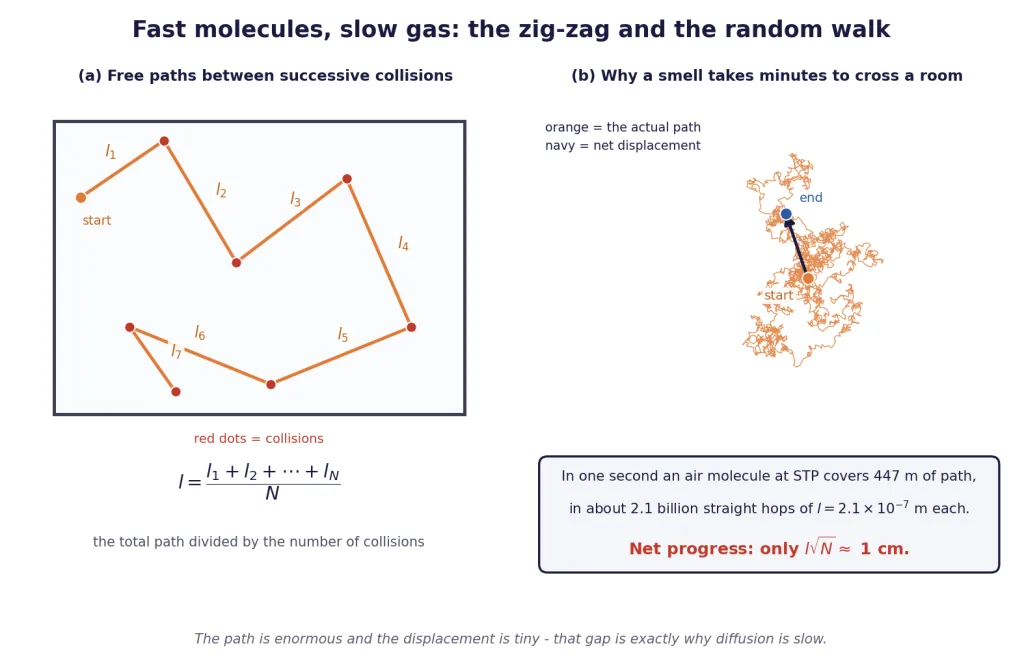
Call those segments Some are short, some are long; there is no way to predict any one of them. But their average is a perfectly definite property of the gas.
Key Point — the mean free path:
The mean free path is the average distance a molecule travels between two successive collisions. It is a length, measured in metres. It is not the distance between neighbouring molecules, and it is not the size of a molecule — as you will see, it is far bigger than both.
[Board Important] Read the definition once more and note the word successive. Students sometimes describe as "the average distance between molecules". That is the mean separation, a completely different (and much smaller) quantity, and mixing the two up is a guaranteed lost mark.
What we are going to need
Two things go into the calculation, and both come from earlier sections.
The number density , molecules per cubic metre. From the gas equation in the form , at K and one atmosphere, (The molar route agrees: one mole occupies about 22.4 L at STP, so , which is the same .)
The mean speed — not the rms speed — which is For air, taking kg/mol at K, this gives m/s. For comparison m/s for the same air; they are close but they are not the same number, and collision counting needs the mean.
[JEE Tip] Collision frequency counts how many collisions happen per second, so what matters is the average distance covered per second, which is . The rms speed is the right tool for energy questions, because energy goes as . Use each where it belongs.
The Collision Cylinder, and the Nobody Should Drop
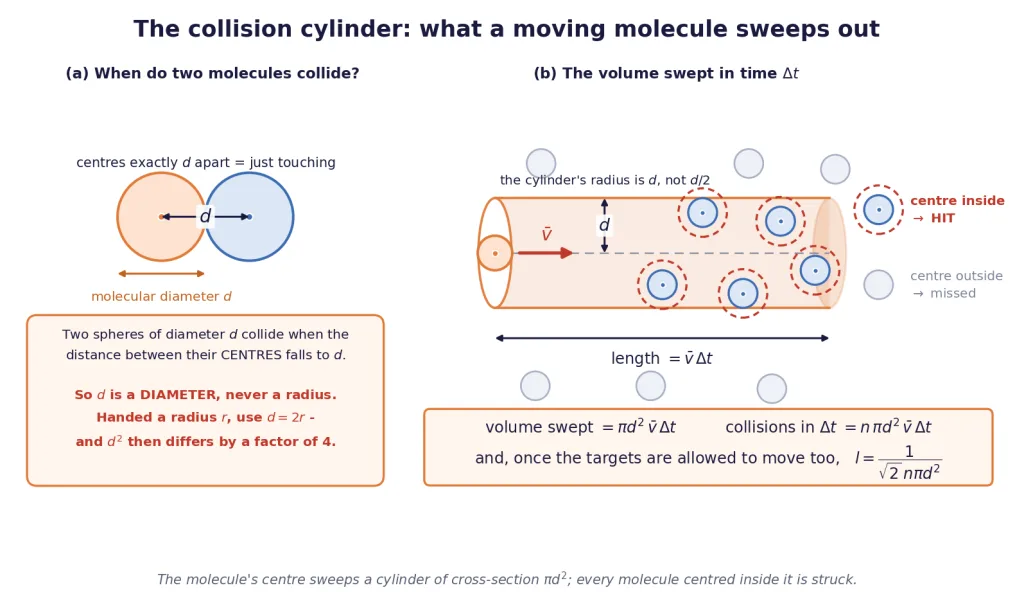
Now build the formula. Model each molecule as a hard sphere of diameter .
When does a collision happen?
Two spheres of diameter touch when the distance between their centres falls to . Not , not — exactly , because each sphere reaches out from its own centre and the two radii add.
Key Point — the trap that costs the most marks in this chapter:
is the molecular DIAMETER. If a problem hands you a molecular radius , you must use before you go anywhere near the formula. Since the formula contains , forgetting this makes your answer wrong by a factor of 4.
Following one molecule
Pick one molecule and, just for the moment, freeze all the others in place. Our molecule moves with speed in a straight line.
Every other molecule whose centre lies within a distance of that line gets hit. So the region our molecule sweeps clean is a cylinder whose axis is the line of flight and whose radius is — giving it a cross-sectional area of This is called the collision cross-section. Notice again that it is , not ; the radius of the cylinder is the full collision distance .
In a time the molecule travels a distance , so the cylinder it sweeps has volume
If there are molecules per unit volume, the number of centres sitting inside that cylinder — that is, the number of collisions in time — is
Divide the distance travelled by the number of collisions and you have the mean free path:
That is clean, it is memorable — and it is not quite right.
The other molecules are moving too
We froze them. In reality every target is moving as fast as our tagged molecule is. What actually decides how often two molecules meet is not the speed of one of them through a field of stationary obstacles, but the average relative speed of a pair.
Two molecules with the same average speed , approaching from random directions, have an average relative speed of rather than . (You can feel where the comes from: for two perpendicular velocities of equal magnitude the relative speed is , and averaging properly over all directions gives the same factor.) Collisions therefore happen times more often than the frozen-target count suggests, and the mean free path is times shorter.
Key Point — the mean free path, the form you must actually use: and, substituting , The first form is the one to reach for when you are told the number density; the second when you are told pressure and temperature.
[JEE Tip] The naive is a useful stepping stone and it is worth being able to derive it, because it shows you where every symbol came from. But every number you report must carry the . Dropping it inflates your answer by 41% — enough to land on a distractor option in a multiple-choice paper, which is exactly what the distractor is there for.
Reading the formula
Both boxed forms say the same three things:
- falls as rises. Pack more molecules in and each one gets less room to run.
- falls as rises. Fat molecules are easier targets. Double the diameter and the mean free path drops to a quarter.
- In the second form, rises with and falls with — but only because and are acting through . Hold fixed and temperature does nothing at all to , which is a favourite exam trick and gets its own treatment two blocks below.
Collision Frequency, Collision Time, and What the Numbers Look Like
The mean free path is a distance. Divide it into a speed and you get the two quantities that turn it into a rate.
The two new definitions
Key Point — collision frequency and collision time:
The collision frequency is the number of collisions one molecule suffers per second: measured in per second. The collision time (or relaxation time) is the average time between two successive collisions: measured in seconds. The three quantities lock together as
Note the symbol. Elsewhere in this chapter counts quadratic energy terms per molecule; here is a frequency in hertz. They are unrelated quantities that unluckily share a letter, so keep the subscript on.
Air at STP: the numbers worth remembering
Take air at K and one atmosphere, with Å m. We already have per cubic metre and m/s.
Put those alongside the other lengths in a gas and the picture snaps into focus:
| Quantity for air at STP | Value | In molecular diameters |
|---|---|---|
| molecular diameter | m | 1 |
| mean spacing between molecules, | m | about 17 |
| mean free path | m | about 1000 |
| distance travelled in one second | 447 m | about |
Key Point — the one-line summary of a gas:
At ordinary temperature and pressure a molecule is about a thousand times smaller than the distance it travels between collisions, and it makes roughly two billion collisions every second.
[NEET Important] Learn the order of magnitude, not the digits: at STP, m (a few tenths of a micrometre), per second, s. A question that asks "the mean free path of air at STP is of the order of" wants exactly that.
Why this makes a gas behave ideally
Look at the middle two rows of the table. The mean free path is about sixty times the mean spacing between molecules. A molecule sails past dozens of neighbours before it actually strikes one, which means that at any instant almost every molecule is in free flight and not interacting with anything.
That is precisely the picture the kinetic theory assumes, and it is why the ideal gas equation works so well for real air. Compress the gas hard and shrinks towards the spacing; then the molecules are permanently within reach of each other, the assumption collapses, and the gas stops being ideal.
How Responds to Everything You Can Change
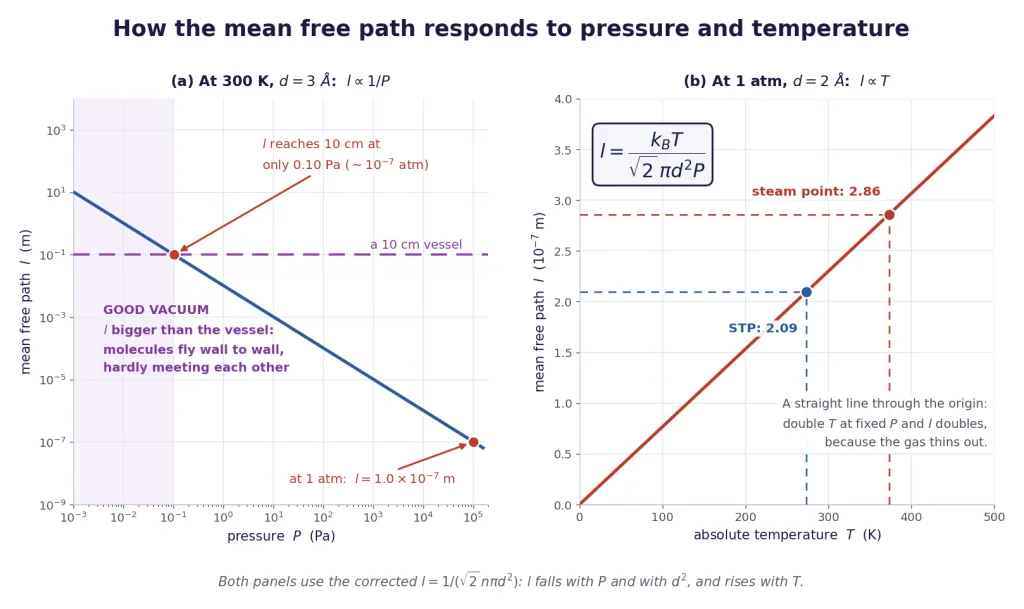
Exam questions on this topic are almost always proportionality questions, so it pays to have the responses at your fingertips rather than re-deriving them under time pressure.
The four dependences
| Change | What happens to | Why |
|---|---|---|
| number density doubles | halves | |
| molecular diameter doubles | falls to one quarter | |
| doubles at constant pressure | doubles | the gas expands, halves |
| doubles at constant temperature | halves | the gas is squeezed, doubles |
| doubles at constant volume | no change at all | has not moved |
Key Point — the trap in that table:
makes it look as though heating a gas always lengthens the mean free path. It does not. Temperature enters only through the number density. Heat a gas in a sealed rigid vessel and does not change by a hair, because is fixed by the vessel. What does change is , so the molecule covers the same free path faster — rises as while stays put.
[JEE Tip] For a combined change, take the ratio and let everything cancel: Triple the temperature while doubling the pressure and goes up by . No constants, no unit conversions, no chance to slip a factor.
The vacuum case
Push the pressure down and grows without limit — until it runs into the vessel.
At K with Å, a pressure of about Pa (roughly a ten-millionth of an atmosphere) already gives cm. In a tube 10 cm across, that means a molecule leaving one wall crosses to the other side without meeting anything on the way. The formula has not stopped being true; it has simply stopped being the smallest length in the problem, and the effective free path becomes the size of the container.
Key Point: In a highly evacuated vessel the mean free path calculated from can exceed the dimensions of the vessel. When it does, the molecules travel wall to wall in straight lines and the vessel size, not the gas, sets the free path.
This is not a curiosity, it is an industry:
- A thermos flask. The silvered double wall encloses a vacuum. Conduction through a gas is a hand-to-hand relay of energy from molecule to molecule; make bigger than the gap and there is no relay left, so the only heat that gets across is what the (silvered, hence poorly emitting) walls radiate.
- Vacuum tubes, CRTs and electron microscopes. An electron beam has to cross the tube without being scattered, so the tube is pumped until the residual gas has a mean free path far longer than the beam path.
- Thin-film coating and semiconductor fabrication. Atoms evaporated from a source must reach the target in a straight line, which again means must exceed the chamber size.
Diffusion, and Graham's Law
Now come back to the perfume bottle.
Why a smell crawls
A molecule leaving the bottle is doing 447 m/s, but it changes direction two billion times a second. Its progress across the room is not a journey — it is a random walk, a stagger of tiny steps per second, each one pointing wherever the last collision happened to send it.
In a random walk of steps of length , the forward and backward steps very nearly cancel. What survives is not but
Put the STP numbers in. In one second and m, so the molecule covers 447 m of path and ends up about from where it started — about a centimetre. To random-walk right across a 3 m room takes of the order of s, which is more than a day. Real rooms are much faster than that only because the air is never truly still: draughts and convection carry the smell bodily, and diffusion alone does the last few centimetres.
Key Point — diffusion:
Diffusion is the gradual mixing of one gas into another by molecular motion alone, without any bulk flow. It is slow, not because molecules are slow, but because collisions make them take an enormously indirect route.
[Board Important] This is the standard "explain why" question: molecular speeds in a gas are comparable with the speed of sound, yet a gas leaking from a cylinder takes a long time to reach the far corner of a room — why? The answer is the finite molecular size, hence the finite mean free path, hence the random walk.
Graham's law
Now put two different gases side by side at the same temperature and ask which one diffuses faster.
Same temperature means the same average kinetic energy per molecule. So the lighter molecule must be the faster one, and from the mean speed
The rate at which a gas diffuses is proportional to how fast its molecules move, so:
Key Point — Graham's law of diffusion:
At the same temperature and pressure, the rate of diffusion of a gas is inversely proportional to the square root of its molar mass (equivalently, of its density): Note which way round the subscripts go: the heavier gas is on top of the fraction whenever the lighter gas's rate is on the left. If instead you are comparing the times two gases take to move the same amount, the relation inverts: .
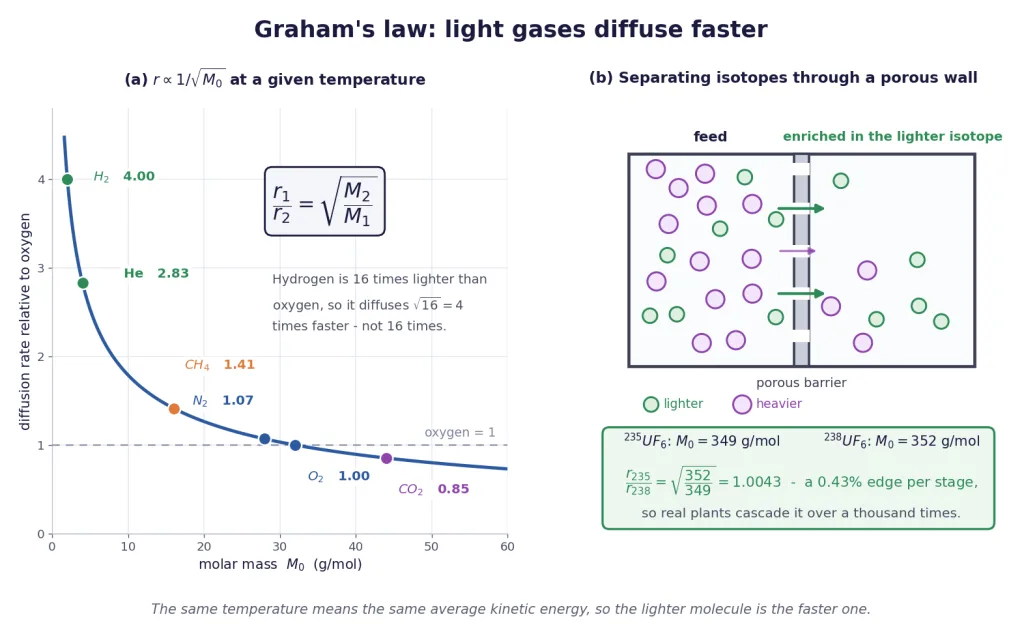
The square root is the whole point. Hydrogen is 16 times lighter than oxygen, so it diffuses times faster — not 16 times faster. Halving the molar mass buys you a factor of only .
Graham's law is stated only in passing in the rationalised syllabus, with no formula attached, but Boards, JEE and NEET all ask it every year, so it is developed in full here.
The same square-root rule governs the escape of a gas through a very small hole into a vacuum, a closely related process called effusion.
The most consequential application
Uranium found in the ground is 99.3% U and only 0.7% of the fissile U. The two are chemically identical, so no chemical process can separate them — but they have different masses, and Graham's law does not care about chemistry.
Convert the uranium to the gas uranium hexafluoride, . The two isotopic versions have molar masses of 349 and 352 g/mol. Push the gas through a porous barrier and the lighter one gets through slightly faster, in the ratio
A 0.43% advantage per stage. It is a tiny edge — which is why real gaseous-diffusion plants cascade the process through more than a thousand stages, and why they were among the largest and most power-hungry industrial buildings ever constructed.
One Length Behind Three Properties
There is a reason the mean free path is worth this much attention, and it is not the mean free path itself.
Whenever something has to be carried across a gas from one place to another — momentum, energy or molecules — it is carried by molecules that fly one free path, collide, and hand it on. The same length therefore turns up in three different measurable properties of a gas, each with the same structure:
| Property | What is transported | Kinetic-theory estimate |
|---|---|---|
| viscosity | momentum | |
| thermal conductivity | energy | |
| diffusion coefficient | molecules |
You are not expected to derive these, and the numerical factor of is only approximate — a fuller treatment shifts it somewhat. What matters is the structure: all three are the product of a speed and the mean free path.
For air at STP, gives a diffusion coefficient of about square metres per second, and with kg per cubic metre gives a viscosity of about Pa s against a measured Pa s. Within a factor of about two and a half, from a model of billiard balls — which for a first-principles estimate is a triumph.
Key Point — how molecules were first measured:
Viscosity and thermal conductivity are things you can measure in a laboratory with a stopwatch and a thermometer, without ever seeing a molecule. Each of them depends on , and depends on through . So a measurement of viscosity can be inverted to give — and this is how the sizes of molecules were first estimated, decades before anyone could image an atom. Run it backwards on the viscosity of air and you get Å, which is right.
[JEE Tip] There is one lovely and thoroughly counter-intuitive consequence sitting in that table. Since and , their product has no in it at all — so the viscosity of a gas does not depend on its pressure. Halve the pressure and you have half as many momentum carriers, but each one now carries momentum twice as far, and the two effects cancel exactly. Maxwell predicted this, refused to believe it, tested it himself, and found it was true.
And it is the same reasoning that explains the thermos flask from the previous block. The cancellation only holds while is smaller than the container. Pump the gap down until exceeds it, and there is nothing left to hand the energy on with — which is when the conduction finally collapses.
Solved Examples
Constants used throughout, unless a problem says otherwise: J/K, J/(mol K), per mol, 1 atm Pa, K. One angstrom (Å) is m.
Example 1: The mean free path of air, from scratch
Estimate the mean free path of an air molecule at STP, taking the molecular diameter as 2 Å. Take the molar mass of air as 29 g/mol.
Solution:
Number density. Both temperature and pressure are given, so use with K (absolute, as every formula in this chapter demands):
The diameter, squared. Å m, so m and
Put it together, with the :
Sanity check. . A molecule travels about a thousand of its own diameters between hits — the right order for a gas.
What the naive formula would have given. Without the , m — bigger by 41%, and wrong.
Final Answer: m, about micrometres.
Takeaway: Two steps, in this order: get from , then divide by . Quote the version and nothing else.
Example 2: They gave you a radius
The radius of a certain gas molecule is Å. Find its mean free path at STP, and state what answer you would have got by careless substitution.
Solution:
Convert the radius to a diameter first. This is the whole point of the question:
Number density at STP is the same as before, per cubic metre.
Substitute:
The careless answer. Feeding the radius straight in as if it were gives smaller by a factor of 4, hence Four times too big — and it will be sitting there as one of the options.
Final Answer: m.
Takeaway: Underline the word "radius" the moment you read it, and write on the next line before doing anything else. The error factor is exactly 4, every time.
Example 3: Collision frequency and collision time for nitrogen
Nitrogen gas ( g/mol) is at K and one atmosphere. Taking the molecular diameter as 3 Å, find the mean free path, the collision frequency and the collision time.
Solution:
Number density.
Mean speed. Convert the molar mass to kilograms per mole first — g/mol kg/mol, not :
Mean free path.
Collision frequency and collision time.
Check the loop closes: m, which is again.
Final Answer: m; per second; s.
Takeaway: Always close the loop with . It costs one line and catches an arithmetic slip in either of the other two answers.
Example 4: Two things change at once
A sample of gas is taken from K and 1 atm to K and 2 atm. By what factor does its mean free path change?
Solution:
Use the pressure form, because pressure and temperature are what you were given:
Take the ratio. The gas is the same, so is unchanged and , and all cancel:
Read it out. The heating alone would have tripled ; the doubled pressure halves it again; the net effect is a 50% increase.
Final Answer: increases by a factor of .
Takeaway: Ratio methods need no constants and no unit conversions — as long as both temperatures are absolute and both pressures are in the same unit, whatever that unit is.
Example 5: Water vapour above boiling water
Estimate the mean free path of a water molecule in steam at K and one atmosphere, taking the effective molecular diameter as 2 Å.
Solution:
Number density, with K: Thinner than air at STP, as expected — same pressure, higher temperature.
Mean free path:
Shortcut check. At constant pressure , so scaling the STP answer of Example 1 gives Same answer, one line.
Perspective. The mean spacing between molecules here is about m, so the mean free path is roughly 80 times the spacing. Steam is a thoroughly gaseous gas.
Final Answer: m.
Takeaway: At fixed pressure, is directly proportional to absolute temperature — so you can scale a known answer instead of redoing the whole calculation.
Example 6: How good a vacuum do you need?
An electron tube is m long. To what pressure must it be evacuated, at K, so that the mean free path of the residual gas is at least m? Take Å. What number density is that?
Solution:
Rearrange the pressure form for :
Substitute, with m:
In atmospheres: atm — a ten-millionth of atmospheric pressure.
Number density there: Still two and a half billion billion molecules in every cubic metre — and yet each one crosses the whole tube without meeting another.
Final Answer: Pa, about atm, at which per cubic metre.
Takeaway: A "good vacuum" is defined by the apparatus, not by the gauge. It means larger than the vessel — and even then the vessel is nowhere near empty.
Example 7: Hydrogen against oxygen
Under identical conditions, how much faster does hydrogen diffuse than oxygen? Molar masses: , 2 g/mol; , 32 g/mol.
Solution:
Graham's law, with the lighter gas's rate on the left:
The molar masses appear only as a ratio, so grams per mole are safe here — the units cancel:
Cross-check from the mean speeds directly, which is where the law comes from. At K, m/s and m/s. Their ratio is . Agreed.
Final Answer: Hydrogen diffuses 4 times faster.
Takeaway: Sixteen times lighter is only four times faster. The square root is the entire content of Graham's law, and the option "16 times" is always on the paper.
Example 8: Identifying a gas from its diffusion rate
An unknown gas takes three times as long as helium to diffuse the same amount through the same apparatus under the same conditions. Find its molar mass. Helium: 4 g/mol.
Solution:
Three times the time means one third the rate:
Apply Graham's law:
Square both sides and solve:
Check the direction. The unknown gas is slower, so it should be heavier than helium — and 36 is comfortably heavier than 4. The logic is consistent.
Final Answer: g/mol.
Takeaway: Convert "time" to "rate" before touching the formula, and then sanity-check the direction: slower gas, heavier gas, always.
Example 9: Separating uranium isotopes
has a molar mass of 349 g/mol and has 352 g/mol. Find the ratio of their diffusion rates through a porous barrier, and comment on what that implies for the process.
Solution:
Graham's law:
Read the number. Each pass through a barrier enriches the mixture in by only — a factor of , not and certainly not .
What that costs. To move the fraction from its natural up to reactor or weapons levels, the ratio of the two isotopes must be multiplied by a factor of over a thousand. With a per-stage gain of , the number of stages needed is which is why gaseous-diffusion plants were built as cascades of thousands of stages covering hundreds of acres.
Final Answer: , a enrichment per stage.
Takeaway: Graham's law works on any mass difference at all, however small — but a square root of a ratio close to 1 gives a gain close to 1, and the engineering cost of that is enormous.
Example 10: A fat molecule and a thin one
At the same pressure and temperature, compare the mean free path of a carbon dioxide molecule ( Å) with that of an air molecule ( Å). Work out the value at STP.
Solution:
Same and means the same , so everything except cancels:
So the mean free path is about a fifth of the air value:
Why it matters. A molecule only 2.3 times wider has a collision cross-section times larger, so it is struck five times as often. Cross-section goes as the square of the size, which is why is the most sensitive input in the whole formula.
Final Answer: m, about of the air value.
Takeaway: depends on , so molecular size is the input that hurts most — a 10% error in is a 20% error in .
Example 11: How far does a molecule actually get?
An air molecule at STP makes collisions per second, with a mean free path of m. Find (a) the total path length it covers in one second, and (b) its approximate net displacement in that second.
Solution:
(a) Total path length. Path number of hops length of each hop: Which is just second, as it must be.
(b) Net displacement. The hops point in random directions, so this is a random walk of steps:
Compare the two. The path is 447 m and the progress is about a centimetre — a ratio of about 46000 to 1.
Final Answer: (a) 447 m of path; (b) about cm of net displacement.
Takeaway: Path length grows as , net displacement only as . That single mismatch is the complete explanation of why diffusion is slow.
Example 12: Sizing a vacuum chamber
A coating chamber is 10 cm across. At K, and taking Å, find the number density and pressure at which the mean free path just equals the chamber size.
Solution:
Solve the number-density form for , setting m:
Convert to a pressure with :
Compare with atmospheric. That is atm, so the chamber has to be pumped down by a factor of about a million — comfortably within reach of an ordinary laboratory pump.
Final Answer: per cubic metre at Pa.
Takeaway: Set equal to the apparatus size and solve backwards for . That is the standard way a vacuum specification is actually written.