
What JEE Adds to This Chapter
Sections 1 to 11 built this chapter properly. The ideal gas equation in all four of its forms, the pressure derivation, the kinetic meaning of temperature, the Maxwell distribution, degrees of freedom, equipartition, the specific heats, the mean free path — all of it is in place, and for the Board paper that build is complete.
What JEE adds is almost no new physics. It is still , still , still , still . What changes is that the gas stops being one clean gas in one clean container. It is two gases mixed. It is two vessels joined. It is a vessel that leaks while it is heated. It is a column of air a hundred kilometres tall. And it is very often two things changing at once, so that no single proportionality does the whole job.
The one idea that organises this whole section
Here it is, up front, because half of what follows is a variation on it.
Key Point — energies add; ratios do not. Internal energy is extensive: pour two gases into one vessel and the internal energies simply sum. Heat capacities therefore sum too. But is a ratio of two extensive quantities, and ratios do not add and do not average. So the recipe for any mixture is always the same three steps: Any shortcut that averages directly is wrong, and the wrong answer is always on the option list.
Notation
Two symbols in this chapter mean the opposite of what they meant in the last one, and every year that costs marks.
Key Point — and : in kinetic theory is the NUMBER DENSITY, molecules per cubic metre, , and is the number of moles. The previous chapter used for moles; this is the reverse, and this is the convention every kinetic-theory formula uses. So: is the number of molecules, the Avogadro number, the mass of the sample and the molar mass. Any formula carried over from thermodynamics gets rewritten with before it is used.
And one more, because both meanings of appear in this section: on its own is the number of quadratic terms per molecule (loosely, the degrees of freedom), while the collision frequency is written throughout. They never share a symbol on the same line.
The twelve things this section teaches
| # | Skill | Why it earns marks |
|---|---|---|
| 1 | Effective and of a mixture, from added energies | The plain average of the two values is always a distractor |
| 2 | Effective of a mixture, and why it need not be a whole number | It converts a mixture into a single fictitious gas |
| 3 | Mean molar mass and the speed it gives | One number replaces the whole composition in |
| 4 | A rigid vessel heated — what is fixed and what is not | never changes; only and do |
| 5 | A vessel that vents while it is heated | is the invariant, not |
| 6 | Two vessels joined, at one temperature or at two | Mole conservation, and a one-line shortcut when they share a temperature |
| 7 | The barometric distribution and the scale height | Explains the atmosphere, and is one integration |
| 8 | Energy per unit volume against per unit mass | Two different questions, two different formulas, one shared trap |
| 9 | Effusion, and why it is not diffusion | The rate carries a that Graham's law alone does not show |
| 10 | Mean free path with and both moving | The ratio form does it in one line; the isochoric case surprises people |
| 11 | Collision-frequency scaling | , which is not the same scaling as |
| 12 | read backwards, then fed into an adiabat | Identify the gas from a measured specific heat, then use it |
Constants and reference values, fixed now
Every solution below restates the constants it uses, and no problem here mixes two values of the same constant.
| Quantity | Value |
|---|---|
| J/(mol K) | |
| J/K | |
| per mol | |
| 1 atm | Pa |
| m/s | |
| , monatomic () | J/(mol K), |
| , rigid diatomic () | J/(mol K), |
| , vibrating diatomic () | J/(mol K), |
| , rigid non-linear polyatomic () | J/(mol K), |
| , rigid linear polyatomic () | J/(mol K), |
| Molar masses used | He , H , N , O , Ar kg/mol |
Note the units column. Every molar mass in that last row is in kilograms per mole. That is not fussiness; it is the single largest source of wrong answers in this chapter, and every worked solution below writes the conversion on its own line before using it.
Some of what follows goes beyond the core Class 11 syllabus altogether — the effective of a mixture, the barometric distribution, effusion. These are extension topics, not trimmed course material, but JEE Main and JEE Advanced set them every year, so each one is developed here from first principles rather than quoted.
[Exam Tip] Four questions, asked before any algebra, choose the method for almost every problem below. What is held fixed — the volume, the pressure, the number of moles, the temperature, or nothing at all? Is the quantity I want extensive (so it adds) or a ratio (so it does not)? Is every temperature in kelvin and every molar mass in kilograms per mole? Which of the three molecular speeds does this formula actually want? Answer those four and you have chosen your method before writing a symbol.
Mixtures: Effective , Effective , Effective
Put moles of one ideal gas and moles of another into the same container, non-reacting, and ask what the mixture behaves like. The answer is that it behaves like one ideal gas, with its own , its own and its own effective — and the whole job is finding those three numbers.
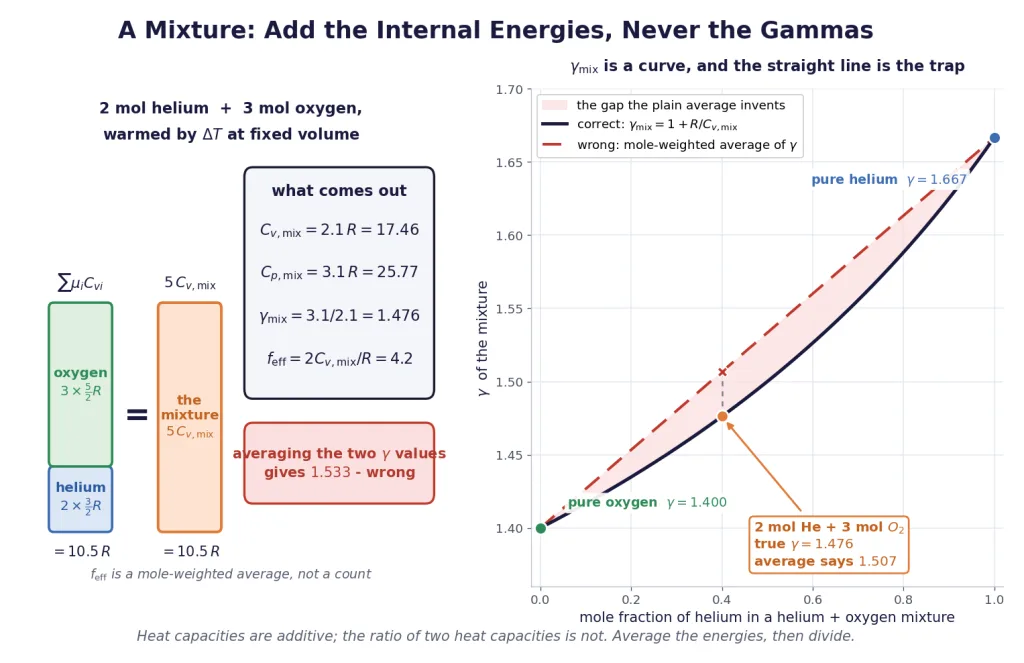
Derive it from energy, which always works
Section 8 gave the internal energy of moles of a gas with quadratic terms per molecule:
The two gases sit in the same vessel at the same temperature, and energy is additive, so
Cancel the and you are done.
Key Point — the mixture's specific heats: Both are mole-weighted averages. And because Mayer's relation holds for each gas separately, it holds for the mixture too, so you only ever compute one of them:
The effective number of degrees of freedom
Since for a single gas, define the mixture's effective the same way:
Key Point — effective : is a mole-weighted average, not a count, so it need not be a whole number. A mixture with is perfectly ordinary; no molecule in it has quadratic terms.
That last formula is the reason the effective- route is worth learning. Once you have , every formula in the chapter applies unchanged: , , , and the previous chapter's adiabatic relations with that .
The compact identity, worth memorising
Substituting for each gas turns the weighted average into something faster to use under time pressure:
Key Point — the mixture identity: It extends to any number of gases with the obvious extra terms. Read it as: the quantity is additive, which is true because is a total heat capacity, and heat capacities add.
Check it on a case you can verify by hand. One mole of helium () with one mole of oxygen (, treating it as rigid):
so , giving exactly, and . The plain average of and would have said — close enough to be tempting and wrong enough to be a distractor.
The trap, stated plainly
is never the average of the values. The right-hand panel of the figure draws both: the true against composition is a curve, and the straight line joining the two end values sits above it everywhere in between. The two agree only at the two ends, where there is only one gas.
Two consequences worth carrying:
- Mixing two gases of the same atomicity changes nothing. Helium with neon is still ; nitrogen with oxygen is still . If a question offers you for a helium-neon mixture, it is checking whether you noticed they are both monatomic.
- A mixture's always lies strictly between the two. If your answer is outside that range you have made an arithmetic slip; check before writing it down.
The mean molar mass, and the speed it gives
Molar masses do not enter , or at all. They enter only when a speed or a density is wanted, and then through one number:
Key Point — mean molar mass: and the mixture's root mean square speed is with in kilograms per mole.
That formula deserves one sentence of honesty, because it is easy to misread. The molecules of the two gases do not all move at that speed — the light ones move much faster than the heavy ones, and each species keeps its own . What is, exactly, is the mass-weighted root mean square:
and those two expressions really are the same number, because the total translational kinetic energy is whatever the composition. So it is the speed you want for the density, for the pressure through , and for the total kinetic energy — and it is not the speed of any particular molecule.
[Exam Tip] When a mixture question gives you masses rather than moles, convert first, and keep the two conversions apart in your head: moles decide , and ; masses decide and every speed. Mixing those two up is the second most common error here, right behind averaging .
Vessels: Heated, Vented, and Joined
Every problem in this family is solved the same way: write down what is being held fixed, and the equation writes itself.
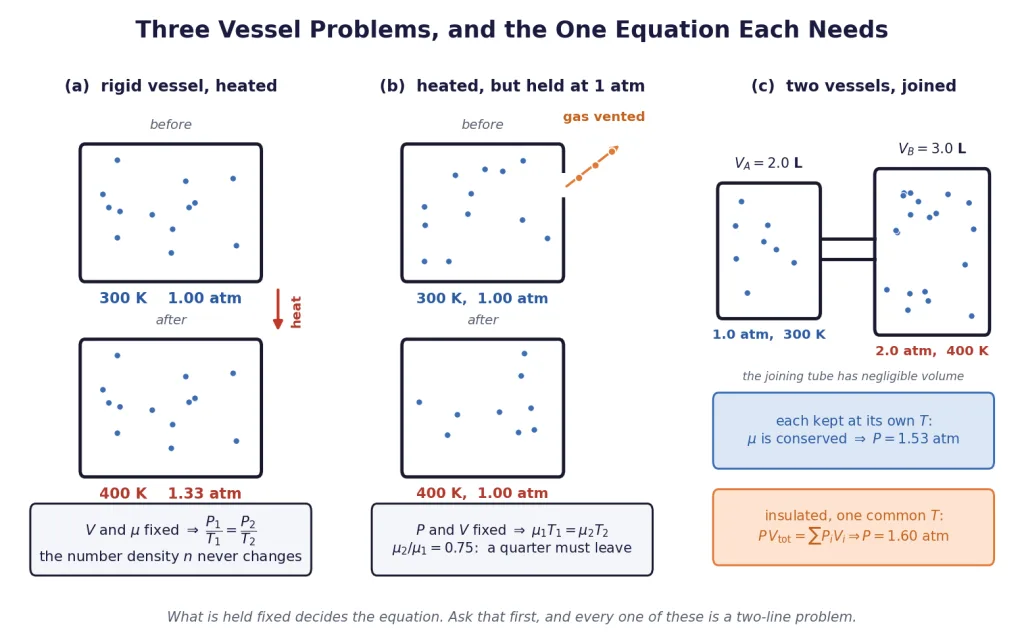
The reading key
| What is held fixed | The invariant | The equation you write |
|---|---|---|
| and (sealed rigid vessel) | , and itself | |
| and (vessel vented while heated) | ||
| and (gas free to expand) | ||
| and (slow leak-free squeeze) | ||
| Total (two vessels joined) |
A rigid vessel that is heated
Nothing enters and nothing leaves, and the walls do not move. So is fixed and is fixed, and therefore
There is one extra fact here that questions love, and it is worth saying out loud:
Key Point — a sealed rigid vessel has a fixed number density. , and neither nor changed. Heat it, cool it, do what you like — does not move. Everything that depends on alone therefore does not move either, and the mean free path is the headline example. It is the same after heating as before.
That is the single most surprising result in this section for most students, and it is on the paper every year. Heating a sealed vessel makes the molecules faster, makes them hit the walls harder and more often, and raises the pressure — and leaves the average distance between collisions exactly where it was.
A vessel that vents while it is heated
Now the container is heated but kept at atmospheric pressure, either by a valve or because it is open. and are both fixed, so from the product is the invariant:
and the fraction of the gas that must escape is
Heat a room from 300 K to 400 K and a quarter of the air in it goes out of the window. This is also why an open flask cannot be used to weigh a gas without recording the temperature.
Two vessels joined by a thin tube
Two containers, gas in each, connected by a tube of negligible volume. The gas redistributes until the pressure is common — that is the only thing a connecting tube can enforce. What happens to the temperatures depends on how the problem is set up, and there are two standard versions.
Version one: each vessel is held at its own temperature (each sits in its own bath). Then only the total number of moles is conserved:
Key Point — joined vessels at two temperatures: so the common pressure is Cancel everywhere; it never survives. Note that the two vessels end up with different number densities, because and they share but not .
Version two: the whole assembly is insulated and comes to one temperature. Now nothing leaves the pair, no work is done on the outside, so the total internal energy is unchanged: . If it is the same gas on both sides, cancels and
and then a very pretty shortcut appears:
Key Point — the one-line shortcut. For one gas in an insulated pair of joined vessels, The final temperature is not needed at all. The quantity is simply conserved because it is , which is of the total translational kinetic energy — and that is what an insulated rigid pair of vessels conserves.
If the two sides hold different gases the shortcut still gives the pressure only when their values are equal; otherwise go back to the energy equation, with a heat-capacity-weighted average:
Note what that is not: it is not the plain average of the temperatures, and it is not the mole-weighted average either, unless the two values happen to agree.
[Exam Tip] Solve every one of these twice, once through and once through . It costs twenty seconds and it catches the single deadliest slip in the chapter — reading as a number of moles. If the two routes disagree by a factor of about , you know exactly which one it was.
Energy Densities, and the Atmosphere
Per unit volume
Start from the result Section 5 established, for the total translational kinetic energy of molecules, and divide by the volume:
Key Point — translational kinetic energy per unit volume: It depends on the pressure alone. Not on the temperature, not on the density, not on which gas it is. Two vessels at the same pressure hold the same translational kinetic energy per cubic metre even if one holds hydrogen at 100 K and the other holds argon at 1000 K.
The full internal energy per unit volume is the same argument with in place of 3:
so for a rigid diatomic gas it is and for a rigid non-linear polyatomic it is . For a monatomic gas alone do and coincide. Everything else stores energy in rotation as well, and a question that says "kinetic energy" when it means the translational part, or "internal energy" when it means all of it, is testing exactly this.
Per unit mass
Now divide the same energy by the mass instead. For one mole, the translational energy is and the mass is , so
Key Point — translational kinetic energy per unit mass: This one depends on the temperature and the molar mass, and not at all on the pressure. At the same temperature a kilogram of helium carries eight times the translational kinetic energy of a kilogram of oxygen, because .
The two formulas are consistent, of course, and the bridge between them is the density:
which is a free cross-check on any answer in this family.
| Question asked | Formula | Depends on |
|---|---|---|
| Translational KE per cubic metre | pressure only | |
| Internal energy per cubic metre | pressure and structure | |
| Translational KE per kilogram | temperature and molar mass | |
| Internal energy per kilogram | temperature, molar mass, structure | |
| Translational KE per molecule | temperature only |
Read the question's units before choosing a row. "Per unit volume" and "per unit mass" are one word apart and land on completely different formulas, and both wrong answers will be offered to you.
The barometric distribution
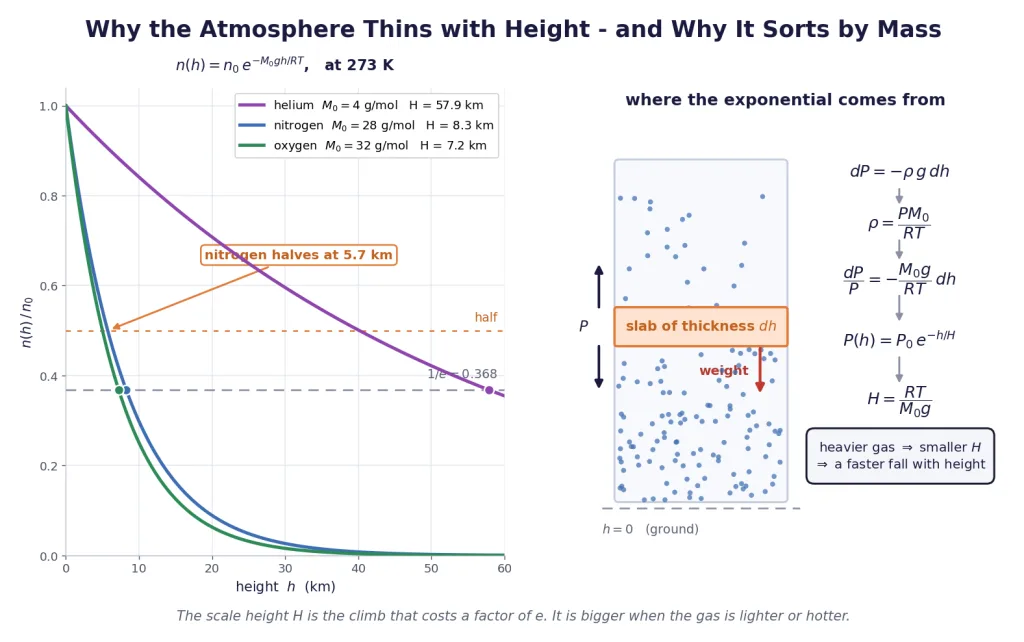
Why is the air thinner on a mountain? Not because gravity pulls the molecules down and leaves a vacuum above — thermal motion would fill that in immediately. The atmosphere is a balance: gravity pulling molecules down against thermal motion spreading them out, and the balance settles into an exponential.
Take a thin horizontal slab of air of thickness and unit area. The pressure at its bottom must exceed the pressure at its top by the weight of the slab:
Now use the gas equation in its density form, , and separate:
Key Point — the barometric formula: is the scale height: the climb that reduces the pressure by a factor of , that is to of its starting value. Per molecule the same statement reads , which is the Boltzmann factor with the potential energy of one molecule.
Three readings of that formula, each of which has been an exam question:
- Heavier gas, smaller . , so helium's scale height is seven times nitrogen's, and the curve in the figure for helium falls seven times more slowly. That is why the upper atmosphere is relatively rich in light gases.
- Hotter gas, larger . , so a warm atmosphere is puffed up and a cold one is squashed down.
- The half-height is not the scale height. Pressure falls to at , and to at . Read which one the question wants.
The formula assumes a single gas at a uniform temperature, so it is a model of the real atmosphere rather than a description of it — real air is a mixture, and its temperature falls with height for the first ten kilometres or so. It still gets the scale of things right, which is what it is for.
[Exam Tip] Any question that says "the number density falls to " or "the pressure falls to " is asking you to take a logarithm, not to memorise anything: . And the ratio questions are faster still — two gases at the same temperature and the same height have , with no exponentials evaluated at all.
Mean Free Path Under Combined Changes, and Effusion
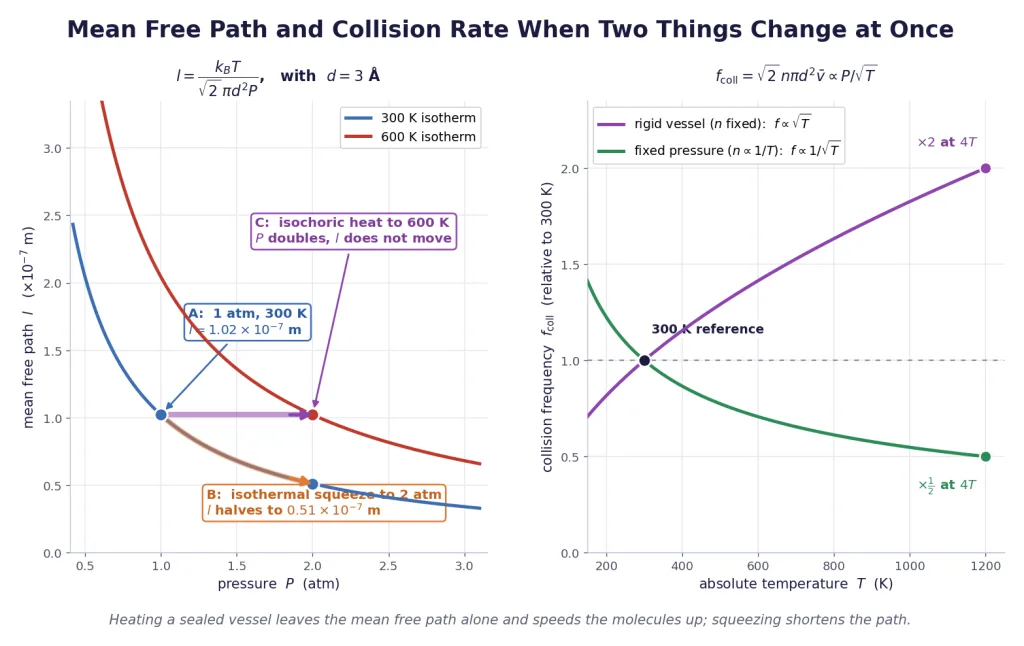
The two forms, and which one to reach for
Section 10 derived
with the molecular diameter and the coming from the fact that the other molecules are moving too, so what matters is the average relative speed. Both forms are the same formula, and choosing the right one saves most of the work:
- If the question tells you about the container — a sealed rigid vessel, a fixed volume, a fixed number of molecules — reach for . It says depends on and and nothing else.
- If the question tells you about the state — pressures and temperatures — reach for , and use it as a ratio.
Key Point — the ratio form, which is what exams actually want: One line, no constants, no molecular diameter needed — the cancels as long as it is the same gas. This handles "both and change" in a single step, which is the whole point.
Along an isotherm and along an isochor
The two special paths behave completely differently, and the figure draws both.
Isothermal ( fixed): . Squeeze the gas to half its volume and the mean free path halves. This is the intuitive case.
Isochoric ( fixed, sealed): here is the one that catches people. Heating a sealed vessel raises and raises , in exact proportion — and the two effects in cancel exactly.
Key Point — heating a sealed vessel does not change the mean free path. is fixed, so is fixed. What does change is the speed: , so the molecules cover the same average distance between collisions but cover it faster, and the collision frequency rises as .
In the figure, the isochoric move from A to C is a horizontal line: the pressure doubles, the temperature doubles, and does not budge.
Collision frequency, and why it scales differently
with the mean speed, not — the collision count is about how far a molecule travels per second, and that is the mean speed by definition. Now substitute and :
Key Point — the scaling: These are three different scalings and they are asked about interchangeably. Note in particular that rises with temperature at fixed pressure while falls — because at fixed pressure the gas thins out faster than the molecules speed up.
| Change | ||||
|---|---|---|---|---|
| Isothermal, doubled | unchanged | |||
| Isobaric, doubled | ||||
| Isochoric, doubled | unchanged | unchanged | ||
| Both: doubled, tripled |
Effusion, and how it differs from diffusion
Punch a hole in a container, small enough that its diameter is much less than the mean free path. Molecules then leave one at a time, without colliding with each other on the way out, and without setting up any organised flow. That is effusion.
Counting the molecules that reach a wall of area per second gives the standard flux result:
Key Point — the effusion rate: Two gases at the same and therefore effuse in the ratio which is Graham's law again — but note that the full formula carries a and a that Graham's law alone does not show, and questions exploit that.
The two temperature cases are worth separating, because they give opposite answers:
- A rigid sealed vessel, heated. is fixed, so the rate goes as . Quadruple the temperature and the rate doubles.
- Held at constant pressure, heated. Now , and the rate goes as . Quadruple the temperature and the rate halves.
And the difference from diffusion, which is asked as a one-mark distinction:
| Effusion | Diffusion | |
|---|---|---|
| Where it happens | through a hole smaller than | through another gas, or through a wide opening |
| Collisions on the way | essentially none | constant, that is the whole mechanism |
| What sets the rate | the molecular flux | the mean free path and the concentration gradient |
| Speed | fast — molecules leave at molecular speeds | slow — a molecule's net progress is a random walk |
| Mass dependence | , exactly | , approximately |
Both obey the same square-root-of-mass law, which is why they are so often confused, but only effusion obeys it exactly and from a clean derivation. Isotope separation by gaseous diffusion is, physically, effusion through an enormous number of tiny pores.
[Exam Tip] For effusion out of a mixture, the escaping gas is richer in the light component — the initial mole ratio in the escaping stream is times the ratio inside. The gas left behind therefore gets steadily heavier, which is exactly why a real enrichment plant needs thousands of stages rather than one.
Reading Backwards, the Adiabatic Cross-Link, and the Five Traps
Identifying a gas from a measured specific heat
Every relation in Section 9 runs forwards from an integer . Each of them also runs backwards, and JEE prefers the backwards direction because it takes one more step.
Key Point — the four backwards routes: Compute , round it to the nearest whole number, and read off the structure: 3 is monatomic, 5 is a rigid diatomic or a rigid linear polyatomic, 6 is a rigid non-linear polyatomic, 7 is a diatomic whose bond is vibrating too.
The one ambiguity is real and worth naming: cannot tell a rigid diatomic from a rigid linear triatomic, because both have 3 translational and 2 rotational modes. Carbon dioxide has for exactly the same reason nitrogen does. Only the molar mass separates them.
If the data is per kilogram, convert first. Lower case and are per kilogram; upper case and are per mole. The bridge is
and that second relation is Mayer's, divided through by — a favourite, because the answer depends on which gas it is, unlike .
Carrying into the previous chapter's adiabats
The previous chapter derived the adiabatic relations for a reversible process but had to take as a measured input. This chapter supplies it from molecular structure. Put the two together and you can start from a molecule and finish at a temperature.
Key Point — the relations, rewritten in this chapter's symbols: Note the : the previous chapter wrote for the number of moles, and every one of those formulas must be rewritten with before it is used here, because in this chapter is a number density.
The combined recipe is four steps and it is worth drilling until it is automatic:
- Count from the molecule, or read it backwards from a given , or .
- Get and .
- Apply the adiabatic relation with that to get the new temperature or pressure.
- Get the energy from , which for an adiabatic process is also the work done on the gas.
For a mixture, step 1 becomes and everything downstream is unchanged.
The five standing traps
These are the five errors that cost the most marks in this chapter, with the damage each one does written next to it.
Trap 1: the molar mass left in grams.
A mixture with a mean molar mass of g/mol at 300 K has m/s. Substitute instead of and you get m/s. The error is a factor of , and m/s is a walking pace, so the answer announces itself if you glance at it. Habit that fixes it: write the conversion on its own line, every time.
Trap 2: substituted where belongs.
Energy and pressure want ; the mean free path and the collision rate want . Since , computing a kinetic energy as instead of makes it of the truth — 15% too small, which is comfortably far enough to hit a distractor and comfortably close enough to look plausible.
Trap 3: the missing .
is the naive result, obtained by pretending the other molecules stand still. The real one carries a in the denominator, so the naive answer is too large. Along with it: is a diameter. A question that hands you a molecular radius of Å means Å, and then differs by a factor of 4.
Trap 4: read as a number of moles.
In this chapter with in molecules per cubic metre, and with in moles. Put moles into the first and you are wrong by a factor of . The cure is the habit from the last block: do every gas-law problem both ways and check the two agree.
Trap 5: a diatomic assumed rigid when the problem has quietly said otherwise.
The words that matter are small: "a diatomic gas whose molecules also vibrate", "at high temperature, where the vibrational mode is active", "a non-rigid diatomic". Any of them means , not 5, and , not . In the last worked example below, that one word moves the final temperature of an adiabatic compression from K to K — a 27% difference, and both numbers are on the option list.
And a sixth, specific to this section: of a mixture need not be an integer, but of a real molecule always is. If you compute for a single named gas, you have made an arithmetic error; if you compute it for a mixture, you have not.
[Exam Tip] Before you write a final answer in this chapter, run a five-second audit. Is every temperature in kelvin? Is every molar mass in kilograms per mole? Did I use the speed the formula asked for? Is my still there? Is a density or a count? Five questions, five seconds, and they catch essentially every mark this chapter takes off people who understood the physics perfectly well.
Solved Examples, Part 1: Mixtures
Values used throughout, unless a problem says otherwise: J/(mol K), per mol, , , with monatomic, rigid diatomic and rigid linear polyatomic, rigid non-linear polyatomic, vibrating diatomic.
Example 1: Two moles of helium, three moles of oxygen
A rigid vessel holds 2 moles of helium and 3 moles of oxygen at 300 K. Treat the oxygen as a rigid diatomic gas. (a) Find , , and . (b) Find the internal energy of the mixture, and check it a second way. (c) Compare with the plain average of the two values, and with the mole-weighted average.
Solution:
Write down each gas's from its . Helium is monatomic, ; rigid oxygen has :
Add the heat capacities, because energies add. With and , total :
Mayer's relation gives for free, because it holds for each gas and therefore for the mixture:
Divide, and only now.
The effective degrees of freedom. Cross-check through the other formula: , and . Agrees.
(b) The internal energy at 300 K. Check it by adding the two gases separately: J. Agrees to the last digit, as it must, since that is where the formula came from.
(c) The two wrong routes. The plain average of the values is . The mole-weighted average of the values is . The correct answer is , so the plain average is high and even the mole-weighted one is high.
Final Answer: , J/(mol K), , , and J at 300 K.
Takeaway: Notice that at no point did the molar masses of helium and oxygen appear. , and are decided by how many moles and what shape, never by how heavy. And notice step 7: both averaging routes are wrong, and both are the kind of wrong that looks right.
Example 2: The same mixture, now its speeds
For the mixture of Example 1 — 2 moles of helium and 3 moles of oxygen at 300 K — with molar masses g/mol and g/mol: (a) Find the mean molar mass and the mixture's root mean square speed. (b) Find each gas's own , and show that the answer to (a) is the mass-weighted combination of them. (c) In one step, find the ratio of the rms speed of helium at 300 K to that of oxygen at 600 K.
Solution:
Convert the molar masses to kilograms per mole first. This line is the whole ball game:
Mean molar mass is total mass over total moles.
The mixture's rms speed. With J/(mol K) and K:
(b) Each gas separately. These differ by a factor of , exactly as demands.
Now combine them by mass. Helium contributes kg and oxygen kg: The same number. The mean-molar-mass formula is a mass-weighted rms in disguise, which is why it is the right speed for energy and density questions and the wrong one for "how fast is a helium molecule".
(c) Two gases, two temperatures, one step. Do not compute either speed:
Final Answer: kg/mol and m/s; the individual speeds are m/s and m/s; and helium at 300 K is exactly twice as fast as oxygen at 600 K.
Takeaway: Two conversions, kept apart. Moles gave and in Example 1; masses give and every speed here. And step 6 is the template for a whole family of one-line questions: put both temperature ratio and mass ratio under one square root and stop.
Example 3: A mixture given by mass, then compressed adiabatically
A cylinder holds 16 g of helium and 16 g of oxygen at 300 K. Oxygen may be treated as rigid. (a) Find and . (b) The mixture is compressed adiabatically and reversibly to half its volume. Find the final temperature and the ratio of the final to the initial pressure. (c) Find the change in internal energy, and the work done on the gas.
Solution:
Equal masses are not equal moles. Convert: Eight times as many moles of helium as of oxygen, from the same mass. That imbalance is the point of the problem.
Mole-weighted .
Hence and . Cross-check with the identity: , and gives , so . Agrees. The mixture sits close to monatomic behaviour, which it should, since 89% of its molecules are helium.
(b) The adiabatic relation, with this . For a reversible adiabatic process is constant, so with :
The pressure ratio, from constant: Check it against the gas law, which must agree: . Agrees.
(c) The internal energy change. Second route, using J. Agrees.
The work. The process is adiabatic, so and the first law gives , where is the work done by the gas. So J, meaning 9722 J of work is done ON the gas — which is right, since it was compressed.
Final Answer: and ; K, ; J, with J of work done on the gas.
Takeaway: Two chapters in one problem. This chapter supplied from the molecules; the previous one supplied constant. And step 1 is where the marks are: equal masses of a light gas and a heavy gas are wildly unequal numbers of moles, and it is the moles that set .
Example 4: Three gases, and one that is not what it looks like
A vessel contains 1 mole each of helium, oxygen and carbon dioxide at the same temperature. Carbon dioxide is a linear triatomic molecule; treat all three as rigid. (a) Find , and . (b) What would the answer have been if carbon dioxide had been treated as a non-linear triatomic? (c) A different mixture, of one monatomic gas and one rigid diatomic gas, is measured to have . Find the ratio of their moles.
Solution:
Count for each molecule. Helium is monatomic: . Oxygen is a rigid diatomic: . Carbon dioxide is linear, so it has 3 translational and only 2 rotational degrees of freedom, exactly like a diatomic: . The third atom does not buy it a third rotation, because rotation about the molecular axis has negligible moment of inertia.
Mole-weighted, with :
(b) The wrong branch, worked out so you can recognise it. If were credited with : That is away from the correct — a different option, and the one most people pick.
(c) Read the mixture backwards. Let the mixture be moles of monatomic () and moles of rigid diatomic (), with . Use the identity:
Check it forwards. Equal moles give , so and . Confirmed, and exactly.
Final Answer: , J/(mol K), ; treating as non-linear would have given ; and a monatomic-plus-diatomic mixture with is in the ratio .
Takeaway: Linear or bent decides everything. A linear triatomic behaves like a diatomic, with , and only a bent one such as water or sulphur dioxide gets . And part (c) shows the identity working in reverse — one equation, one unknown ratio, no simultaneous equations needed.
Solved Examples, Part 2: Vessels, Energy Densities and the Atmosphere
Constants used: J/(mol K), J/K, per mol, atm Pa, m/s.
Example 5: A rigid tank, and then the same tank with a valve
A rigid tank of volume 20 litres holds oxygen at 1.00 atm and 300 K. (a) How many moles are in it? Do it both ways. (b) It is sealed and heated to 400 K. Find the new pressure, and say what happens to the number density and the mean free path. (c) Instead, it is heated to 400 K with a valve open so the pressure stays at 1.00 atm. What fraction of the gas escapes, and what mass is that?
Solution:
(a) Route one, through moles. With litres m, Pa and K:
Route two, through molecules. The number density is so molecules, and mol. The two routes agree, which is the check worth doing every time.
(b) Sealed and heated. and are both fixed, so is the invariant:
What happened to ? Nothing at all. , and neither changed: per m before and after. Check it against at the new state: per m. Unchanged, exactly as it must be.
And the mean free path? depends on and only, so the mean free path is unchanged too. The molecules are faster, they collide more often — rises by — but the average distance between collisions is exactly what it was.
(c) Heated with the valve open. Now and are fixed, so is the invariant: so the fraction that escapes is , that is 25%.
The mass. mol, and with g/mol kg/mol:
Final Answer: mol initially; sealed heating gives atm with and both unchanged; venting at constant pressure loses of the gas, which is g.
Takeaway: One tank, two ways of heating it, two completely different invariants. Sealed, is fixed. Vented, is fixed. And step 5 is the one that costs marks: heating a sealed vessel does not change the mean free path, because it does not change the number density.
Example 6: Two vessels joined, twice over
Vessel A has volume 2.0 L and holds helium at Pa and 300 K. Vessel B has volume 3.0 L and holds helium at Pa and 400 K. They are joined by a thin tube of negligible volume. (a) If A is kept at 300 K and B at 400 K, find the common pressure. (b) If instead the whole assembly is insulated and allowed to reach one temperature, find that temperature and the final pressure.
Solution:
Count the moles in each vessel. With J/(mol K), m and m:
(a) Each vessel stays at its own temperature. Only the total mole count is conserved, and the pressure is common:
Sanity-check the answer's position. It lies between the two starting pressures, and Pa, and closer to the larger one, since vessel B is bigger and started higher. Reasonable. Note also that the two vessels now hold different number densities, with a common and different — the cold vessel is denser.
(b) Insulated, one temperature. Same gas on both sides, so cancels from the energy balance and
Then the pressure, from the gas law over the combined volume of m:
The shortcut, which skips step 4 entirely. Since for each vessel and the total internal energy is conserved, The same answer in one line, with no moles and no final temperature.
Audit the energy. Helium is monatomic, J/(mol K). Before: J. After: J. Closes exactly.
Final Answer: (a) Pa. (b) K and Pa.
Takeaway: Two versions of the same picture, two different answers, and the difference is entirely about whether the two vessels are allowed to share a temperature. Learn the shortcut in step 6 — for one gas in an insulated pair — and check it, as here, against the long route the first few times you use it.
Example 7: Per cubic metre, per kilogram, and the gap between them
Oxygen is held at Pa and 300 K. Take g/mol and treat the molecules as rigid diatomic. (a) Find the translational kinetic energy per unit volume. (b) Find the total internal energy per unit volume. (c) Find the translational kinetic energy per unit mass, and check it against (a) through the density. (d) By what factor would (c) change if the gas were helium at the same temperature?
Solution:
(a) Per unit volume, translational only. The result needs the pressure and nothing else: Check through the molecular route: per m, and J/m. Agrees.
(b) Now the whole internal energy. A rigid diatomic has : The ratio , which says that only of this gas's internal energy is translational; the other is in rotation. For helium the two would have been equal.
(c) Per unit mass. Convert the molar mass first: g/mol kg/mol. Then
The cross-check through the density. Agrees, and note that this check would have failed loudly if the molar mass had been left in grams.
(d) Helium instead. The formula depends on the molar mass only, so at the same temperature A kilogram of helium carries eight times the translational kinetic energy of a kilogram of oxygen at the same temperature — because it is eight times as many molecules, each carrying the same .
Final Answer: J/m, J/m, J/kg, and helium's figure is 8 times larger.
Takeaway: Three answers, three different dependences. Per unit volume depends on pressure only. Per unit mass depends on temperature and molar mass only. Per molecule depends on temperature only. And parts (a) and (b) differ by the factor , which is the difference between "kinetic energy" and "internal energy" — one word in the question, a difference in the answer.
Example 8: How high before the air is half as thick?
Take nitrogen, g/mol, at a uniform 273 K, with m/s and J/(mol K). (a) Find the scale height. (b) At what height has the number density fallen to half its ground-level value? (c) What fraction remains at 10 km? (d) Repeat (a) and (c) for helium, g/mol, and comment.
Solution:
(a) The scale height. Convert the molar mass first: g/mol kg/mol. Then That is the climb over which the density falls by a factor of , that is to .
(b) The half-height. Set in and take logarithms: Note that this is smaller than , not larger; a factor of 2 is a smaller drop than a factor of .
(c) At 10 km. About of the ground-level nitrogen density remains — which is close to the real figure for air, and is why aircraft cabins are pressurised.
(d) Helium. With g/mol kg/mol:
The ratio, without any exponentials. exactly. Helium's atmosphere is seven times as tall.
Final Answer: For nitrogen km, half-density at km, and remaining at 10 km. For helium km and remaining at 10 km, seven times the scale height.
Takeaway: The scale height is the whole formula in one number, and it is inversely proportional to molar mass and directly proportional to temperature. Heavy gases hug the ground; light ones spread out — and combined with the high-speed tail of the Maxwell distribution from Section 6, that is the two-part reason the Earth has kept its nitrogen and lost its hydrogen.
Solved Examples, Part 3: Mean Free Path, Effusion and Identifying a Gas
Every mean free path below uses the corrected form with the . Every is a diameter. Constants: J/K, J/(mol K), atm Pa.
Example 9: Pressure and temperature both change
A gas has a mean free path of m at 300 K and Pa. The pressure is raised to Pa and the temperature to 450 K. (a) Find the new mean free path. (b) Find the factor by which the collision frequency changes, two different ways.
Solution:
Use the ratio form, not the full formula. Since and is the same gas throughout, every constant cancels in a ratio:
Substitute, in kelvin and in pascals.
Read the two effects separately, because that is what the options test. Heating alone would have multiplied by ; compressing alone would have multiplied it by . The temperature helped and the pressure hurt, and the pressure won. An option list will contain (heating only) and (compression only).
(b) Collision frequency, route one. , and , so
Route two, straight from the scaling. with gives , so The two routes agree, and the second is faster once you trust it.
Final Answer: m, and the collision frequency rises by a factor of .
Takeaway: When two things change at once, do not reason about them one at a time in prose — write the ratio form and multiply the two factors. And note that went down while went up by more than the reciprocal, because the molecules got faster as well.
Example 10: The same gas along an isotherm and along an isochor
Nitrogen at 1.00 atm and 300 K has molecules of effective diameter Å. Take g/mol. (a) Find , , , and the collision time. (b) The gas is heated to 600 K in the same sealed rigid vessel. Find the new pressure, and . (c) Instead, starting from the original state, it is compressed isothermally to half its volume. Find the new and .
Solution:
(a) Number density first. With Pa, J/K and K:
The mean free path, with the . Note Å m is a diameter: That is molecular diameters — a few hundred, which is the right order of magnitude and a useful sanity check. Without the you would have got m, too large by .
The mean speed — not the rms speed. Convert first: g/mol kg/mol. (For comparison m/s; using it here would inflate the collision rate by .)
Collision frequency and collision time. Check: m, which is . Closes.
(b) Heat it to 600 K in the sealed vessel. and are fixed, so is fixed at per m, and The collision frequency rose by exactly , and the mean free path did not move at all. Check it against the ratio form too: . Consistent.
(c) Compress isothermally to half the volume. Now is fixed and doubles to per m: The path halved and the collision frequency doubled.
Final Answer: (a) per m, m, m/s, per s, s. (b) atm, unchanged, per s. (c) m, per s.
Takeaway: Two paths from the same starting point, and they do opposite things. Isochoric heating leaves alone and raises by ; isothermal compression halves and doubles . And step 3 is the habit worth keeping: the collision formulas want , and reaching for costs you every time.
Example 11: Effusion from a mixture, and what heating does to it
A vessel holds hydrogen and oxygen in a mole ratio at 300 K. A pinhole is opened whose diameter is much smaller than the mean free path. Molar masses: hydrogen g/mol, oxygen g/mol. (a) Find the ratio of the initial effusion rates. (b) Find the composition of the gas that comes out at first. (c) The vessel is rigid and is heated to 1200 K. By what factor does the total effusion rate change? What if instead the vessel had been kept at constant pressure while heated?
Solution:
(a) The effusion rate is the molecular flux through the hole, . The two gases share the vessel, so they share and , and their number densities are equal because the mole ratio is . So the rates are in the ratio of the mean speeds: (The molar masses were converted to kilograms per mole, though in a ratio they need not have been — but the habit is worth keeping.)
Confirm with the actual speeds. at 300 K gives m/s for hydrogen and m/s for oxygen, and . Agrees.
(b) The composition of the escaping gas. For every 4 hydrogen molecules that leave, 1 oxygen molecule leaves, so the effusate is The escaping stream is enriched in the light gas, from hydrogen inside to hydrogen outside — and correspondingly the gas left behind gets steadily heavier as the process runs.
(c) A rigid vessel, heated to 1200 K. Rigid and sealed means the number density is fixed. The rate is , so it follows : The rate doubles.
The same heating at constant pressure instead. Now falls as while still rises as , so the rate goes as : The rate halves — the opposite answer, from the same heating.
Final Answer: The rates are in the ratio ; the escaping gas is hydrogen and oxygen; heating a rigid vessel from 300 K to 1200 K doubles the rate, while heating it at constant pressure halves it.
Takeaway: Graham's law, , is only the mass part of . Read what is being held fixed before you decide what heating does, because rigid-and-sealed and open-at-constant-pressure give opposite answers. And note step 3: effusion is the physics behind isotope separation, and one stage barely moves the needle.
Example 12: Name the gas, then compress it
A gas is measured to have a specific heat at constant volume of kJ/(kg K), and its molar mass is g/mol. (a) Identify the gas's structure. (b) One mole of it, initially at 300 K, is compressed reversibly and adiabatically to one eighth of its volume. Find the final temperature and the pressure ratio. (c) Find the work done on the gas. (d) At a high enough temperature the bond of this molecule vibrates as well. Redo (b) for that case and comment.
Solution:
(a) Convert the per-kilogram figure to a per-mole one. Lower case is per kilogram, upper case per mole, and the bridge is , with g/mol kg/mol:
Read backwards. With J/(mol K), means 3 translational plus 2 rotational and no active vibration — a rigid diatomic (or a rigid linear polyatomic, but the molar mass of 28 g/mol says nitrogen or carbon monoxide, both diatomic). Hence Cross-check the per-kilogram figures: J/(kg K), and . Mayer's relation, per kilogram. Confirmed.
(b) The adiabat. constant, with and :
The pressure ratio. Check against the gas law: . Agrees.
(c) The work. Adiabatic means , so with mole, and since , the work done by the gas is J, meaning 8090 J of work is done on the gas. Second route: J. Agrees.
(d) The same molecule with its vibration awake. Now , because a vibrational mode contributes two quadratic terms, so
Compare. K against K — the rigid assumption gives an answer too high. Both numbers appear as options in questions of this type, and the only thing separating them is whether the problem said "rigid" or said "vibrating".
Final Answer: (a) A rigid diatomic gas, , . (b) K, . (c) J of work done on the gas. (d) If vibrating, and K, lower.
Takeaway: The full arc of this section in one problem: a measured number converted to per-mole units, read backwards to an integer , turned into , and fed into the previous chapter's adiabatic relation. And part (d) is the trap worth fearing — "rigid" is a word that carries a answer change, so read it, and if a problem does not say it, ask yourself which one it meant.