
How to Use This Section
This is the last section of the chapter and it has exactly one job: to be read the night before the paper, and again in the queue outside the hall.
Nothing new is taught here. Every card below compresses something an earlier section built properly, in the same notation and with the same numbers. So if a line here surprises you, that is not a line to memorise — it is a signal to go back and reread the section that owns it.
Six cards, two figures, the degrees-of-freedom lookup table, one proportionality chart, one mistake checklist, a 60-second list and a fast self-test. Screenshot the lookup table and the proportionality chart.
The notation, before anything else
Kinetic theory borrows two symbols that the previous chapter used for something else, and swaps their meanings. Get that wrong and every card below breaks quietly, with no warning in the arithmetic.
Key Point — THIS CHAPTER'S NOTATION. Read this before you read anything else on this page.
- is the NUMBER DENSITY — molecules per cubic metre, .
- is the NUMBER OF MOLES.
The previous chapter wrote for moles. This is the reverse, it is the convention every kinetic-theory formula and every exam paper uses, and it will trip you for exactly one week. So the gas equation is and heat supplied at constant volume is , never .
| Symbol | Means | The thing that goes wrong |
|---|---|---|
| number density, molecules per m | it is not moles in this chapter | |
| number of moles, | the previous chapter wrote this as | |
| number of molecules | and differ by the factor ; in the degrees-of-freedom rule alone, counts the atoms in one molecule | |
| molar mass in kilograms per mole | oxygen is , not | |
| mass of one molecule, in kg | ; for oxygen kg | |
| total mass of the sample, in kg | — a third quantity, not either of the others | |
| number of quadratic terms per molecule | loosely called degrees of freedom | |
| collision frequency, in hertz | a different quantity that unluckily shares a letter | |
| absolute temperature in kelvin — always | write or for Celsius | |
| translational kinetic energy only | equals only for a monatomic gas | |
| the full internal energy | ||
| , | molar specific heats, J/(mol K) | lowercase , are per kilogram |
| the mean of the squares | not , the square of the mean |
Three of those decide more marks than everything else on this page put together. is a number density, not a mole count. goes in as kg/mol. is in kelvin, every single time.
The constants sheet
Write these at the top of your working and use them everywhere. Never mix with inside one problem — pick one and stay with it.
| Constant | Value used throughout this chapter |
|---|---|
| Universal gas constant | 8.314 J/(mol K) |
| Boltzmann constant | J/K |
| Avogadro number | per mole |
| The bridge between them | |
| Standard atmosphere | Pa |
| Ice point | 273.15 K, rounded to 273 K in most problems |
| Molar volume at STP | 22.4 litre, the same for every ideal gas |
| Number density at STP | per m |
| Typical molecular diameter | Å m |
The whole chapter, on one page
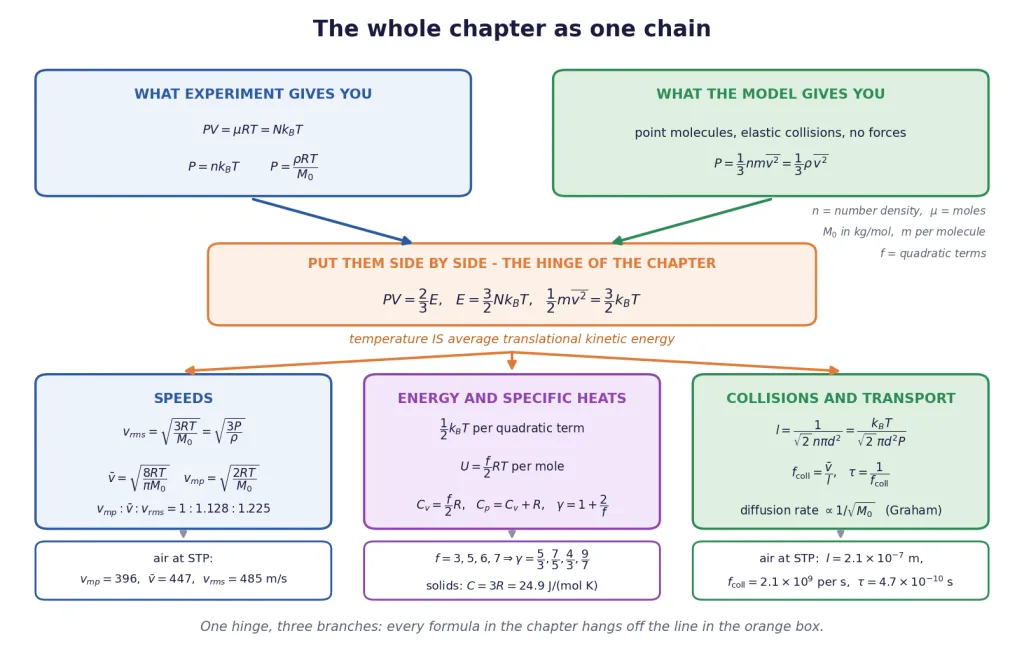
Read it left to right and top to bottom. Experiment hands you one equation of state; the molecular model hands you a formula for pressure. Set the two side by side and out drops the single line that the rest of the chapter is built on — , temperature is average translational kinetic energy. Everything below that box is a consequence: the speeds on the left, the energies and specific heats in the middle, the collisions on the right.
If you can rebuild that diagram from memory on the back of your question paper, you can rebuild the chapter.
Five things on these cards that the body text does not carry
The Maxwell speed distribution, the formulas for and , Brownian motion, Graham's law of diffusion and the pressure law all sit outside the body text of the rationalised syllabus, and Boards, JEE and NEET ask about them every single year — so they are on these cards in full.
Card 1 — The Ideal Gas Equation, in All Four Forms
One fact, four coats. Which coat you reach for is decided entirely by what the question hands you, and being fluent between them is most of what makes a gas problem quick.
Key Point — the four forms. They are the same equation.
| Form | Use it when the question gives you | The bridge that gets you there |
|---|---|---|
| a mass, or a number of moles | ||
| a count of molecules | ||
| molecules per m, or no volume at all | ||
| a density, or an unknown gas |
Three readings that get examined directly:
- carries no volume. That makes it a local statement — it applies to the air at one point in a room, to a patch of the upper atmosphere, to the residue in a vacuum chamber. Turn it round and says that pressure and temperature alone fix the number density, whatever the gas is. That is Avogadro's hypothesis in four symbols.
- The density form is the only one in which the gas's identity appears, through . So it is the form that lets you identify an unknown gas, and it is why at fixed and density is proportional to molar mass — carbon dioxide sinks, helium rises.
- For a fixed sample changing state, divide one state by the other and everything constant cancels: , with in kelvin. Most two-state problems are one line long.
The three gas laws, and Dalton's
| Law | Held fixed | Statement | Graph that is a straight line |
|---|---|---|---|
| Boyle's law | constant | against , through the origin | |
| Charles' law | constant | against in kelvin, through the origin | |
| The pressure law | constant | against in kelvin, through the origin |
Key Point — Dalton's law of partial pressures: for a mixture of non-reacting ideal gases, Each gas fills the whole vessel and behaves as if the others were not there, because in an ideal gas the molecules do not interact.
[Board Important] Extrapolate the -against- lines of Charles' law, drawn at several different pressures, and they all meet at one point on the temperature axis — C. No gas actually gets there; every real gas liquefies first. But the meeting point is what makes the kelvin scale the natural one.
Real gases depart from all of this at high pressure and low temperature, for two reasons that push in opposite directions: molecules occupy volume (which makes too large) and molecules attract each other (which makes too small). A gas behaves ideally when it is hot and dilute, so that neither correction matters.
Card 2 — Pressure, Temperature and the Three Speeds
The pressure result
Key Point: with the number density, the mass of one molecule and the mass density. The is isotropy — no direction is special, so .
Two things about that formula are worth one sentence each, because both are asked. The shape of the container does not matter, since any vessel can be built out of small cubes and the derivation is local. Intermolecular collisions do not matter either, because a collision merely swaps two molecules' velocities, and the gas is in equilibrium so the distribution of speeds is unchanged.
The kinetic interpretation of temperature — the hinge of the chapter
Multiply the pressure result by , compare it with , and one line comes out:
Key Point: Temperature IS the average translational kinetic energy of a molecule, and nothing else. It does not know the gas's identity, its pressure or its volume.
At 300 K the average translational kinetic energy of one molecule is J, and per mole it is J. The same number for helium, for oxygen and for carbon dioxide.
[NEET Important] Equal temperature means equal energy per molecule, not equal speed. Since is the same for every gas in a mixture, the heavy molecules must be slower: .
The three molecular speeds
Key Point — learn all three, and learn which is which. That ratio is a pure number: it does not depend on the gas, the temperature or the pressure. Know one speed and you know the other two by multiplication.
in every one of those is in kg per mole. Oxygen is , not .
| Gas | in kg/mol | |||
|---|---|---|---|---|
| Hydrogen, H | 0.002 | 1579 | 1782 | 1934 |
| Helium, He | 0.004 | 1117 | 1260 | 1368 |
| Nitrogen, N | 0.028 | 422 | 476 | 517 |
| Oxygen, O | 0.032 | 395 | 445 | 484 |
| Carbon dioxide, CO | 0.044 | 337 | 380 | 412 |
All at 300 K, all in metres per second. Read down a column and you see the law; read across a row and you see the fixed ratio. For air at STP, with an average molar mass of kg/mol, the three come out as 396, 447 and 485 m/s — and those three numbers are not interchangeable.
Which speed does which job
| Use | Use | Use |
|---|---|---|
| energy, | mean free path and collision frequency | the peak of the curve |
| pressure, | effusion and diffusion rates | scaling a distribution |
| anything with in it | anything counting distance travelled | "the commonest speed" |
Swap them and the error is fixed and recognisable: using in an energy gives an answer 15.1% too low, and using in a collision count gives one 8.5% too high.
The distribution itself
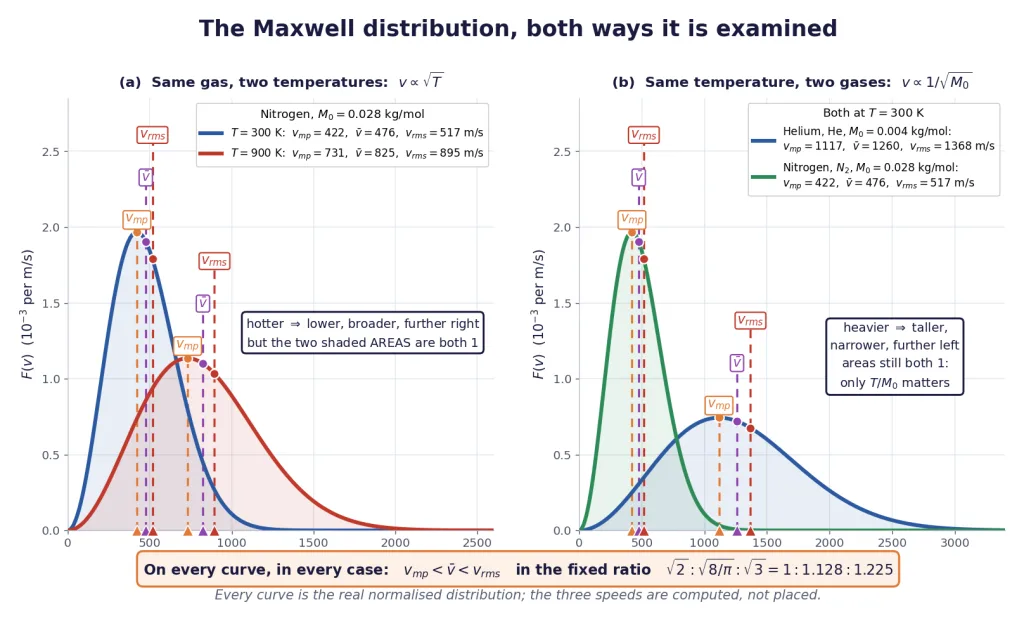
Everything the paper asks about this curve is in that one picture.
- Area, not height, is the physics. The area between two speeds is the fraction of molecules in that range, and the total area is always exactly 1.
- Heat it and the curve flattens, broadens and slides right — but the area stays 1. It never grows: heating does not create molecules.
- Make the gas heavier and the curve sharpens, narrows and slides left, again with the area unchanged.
- Only the combination matters. Oxygen at 1200 K has exactly the same distribution as helium at 150 K, because .
- The curve is lopsided, with a long tail to the right. That asymmetry is why the three speeds differ at all, and why the tail responds far more violently to heating than the average does — which is the whole explanation of evaporation and of atmospheric escape.
Key Point: always, with equality only if every molecule has the same speed. Square first, then average — the other order gives a different and smaller number. For the Maxwell distribution , whose square root is the that separates from .
Card 3 — Degrees of Freedom, Equipartition and the Specific Heats
This card is one machine: count , and three numbers fall out. Learn the counting, not the table.
Counting
- A molecule of atoms has degrees of freedom in total.
- 3 are translational, always.
- Rotational: 2 if the molecule is linear, 3 if it is not. A linear molecule has no meaningful rotation about its own axis, because the moment of inertia about that line is vanishingly small.
- The rest, (linear) or (non-linear), are vibrational — and each vibration counts twice, because it stores both kinetic and potential energy.
The law of equipartition
Key Point: in thermal equilibrium at temperature , every quadratic term in a molecule's energy carries an average of . Translation contributes and its two partners; each rotation contributes ; each vibration contributes two terms, and .
The word to hold on to is quadratic term, not "degree of freedom". That single change of vocabulary is what makes a vibration worth 2 rather than 1, and it is the only reason the counting works.
The three numbers that follow
Key Point — the whole of specific heats, in one line: is exact for every ideal gas, monatomic or not — 8.314 J/(mol K), always. The gas at constant pressure has to do work as well as warm up, and per mole per kelvin is exactly what that work costs.
The lookup table — screenshot this one
| Type of molecule | Examples | , J/(mol K) | , J/(mol K) | ||||
|---|---|---|---|---|---|---|---|
| Monatomic | He, Ne, Ar, Hg vapour | 3 | 12.47 | 20.79 | |||
| Rigid diatomic | H, N, O, CO, air | 5 | 20.79 | 29.10 | |||
| Rigid linear polyatomic | CO, NO, CH | 5 | 20.79 | 29.10 | |||
| Rigid non-linear polyatomic | HO, NH, CH, SO | 6 | 24.94 | 33.26 | |||
| Vibrating diatomic | hot H, hot O | 7 | 29.10 | 37.41 |
[JEE Tip] Look at rows two and three. A rigid linear triatomic such as carbon dioxide has , exactly like a diatomic — not 6 — because a linear molecule gets only 2 rotations. Treating every triatomic as though it were bent is the commonest way to get a question wrong, and it changes every number downstream.
Three readings of that table:
- is always greater than 1, and its largest possible value is , reached by a monatomic gas. A quoted of 1.8, or of 0.9, is impossible.
- falls as the molecule gets more complicated, because more ways of storing energy means a larger and a ratio closer to 1.
- The table runs backwards too. Measure and you get ; measure and you get . That is how a gas is identified from a calorimetry experiment.
Solids: the Dulong-Petit result
Each atom in a simple crystal sits in a potential well and vibrates about a fixed site in three dimensions. Three vibrations, each worth two quadratic terms, gives :
Key Point: The same value for lead, gold, silver, iron and copper — which is a startling prediction, and it is very nearly right. There is no separate and worth distinguishing for a solid, because a solid barely expands.
[NEET Important] The exceptions are light, stiffly bonded solids — beryllium, graphite and above all diamond, whose measured molar specific heat at room temperature is only about a quarter of . Their vibrations are frozen out: the energy step to the first vibrational level is large compared with , so the mode simply refuses to take its share. The same freezing explains why hydrogen behaves as if at very low temperature, as if at room temperature, and only approaches when it is very hot.
Key Point: is the translational kinetic energy alone; is the full internal energy. They coincide only for a monatomic gas. For a rigid diatomic gas, — the other two fifths are rotation.
Card 4 — Mean Free Path, Collisions and How Everything Scales
The mean free path, with its
Key Point — the form to use in every number you report: The comes from the fact that the other molecules are moving too: two molecules with the same average speed approaching from random directions have an average relative speed of , not .
Two warnings sit on that formula, and between them they account for most of the marks lost on this topic.
Drop the and your answer is 41% too large — comfortably enough to land on a wrong option that was put there for exactly that reason. The naive is a fine stepping stone for understanding where the symbols come from; it is not an answer.
is the molecular DIAMETER, not the radius. A problem that quotes a radius of Å means Å, and then differs by a factor of 4. This is the single most reliable trap in the chapter's numericals.
Collision frequency and collision time
Key Point: Both use the mean speed , not — they count distance travelled, and that is an ordinary average of speed.
Keep the subscript on . Elsewhere on these cards counts quadratic terms; here it is a frequency in hertz. Two unrelated quantities, one unlucky letter.
The numbers for air at STP, worth knowing as orders of magnitude
Take air at 273 K and one atmosphere, with Å and per m:
| Quantity | Value | As a multiple of the molecular diameter |
|---|---|---|
| molecular diameter | m | 1 |
| mean spacing between molecules, | m | about 17 |
| mean free path | m | about 1000 |
| mean speed | 447 m/s | — |
| collision frequency | per second | — |
| collision time | s | — |
Three lengths in a ladder: a molecule is about 2 Å across, its neighbours sit about 17 diameters away, and it flies about 1000 diameters between collisions. A gas is mostly empty space, and a molecule's flight is long compared with everything else in the picture.
[NEET Important] Learn the orders of magnitude, not the digits: at STP m, per second, s. That is what "of the order of" questions want.
In a good vacuum can exceed the size of the vessel. When it does, the molecules fly wall to wall in straight lines and it is the vessel, not the gas, that sets the free path.
Diffusion and Graham's law
A molecule leaving an open bottle is doing hundreds of metres per second but changes direction two billion times a second, so its progress across a room is a random walk, not a journey. In one second it covers 447 m of path and gets about a centimetre from where it started. That is why a smell takes minutes to cross a room.
Key Point — Graham's law of diffusion: at the same temperature and pressure, The square root is the whole point. Hydrogen is 16 times lighter than oxygen, so it diffuses times faster, not 16 times faster.
Key Point — Brownian motion: a speck of pollen or smoke suspended in a fluid is seen under a microscope to jiggle ceaselessly along a random zig-zag. It is being struck by molecules from every side, and because the number arriving on one face in a short interval differs by chance from the number arriving on the opposite face, the net force never quite cancels. The motion is more vigorous for a smaller particle, at a higher temperature, and in a less viscous fluid — and it never stops, because the molecules never stop. It is the most direct visible evidence that matter is made of moving molecules at all.
The proportionality chart
This is the single most useful table for one-line MCQs. Everything else on the page is held fixed while the named quantity changes.
| Quantity | with | with | with |
|---|---|---|---|
| , , | independent | ||
| mean translational KE, | independent | independent | |
| internal energy | independent | independent | |
| number density | independent | ||
| mass density | |||
| mean free path | independent | ||
| collision frequency | |||
| , , | independent | independent | independent |
Read the column carefully. It is written at constant pressure, which is where the surprises live. The same four changes, as multipliers:
| The change | ||||
|---|---|---|---|---|
| doubled at constant | ||||
| doubled at constant | unchanged | unchanged | ||
| doubled at constant | unchanged | |||
| quadrupled, same and | unchanged | unchanged |
[JEE Tip] Row two is the trap. Writing makes it look as though heating always lengthens the mean free path. It does not. Heat a gas in a sealed rigid vessel and does not change by a hair, because depends on temperature only through , and is fixed by the vessel. What does change is the speed, so the collisions come faster.
, and sit at the bottom of the chart on a row of their own for a reason: they depend on nothing but . Not on temperature (as long as no new mode wakes up), not on pressure, not on the molar mass. A gas with is monatomic whether it is helium at 4 g/mol or mercury vapour at 200.
Card 5 — The Mistakes That Cost the Most Marks
Ordered by how often they actually turn up in answer scripts. The first four are worth more than the rest of the list combined.
1. Leaving the molar mass in grams per mole. This is the commonest error in the chapter, by a distance. In the molar mass must be in kg per mole. Oxygen is , not . Substituting makes your answer smaller by a factor of — oxygen at 300 K comes out at 15.3 m/s instead of 484 m/s, which is slower than a bicycle. Write the conversion on its own line, every time. And keep the three mass symbols apart: is the molar mass, is the mass of one molecule, and is the mass of the whole sample.
2. Interchanging and . They differ by only 8.5%, which is exactly what makes the swap so easy and so costly. for anything with in it — energy, pressure. for anything counting distance travelled — mean free path, collision frequency, effusion, diffusion. Using in an energy formula makes the answer 15.1% too low; using in a collision count makes it 8.5% too high. And quoting where was wanted is 18.4% out.
3. Dropping the from the mean free path. , always. The naive is a derivation step, not an answer, and it inflates every mean free path by 41% and deflates every collision frequency by the same factor. At STP with Å the answer is m, not m.
4. Reading as a number of moles. In this chapter is the number density, and is the mole count. pairs number density with ; pairs moles with . Mix the pairs and you are wrong by , a factor of , which at least announces itself.
5. Celsius where kelvin is required. Every speed formula, every gas-law step, every ratio and every energy needs absolute temperature. . A temperature may be left in Celsius only when it appears as a difference , because a rise of C and a rise of 1 K are the same interval — so is safe, and is not.
6. Taking to be a radius. is the molecular diameter. Given a radius, double it before squaring. Forgetting to changes , and therefore , by a factor of 4.
7. Treating every triatomic molecule as bent. A linear triatomic such as CO has 2 rotations, so and — the same as a diatomic. Only a non-linear molecule such as HO gets 3 rotations, and .
8. Counting a vibration as one quadratic term instead of two. A vibrational mode stores kinetic and potential energy, so it contributes , not . That is why a vibrating diatomic has and not 6.
9. Confusing with . is the translational kinetic energy only. is the whole internal energy. They are the same number only for a monatomic gas. Writing for nitrogen loses two fifths of the energy.
10. Believing that equal temperature means equal speed. It means equal average translational kinetic energy. In a mixture the light molecules are always faster, in the ratio .
11. Using for the wrong kind of gas. monatomic, diatomic and rigid linear polyatomic, rigid non-linear polyatomic. Helium, neon and argon are monatomic; hydrogen, nitrogen, oxygen and air are diatomic.
12. Squaring the mean instead of meaning the squares. . Square first, then average. For two molecules at 300 and 500 m/s, m/s but m/s, and the gap is the spread of the speeds.
13. Expecting the mean free path to change when a sealed vessel is heated. It does not. depends on temperature only through , and a rigid sealed vessel fixes . The collision frequency goes up, because the molecules are faster.
14. Forgetting the square root in Graham's law. Rate of diffusion . Four times the molar mass means half the rate, not a quarter of it.
15. Quoting or per kilogram when the formula wanted per mole. is molar, in J/(mol K). The per-kilogram versions are and , and they obey . The ratio is the same either way, because the mass cancels.
Key Point: Three that cost single marks each — leaving a volume in litres inside , forgetting that has no unit, and reporting a molecular speed without saying which of the three it is.
The 60-Second Revision
You are in the queue outside the hall. This is the irreducible minimum.
Notation. is the number density, is the mole count, is in kg/mol, is one molecule's mass, is the sample's mass, counts quadratic terms, is in kelvin.
Gas equation, four coats. ; ; . And J/(mol K).
Gas laws. Boyle constant at fixed ; Charles constant at fixed ; the pressure law constant at fixed . Dalton: partial pressures add.
Pressure. . The is isotropy.
Temperature. , , and . Temperature is average translational kinetic energy — J per molecule at 300 K, the same for every gas.
Speeds. , , . Ordering , ratio . and .
The curve. Area is the fraction of molecules; the total area is 1. Hotter is lower, broader, further right; heavier is taller, narrower, further left. Only matters.
Degrees of freedom. 3 translational always; 2 rotations if linear, 3 if not; each vibration counts 2. Rigid values: monatomic 3, diatomic 5, linear polyatomic 5, non-linear polyatomic 6, vibrating diatomic 7.
Equipartition. per quadratic term, so .
Specific heats. , , . So , , . Solids: J/(mol K).
Mean free path. . Never drop the ; is a diameter. At STP, m, per second, s.
Collisions and diffusion. , , both with . Graham: rate .
Habits. Convert the molar mass to kg/mol on its own line. Convert every temperature to kelvin. Say which speed you are quoting. Check whether the vessel is rigid before you touch . Count before you write any or .
The Fast Self-Test
Cover the answers. Fifteen questions, five minutes. Anything you miss tells you which card to reopen tonight.
- What do and stand for in this chapter, and which constant pairs with each?
- Write the ideal gas equation in all four forms.
- State Boyle's law, Charles' law and the pressure law, saying what is held fixed in each.
- Write the kinetic-theory pressure formula in both of its forms, and say where the comes from.
- What single sentence does say about temperature?
- Write the three molecular speeds, their ordering and their ratio.
- Which speed goes into an energy calculation, and which into a collision count?
- What does the area under the Maxwell curve between two speeds mean, and what is the total area?
- Two curves are drawn for the same gas at and . Which is taller, and which encloses more area?
- How many rotational degrees of freedom does a linear molecule have, and how many does a bent one have?
- How much energy does one vibrational mode carry, and why is it not ?
- Write , and in terms of , and give all three for a rigid diatomic gas.
- State the Dulong-Petit result and the value of behind it.
- Write the mean free path both ways, and say what the is doing there.
- A sealed rigid vessel of gas is heated. What happens to , to and to ?
Answers. 1. is the number density in molecules per m and pairs with ; is the number of moles and pairs with . 2. , , , . 3. Boyle: constant at fixed temperature. Charles: constant at fixed pressure. Pressure law: constant at fixed volume. All with in kelvin. 4. ; the is isotropy, since . 5. That the absolute temperature is the average translational kinetic energy of a molecule, independent of the gas, the pressure and the volume. 6. , , , with in the ratio . 7. for energy (anything with ); for a collision count or a mean free path. 8. The fraction of molecules with speeds in that range; the total area is exactly 1. 9. The curve is taller and narrower; both enclose the same area, namely 1. 10. Linear 2, non-linear 3. 11. , because a vibration stores both kinetic and potential energy and so contributes two quadratic terms. 12. , , ; for that is 20.79, 29.10 and . 13. A simple crystalline solid has J/(mol K), from — three vibrations, each worth two quadratic terms. 14. ; the accounts for the fact that the target molecules are moving too, so the average relative speed is . 15. is unchanged (rigid vessel), so is unchanged; rises as , so rises as too.
That is the whole chapter. Go and get the marks.