
Three Laws Hiding Inside One Equation
Section 2 handed you and, at the very end, a promise: that Boyle's law, Charles' law, the pressure law and Dalton's law are not four extra things to learn but four corners of that single equation. This section collects on that promise — and then asks the harder question of what happens when a real gas refuses to cooperate.
These two symbols run through everything below. is the number of moles; is the number density, molecules per cubic metre. That convention is fixed in Section 2.
The trick is to hold something still
Look at and count the things that can change: , , and . Seal the gas in a container and is fixed. That leaves three. Now nail down one more, and whatever survives is a law.
| Hold fixed | What survives | The law | First stated by |
|---|---|---|---|
| , | constant | Boyle's law | Robert Boyle, 1662 |
| , | constant | Charles' law | Jacques Charles, 1787 |
| , | constant | the pressure law | Joseph Gay-Lussac, 1802 |
Key Point — the three gas laws are one equation, three ways:
- At constant : constant
- At constant : constant
- At constant : constant
All three demand a fixed amount of gas and, in the last two, in kelvin. Break either condition and the law is simply false.
Historically it ran the other way round: Boyle, Charles and Gay-Lussac each measured their law a century or more before anyone wrote , and the gas equation was assembled from them. We get to run the film backwards, which is much less work.
Boyle's Law
Fix the temperature and fix the amount. Then on the right of the gas equation is a constant, so
Key Point — Boyle's law:
At constant temperature, the pressure of a fixed mass of gas is inversely proportional to its volume: Squeeze a gas into half the space at the same temperature and it pushes back twice as hard.
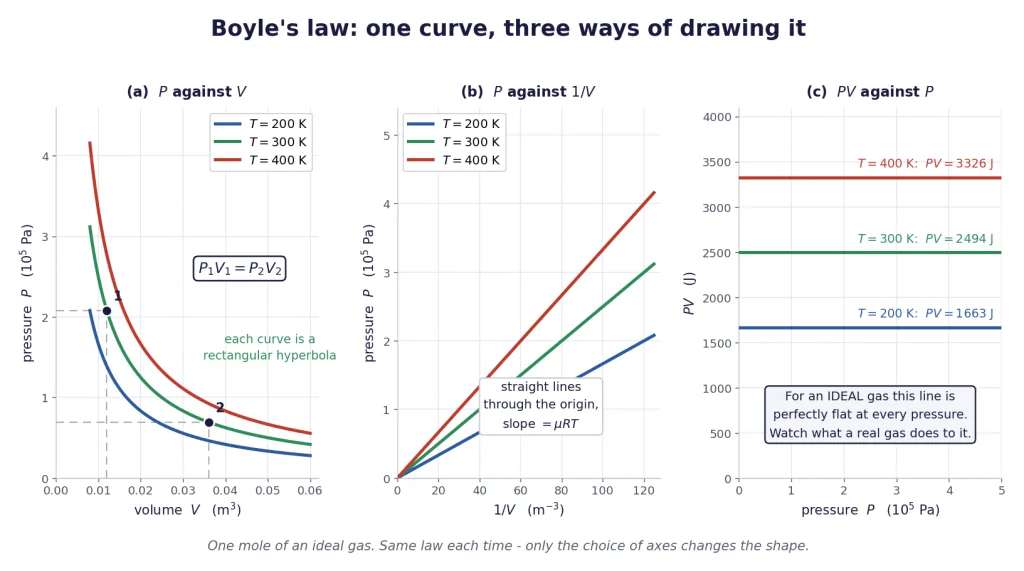
Reading the three panels
They are the same law and the same data. Only the axes change — and being able to switch between them on sight is worth a lot of marks, because examiners ask for the shape far more often than for the number.
- Panel (a), against . A curve that falls steeply and then flattens, never touching either axis. Its proper name is a rectangular hyperbola — "rectangular" because its two asymptotes, the axis and the axis, are at right angles. A curve of this kind drawn at one fixed temperature is called an isotherm. A higher temperature gives a bigger constant , so its isotherm sits further from the origin: the isotherms never cross.
- Panel (b), against . Now the relationship is a direct proportionality, , so you get a straight line through the origin of slope . This is the graph a laboratory actually plots, because a straight line is easy to test by eye and a hyperbola is not.
- Panel (c), against . The product does not depend on at all, so the graph is a horizontal straight line at height . Remember this one especially. It is the graph on which a real gas gives itself away, as you will see at the end of this section.
The two conditions people forget
Boyle's law is only as good as its small print.
- The temperature must actually stay constant. Compress a gas quickly — pumping up a bicycle tyre, say — and it gets hot, so climbs rather than staying put. Boyle's law describes a slow compression in which the gas stays in touch with its surroundings.
- The amount of gas must not change. If gas leaks out, or you pump more in, changes and has a different constant at each end. Then is not merely inaccurate, it is the wrong equation.
[JEE Tip] When a question describes a graph and asks which one it is, translate the axes into the equation before you look at the options. against at constant is a hyperbola; against is a straight line through the origin; against or against is a horizontal line; against is again a straight line through the origin. And against is a straight line of slope , since — a favourite, because the slope is the answer.
[Board Important] Pressure in these formulas is always absolute pressure. A tyre gauge or a cylinder gauge reads the excess over atmospheric, so you must add atm before using its number. A gauge reading 2 atm means an absolute pressure of 3 atm, and Boyle's law applied to the gauge reading gives a straightforwardly wrong answer.
Charles' Law, and Why the Kelvin Scale Starts Where It Does
Now hold the pressure fixed instead — a gas in a cylinder under a free piston loaded with a constant weight, so it can expand but the pressure on it never changes. Rearranging ,
and everything in the bracket is constant. So:
Key Point — Charles' law:
At constant pressure, the volume of a fixed mass of gas is directly proportional to its absolute temperature: with in kelvin, always.
Double the absolute temperature of a gas at constant pressure and it takes up twice the room. That is why hot air rises — heated air expands, so the same mass of it occupies more volume, so its density drops and it floats up through the cooler air around it. A hot-air balloon is Charles' law with a wicker basket attached.
The graph, and the number hiding in it
Plot against in kelvin and you get a straight line through the origin. Plot against in degrees Celsius and you get a straight line that does not pass through the origin — but if you take a ruler and extend it backwards, something remarkable happens.
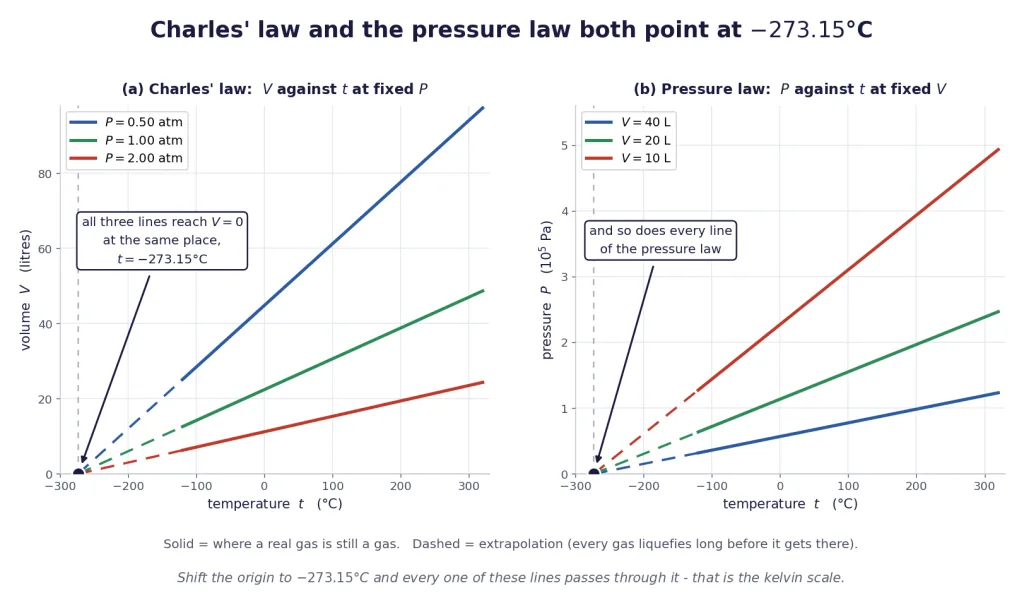
Look at panel (a). Three different pressures, three different lines with three different slopes — and every one of them, extended backwards, cuts the temperature axis at the same place:
Change the gas, change the pressure, change the amount, and the intercept does not move. That is not a property of any particular gas. It is a property of temperature itself, and it is the whole reason the kelvin scale exists: shift the origin to °C and every one of those lines passes through it, so becomes literally true rather than approximately convenient.
Charles himself wrote his law in the Celsius form, where is the volume at 0°C. The coefficient per degree Celsius is the same for every gas, which is exactly the fact that pins the intercept.
Key Point — what absolute zero is, and what it is not:
°C, or K, is the temperature at which the extrapolated volume of an ideal gas would fall to zero.
- It is an extrapolation, not a measurement. Every real gas liquefies and then freezes long before it gets anywhere near — which is why the low-temperature part of every line in the figure is drawn dashed.
- A volume of zero is physically impossible, so the straight line cannot be believed all the way down. What is real is where the line points.
- No lower temperature exists, and absolute zero itself has never been reached. Laboratories have got within a billionth of a kelvin of it and stopped there.
[NEET Important] The single commonest error in this whole topic is doing a Charles' law ratio in degrees Celsius. Heating a gas from 27°C to 127°C at constant pressure does not multiply its volume by . It multiplies it by . Convert to kelvin on its own line, before the ratio, every single time.
The Pressure Law (Gay-Lussac's Law)
The third member of the family is the one that gets left out. Hold the volume fixed — a gas sealed in a rigid steel vessel that cannot expand — and gives
Key Point — the pressure law, also called Gay-Lussac's law:
At constant volume, the pressure of a fixed mass of gas is directly proportional to its absolute temperature: with in kelvin. It is sometimes written in Celsius form as , with the same coefficient as Charles' law.
The rationalised syllabus names and draws Boyle's law and Charles' law but never names this third one, even though it completes the set and follows from the same equation in the same single step. Boards, JEE Main and NEET all ask for it every year — often as the graph, sometimes as a one-line numerical — so it is set out here in full.
Panel (b) of the figure above is the pressure law drawn the same way as Charles' law: against in Celsius, at three different fixed volumes. Same story, same intercept. Six straight lines, two entirely different experiments, one meeting point at °C.
Where you meet it in real life
- The constant-volume gas thermometer. Trap a fixed amount of a dilute gas in a rigid bulb and measure its pressure. Since , the pressure is a thermometer. Calibrate it once at a known fixed point — the triple point of water, K — and then any unknown temperature follows from a single ratio, . Because every dilute gas gives the same answer, this instrument defined the absolute temperature scale for most of a century.
- A sealed can must never be heated. An aerosol can, a deodorant tin, a sealed pressure cooker with a blocked vent: the volume cannot change, so heating it drives the pressure straight up in proportion to . Doubling the absolute temperature doubles the pressure. This is why "do not incinerate" is printed on the can, and it is worth a worked example below.
- Tyre pressure on a hot day. A tyre is close enough to constant volume that a long drive, which heats the air inside, measurably raises the pressure. Garages ask you to check tyres cold for exactly this reason.
All three together, plus the combined law
| Law | Held fixed | Relation | Two-state form | Straight-line graph |
|---|---|---|---|---|
| Boyle | against | |||
| Charles | against (K) | |||
| Pressure law | against (K) |
And when nothing at all is held fixed except the amount of gas, the three collapse into the single relation Section 2 already gave you:
Key Point — the combined gas law: valid for any fixed amount of an ideal gas taken between any two states. Every one of the three laws above is this equation with one variable cancelling out. If you remember only one line from this section, remember this one — and remember that it fails the moment gas is added or removed.
[JEE Tip] Before touching a two-state gas problem, ask one question: has the amount of gas changed? If a container leaks, is topped up, or is connected to another vessel, is different at the two ends and the combined law is illegal. Compute separately at each state from and work with the difference instead. Spotting which of the two situations you are in is usually half the marks.
Dalton's Law of Partial Pressures
Everything so far has assumed one pure gas. But the most important gas you will ever meet — air — is a mixture, and so is the contents of a diver's cylinder, a patient's oxygen mask and a chemist's collecting jar. What is the pressure of a mixture?
The answer is the simplest one imaginable, and it drops straight out of the number-density form of the gas equation.
The one-line derivation
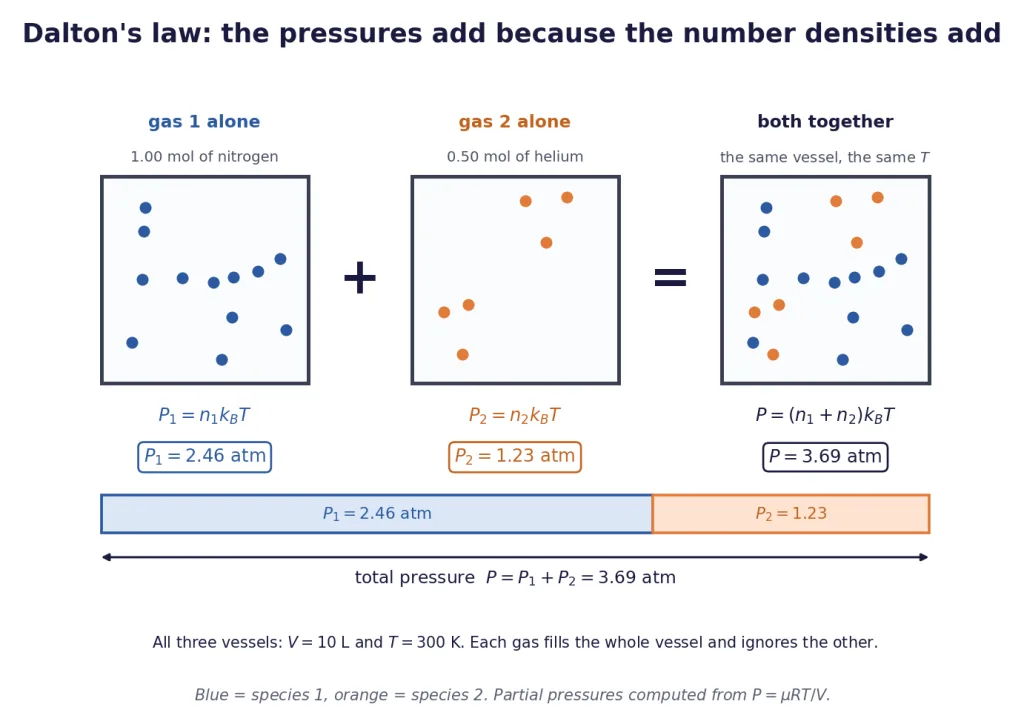
Put moles of gas 1, moles of gas 2, and so on, into a single vessel of volume at temperature . The gases do not react with each other. Counting molecules, the number density of the mixture is just the sum of the separate number densities, because every molecule of every species is in the same box:
Now apply , which is true for the mixture as a whole:
But is exactly the pressure gas 1 would exert if it were alone in that vessel at that temperature. Call it . So
Key Point — Dalton's law of partial pressures:
The partial pressure of a gas in a mixture is the pressure it would exert if it alone occupied the whole vessel at the same temperature: and for a mixture of non-reacting ideal gases the total pressure is the sum of the partial pressures:
The same result in mole language is one line shorter. The equation of state of the mixture is , so
Either route says the same physical thing: each gas fills the whole vessel and behaves as though the others were not there.
The mole-fraction form, which is faster
Divide the partial pressure by the total:
Key Point — partial pressure from mole fraction: is the mole fraction of that species. Air is 78% nitrogen by moles, so nitrogen carries 78% of atmospheric pressure. Mole fractions always add to 1, and so, therefore, do the partial pressures.
This is the form to reach for when a question gives you a composition as a percentage. It needs no constants, no volume and no temperature.
The conditions, and the trap
Dalton's law needs the gases to be non-reacting and each of them to be behaving ideally. If two gases react — hydrogen and oxygen sparked together, say — the molecule count changes and the law has nothing to say about the products. It also needs all the gases to be at the same volume and the same temperature, which in a single sealed vessel they automatically are.
Why each gas ignores the others is a molecular question, and Section 5 answers it properly: at a common temperature every species has the same average kinetic energy per molecule regardless of its mass, so each contributes to the pressure purely in proportion to how many molecules it has. For now, take the arithmetic and note that it works.
[NEET Important] The trap is always mass versus moles. Partial pressure goes with the number of molecules, not the weight. Put 4 g of hydrogen and 4 g of oxygen in a flask — identical masses — and the hydrogen exerts sixteen times the partial pressure, because g of hydrogen is 2 moles while g of oxygen is only mol. Convert every mass to moles before you compare anything.
Where it earns its keep
- The atmosphere. At sea level the total is atm, of which oxygen contributes about atm. It is that partial pressure, not the total, that drives oxygen across the lining of your lungs — which is why climbers struggle at altitude even though the air is still 21% oxygen. The total has dropped, so the oxygen partial pressure has dropped with it.
- Collecting a gas over water. A gas bubbled into an inverted jar of water comes out saturated with water vapour, so the jar holds a mixture. The pressure of the dry gas is the measured total minus the vapour pressure of water at that temperature — a subtraction that is pure Dalton.
- Breathing mixtures. Divers breathe helium-oxygen blends precisely because the partial pressure of each component is what the body responds to, and at depth the partial pressure of ordinary nitrogen becomes a problem.
When a Real Gas Stops Cooperating
Section 2 defined an ideal gas as one that obeys exactly, everywhere, and then admitted that no such gas exists. Time to be specific about how real gases fail, by how much, and why.
The test that exposes everything
Take a fixed amount of a real gas — one mole, say — hold it at some temperature, and measure its volume at pressure after pressure. Then plot the quantity
against . For an ideal gas this is J/(mol K) at every single pressure, so the graph must be a perfectly flat horizontal line. Nothing about the gas, the pressure or the temperature can move it. That makes it the ideal test: any departure from flatness is a departure from ideality, and you can read its size straight off the axis.
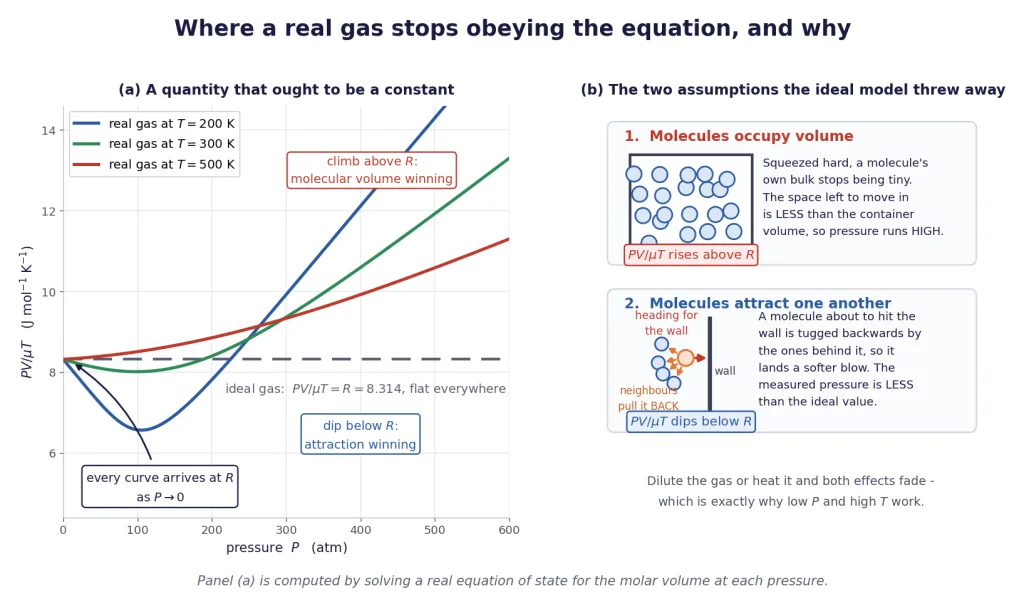
Reading panel (a)
Three things to notice, and each of them is a standard exam answer.
- Every curve converges on as . However badly a gas misbehaves at high pressure, dilute it enough and it becomes ideal. This is not a coincidence — it is the reason the ideal model is useful at all.
- The departures grow with pressure and shrink with temperature. The K curve strays least; the K curve strays most, and it strays first.
- The curves go the wrong way in two different directions. At moderate pressures the cooler curves dip below . At high pressures every curve climbs above , and keeps climbing. Two competing effects, and which one wins depends on where you are.
Key Point — when the ideal gas model is safe:
A real gas behaves ideally at low pressure and high temperature — that is, when it is dilute and far above its liquefaction temperature. Both statements say the same physical thing: the molecules are far apart and moving fast, so they barely notice one another.
The two causes, and why there are exactly two
Section 4 will list the assumptions of the ideal model in full, but two of them are doing all the damage here, and panel (b) shows both.
Cause 1 — molecules occupy volume. The model treats molecules as points, so the space available to move in is the whole container volume . Real molecules have a size, and the space genuinely available is minus the room the molecules themselves take up. At ordinary pressures that correction is laughably small. Squeeze the gas hard and it stops being small:
| Pressure at 0°C | Volume of one mole | Filled by the molecules themselves |
|---|---|---|
| 1 atm | 22.4 L | about 0.04% |
| 100 atm | 224 cm | about 3.8% |
| 500 atm | 44.8 cm | about 19% |
With a fifth of the box already solid, the molecules are confined to far less room than , they hit the walls more often than the equation expects, and the measured pressure comes out too high. On the graph, rises above . This effect grows without limit as you compress, which is why every curve eventually turns upwards.
Cause 2 — molecules attract one another. The model says molecules exert no force on each other except during a collision. In fact they attract at short range, as Section 1's intermolecular force curve showed. Consider a molecule just about to strike the wall: it has neighbours behind it and none in front, so the net pull on it is backwards, away from the wall. It arrives with less momentum than it would have had, and delivers a gentler blow. Every molecule hitting the wall is softened the same way, so the measured pressure comes out too low. On the graph, dips below .
Attraction only matters when molecules are close enough to feel each other and slow enough for the tug to change their motion appreciably — so it dominates at moderate pressure and low temperature, which is exactly where the dips appear.
Key Point — the two departures in one sentence each:
- Molecules have volume less free space than pressure higher than ideal above . Wins at high pressure.
- Molecules attract softer wall collisions pressure lower than ideal below . Wins at moderate pressure and low temperature.
These are precisely the two assumptions the ideal model throws away. Restore them and you have explained the whole graph.
A corrected equation of state that puts both effects back in does exist, and you will meet it in a later course. It is not on this syllabus, and no examiner will ask you for it. What is asked, every year, is the physical reason — so learn the two mechanisms and the direction each one pushes the curve.
Reading experimental - and - curves against the ideal ones
The same story shows up if you plot measured isotherms beside Boyle's hyperbolas, or measured - lines beside Charles' straight lines.
- Measured isotherms against Boyle's hyperbolas. At high temperature and low pressure the measured curve lies almost exactly on the hyperbola. Move to low temperature and high pressure and the measured curve pulls away — and at a low enough temperature it does something the hyperbola cannot do at all: it develops a flat horizontal step, where the gas is condensing to a liquid at constant pressure. has no liquid in it and no step. This is the most dramatic failure of the model, and it is a failure of kind, not of degree.
- Measured - lines against Charles' straight lines. Near room temperature the measured points sit on the straight line. Cool the gas towards liquefaction and the measured volume falls away below the line, then collapses as the gas condenses. The line never gets anywhere near the intercept it is pointing at.
Key Point — how to answer "where and why do they diverge?":
They agree at low pressure and high temperature and diverge at high pressure and low temperature, because that is where the molecules stop being far apart and fast. Say which of the two causes is responsible for the direction of the divergence you are being shown, and you have the full answer.
The checklist for this section
- Kelvin in every ratio. Charles' law and the pressure law are false in Celsius.
- Absolute pressure, not gauge. Add atm to a gauge reading first.
- Fixed amount, or no combined law. A leak or a top-up changes and kills .
- Partial pressures follow moles, not grams. Convert masses to moles before comparing.
- Know the shape of every graph, in both the ideal and the real case; the graph is asked more often than the number.
- Ideal means low and high — and the two causes of failure are molecular volume and molecular attraction, pushing the curve in opposite directions.
Solved Examples
Constants used throughout, unless a problem says otherwise: J/(mol K); J/K; per mol; atm Pa; K. Molar masses in kg/mol: hydrogen , helium , nitrogen , oxygen .
Example 1: Boyle's law, and the check that the product really is constant
A cylinder holds 15 litres of oxygen at an absolute pressure of 4.0 atm and a temperature of 27°C. The gas is allowed to expand slowly, at constant temperature, until it fills 24 litres. Find the new pressure, and verify that is unchanged.
Solution:
Check the conditions. The temperature is constant and the cylinder is sealed, so the amount of gas is fixed. Boyle's law applies.
Apply . The volume units cancel in the ratio, so litres are fine here:
Verify the product. In SI, Pa and m: Equal, as they must be.
The cross-check through the full equation. Converting: K. Then and going forward again, Pa atm. Same answer, longer road.
Final Answer: atm, and J at both ends.
Takeaway: In a Boyle's law ratio the units of and cancel, so you may leave them in atm and litres — but the moment you want the actual product in joules, everything must go into pascals and cubic metres.
Example 2: A trapped column of air
A vertical tube closed at the bottom holds a column of air 40 cm long, trapped by a frictionless piston. The air is at atmospheric pressure. Weights are added to the piston until the pressure on the trapped air is 1.6 atm, the temperature being unchanged throughout. How long is the column now, and by what fraction has it shortened?
Solution:
Volume is proportional to length. The tube has a fixed cross-sectional area , so and the area cancels out of every ratio. This is the standard trick with columns of gas: you never need to know .
Boyle's law in terms of length:
Substitute:
The fractional shortening:
Final Answer: The column is 25 cm long, having shortened by 37.5%.
Takeaway: Whenever a gas is confined in a tube of constant cross-section, replace volume by length. Every gas-column problem — mercury threads, capillary tubes, sealed manometers — starts with this substitution.
Example 3: Charles' law, and the Celsius trap
A balloon holds 500 cm of gas at 27°C. It is warmed to 127°C at constant pressure. Find the new volume. Then show what answer you would have got by working in degrees Celsius, and how wrong it is.
Solution:
Convert to kelvin first, on its own line. This is the whole question.
Apply Charles' law:
Now the wrong way, for contrast. Using the Celsius numbers directly, which is more than three times too large, and physically absurd — the gas has been warmed by a third in absolute terms, not by a factor of nearly five.
Final Answer: cm. The Celsius calculation gives 2352 cm and is wrong by a factor of 3.5.
Takeaway: A ratio of temperatures is only meaningful in kelvin. Celsius has an arbitrary zero, so ratios of Celsius readings mean nothing at all — the same physical change would give a different "ratio" on the Fahrenheit scale.
Example 4: Finding absolute zero from two measurements
A fixed mass of gas at constant pressure is found to occupy litres at 20°C and litres at 80°C. Using only these two readings, find the temperature at which the volume would extrapolate to zero.
Solution:
Charles' law in Celsius is a straight line, , where is the slope. Two points determine it.
The slope:
Extrapolate back to . Starting from the first reading and walking backwards down the line:
Compare with the accepted value. The true intercept is °C; the two rounded readings put it at °C, an error of about in , or one part in two thousand. That is the rounding in the second volume, not the physics.
A second route to the same thing. The volume at 0°C would be L, and per °C, which is per °C — Charles' coefficient, recovered from two volume readings.
Final Answer: The extrapolated intercept is about °C, that is absolute zero.
Takeaway: Two volume readings and a ruler locate absolute zero. That is genuinely how it was first found, and it is why the temperature that appears in every gas law is measured from there and not from the freezing point of water.
Example 5: Why the can says "do not incinerate"
A sealed aerosol can of fixed volume contains gas at an absolute pressure of 3.0 atm at 27°C. The can is designed to burst when the internal pressure reaches 6.0 atm. (a) At what temperature will it burst? (b) What would the pressure be if it were merely left in a car at 60°C?
Solution:
The volume is fixed and the can is sealed, so this is the pressure law:
Kelvin, first. K.
(a) The bursting temperature. The pressure has to double, so the absolute temperature has to double:
(b) In a hot car. K: An 11% rise from a 33 K warming — modest, but the same mechanism, and quite enough to matter for a can already near its limit.
Final Answer: The can bursts at about 327°C, that is 600 K. At 60°C the pressure is 3.33 atm.
Takeaway: At constant volume, pressure follows the absolute temperature exactly. Note how ordinary 327°C is — well inside a bonfire, well inside a burning building. The warning on the can is not decoration.
Example 6: The constant-volume gas thermometer
A constant-volume gas thermometer reads a pressure of Pa when its bulb is at the triple point of water, K. Immersed in a hot liquid, the pressure rises to Pa. Find the temperature of the liquid, in kelvin and in degrees Celsius.
Solution:
The bulb is rigid and sealed, so the pressure law applies and the calibration is a single ratio:
Substitute:
In Celsius:
Why this instrument is special. Repeat the experiment with helium in the bulb, then hydrogen, then nitrogen, using less and less gas each time, and the answers converge on the same number. No other kind of thermometer is independent of the substance inside it, and that is what made this one the definition of absolute temperature.
Final Answer: K, that is about 135.9°C.
Takeaway: One fixed point plus one ratio gives the whole scale, because passes through the origin. A thermometer whose graph goes through the origin needs only a single calibration point — a mercury thermometer, whose scale does not, needs two.
Example 7: A weather balloon on the way up
A weather balloon has a volume of m at ground level, where the pressure is atm and the temperature is 300 K. It rises to a height where the pressure is atm and the temperature is 220 K. Find its new volume, assuming the balloon can expand freely.
Solution:
The gas is sealed inside the balloon, so the amount is fixed and the combined law applies:
Both temperatures are already absolute — 300 K and 220 K — and both are positive, so no conversion is needed. Rearranging,
Substitute, keeping the two factors separate so you can see what each does:
Read the two factors. The pressure drop alone would have expanded the balloon fourfold; the cooling then pulled it back by a factor of . The pressure wins comfortably, which is why high-altitude balloons are launched slack and limp — they have to have room to nearly triple in size.
Cross-check. The amount of gas should come out the same at both ends: mol, and mol. It does.
Final Answer: The balloon expands to about m.
Takeaway: In the combined law the pressure factor and the temperature factor multiply, and they usually pull in opposite directions. Write them as two separate fractions rather than one messy one, and you can see at a glance which is winning.
Example 8: Two gases in one vessel
A 10-litre vessel at 300 K contains 4.0 g of helium and 28 g of nitrogen. Find the partial pressure of each gas and the total pressure, and check the answer through the number density.
Solution:
Moles first — this is always the first step in a mixture problem. With kg/mol for helium and kg/mol for nitrogen: One mole of each, as it happens — which is exactly the kind of coincidence a question is built around.
Volume into SI: L m.
Partial pressures, each computed as if that gas were alone:
Total, by Dalton:
The independent check, through number density. The mixture holds molecules, so The two routes agree to better than a tenth of a percent, the gap being only the rounding in .
Final Answer: atm each; total atm.
Takeaway: Equal moles means equal partial pressures, whatever the gases are — 4 g of helium and 28 g of nitrogen push exactly as hard as each other, despite the seven-fold difference in mass. Pressure counts molecules, not kilograms.
Example 9: The partial pressures in the air around you
Dry air is, by moles, 78.0% nitrogen, 21.0% oxygen and 1.0% argon. Find the partial pressure of each at sea level, where the total pressure is 1 atm. Then find the partial pressure of oxygen at an altitude where the total pressure has fallen to atm, and comment.
Solution:
Use the mole-fraction form, which needs nothing but the percentages:
At sea level, with Pa:
Check that they add up. , so the partial pressures sum to exactly the total. If yours do not, you have made an arithmetic slip and the check has just caught it.
At altitude. The composition of the air does not change with height in the lower atmosphere — it is still 21% oxygen — but the total pressure has halved, so
Comment. The body responds to the partial pressure of oxygen, not to the percentage. At atm there is only half as much oxygen pressing into the blood at each breath, which is why altitude is hard work even though the air is chemically unchanged.
Final Answer: At sea level , and atm respectively; the oxygen partial pressure falls to atm where the total is atm.
Takeaway: Percentage composition and partial pressure are different things, and it is the partial pressure that does the physics. A gas can keep the same mole fraction everywhere while its partial pressure collapses.
Example 10: Equal masses are not equal pressures
A 5.0-litre vessel at 300 K contains 4.0 g of hydrogen and 4.0 g of oxygen. Find the partial pressure of each and the total pressure. Which gas dominates, and by how much?
Solution:
Convert both masses to moles. This is the entire question; everything after it is arithmetic. With kg/mol for hydrogen and kg/mol for oxygen: The same 4 g of matter is 2 moles of one gas and an eighth of a mole of the other, because an oxygen molecule is 16 times heavier than a hydrogen molecule.
Volume into SI: L m.
Partial pressures:
Total:
The ratio. which is exactly the inverse ratio of the molar masses, . Hydrogen supplies 94% of the pressure in that flask while supplying only half the mass.
Final Answer: atm, atm, total atm; hydrogen's partial pressure is 16 times oxygen's.
Takeaway: For equal masses, the partial pressures are in the inverse ratio of the molar masses. Worth committing to memory as a shortcut — and worth remembering as a warning, because "equal masses" in a question is almost always bait for the assumption that the pressures are equal too.
Example 11: Measuring how badly a real gas misbehaves
One mole of nitrogen at 200 K is compressed. At 100 atm its measured volume is litres; at 600 atm it is litres. For each case find the volume the ideal gas equation predicts, evaluate , and say by what percentage the gas departs from ideal behaviour and in which direction.
Solution:
The ideal prediction at 100 atm. With Pa and K: The gas actually occupies L — noticeably less than predicted.
Evaluate the test quantity at 100 atm. With L m: Against the ideal value , that is
Now at 600 atm. Pa, so m L, while the gas actually occupies L — now twice the predicted volume, in the opposite direction. Then
Interpret. Same gas, same temperature, and the two departures point opposite ways. At 100 atm the attraction between molecules is winning: they pull each other inwards, the gas collapses into less volume than predicted and pushes on the walls more gently than predicted, so the quantity dips below . By 600 atm the molecules are jammed so close that their own volume dominates: the gas can no longer be squeezed into the space the equation wants, so the quantity shoots above .
Final Answer: At 100 atm, , some 21% below ; at 600 atm it is , some 98% above .
Takeaway: is the number to compute whenever a question asks "how ideal is this gas?" — it should be , and both the size and the sign of the gap tell you which physical effect is in charge.
Example 12: How much of the box do the molecules themselves fill?
Treat a gas molecule as a sphere of diameter Å m. Find the total volume actually occupied by the molecules in one mole, and express it as a percentage of the volume of one mole at 0°C at 1 atm, at 100 atm, and at 500 atm. Comment on what this says about the ideal gas model.
Solution:
The volume of one molecule, as a sphere of diameter :
Multiply by the Avogadro number to get the volume the molecules of one mole occupy between them: That is about the size of a sugar cube — and it is essentially the volume the gas would have if you could liquefy it.
The molar volume at each pressure, from with K:
| Pressure | ||
|---|---|---|
| 1 atm | 22400 cm | 0.038% |
| 100 atm | 224 cm | 3.8% |
| 500 atm | 44.8 cm | 19% |
- Comment. At ordinary pressure the molecules occupy about four parts in ten thousand of the container: treating them as points costs nothing, and the ideal gas model is excellent. At 500 atm nearly a fifth of the box is solid matter, the free space is far smaller than , and the model has no chance. Note that the percentage is directly proportional to the pressure, so the failure creeps in steadily rather than switching on suddenly.
Final Answer: The molecules of one mole occupy about cm — some 0.04% of the box at 1 atm, 3.8% at 100 atm and 19% at 500 atm.
Takeaway: The "point-like molecule" assumption is not an approximation that is either right or wrong — it is one that degrades in proportion to the pressure. This single calculation is the quantitative answer to why real gases climb above at high pressure, and it is worth being able to reproduce in three lines.