
Six Assumptions, and Why You Should Read Them Twice
So far the ideal gas equation has been a summary of experiments. Boyle measured, Charles measured, somebody wrote and it fitted. Nobody explained why.
This section explains why. We are going to start from nothing but molecules and Newton's laws, and end up with a formula for the pressure of a gas that no experiment was consulted for. That is the whole point of kinetic theory, and it is the derivation this chapter is named after.
But a derivation is only as honest as the assumptions it starts from, so here they are first — numbered, so that later, when something in this chapter looks too clean to be true, you can come back and find which assumption bought it.
Notation
In this chapter is the number density — the number of molecules per cubic metre, — and is the number of moles. The previous chapter used for moles, so this is the exact reverse; it is the convention every kinetic-theory formula uses, so switch over now and hold it. is the number of molecules and is the Avogadro number.
The assumptions
Key Point — the six assumptions of the kinetic theory of an ideal gas:
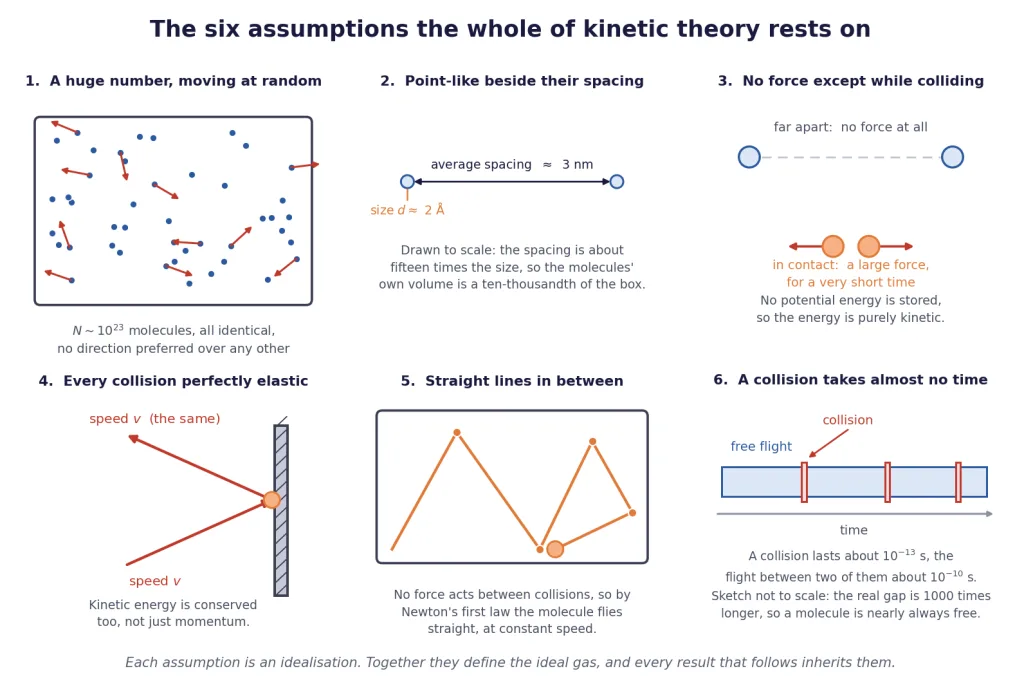
1. A gas is an enormous number of identical molecules in random motion. Enormous means of the order of the Avogadro number, so that averages over the molecules are perfectly sharp. Random means no direction is preferred over any other, and no speed is shared by all.
2. The molecules are point-like compared with the distances between them, so their own volume is negligible beside the volume of the container. A molecule is about 2 Å across; at ordinary pressure and temperature the average spacing is more than ten times that.
3. They exert no force on one another except during a collision. Between collisions there is no attraction and no repulsion, so there is no potential energy of interaction to store — the energy of the gas is purely kinetic.
4. Every collision — molecule with molecule, and molecule with wall — is perfectly elastic. Both momentum and kinetic energy are conserved. Nothing is lost to heat, sound or deformation.
5. Between collisions the molecules travel in straight lines at constant speed, obeying Newton's laws. No force acts, so by the first law the path is straight.
6. The time spent in a collision is negligible compared with the time between collisions. A collision lasts around s; the free flight between two of them lasts around s, a thousand times longer.
Reading them properly
Assumptions 2 and 3 are the two that define the ideal gas. Between them they say the molecules take up no room and pull on nothing — and those are exactly the two things a real gas gets wrong, which is why real gases depart from ideal behaviour at high pressure and low temperature. Everything a real gas does that an ideal gas does not can be traced back to one of those two lines.
Assumption 4 is the one that makes the gas last. If wall collisions were even slightly inelastic, the molecules would lose a sliver of kinetic energy at every bounce, the gas would quietly cool down and its pressure would sag, all on its own, in a sealed insulated box. It does not. So the bounces must be elastic.
Assumption 1 is what makes the whole thing predictable. A single molecule arriving at a wall delivers a jolt. But of them arriving delivers a perfectly steady push, in the same way that individual raindrops on a tin roof merge into a continuous hiss. Pressure is an average, and it is a very good average because the number is very large.
[Board Important] "State the assumptions of the kinetic theory of gases" is a standard two- or three-mark question, and it wants the list, not a paragraph. Learn them as six short lines: huge number and random; point-like; no force between collisions; elastic collisions; straight lines and Newton's laws; collision time negligible.
[JEE Tip] Watch for the trap version: which of the following is NOT an assumption? The usual wrong options are "the molecules all move with the same speed" and "the collisions are inelastic". Both contradict the list — assumption 1 says the motion is random, which is precisely the statement that the speeds are spread out, and assumption 4 says the collisions are elastic.
One Molecule, One Wall
Now the derivation. It has three moves: work out what one collision does, count how many collisions happen, then average over all the molecules. This block is the first move.
The set-up
Put the gas in a cube of side , with the axes parallel to the edges. Fix your attention on the wall lying in the -plane, which has area .
Take one molecule, of mass , with velocity components , and let it hit that wall.
What the wall does to it
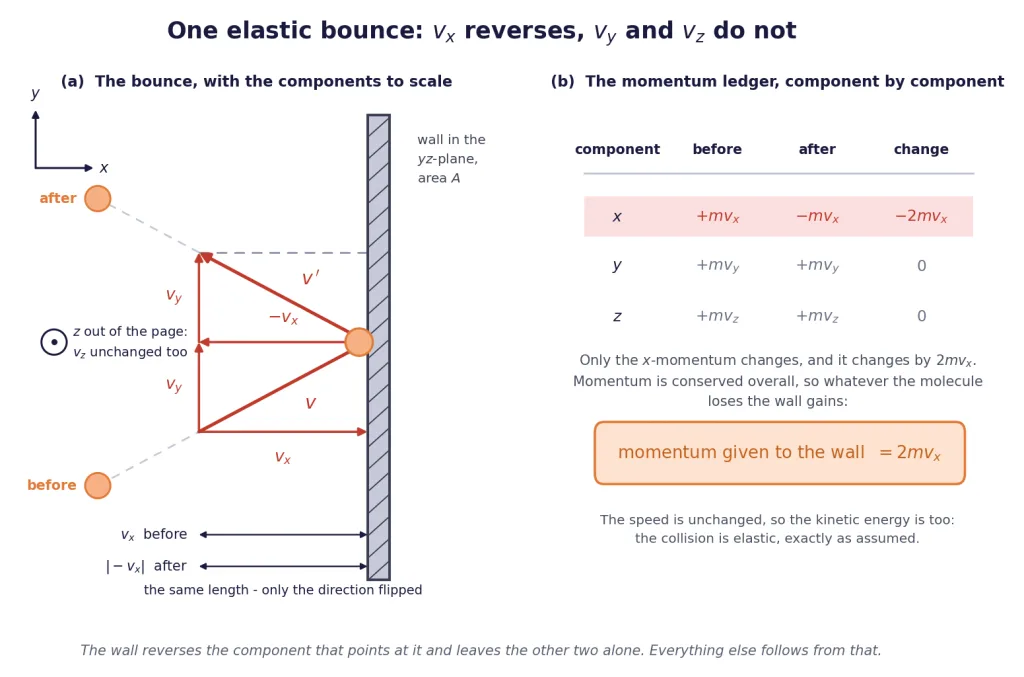
The collision is elastic (assumption 4) and the wall is flat, so the wall can only push the molecule along the direction normal to itself — the -direction. It has nothing to push with in the other two directions.
So the molecule comes away with
The -component reverses. The - and -components are untouched. And the speed is unchanged, because which is exactly what "elastic" demanded: the same speed, so the same kinetic energy.
The momentum ledger
Work component by component. Before the bounce the molecule's momentum is ; after it is .
| Component | Before | After | Change |
|---|---|---|---|
Only the -momentum changes, and it changes by . Momentum is conserved overall, so whatever the molecule loses, the wall gains:
Key Point: In one elastic collision with a wall in the -plane, a molecule's momentum changes by , and the momentum handed to the wall is The factor of 2 is there because the molecule does not merely stop — it turns round. Stopping would deliver ; reversing delivers twice that.
Two things to notice
Only appears. The molecule may be tearing along the wall at 800 m/s in the -direction; the wall never finds out. As far as this wall is concerned, the only thing that matters about a molecule is how fast it is coming at it. That single observation is what will eventually let us split the mean square speed into three equal shares.
The factor of 2 is where marks go missing. Writing instead of halves the final pressure. If your derived ever comes out as , this is where you lost the factor.
[JEE Tip] The same 2 appears in every "molecules striking a surface" problem — a gas jet on a plate, radiation pressure, an effusing beam. If the particles rebound elastically, each delivers . If they stick to the surface instead, each delivers only , and the force is half as big. Read the question for which one it is; that is usually the entire difficulty.
Counting the Hits
One collision delivers . To get a force we need to know how many collisions happen per second, and for that we need a genuinely clever little argument.
Who can even reach the wall?
Watch the wall for a short time . Which molecules can possibly hit it in that time?
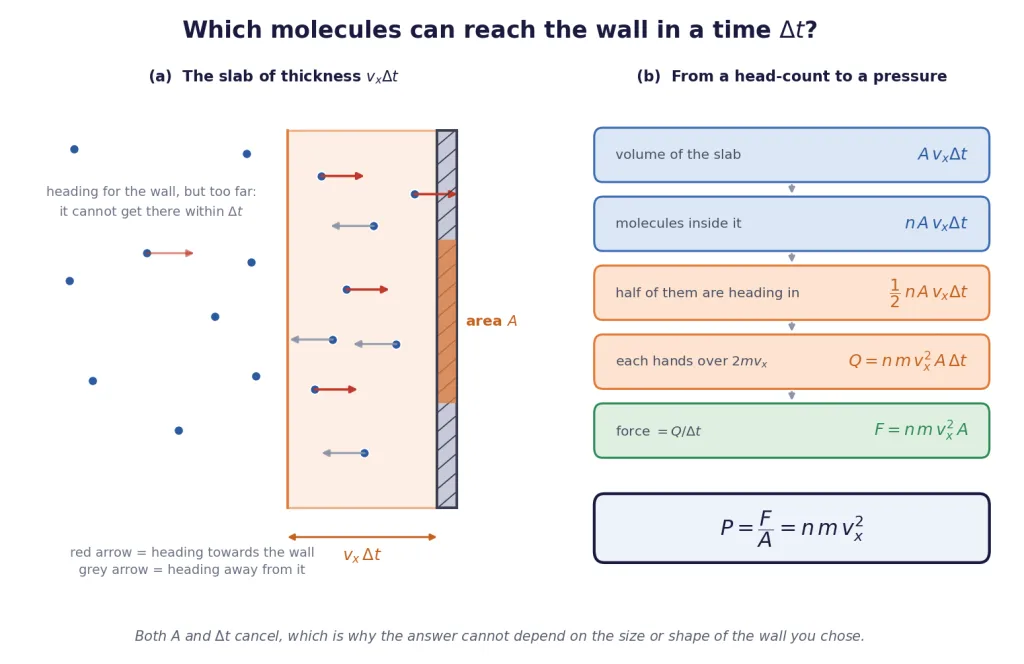
A molecule approaches the wall at speed in the -direction, so in a time it can cover a distance towards the wall — no more. So only the molecules lying within a distance of the wall stand a chance. Anything further away simply cannot get there in time, however keen it is.
That marks out a slab sitting against the wall: face area , thickness , and therefore
With molecules per unit volume, the number of molecules inside that slab is
But only half of them are coming
Being in the slab is not enough. Half of those molecules are travelling in the direction, towards the wall; the other half are travelling in the direction, away from it. The ones heading away will never touch it.
That is assumption 1 doing its work: the motion is random, so on average there is no reason for more molecules to be moving one way along than the other. Hence the factor of one half:
Multiply, divide, done
Each of those molecules hands over . So the total momentum delivered to the wall in time is
Force is the rate of transfer of momentum, so
and pressure is force per unit area:
Look at what vanished
Both and have cancelled clean out. That is not a coincidence and it is not luck — it is the reason the answer is a pressure at all. Had the result still depended on how big a patch of wall you chose or how long you watched it, it would not have been a property of the gas.
[JEE Tip] Three numbers went into that line and each is a favourite thing to drop: the 2 from the reversal, the from the half that are heading in, and the that appears twice — once as the speed of approach in the slab thickness, once as the momentum per hit. They are what turns a into a . Lose the 2 and you get half the right pressure; lose the and you get twice it; lose both and, by a stroke of luck that has fooled many students, you get the right answer for the wrong reason.
Isotropy, and the Result
We are one step away. But the equation that we just derived is not yet about a gas — it is about a group of molecules that all happen to have the same .
Averaging over the groups
Real molecules have a spread of velocities. Some are crawling, some are sprinting; a molecule's velocity changes at every collision anyway. So sort the gas into groups by their value of , apply the last block's result to each group separately, and add up the contributions. Group by group, the number density becomes the number density of that group, and the pressures simply add — pressure is a scalar, and each group pushes on the wall independently of the others.
Adding them all up replaces by its average over the whole gas:
where the bar means "averaged over all the molecules", and is called the mean square of .
Now use the fact that no direction is special
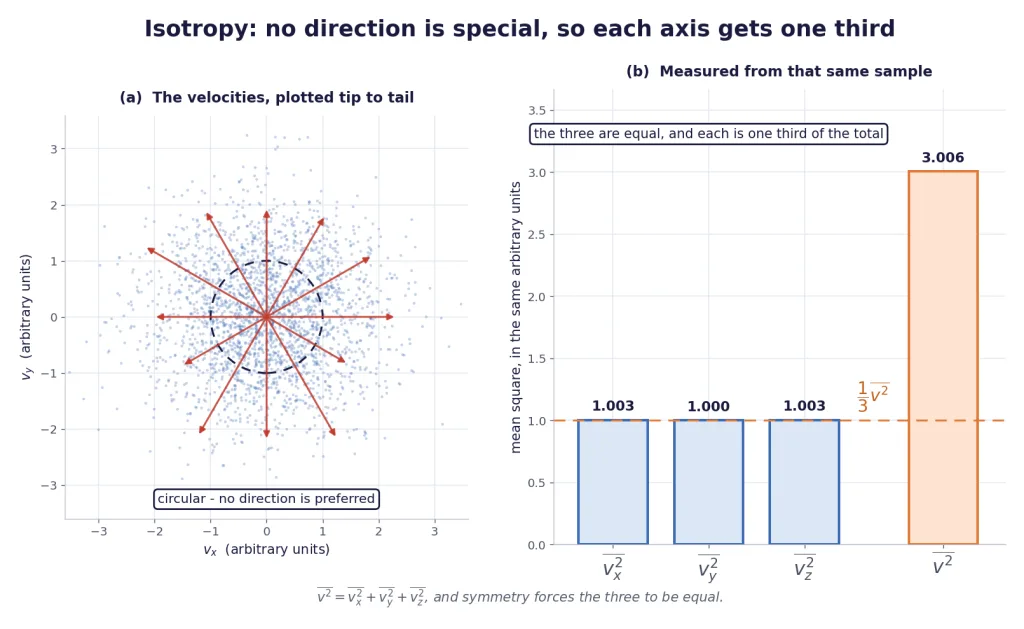
This is where the argument becomes elegant. The gas has no idea which way we drew our axes. There is nothing about a box of gas in equilibrium that singles out the -direction over the - or the -direction — the molecules are moving at random, so the three directions are on exactly the same footing. That property has a name: the gas is isotropic.
If the three directions are equivalent, their mean squares must be equal:
And for every single molecule, its speed and its components are tied together by Pythagoras in three dimensions, . Averaging that over all the molecules,
so each one is a third of the total:
The result
Put that back into :
Key Point — the pressure of an ideal gas from kinetic theory: where is the number density (molecules per cubic metre), is the mass of one molecule in kilograms, and is the mean square speed in m/s.
Since is (molecules per cubic metre) (kilograms per molecule) kilograms per cubic metre, which is just the density , the same result can be written and, multiplying by the volume, with the number of molecules and the total mass of the gas.
Check the units on the density form: kg/m times m/s is kg/(m s), which is N/m, which is the pascal. It really is a pressure.
That formula was built out of Newton's laws, a bounce and a head-count. No thermometer was involved anywhere.
The warning: is not
This is the single most dangerous notation in the chapter, so meet it now.
means square each molecule's speed first, then average. means average the speeds first, then square. They are different numbers, and it is — the mean of the squares — that appears in the pressure formula.
Take two molecules, one at 100 m/s and one at 300 m/s.
- Mean speed: m/s, so m/s.
- Mean square speed: m/s.
Not equal — and out by 25%. Squaring is not a fair operation to average through: the fast molecules get counted extra heavily, because squaring rewards them out of proportion. Use in the pressure formula and you will underestimate the pressure every single time.
Key Point: always, with equality only if every molecule has exactly the same speed — which never happens in a real gas. So the square root of the mean square speed is always a little larger than the mean speed.
That square root has a name, and it is tied to the temperature of the gas — but both of those belong to the next section, and the spread of speeds behind this inequality is developed properly a little later still. For now, hold on to the rule: in the pressure formula, square first, then average.
Two Remarks That Rescue the Derivation
The derivation above looks suspiciously convenient. We chose a cube. We quietly pretended that molecules never bump into each other on the way to the wall. Both of those should worry you, and both have good answers.
Remark 1: the shape of the container does not matter
We drew a cube because a cube has flat walls parallel to the axes and that made the algebra painless. But nothing in the final answer remembers the cube.
Take a container of any shape at all — a sphere, a flask, a bicycle tyre. Pick any small patch on its inner surface. Make it small enough and it is effectively flat, so choose your axes locally with the -axis along the normal to that patch. Now every line of the derivation goes through unchanged: molecules within of the patch, half of them heading in, each, divide by the area and the time.
And the answer that comes out — — contains neither the area of the patch nor the time . It could not depend on the shape even if it wanted to; there is nothing left in it that knows about the geometry.
There is a second, independent reason for the same conclusion. Pressure in a fluid at equilibrium is the same everywhere in a connected body of it; if one region of the gas were at a higher pressure than another, the gas would flow until it was not, and it would no longer be in equilibrium. So a single number describes the whole vessel, and the awkwardly shaped corners are pushed on exactly as hard as the flat faces.
Key Point: The cube is a scaffold, not a hypothesis. Any container works, because and cancel and pressure in an equilibrium gas is uniform.
Remark 2: ignoring intermolecular collisions does not spoil the answer
This is the sharper objection. A molecule inside the slab, heading for the wall, might well collide with another molecule first, get knocked sideways, and never arrive. Our head-count assumed it sailed straight in. Doesn't that wreck the count?
No — and the reason is that the gas is in a steady state.
Suppose a molecule that was heading for the wall with velocity gets deflected out of that group by a collision. Fine. But the collisions are random and the gas is not changing with time, so at that same moment some other molecule, previously travelling with some different velocity, is being knocked into velocity by a collision of its own. The two events cancel in the ledger.
They have to cancel. If more molecules were leaving a velocity group than joining it, that group would be steadily emptying, the distribution of velocities would be changing with time, and the gas would not be in a steady state at all. Steadiness is precisely the statement that every velocity group keeps its membership constant, even though the individual members keep swapping.
And notice what the derivation actually needs: not the fate of any particular molecule, but the value of averaged over the gas. Collisions shuffle molecules between velocity groups; they do not change how many molecules are in each group. The average survives the shuffling untouched.
The one thing this argument does need is assumption 6 — that a collision takes negligible time compared with the flight between collisions. If molecules spent an appreciable fraction of their lives locked in collisions, they would not be flying freely most of the time and the whole picture would need reworking. In an ordinary gas that fraction is about one in a thousand, so we are safe.
Key Point: Collisions redistribute molecules among velocity groups without changing the population of any group, so the averages the pressure formula depends on are unaffected. This works because the gas is in a steady state and collisions are brief.
What the formula is telling you
Three readings, all worth having:
- Pressure is a rate of momentum delivery. Not a weight, not a squeezing. It is molecules arriving, turning round, and leaving, times a second on every square metre — so many that the hail feels like a steady push.
- Pressure scales with how many and how fast. Double at fixed and doubles. Double at fixed and doubles. It is linear in both.
- The mass enters only through . A gas of heavy molecules moving slowly can sit at exactly the same pressure as a gas of light molecules moving fast, as long as the product matches.
The trap list for this section
- is the number density, not the number of moles. In this chapter is the moles. Mixing them up changes the answer by a factor of .
- is the mass of one molecule, in kilograms. If a problem gives you a molar mass, divide by the Avogadro number — and convert grams per mole to kilograms per mole first.
- Square first, then average. , never .
- Keep the . It came from isotropy. There is no in , and there must be one in .
- is the density of the gas, in kg/m — not the density of the liquid it condenses to, and not a relative density.
Everything from here on is squeezing this one formula. Put it next to the ideal gas equation and the whole molecular meaning of temperature falls out, which is exactly where the next section starts.
Solved Examples
Constants used throughout, unless a problem says otherwise: per mole; 1 atm Pa; J/K.
Example 1: Pressure straight from the formula
A vessel contains nitrogen with a number density of molecules per cubic metre. The mass of a nitrogen molecule is kg and the mean square speed of the molecules is m/s. Find the pressure, and express it in atmospheres.
Solution:
Identify the three quantities. per m is the number density (not moles); kg is the mass of one molecule; m/s is already a mean square speed, so no squaring is needed.
Get the density first, because it makes the arithmetic shorter and gives a number you can sanity-check: That is a believable density for a gas at around atmospheric pressure — a good sign.
Apply the pressure formula:
Convert to atmospheres:
Final Answer: Pa, which is 0.92 atm.
Takeaway: Collapse into the moment you see it. One multiplication less, and the intermediate number is one you can judge — gas densities at ordinary pressures live around 1 kg/m.
Example 2: Working the formula backwards
Air at 0°C and 1 atm has a density of 1.29 kg/m. Find the mean square speed of its molecules, and the square root of that.
Solution:
Rearrange the density form. From ,
Put the numbers in, in SI: Pa and kg/m.
Take the square root to get a quantity with the units of a speed:
Is that sensible? It is about 1750 km/h, faster than a passenger jet and rather faster than the speed of sound in air, which is 331 m/s at this temperature. It should be: sound is carried by these molecules, so it cannot travel much faster than they do, and in fact the two are within a factor of 1.5 of each other. That agreement is one of the earliest successes of the kinetic theory.
Final Answer: m/s; its square root is 485 m/s.
Takeaway: gets you a molecular speed from two things you can measure with laboratory apparatus — a pressure gauge and a balance. The name for that square root, and its link with temperature, come in the next section.
Example 3: Mean of the squares against square of the mean
Five molecules have speeds 300, 400, 500, 600 and 700 m/s. Find , and . If a careless student used in the pressure formula instead of , by what percentage would the pressure be wrong?
Solution:
Mean speed — add and divide: so m/s.
Mean square speed — square each one first, then average:
Compare. is bigger than , as it must be. Their square roots are 519.6 m/s and 500 m/s.
The error in the pressure. is proportional to whichever of these you feed it, so The pressure would come out 7.4% too low.
Final Answer: m/s, , m/s; the pressure would be 7.4% too small.
Takeaway: whenever the speeds are not all identical, and the wider the spread the bigger the gap. Spread these five speeds out to 100, 300, 500, 700, 900 and the error grows to 24%.
Example 4: From molar mass to the mass of one molecule
A vessel holds oxygen at a number density of molecules per cubic metre, with a mean square speed of m/s. The molar mass of oxygen is 32 g/mol. Find the pressure.
Solution:
Convert the molar mass to kilograms per mole, on its own line, before anything else: Leaving it as 32 here would make every speed and every mass wrong by a factor of a thousand.
Get the mass of one molecule by dividing by the Avogadro number:
Density:
Pressure: which is 1.18 atm.
Final Answer: kg and Pa.
Takeaway: with in kg/mol — write the conversion as its own line every time. A molecular mass should always land somewhere near kg; if yours comes out near , you left the molar mass in grams.
Example 5: The pressure of the gas in a box
A cubical box of side 10 cm contains molecules of a gas, each of mass kg, with a mean square speed of m/s. Find (a) the number density, (b) the mass of gas in the box, (c) the density, and (d) the pressure.
Solution:
(a) Number density. The volume is m, so
(b) Mass of gas. Number of molecules times the mass of one: that is 1.43 g.
(c) Density. Either or ; both give
(d) Pressure: about 1.13 atm.
Final Answer: per m; g; kg/m; Pa.
Takeaway: are three names for one number. Whichever route you take must give the same value — a free check that costs one line.
Example 6: One molecule in a box, doing all the work
A single molecule of mass kg bounces back and forth between two opposite faces of a cube of side 0.20 m, with an -component of velocity of 400 m/s. Find (a) how many times per second it strikes one particular face, (b) the average force it exerts on that face, and (c) the pressure that one molecule contributes.
Solution:
(a) Rate of hitting one face. Between two hits on the same face the molecule must cross the box and come back, a distance : so it strikes that face 1000 times per second.
(b) Average force. Each hit delivers , and force is momentum delivered per second:
(c) Pressure. The face has area m:
A sanity check on the whole chapter. To reach 1 atm you would need about such molecules. A box of side 0.20 m at ordinary pressure and temperature actually holds about molecules — the same order of magnitude. The theory hangs together.
Final Answer: 1000 hits per second; N; Pa.
Takeaway: for one molecule in a box of side , and the pressure it contributes is . Add that over molecules and average, and you have re-derived by a second route — note the , not , in the round trip.
Example 7: A molecular beam on a plate
A beam of hydrogen molecules strikes a plate of area 2.0 cm head on, at molecules per second, each moving at 1000 m/s normal to the plate. The molar mass of hydrogen is 2 g/mol. Find the pressure on the plate (a) if the molecules rebound elastically, and (b) if instead they stick to it.
Solution:
Mass of one molecule. Convert the molar mass first:
(a) Elastic rebound: each molecule delivers . With per second, The area is cm m, so
(b) If they stick, each delivers only — the molecule is stopped, not turned round — so both the force and the pressure are halved:
Final Answer: (a) 332 Pa; (b) 166 Pa, exactly half.
Takeaway: Rebounding delivers twice as much momentum as sticking. A shiny surface that reflects therefore feels twice the pressure of a black one that absorbs — the same idea reappears for light, as radiation pressure.
Example 8: Same pressure, two different gases
Two vessels hold different gases at the same pressure and the same number density. Gas A has molecules 16 times heavier than gas B. Compare their mean square speeds and the square roots of those.
Solution:
Write the formula for each, with and common to both:
Cancel and :
Take square roots for the ratio of the speeds themselves: The heavier gas moves four times more slowly.
Read it physically. Each molecule of A carries four times the momentum per unit speed, so it needs only a quarter of the speed to push on the wall as hard — and since pressure goes as the square of the speed, a factor of 16 in mass is undone by a factor of 4 in speed.
Final Answer: , and the square roots are in the ratio .
Takeaway: At the same pressure and number density, is the same for every gas. Heavier molecules always move more slowly, and the speed ratio is the square root of the inverse mass ratio.
Example 9: Squeezing the box
A sealed vessel of gas is compressed to half its volume, with no molecules escaping and with the mean square speed of the molecules held unchanged. What happens to the number density, the density and the pressure?
Solution:
Number density. is fixed and has halved, so The number density doubles.
Density. and has not changed, so . The same mass now occupies half the room.
Pressure. With held fixed, The pressure doubles — twice as many molecules hitting each square metre per second, each hit exactly as hard as before.
A word of caution. Holding fixed while compressing is an extra condition imposed by the problem, not something that happens by itself. Compress a gas quickly in an insulated cylinder and the molecules speed up. What that has to do with temperature is the next section's business.
Final Answer: doubles, doubles, doubles.
Takeaway: At fixed , pressure is directly proportional to number density. This is Boyle's law emerging from the molecular picture — and notice that the kinetic theory delivers it without any appeal to experiment.
Example 10: Counting the arrivals
In a gas of number density molecules per cubic metre, consider the group of molecules whose -component of velocity is 300 m/s. That group makes up 2.0% of all the molecules. How many of them strike an area of 1.0 cm of the wall in 1.0 microsecond?
Solution:
Number density of the group. Two per cent of the total:
Convert everything to SI. cm m, and microsecond s.
Thickness of the slab that can reach the wall: a third of a millimetre.
Count the arrivals — the slab volume times the group's number density, halved because only half are heading in:
Final Answer: About molecules from that group strike the patch in one microsecond.
Takeaway: is the counting formula — slab volume, times number density, halved. Eight thousand million million hits in a millionth of a second on a fingernail-sized patch, from one narrow group alone: that is why pressure feels perfectly smooth.
Example 11: Getting the density of an unknown gas
A gas is at a pressure of Pa, and the square root of its mean square speed is 500 m/s. Find its density, and then its number density if each molecule has a mass of kg.
Solution:
Rearrange for the density:
Square the given speed first to get the mean square speed:
Substitute:
Number density, from :
Final Answer: kg/m and molecules per m.
Takeaway: The pressure formula has four quantities in it — , , and — and any three give you the fourth. Most problems in this section are that sentence in disguise.
Example 12: Does the shape of the vessel change anything?
A cubical vessel and a spherical vessel of the same volume hold the same gas, with the same number of molecules and the same mean square speed. A student argues that the sphere must be at a lower pressure, since a curved wall "deflects molecules sideways rather than straight back". Decide whether the pressures differ, and say exactly where the student's reasoning fails.
Solution:
Compare the quantities in the formula. Same and same gives the same ; same gas gives the same ; and is given equal. So returns the same number for both. The pressures are equal.
Where the derivation allowed for this. We never used the flatness of the whole wall — only of a small patch, which any smooth surface has. Choose the -axis along the local normal to that patch and every step goes through: the slab of thickness , the half heading in, the per hit.
Where the student's reasoning fails. A molecule hitting a curved wall does rebound in a different direction from one hitting a flat wall — but the momentum it transfers to the wall is still along the local normal, because it is the local normal that decides which component gets reversed. Individual bounces differ; the average momentum delivered per unit area per unit time does not.
The clinching observation. Neither the patch area nor the observation time survives into the final formula. A result that has forgotten both cannot be remembering the shape.
Final Answer: The pressures are identical. The argument fails because the derivation only ever needs a locally flat patch, and the momentum transfer is always along the local normal.
Takeaway: The cube in the derivation is a convenience, not an assumption. Pressure in a gas at equilibrium is one number for the whole vessel, whatever its shape.