
From a Count of Modes to a Number of Joules
The last section left you with an integer. Helium: 3. Rigid oxygen: 5. Water vapour: 6. A vibrating diatomic: 7.
An integer is not energy. Knowing that an oxygen molecule has five independent places to keep energy tells you nothing at all about how much energy is in each of them — and it is entirely possible to imagine a gas that dumps most of its energy into flying about and only a trickle into tumbling.
Nature does not do that. Nature is scrupulously fair, and the statement of exactly how fair is the law of equipartition of energy. It is the bridge between the counting you have just done and the joules you can actually measure, and it is one of the shortest, most powerful sentences in Class 11 physics.
Symbols. Here is the number of moles and is the number density, molecules per cubic metre. The previous chapter used for moles; this is the reverse, and it is the convention every kinetic-theory formula uses. is the number of molecules and is the Avogadro number, so .
Start where you already have an answer
You do not have to guess at the fair share, because for translation you already know it. Section 5 compared the pressure formula with the gas equation and got
That is the average translational kinetic energy of one molecule. Now split it three ways.
The speed of a molecule is built from three components, , so averaging over the whole gas,
And now isotropy — the same assumption that carried the pressure derivation. A gas in equilibrium has no preferred direction. There is nothing about that makes it different from or : if there were, the gas would be drifting or swirling, and it is not. So the three averages must be equal, and each must be one third of the total:
Multiply through by and substitute:
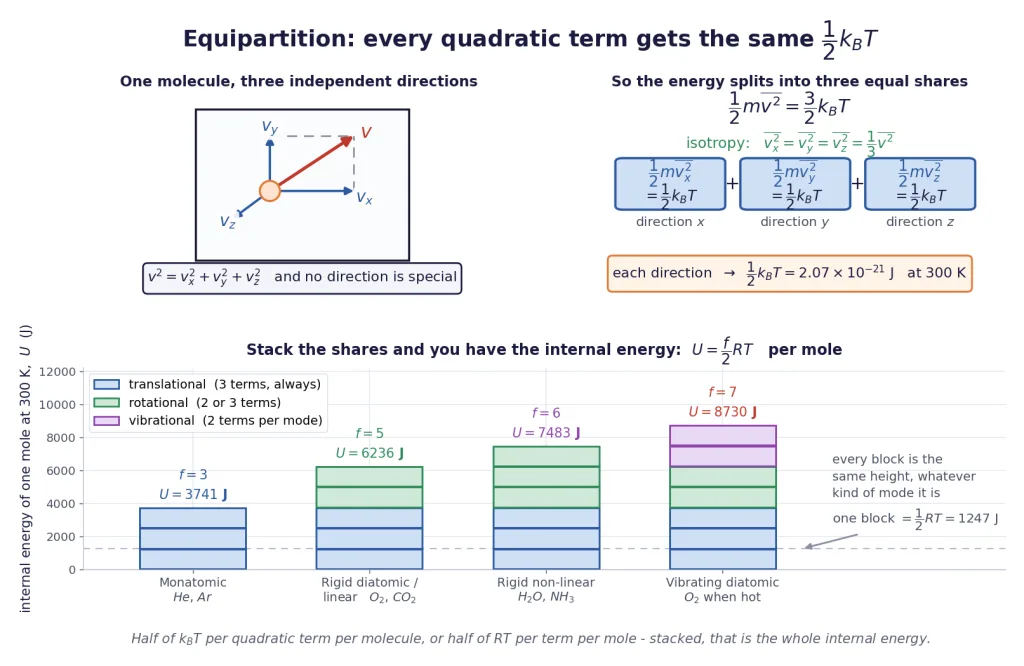
There it is. Motion along carries an average of per molecule. So does motion along . So does motion along . Three shares, all exactly equal, adding to the we started with.
Nothing was assumed to get this. It came out of the kinetic interpretation of temperature and the single observation that no direction is special.
The law
Equipartition is the assertion that this is not a coincidence about translation. It holds for every way a molecule can store energy.
Key Point — the law of equipartition of energy:
For a system in thermal equilibrium at absolute temperature , the total energy is shared equally among all the available modes, and each quadratic term in the expression for the molecule's energy carries an average of Multiply by the Avogadro number and, since , the same statement per mole is
Put numbers on it at room temperature, because the two values are worth carrying:
Every mode in the gas gets that, and gets exactly that, whatever kind of mode it is. A tumbling water molecule's rotation about its awkwardest axis draws the same J at 300 K as a helium atom's motion along . The molecules do not know or care what the energy is being used for.
Why the sharing happens
The mechanism is collisions. Molecules are colliding billions of times a second, and a collision is perfectly capable of turning translation into rotation — hit a dumbbell off-centre and it spins. It can turn rotation back into translation just as easily.
So energy is not merely divided; it is continually redistributed. Any mode that happened to be running rich would be losing energy to the others faster than it gained, and any mode running lean would be gaining. Equilibrium is the state where the traffic balances, and the balance point, remarkably, is dead level: the same everywhere.
That is worth pausing on. It is a statement about averages, not about individual molecules. At this instant some molecule in the room is barely moving and another is going at three times ; some are tumbling wildly and some hardly at all. Equipartition says nothing about any one of them. It says that if you average over the enormous number present, every mode comes out at , and that average is what a thermometer, a calorimeter and an exam question are all actually measuring.
[Board Important] State the law in the form that earns the marks: in thermal equilibrium at absolute temperature , the energy of a system is shared equally among its degrees of freedom, each quadratic term in the energy contributing per molecule. Leaving out the words "quadratic term" is what costs the mark, and the next block shows exactly why.
Quadratic Terms, Not Motions
The last block slipped a word past you: quadratic. It is the most important word in the law, and it is the one every hurried summary drops.
What the word is doing there
Write out the energy of a molecule, piece by piece, and look at the shape of each piece.
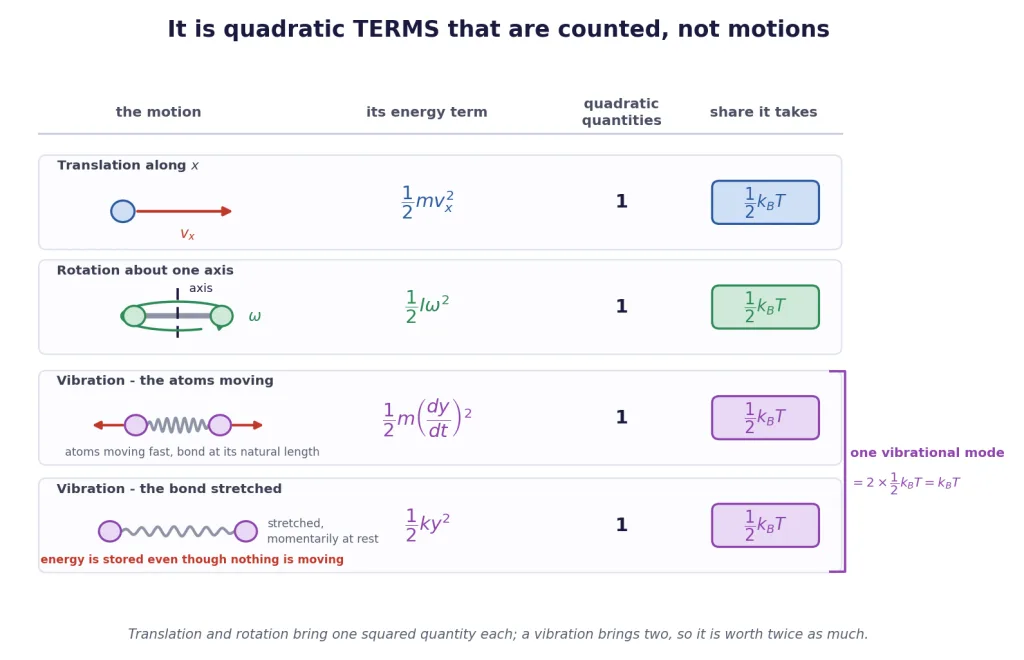
Every single piece has the same form: a constant multiplied by the square of an independent coordinate or velocity. squared. squared. squared. That is what "quadratic" means, and it is the only property equipartition cares about.
It does not care whether the squared quantity is a velocity or a position. It does not care whether the constant out in front is a mass, a moment of inertia or a spring constant. It does not care what the motion is called. Any term of the form
collects . Full stop.
The ledger
| The motion | Its energy term | Quadratic quantities | Share per molecule |
|---|---|---|---|
| Translation along | 1 | ||
| Translation along | 1 | ||
| Translation along | 1 | ||
| Rotation about one axis | 1 | ||
| Vibration, atoms moving | 1 | ||
| Vibration, bond stretched | 1 |
Read the last two rows together and the whole point of this block appears. They belong to one vibrational mode. One motion, two terms, two shares.
Key Point — count terms, not motions:
The number that appears in every formula from here on is the number of quadratic terms in the molecule's energy.
- Translation: 1 term per direction, so 3 terms, always.
- Rotation: 1 term per axis, so 2 terms for a linear molecule, 3 for a non-linear one.
- Vibration: 2 terms per mode, one kinetic and one potential. Everyone, including exam papers, calls "the number of degrees of freedom". For translation and rotation the two counts happen to be the same, so no harm is done. For vibration they are not, and that is where the marks are lost.
What does not get a share
Two honest exclusions, because a law with no boundary is not a law.
A term that is not quadratic does not get . The clean example is potential energy in a uniform gravitational field, , which is linear in , not quadratic. Equipartition as we have stated it simply has nothing to say about it. (There is a more general theorem that covers such cases, and it gives a different answer — but that is beyond this chapter, and no question here will need it.)
A mode that cannot be excited does not get a share either. This is the whole content of the freezing-out story from the last section, and equipartition, being pure classical mechanics, does not know about it. The law tells you what an available mode receives. Deciding which modes are available at your temperature is a separate question, answered by comparing the mode's energy quantum with , and the last block of this section returns to what happens when the two answers disagree.
[JEE Tip] Whenever a problem gives you an unfamiliar energy expression and asks for the average energy per molecule, the recipe is mechanical: count the squared quantities, and multiply by . A molecule whose energy is has four squared quantities, so its average energy is , and you never had to decide what any of the motions were called.
Why a Vibration Is Worth Exactly Two
The previous section told you that a vibrational mode counts double. This block is the reason, and it is a genuinely physical reason rather than a bookkeeping convention.
A vibrating bond has two accounts
Take the simplest case: a diatomic molecule whose bond can stretch. Let be the displacement of the bond from its natural length. The bond behaves like a spring of force constant , so the energy tied up in the vibration is
Two terms. Both quadratic. Both independent — you can specify how fast the bond is changing length and, separately, how stretched it is right now, and the two are different pieces of information.
Compare with what a rotation offers. A rigid molecule tumbling about an axis has and nothing else. There is no potential energy of orientation: pointing north-east costs a free molecule exactly as much as pointing north, which is to say nothing. One term.
The same is true of translation. Being at m costs no more than being at m. One term.
So it is only vibration that stores energy in a form that survives the motion stopping. At the two ends of its swing a vibrating bond is momentarily at rest, its kinetic energy zero — and yet it is still holding energy, exactly as a compressed spring does. That stored potential energy is a second, genuinely separate place to keep energy, and the law has to pay it separately.
Watch it happen
Set a bond oscillating with total energy and follow the two accounts through a cycle.
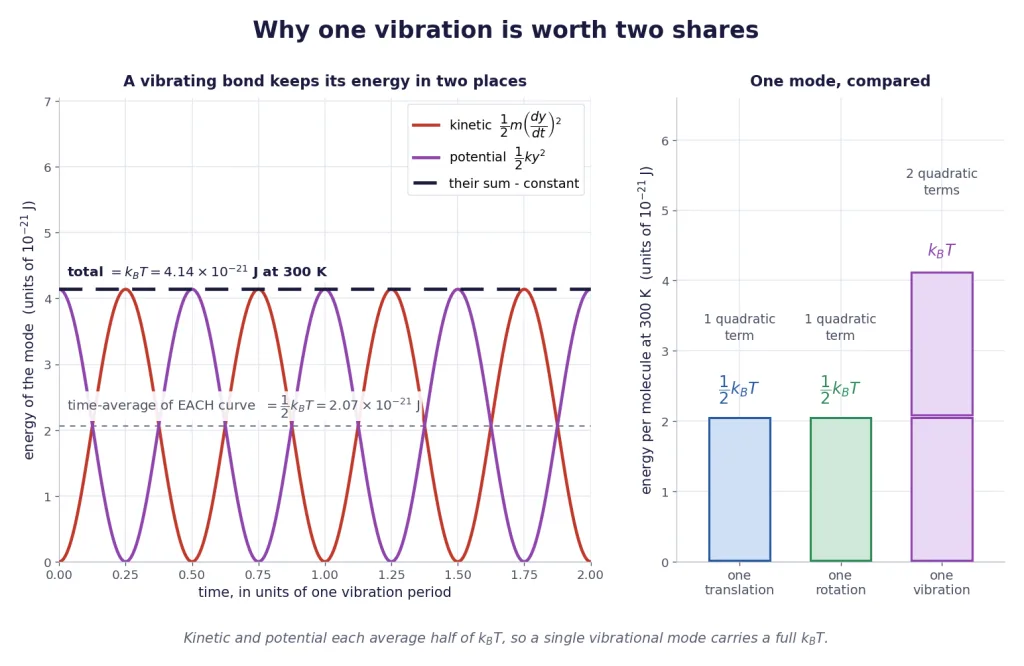
At the instant the bond passes through its natural length the atoms are moving fastest: all of the energy is kinetic, none potential. A quarter of a cycle later the bond is at full stretch and the atoms are momentarily still: all potential, no kinetic. In between the energy sloshes back and forth.
The two curves are mirror images, and their sum is flat — energy is conserved, as it must be. And because they are mirror images, their time-averages are identical, so each must be half of the total:
You can prove that in one line if you have met simple harmonic motion. With the potential energy is and the kinetic energy is ; over a whole number of cycles the average of and the average of are both , so each average is and the two are equal. That is the classical result. Equipartition then fixes the value of each at .
Key Point — the double count: A vibrating diatomic therefore has , not 6. Getting 6 is the single most common arithmetic slip in this topic.
A useful cross-check
Notice what the double count implies about a hot gas. If you take a diatomic gas from rigid behaviour to fully vibrating behaviour, you add per mole — and only , because a diatomic has just one vibrational mode. At 1000 K that is J per mole, which is not a small correction: it lifts the internal energy from J per mole to J per mole, a rise of 40%.
[NEET Important] If a question says "a diatomic molecule which also vibrates", or hands you a temperature of a few thousand kelvin, use . If it says "rigid", or says nothing at all, use . Those two words change every number downstream.
The Result:
Now assemble. The counting came from the last section, the share from this one, and multiplying them together gives the internal energy of a gas — which is the quantity the previous chapter used constantly and never explained.
Per molecule, then per mole
A molecule with quadratic terms in its energy holds, on average,
One mole contains molecules, so its total energy is times that. Using ,
Key Point — the internal energy of an ideal gas: where is the number of quadratic terms per molecule. Equivalently, per molecule , and for molecules .
That single line contains the whole of the last two sections. Count the terms; halve; multiply by .
The table
Numbers at 300 K, all of them just J:
| Molecule | per mole | at 300 K, J/mol | |
|---|---|---|---|
| Monatomic — He, Ne, Ar | 3 | 3741 | |
| Rigid diatomic — , , | 5 | 6236 | |
| Rigid linear polyatomic — , | 5 | 6236 | |
| Rigid non-linear polyatomic — , , | 6 | 7483 | |
| Vibrating diatomic — hot , | 7 | 8730 |
Look down the last column and notice that carbon dioxide and water vapour, both triatomic, sit on different rows. That is the linear-versus-bent distinction from the last section earning its keep: the same three atoms, a different shape, a 20% difference in internal energy at the same temperature.
It depends on temperature and nothing else
Read the boxed formula again and notice what is not in it. No pressure. No volume. No density. Nothing at all about the container.
Key Point — the point of the whole exercise:
The internal energy of an ideal gas depends only on its absolute temperature. Compress it at constant temperature and does not change. Let it expand at constant temperature and does not change. Only heating or cooling it changes .
The previous chapter asserted exactly this, as a thermodynamic fact about state functions, and used it to derive Mayer's relation and to write for every process on a - diagram. We have now proved it molecularly — the internal energy is nothing but the sum of the energies in the modes, every mode holds , and is the only thing in that expression.
The molecular reason for the independence is worth one sentence: an ideal gas has no intermolecular potential energy. Real molecules attract one another, so pulling them further apart costs energy and then does depend a little on volume — which is precisely why the result is exact for an ideal gas and only approximate for a real one.
Changes in internal energy
Because is proportional to , a change of temperature gives
and this holds whatever route the gas took, since depends on the end temperatures alone.
and are not the same thing
This is the trap of the whole section, and it catches good students.
is the translational kinetic energy only. That is the quantity Section 5 derived, and it is for every ideal gas, monatomic or not, because every molecule has exactly 3 translational terms whatever else it has.
is the total internal energy — translation plus rotation plus vibration.
| Gas | , translational | , total | |
|---|---|---|---|
| Monatomic | 1 | ||
| Rigid diatomic or linear | 0.6 | ||
| Rigid non-linear | 0.5 | ||
| Vibrating diatomic |
They coincide only for a monatomic gas, where there is nowhere else for energy to go. For anything else, asking "the internal energy" and getting is simply the wrong answer.
[JEE Tip] The pressure of a gas is set by translation alone — has no rotation in it — so holds for every ideal gas, but holds only for a monatomic one. A question that offers you for nitrogen is offering you a wrong answer that looks familiar.
What comes next
You now have the internal energy of any ideal gas from a single integer. The next section asks the obvious follow-up — how much heat does it take to raise that temperature by one kelvin? — and the answer falls out by differentiating the boxed formula. That is where the molar specific heats and the ratio come from, and every one of them is just wearing a different hat.
Where Equipartition Fails, and Why That Mattered More Than Its Successes
Equipartition is a beautiful law and it is also, strictly speaking, wrong. Understanding exactly how it is wrong turned out to be worth more to physics than everything it got right.
The prediction it cannot avoid making
Classical mechanics gives equipartition no room to negotiate. If a mode exists, it is quadratic, and the system is in equilibrium, then that mode holds . There is no clause allowing a mode to sit an argument out, no temperature dependence beyond the plain factor of , no exceptions.
So must be a constant for a given molecule, fixed by its structure, and must be a straight line through the origin when plotted against .
Both predictions are false, and hydrogen is where it shows most clearly.
The anomalous specific heat of hydrogen
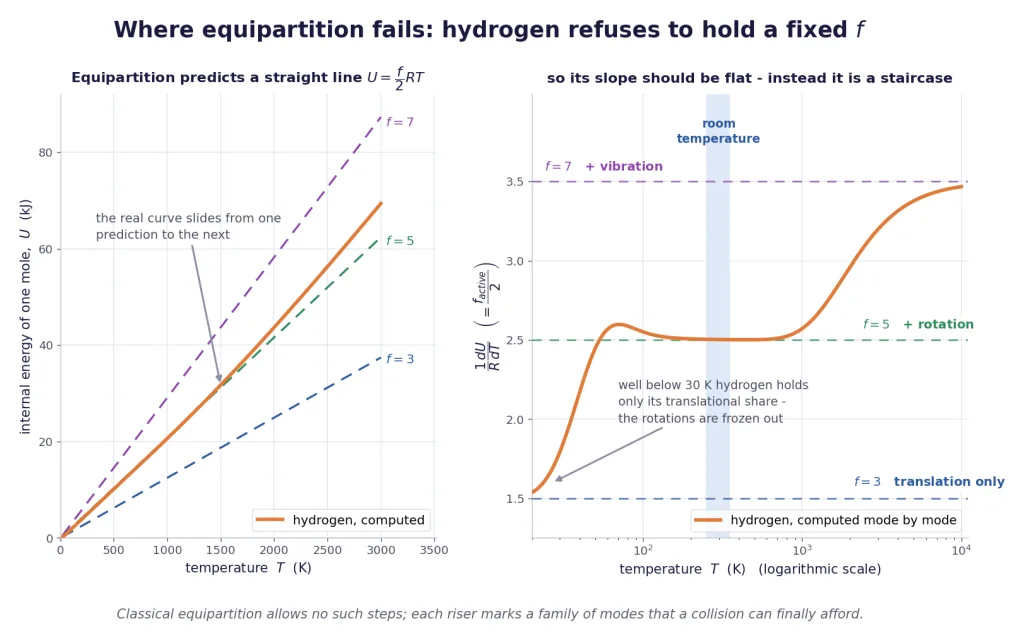
Measure how hydrogen's internal energy grows with temperature across the widest range you can manage, and you do not get one straight line. You get a curve that slides from one straight line to another:
- Below about 30 K it tracks , the monatomic prediction. Hydrogen's molecules are unmistakably dumbbells, and yet they behave as though they cannot rotate at all.
- Across a broad plateau that includes room temperature it tracks , with translation and rotation active and vibration absent.
- Above a couple of thousand kelvin it starts climbing towards as the bond finally begins to stretch.
Plot the slope of that curve instead of the curve itself and the sliding becomes a staircase, with a flat tread at each of the three predictions and a riser between them. Classical physics allows treads. It forbids risers absolutely.
This was not a small embarrassment. Maxwell, who had done as much as anyone to build the kinetic theory, singled out the specific heats of gases as the greatest difficulty the molecular theory had yet met — and he wrote that in the 1870s, knowing perfectly well that his own theory had no way out of it.
The explanation, and why it required new physics
The resolution is the one the last section gave for frozen modes. A mode cannot accept an arbitrarily small dribble of energy; it has a minimum quantum, and if that quantum is much larger than then almost no collision can pay it and the mode holds essentially nothing.
Hydrogen is the extreme case because it is the lightest molecule with the shortest bond, which makes both its moment of inertia and its vibrating mass unusually small — and small means a large rotational quantum, small mass on a stiff bond means a large vibrational quantum. Its rotational quantum corresponds to about 88 K and its vibrational quantum to over 6000 K, so hydrogen is the one gas in which you can watch rotation switch off in an ordinary laboratory.
Key Point — the boundary of the law:
Equipartition holds for every mode whose energy quantum is small compared with , and fails completely for every mode whose quantum is large compared with . It is therefore a high-temperature law. It is not that the counting is wrong — the modes really are there — but that classical physics wrongly assumed every mode must be used.
The other failures, briefly
Hydrogen was not alone.
Vibrations in ordinary air. Oxygen and nitrogen have one vibrational mode each, so classical equipartition insists on and . Measurement says at room temperature. The vibrational quanta of and correspond to a few thousand kelvin, so at 300 K those modes are frozen and contribute nothing. Every in this chapter is really a quantum result wearing classical clothes.
Solids at low temperature. Apply equipartition to a crystal and you get a definite answer. Each atom sits in a well and vibrates in three independent directions, and each of those vibrations is a mode with a kinetic and a potential term — so each atom has quadratic terms and
which at 300 K is J per mole. For most metals at room temperature that works extremely well. Cool the same metal towards absolute zero, though, and the measured energy collapses far below the prediction, because the vibrational modes freeze out one after another. Light, stiffly bonded solids such as diamond fail even at room temperature. (What that implies for the specific heat of a solid, and the name attached to it, is the next section's business.)
Radiation. The most spectacular failure of all came from applying equipartition where it seems to belong. The electromagnetic field inside a hot cavity has modes too, and there are infinitely many of them at short wavelengths. Give each one and the cavity contains infinite energy — a prediction so absurd it was christened the ultraviolet catastrophe. Planck's escape from it, in 1900, was to suppose that energy is exchanged in discrete lumps, which is the same idea that fixes hydrogen.
Why the failures mattered more
Key Point — the historical verdict:
The successes of equipartition — the specific heats of the noble gases, of nitrogen and oxygen, of most metals near room temperature — confirmed a picture people already believed. Its failures did something far more valuable: they were the first hard, quantitative evidence that classical mechanics is incomplete, and that energy at the molecular scale is exchanged in quanta. Specific heats and cavity radiation were the two experiments that forced quantum theory into existence.
There is a moral in this worth more than the formula. A law that fits everything teaches you nothing new; you already knew what it says. A law that fits most things and then breaks in one clean, reproducible, stubborn place is pointing at physics you have not discovered yet. Equipartition broke in exactly that way, and following the break took physics from Maxwell to Planck to Einstein in thirty years.
[Board Important] Two sentences, and they are asked most years: the law of equipartition assigns per molecule to each quadratic term in the energy, giving per mole; and it fails at low temperatures because the energy of a mode is quantised, so a mode whose quantum exceeds cannot be excited and holds no energy — the anomalous behaviour of hydrogen below 100 K being the classic example.
Solved Examples
Constants used throughout: J/K, J/(mol K), per mol, atm Pa. Room temperature means 300 K, always absolute.
Example 1: The share, in joules
At 300 K, find (a) the average energy associated with one quadratic term, per molecule and per mole, and (b) the average translational kinetic energy of a molecule of any gas.
Solution:
Per molecule, one term. Equipartition gives directly:
Per mole, one term. Multiply by , which turns into :
(b) Translation has 3 terms — one for each of , , — for every molecule, whatever its shape: Per mole that is J.
Final Answer: One quadratic term carries J per molecule, or J per mole. The translational kinetic energy is J per molecule, J per mole.
Takeaway: These two numbers, J and J at 300 K, are the currency of the whole section. Everything else is an integer multiple of one of them.
Example 2: Two moles of oxygen, and how much of it is translation
Find the internal energy of 2 moles of oxygen at 300 K, treating the molecules as rigid rotators, and find what fraction of that energy is translational.
Solution:
Count the terms. Oxygen is diatomic and rigid, so 3 translational plus 2 rotational, no vibration:
Apply the formula. With moles:
The translational part. Only the 3 translational terms count here, and this is , not :
The fraction. Which you could have written down without computing either number — the fraction is just the ratio of the term counts.
Final Answer: J, of which J, or 60%, is translational.
Takeaway: and are different quantities and only coincide for a monatomic gas. The fraction is worth remembering: it needs no arithmetic at all.
Example 3: Rigid or vibrating, at 1000 K
One mole of a diatomic gas is at 1000 K. Find its internal energy (a) treating the molecule as rigid and (b) allowing the bond to vibrate. How much energy does switching the vibration on account for?
Solution:
(a) Rigid. :
(b) Vibrating. A diatomic has vibrational mode, and that mode is worth two quadratic terms:
The difference. Exactly , which is — the two quadratic terms of the single vibrational mode, and nothing else.
Final Answer: J rigid, J vibrating, a difference of J per mole, a rise of 40%.
Takeaway: Turning on one vibrational mode adds exactly per mole, never . If your difference comes out as you have counted the mode once instead of twice.
Example 4: How much energy is in the tumbling?
For one mole of nitrogen at 300 K, behaving as a rigid rotator, find the energy stored in rotation alone, both per mole and per molecule.
Solution:
Count the rotational terms. Nitrogen is a linear (diatomic) molecule, so it has 2 rotational degrees of freedom, each contributing one quadratic term . So 2 terms.
Per mole. Each term carries :
Per molecule. Each term carries :
Sanity check. The total is J, and — two of the five terms. Consistent.
Final Answer: J per mole, or J per molecule, is in rotation.
Takeaway: You can ask equipartition for the energy in any subset of the modes. Count that subset's quadratic terms and multiply by (or ). No other formula is needed.
Solved Examples (continued)
Example 5: Argon and steam sharing a vessel
A sealed vessel at 400 K holds 1 mole of argon, for which , together with 3 moles of water vapour, for which . Both values of are given to you. Find the total internal energy of the mixture, the average energy of one of its molecules, and the effective number of quadratic terms per molecule. Take J/(mol K), per mole.
Solution:
One rule only: energies add. The two gases share the vessel but not their energy stores. Each keeps its own , and the total is the sum. Do not average the two values at the start — that is an answer, not a starting point.
Argon. With and :
Water vapour. With and :
Total. Notice how lopsided the split is: the steam holds 86% of the energy, because it has both three times the moles and twice the quadratic terms.
Per molecule. The vessel holds moles in all, so
Effective . Define it by insisting the mixture obey the same single formula that each component obeys: A number between 3 and 6, and much nearer 6 — exactly where three parts steam to one part argon should put it. And is just J, the same number step 5 reached the long way round.
Final Answer: J, J per molecule, .
Takeaway: For a mixture, add the internal energies first and extract an effective from the total afterwards, if you want one at all. It need not be a whole number, and it is never the plain average of the two values unless the moles happen to be equal.
Example 6: Heating four grams of helium
Four grams of helium gas are heated from 300 K to 600 K in a closed rigid vessel. Find the increase in its internal energy. The molar mass of helium is 4 g/mol.
Solution:
Convert the molar mass before anything else. This conversion is the one that decides most wrong answers in this chapter. Convert the sample mass to kilograms as well, so that the two masses are in the same units before you divide.
Number of moles. With the sample mass g kg,
Count the terms. Helium is monatomic: .
The change in internal energy. Both temperatures are already absolute, and K:
Why the rigid vessel does not enter. depends on temperature alone, so the answer would be the same if the gas had been allowed to expand, or compressed, or taken round a loop — provided it ended at 600 K.
Final Answer: J.
Takeaway: is path-independent. The container, the process and the pressure are all irrelevant; only the two temperatures and the molecule's structure matter.
Example 7: Same three atoms, different answers
Compare the internal energy of one mole of water vapour with that of one mole of carbon dioxide, both at 400 K and both treated as rigid.
Solution:
Both have atoms, so both have coordinates. The atom count does not separate them.
Carbon dioxide is linear (, bond angle ). The axis through all three nuclei has negligible moment of inertia, so only 2 rotations count:
Water is bent (bond angle about ). No axis contains all three nuclei, so all 3 rotations count:
The ratio.
Final Answer: : J per mole. : J per mole, 20% more.
Takeaway: Shape, not size, sets the rotational count, and the rotational count sets the internal energy. Always ask "linear or bent?" before reaching for a number.
Example 8: Reading the structure off the energy
A gas is found to have an internal energy of J per mole at 300 K. How many quadratic terms does each of its molecules have, and what sort of gas is it?
Solution:
Invert the formula.
Substitute, with in kelvin as always:
Interpret. means 3 translational terms and nothing else: no rotation, no vibration. That is a monatomic gas — helium, neon, argon, or a metal vapour.
Final Answer: ; the gas is monatomic.
Takeaway: runs the whole section backwards. Measuring how much energy a gas holds at a known temperature tells you the shape of its molecules — which is a remarkable thing for a calorimeter to be able to do.
Solved Examples (continued)
Example 9: A cubic metre of helium, three ways
A vessel of volume m contains helium at a pressure of atm and a temperature of 300 K. Find its internal energy, and confirm the answer by two independent routes.
Solution:
Route 1 — straight from the pressure. For a monatomic gas , so ; and since ,
Route 2 — through the moles.
Route 3 — through the molecules. In this chapter is the number density, so from ,
All three agree.
- A warning. The shortcut works only because helium is monatomic. For nitrogen at the same and the internal energy would be , not — but the translational energy would still be , since holds for every ideal gas.
Final Answer: J.
Takeaway: is often the fastest route when a problem hands you pressure and volume instead of moles. Just be certain which you are entitled to.
Example 10: Hydrogen at three temperatures
Estimate the internal energy of one mole of hydrogen at (a) 50 K, (b) 300 K and (c) 3000 K, given that its rotational modes switch on near 88 K and its vibrational mode near 6000 K.
Solution:
(a) 50 K. Well below the rotational switch-on temperature, so rotation is frozen out and hydrogen behaves as though monatomic: .
(b) 300 K. Comfortably above 88 K, so rotation is fully awake; far below 6000 K, so vibration is dead: .
(c) 3000 K. Rotation long since awake, and now a substantial part of the vibrational mode is excited too. Taking it as fully active, : (At 3000 K the vibration is in fact only partly on, so the true value sits a little below this — which is exactly the point of the next example's discussion.)
Final Answer: roughly J at 50 K, J at 300 K and J at 3000 K, with , 5 and 7 respectively.
Takeaway: is not a property of the molecule alone; it is a property of the molecule at a temperature. The same one mole of hydrogen is described by three different integers over this range, which is precisely why classical equipartition cannot be the last word.
Example 11: A solid
Using equipartition, find the internal energy of one mole of a simple crystalline solid at 300 K, and the average energy of one of its atoms.
Solution:
What an atom in a solid does. It cannot travel — it is locked in place by its neighbours — but it vibrates about its equilibrium position in three independent directions.
Count the quadratic terms. Each of those three vibrations is a genuine vibrational mode, so each contributes two terms, one kinetic and one potential: Note there is no separate translational contribution: the atom's motion is the vibration.
Per mole of atoms.
Per atom.
Final Answer: J per mole of atoms, or J per atom.
Takeaway: For a solid the count is 6 per atom, not 3 — a lattice atom is all vibration, and every vibration is worth two. What that implies about how much heat a solid needs is the next section's business.
Example 12: How far does a bond actually stretch?
A diatomic molecule's bond behaves as a spring of force constant N/m. Using equipartition, estimate the root-mean-square stretch of the bond at 300 K.
Solution:
Pick out the right quadratic term. The stretch appears in the potential energy term , and equipartition assigns that term an average of :
Solve for the mean square stretch.
Take the root.
Is that sensible? A typical bond length is around m, so the bond is wobbling by about 20% of its own length — large, which is a hint that this classical estimate is being generous, and indeed a real bond at 300 K is much stiffer than N/m and vibrates far less.
Final Answer: m, about angstrom.
Takeaway: Equipartition works on the potential term as happily as on the kinetic one, and that is what lets it predict a displacement rather than a speed. Any term of the form gives straight away.