
One Sentence, If You Could Only Save One
Richard Feynman once set himself a thought experiment. Suppose some catastrophe wiped out all scientific knowledge, and you were allowed to pass just one sentence on to whatever creatures came next. Which sentence carries the most information in the fewest words?
His answer was the atomic hypothesis:
Key Point — the atomic hypothesis:
All things are made of atoms — little particles that move around in perpetual motion, attracting each other when they are a little distance apart, but repelling upon being squeezed into one another.
Read it again slowly, because that one sentence is the entire syllabus of this chapter compressed into three clauses.
- "little particles" — matter is not continuous. Cut it finely enough and you reach grains that cannot be cut further by ordinary means. That gives us sizes, and therefore numbers.
- "in perpetual motion" — they never stop. Ever. Not in a gas, not in a liquid, not in a block of steel sitting on a table. Motion means kinetic energy, and kinetic energy will turn out to be temperature.
- "attracting… but repelling upon being squeezed" — the force between two of them is attractive at a distance and repulsive up close. That single shape, as you will see in a few pages, is the whole reason there are solids, liquids and gases at all.
Everything in the next ten sections is an unpacking of those three clauses. Hold on to the sentence.
The idea is much older than the evidence
Speculation that matter comes in indivisible pieces is ancient, and it appeared independently in more than one culture.
In India, the Vaiseshika school of thought, founded by Kanada in about the sixth century BC, developed the atomic picture in considerable detail. Atoms were held to be eternal, indivisible, infinitesimal and the ultimate parts of matter, and the Sanskrit word for the smallest particle, paramanu, is still the word for "atom" in several Indian languages. The argument for indivisibility was a lovely one: if matter could be subdivided endlessly, then there would be no real difference between a mustard seed and a mountain, since both would contain the same infinity of pieces. Four kinds of atom were postulated — Bhoomi (earth), Ap (water), Tejas (fire) and Vayu (air) — each with its own mass and attributes, while Akasa (space) was thought to be continuous and without atomic structure. Atoms were said to combine into molecules: two atoms making a dvyanuka, three a tryanuka, with the properties of the result depending on the nature and ratio of the constituents. Sizes were even estimated, and in the Lalitavistara, written mainly in the second century BC, the estimate comes out close to the modern figure of about m.
In Greece, Democritus in the fourth century BC argued the same way. The word atom itself means "indivisible" in Greek. He proposed that atoms differ physically in shape and size, and that these differences produce the different properties of substances: water atoms smooth and round, so they cannot hook on to each other and the liquid flows; earth atoms rough and jagged, so they lock together into hard solids; fire atoms thorny, which is why fire burns.
These are remarkable ideas. But notice what is missing from all of them.
Key Point: Ancient atomism was conjecture — ingenious, internally consistent, and completely untested. What turned atomism into science, two thousand years later, was that somebody found quantitative measurements that the theory explained and nothing else did.
That somebody was John Dalton, and the measurements came from a chemistry laboratory.
Dalton, and the two laws he was trying to explain
Around 1808, chemists had two stubborn experimental regularities on their hands.
The law of definite proportions. Any given compound always contains its constituent elements in a fixed proportion by mass, no matter how it was made or where it came from. Water from a Himalayan spring, water made by burning hydrogen in a laboratory, water condensed from a cloud — decompose any of them and you get hydrogen and oxygen in a mass ratio of 1 to 7.94, every single time.
The law of multiple proportions. When two elements form more than one compound, then for a fixed mass of the first element, the masses of the second are in a ratio of small whole numbers. Carbon and oxygen make two compounds; for 12 g of carbon, one of them holds 16 g of oxygen and the other 32 g — a ratio of 1 to 2. Nitrogen and oxygen make several; per 14 g of nitrogen the oxygen comes in at 8 g, 16 g and 32 g, a ratio of 1 to 2 to 4.
Why small whole numbers? Nothing about a continuous, infinitely divisible substance predicts that. If matter were a smooth paste, compounds could form in any ratio at all, and the ratios would drift about depending on conditions.
Dalton's explanation was as simple as it was radical:
Key Point — Dalton's atomic theory, in four lines:
- The smallest constituents of an element are atoms.
- Atoms of one element are identical to each other and different from those of every other element, in particular in mass.
- Atoms are not created, destroyed or changed in a chemical reaction — they are only rearranged.
- A small whole number of atoms of each element combine to form a molecule of a compound.
Now the two laws are not mysterious, they are unavoidable. A compound is a fixed recipe of atoms, so its mass proportions are fixed — that is the first law. And you cannot use half an atom, so a second compound of the same two elements must use a different whole number of atoms, which is exactly why the ratio comes out as 1 to 2 rather than 1 to 1.83 — that is the second law.
[Board Important] A very common exam question is simply "why did Dalton propose the atomic theory?" The answer is not "to explain that matter is made of atoms" — that is circular. The answer is: to explain the laws of definite and multiple proportions, which were experimental facts crying out for an explanation.
Because elements often exist as molecules rather than free atoms, Dalton's atomic theory is also called the molecular theory of matter. And though it is completely standard today, resistance lasted a surprisingly long time: at the very end of the nineteenth century there were still famous scientists who did not believe atoms were real. What finally silenced them is the subject of the last block of this section.
From Volumes to Molecules: Gay-Lussac and Avogadro
Dalton's theory explained mass ratios. But it left a large hole, and closing it took two more ideas.
Gay-Lussac's law of combining volumes
In the early nineteenth century Joseph Gay-Lussac measured what happens when gases react, and found something at least as striking as Dalton's mass ratios:
Key Point — Gay-Lussac's law of combining volumes:
When gases combine chemically to yield another gas, their volumes — all measured at the same temperature and pressure — are in the ratios of small integers.
The measurements are clean and easy to remember:
| Reaction | Volumes that react | Volume produced |
|---|---|---|
| hydrogen + oxygen gives steam | 2 : 1 | 2 |
| hydrogen + chlorine gives hydrogen chloride | 1 : 1 | 2 |
| nitrogen + hydrogen gives ammonia | 1 : 3 | 2 |
Small whole numbers again — but this time in volumes, not masses. That is a strong hint. Mass ratios come out as whole numbers because atoms are counted; if volume ratios also come out as whole numbers, then volume must somehow be counting things too.
Careful with the wording. This is not the same as the pressure law, which is also sometimes attached to Gay-Lussac's name and which you will meet in a later section. This one is about combining volumes in a chemical reaction.
Avogadro's hypothesis
Amedeo Avogadro supplied the missing link in 1811, and it is one line long:
Key Point — Avogadro's hypothesis:
Equal volumes of all gases, at the same temperature and pressure, contain equal numbers of molecules.
Every word in that sentence is load-bearing. All gases — hydrogen, oxygen, carbon dioxide, it makes no difference. Same temperature and pressure — without that condition the statement is false. Numbers of molecules — not atoms, and not mass.
Notice how outrageous this should sound. A carbon dioxide molecule is twenty-two times heavier than a hydrogen molecule and physically much larger, yet a litre of each at the same temperature and pressure holds the same number of them. Avogadro had no proof; he had the fact that it made Gay-Lussac's whole-number volumes fall out immediately. The reason it is true will emerge naturally from kinetic theory later in this chapter.
The two together turn volumes into a molecular formula
Here is the payoff, and it is worth working through slowly because it is the moment chemistry became molecular.
Take the first row of the table: 2 volumes of hydrogen + 1 volume of oxygen give 2 volumes of steam.
Apply Avogadro's hypothesis. If 1 volume contains molecules, then equal volumes contain equal numbers, so the reaction reads:
Divide through by — the actual value never matters, which is the beauty of the argument:
Now count. Each water molecule must receive one whole hydrogen molecule, and half an oxygen molecule.
That second phrase is the crowbar. You cannot have half an atom — Dalton is emphatic on that. So if half an oxygen molecule ends up in each water molecule, the oxygen molecule must contain at least two atoms that can be split apart. Oxygen gas is , not . The same argument run on ammonia and on hydrogen chloride shows that hydrogen, nitrogen and chlorine are diatomic too.
And once you accept and , the formula of water follows: each water molecule gets 2 hydrogen atoms and 1 oxygen atom, so water is .
Key Point: Gay-Lussac's law plus Avogadro's hypothesis is what converted chemistry's mass ratios into molecule counts. Dalton could say that water always has hydrogen and oxygen in a 1 to 7.94 mass ratio; only after Avogadro could anyone say that a water molecule is two hydrogen atoms and one oxygen atom.
And it hands you relative molecular masses for free
There is a second dividend. If equal volumes hold equal numbers of molecules, then at the same temperature and pressure
because the number of molecules in that volume cancels top and bottom. Weigh a litre of oxygen and a litre of hydrogen at the same temperature and pressure and you get 1.429 g and 0.0899 g. The ratio is 15.9, so an oxygen molecule is 15.9 times heavier than a hydrogen molecule. Take hydrogen as 2 units and oxygen comes out at 31.8, which is 32 to within the accuracy of the weighing.
[JEE Tip] This is the origin of the whole table of molecular masses, and it is worth remembering that it came from weighing gases, not from weighing single molecules. Nobody weighed a single molecule for another hundred years.
Counting molecules by the litre eventually produced the number that carries Avogadro's name — about molecules in one mole. We will use that number in the next block simply as a count, and set it up properly, along with the mole itself, in the next section.
The Scale of Things
Everything so far has been qualitative. The chapter only becomes quantitative once we know how big molecules are and how far apart they sit — because those two numbers decide, for each state of matter, whether the intermolecular force matters or can be ignored.
The remarkable thing is that you can get all of them from measurements you could make in a school laboratory.
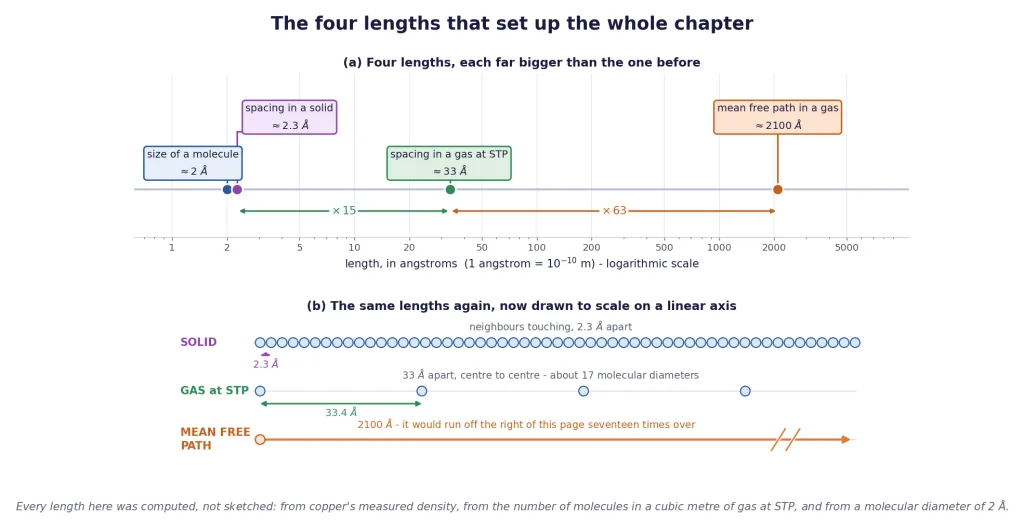
Start with the unit
Molecular distances are so small that metres are useless for them, so we use the angstrom:
An atom is about 1 Å across. Ten million of them side by side make a millimetre.
How close together are they in a solid?
You do not need a microscope. You need a balance and a measuring cylinder.
Copper has a density of 8960 kg per cubic metre, and one mole of copper — that is atoms — has a mass of 63.5 g. So the volume belonging to a single copper atom is
Give each atom a little cube of that volume and the cube's edge — which is the centre-to-centre distance to its neighbour — is
Run the same calculation for liquid water (density 1000, molar mass 18 g) and you get 3.1 Å.
Key Point: In solids and liquids the molecules are separated by only a couple of angstroms — which, since a molecule is itself about 1 to 2 Å across, means they are essentially touching. This is why solids and liquids are hard to compress: there is nowhere left to go.
[Board Important] Notice that liquids and solids come out at roughly the same spacing. That is the whole reason a liquid is nearly as dense and nearly as incompressible as the corresponding solid. What separates them is not distance, it is order — a point the next block takes up.
And in a gas?
Now do the same for a gas. At standard temperature and pressure a cubic metre of any gas contains about molecules, so the volume per molecule is
and the spacing is the cube root of that:
Key Point: In a gas, the molecules sit tens of angstroms apart — roughly 15 times further than in the corresponding solid or liquid, and about 17 molecular diameters.
Fifteen times the distance in each of three directions means about times the volume per molecule. That is why a litre of water boils away into well over a thousand litres of steam, and it is the single fact that makes gases so much easier to think about than liquids.
One more length: how far does a molecule get?
A gas molecule does not sit still at its 33 Å post. It flies about, and every so often it runs into another one. The average distance it covers between two successive collisions is called the mean free path, and at STP for a molecule 2 Å across it comes out at
That is thousands of angstroms — about a thousand molecular diameters, and about sixty times the spacing between neighbours. A molecule sails past dozens of others before it actually hits one.
The formula behind that number, and everything it explains, belongs to a later section. What matters here is the ladder of four lengths, because the rest of the chapter lives on it:
| Length | Size | What it tells you |
|---|---|---|
| diameter of a molecule | about 1 to 2 Å | how big the particle itself is |
| spacing in a solid or liquid | about 2 to 3 Å | touching, so the force is always on |
| spacing in a gas at STP | about 33 Å | far apart, so the force is almost always off |
| mean free path in a gas at STP | about 2100 Å | free flight is the normal state, collisions are events |
[NEET Important] Learn this ladder as four orders of magnitude — 1 Å, 2 Å, 30 Å, 2000 Å. Order-of-magnitude questions on it are asked directly, and every later formula in the chapter is a quantitative version of one of these rows.
The consequence that makes kinetic theory possible
Here is what all of this is for. Take the gas molecules to be spheres 2 Å across. Each one has a volume of about m, while each has m of room. So the fraction of a gas that is actually occupied by matter is
Roughly one part in ten thousand. A container of air at room conditions is 99.99% empty space.
Key Point: That number is the licence for everything that follows. Because the molecules occupy almost none of the volume and spend almost all their time far outside each other's reach, a gas can be modelled as point particles that do not interact except when they collide — and that model is simple enough to solve with Newton's laws. In a solid or a liquid, where the molecules are touching, no such simplification is available. It is not an accident that this chapter is mostly about gases.
The Force Between Two Molecules
Go back to Feynman's sentence: molecules attract "when they are a little distance apart, but repel upon being squeezed into one another." That clause is doing an enormous amount of work, so let us look at the actual shape of the force.
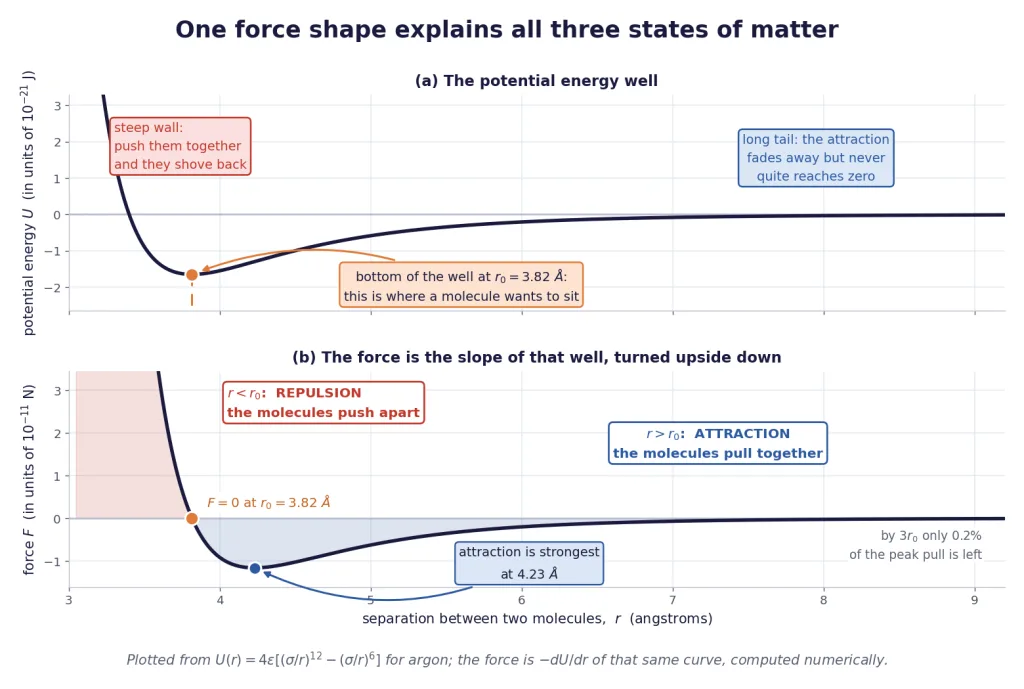
The figure is not a sketch. It is the intermolecular potential energy of two argon atoms, plotted from the standard model expression, with the force underneath obtained as the slope of that same curve. Three features matter, and only three.
1. Far apart, they pull — weakly, and it fades fast
At large separations the force is attractive. Two molecules that are a few angstroms apart drift towards each other.
But look at how fast the attraction dies. The strongest pull in the whole curve happens at about 4.2 Å. Move out to twice the equilibrium separation and only about 3% of that peak pull survives. Move out to three times it and you are down to 0.2% — effectively nothing.
Key Point: The intermolecular attraction is a genuinely short-range force. Unlike gravity or the electrostatic force, which fall off as and reach across a room, this one is essentially dead a few molecular diameters out.
That one sentence explains why a gas at 33 Å spacing behaves as though there were no forces at all, while a solid at 2.3 Å spacing is dominated by them.
2. Close in, they push — very hard
Squeeze two molecules towards each other and at some point the force flips sign and becomes repulsive, and it climbs almost vertically. This is why matter takes up space at all: it is not that atoms are little billiard balls with hard surfaces, it is that the repulsion becomes overwhelming so quickly that they behave as if they had one.
You can see the asymmetry in the figure. The attractive side is a long, shallow, lazy tail. The repulsive side is a wall.
3. In between, there is one special separation
Somewhere between "pulling" and "pushing" there must be a separation where the force is exactly zero. Call it . For argon it is at 3.82 Å.
Key Point — the equilibrium separation :
- For , the force is attractive — the molecules are pulled back together.
- For , the force is repulsive — the molecules are pushed back apart.
- At , the force is zero and the potential energy is at its minimum.
Displace a molecule either way from and the force pushes it back. is a point of stable equilibrium, and it is where a molecule sits if you leave it alone and take its energy away.
[JEE Tip] Two questions are asked constantly and are easy to mix up. Where is the force zero? At , the bottom of the potential well. Where is the potential energy zero? At a smaller separation, on the way up the repulsive wall, and also out at infinity — the zero of potential energy is a matter of convention and is not a physically special place. The force is , so force-zero means slope-zero, which is the bottom of the well, not the crossing of the axis.
Why this shape produces a potential well
Because the force pulls inward outside and pushes outward inside it, the potential energy has a minimum at — a well. And a well is a trap.
Whether a molecule stays in that trap comes down to one comparison, and it is the comparison that decides which state of matter you are looking at:
Key Point — the whole of the next block in one line:
Compare the depth of the potential well with the typical thermal kinetic energy a molecule has at temperature .
- Thermal energy much smaller than the well depth: the molecules are trapped. Solid.
- Thermal energy comparable to the well depth: trapped, but able to swap partners. Liquid.
- Thermal energy much larger than the well depth: the molecules ignore the well entirely. Gas.
For argon the well is about J deep, while at room temperature a molecule's thermal energy is about two and a half times that. Which is exactly why argon is a gas at room temperature, and a liquid only below about 87 K.
Three States of Matter, One Force — and Why a Still Gas Is Not Still
Now put the last two blocks together. The spacing ladder tells you how far apart the molecules are; the force curve tells you what they feel at that distance. Between them they give you all three states of matter.
Solid: trapped at , in a fixed place
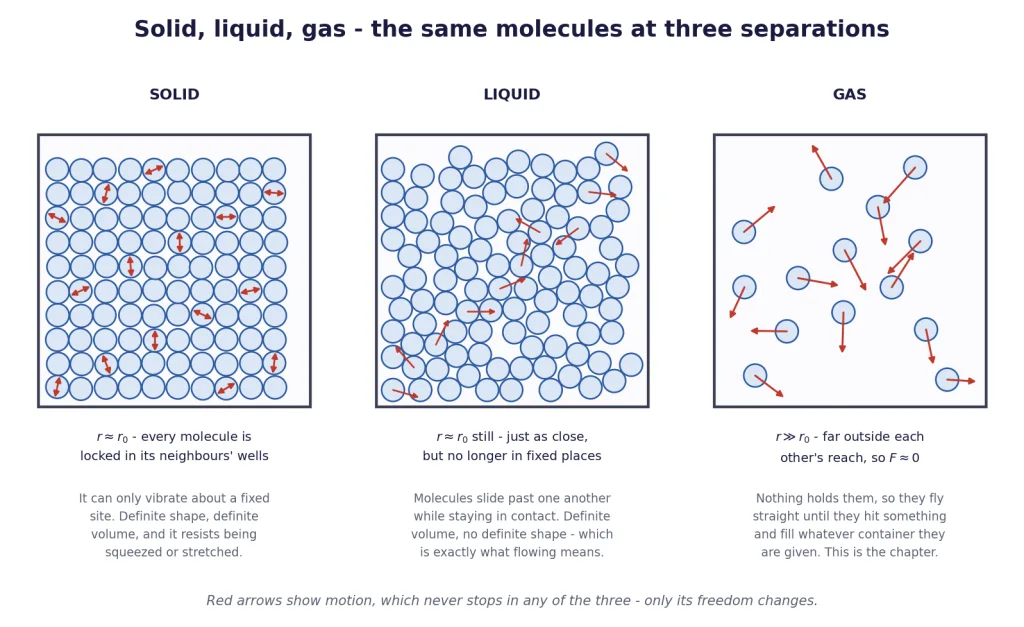
In a solid the molecules sit at roughly from each other — a couple of angstroms, essentially touching — and each one is caught in the potential wells of all its neighbours at once. Its thermal energy is far too small to climb out.
So it does the only thing left: it vibrates about a fixed site. Not "sits still" — vibrates, always, right down to the coldest temperatures you can reach. But it does not wander.
That gives a solid its two defining properties. Definite volume, because the molecules are already touching and the repulsive wall stops you compressing them. Definite shape, because each molecule has a fixed address; move one and the force drags it back.
Liquid: still at , but no longer in a fixed place
Here is the part students find surprising: a liquid is packed almost exactly as tightly as a solid. The spacing works out at 3.1 Å for water against 2.3 Å for copper — the same ballpark, and nothing like the 33 Å of a gas.
What has changed is not the distance, it is the order. In a liquid the molecules have enough thermal energy to escape any one neighbour's well, but nothing like enough to escape all of them. So they slide past each other and swap neighbours constantly, while never actually getting away.
That gives a liquid its odd combination. Definite volume — still touching, still nearly incompressible, just like a solid. No definite shape — because no molecule has a fixed address, the whole assembly can be poured into any container and reshape itself. That is precisely what flowing means, at the molecular level.
Key Point: Solid and liquid differ in order, not in spacing. Liquid and gas differ in spacing, not really in order. Getting this the wrong way round is one of the commonest conceptual errors in the chapter.
Gas: outside the well altogether
In a gas the spacing is tens of angstroms, and we saw in the last block that at three times the attraction has already fallen to 0.2% of its peak. At 33 Å it is nothing at all.
So a gas molecule feels no force for almost its entire life. It travels in a straight line at constant velocity — obeying Newton's first law, not some special gas law — for about 2100 Å, then collides, changes direction, and flies straight again.
Nothing holds a gas together. Open the container and it disperses. Put it in a bigger container and it fills the bigger container, because there is no reason for a molecule to stop anywhere in particular.
Here is the summary table, and it is worth memorising as a unit:
| Spacing | Force felt | Order | Volume | Shape | |
|---|---|---|---|---|---|
| Solid | about , 2-3 Å | strong, always | fixed lattice sites | definite | definite |
| Liquid | about , 2-3 Å | strong, always | none — they swap places | definite | takes the container |
| Gas | tens of Å | negligible except in collisions | none | takes the container | takes the container |
[NEET Important] Two one-line answers worth having ready. Why does a liquid have a definite volume but no definite shape? Because its molecules are still in contact (so the volume is fixed by the repulsive core) but are no longer at fixed sites (so the shape is not). Why does a gas fill its container? Because the intermolecular force is negligible at gas separations, so nothing holds a molecule anywhere.
The static appearance of a gas is misleading
Now the point this section has been building towards, and it is the one that trips people up.
Look at a sealed jar of air. Nothing happens. The pressure reads the same as it did an hour ago; so does the temperature. It is tempting to conclude that the gas is sitting there doing nothing.
It is doing an enormous amount. Inside that jar, molecules are travelling at hundreds of metres per second, and each one is colliding with another roughly two billion times every second. In every one of those collisions two molecules exchange momentum and energy: one speeds up, the other slows down. No molecule keeps the same velocity for more than about half a nanosecond.
Key Point — dynamic equilibrium:
The equilibrium of a gas is dynamic, not static. Molecules are colliding continuously and changing their individual speeds all the time. What stays constant is only the set of averages — the average speed, the average kinetic energy, the number of molecules per unit volume, and therefore the pressure and the temperature you measure.
This idea is worth taking seriously, because the whole of kinetic theory depends on it. When we later write for the mean square speed of the molecules, we are not claiming that any molecule has that speed, or keeps it. We are claiming that the average over the enormous number of molecules is steady even though every individual term in it is changing violently.
[Board Important] The classic illustration is a partly filled bottle of water, closed and left alone. The water level stops falling, and it is easy to say "evaporation has stopped". It has not. Molecules keep leaving the surface and keep returning to it, and the level is steady only because the two rates have become equal. Warm the bottle and both rates rise, the balance shifts, and more of the water sits in the vapour — which could not happen if anything had genuinely stopped.
And if you find all this hard to believe about something you cannot see — good. So did most of the nineteenth century. Which brings us to the experiment that settled it.
Brownian Motion: Seeing the Molecules Without Seeing Them
Brownian motion sits outside the body text of the rationalised syllabus, but it is the classic direct evidence for molecular motion and Boards and NEET ask about it most years, so it is developed here in full.
Everything so far has been inference. Dalton inferred atoms from mass ratios; Avogadro inferred molecule counts from volumes. Nobody had seen anything move.
What Robert Brown saw
In 1827 the botanist Robert Brown put a suspension of pollen grains in water under his microscope. The grains would not sit still. Each one jittered and staggered about in a random, ceaseless, direction-changing dance, and it never stopped, no matter how long he watched.
His first thought was that he was seeing something alive. So he tested it properly: he repeated the experiment with fine particles of ground glass, of rock, and even of a fragment of the Sphinx — material that had been dead for thousands of years, or had never been alive at all. Every one of them jiggled in exactly the same way.
Whatever was moving those grains was not biology. It was physics.
You can see the same effect far more easily with smoke particles in air, lit from the side and viewed through a microscope: bright specks in constant, aimless, jerking motion. That is the standard classroom demonstration, and it is the one most often described in exam answers.
The explanation, and why it is such good evidence
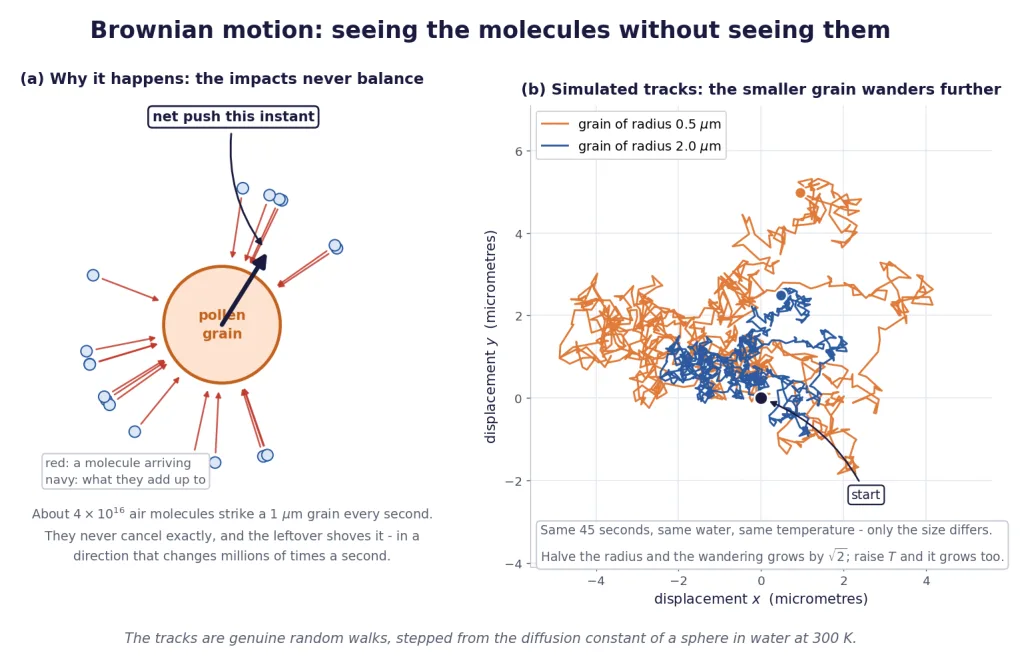
A pollen grain a couple of micrometres across — a radius of about 1 micrometre — is being struck from every side by the molecules of the surrounding fluid. In air at room conditions, about molecules hit a grain of that size every second.
Now, if the molecules arrived in a perfectly balanced way, all those pushes would cancel and the grain would sit still. But they arrive at random. At any given instant slightly more of them happen to be arriving from one side than the other, and that leftover imbalance gives the grain a shove. A fraction of a moment later the imbalance points somewhere else, and the grain is shoved that way instead.
The result is a random walk: a jerky, jagged, never-repeating path with no preferred direction, exactly as observed. And it never stops, because the molecules never stop.
Key Point — why Brownian motion matters:
It is the direct visual evidence that matter is made of molecules and that those molecules are in perpetual random motion. Everything before it was inference from chemistry. This you can watch through a microscope, with your own eyes, in a school laboratory.
That is why it ended the argument. By 1908 Jean Perrin had measured Brownian motion carefully enough to extract a value for the number of molecules in a mole from it, using theory Einstein had published in 1905 — and after that essentially nobody doubted that atoms were real.
How the jiggling depends on the conditions
This is what exams actually ask, so learn the four dependences and, more importantly, the reason for each.
Smaller particle, more vigorous motion. This is the one worth understanding rather than memorising. The number of molecular impacts a particle receives goes up with its surface area, so with the square of its radius. But random fluctuations grow only like the square root of the number of events, so the leftover unbalanced force grows like — just the first power of the radius. Meanwhile the particle's mass grows as . So the acceleration it gets, force over mass, scales as
Make the particle ten times smaller and the shoving is a hundred times more effective. That is why you must use very fine particles to see the effect at all, and why a visible speck of dust sits stubbornly still. A cricket ball is being bombarded too — the jiggle is just unmeasurably small.
Higher temperature, more vigorous motion. Hotter molecules move faster, so they hit harder and more often, and the grain is knocked about more energetically. This is the observation that most directly ties Brownian motion to temperature, and it foreshadows the central result of this chapter.
Less dense, less viscous medium, more vigorous motion. A grain in air jiggles far more freely than the same grain in water, and in a thick oil it barely moves. The surrounding fluid resists the motion it is causing.
Heavier molecules in the medium — no effect at all, at the same temperature. This one is worth getting right, because the plausible-sounding argument for it is wrong. Yes, at a given temperature a heavier molecule carries more momentum per impact. But it is also slower, so it arrives less often, and the two effects cancel. What is left is a theorem: the suspended grain, of mass , is itself just another particle in thermal equilibrium, so its own mean kinetic energy is
which is fixed by the temperature alone — the mass of the surrounding molecules does not appear in it anywhere. And how far the grain actually wanders in a given time is set by the medium's viscosity and the grain's radius through the diffusion coefficient
Temperature, viscosity, size. Nothing else. Swapping the medium for one of heavier molecules changes the jiggling only through whatever it does to .
| Change | Effect on the jiggling | Reason in one line |
|---|---|---|
| smaller suspended particle | much more | unbalanced force goes as , mass as ; also |
| higher temperature | more | faster molecules, harder and more frequent impacts; |
| more viscous medium | less | — the medium resists the motion it is causing |
| heavier molecules in the medium, same | no change in itself | bigger momentum per impact, but fewer impacts; the two cancel |
[NEET Important] The single most common question is a comparison: two particles of different size in the same fluid, which shows more vigorous Brownian motion? Answer: the smaller one, and the reason is the scaling above, not simply "because it is lighter".
[JEE Tip] Brownian motion is a fluctuation phenomenon, and it is the clearest demonstration in Class 11 that thermodynamic quantities are averages that only look exact because is huge. Pressure on a wall looks perfectly steady for the same reason a large particle looks still: the fluctuations are there, they are just of the total. Shrink the system and they come roaring back.
Where this leaves us
The atomic hypothesis is now on solid ground. Matter is made of molecules; they are about an angstrom across; in a gas they sit tens of angstroms apart and fly thousands of angstroms between collisions; they attract weakly at a distance and repel violently up close; and they are in permanent, random, temperature-dependent motion which you can watch under a microscope.
Atomic theory is not the end of the enquiry, of course — atoms turned out to have nuclei and electrons, nuclei to have protons and neutrons, and those to be made of quarks. But for this chapter we stop at the molecule, and spend the next nine sections working out what an enormous number of them, moving randomly in a box, must do.
Solved Examples — Part 1: The Evidence for Molecules
Constants used throughout, unless a problem states otherwise: the number of particles in one mole is ; the number of molecules in a cubic metre of gas at STP is ; K; 1 atm Pa; 1 Å m.
Example 1: The same compound, three different samples
Three samples of pure water are completely decomposed. Sample A has a mass of 9.00 g and yields 1.007 g of hydrogen. Sample B, of mass 4.50 g, yields 0.504 g of hydrogen. Sample C, of mass 18.00 g, yields 2.014 g of hydrogen. Find the mass ratio of oxygen to hydrogen in each, and say which law this illustrates.
Solution:
Get the oxygen by subtraction, since only two elements are present. Sample A: g. Sample B: g. Sample C: g.
Form the ratio for each sample.
Read the result. Three samples of wildly different mass, and the proportion by mass is identical to three significant figures.
Final Answer: Oxygen to hydrogen is in all three, which is the law of definite proportions.
Takeaway: A compound is a fixed recipe. The total mass tells you how much water you had; it tells you nothing about the proportions, because those are set by the molecule, not by the sample.
Example 2: Three oxides of nitrogen
Nitrogen forms three oxides. In the first, 28.0 g of nitrogen is combined with 16.0 g of oxygen. In the second, 14.0 g of nitrogen is combined with 16.0 g of oxygen. In the third, 14.0 g of nitrogen is combined with 32.0 g of oxygen. Show that these obey the law of multiple proportions.
Solution:
Reduce everything to a common mass of nitrogen. The law compares the other element for a fixed mass of the first, so bring all three to 14.0 g of nitrogen.
First oxide: it has 16.0 g of oxygen per 28.0 g of nitrogen, so per 14.0 g of nitrogen it has Second oxide: already at 14.0 g of nitrogen, so 16.0 g of oxygen. Third oxide: already at 14.0 g of nitrogen, so 32.0 g of oxygen.
Form the ratio.
Check the requirement. The law demands small whole numbers, and is about as clean as it gets.
Final Answer: The oxygen masses are in the ratio , which obeys the law of multiple proportions.
Takeaway: Always normalise to a fixed mass of one element first. Students who compare the raw numbers 16, 16 and 32 get the ratio and lose the mark. The normalisation step is where the physics is.
Example 3: Deducing a molecular formula from volumes alone
At the same temperature and pressure, 1 volume of nitrogen gas combines with 3 volumes of hydrogen gas to give 2 volumes of ammonia gas. Using Avogadro's hypothesis, deduce how many nitrogen atoms and how many hydrogen atoms an ammonia molecule contains, given that nitrogen and hydrogen are both diatomic.
Solution:
Convert volumes to molecule counts. Avogadro's hypothesis says equal volumes at the same temperature and pressure contain equal numbers of molecules, so if 1 volume holds molecules the reaction reads
Divide by . The value of never appears in the answer, which is the point of the method.
Count nitrogen. One nitrogen molecule contains 2 nitrogen atoms, and those 2 atoms are shared between 2 ammonia molecules. So each ammonia molecule gets
Count hydrogen. Three hydrogen molecules contain 6 hydrogen atoms, shared between 2 ammonia molecules:
Final Answer: One nitrogen atom and three hydrogen atoms, so ammonia is .
Takeaway: Gay-Lussac gives you the volume ratio; Avogadro turns it into a molecule ratio; conservation of atoms turns that into a formula. No masses are needed anywhere in the argument.
Example 4: Weighing molecules without touching one
At the same temperature and pressure, one litre of oxygen has a mass of 1.429 g and one litre of hydrogen has a mass of 0.0899 g. Taking the molecular mass of hydrogen to be 2.00 units, find the molecular mass of oxygen. State the assumption you are using.
Solution:
State the assumption. By Avogadro's hypothesis, both litres contain the same number of molecules — call it . This is the only thing that makes the problem solvable.
Write the two masses. If a single molecule of each has mass and , then
Divide, and watch cancel.
Scale to the given standard.
Final Answer: About 31.8 units, which is 32 to the accuracy of the measurement.
Takeaway: A density ratio is a molecular mass ratio, provided the two gases are at the same temperature and pressure. This is how the entire table of molecular masses was first built — by weighing gases, not molecules.
Solved Examples — Part 2: The Scale of Things
Example 5: How big is a copper atom?
Copper has a density of 8960 kg per cubic metre and a molar mass of 63.5 g. Estimate the volume occupied by one copper atom and the centre-to-centre distance between neighbouring atoms. Take one mole to contain atoms.
Solution:
Convert the molar mass to SI. 63.5 g per mole is Doing this conversion on its own line is a habit worth forming now, because in later sections a molar mass left in grams is the single most expensive mistake in the chapter.
Find the volume of one mole. That is about 7.1 cm — a lump you could hold between two fingers.
Divide by the number of atoms in it.
Take the cube root to get the edge of the little cube each atom owns, which is the spacing to its neighbour.
Final Answer: m and m, which is 2.28 Å.
Takeaway: Density plus molar mass plus the number in a mole gives you the size of an atom — three laboratory measurements and no microscope. The answer, a couple of angstroms, is the number quoted for solids everywhere in this chapter.
Example 6: The same calculation for a gas
A cubic metre of any gas at STP contains about molecules. Find the average volume available to one molecule and the average spacing between neighbours, and compare the spacing with the 2.28 Å found for solid copper.
Solution:
Volume per molecule is just the reciprocal of the number per cubic metre.
Spacing is the cube root.
Compare with the solid.
Compare the volumes, which is the more dramatic figure:
Final Answer: About m per molecule and a spacing of about 33.4 Å, roughly 15 times the spacing in the solid and about 3200 times the volume per particle.
Takeaway: Fifteen times the distance means three thousand times the room. That factor is why a small volume of liquid becomes an enormous volume of gas on boiling, and why a gas is compressible while a liquid is not.
Example 7: How much of a gas is actually made of gas?
Treating the molecules of a gas at STP as spheres of diameter 2 Å, estimate the fraction of the container's volume that the molecules themselves occupy. Comment on what the answer permits.
Solution:
Volume of one molecule, as a sphere of diameter m, so radius m:
Volume available to one molecule, from the previous example:
Take the ratio.
Express it in a way you will remember: that is about 0.011%, or roughly one part in ten thousand.
Final Answer: About of the volume — the gas is 99.99% empty space.
Takeaway: This number is the licence for the whole ideal-gas model. Because the molecules occupy essentially none of the container, we are allowed to treat them as point particles with no volume of their own — an approximation that would be absurd for a liquid, where the same calculation gives about 0.36.
Example 8: Four lengths, one ladder
For a gas at STP take the molecular diameter as 2 Å, the intermolecular spacing as 33.4 Å and the mean free path as 2100 Å. Express the spacing and the mean free path as multiples of the molecular diameter, and state in one sentence what each ratio tells you physically.
Solution:
Spacing in units of the diameter:
Mean free path in units of the diameter:
Mean free path in units of the spacing, which is the ratio students most often overlook:
Interpret each. A spacing of 17 diameters means the molecules are far outside each other's force range, so a gas molecule feels essentially no force. A mean free path of 1000 diameters means a molecule travels a huge distance compared with its own size before anything happens to it. A mean free path of 63 spacings means it sails past about sixty neighbours before it actually strikes one — collisions are rare events, not a continuous jostle.
Final Answer: The spacing is about 17 molecular diameters, the mean free path about 1000 molecular diameters, and about 63 intermolecular spacings.
Takeaway: Learn the ladder as ratios, not just as numbers. "Seventeen diameters apart, a thousand diameters between collisions" survives in memory far better than "33 Å and 2100 Å", and it is the ratios that the conceptual questions test.
Solved Examples — Part 3: Forces, Phases and Brownian Motion
Example 9: Reading the intermolecular force curve
For a pair of argon atoms the potential energy is well described by with Å and a well depth J. Find (a) the separation at which the force between the atoms is zero, and (b) the separation at which . Explain why the two answers are different.
Solution:
The force is minus the slope of the potential, . So the force vanishes wherever the potential energy curve is flat — at the bottom of the well.
(a) Differentiate and set to zero.
(b) Set the potential itself to zero. The bracket vanishes when
Why they differ. Zero force means zero slope; zero potential energy means zero height. A curve at its minimum has zero slope but a very much non-zero height — here J, the deepest point on the whole curve. The two conditions have no reason to coincide, and they do not.
Final Answer: (a) Å. (b) Å. Zero force is a statement about slope; zero potential energy is a statement about height.
Takeaway: Force zero is at the bottom of the well, not where the curve crosses the axis. This is the most reliably examined confusion on the force curve, and it is settled entirely by remembering .
Example 10: How short-ranged is "short-ranged"?
Using the same argon curve, the attractive force reaches its greatest magnitude at Å. Calculate the magnitude of the attractive force at and at as a percentage of that peak value, taking Å. What does the answer justify?
Solution:
Write the force. Differentiating the potential and changing sign, where a negative value means attraction.
Evaluate at the peak, Å:
At Å, the term is utterly negligible and the force is essentially :
At Å, the dependence bites hard. Trebling divides the force by roughly :
Final Answer: About 3.4% of the peak at , and about 0.20% at .
Takeaway: Two molecular diameters out, the attraction is essentially gone. That is what "short-range force" means quantitatively, and it is the justification for the assumption — made in every kinetic theory derivation later in this chapter — that gas molecules exert no force on one another except during a collision.
Example 11: How hard would you have to squeeze a gas before it noticed?
A gas at STP has its molecules about 33.4 Å apart, while the intermolecular force is only appreciable out to about twice the equilibrium separation, which for argon is Å. By what factor would you have to compress the gas, at constant temperature, before the molecules were close enough for the attraction to matter?
Solution:
Identify what has to change. The spacing must fall from 33.4 Å to 7.63 Å.
Find the linear compression factor.
Convert to a volume factor. Volume goes as the cube of a linear dimension, and squeezing a gas shrinks it in all three directions at once:
Interpret. You would have to reduce the volume by a factor of about 84, which at constant temperature means raising the pressure by roughly the same factor — of the order of 80 atmospheres.
Final Answer: A volume compression of about 84 times, corresponding to a pressure of order 80 atm.
Takeaway: This is why the ideal gas model works so well in ordinary life and starts failing at high pressure. Nothing about the intermolecular force switches on suddenly; you simply have to push the molecules close enough to feel it, and at ordinary pressures they are nowhere near.
Example 12: Which grain jiggles more?
Two spherical particles, one of radius 1 micrometre and one of radius 10 micrometres, are suspended in the same sample of air at the same temperature. (a) Compare the number of molecular impacts each receives per second. (b) Using the fact that a random imbalance among events scales as , compare the acceleration each acquires from the unbalanced impacts. (c) Which shows more vigorous Brownian motion?
Solution:
(a) Impacts scale with surface area. The number of molecules striking a sphere per second is proportional to its surface area , so The larger grain is struck a hundred times more often. In absolute terms the smaller grain still takes about hits per second.
(b) The unbalanced force scales as the square root of the number of impacts. So the net force on the larger grain is only 10 times bigger, not 100 times.
Now bring in the mass, which grows as the volume:
Divide.
(c) The smaller grain is shoved about 100 times more effectively.
Final Answer: (a) The larger grain receives 100 times as many impacts. (b) Its acceleration is 100 times smaller. (c) The 1 micrometre grain shows far more vigorous Brownian motion.
Takeaway: More impacts means less jiggling, which is the opposite of the intuitive answer. The reason is that impacts grow as while their imbalance grows only as , and mass grows as . This is also why the same argument makes pressure on a container wall look perfectly steady: the fluctuations are still there, but they are of an enormous number.