
Picking Up Where the Pressure Formula Left Off
The previous section ended with a formula built entirely out of Newton's laws, a bounce and a head-count:
We are not going to derive that again. We are going to squeeze it, because hiding inside it is the answer to a question that has been dangling since the first page of this chapter: what is temperature, actually?
A note on symbols, since two of them are about to matter
In this chapter is the number density — molecules per cubic metre, — and is the number of moles. The previous chapter used for moles, so this is the exact reverse; it is the convention every kinetic-theory formula and every exam paper uses, so switch over now and hold it. is the number of molecules, the Avogadro number, and .
Step 1: multiply through by the volume
Start from and multiply both sides by . Since , the number of molecules in the sample,
That is just bookkeeping. Nothing new has been said.
Step 2: make a kinetic energy appear
Now look at the right-hand side and notice what it is nearly. The kinetic energy of one molecule is . On the right we have — the same thing, but missing its .
So put the in, and compensate with a outside:
Multiply the by 2 and you get ; divide the by 2 and you get . The two changes cancel exactly, so this is the same equation we started with, rearranged so that a recognisable quantity is standing in plain sight.
And what is standing there is important. is the average translational kinetic energy of one molecule — average, because the bar is over the whole gas; translational, because it is built from the molecule's speed through space and nothing else.
Step 3: name the total
Multiply that per-molecule average by the number of molecules and you have the total translational kinetic energy of the gas, which we call :
and the equation from Step 2 becomes remarkably compact.
Key Point: where is the total translational kinetic energy of all the molecules in the gas. Pressure times volume is two-thirds of the energy of molecular motion — no more, no less.
Look at how much has been thrown away and how little was lost. The mass of a molecule has vanished. The number density has vanished. The mean square speed has vanished. Whatever the gas is, whatever its molecules weigh, whatever they are doing individually, counts up their translational energy and multiplies by .
The warning that students miss every single year
is the translational kinetic energy only. It is not, in general, the whole internal energy of the gas.
Key Point — and are not the same symbol wearing different hats:
- = the translational kinetic energy of the molecules — the energy of their motion from place to place. This is what appears in .
- = the total internal energy — everything the molecules own, including any energy in their rotation and in the vibration of their bonds.
For a monatomic gas such as helium, argon or neon, a molecule is a single atom with nowhere else to put energy, so and the distinction is invisible.
For everything else — nitrogen, oxygen, carbon dioxide, water vapour — the molecule can also spin and its bonds can stretch, so . Translation is only part of the story.
Why does care about translation alone? Because pressure is made by molecules arriving at a wall and bouncing off it, and only motion through space carries a molecule to a wall. A nitrogen molecule that is spinning furiously pushes on the wall exactly as hard as an identical one that is not spinning, provided the two are travelling at the same speed. Rotation and vibration are real energy, but they are invisible to the pressure gauge.
Counting how many places a molecule can store energy is the job of a later section, and turning that count into joules is the job of the one after it. For now, keep the two letters separate in your head: is what measures; is what the gas has.
What Temperature Actually Is
We now have two expressions for the same quantity , and they came from completely different places.
- From kinetic theory, with nothing but molecules and Newton's laws:
- From experiment, summarised in the ideal gas equation:
The gas cannot have two different values of . So the right-hand sides must be equal:
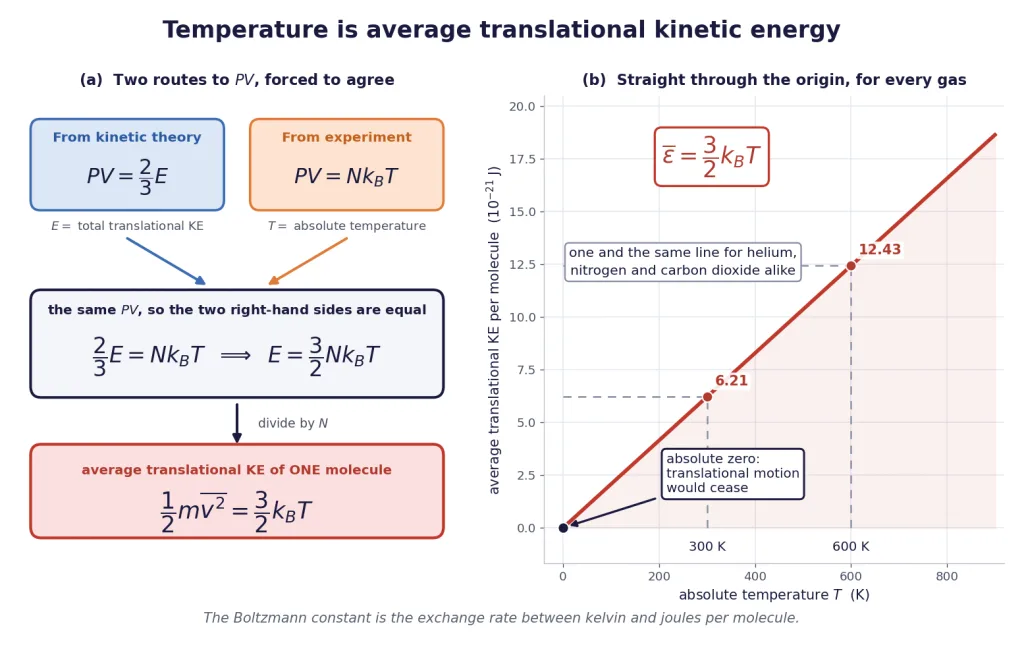
Multiply both sides by and the two central results of this chapter drop out.
Key Point — the kinetic interpretation of temperature: and, dividing by the number of molecules, The average translational kinetic energy of a molecule is , and nothing else.
Read the second equation slowly, because it is the whole point of the chapter. On the left is a molecular quantity that no instrument can measure directly. On the right is the temperature, which you read off a thermometer. The Boltzmann constant is the exchange rate between the two worlds — the number of joules per molecule that one kelvin is worth.
What is remarkable about the right-hand side
Look at what the average kinetic energy per molecule depends on. Temperature. That is the entire list.
It does not depend on the pressure. It does not depend on the volume. It does not depend on the density. And — this is the one that surprises people — it does not depend on which gas it is. Helium, nitrogen, carbon dioxide, water vapour, a gas nobody has discovered yet: at the same temperature, every molecule of every ideal gas has the same average translational kinetic energy.
That is what temperature is, microscopically. Not "hotness". Not "heat content". Temperature is a direct measure of the average translational kinetic energy of the molecules, and the graph of one against the other is a straight line through the origin, identical for every gas.
Putting a number on it
At room temperature, with J/K and K:
That is a preposterously small number, which is exactly as it should be — it belongs to one molecule. Scale it up to a mole by multiplying by , or equivalently replace by :
About 3.7 kilojoules of pure translational motion in a single mole. [Board Important] Both forms get asked: per molecule, per mole. They differ by a factor of , and mixing them up is a factor-of- error.
Three consequences worth memorising
1. The internal energy of an ideal gas depends on temperature alone. Since depends only on , and for a monatomic gas — and, as the later sections will show, the rotational and vibrational contributions depend only on as well — the internal energy of any ideal gas is a function of temperature and nothing else. Squeeze an ideal gas into half its volume at constant temperature and its internal energy does not change by one joule. The previous chapter asserted this thermodynamically; here is the molecular reason for it.
2. Absolute zero is where translational motion would cease. Set in and you get : every molecule at rest. That is the kinetic meaning of the zero of the kelvin scale, and it is why negative absolute temperatures make no sense in this picture — kinetic energy cannot be negative. [JEE Tip] Real gases liquefy and then freeze long before they get there, and quantum mechanics leaves a residual "zero-point" motion even at , so absolute zero is a limit that is approached and never reached. For this chapter, the ideal-gas statement is the one you want.
3. Temperature is an average, not a property of one molecule. A single molecule does not have a temperature. It has a speed, and that speed changes at every collision. Temperature is a statement about of them at once, which is why it is a perfectly sharp number even though no individual molecule obeys it.
Equal Energy, Not Equal Speed
Here is the result doing some work.
Put helium in one container and oxygen in another, press the two containers together through a conducting wall, and wait. Everyone knows what happens: they reach the same temperature. But what does "the same temperature" mean down at the molecular level?
It means their molecules end up with the same average translational kinetic energy:
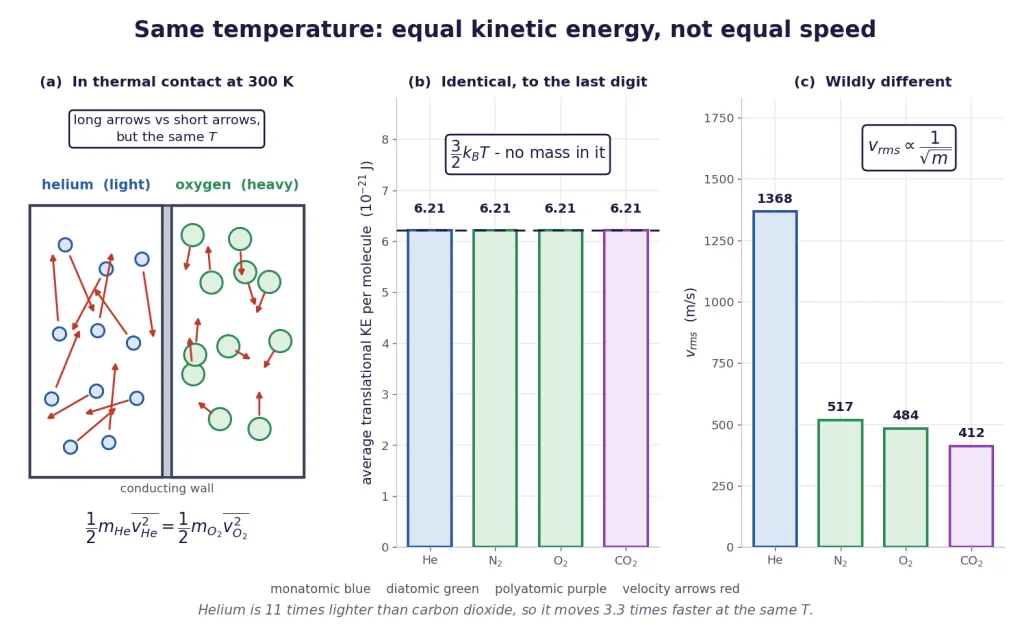
It emphatically does not mean they end up with the same speed. An oxygen molecule is 8 times heavier than a helium atom, so if the two products are to come out equal, helium's must be 8 times larger — which makes its speed larger by . At 300 K the actual numbers are 1368 m/s for helium against 484 m/s for oxygen.
Key Point: Thermal equilibrium equalises energy per molecule, not speed. At the same temperature, Lighter molecules move faster, in exact inverse proportion to the square root of their mass.
This single line explains a great deal of chemistry and quite a lot of the atmosphere. Hydrogen and helium move so much faster than nitrogen and oxygen at the same temperature that Earth has failed to hold on to either of them, while Jupiter, being colder and far more massive, has kept its hydrogen. (The full account of atmospheric escape needs the spread of speeds rather than just their average, which is the next section's business.) Closer to home, it is why a helium balloon goes limp overnight while an air-filled one of the same rubber does not.
[NEET Important] The two-part question "at the same temperature, compare the average kinetic energies and the rms speeds of gas A and gas B" is asked almost every year. The first answer is always 1:1. The second is always the inverse square root of the mass ratio. Give the first one without any arithmetic at all.
Dalton's law, derived a second time — now from the inside
The earlier section on the gas laws stated Dalton's law of partial pressures as an experimental fact: in a mixture of non-reacting gases, each gas exerts the pressure it would exert if it were alone, and the pressures add. Kinetic theory can now prove it.
Take a mixture of two gases in one container. The molecules of species 1 hammer on the walls, and so do the molecules of species 2, and pressure is a scalar, so their contributions simply add:
Nothing has been assumed here except that the two species do not react and do not stick together. Now apply what we have just learned. The mixture is at one temperature, so every species in it has the same average kinetic energy per molecule:
which rearranges to . Substituting that into the pressure sum, every bracket becomes the same thing:
Key Point — Dalton's law from the molecular side: Each species contributes , which is exactly the pressure it would exert alone in that container at that temperature. The law is not a coincidence of measurement — it follows from the fact that molecules of different species share a temperature by sharing an average kinetic energy.
Notice what makes the proof work: the step where and both collapse to . Without the kinetic interpretation of temperature there is no reason those two products should be equal, and Dalton's law would remain a curiosity. The masses cancel, the speeds cancel, and only the head-count survives.
The Root Mean Square Speed
We have , the mean square speed. Its units are m/s, which is not a speed, so take the square root and give the result a name.
Key Point — the root mean square speed: Read the name backwards to remember the recipe: take the square of each molecule's speed, take the mean of those, take the root of that.
To get a formula for it, start from the result of the last two blocks and make the subject:
Take the square root:
That form uses , the mass of one molecule. Usually a problem hands you a molar mass instead, so convert the whole formula at once. Multiply top and bottom inside the root by : the top becomes , and the bottom becomes , the molar mass.
Key Point — the two faces of the same formula: Use the first when you know the mass of one molecule in kilograms. Use the second when you know the molar mass — in kilograms per mole. And since from the previous section, there is a third face that needs no temperature at all:
A number, and a coincidence that isn't one
Nitrogen at 300 K, with kg/mol:
(Going the other way, with the mass of one nitrogen molecule kg and J/K, you get 516 m/s — the same answer to the accuracy of the constants.)
Half a kilometre per second. At room temperature. In the air in front of you.
Now compare that with the speed of sound in air, which at the same temperature is about 347 m/s. The two are within a factor of 1.5 of each other, and that is not a coincidence. Sound is a pressure disturbance passed along by the molecules themselves; it cannot outrun the messengers carrying it. Written out, the speed of sound in a gas is against our , so the ratio is fixed at
for air. Same , same , only the numerical factor differs. That the kinetic theory got this right, from nothing but bouncing spheres, was one of its earliest triumphs.
How moves
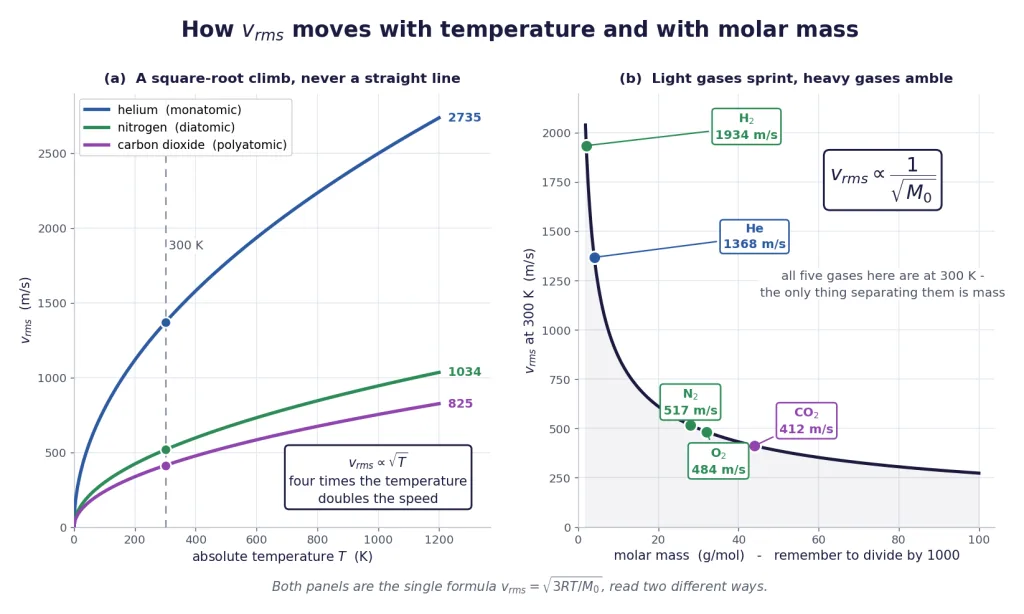
Two proportionalities carry almost every question in this chapter:
- Temperature. To double the rms speed you must quadruple the absolute temperature. Going from 300 K to 600 K raises the speed by only a factor of , not 2. This catches people constantly.
- Mass. At a fixed temperature, hydrogen ( kg/mol) beats oxygen ( kg/mol) by exactly.
Here are the numbers at 300 K, all from the one formula:
| Gas | Molar mass (g/mol) | (kg/mol) | at 300 K (m/s) |
|---|---|---|---|
| Hydrogen, H | 2 | 0.002 | 1934 |
| Helium, He | 4 | 0.004 | 1368 |
| Nitrogen, N | 28 | 0.028 | 517 |
| Oxygen, O | 32 | 0.032 | 484 |
| Carbon dioxide, CO | 44 | 0.044 | 412 |
Every one of those is a few hundred to a couple of thousand metres per second. That range is your sanity check: if a molecular speed comes out as 15 or as 15000, something has gone wrong, and the next block says what.
One last thing before you go looking for it
is not the only speed a gas has. The molecules are spread over a whole range of speeds, and that spread defines three different characteristic speeds — the most probable speed, the average speed and the rms speed — which are always in that order and always in a fixed ratio. is the one that belongs here, because it is the one tied to kinetic energy and pressure; the distribution behind it, and the other two speeds, are developed in the next section.
The Molar-Mass Hazard
This gets its own block because it costs more marks in this chapter than every other mistake put together.
Key Point — is in KILOGRAMS per mole, never grams per mole:
In the constant J/(mol K) is an SI quantity, so must be SI too.
- Oxygen: kg/mol, not 32.
- Nitrogen: kg/mol, not 28.
- Hydrogen: kg/mol, not 2.
Leaving the molar mass in grams per mole makes the denominator 1000 times too big, so the answer comes out times too small. Not 1000 times — the square root protects you from a thousandfold error and hands you a thirty-onefold one instead, which is quite bad enough.
See it happen
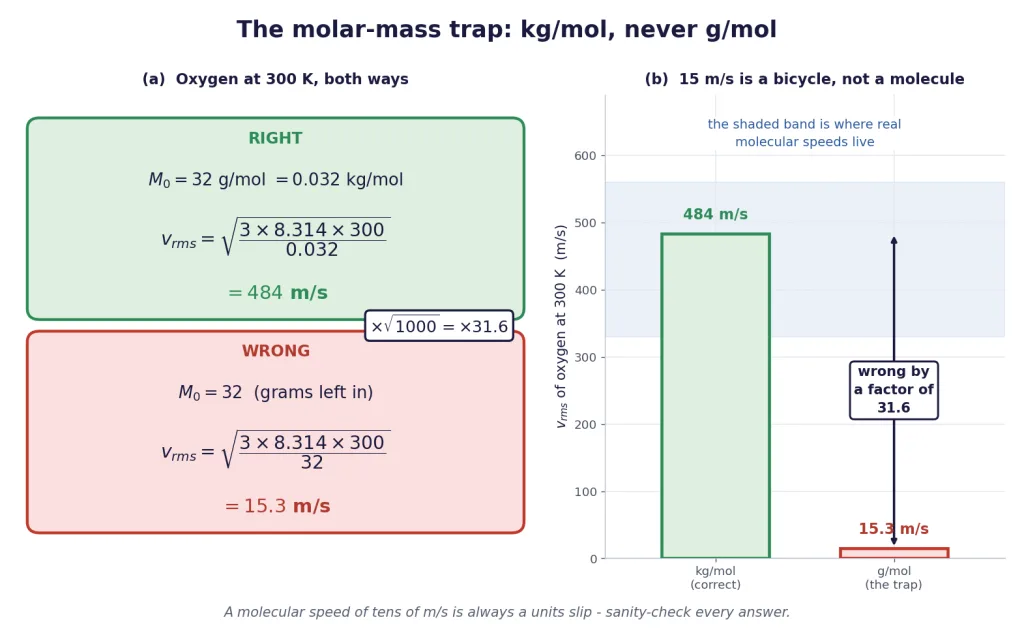
Oxygen at 300 K, done both ways:
Right. g/mol kg/mol, so
Wrong. Grams left in, , so
The wrong answer is 15 m/s, which is a brisk cycle ride. Molecules do not amble. Any molecular speed that comes out in the tens of metres per second is a units error, every time.
So: write the conversion on its own line, before you write the formula. Every worked solution in this section does exactly that, and so should yours. It costs four characters and a decimal point.
Three symbols, three meanings — keep them apart
| Symbol | Means | Units | Oxygen, as an example |
|---|---|---|---|
| mass of one molecule | kg | ||
| molar mass | kg/mol | ||
| total mass of the sample | kg | whatever you weighed out |
They are linked by and . A molecular mass should always land somewhere near kg; if yours comes out near , you left the molar mass in grams.
The trap list for this section
- in kg/mol. Written above, worth writing again.
- in kelvin, always. is K, in practice 300 K — never 27. A speed formula fed a Celsius number is not slightly wrong, it is meaningless.
- per molecule, per mole. Check which one the question wants.
- is translational only. For helium ; for nitrogen and everything larger, . Do not use for the internal energy of a diatomic gas.
- Equal temperature means equal kinetic energy, not equal speed. The ratio of rms speeds is , and the ratio of kinetic energies is 1.
- To double , quadruple . The square root is not optional.
- is the number density here, is the moles. and are the same statement counted two different ways — and solving a problem both ways is the fastest check you own.
Solved Examples
Constants used throughout, unless a problem says otherwise: J/K; J/(mol K); per mole; 1 atm Pa; K.
Example 1: The energy of a molecule, and of a mole
Find the average translational kinetic energy of a molecule of any ideal gas at 27°C. Hence find the total translational kinetic energy of one mole, and of two moles, at that temperature.
Solution:
Kelvin first, always.
Per molecule, using : Notice that the question said "any ideal gas" and did not need to say which. It genuinely does not matter.
Per mole. Multiply by , or equivalently swap for :
Two moles. Translational energy is extensive, so just double it:
Cross-check by the other road. For 2 moles at 300 K, J, and gives J. The two agree.
Final Answer: J per molecule; 3741 J per mole; 7483 J for two moles.
Takeaway: per molecule, per mole, for moles. One factor of separates the first two — decide which one the question wants before you reach for a constant.
Example 2: The rms speed of nitrogen, by both routes
Find for nitrogen at 300 K. Molar mass of nitrogen is 28 g/mol. Do it once from the molar mass and once from the mass of a single molecule, and check that the two agree.
Solution:
Convert the molar mass, on its own line:
Route A — from and :
Route B — from and . First the mass of one molecule: then
Compare. 517 against 516 — a difference of 0.2%, which is entirely the rounding in and in , not a mistake. The two formulas are algebraically identical, since and .
Final Answer: m/s (516 m/s by the per-molecule route).
Takeaway: and are the same formula. Use whichever the data hands you, and if you have time, use both — an agreement to within rounding is a free guarantee that no factor of went astray.
Example 3: Oxygen, and the conversion that decides the answer
Find the rms speed of oxygen molecules at 27°C. Molar mass of oxygen is 32 g/mol. Then find what answer a student would get who forgot to convert the molar mass, and say by what factor they would be wrong.
Solution:
Temperature to kelvin:
Molar mass to kilograms per mole — its own line, always:
Substitute:
The wrong road. With left as 32:
The factor. The denominator was 1000 times too large, so the speed comes out times too small:
Final Answer: 484 m/s. The unconverted answer, 15.3 m/s, is too small by a factor of 31.6.
Takeaway: A molecular speed in the tens of metres per second is always a units error. Room-temperature gases run from about 400 m/s for the heavy ones to about 2000 m/s for hydrogen. If your answer is outside that neighbourhood, check the molar mass before you check anything else.
Example 4: A mixture of argon and chlorine
A flask holds argon and chlorine mixed in the ratio 2:1 by mass, at 27°C. Find (i) the ratio of the average kinetic energy per molecule of the two gases, and (ii) the ratio of their rms speeds. Take the atomic mass of argon as 39.9 u and the molecular mass of chlorine as 70.9 u.
Solution:
(i) The kinetic energies. Both gases are in the same flask, so both are at the same temperature. The average translational kinetic energy per molecule is for any ideal gas, monatomic argon and diatomic chlorine alike. So No arithmetic was required and none of the given data was used.
(ii) The speeds. Since is the same number for both,
Take the square root: Argon, being lighter, moves about a third faster.
What about the 2:1 by mass? Completely irrelevant. Change it to 5:1 or 1:9 and both answers are unchanged, because neither depends on how much of each gas is present — only on the temperature and the molecular masses.
Final Answer: (i) ; (ii) .
Takeaway: Composition by mass is a distractor in every question of this type. Average kinetic energy per molecule depends on alone, and the rms speed ratio depends on the masses alone. Neither notices the mixing ratio.
Example 5: How much faster is the lighter isotope?
Uranium hexafluoride is made from two isotopes of uranium, of atomic masses 235 u and 238 u. Which of the two kinds of molecule moves faster, and by what percentage, at any given temperature? The atomic mass of fluorine is 19 u.
Solution:
Build the molecular masses. A hexafluoride molecule is one uranium atom and six fluorines:
Which is faster? At a fixed temperature is the same for both, so the lighter molecule is the faster one. The molecule built from uranium-235 moves faster.
The ratio. Speeds go as the inverse square root of the masses:
As a percentage:
How small that really is. Two molecules that differ in mass by 3 parts in 352 differ in speed by only 0.43% — and that tiny speed edge is the only handle chemistry and physics give you on the difference between the two isotopes, since the enrichment machinery built on it belongs with mean free path and diffusion later in the chapter.
Final Answer: The uranium-235 compound is faster, by 0.43%.
Takeaway: Add up the whole molecule before comparing masses. The uranium atoms differ by more than 1%, but the six fluorines dilute that down to 0.43% once you weigh the actual molecules — and it is the molecules that move.
Example 6: Matching a light gas with a heavy one
At what temperature will oxygen molecules have the same rms speed as hydrogen molecules at 27°C? Molar masses: hydrogen 2 g/mol, oxygen 32 g/mol.
Solution:
Convert both molar masses, and the temperature:
Set the two speeds equal. Using for each and squaring, The cancels, leaving the clean statement that must match:
Solve:
Check the number is believable in the right direction. Oxygen is 16 times heavier, so it needs 16 times the absolute temperature to reach the same speed — the mass ratio enters linearly here because we matched , not .
Verify by computing both speeds. Hydrogen at 300 K: m/s. Oxygen at 4800 K: m/s. They match.
Final Answer: 4800 K, which is about 4527°C.
Takeaway: Equal means equal . Since the ratio of molar masses in g/mol is the same as the ratio in kg/mol, this particular question forgives you the conversion — but write it anyway, because the verification step in point 5 does not forgive you.
Example 7: Total translational energy of a real sample
A sealed vessel of volume 20 litres contains an ideal gas at a pressure of Pa. Find the total translational kinetic energy of the gas. If the gas is at 300 K, how many moles are present, and what is the average kinetic energy per molecule?
Solution:
Use the form that needs no temperature. From , Note what was not needed: the temperature, the molar mass, the identity of the gas. alone fixes the translational energy.
Now the moles, from :
Cross-check the energy by the other road: The same 6000 J, as it must be.
Per molecule. The number of molecules is , so which is at 300 K, exactly as predicted.
Final Answer: J; mol; J.
Takeaway: is the fastest formula in the section when a problem gives you a pressure and a volume and asks for energy. No temperature, no molar mass, no gas identity — and it works for a mixture too.
Example 8: Where and part company
One mole of helium and one mole of nitrogen are each held at 300 K. Compare (a) the average translational kinetic energy per molecule, (b) the total translational kinetic energy of each sample, and (c) the total internal energy of each sample. Helium is monatomic; treat nitrogen as a rigid diatomic molecule.
Solution:
(a) Per molecule. for any ideal gas, so both are Identical.
(b) Translational energy of each sample. One mole of each, so Also identical. This is the part that measures, and indeed both samples at 300 K in equal volumes would read the same pressure.
(c) Internal energy. Here they separate. A helium atom is a single point-like particle: translation is the only motion available to it, so A nitrogen molecule is a dumbbell. Besides moving through space it can also tumble, about either of the two axes perpendicular to its bond, and that rotational motion carries energy too. Counting those extra modes properly is the business of the next few sections; the result they establish is per mole for a rigid diatomic gas, so
The comparison. For nitrogen, only 60% of the internal energy is translational. The other 40% is spinning, and the pressure gauge cannot see it.
Final Answer: (a) both J; (b) both 3741 J; (c) J but J.
Takeaway: only for a monatomic gas. For anything with more than one atom, , because rotation (and at high enough temperature, vibration) stores energy that never shows up in the pressure. Never substitute for the internal energy of oxygen or nitrogen.
Example 9: A mixture, its partial pressures, and its speeds
A 10 litre vessel at 300 K contains 2.0 g of helium and 32 g of oxygen. Find (a) the partial pressure of each gas, (b) the total pressure, (c) the average kinetic energy per molecule of each gas, and (d) the ratio of their rms speeds. Molar masses: helium 4 g/mol, oxygen 32 g/mol.
Solution:
Everything into SI first.
Moles of each, from — using the sample mass and the molar mass in the same units:
(a) Partial pressures. Each gas behaves as though it were alone in the vessel:
Check the helium by the molecular route. Its number density is The two routes agree, which is the check that catches a mole-for-molecule slip.
(b) Total pressure. Dalton's law, which the notes above derived from the molecular side: that is 3.69 atm. Equivalently with 1.5 moles in total — same answer.
(c) Kinetic energy per molecule. Same vessel, same temperature, so both gases have Identical for helium and for oxygen, and not affected by the fact that there is twice as much oxygen.
(d) Ratio of rms speeds. Inverse square root of the molar masses: For the record, the speeds themselves are 1368 m/s and 484 m/s.
Final Answer: (a) Pa and Pa; (b) Pa; (c) J for both; (d) .
Takeaway: In a mixture, the temperature is shared, so the energy per molecule is shared — but the pressure is divided according to head-count and the speeds according to mass. Solve any mixture problem through both and ; if they disagree, you have confused moles with molecules.
Example 10: Doubling a speed, doubling an energy
Nitrogen at 27°C has m/s. (a) To what temperature must it be raised to double the rms speed? (b) To what temperature must it be raised to double the average kinetic energy per molecule? (c) By what percentage does rise if the gas is warmed from 27°C to 127°C?
Solution:
(a) Doubling the speed. Since , doubling needs multiplied by : that is 927°C. As a check, m/s, which is twice 517.
(b) Doubling the energy. The average kinetic energy is , which is proportional to itself, not to its square root: that is 327°C.
Contrast the two. Doubling the energy takes twice the absolute temperature; doubling the speed takes four times. [JEE Tip] Exam questions swap these two deliberately. Ask yourself whether the quantity in question carries a square root before you multiply anything.
(c) 27°C to 127°C. Kelvin first: 300 K to 400 K. a rise of 15.5%. A 100-degree jump — a third more absolute temperature — buys only a sixth more speed.
Final Answer: (a) 1200 K; (b) 600 K; (c) a rise of 15.5%.
Takeaway: Energy is linear in ; speed is linear in . Warming a gas is a very inefficient way of making its molecules faster, and that square root is the reason the atmosphere holds on to nitrogen even on a hot day.
Example 11: A speed from a pressure and a density
A cylinder of oxygen is at 1 atm and its density is measured as 1.30 kg/m. Find the rms speed of the molecules, and hence the temperature of the gas, without using a thermometer. Molar mass of oxygen is 32 g/mol.
Solution:
Use the density form of the pressure result. From , Only a pressure gauge and a balance were used — no temperature anywhere.
Now get the temperature from the speed. Convert the molar mass first: and rearrange . Keep the unrounded speed here, because it is about to be squared:
Check it independently through the gas equation. The density form gives, at 300 K, which is the density we were handed. Consistent.
And the number density, for completeness: Multiply by the mass of one molecule, kg, and you recover kg/m once more.
Final Answer: m/s and K, that is 27°C.
Takeaway: is a thermometer made of a pressure gauge and a balance. Every route in this chapter — through , through and , through and — has to land on the same speed, and checking two of them against each other costs one line.