
Same Chapter, Half the Clock
Sections 1 to 11 took kinetic theory apart slowly and worked forty-odd problems through it. If you did that work, you already know more than this section will ever ask of you.
So why a separate corner? Because the skill being tested here is different. This paper does not want a derivation. It wants a sentence you can quote, a formula you can recognise, one substitution you can do without a calculator, and a proportionality you can read off in five seconds.
Physics is 45 questions, and inside a 180-minute paper shared with Chemistry and Biology those 45 deserve about 45 minutes. One minute each. Kinetic theory reliably supplies two to four of them, and every one has to be finished in well under a minute, correctly, so the time is banked for the questions that genuinely need it.
One syllabus note. The Maxwell speed distribution, the formulas for and , Brownian motion, Graham's law of diffusion and the pressure law all sit outside the body text of the rationalised syllabus, yet NEET has asked about every one of them, so every one appears in the tables and the practice below.
The symbol that trips everyone who has just finished the previous chapter
In this chapter is the NUMBER DENSITY — molecules per cubic metre, — and is the number of moles. The previous chapter used for moles; this is the exact reverse, and it is the convention every kinetic-theory formula and every exam paper uses. So it is and here, never . is the number of molecules and is the Avogadro number, with .
The five types, and what each should cost you
| Type | What it looks like | Your budget | The right instinct |
|---|---|---|---|
| 1. Direct recall | "State the assumptions." "What does temperature measure?" "State the law of equipartition." | 15-20 s | You either know it or you do not. Never derive a definition. |
| 2. One-step plug-in | , , , | 25-35 s | Name the card, substitute once. |
| 3. Proportionality | " is doubled. What happens to , to , to the collision frequency?" | 15-25 s | Cancel everything common. Never substitute numbers. |
| 4. Graph reading | A speed-distribution curve: which gas, which temperature, what the area means | 20-30 s | Read the axes, find the peak, remember area is a fraction. |
| 5. Assertion-Reason / Column matching | Two special formats, both drilled below | 35-45 s | Judge each statement alone, then judge the link. |
[Important] A diagnostic worth internalising: if a kinetic theory question needs a fifth line of working, you have misread it. You are given a temperature and a molar mass and asked for a speed, or a molecule and asked for its . If your page is filling up, stop and reread the stem.
The two mistakes that cost more marks than everything else combined
Neither is a concept. Both are units.
Key Point — THE MOLAR-MASS RULE, and it never bends:
- is the molar mass in kilograms per mole. Oxygen is , not .
- is the mass of one molecule, in kilograms. For oxygen, kg.
- with no subscript is the total mass of the sample. Three symbols, three meanings, keep them apart.
Substituting grams where kilograms belong makes your answer too small by a factor of . Nitrogen at 300 K has m/s. Do it with and you get m/s — a walking pace, printed on the option list every single time.
Key Point — THE KELVIN RULE:
is ALWAYS an absolute temperature in kelvin. Write or for Celsius, and convert with before anything else.
Every speed formula, every energy, every gas-law step and every ratio in this chapter needs an absolute temperature, so all of them are in kelvin. The one and only exception is a bare difference: a change of is the same number in Celsius degrees as in kelvin, so may take straight off a Celsius reading. Wherever a temperature stands alone — under a square root, inside a ratio , multiplied by — it must be converted first. Knowing which of the two situations you are in is worth several marks; when in doubt, convert at the top of the page and never think about it again.
Here is what ignoring the kelvin rule costs. A gas is heated from 27°C to 327°C and you are asked by what factor changes.
- Right: .
- Wrong: .
Both numbers are on the option list. Write the letter K next to every temperature before you substitute anything.
The constants this section fixes, now
Every solution below states the constants it uses inside the solution. A question that supplies its own number always wins.
| Quantity | Value |
|---|---|
| Boltzmann constant, | J/K |
| universal gas constant, | J/(mol K) |
| Avogadro number, | per mol |
| the link between them | |
| atm | Pa mmHg |
| absolute zero | °C, so |
| molar volume at STP | L, so per m |
| molecular diameter, air | about Å m |
| mean free path of air at STP | about m |
Working values for this section.
What this section does, and what it does not repeat
We will not rebuild the atomic hypothesis (Section 1), rederive the gas equation (Section 2), reargue Boyle, Charles and the pressure law (Section 3), redo the pressure derivation (Section 4), rederive the kinetic interpretation of temperature (Section 5), rebuild the Maxwell distribution from its equation (Section 6), recount degrees of freedom from the rule (Section 7), reprove equipartition (Section 8), rederive the specific heats (Section 9) or rederive the mean free path (Section 10). What you get instead is the same material reorganised for recognition speed:
- The sentences that come back almost verbatim.
- Every formula in the chapter as a recognition table, with a hook for each.
- The three speeds and the degree-of-freedom count, both reduced to a lookup.
- The proportionality grid, which is the highest-yield page in this section, and graph reading.
- The biology-adjacent physics this paper reaches for every year.
- The two special formats, and the habits that finish a question in under 45 seconds.
The / arithmetic
Four marks right, minus one wrong, zero blank. On a doubtful item the real question is not "can I get this?" but "can I get this in 40 seconds?" A blind guess among four is worth , essentially nothing. Eliminate two options first and a guess between the survivors is worth marks on average. Eliminate, then commit.
The Sentences That Come Back Almost Verbatim
Read this block as flashcards, not as prose. Every item here has appeared as a complete question by itself.
The assumptions of kinetic theory, in order
They are asked as a list, and they are asked in the trap form which of the following is NOT an assumption?
Key Point — the six assumptions of the kinetic theory of an ideal gas:
- A gas is an enormous number of identical molecules in random motion. Enormous, so that averages are perfectly sharp; random, so no direction and no speed is preferred.
- The molecules are point-like compared with their separation — their own volume is negligible beside the volume of the container.
- They exert no force on one another except during a collision. So there is no potential energy of interaction, and the energy of the gas is purely kinetic.
- Every collision, molecule with molecule and molecule with wall, is perfectly elastic — momentum and kinetic energy are both conserved.
- Between collisions they travel in straight lines at constant speed, obeying Newton's laws.
- The time spent in a collision is negligible compared with the time between collisions.
Three things the paper does with that list. Assumptions 2 and 3 are the two that define an ideal gas, and they are exactly the two a real gas gets wrong, which is why real gases misbehave at high pressure and low temperature. Assumption 3 is what makes the internal energy purely kinetic, and hence what makes depend on temperature alone. And the two commonest fake assumptions offered as options are "all the molecules move with the same speed" and "the collisions are inelastic" — both contradict the list outright.
What temperature actually is
Key Point: Combining the kinetic result with the gas equation gives The absolute temperature of a gas is a direct measure of the average translational kinetic energy of one of its molecules — and of nothing else.
Now the sentence that is worth four marks by itself, because it is the one the paper keeps rephrasing.
Key Point — why the average kinetic energy depends on temperature ALONE:
Look at what survived and what cancelled. On the right-hand side of there is a universal constant and a temperature. There is no , no , no , no and nothing that identifies which gas it is. So at a given temperature:
- a helium molecule and a carbon dioxide molecule have exactly the same average translational kinetic energy;
- they do not have the same speed, because the same energy in a heavier molecule buys a smaller ;
- compressing the gas at constant temperature changes , and and leaves that energy untouched.
Absolute zero, in the same language: would mean , all molecular translation stopped. That is why there is nothing below it — you cannot have less motion than none.
[Important] Read the words in the stem with care. Average kinetic energy per molecule is and is the same for every gas at a given . Kinetic energy per mole is , also the same for every gas. Kinetic energy per kilogram is , and that one is not the same — it is bigger for a lighter gas. Three different questions, three different answers, one careless reading between them.
The law of equipartition, word for word
Key Point: In thermal equilibrium at absolute temperature , the total energy of a molecule is distributed equally among all its possible modes, each quadratic term in the expression for the energy carrying an average energy of .
Say quadratic term, not "degree of freedom". That is the whole precision of the law, and it is what makes the next paragraph work.
At 300 K, one quadratic term is worth and the three translational terms together give J per molecule.
Why a vibrational mode counts twice
This is the single most-asked "why" in the whole chapter.
Key Point: Count the squared terms in the energy, not the motions.
- A translational degree of freedom contributes one term, . One term, so .
- A rotational degree of freedom contributes one term, . One term, so .
- A vibrational mode contributes two terms, because a vibrating bond stores energy in two places at once: kinetic, , and potential, . Two terms, so .
A spring-like mode has somewhere to put the energy even when it is momentarily at rest. That is the whole reason, and it is the sentence to write.
Why an inert gas has
Key Point: An inert gas — helium, neon, argon, krypton, xenon, radon — is monatomic. A single atom is a point as far as this chapter is concerned: it can move in three directions and that is all. It has no bond to rotate about and no bond to stretch, so And since every molecule has at least the three translational terms, always, so always. is the largest value of any ideal gas can have, and mercury vapour and sodium vapour reach it too, because they are monatomic as well.
Read that backwards and it becomes a standard question: a gas measured to have is monatomic, whatever else the stem tells you about it.
The always-true / never-true table
Speed comes from knowing which sentences are safe.
| Statement | Verdict |
|---|---|
| All the molecules of a gas at a given temperature move at the same speed | Never — the whole point of the distribution |
| Two gases at the same have equal average translational KE per molecule | Always |
| Two gases at the same have equal | Never — unless they have the same |
| , always and for every gas | Always |
| The internal energy of an ideal gas depends on temperature alone | Always |
| , the translational kinetic energy, equals , the internal energy | Only for a monatomic gas |
| Molecular collisions with the wall are elastic | Always, by assumption 4 |
| Pressure is caused by molecules colliding with each other | Never — it is momentum delivered to the wall |
| At K all molecular translation ceases | Always, in this classical picture |
| can exceed | Never |
| A vibrational mode contributes , a rotational one | Always |
| is a triatomic molecule, so it has 3 rotational degrees of freedom | Never — it is linear, so it has 2 |
| The mean free path depends on the temperature at fixed volume | Never — it depends on and |
| Heating a gas in a rigid sealed vessel raises the collision frequency | Always — the molecules are faster, the path is the same |
| The mean speed , not , belongs in a collision count | Always |
| Never — the mean of the squares exceeds the square of the mean | |
| A lighter gas diffuses faster under the same conditions | Always — Graham's law |
| The area under a speed-distribution curve is 1 | Always |
[Important] The four most reused distractors in this chapter are "the molar mass in grams", " has 3 rotations", "the mean free path changes when you heat a rigid vessel" and " goes into the collision frequency". Each turns up somewhere almost every year, and each is worth four marks in fifteen seconds.
The Recognition Table, With a Hook for Each
Sections 1 to 11 derived all of these. Your job here is different: see the situation, name the formula, substitute. No derivation, ever.
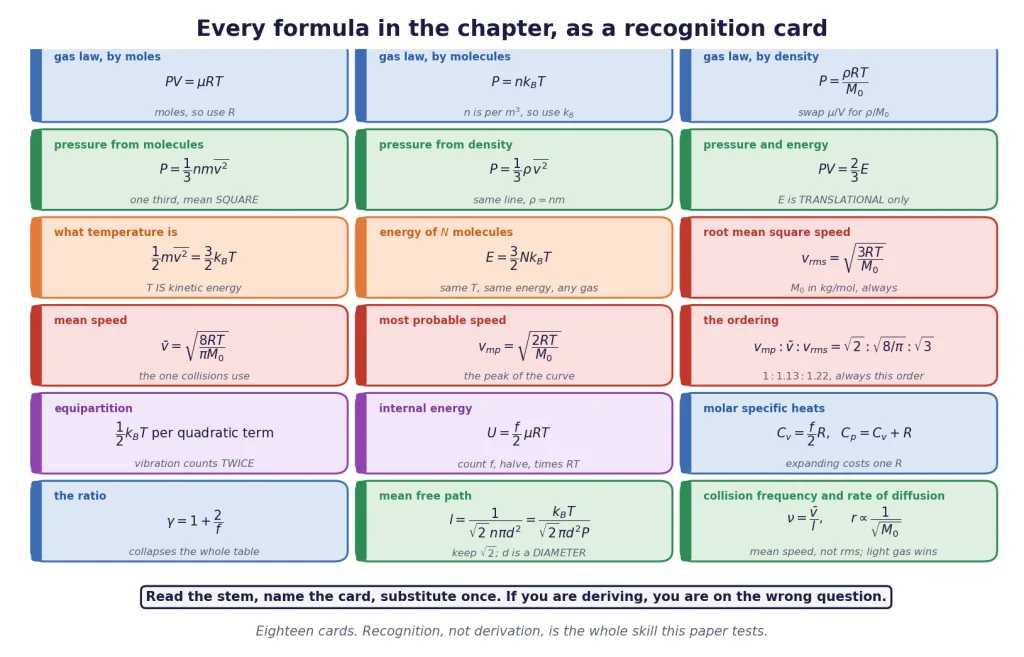
The eighteen you must know cold
| # | Situation | Formula | Memory hook |
|---|---|---|---|
| 1 | gas law, counting moles | moles go with | |
| 2 | gas law, counting molecules | is per m, so use | |
| 3 | gas law, from density | swap for | |
| 4 | link between them | per mole per molecule | |
| 5 | pressure from molecules | one third, mean square | |
| 6 | the same in one symbol fewer | since | |
| 7 | pressure and energy | is translational only | |
| 8 | what temperature is | is kinetic energy | |
| 9 | energy of molecules | same , same energy, any gas | |
| 10 | root mean square speed | in kg/mol, always | |
| 11 | mean speed | the one collisions use | |
| 12 | most probable speed | the peak of the curve | |
| 13 | the ordering | , in that order | |
| 14 | equipartition | per quadratic term | vibration counts twice |
| 15 | internal energy | count , halve, times | |
| 16 | molar specific heats | , | expanding costs one |
| 17 | the ratio | collapses the whole table to one line | |
| 18 | mean free path | keep the ; is a diameter |
And two more that finish the chapter:
| # | Situation | Formula | Memory hook |
|---|---|---|---|
| 19 | collision frequency and collision time | , | mean speed, not rms |
| 20 | Graham's law of diffusion | the light gas wins |
The three traps hiding inside that table
Trap 1 — the mean free path formula has a and is a diameter. Two separate ways to lose the same question. The comes from the fact that the other molecules are moving too, so what matters is the average relative speed. Drop it and every answer is too big. And if a stem hands you a radius of Å, then Å, and is four times larger — your mean free path is four times too big if you forget.
Trap 2 — is not . is the translational kinetic energy only. is the whole internal energy. For a monatomic gas and they coincide; for a rigid diatomic gas and . A stem that says "total kinetic energy of the molecules" for nitrogen and an option that gives are placed together deliberately.
Trap 3 — of a monatomic gas and of a diatomic gas are the same number, J/(mol K). If a question hands you and asks what the gas is, the honest answer is "not determined until you are told which specific heat it is".
[Exam Tip] Three unit checks are free marks. , and are all in J/(mol K), which is why is dimensionally sane. has no unit, being a ratio, and it always lies strictly between 1 and . And is in J/K while is in J/(mol K) — the difference between them is one factor of , and that factor is the single commonest slip in this chapter after the molar mass.
Two Lookups That Answer a Third of the Questions
Lookup one: the three speeds
There are exactly three molecular speeds in this chapter, they always come in the same order, and the ratio between them never changes.
Key Point: Same temperature, same molar mass, same — only the number on top changes, and it runs 2, then , then 3. So
How to hold the order. The peak of the curve is the most probable speed, and the curve has a long tail to the right; averaging drags you rightwards past the peak, and squaring before averaging drags you further right again, because the fast molecules are weighted by . Peak, then mean, then root mean square. It is alphabetical if you say "most probable, mean, rms" — m, m, r.
The three ratios you will actually be asked for.
| Asked for | Value | In one line |
|---|---|---|
| the mean is about of the rms | ||
| the peak is about of the rms | ||
| the mean is about above the peak |
So if a stem gives you any one of the three, the other two are one multiplication away. Nitrogen at 300 K: m/s, so m/s and m/s. Ten seconds, no calculator.
Key Point — which speed goes where, and this is examined directly:
- Anything about energy — , — uses , because energy involves the square of the speed.
- Anything about collisions — the collision frequency , the collision time, how far a molecule travels per second — uses , because that is the average distance covered per unit time.
- Anything about the peak of the curve, or "the speed possessed by the largest number of molecules", is .
Swapping for in a collision count makes your answer too big, and that wrong value is on the option list.
And one distinction that is worth a whole question. , the mean of the squares, is not , the square of the mean. Take two molecules at 300 and 500 m/s. Then m/s so , while m/s, giving m/s. The rms speed always exceeds the mean speed, and using for the average kinetic energy gives an answer that is too small.
Lookup two: degrees of freedom
Nobody has time to rebuild the count in an exam. Learn the table and read off the row.
Key Point — the count.
is the number of quadratic terms per molecule. Translation always gives 3. Rotation gives 2 for anything linear and 3 for anything non-linear. Each active vibrational mode gives 2. At ordinary temperatures the vibrations of common gases are frozen out, so treat every molecule as rigid unless the stem says otherwise.
| Molecule | Shape | Trans | Rot | (rigid) | |||
|---|---|---|---|---|---|---|---|
| He, Ne, Ar, Kr, Xe, Hg vapour | monatomic | 3 | 0 | 3 | |||
| , , , CO, HCl | diatomic | 3 | 2 | 5 | |||
| , , , | linear polyatomic | 3 | 2 | 5 | |||
| , , , , | non-linear polyatomic | 3 | 3 | 6 | |||
| a diatomic whose bond also vibrates | diatomic, hot | 3 | 2 (+2 vib) | 7 |
Molar specific heats in J/(mol K), with J/(mol K). Every value here comes from , and — three formulas, not thirty numbers.
The two rows people get wrong.
is triatomic but behaves like a diatomic. Its three nuclei lie on a straight line, so rotation about that line moves essentially nothing and carries no energy: 2 rotations, not 3, and . is also triatomic and does not, because it is bent, so it gets all 3 rotations and . Same number of atoms, different answers, and the stem always tells you the shape if you read it. Count the shape, not the atoms.
Vibration is frozen out at room temperature. Nitrogen and oxygen behave as at 300 K even though the bond can certainly stretch, because the energy needed to excite one vibrational quantum is far more than a typical collision can deliver. Heat them to a few thousand kelvin and climbs to 7. This is also why hydrogen behaves like a monatomic gas near 20 K — even the rotations are frozen out there — and classical equipartition, which knows nothing of quanta, cannot explain any of it.
Key Point — read the table backwards, because that is how it is usually set. , monatomic. , diatomic or a rigid linear molecule. , non-linear polyatomic. , a vibrating diatomic. Likewise gives straight away.
[Exam Tip] For a mixture, do not average — average the energy. With moles of a gas with terms and moles with , the internal energy is , and the effective count is . Feed that single number into and and the mixture is finished.
The Proportionality Grid, and Reading the Graph
Change one thing, read the column
This is the highest-yield page in the section. Most kinetic theory questions on this paper do not ask for a number at all — they ask what happens to something when the temperature doubles or the pressure is halved. Substituting numbers into those is a waste of forty seconds.

Key Point — the master line, from which every column follows:
Everything below is that one line, read out loud.
| Quantity | Rigid vessel, | Constant , | Constant , |
|---|---|---|---|
| all three speeds | unchanged | ||
| average KE per molecule | unchanged | ||
| number density | unchanged | ||
| mean free path | unchanged | ||
| collision frequency | |||
| pressure | unchanged |
The three cells worth memorising as sentences.
Heating a rigid sealed vessel leaves the mean free path completely unchanged. The mean free path depends on how crowded the box is and how fat the molecules are — on and on — and heating a sealed rigid box changes neither. The molecules simply cover the same average distance faster, which is why the collision frequency rises by while does not move at all. This is asked almost every year and the wrong answer "doubles" is always on the list.
Doubling the temperature at constant pressure makes collisions rarer, not commoner. The gas expands, so halves and the mean free path doubles; the molecules are times faster but have twice as far to go, so falls by . The competing effects do not cancel, and the slower one wins.
Speeds care about , energies care about . To double you must quadruple the absolute temperature. To double the average kinetic energy you need only double it. Confusing those two is the second commonest arithmetic slip here.
[Exam Tip] Do these as ratios, never as substitutions. needs no , no and no calculator. If you find yourself typing into a proportionality question, you have chosen the ninety-second route to a ten-second answer.
Reading a speed-distribution graph
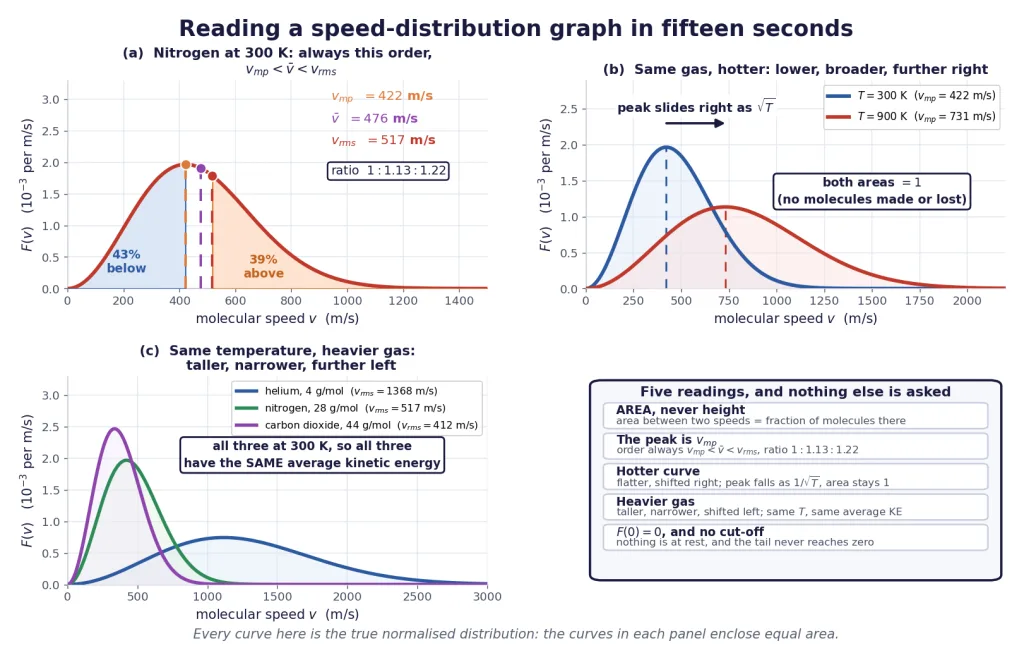
Five readings cover every distribution question this chapter can produce.
| What you are shown | What to say |
|---|---|
| the area between two speeds | the fraction of molecules with speeds in that range |
| the total area under the curve | exactly 1 — every molecule has some speed |
| the peak | ; and and lie to its right, in that order |
| a curve that is flatter and further right | the hotter one — same gas, higher |
| a curve that is taller, narrower and further left | the heavier gas — same , larger |
Three habits that make this fast.
1. Check what is being varied before anything else. If the two curves are the same gas, the difference is temperature. If they are at the same temperature, the difference is molar mass. The stem always says which.
2. Remember that the areas must be equal. Both curves describe the same number of molecules, so if one is broader it must also be lower. A picture showing the hotter curve both higher and broader is wrong, and "the peak height increases with temperature" is a distractor, not a fact. The peak height falls as .
3. Never read a height as a number of molecules. is a distribution per unit speed range. The fraction of molecules moving at exactly m/s is zero — there is no area in a single point. That is a genuine exam question, and "zero" is the answer.
Two more facts the curve is asked about directly. — no molecule is at rest, because the factor kills the curve at the origin. And the tail never reaches zero — there is no upper limit on molecular speed, only a vanishing probability. That tail is why liquids evaporate below their boiling point, why a light gas like hydrogen escapes a planet's atmosphere while nitrogen stays, and why a modest temperature rise can change a reaction rate enormously: all three are questions about the few molecules far out on the right, not about the average.
Kinetic Theory Wearing a Lab Coat
Two thirds of this paper is about living things, and kinetic theory is the physics chapter that reaches furthest into them. Breathing is a partial-pressure problem. Diffusion across a membrane is Graham's law with a correction. Osmotic pressure is the ideal gas equation with a different label on it. Expect at least one of your kinetic theory questions to arrive wearing biological clothes, and be pleased when it does, because the physics in them is always the easy kind.
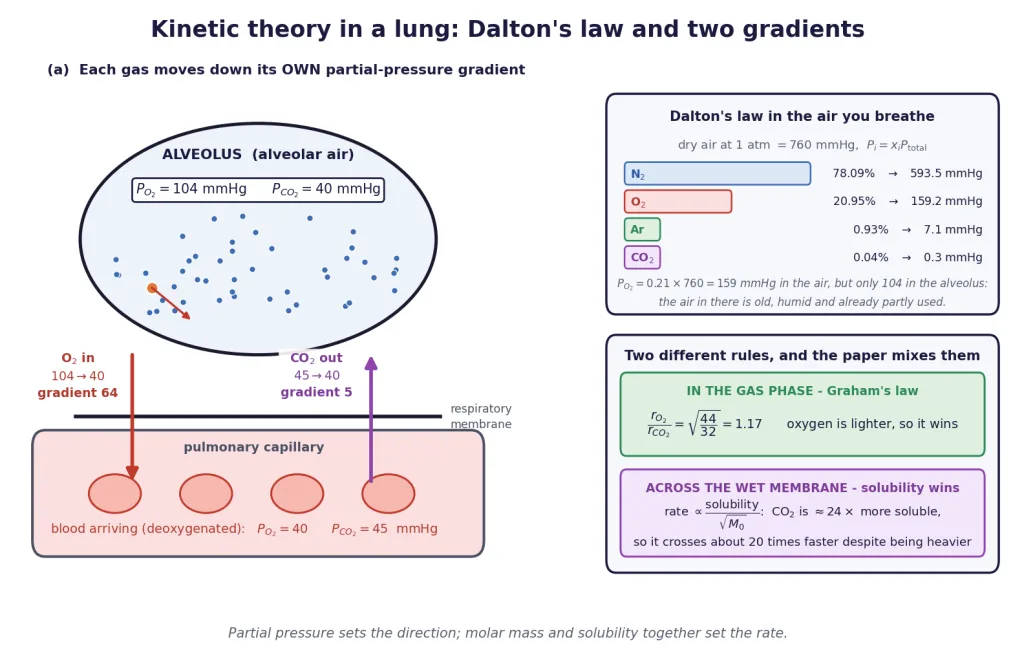
Breathing is Dalton's law
Air is a mixture of non-reacting gases, so each component behaves as if the others were not there and contributes its own partial pressure, , with the mole fraction. At sea level, atm mmHg:
| Gas | Fraction of dry air | Partial pressure |
|---|---|---|
| nitrogen | mmHg | |
| oxygen | mmHg | |
| argon | mmHg | |
| carbon dioxide | mmHg |
Key Point: Every gas moves down its own partial-pressure gradient, and takes no notice whatever of the others. The total pressure inside an alveolus and inside the blood are both about one atmosphere, so nothing moves in bulk. What drives the exchange is that is higher in the alveolus than in the arriving blood, while is higher in the blood than in the alveolus. Two gases, two gradients, opposite directions, one and the same law.
The numbers, in the units physiology uses:
| Location | ||
|---|---|---|
| atmospheric air | ||
| alveolar air | ||
| blood arriving (deoxygenated) | ||
| blood leaving (oxygenated) |
All values in mmHg; mmHg Pa, so mmHg is about kPa.
So oxygen crosses into the blood down a gradient of mmHg, and carbon dioxide crosses out down a gradient of only mmHg. Which raises the obvious question, and it is a favourite.
Why carbon dioxide and oxygen move at different rates
There are two different rules here and the paper likes to see whether you know which applies where.
Key Point — in the GAS phase, Graham's law: the rate of diffusion or effusion goes as Oxygen is lighter, so in open air oxygen spreads about faster than carbon dioxide. This follows straight from at a given temperature: lighter means faster means more arrivals per second at any surface.
Key Point — across the WET respiratory membrane, solubility takes over: a gas can only cross a fluid-filled membrane if it first dissolves in it, so the rate goes as Carbon dioxide is about 24 times more soluble than oxygen in body fluid, and only times slower on the molar-mass count, so Carbon dioxide crosses about twenty times faster than oxygen, despite being the heavier molecule. That single fact is why a gradient of only 5 mmHg is enough to clear it, while oxygen needs 64.
[Important] The trap is to answer "carbon dioxide is heavier, so it diffuses more slowly" for the membrane question, or "carbon dioxide is more soluble, so it diffuses faster" for a question about two gases escaping from a punctured balloon. Gas phase: molar mass alone. Across a wet membrane: solubility dominates. Read which one the stem is describing.
Osmotic pressure is the gas equation in disguise
Dissolved particles in a solvent behave, to a good approximation, exactly like a gas confined to the volume of the solution: they wander at random, they bounce off the walls, and they exert a pressure.
Key Point: For a dilute solution, with the total molar concentration of dissolved particles in mol/m. It is with renamed — same equation, same , same kelvin rule. Written per particle it is , exactly card 2 of the recognition table.
Worked, in one line. Blood plasma has a total solute concentration of about osmol/L, which is mol/m, at a body temperature of K:
Nearly eight atmospheres, from a solution that is water. This is why an intravenous drip must be isotonic: put a cell into pure water and that pressure difference drives water inwards until it bursts, and into a concentrated solution and the water leaves and the cell shrivels. And notice that depends on the number of dissolved particles, not on what they are — which is why M NaCl, splitting into two ions, is isotonic while M glucose is not.
The rest of the biology-adjacent list, one line each
| Observation | The physics |
|---|---|
| Pollen grains jiggling in water under a microscope | Brownian motion — unbalanced molecular impacts; direct evidence that molecules exist and move |
| Smaller grains jiggle more violently | fewer impacts per side, so the imbalance is a larger fraction; also less mass to shift |
| Warming the suspension makes the jiggling more vigorous | the molecules are faster, since |
| A gas leak is smelt across a room only after a minute or two | molecules move at hundreds of m/s but the mean free path is m, so the path is a zig-zag of collisions per second |
| Oxygen reaching a tissue cell from a capillary | diffusion over micrometres, which is fast; over centimetres it would be hopeless, which is why we need a circulation |
| Why a mountaineer gasps at altitude | falls, so falls with it; the fraction of oxygen in the air is unchanged |
| Why leaves the blood on a 5 mmHg gradient | solubility, not molar mass, governs crossing a wet membrane |
| Water rising in a plant, and a cell in distilled water | , the ideal gas equation under another name |
| Why food spoils faster in warm weather | the fast tail of the Maxwell curve grows sharply with , so far more molecules clear the reaction barrier |
The Two Special Formats, and the Speed Habits
Assertion-Reason: the four codes
You are given an Assertion (A) and a Reason (R) and asked to choose:
| Code | Meaning |
|---|---|
| (a) | Both A and R are true, and R is the correct explanation of A |
| (b) | Both A and R are true, but R is not the correct explanation of A |
| (c) | A is true but R is false |
| (d) | A is false but R is true |
Read the option list before you start — the order of these four is not fixed between papers, and choosing "option (a)" from memory when the paper has shuffled them is a self-inflicted wound.
Key Point: Three separate judgements, in this order, and never let one influence the next:
- Cover R. Is A true, on its own?
- Cover A. Is R true, on its own?
- Only if both are true: does R actually explain A, or is it merely another true statement about the same topic?
Step 3 is where the marks are. Ask: if R were false, would A stop being true? If yes, R explains A. If A would survive without R, the answer is (b).
Worked, four times.
Item 1. A: At the same temperature, hydrogen molecules move faster than oxygen molecules. R: At a given temperature all gas molecules have the same average translational kinetic energy. A alone: true, by a factor of 4. R alone: true. Does R explain A? Yes — equal energy, , with a smaller forces a larger . Both true, R explains A.
Item 2. A: At the same temperature, hydrogen molecules move faster than oxygen molecules. R: Hydrogen is a diatomic gas with five degrees of freedom. A alone: true. R alone: true — hydrogen is diatomic and rigid at room temperature. But does R explain A? No. Oxygen is also diatomic with , so that fact cannot distinguish them; the explanation is the molar mass. Both true, R does not explain A. Items 1 and 2 have the same assertion and completely different answers, and that is exactly how this format is built.
Item 3. A: The mean free path of a gas is unchanged when it is heated in a rigid sealed vessel. R: The mean free path depends only on the number density and the molecular diameter, neither of which changes. A alone: true. R alone: true, and it is precisely the reason. Both true, R explains A.
Item 4. A: A vibrational mode contributes to the average energy of a molecule, the same as a rotational one. R: A vibrating molecule stores both kinetic and potential energy, contributing two quadratic terms. A alone: false — a vibrational mode contributes , twice as much. R alone: true, and it is the reason A is false. A is false but R is true. Watch how the assertion has been written to look like the standard sentence with one number quietly changed.
Column matching: anchor, do not solve
You are given four items in Column I, four in Column II, and four codes. Never work out all four pairings. Find the one or two that are unmistakable and use them to kill codes.
Key Point: Anchor on whatever is structurally unique in Column II — the only entry with a in it, the only one that is zero, the only , the only . Two anchors almost always leave exactly one surviving code.
Worked. Column I: (A) monatomic gas (B) rigid diatomic gas (C) rigid non-linear triatomic gas (D) vibrating diatomic gas. Column II: (i) (ii) (iii) (iv) .
Anchor 1: is the largest any gas can have and only reaches it, so A-ii. Anchor 2: is the only value below , so it needs the largest , which is the vibrating one, so D-i. Two anchors, and any code disagreeing with either is dead. The remaining two fall out with no work: gives , so B-iv, and gives , so C-iii.
[Exam Tip] In this chapter one anchor is nearly always free. can only be monatomic and can only be monatomic; under heating can only be a rigid vessel; and anything with a in it is the mean free path. Find whichever of those appears and you have your first pairing before you have read the rest of the question.
The six habits that finish a question in under 45 seconds
1. Read the last line of the stem first. It tells you which card you need and, half the time, which trap is set. The words "per molecule", "per mole", "per kilogram", "translational", "total internal", "rms", "average" and "most probable" all change the answer without changing the topic.
2. Convert the temperature and label it K, before anything else. Then convert the molar mass to kg/mol and write the zeros. Two conversions, done reflexively at the top of the page, remove the chapter's two commonest wrong answers.
3. Ask whether the question is a ratio. If two situations are being compared, cancel everything common and read the exponent off the master line. No constants, no calculator.
4. Count from the shape, not the atom count. Linear or bent? Rigid or vibrating? One glance at the stem, one row of the lookup table, and , and all follow from that single number.
5. Sanity-check the size before you look at the options. Molecular speeds at room temperature are hundreds of metres per second — several hundred for air, a couple of thousand for hydrogen, never single digits and never . lies strictly between and . lies between and about J/(mol K). A mean free path at ordinary pressure is around m. If your answer is a decade away from those, you have dropped a conversion.
6. Read what each wrong option encodes. In this chapter the distractors are almost never a few per cent out. They are the grams-for-kilograms answer (out by ), the Celsius-for-kelvin answer, the -forgotten answer ( instead of ), the naive mean free path (bigger by ), the radius-used-as-diameter answer (bigger by 4), the -for- answer (out by for a diatomic gas) and the 3-rotations-for- answer. Identify which trap each option encodes and you can often eliminate two of them without computing anything at all.
[Important] One last habit, and it is about the clock rather than the physics. If forty seconds have gone and you are still on line two, mark it and move. Kinetic theory questions on this paper are worth exactly as much as the easier ones elsewhere in it, and the four marks you lose by running out of time at the end of the paper are worth the same as the four you were fighting for here.
Solved Examples
Twelve problems at exam level and exam pace. Give yourself 45 seconds on each before reading the solution. Throughout, J/(mol K), J/K, per mol and ; other constants are stated where they are used. Every solution that computes a speed shows the conversion of the molar mass to kg/mol on its own line.
Example 1: Twenty one-liners, straight from the statements
Answer each in a single sentence, with no calculation.
(a) List the six assumptions of the kinetic theory of an ideal gas. (b) Which assumption makes the internal energy of an ideal gas purely kinetic? (c) What does the absolute temperature of a gas measure? (d) Why does the average kinetic energy of a molecule not depend on the pressure, the volume or the identity of the gas? (e) Two gases at the same temperature: what is equal, and what is not? (f) State the law of equipartition of energy. (g) Why does a vibrational mode count twice while a rotational one counts once? (h) Why does an inert gas have ? (i) What is the largest possible value of , and why? (j) How many rotational degrees of freedom has , and why? (k) What is the order of the three molecular speeds, and their ratio? (l) Which speed goes into a collision frequency? (m) Is equal to ? (n) What does the area under a speed-distribution curve between two speeds represent? (o) What is , and why? (p) Where does the in the mean free path come from? (q) Is in that formula a radius or a diameter? (r) What happens to the mean free path when a rigid sealed vessel is heated? (s) State Graham's law of diffusion. (t) For which gas do and coincide?
Solution:
(a) A huge number of identical molecules in random motion; point-like compared with their separation; no forces between them except during collisions; all collisions perfectly elastic; straight-line motion at constant speed between collisions, obeying Newton's laws; collision time negligible compared with the time between collisions.
(b) The third — no intermolecular forces except during a collision. With no forces there is no potential energy of interaction to store, so all the energy is kinetic.
(c) The average translational kinetic energy of one molecule: .
(d) Because none of them appears in that relation. Only and survive on the right-hand side, so the energy is fixed by the temperature alone.
(e) Equal: the average translational kinetic energy per molecule, . Not equal: the rms speed, unless the molar masses happen to match — the heavier gas is slower.
(f) In thermal equilibrium at absolute temperature , the energy is shared equally among all available modes, each quadratic term in the molecular energy carrying an average of .
(g) Because a vibrating bond stores both kinetic and potential energy, contributing two squared terms, and . A rotation contributes only , one term.
(h) An inert gas is monatomic, so and .
(i) . Since and every molecule has at least the 3 translational terms, and .
(j) Two. Its three nuclei lie on a straight line, so rotation about that line moves nothing appreciable and carries no energy.
(k) , in the ratio .
(l) The mean speed , since counts distance covered per second.
(m) No. The mean of the squares always exceeds the square of the mean, which is why .
(n) The fraction of molecules whose speeds lie between those two values. The total area is exactly 1.
(o) Zero. The factor in vanishes at the origin, so no molecule is at rest.
(p) From the fact that the other molecules are moving too, so what matters is the average relative speed, which is times the average speed.
(q) A diameter. Given a radius, double it first, or your is four times too small.
(r) Nothing — it is unchanged. depends on and , and heating a rigid sealed vessel changes neither.
(s) Under the same conditions the rate of diffusion or effusion of a gas is inversely proportional to the square root of its molar mass: .
(t) A monatomic gas, where so . For anything else .
Takeaway: Twenty questions, no arithmetic, and about five minutes of your life. Every one of them has been the whole of somebody's four marks.
Example 2: One speed computed, two multiplied
Nitrogen has g/mol. At 300 K find , and .
Solution:
The conversion, on its own line, before anything else: and K is already absolute. With J/(mol K):
Now do not compute the other two from scratch. Use the fixed ratios:
Check the ordering: , and . Both as they must be.
Cross-check by the other route, using the mass of one molecule:
Takeaway: Compute one speed properly, then multiply. takes you to the mean and to the most probable, and you have three answers for the price of one.
Example 3: The trap, set and disarmed
A student calculates the rms speed of oxygen ( g/mol) at 27°C and writes down m/s. What went wrong, and what is the right answer?
Solution:
Step 1 — the temperature. K, which we round to K. Never .
Step 2 — the molar mass, on its own line.
Step 3 — substitute.
What the student did. They left as : which is out by a factor of , and exactly. The mistake is always this factor, never anything else, so if your speed comes out around 15 or 16 when it should be around 500, you know precisely which line to fix.
The sanity check that would have caught it in two seconds. Molecular speeds at room temperature are comparable with the speed of sound, which is m/s in air. An answer of m/s is a bicycle. An answer of m/s is right.
Takeaway: Write the kg/mol conversion as a separate line every time. It costs you three seconds and it is the difference between four marks and minus one on perhaps a third of the numericals in this chapter.
Solved Examples (continued)
Example 4: One vessel, three changes, no calculator
A sealed rigid vessel of nitrogen at 300 K is heated to 1200 K. For each of the following, state the factor by which it changes: (a) , (b) the average translational kinetic energy of a molecule, (c) the pressure, (d) the number density, (e) the mean free path, (f) the collision frequency.
Solution:
Both temperatures are already absolute, and . Rigid and sealed means and are fixed.
(a) , so the factor is . Doubling the speed took a fourfold temperature rise — that is the whole content of the square root.
(b) , so the factor is . Note that (a) and (b) have different answers; energy is linear in , speed is not.
(c) At fixed and , , so the factor is .
(d) with both fixed, so unchanged.
(e) depends on and only, and neither has moved. Unchanged. This is the cell people get wrong: it is tempting to reason "hotter, so faster, so further between collisions", but the distance between neighbours has not changed at all.
(f) with up by 2 and unchanged, so the factor is . Faster molecules crossing the same gaps hit more often.
Takeaway: In a rigid sealed vessel, only the temperature-driven quantities move: speeds by , energies and pressure by , collision frequency by . Number density and mean free path do not move at all.
Example 5: The other two columns
(a) A gas is heated from 300 K to 600 K at constant pressure. What happens to its mean free path and its collision frequency? (b) A gas is compressed isothermally until its pressure is four times larger. Same two questions.
Solution:
Use and , both read straight off the master line.
(a) Constant pressure, doubled. The mean free path doubles and the collision frequency falls by . Read that physically: the gas expanded to twice the volume, so the molecules are half as crowded and have twice as far to travel; they are times faster, but twice the distance beats times the speed. Heating at constant pressure makes collisions rarer.
(b) Constant temperature, quadrupled. The mean free path falls to one quarter and the collision frequency is four times larger. The speeds are untouched, because has not changed — a compression at constant temperature does not speed any molecule up.
Takeaway: Two proportionalities, and , answer every question of this kind. And notice the pattern: pressure acts on both, temperature acts on them in opposite directions.
Example 6: Five molecules, one lookup, sixty seconds
For helium, nitrogen, carbon dioxide, water vapour and methane, all treated as rigid at ordinary temperature, write down , , and .
Solution:
Identify the shape first, then read the row. J/(mol K), , , .
| Gas | Shape | ||||
|---|---|---|---|---|---|
| He | monatomic | 3 | |||
| diatomic | 5 | ||||
| linear triatomic | 5 | ||||
| bent triatomic | 6 | ||||
| non-linear, 5 atoms | 6 |
All specific heats in J/(mol K).
The two rows to look at twice.
and both have three atoms and different answers. is linear, so rotation about the long axis carries no energy and it gets 2 rotations, exactly like a diatomic. is bent, so all 3 rotations count. Treating as gives , which is too large and is always on the option list.
has five atoms and the same answer as . Because for a rigid molecule only the shape matters — 3 translations plus 3 rotations — and more atoms add nothing until the vibrations wake up. Bigger does not mean more.
Check, on any row: , and agrees with .
Takeaway: Shape, then , then three one-line formulas. Never memorise the numbers — memorise and generate them.
Solved Examples (continued)
Example 7: Four measurements, four verdicts
(a) A gas is found to have . What is it, and what is its ? (b) Another gas has J/(mol K). What is its likely structure? (c) A third has J/(mol K). Can you name it? (d) A fourth has J/(mol K). Can you name it?
Solution:
Invert the two formulas: and , with J/(mol K).
(a) . A gas with only the three translational terms is monatomic — an inert gas such as helium, neon or argon, or a metal vapour. Then
(b) . Six terms means 3 translations plus 3 rotations, so a rigid non-linear polyatomic molecule — water vapour, ammonia, sulphur dioxide, methane. Its is .
(c) gives , so and the gas is monatomic. Yes, it can be named — but only because you were told it was .
(d) gives , so the gas has 3 translations and 2 rotations: a diatomic molecule or a rigid linear polyatomic one such as . The number alone cannot distinguish those two, and any option claiming it must be diatomic is overreaching.
Note how (c) and (d) hand you the same number, , and want different answers. That is not an accident. of a monatomic gas and of a diatomic gas are equal, and a stem that omits which one it is meant is testing exactly this.
Takeaway: One number in, one out, everything else follows. Always ask whether the number you were given was or before you use it.
Example 8: Mean free path, once properly and once by scaling
Take air at STP with a molecular diameter of Å, J/K and atm Pa. (a) Find the number density. (b) Find the mean free path. (c) Find it again at a pressure of atm and the same temperature. (d) Nitrogen has m/s at STP; find its collision frequency and collision time there.
Solution:
(a) From with K:
(b) Å m, a diameter, so m. With the : Leaving the out gives m, which is the classic wrong option — bigger by exactly . And if the stem had given a radius of Å instead, careless doubling-forgotten arithmetic would give m, four times too large.
(c) At constant temperature , so reducing the pressure by a factor of 100 multiplies by 100: No substitution needed. Note the practical point: even at atm the mean free path is only about a fiftieth of a millimetre, which is why a real vacuum tube needs pressures many orders of magnitude lower still.
(d) Collision frequency uses the mean speed: Check: m, which is again .
Using m/s here instead would have given , about high — small enough to look plausible and large enough to be a separate option.
Takeaway: Four habits in one problem. Keep the . Check whether you were given a radius. Scale rather than resubstitute. Use , not , for collisions.
Example 9: The alveolus as a partial-pressure problem
Atmospheric pressure is mmHg and dry air is oxygen and carbon dioxide by mole. Alveolar air has mmHg and mmHg; blood arriving at the alveolus has mmHg and mmHg.
(a) Find the partial pressures of oxygen and carbon dioxide in atmospheric air. (b) In which direction does each gas cross the membrane, and down what gradient? (c) Express the alveolar in kPa, given mmHg Pa. (d) At the top of a mountain the atmospheric pressure is mmHg. What is there, and has the percentage of oxygen in the air changed?
Solution:
(a) Dalton's law: each component contributes .
(b) Each gas moves down its own gradient, ignoring the other completely.
- Oxygen: in the alveolus against in the blood, so it crosses into the blood, down a gradient of mmHg.
- Carbon dioxide: in the blood against in the alveolus, so it crosses out into the alveolus, down a gradient of mmHg.
Both total pressures are about one atmosphere, so nothing flows in bulk — this is pure diffusion, gas by gas.
(c) Pa kPa.
(d) The composition of the air is unchanged — it is still oxygen at the summit. What has fallen is the total pressure, and the partial pressure falls with it: Alveolar falls further still, and once it approaches the mmHg of venous blood the gradient driving oxygen into the blood has almost vanished. That is altitude sickness, in one line of Dalton's law. The common misconception the question is aimed at — "there is less oxygen in the air up there" — is wrong as a statement about fraction and right as a statement about partial pressure.
Takeaway: , then compare the same gas on the two sides. Direction comes from the partial pressure of that one gas, never from the total.
Solved Examples (continued)
Example 10: Why the heavier gas crosses faster
Oxygen has g/mol and carbon dioxide g/mol. (a) Which effuses faster through a small hole, and by what factor? (b) Carbon dioxide is about 24 times more soluble than oxygen in body fluid. Which crosses the respiratory membrane faster, and by roughly what factor? (c) Reconcile the two answers. (d) Hydrogen and oxygen leak from identical punctured balloons. What is the ratio of their rates?
Solution:
(a) In the gas phase, Graham's law applies: Oxygen effuses about faster, because it is lighter and therefore moves faster at the same temperature: .
(b) Across a fluid-filled membrane a gas must first dissolve, so Carbon dioxide crosses about 20 times faster than oxygen.
(c) They are not in conflict, because they are answers to two different questions. Molar mass is the only thing that matters in the gas phase, and there oxygen wins by . Solubility dominates across a wet membrane, and there carbon dioxide's factor of 24 swamps the handicap and wins by about 20. This is exactly why the body can clear carbon dioxide on a gradient of mmHg while oxygen needs .
(d) Hydrogen is g/mol, oxygen : Hydrogen leaks four times as fast — which is why a hydrogen balloon deflates visibly faster than one of the same size filled with air.
Takeaway: Read the medium before you choose the rule. Gas phase, Graham. Wet membrane, solubility first, then Graham.
Example 11: Osmotic pressure with the gas equation
A solution contains mol of dissolved particles per litre at K. (a) Find its osmotic pressure in pascals and in atmospheres. (b) Why is M NaCl isotonic with it while M glucose is not? (c) What happens to a red blood cell placed in pure water, and why?
Solution:
(a) Convert the concentration to SI first: mol/L mol/m. Then, with J/(mol K) and K already absolute:
Check it against the molecular form. The number density of dissolved particles is per m, and The same two routes as any gas problem, and they agree, because osmotic pressure really is the gas equation with a new symbol.
(b) Because counts particles, not formula units. NaCl dissociates into and , so M NaCl supplies mol/L of particles. Glucose does not dissociate, so M glucose supplies only mol/L and gives half the osmotic pressure. What matters is how many independent particles are wandering about, exactly as the pressure of a gas mixture depends on the total number density and not on which gases they are.
(c) Pure water has , so there is an osmotic pressure difference of about atm across the cell membrane, driving water into the cell. It swells and bursts. In a concentrated solution the difference runs the other way and the cell shrinks. This is why an intravenous fluid must be isotonic, and it is a question about , not about biology.
Takeaway: is wearing a lab coat. Convert to mol/m, use kelvin, and count dissociated particles.
Example 12: One assertion-reason set and one column match, at speed
(a) A: Two gases at the same temperature have the same rms speed. R: At a given temperature all gas molecules have the same average translational kinetic energy. (b) A: The collision frequency of a molecule increases when a gas in a rigid sealed vessel is heated. R: Heating increases the mean speed while the mean free path stays the same. (c) Match Column I to Column II. Column I: (A) (B) (C) (D) the ratio . Column II: (i) (ii) (iii) (iv) .
Solution:
(a) A alone: false. Equal temperature gives equal average kinetic energy, not equal speed; the heavier gas is slower, since . R alone: true, and it is precisely the statement A has been built to look like. So A is false, R is true. Note how the trap works: R is the correct sentence, and A is that sentence with "energy" swapped for "speed".
(b) A alone: true. R alone: true — rises, and depends on and , neither of which changes in a rigid sealed vessel. Does R explain A? Yes, directly: , numerator up, denominator fixed. Both true, R explains A.
(c) Anchor 1: (ii) is the only pure number, and a ratio of two speeds is the only dimensionless item in Column I, so D-ii. Anchor 2: (i) is the only entry containing , and appears in exactly one speed formula, the mean speed, so B-i. Two anchors, and the rest is forced: the smallest coefficient, 2, is the most probable speed, A-iii, and 3 is the rms, C-iv.
Check the ordering as a final sanity test: the coefficients run , so , as it must be.
Takeaway: For assertion-reason, judge each statement with the other one covered, then ask whether R would take A down with it. For column matching, anchor on the structurally unique entry — the only number, the only , the only — and never work out all four.