
Close the Notes. Start the Clock.
Sections 1 to 12 taught you this chapter: the atomic hypothesis, the ideal gas equation in all four of its forms, Boyle's law and Charles' law and the pressure law, the assumptions of kinetic theory and the pressure derivation built on them, what temperature actually is, the three molecular speeds and the distribution they come from, degrees of freedom, equipartition, the molar specific heats, the mean free path, and an advanced toolkit on top of all of it.
This section asks one different question: can you use any of it with a timer running?
There is no new theory below. There are 30 single-correct questions built to the exam pattern, and a marking scheme designed to punish the four habits this chapter rewards most cruelly: leaving a molar mass in grams per mole inside a speed formula, reaching for where belongs, dropping the out of the mean free path, and squaring a radius that the question meant you to double first.
The rules of engagement
Key Point: This is not a reading exercise. Blank sheet, pen, timer. Attempt all 30 questions in one unbroken sitting, and do not open a single explanation until the last answer is written.
| The setup | What it is |
|---|---|
| Number of questions | 30, single correct option |
| Marking scheme | correct, incorrect, unattempted |
| Maximum score | marks |
| Minimum possible score | marks |
| Suggested time limit | 50 minutes (a shade over a minute and a half per question) |
| Take as | 273 K throughout |
| Allowed | rough sheet, your own head |
| Not allowed | calculator, formula sheet, a glance back at the earlier sections |
Everything in this drill sits inside the JEE Main syllabus for kinetic theory; the two or three items marked Advanced in their tags go a step past it and are there to stretch you, not to scare you.
Notation
Several of the traps below turn on it.
Key Point: In kinetic theory is the number density - molecules per cubic metre, - and is the number of moles. The previous chapter used for moles; this is the reverse, and it is the convention every formula here follows. So the gas equation is and , and the heat at constant volume is .
The rest of the alphabet, fixed for all 30 questions:
- is the number of molecules and the Avogadro number, so . The one exception is the degrees-of-freedom rule, where counts the atoms inside one molecule; the rule itself always says so.
- is the molar mass in kilograms per mole, is the mass of one molecule in kilograms, and is the total mass of the sample. Three symbols, three different things.
- is always an absolute temperature in kelvin. A Celsius value is written or .
- is the number of quadratic terms per molecule (loosely, degrees of freedom). Where a collision frequency turns up in the same question it is called , never .
- and are molar specific heats in J/(mol K); lower-case and are per kilogram. .
- is the translational kinetic energy only; is the whole internal energy. They agree for a monatomic gas and for nothing else.
- is the mean of the squares and the mean speed. is not .
The constants sheet
Every question that needs a number uses these and no others. Copy them to the top of your sheet before you start.
| Quantity | Value |
|---|---|
| Universal gas constant | J/(mol K) |
| Boltzmann constant | J/K |
| Avogadro number | per mol |
| 1 atm | Pa |
| Molar volume at STP | 22.4 L |
| , monatomic | J/(mol K) |
| , rigid diatomic | J/(mol K) |
| , rigid non-linear polyatomic | J/(mol K) |
| : monatomic, rigid diatomic, rigid non-linear polyatomic | , , |
| Molar masses (g/mol) | H 2, He 4, N 28, O 32, Ar 40, CO 44 |
| Useful roots | , , , |
The constants used throughout this drill. Nothing else is needed.
The three formulas that decide the most marks
In the first line is in kilograms per mole. In the second, is the molecular diameter, and the is not optional. In the third, counts quadratic terms, so a vibrational mode contributes 2 and a rotational degree of freedom only 1.
What this set covers
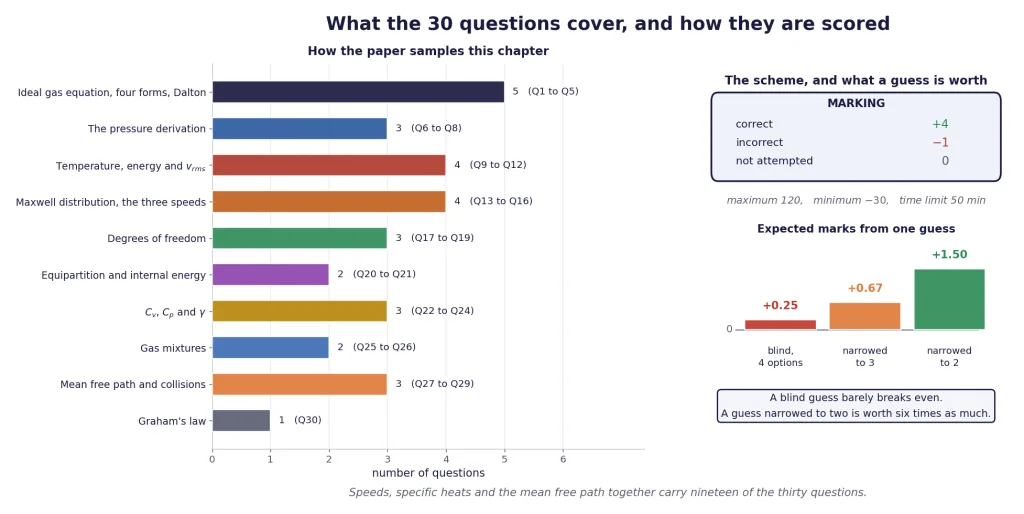
| Topic | Questions | How many |
|---|---|---|
| The ideal gas equation, its four forms and Dalton's law | Q1 to Q5 | 5 |
| The pressure derivation and its consequences | Q6 to Q8 | 3 |
| Temperature, kinetic energy and | Q9 to Q12 | 4 |
| The Maxwell distribution and the three speeds | Q13 to Q16 | 4 |
| Degrees of freedom, linear against non-linear | Q17 to Q19 | 3 |
| Equipartition and internal energy | Q20 to Q21 | 2 |
| , and | Q22 to Q24 | 3 |
| Gas mixtures | Q25 to Q26 | 2 |
| Mean free path and collision frequency | Q27 to Q29 | 3 |
| Graham's law of diffusion | Q30 | 1 |
That spread mirrors how the paper actually samples this chapter. Speeds, specific heats and the mean free path together carry 19 of the 30, because those are the blocks that carry the multi-step questions, and therefore the marks.
The difficulty mix is roughly 25% easy, 45% medium and 30% hard. A handful will feel brutal. They are meant to.
[Exam Tip] That changes the arithmetic of guessing. A blind guess among four options returns marks on average, barely worth the minute it costs. A question narrowed to two options returns marks on average, six times as much. Narrow first, then commit. Leave blank only what you could not narrow at all.
[Exam Tip] Before you start, write five lines at the top of your sheet: kelvin, not Celsius?, is in kg/mol?, which of the three speeds does this want?, diameter or radius?, did I keep the ? Those five questions catch the overwhelming majority of the marks lost in this chapter.
Scoring Yourself Honestly
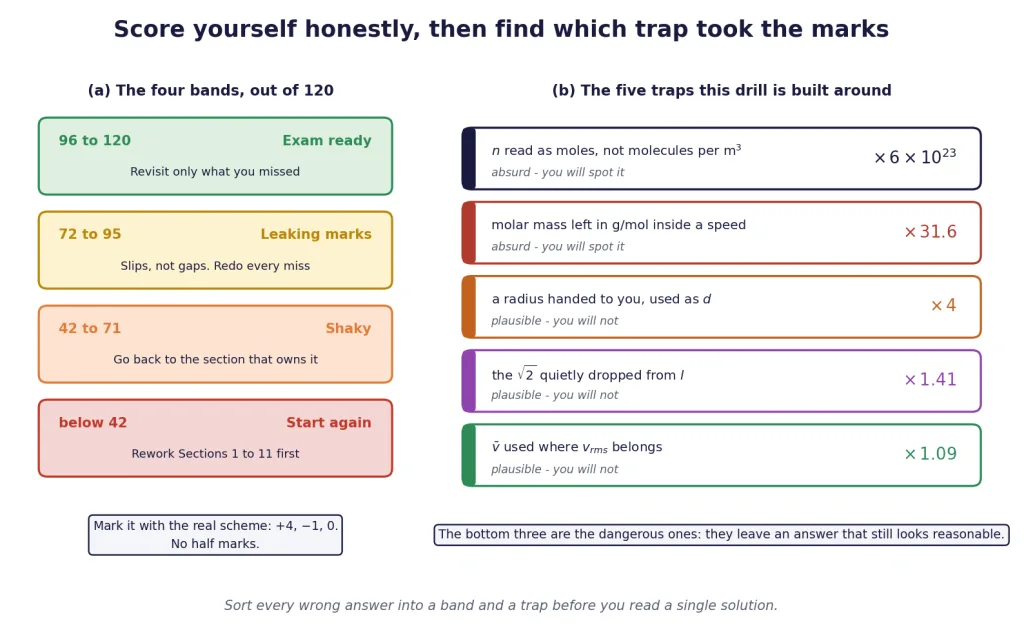
Mark your sheet with the real scheme, and and , and total it. No half marks for "I knew that one really". The number you get is the number that matters.
The bands
| Your score (out of 120) | Verdict | What to do next |
|---|---|---|
| 96 to 120 | Exam ready. 80% or more on a hard set, inside the time. | Move on. This chapter will not cost you marks. Revisit only the specific items you missed. |
| 72 to 95 | Solid, but leaking marks. | Almost always slips rather than gaps: a molar mass left in grams, a mean speed where an rms speed belonged, a radius squared without being doubled. Redo every wrong question without the explanation first. |
| 42 to 71 | Shaky. The ideas are there; the execution is not. | For each wrong answer go back to the section that owns it (use the topic table above) and rework its solved examples before re-attempting. |
| Below 42 | Start again. | Work Sections 1 to 10 properly, then Section 11's worked problems, then Section 12. Re-attempting this set now teaches you nothing but the answer key. |
Read your own answer sheet
Before you touch a single explanation, sort your mistakes into three piles. This is the most valuable ten minutes in the whole section.
- Method errors. You used where the physics wanted , or the other way round. You counted a linear triatomic as though it had 3 rotational degrees of freedom. You applied a formula for one molecule to a whole mole, or a molar specific heat to one molecule. You put a Celsius temperature into a ratio. These are the expensive ones, because the whole solution is wrong from line one.
- Execution errors. Right method, wrong arithmetic. The classic four here: substituted where belonged; the dropped out of the mean free path; a radius squared without being doubled into a diameter first; litres left unconverted inside .
- Reading errors. The question asked for the most probable speed, not the rms one. For the internal energy, not the translational kinetic energy. For , not . For the number of molecules, not the number of moles. For the collision time, not the collision frequency. For the gas that diffuses slower, not faster.
Key Point: In this chapter pile 2 is unusually fat, because the chapter's four standing traps are all pure execution: grams for kilograms, mean speed for rms speed, radius for diameter, and the missing . Two of them wreck the answer so badly you would notice; two of them leave a number that still looks perfectly reasonable. Those two are the ones that cost marks.
How badly each trap hurts
| The slip | What it does to your answer |
|---|---|
| read as moles instead of molecules per cubic metre | out by a factor of |
| left in g/mol inside a speed formula | out by |
| A radius used directly as in the mean free path | comes out 4 times too large |
| The dropped from the mean free path | comes out times too large |
| used where belongs | out by |
The last two are the dangerous ones. Nobody ships an answer that is times too big; everybody ships one that is 9% off.
The eight habits this set is drilling
- Write the molar mass in kg/mol on its own line, every single time. g/mol becomes kg/mol before it goes anywhere near a square root. If your rms speed comes out around 15 m/s instead of 480, this is why.
- Name the speed before you compute it. Energies and pressures want . Mean free paths, collision frequencies and effusion want . The peak of the distribution is . The order never changes: , in the ratio .
- Count before you write any specific heat. Monatomic 3, rigid diatomic 5, rigid linear polyatomic 5, rigid non-linear polyatomic 6, vibrating diatomic 7. Then and hand you everything else.
- Carbon dioxide is linear. It behaves like a diatomic, not like water vapour. Getting this wrong changes from to and every downstream number with it.
- Keep and apart. is translational only, whatever the gas. is the whole thing. They coincide only when .
- In the mean free path, check two things before you divide: is a diameter, and is the still there? , and nothing else.
- Scale rather than recompute. , , . Most of the multi-step questions in this set fall in one line to a proportionality and in five lines to brute force.
- Sanity-check every speed against room temperature. At 300 K, hydrogen is around 1900 m/s, helium around 1400, nitrogen and oxygen around 500, carbon dioxide around 400. An answer of 15 or of 15000 is a units error, not a discovery.
[Exam Tip] Every explanation below is a full step-by-step solution, so this set doubles as revision. Read the explanation even for the questions you got right - several of these have a two-line route and a two-page route, and it is the two-line route you will need in the hall.