
First, the Two Symbols That Change Meaning in This Chapter
Before a single equation, a warning — because this one costs more marks in kinetic theory than any other single thing, and it costs them silently.
In the previous chapter, on thermodynamics, meant the number of moles. You wrote and and never thought about it again.
In this chapter, means something completely different.
Key Point — the notation rule for the whole of kinetic theory:
- is the number density — the number of molecules per unit volume, , measured in molecules per cubic metre. A typical value is around .
- (the Greek letter mu) is the number of moles. A typical value is 1, or 2, or 0.5.
This is the exact reverse of the previous chapter's convention. Every kinetic-theory formula and every exam paper you will meet uses it this way, so it is worth adopting cleanly rather than fighting.
That means every formula you carried over from thermodynamics has to be rewritten before you use it here:
| The previous chapter wrote | This chapter writes |
|---|---|
| = number of moles | = number of moles, = molecules per m |
[JEE Tip] A question that hands you " per m" and asks for the pressure wants . A question that hands you "" wants . Read the units attached to the number, not the letter — the units never lie. If a quantity is per cubic metre it is a number density; if it is dimensionless and small it is a mole count.
The full cast
Every symbol for "how much gas", laid out together so you can keep them apart. Learn this table; it is the whole of the bookkeeping.
| Symbol | Name | Units | Typical size |
|---|---|---|---|
| number of molecules | none (a pure count) | and up | |
| number of moles | mol | 0.1 to 100 | |
| number density | molecules per m | at ordinary conditions | |
| mass of the sample | kg | grams to kilograms | |
| molar mass | kg per mol | 0.002 to 0.35 | |
| mass of ONE molecule | kg | ||
| mass density | kg/m | about 1.2 for air |
Three of those are masses and they are not interchangeable. is what the balance reads for your sample. is what one mole of the stuff weighs. is what a single molecule weighs. Oxygen, for instance: a g sample has kg, while kg/mol and kg.
Key Point — is in KILOGRAMS per mole:
Oxygen's molar mass is kg/mol, not 32. The number 32 is grams per mole, and every formula in this chapter is SI. Write the conversion on its own line, every single time: Slip here and your answer is out by a factor of 1000 — or, once a square root gets involved later in the chapter, by a factor of about 32.
[Board Important] And one more that is not negotiable anywhere in this chapter: is always the absolute temperature in kelvin. Write for a Celsius reading if you need one. Every form of the gas equation, every ratio, every proportionality below fails outright if a Celsius number sneaks in. Convert first, on its own line, then start.
From One Experimental Fact to
Now the physics. The route to the ideal gas equation is short, and worth walking rather than memorising, because the payoff at the end is a genuinely surprising result.
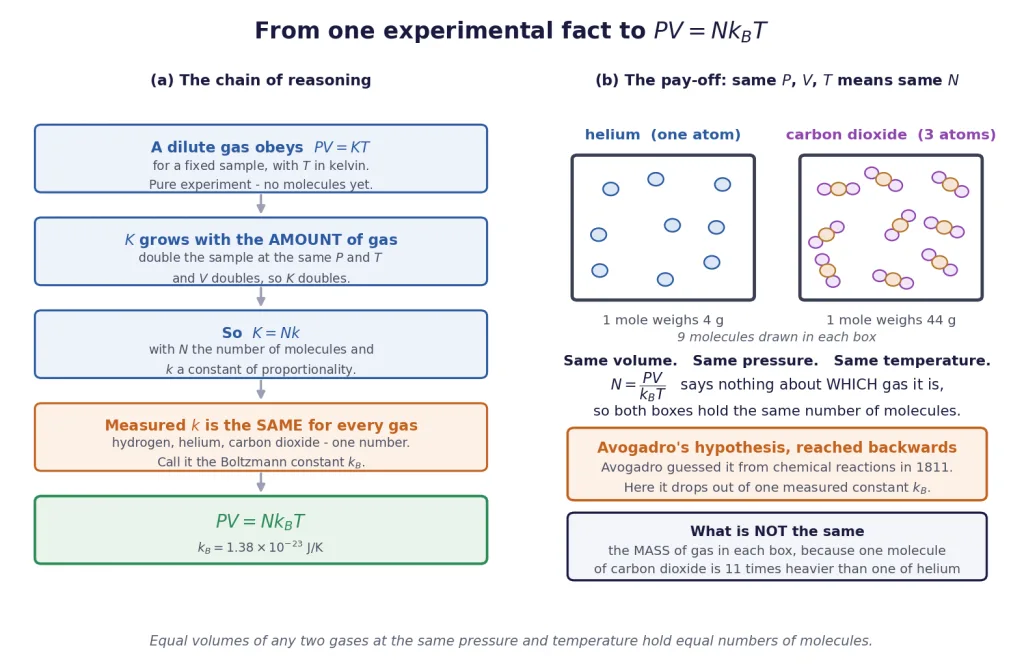
The starting point is pure experiment
Take a fixed sample of any gas — a sealed flask of nitrogen, say — keep it dilute, and keep it well away from the temperature at which it would liquefy. Measure its pressure, volume and absolute temperature in every combination you can arrange. What you find is
That is it. No molecules, no theory, just three numbers from three instruments and a constant that stays put as long as you do not change the sample.
is a constant for that sample, but change the sample and changes. Pour twice as much gas into a flask of twice the volume, at the same pressure and temperature, and doubles while stays the same — so doubles. tracks how much gas there is.
Bringing in molecules
If we now allow ourselves the idea that a gas is a collection of molecules, "how much gas there is" has an obvious meaning: the number of molecules . So write for some constant .
Here is the surprise, and it is entirely experimental. Measure for hydrogen, for helium, for oxygen, for carbon dioxide, for anything — and you get the same number every time. Not roughly the same. The same. It does not care about the mass of the molecule, its shape, how many atoms it has, or anything else about it.
That universal constant is the Boltzmann constant:
Key Point — the Boltzmann constant: and with it the ideal gas equation in its most fundamental form, where is the number of molecules in the sample and is in kelvin. is the same for every gas — which is the whole content of the result.
What that universality buys you
Rearrange the equation for two different samples of two different gases:
Now suppose the two samples sit at the same pressure, in the same volume, at the same temperature. Then , and the equality above forces
Read that again, because it is a strong statement. Equal volumes of any two gases, at the same temperature and pressure, contain equal numbers of molecules. A litre of hydrogen and a litre of carbon dioxide at room conditions hold the same number of molecules, even though the carbon dioxide weighs 22 times as much.
That is Avogadro's hypothesis — the guess Avogadro made in 1811 from the volume ratios in chemical reactions, with no way at the time to justify it. Here it is not a guess at all. It falls out of one measured constant. Section 1 told the story from the chemistry side; this is the same result reached from the other direction, and kinetic theory will eventually explain why is universal.
[NEET Important] The equal-volumes statement is asked directly, and the trap is always mass. Same , and means the same number of molecules and the same number of moles — it does not mean the same mass, and it does not mean the same density. Two flasks of different gases under identical conditions have identical molecule counts and quite different weights.
The Mole, , — and the 22.4 Litres
is the honest form, but nobody counts molecules in a laboratory. They weigh things. The mole is the bridge between the two.
The mole and the Avogadro number
Key Point — the mole and the Avogadro number:
A mole is the amount of a substance that contains exactly as many entities as there are in g of carbon-12. That number is the Avogadro number, One mole of any substance therefore contains molecules, and its mass in grams is numerically its molecular weight: 4 g of helium, 28 g of nitrogen, 44 g of carbon dioxide.
So the number of moles in a sample can be got two ways, and they must agree:
Key Point — three ways to say "how much": where is the sample's mass, its molar mass in kg/mol, and its molecule count. Going the other way, and .
The gas constant is not a new constant
Substitute into :
The combination is two universal constants multiplied together, so it is itself a universal constant. Call it :
Key Point — the universal gas constant: and hence the form you will use most often, with the number of moles.
Check it yourself: . (You get rather than purely because was quoted to three figures. The two constants are not independent — is just scaled up from one molecule to one mole.)
That is the cleanest way to hold the pair in your head. is the gas constant per molecule; is the gas constant per mole. Everything else follows.
Molar volume: the 22.4 litres
Put one mole of any ideal gas at STP — standard temperature and pressure, meaning K and atm Pa — and ask what volume it occupies:
Key Point — molar volume at STP: for every ideal gas, whatever it is made of. Know this number cold: it converts between the macroscopic world of litres and the molecular world of counts in a single step.
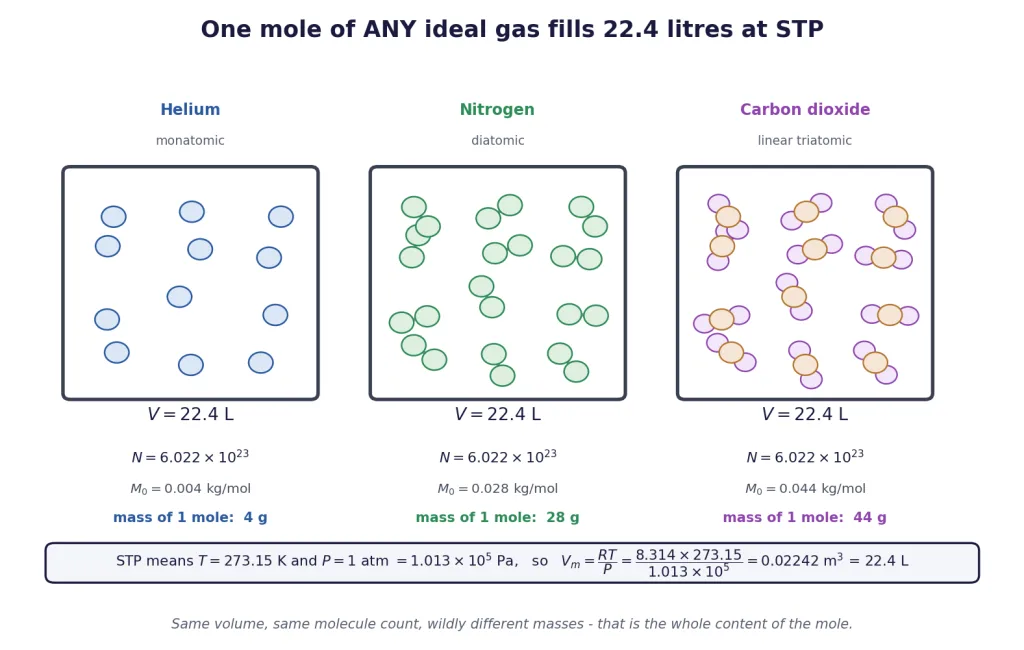
Notice what the figure is really saying. Three boxes, same volume, same pressure, same temperature — so by Avogadro, the same molecules in each. What differs is only the mass on the label: 4 g, 28 g, 44 g. That is the entire content of the mole in one picture.
Two immediate consequences worth carrying:
- The mass of 22.4 litres of any gas at STP is its molecular weight in grams. Weigh 22.4 litres of an unknown gas at STP, read 44 g, and you have found its molar mass without a single chemical test.
- Room conditions are not STP. At 300 K and 1 atm the molar volume is m, that is 24.6 litres. Using 22.4 where the problem says 27°C is a small, common and entirely avoidable error.
[Board Important] Watch for the two rival definitions of "standard conditions" floating about. Take K with atm, giving 22.4 L. A different convention uses K with bar Pa, which gives 22.7 L. Unless a problem explicitly says "1 bar", use 22.4 L.
The Four Forms, and Which One to Reach For
The same equation can be written four ways. They are not four facts — they are one fact, wearing whichever coat suits the data you were handed. Being fluent between them is most of what makes gas problems quick.
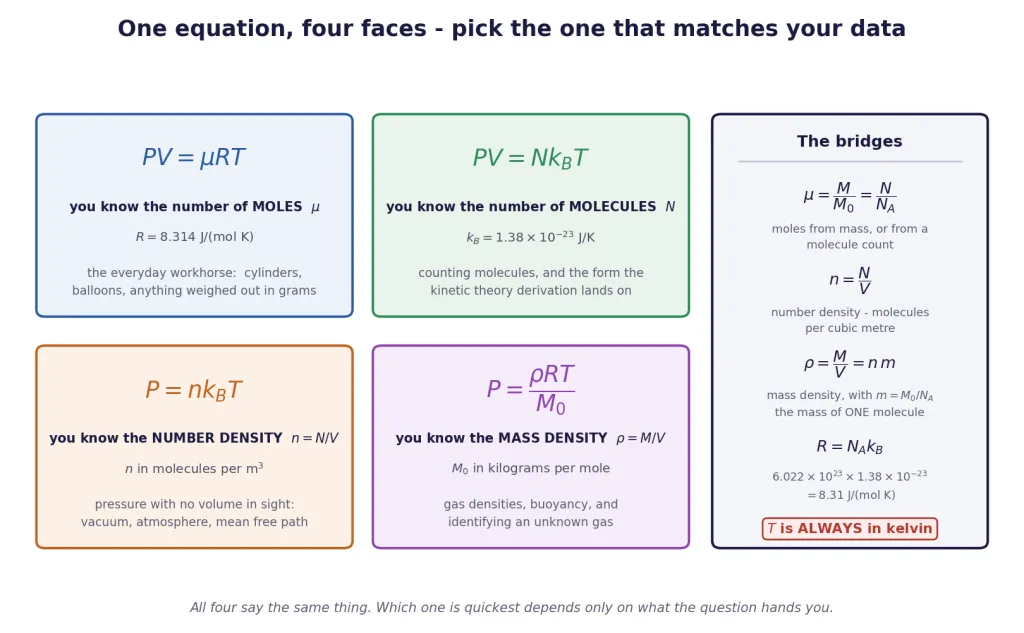
Form 1 — in terms of moles
The workhorse. Use it whenever the question gives you a mass, or a number of moles, or asks for one. Cylinders, balloons, tyres, anything weighed on a balance.
Form 2 — in terms of molecules
Use it when the question counts molecules. It is also the form that the kinetic-theory derivation in Section 4 lands on naturally, so it is the one that gets compared with the molecular picture later.
Form 3 — in terms of number density
Divide by and recognise as the number density :
Key Point — number density form: There is no volume in this equation. That is what makes it powerful: it is a local statement. It applies to the air at one point in a room, to a patch of the upper atmosphere, to the residual gas inside a vacuum chamber — anywhere you can name a pressure and a temperature but cannot sensibly name a volume.
Turned around, says something worth pausing on: fix the pressure and the temperature and you have fixed the number density, whatever the gas is. Avogadro's hypothesis again, in its most compact form.
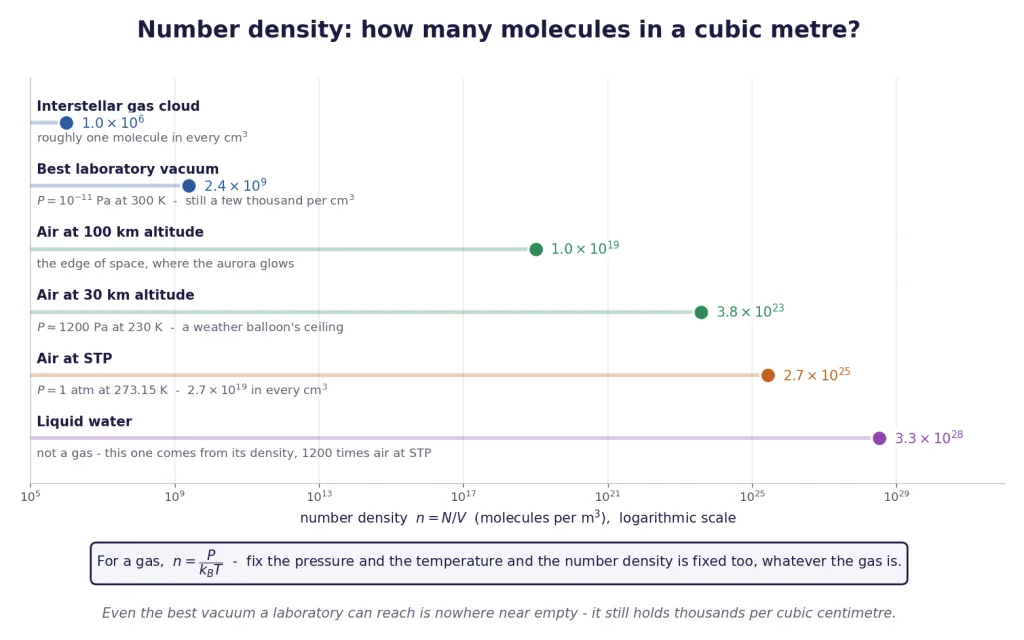
At STP, per m — which is molecules in every cubic centimetre. That number is worth remembering as a benchmark. It is why even a very good vacuum is nowhere near empty.
Form 4 — in terms of mass density
Start from and put :
and is the mass density :
Key Point — density form: with in kg/mol and in kg/m. This is the only one of the four in which the identity of the gas appears explicitly, through — which is exactly why it is the form that lets you identify an unknown gas from a density measurement.
Read the second version and two facts fall out at once. At fixed and , density is proportional to molar mass — carbon dioxide is denser than air, helium is far less dense, and that is the whole of why balloons rise. And for a fixed gas, density is proportional to pressure and inversely proportional to absolute temperature.
Choosing between them
| You are given / asked for | Use | Because |
|---|---|---|
| mass in grams, or moles | gets you straight in | |
| a number of molecules | no mole conversion needed | |
| molecules per m, or no volume at all | it is local; volume never appears | |
| a density in kg/m, or an unknown gas | is the only unknown left | |
| two states of the same sample | the amount cancels — see below |
That last row is worth its own line. If a fixed sample of gas is taken from one state to another, is the same at both ends, so
No constants, no molar masses, no unit conversions except kelvin. Any gas problem in which the amount of gas does not change should start here.
[JEE Tip] Every one of the four forms is a rearrangement of the other three, so a problem you can do one way you can always do another way. Use that: solve it once through , then check it through . If the two disagree by more than a fraction of a percent you have made a mole-versus-molecule slip, and you have caught it before it cost you anything. (A residual gap of about is normal and harmless — it is only the rounding in , since comes to rather than .)
What "Ideal" Actually Means, and the Honest Admission
We have been writing "the ideal gas equation" without ever saying what an ideal gas is. The definition is deliberately circular, and that is the point.
Key Point — the ideal gas, defined:
An ideal gas is a gas that satisfies exactly, at every pressure and every temperature.
That is the whole definition. It is not a claim about molecules; it is a claim about behaviour. And it lets us be perfectly honest about the next sentence:
Key Point — the admission:
No real gas is ideal. The ideal gas is a theoretical model, not a substance. Hydrogen, helium and nitrogen come close under ordinary conditions; none of them obeys the equation exactly, and every one of them fails badly enough somewhere — squeeze it hard enough, or cool it far enough, and it will condense into a liquid, something the equation flatly forbids.
So why use it at all? Because over the range of conditions you meet in a laboratory, a lung or an exam paper, real gases obey it to within a percent or two — and a model that is right to a percent and can be written on one line beats a model that is right to a tenth of a percent and takes half a page.
The rule of thumb for when to trust it:
Key Point — when the model works:
A real gas behaves ideally at low pressure and high temperature — more precisely, whenever the gas is dilute and far above the temperature at which it would liquefy. Both conditions say the same physical thing: the molecules are far enough apart, and moving fast enough, that they barely notice each other.
Section 3 takes that apart properly — what the departures look like when you plot them, and the two specific assumptions the model throws away that cause them. Section 4 goes further still and derives the equation from a picture of molecules bouncing off walls, which is where the ideal gas stops being a definition and starts being a consequence.
What follows from this equation, and where
Almost everything else you know about gases is this one equation with two of its variables held still. Hold and fixed and is constant — Boyle's law. Hold fixed and — Charles' law. Hold fixed and — the pressure law. Add several gases in one vessel and the pressures simply add — Dalton's law of partial pressures. All four are worked out, with their graphs and their exam traps, in the next section. They are listed here only so you can see that they are not four extra facts to learn. They are four corners of one equation.
The checklist before you write anything down
Six habits. They cost seconds and they save whole questions.
- Kelvin, always. in the gas equation is absolute. is K, and in practice K. Never .
- in kg/mol. g/mol is kg/mol. Write the conversion line.
- is number density here, not moles. Moles are . If a number arrives with "per m" attached, it is .
- Pressure in pascals. atm Pa. And if a problem quotes a gauge pressure — a tyre or a cylinder gauge — add one atmosphere to get the absolute pressure the equation wants.
- Volume in cubic metres. litre m; cm m.
- If the amount of gas is unchanged, use the ratio form. dodges every constant in the chapter.
[NEET Important] The single most common wrong answer in this whole topic is not a physics error at all — it is 22.4 litres used at a temperature that is not K. The molar volume is a value at STP, not a property of gases. Away from STP, go back to and compute it.
Solved Examples
Constants used throughout, unless a problem says otherwise: J/(mol K); J/K; per mol; atm Pa; K; molar volume at STP L. Molar masses in kg/mol: hydrogen , helium , nitrogen , air , oxygen , carbon dioxide .
Example 1: Mass, moles and molecules — the three-way conversion
A sealed flask holds 16 g of oxygen. Find (a) the number of moles, (b) the number of molecules, (c) the mass of a single oxygen molecule, and (d) the volume this sample would occupy at STP.
Solution:
Molar mass in SI first. Oxygen is , molecular weight 32, so The sample mass is g kg.
(a) Moles.
(b) Molecules.
(c) One molecule. Sanity check: kg, which is the sample mass. Good.
(d) Volume at STP. Half a mole of anything occupies half of 22.4 L: Or the long way, which must agree: m.
Final Answer: mol; molecules; kg; L at STP.
Takeaway: is the hinge every gas problem swings on. Get first, and mass, molecule count and volume are all one multiplication away.
Example 2: Deriving the 22.4 litres, and what it is not
Show from the gas equation that one mole of an ideal gas occupies 22.4 L at STP. Then find the volume one mole occupies at 27°C and 1 atm, and comment.
Solution:
STP means K and atm Pa. Both already absolute.
Rearrange for one mole: Nothing about the gas entered the calculation — only , and . That is why the answer is the same for helium and for carbon dioxide.
Now at 27°C. Convert: K, which we round to 300 K.
Comment. That is 10% larger. The 22.4 L figure is a value at a particular temperature and pressure, not a property of gases in general. Away from STP, always go back to .
Final Answer: L at STP; L at 27°C and 1 atm.
Takeaway: 22.4 L belongs to STP and nowhere else. The habit of reaching for it automatically is one of the most reliable ways to lose a mark in this chapter.
Example 3: How many molecules are in this room?
A room measures m m m and holds air at 1 atm and 300 K. Find the number density of the air, the total number of molecules, the number of moles, and the mass of air in the room. Take the molar mass of air as 29 g/mol.
Solution:
Number density needs no volume at all. Use the local form: That is molecules in every cubic centimetre — in the air right in front of you.
Total molecules. The room's volume is m:
Moles, two ways. From the count, and independently from , The two routes agree, which is the check worth doing.
Mass. With kg/mol,
Final Answer: per m; molecules; mol; kg.
Takeaway: The air in an ordinary room weighs about as much as the person standing in it. And got the density of molecules before the room's size was ever mentioned — that is the form to use whenever volume is not what you are given.
Example 4: What is in an oxygen cylinder
A hospital oxygen cylinder of internal volume 30 litres contains oxygen at an absolute pressure of 15 atm and a temperature of 27°C. Find the number of moles, the mass of oxygen, and the number of molecules.
Solution:
Everything into SI, on its own lines.
Moles, from :
Mass:
Molecules:
The cross-check, through the other form. Independently, per m, so and mol. The two routes agree to better than a tenth of a percent — the residual gap is only the rounding in .
Final Answer: mol; g of oxygen; molecules.
Takeaway: Convert pressure, volume, temperature and molar mass to SI on four separate lines before touching the equation. Almost every wrong answer to a problem of this type is a unit, not a method.
Example 5: The cylinder after it has been used
The cylinder of Example 4 is used overnight. In the morning the gauge shows an absolute pressure of 11 atm and the temperature has fallen to 17°C. What mass of oxygen was withdrawn?
Solution:
The volume is fixed at m, but the amount of gas is not fixed — that is the whole point of the question — so the ratio form does not apply here. Compute the moles at each end separately.
Before (from Example 4): mol.
After. K and Pa:
The difference is what left:
Final Answer: About g of oxygen was withdrawn, that is moles.
Takeaway: When gas leaks or is drawn off, the amount changes, so you cannot use the two-state ratio form. Compute at each state from and subtract. Spotting which of the two situations you are in is half the marks.
Example 6: A bubble rising in a lake
An air bubble of volume cm is released at the bottom of a lake 40 m deep, where the temperature is 12°C. It rises to the surface, where the temperature is 35°C. What is its volume just as it reaches the surface? Take the density of water as kg/m and m/s.
Solution:
The amount of air in the bubble does not change, so this is a two-state problem and the ratio form is exactly right:
Kelvin, both ends. K and K.
The pressure at the bottom is atmospheric plus the water column: At the surface, Pa.
Solve for :
Read the two factors separately. The pressure drop alone would have expanded the bubble by a factor of ; the warming added only another . In problems like this the pressure almost always dominates — but the temperature factor is where the marks are lost, because it is the one that needs kelvin.
Final Answer: The bubble reaches the surface with a volume of about cm.
Takeaway: Since the units of cancel in the ratio, you may leave the volume in cm — but the temperatures must be in kelvin and the pressures must be absolute. Using and instead of and gives a ratio of instead of , and an answer nearly three times too big.
Example 7: The density of a gas from the equation
Find the density of nitrogen at 300 K and 1 atm. Then find the density of the same nitrogen if it is compressed to 3 atm at the same temperature.
Solution:
Use the density form, rearranged for :
Molar mass in SI: nitrogen is , molecular weight 28, so g/mol kg/mol.
Substitute: which is close to the familiar density of air, as it should be — air is mostly nitrogen.
At 3 atm, same temperature. Density is directly proportional to pressure at fixed :
Cross-check through number density. per m and the mass of one molecule is kg, so kg/m. Agreed.
Final Answer: kg/m at 1 atm; kg/m at 3 atm.
Takeaway: is the form to memorise, because it reads off three proportionalities at a glance: density rises with pressure, falls with absolute temperature, and rises with molar mass.
Example 8: Naming an unknown gas from its density
An unknown gas is found to have a density of kg/m at STP. Find its molar mass and suggest what it might be.
Solution:
Rearrange the density form for :
Substitute STP values:
Convert to the units a chemist would quote:
Identify. A molecular weight of 28 fits nitrogen () or carbon monoxide (). Density alone cannot separate them — the measurement knows about mass, not about chemistry.
A one-line shortcut worth knowing. At STP one mole fills 22.4 L, so the mass of 22.4 L is the molar mass in grams: kg g. Same answer, no constants needed.
Final Answer: g/mol kg/mol; the gas is nitrogen or carbon monoxide.
Takeaway: Molar mass in g/mol is just the mass of 22.4 litres at STP, so a density measurement at STP identifies a gas in one multiplication. Note that the answer came out as kg/mol — if yours comes out bigger than 1, you have left something in grams.
Example 9: Filling a helium balloon
A balloon of volume m is filled with helium at 1 atm and 300 K. Find the number of moles and the mass of helium. Then find the mass of air that same volume would have held, and hence the lift the balloon generates. Take air as 29 g/mol.
Solution:
Moles of helium. Nothing here depends on which gas it is:
Mass of helium, with g/mol kg/mol:
Mass of the air displaced. By Avogadro, the same volume at the same and holds the same 20.3 moles whatever the gas — so the air it displaces is
The lift is the difference: so the balloon can lift about half a kilogram before it stops rising.
Final Answer: mol; g of helium; the displaced air weighs g, giving about g of lift.
Takeaway: Balloons float because of Avogadro, not because helium is "light" in some vague sense. Equal volumes hold equal molecule counts, so the mass ratio is just the molar-mass ratio, .
Example 10: Two flasks, two gases, one condition
Two identical flasks are kept at the same temperature and pressure. One contains hydrogen, the other oxygen. Compare (a) the number of molecules, (b) the number of moles, (c) the masses, and (d) the number densities.
Solution:
(a) and (b) — the counts. Same , same , same , so from , The molecule counts are equal, and dividing by , so are the mole counts. This is Avogadro's hypothesis applied directly.
(c) The masses are not equal. With the same in each, The oxygen flask weighs 16 times as much as the hydrogen one.
(d) Number densities. contains nothing about the gas, so the two number densities are equal as well. Their mass densities are in the ratio , since and the molecular masses differ by that factor.
Final Answer: Equal numbers of molecules, equal moles and equal number densities; masses and mass densities in the ratio .
Takeaway: At the same , and : counts equal, masses not. Whenever a question compares two gases under identical conditions, write down which quantities are gas-independent (, , ) and which are not (, ) before you calculate anything.
Example 11: Pumping up a tyre
A bicycle tyre of fixed internal volume m contains air at Pa and 300 K. Air is pumped in until the pressure reaches Pa, with the temperature unchanged. What mass of air was added?
Solution:
The volume and temperature are fixed but the amount is not, so compute at each end.
Added moles: Equivalently, and faster, mol.
Mass added, with air at kg/mol:
Final Answer: About g of air, that is moles, was pumped in.
Takeaway: At fixed and , moles are directly proportional to pressure, so in one step. Note that these are absolute pressures — a tyre gauge reads gauge pressure and you must add an atmosphere before using its number.
Example 12: How empty is a good vacuum?
A vacuum chamber of volume 1.0 litre is pumped down to a pressure of Pa at 300 K — about as good as a laboratory can manage. How many molecules per cubic centimetre remain, and how many are in the chamber altogether?
Solution:
No volume is needed for the density, so use the local form:
Per cubic centimetre, dividing by :
In the whole chamber, L m:
Put that beside ordinary air. At STP, per m. So this chamber has had its molecules thinned by a factor of about — and it still contains over two million of them.
Final Answer: About molecules per cm, and roughly molecules in the chamber.
Takeaway: "Vacuum" never means "no molecules". is the natural tool whenever a pressure is quoted with no volume attached, and it makes the point that emptiness in a laboratory is a matter of degree — sixteen orders of magnitude of degree, and still not empty.