
Differentiate, and the Specific Heats Fall Out
The last section handed you a single line:
Count the quadratic terms in a molecule's energy, halve, multiply by . That is the internal energy of one mole of any ideal gas.
Now ask the question a calorimeter asks. How much heat does it take to warm that mole by one kelvin?
That is a derivative, and the formula is already sitting there waiting to be differentiated.
A note on symbols, once. In this chapter is the number of moles and is the number density, molecules per cubic metre. The previous chapter used for moles; this is the reverse, and it is the convention kinetic theory uses everywhere. So every heat formula below reads , never .
: the whole joule goes into
Hold the volume fixed. The gas cannot expand, so it does no work, so every joule of heat you supply ends up as internal energy. For one mole that means
and differentiating with respect to is a one-step job, because , and are all constants:
That is the whole derivation. There is nothing else to it.
: pay for the pushing as well
Now let the gas expand at constant pressure while you heat it. Same temperature rise, so the same rise in internal energy — but the gas has also pushed its surroundings back and that work has to come out of the heat you supplied. The extra, per mole per kelvin, is exactly :
The previous chapter got that relation from the first law of thermodynamics, working with and the equation of state, and calling it Mayer's relation. We are not going to redo it; we are here to supply the thing thermodynamics could not, which is the individual values of and for a named gas, from the shape of its molecules alone.
: divide one by the other
The ratio of the two is the quantity every adiabatic problem asks for. Divide, and watch and the cancel:
Key Point — the three formulas of this section: with the number of quadratic terms per molecule and J/(mol K). and are molar specific heats in J/(mol K); is a pure number.
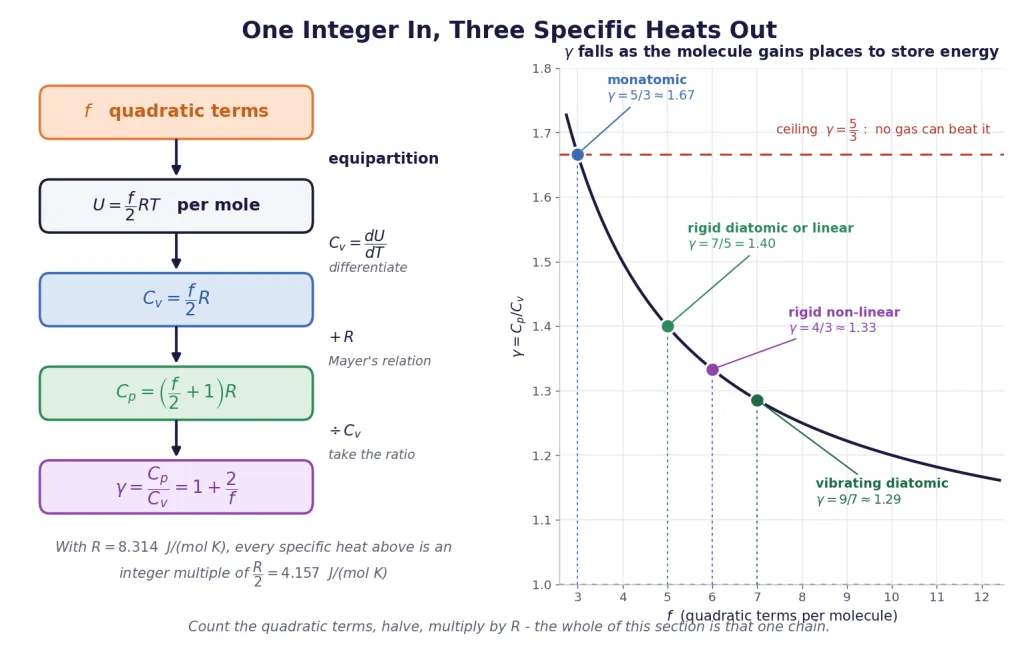
Stop and look at what has happened. One integer now produces every specific heat in the chapter. You do not memorise a table of numbers; you count quadratic terms once and the three formulas do the rest. Everything that follows in this section is those three lines with a number substituted in.
The one number worth carrying
Since J/(mol K), every molar specific heat in this section is an integer multiple of — and every is one whole above its own .
[Board Important] The derivation is a standard three-mark answer: state from the law of equipartition; write and differentiate to get ; quote ; and divide to get . Marks are lost by jumping straight to the numbers without the line.
[JEE Tip] runs both ways, and running it backwards is the more common exam move: . Given you get in one step, and from there and without touching a table.
Case by Case, With the Numbers
Now feed the formulas the integers from the degrees-of-freedom count. There are only five cases in this whole chapter, and three of them share a value.
Monatomic,
Helium, neon, argon, krypton, and the vapours of metals such as mercury. A single atom can only fly about — three translational terms and nothing else.
This is the largest any gas can have, because can never be smaller than 3.
Rigid diatomic,
Hydrogen, nitrogen, oxygen, carbon monoxide, hydrogen chloride — a dumbbell that flies and tumbles but whose bond does not stretch. Three translational plus two rotational terms.
Air is about four fifths nitrogen and one fifth oxygen, so air behaves as a rigid diatomic gas and is the default whenever a problem says "a gas" and nothing more.
Vibrating diatomic,
Take the same dumbbell to a few thousand kelvin and its bond starts to stretch. One vibrational mode, worth two quadratic terms — kinetic and potential — so .
Notice the arithmetic: switching one vibration on raises by , which is J/(mol K), not . Counting the mode once instead of twice is the commonest slip in the topic.
Notice something else, and store it: the of a vibrating diatomic, , is numerically the same as the of a rigid one. Two entirely different quantities that happen to land on the same number, and an option list will offer you both.
Rigid non-linear polyatomic,
Water vapour, ammonia, methane, sulphur dioxide — molecules whose atoms do not lie on a straight line, so all three rotation axes are real.
Rigid linear polyatomic, — the case that is usually got wrong
Carbon dioxide, nitrous oxide, acetylene, hydrogen cyanide. All their nuclei sit on one straight line, so the axis along that line has effectively no moment of inertia and does not count, exactly as for a diatomic. A rigid linear molecule has 2 rotational degrees of freedom however many atoms it has, so and it gets the diatomic numbers:
A quick summary that offers one "triatomic" row at has quietly assumed the molecule is bent. That is right for water and wrong for carbon dioxide, and it changes every downstream answer by 20%.
The master table
Key Point — every specific heat in this chapter, from one integer:
| Molecule | , J/(mol K) | , J/(mol K) | ||||
|---|---|---|---|---|---|---|
| Monatomic — He, Ne, Ar, Hg vapour | 3 | 12.47 | 20.79 | |||
| Rigid diatomic — , , , | 5 | 20.79 | 29.10 | |||
| Rigid linear polyatomic — , , | 5 | 20.79 | 29.10 | |||
| Rigid non-linear polyatomic — , , | 6 | 24.94 | 33.26 | |||
| Vibrating diatomic — hot , | 7 | 29.10 | 37.41 |
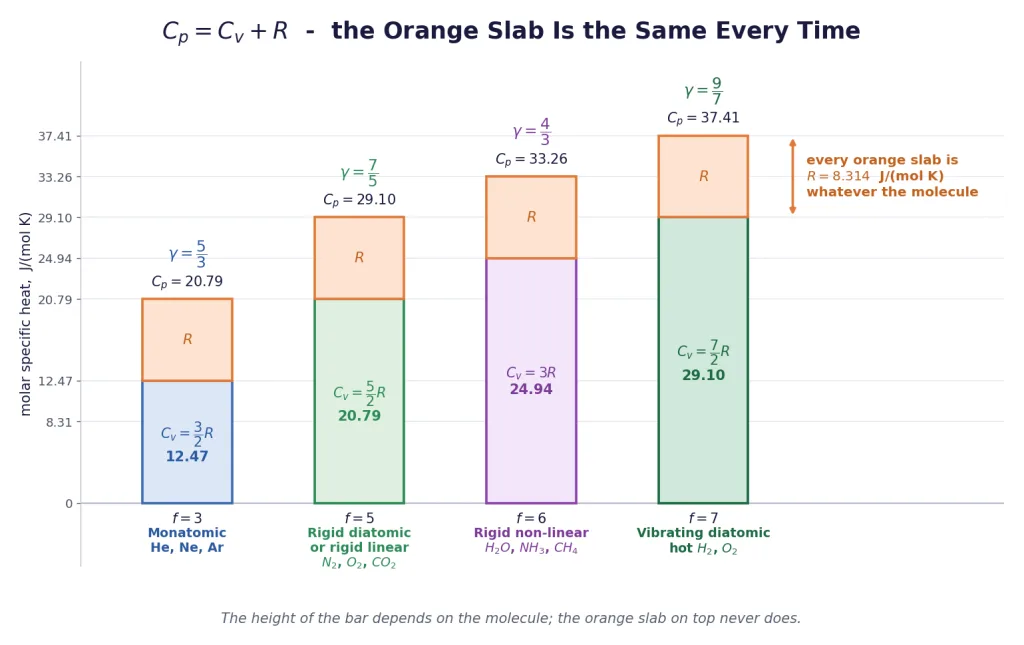
Read the picture rather than the table for a moment. The blue, green and purple blocks are the four different values — they change with the molecule, because the molecule decides how many places there are to store energy. The orange slab sitting on top of each one is the same height every time. That slab is . It is the work one mole does pushing its surroundings back when its temperature rises by one kelvin, and it does not care what the molecule looks like.
[NEET Important] Four numbers, learnt cold, cover almost every question: monatomic, diatomic or linear, non-linear polyatomic, vibrating diatomic. And the pair that goes with the second row, and J/(mol K), since air lives there.
Mayer's Relation Holds for Everything, and How to Run the Table Backwards
Two things follow from the master table that are worth more than the table itself.
The difference is for every gas there is
Go down the column: , , , . Go down the column: , , , . Subtract, row by row: , , , .
The algebra says the same thing in one line, and the point is which symbol disappears:
The cancels. Whatever the molecule is — one atom or forty, straight or bent, rigid or vibrating, cold or hot — the gap between its two molar specific heats is the same J/(mol K).
Key Point — Mayer's relation is structure-blind: The individual values depend completely on the molecule. Their difference does not depend on it at all, because the difference is not about storing energy — it is about the work of pushing the surroundings back, and one mole of any ideal gas pushes exactly the same amount.
This is worth seeing twice because it is derived twice, from two completely different starting points. The previous chapter got it from the first law of thermodynamics and the equation of state, without ever mentioning a molecule. We have just got it again by counting quadratic terms and watching cancel. Two arguments with nothing in common landing on the same result is what makes a result trustworthy.
Running the formulas backwards
Measure for an unknown gas — you can do it by timing sound through it, or by watching how it cools when it expands — and the three formulas run in reverse to tell you what the molecule is:
Key Point — the inverse trio:
Check them on a case you know. For : , and J/(mol K). All three agree with the table.
A calorimeter measuring how much heat a gas takes is, quite literally, counting the molecule's degrees of freedom. That is a remarkable thing for a thermometer and a heater to be able to do.
The bounds, and the sanity checks they give you
Because always — every molecule has three translations, no matter what — the formulas come with hard limits.
| Quantity | Smallest possible | Largest possible | Reached by |
|---|---|---|---|
| 3 | no ceiling | monatomic at the bottom | |
| no ceiling | monatomic | ||
| no ceiling | monatomic | ||
| just above 1 | monatomic |
Key Point — three checks to run before you write an answer down:
- can never exceed . An option offering is wrong on sight.
- can never be less than or equal to 1, since always.
- can never be below J/(mol K) for any gas.
[JEE Tip] A frequent trap runs: "a gas has ; is it monatomic, diatomic or polyatomic?" Run the inverse: . No single molecule has — the values are 3, 5, 6, 7 — so the gas cannot be pure. It is a mixture, and the effective of a mixture is a mole-weighted average that need not be a whole number at all.
What Measurement Actually Says
Everything so far is a prediction made from a drawing of a molecule. Here is what a laboratory finds when it measures the same gases near room temperature and ordinary pressure. The rigid-molecule prediction is in the middle columns, and the measurement is next to it.
| Gas | Structure | predicted | measured | measured | measured | ||
|---|---|---|---|---|---|---|---|
| Helium (He) | monatomic | 3 | 12.47 | 12.47 | 20.79 | 8.32 | 1.67 |
| Argon (Ar) | monatomic | 3 | 12.47 | 12.47 | 20.79 | 8.32 | 1.67 |
| Hydrogen () | rigid diatomic | 5 | 20.79 | 20.4 | 28.8 | 8.4 | 1.41 |
| Nitrogen () | rigid diatomic | 5 | 20.79 | 20.8 | 29.1 | 8.3 | 1.40 |
| Oxygen () | rigid diatomic | 5 | 20.79 | 21.0 | 29.4 | 8.4 | 1.40 |
| Chlorine () | rigid diatomic | 5 | 20.79 | 25.6 | 33.9 | 8.3 | 1.32 |
| Carbon dioxide () | rigid linear | 5 | 20.79 | 28.5 | 36.9 | 8.4 | 1.29 |
| Ethane () | rigid non-linear | 6 | 24.94 | 44.2 | 52.5 | 8.3 | 1.19 |
All values in J/(mol K) except , which has no units. Every in the last column is that row's own divided by its own — a table of measured specific heats that fails that test has a misprint in it.
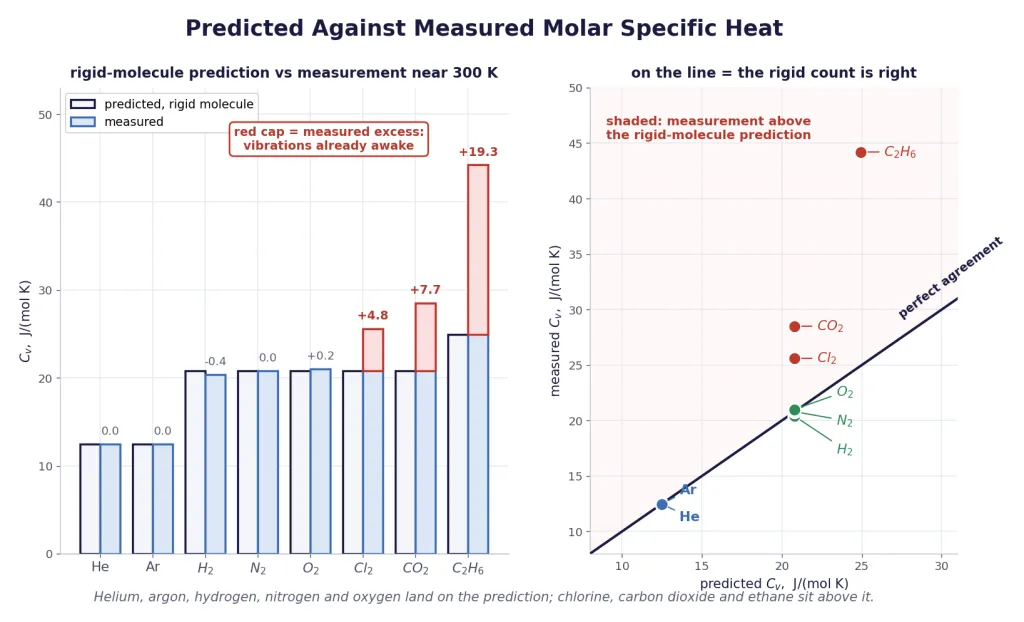
What went right
Mayer's relation is flawless. The column reads or all the way down, against a predicted , for molecules that could hardly be more different from one another. Nothing in the table tests the theory more directly, and nothing passes more cleanly.
Helium and argon are exact. Predicted , measured . Two atoms with a fifty-fold difference in mass give identical specific heats, because a lone atom stores energy in exactly three ways whatever it weighs. That is equipartition working perfectly.
Hydrogen, nitrogen and oxygen are within one percent of the rigid diatomic prediction. They have a vibrational mode each, and classical physics insists it should be carrying energy — but at 300 K those modes are frozen out, and the measurement agrees with the rigid count, not the full one.
What went wrong, and why it is honest to say so
Three rows are badly off, and all three miss in the same direction: measurement exceeds the prediction, never falls short.
| Gas | predicted | measured | Excess | Effective from |
|---|---|---|---|---|
| Chlorine () | 20.79 | 25.6 | 6.16 | |
| Carbon dioxide () | 20.79 | 28.5 | 6.86 | |
| Ethane () | 24.94 | 44.2 | 10.63 |
The direction is the whole clue. A gas can only come out above the prediction if it has found somewhere extra to put energy — and the only somewhere left is vibration, which the rigid count deliberately ignored.
- Chlorine. Its two atoms are heavy and the bond is weak, so the molecule vibrates slowly and its vibrational quantum is small — small enough that ordinary collisions at 300 K can already pay it. Its single vibrational mode is roughly half awake, which is why its effective of sits between the rigid value 5 and the fully vibrating value 7, and is not a whole number at all.
- Carbon dioxide. It has four vibrational modes, and two of them are low-frequency bends — the molecule flexing away from straight — which cost very little energy to excite. Those bends are partly active at room temperature, pushing the effective from 5 up towards 7.
- Ethane. Eight atoms, so vibrational modes, several of them soft. With that many places to put energy, an effective above 10 is no surprise at all.
Key Point — read the discrepancies, do not hide them:
Where the rigid prediction fails, it fails by being too small, and the reason is always the same: vibrational modes that the rigid count set to zero are in fact already partly excited at room temperature. Heavy atoms, weak bonds and soft bending modes are what make a molecule miss early. Light atoms on stiff bonds — hydrogen, nitrogen, oxygen — stay rigid and stay on the prediction.
Notice that the measured of carbon dioxide is , the same as the value predicted for a vibrating diatomic. Two quite different molecules can share a , so on its own never identifies a gas — it only pins down the effective .
[JEE Tip] In problems, use the clean table values unless the question tells you otherwise. If it wants vibration counted it will say "vibrating", or hand you a temperature of several thousand kelvin, or simply give you to use. The measured excesses above are physics worth understanding, not arithmetic to apply.
[Board Important] One sentence, asked most years: the experimental specific heats of gases such as chlorine, carbon dioxide and ethane are larger than the values predicted by counting only translation and rotation, because their vibrational modes are already excited at ordinary temperatures and each such mode contributes a further to .
Solids: One Prediction for Every Element in the Table
Equipartition was built for gases, but nothing in it says the system has to be a gas. It says quadratic terms get each. Apply that to a crystal and something startling comes out: a single number that fits most of the elements in the periodic table.
What an atom in a solid is doing
An atom in a crystal cannot travel — its neighbours are in the way, and it is locked to its lattice site. What it can do is vibrate about that site, and it can do so in three independent directions.
Each of those three vibrations is a genuine oscillator, and an oscillator stores energy in two forms: kinetic while the atom is moving, potential while the bonds around it are stretched. So each direction supplies two quadratic terms, and
There is no separate translational contribution to add on. The atom's motion is the vibration; you must not count it twice.
The energy, and then the heat capacity
Per mole of atoms, with atoms each holding :
Now differentiate. A solid barely expands when you heat it — a metal block warmed by 100 K changes volume by well under one percent — so the work it does pushing the air aside is negligible, and are the same thing, and and are the same number. A solid needs only one specific heat.
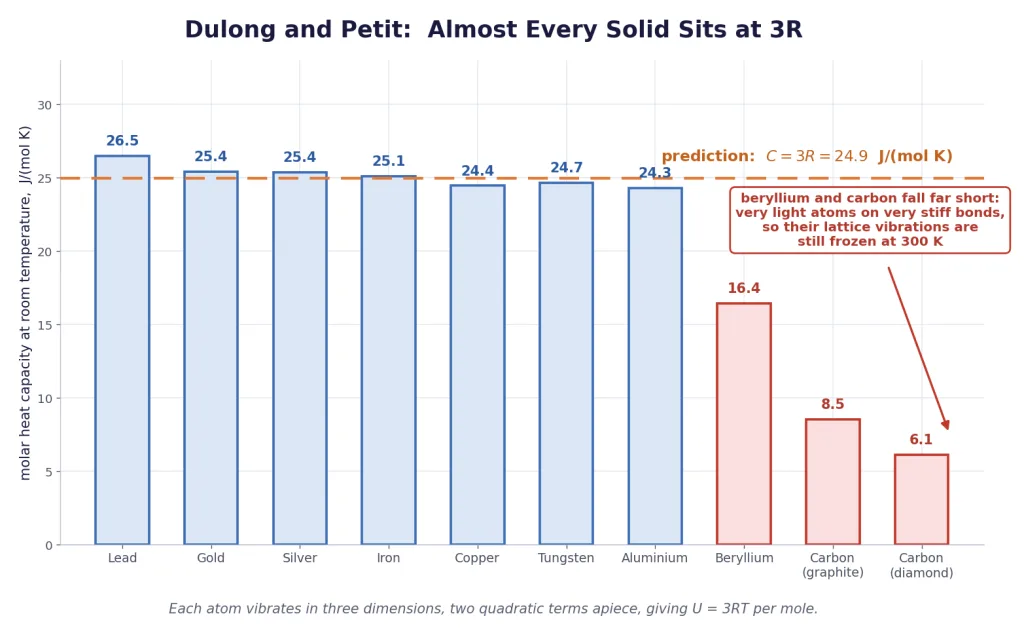
Key Point — the Dulong-Petit law: The molar heat capacity of a simple crystalline solid is about J/(mol K), the same for every such solid, independent of which element it is made of and independent of temperature.
Per kilogram it is , which does depend on the element, because the molar mass does. Note in kilograms per mole — copper is , not .
That is an extraordinary claim to make about lead and about aluminium in the same breath. It says a mole of anything solid holds the same thermal energy at the same temperature — which, once you have the molecular picture, is obvious: a mole is a fixed number of atoms, and each atom gets six shares of regardless of how heavy it is or what it is bonded to.
The test
| Solid | , kg/mol | measured , J/(kg K) | measured , J/(mol K) | as a multiple of |
|---|---|---|---|---|
| Lead | 0.207 | 128 | 26.5 | 3.19 |
| Gold | 0.197 | 129 | 25.4 | 3.06 |
| Silver | 0.108 | 235 | 25.4 | 3.05 |
| Iron | 0.0558 | 450 | 25.1 | 3.02 |
| Tungsten | 0.184 | 134 | 24.7 | 2.97 |
| Copper | 0.0635 | 385 | 24.4 | 2.94 |
| Aluminium | 0.027 | 900 | 24.3 | 2.92 |
| Beryllium | 0.009 | 1825 | 16.4 | 1.98 |
| Carbon (graphite) | 0.012 | 710 | 8.5 | 1.02 |
| Carbon (diamond) | 0.012 | 509 | 6.1 | 0.73 |
Look at the per-kilogram column first, and then at the per-mole one. The specific heats per kilogram run from to J/(kg K) — a factor of fourteen. Convert to per mole and seven of them collapse onto . The scatter in the second column was never physics; it was just molar mass.
The two failures, and what they were worth
The bottom rows are not rounding errors. Diamond measures J/(mol K) where the law demands — wrong by a factor of four. Graphite is barely better. Beryllium is well short too.
The reason is the one this chapter keeps returning to. A lattice vibration has an energy quantum, and that quantum is large when the atoms are light and the bonds are stiff. Carbon atoms are very light and the bonds in diamond are among the stiffest in nature, so diamond's vibrational quanta are enormous, and at 300 K most of its modes cannot be excited at all. They are frozen out, they hold nothing, and the count of 6 per atom is a fiction.
Cool any of the metals in that table towards absolute zero and the same thing happens to them: drops away from and heads for zero. Diamond is simply the material stubborn enough to be doing it at room temperature.
Key Point — the boundary of Dulong and Petit:
works for most solids at ordinary temperatures. It fails for light, stiffly bonded solids at room temperature — carbon above all — and it fails for every solid at low enough temperature. In both cases the reason is identical: a mode whose quantum exceeds cannot be excited and contributes nothing.
Einstein, in 1907, took precisely this failure and used it to show that quantisation was not a trick special to light. The heat capacity of a lump of diamond turned out to be evidence for quantum mechanics.
[NEET Important] Three facts, in the order they get asked. A solid has essentially one specific heat, not two, because it does not expand. Its molar value is J/(mol K) for most solids at room temperature. Carbon is the standard exception, and the reason is that its vibrational modes are frozen out.
Where this leaves the chapter
You can now go from a picture of a molecule to a number a calorimeter will read: count the atoms, ask whether they lie on a line, decide whether vibration is awake, and turn the handle. The next section leaves energy behind and asks a different question entirely — how far a molecule travels between collisions, and what that distance controls.
Solved Examples
Constants used throughout: J/(mol K), J/K, per mol. Temperatures are always absolute.
Example 1: Argon, from the drawing to the joules
Find , and for argon, and then find the heat needed to warm 2 moles of it by 15 K (a) in a sealed rigid vessel and (b) at constant atmospheric pressure.
Solution:
Count. Argon goes around as single atoms, so , , and all three coordinates are translational. There is no orientation to specify and no bond to stretch:
Turn the handle.
(a) Rigid vessel — constant volume. With moles and K:
(b) Constant pressure.
Where the extra went. The difference is which is exactly the work the expanding gas did on the atmosphere.
Final Answer: , J/(mol K), ; J at constant volume and J at constant pressure.
Takeaway: The extra heat needed at constant pressure is always and nothing else. It has no in it, so it is the same for every gas.
Example 2: Nitrogen, and where the heat actually goes
One mole of nitrogen is warmed by 100 K at constant pressure. Find the heat supplied, the rise in internal energy, and the work done. What fraction of the heat became work?
Solution:
Count. Nitrogen is a rigid diatomic at ordinary temperatures: 3 translational plus 2 rotational.
Heat supplied, with and K:
Rise in internal energy. Use even though the volume is changing — for an ideal gas depends on alone:
Work done, by difference:
The fraction.
Final Answer: J, of which J and J. Just under 29% became work.
Takeaway: at constant pressure. For a monatomic gas that is ; for a diatomic, . The more places a molecule has to store energy, the smaller the share that escapes as work.
Example 3: Hydrogen, before and after the vibration wakes up
Hydrogen at room temperature behaves as a rigid diatomic. Heated to a few thousand kelvin, its bond begins to vibrate. Find , and in each case, and state how much each quantity changes.
Solution:
Rigid, .
Vibrating. A diatomic has vibrational mode, and that mode is worth two quadratic terms:
The changes.
Final Answer: rigid ; vibrating . Both specific heats rise by exactly ; falls by .
Takeaway: Switching on one vibrational mode adds to and to — never . Their difference is untouched, so Mayer's relation survives the change, as it survives everything.
Example 4: Two polyatomics that answer differently
Compare , and for carbon dioxide and for ammonia, both treated as rigid.
Solution:
Carbon dioxide is linear. In all three nuclei lie on one straight line, so the axis through them is dead and only 2 rotations count:
Ammonia is not linear. is a pyramid, so no axis contains all four nuclei and all 3 rotations are real:
The ratio.
Final Answer: : , , . : , , . Ammonia's specific heats are 20% larger.
Takeaway: "Polyatomic" is not a value of . Linear or not is. Carbon dioxide is a three-atom molecule with a diatomic's specific heats, and treating it as a generic triatomic overstates by 20%.
Solved Examples (continued)
Example 5: Naming a gas from its
(a) A gas is found to have . How many quadratic terms has its molecule, and what is its ? (b) A second gas has . What can you say about it, and what can you not?
Solution:
(a) Run the inverse. Three quadratic terms means translation only — a monatomic gas: helium, neon, argon, or a metal vapour.
Its .
(b) Same move.
Now be careful about what that proves. An effective of 7 is consistent with a vibrating diatomic, whose predicted is exactly . But carbon dioxide at room temperature also measures , for a completely different reason — it is a rigid linear molecule, , whose soft bending modes are partly awake. Two different molecules, two different stories, one value of .
Final Answer: (a) , monatomic, J/(mol K). (b) The effective is about 7, but that does not identify the molecule: a hot diatomic and room-temperature carbon dioxide both land there.
Takeaway: pins down the effective number of quadratic terms and nothing more. Going from there to a molecular structure needs one extra piece of information — the temperature, or the atom count.
Example 6: Oxygen per kilogram
Find the specific heats of oxygen per kilogram at constant volume and constant pressure, and verify that their difference is what it should be. Take as a rigid diatomic, molar mass 32 g/mol.
Solution:
Convert the molar mass first — this is the step that decides the answer. Leaving it as 32 makes every answer below a thousand times too small.
Molar values. , so
Divide by the molar mass in kg/mol.
Check the difference. Not — the per-kilogram gap depends on the gas, because the molar mass does.
And is unchanged. , the same as , because the molar mass cancels in a ratio.
Final Answer: J/(kg K), J/(kg K), difference J/(kg K), .
Takeaway: Capital means per mole and ; lower-case means per kilogram and . Mixing the two is the commonest way to get a numerically careful answer marked wrong.
Example 7: Identifying a gas from per-kilogram data
A gas is measured to have J/(kg K) and J/(kg K). Find its molar mass, its , its , and name it.
Solution:
Use the per-kilogram form of Mayer's relation.
Substitute. The answer comes out in kg per mole automatically, because is per mole and is per kilogram.
The ratio.
Name it. Molar mass 4 g/mol and : helium.
Cross-check. The molar values should be the monatomic ones:
Final Answer: kg/mol, , ; the gas is helium.
Takeaway: turns two calorimeter readings into a molar mass. Combined with , it identifies the gas outright — mass tells you which element, tells you the shape.
Example 8: Chlorine, read backwards
Chlorine measures and J/(mol K) at room temperature, well above the rigid diatomic prediction. Find its effective , check that Mayer's relation still holds, and explain the excess.
Solution:
Effective number of quadratic terms.
Where that sits. A rigid diatomic has ; a fully vibrating one has . Chlorine is at , which is between them and not a whole number. Its one vibrational mode is roughly half excited.
Mayer's relation. It holds, as it must — the relation never cared how many modes were awake.
, two ways.
Why chlorine and not oxygen. A vibrational quantum is small when the atoms are heavy and the bond is weak. Chlorine atoms are more than twice as heavy as oxygen atoms and the bond is far weaker than the double bond, so chlorine's vibration is cheap enough for room-temperature collisions to excite. Oxygen's is not.
Final Answer: , between 5 and 7. still holds, and from either route.
Takeaway: An effective that is not a whole number is not an error — it is a partly excited vibrational mode, and it is exactly what you should expect from a heavy, weakly bonded molecule at room temperature.
Solved Examples (continued)
Example 9: Copper, and how well Dulong and Petit do
The measured specific heat of copper at room temperature is 385 J/(kg K) and its molar mass is 63.5 g/mol. Compare this with the prediction from equipartition.
Solution:
Convert the molar mass.
The prediction. Each atom vibrates in three directions and each vibration carries two quadratic terms, so per atom and Per kilogram,
Compare. Predicted , measured :
The other direction. Converting the measurement to molar units, against a predicted — the same 2% agreement, seen the other way round.
Final Answer: predicted J/(kg K) against a measured , agreeing to about 2%.
Takeaway: Dulong and Petit is a per-mole law. Its accuracy only shows up once you divide by the molar mass in kilograms per mole; in J/(kg K) copper and lead look nothing alike.
Example 10: Diamond, where the law falls apart
Diamond has a measured specific heat of 509 J/(kg K) at room temperature, with a molar mass of 12 g/mol. What does equipartition predict, and by how much does it miss?
Solution:
Convert.
Predicted, per kilogram.
Measured, in molar units. against a predicted . As a multiple of the measurement is only
The size of the failure. The prediction is too big by a factor of four. This is not a small correction to be waved away.
Why. A lattice vibration has an energy quantum, and that quantum is large when the atoms are light and the bonds are stiff. Carbon atoms are among the lightest in any solid and diamond's bonds are among the stiffest in nature, so at 300 K almost all of its vibrational modes are frozen out and hold no energy. The count of 6 quadratic terms per atom is simply not available.
Final Answer: predicted J/(kg K) against a measured — too large by a factor of about 4. In molar terms, predicted against measured.
Takeaway: Dulong and Petit fails for light, stiffly bonded solids at room temperature, and for every solid at low enough temperature. Both failures have one cause: modes whose quantum exceeds cannot be excited.
Example 11: Half a mole of carbon dioxide
Half a mole of carbon dioxide is warmed by 40 K at constant pressure. Treating the molecule as rigid, find the heat supplied, the rise in internal energy and the work done. What answer would you get by treating as a generic triatomic with , and how big is that error?
Solution:
Get right. is linear: , all three nuclei on one straight line. So 2 rotations, not 3:
Heat supplied, with and K:
Internal energy.
Work. Check: J. The books balance.
The wrong route. Taking gives and which is too large by
Final Answer: J, J, J. Assuming would give J, a 14% error.
Takeaway: Before you reach for a specific heat, ask linear or bent? For carbon dioxide the answer is linear, and the whole calculation runs on the diatomic numbers.
Example 12: Three answers that cannot be right
A question offers four candidate gases, described by: (a) , (b) J/(mol K), (c) J/(mol K), (d) J/(mol K). Which of these are impossible for an ideal gas, and why?
Solution:
The bounds, from . Every molecule has 3 translational terms whatever else it has, so can never be below 3, and therefore
(a) . Above the ceiling of . Impossible. It would need , fewer than the three translations every molecule has.
(b) . Below the floor of . Impossible — it corresponds to .
(c) . Below the floor of . Impossible, for the same reason: it implies , again below .
(d) . Mayer's relation fixes this difference at J/(mol K) for every ideal gas. Impossible — unless the numbers were per kilogram, in which case would be and would imply kg/mol, which is far heavier than any real gas.
Final Answer: All four are impossible for an ideal gas.
Takeaway: Three sanity checks, run before anything else: , , and is exactly in molar units. Between them they kill most wrong options without any calculation at all.